V
OLUMEN
O.
7
(2017),
I
SSUEN
O.
09
(S
EPTEMBER)
ISSN
2231-5756
A Monthly Double-Blind Peer Reviewed (Refereed/Juried) Open Access International e-Journal - Included in the International Serial Directories Indexed & Listed at:
Ulrich's Periodicals Directory ©, ProQuest, U.S.A., EBSCO Publishing, U.S.A., Cabell’s Directories of Publishing Opportunities, U.S.A., Google Scholar, Open J-Gage, India [link of the same is duly available at Inflibnet of University Grants Commission (U.G.C.)],
Index Copernicus Publishers Panel, Poland with IC Value of 5.09 (2012) & number of libraries all around the world.
V
OLUMEN
O.
7
(2017),
I
SSUEN
O.
09
(S
EPTEMBER)
ISSN
2231-5756
INTERNATIONAL JOURNAL OF RESEARCH IN COMMERCE, IT & MANAGEMENT
CONTENTS
Sr.
No.
TITLE & NAME OF THE AUTHOR (S)
Page
No.
1
.
HEALTH INSURANCE SCHEME (AAWAZ) FOR DOMESTIC MIGRANT LABOURERS IN KERALA
OPPORTUNITIES AND CHALLENGES
UMA.K & Dr. E. K. SATHEESH
1
2
.
FINANCIAL LITERACY: A STEP FORWARD TOWARDS SUCCESS
V.VIJAYA & Dr. V.MANICKAVASAGAM
4
3
.
ECONOMIC DEVELOPMENT AND ENVIRONMENTAL CHALLENGES: A CASE OF PUNJAB
Dr. JASDEEP KAUR DHAMI, Dr. MANISH GUPTA & SANGRAM SINGH
8
4
.
EQUIPPING EVERY LEARNER FOR 21
STCENTURY
Dr. AMARDEEP KAUR
13
5
.
A STUDY ON THE PROMOTION AND REWARD POLICY WITH REFERENCE TO RELIANCE DYEING
WORKS TIRUPUR
Dr. S. KALAIYARASI
15
6
.
A STATISTICAL STUDY ON CUSTOMERS LOYALTY OF MOBILE PHONE SERVICES
LENIN JOHN & Dr. D. RANJITHAM
20
7
.
A STUDY ON CONSUMER SATISFACTION TOWARDS ORGANIC FOOD PRODUCTS IN COIMBATORE
CITY
S. AMUDHA & Dr. M. KANAGARATHINAM
24
8
.
FACTORS INFLUENCING CUSTOMER LOYALTY: A STUDY ON ORGANISED FOOD & GROCERY
OUTLETS
Dr. D. PADMA & A. SHANTHI
27
9
.
DYNAMIC CONGESTION CONTROL IN NETWORK LAYER FOR ADVANCED CLOUD COMPUTING
G. RAMASUBBAREDDY, K. RANGASWAMY & Dr. C. RAJABHUSANAM
33
10
.
ENTREPRENEURSHIP SKILL DEVELOPMENT IN VARIOUS BUSINESS SECTORS IN TAMILNADU
Dr. G. YOGANANDAN & T. VIGNESH
36
11
.
GROWTH AND DEVELOPMENT OF TELECOM SECTOR IN INDIA: AN OVERVIEW
Dr. N. VIJAYAKUMAR
40
12
.
FUTURE CLOSING PRICE, TRADING VOLUME AND OPEN INTEREST: EVIDENCE FROM STOCK
FUTURES & INDEX FUTURES OF NIFTY 50 ON NSE IN INDIA
KERKAR PUJA PARESH & Dr. P. SRI RAM
45
13
.
FUTURE TRACK OF STRATEGIC GROWTH OF M-COMMERCE MARKET IN GLOBAL SCENARIO
Dr. VAIBHAV SHARMA
55
14
.
AN ANALYSIS OF CSR SPENDING IN INDIAN COMPANIES
NEHA PUSHPAK
58
15
.
REMITTANCES AND HOUSEHOLD SAVINGS AND INVESTMENT
SULTANA B. A. MAZUMDER
62
16
.
THE FUTURE OF BUSINESS IS DIGITAL MARKETING: A DESCRIPTIVE STUDY
BAJRANG LAL & Dr. AJMER SINGH
67
17
.
AN ANALYSIS OF THE USE OF STRATEGIC MANAGEMENT ACCOUNTING BY ZIMBABWEAN
MEDICAL LABORATORIES IN HARARE
CHEZA ALEXANDER, MATAMANDE WILSON & KAPESA TONDERAI
74
18
.
GROWTH AND PROGRESS OF HANDLOOM INDUSTRY IN INDIA - A STUDY
VINAY KUMAR BOLLOJU & A. SREENIVAS
79
19
.
GENDER INCLUSIVITY IN IT-BPM SECTOR
SUMI.KV
81
20
.
E-COMMERCE IN INDIAN CONTEXT: A SWOT ANALYSIS
SALIM KHAN
85
V
OLUMEN
O.
7
(2017),
I
SSUEN
O.
09
(S
EPTEMBER)
ISSN
2231-5756
INTERNATIONAL JOURNAL OF RESEARCH IN COMMERCE, IT & MANAGEMENT
CHIEF PATRON
Prof. (Dr.) K. K. AGGARWAL
Chairman, Malaviya National Institute of Technology, Jaipur
(An institute of National Importance & fully funded by Ministry of Human Resource Development, Government of India)
Chancellor, K. R. Mangalam University, Gurgaon
Chancellor, Lingaya’s University, Faridabad
Founder Vice-Chancellor (1998-2008), Guru Gobind Singh Indraprastha University, Delhi
Ex. Pro Vice-Chancellor, Guru Jambheshwar University, Hisar
FOUNDER PATRON
Late Sh. RAM BHAJAN AGGARWAL
Former State Minister for Home & Tourism, Government of Haryana
Former Vice-President, Dadri Education Society, Charkhi Dadri
Former President, Chinar Syntex Ltd. (Textile Mills), Bhiwani
FORMER CO-ORDINATOR
Dr. S. GARG
Faculty, Shree Ram Institute of Business & Management, Urjani
ADVISOR
Prof. S. L. MAHANDRU
Principal (Retd.), Maharaja Agrasen College, Jagadhri
EDITOR
Dr. R. K. SHARMA
Professor & Dean, Bharti Vidyapeeth University Institute of Management & Research, New Delhi
CO-EDITOR
Dr. BHAVET
Faculty, Shree Ram Institute of Engineering & Technology, Urjani
EDITORIAL ADVISORY BOARD
Dr. S. P. TIWARI
Head, Department of Economics & Rural Development, Dr. Ram Manohar Lohia Avadh University, Faizabad
Dr. CHRISTIAN EHIOBUCHE
Professor of Global Business/Management, Larry L Luing School of Business, Berkeley College, USA
Dr. SIKANDER KUMAR
Chairman, Department of Economics, Himachal Pradesh University, Shimla, Himachal Pradesh
Dr. JOSÉ G. VARGAS-HERNÁNDEZ
Research Professor, University Center for Economic & Managerial Sciences, University of Guadalajara,
Guadala-jara, Mexico
Dr. M. N. SHARMA
Chairman, M.B.A., Haryana College of Technology & Management, Kaithal
Dr. TEGUH WIDODO
Dean, Faculty of Applied Science, Telkom University, Bandung Technoplex, Jl. Telekomunikasi, Indonesia
Dr. M. S. SENAM RAJU
Professor, School of Management Studies, I.G.N.O.U., New Delhi
Dr. D. S. CHAUBEY
Professor & Dean, Research & Studies, Uttaranchal University, Dehradun
Dr. CLIFFORD OBIYO OFURUM
Professor of Accounting & Finance, Faculty of Management Sciences, University of Port Harcourt, Nigeria
Dr. KAUP MOHAMED
V
OLUMEN
O.
7
(2017),
I
SSUEN
O.
09
(S
EPTEMBER)
ISSN
2231-5756
INTERNATIONAL JOURNAL OF RESEARCH IN COMMERCE, IT & MANAGEMENT
SUNIL KUMAR KARWASRA
Principal, Aakash College of Education, ChanderKalan, Tohana, Fatehabad
Dr. MIKE AMUHAYA IRAVO
Principal, Jomo Kenyatta University of Agriculture & Tech., Westlands Campus, Nairobi-Kenya
Dr. SYED TABASSUM SULTANA
Principal, Matrusri Institute of Post Graduate Studies, Hyderabad
Dr. BOYINA RUPINI
Director, School of ITS, Indira Gandhi National Open University, New Delhi
Dr. NEPOMUCENO TIU
Chief Librarian & Professor, Lyceum of the Philippines University, Laguna, Philippines
Dr. SANJIV MITTAL
Professor & Dean, University School of Management Studies, GGS Indraprastha University, Delhi
Dr. ANA ŠTAMBUK
Head of Department of Statistics, Faculty of Economics, University of Rijeka, Rijeka, Croatia
Dr. RAJENDER GUPTA
Convener, Board of Studies in Economics, University of Jammu, Jammu
Dr. SHIB SHANKAR ROY
Professor, Department of Marketing, University of Rajshahi, Rajshahi, Bangladesh
Dr. ANIL K. SAINI
Professor, Guru Gobind Singh Indraprastha University, Delhi
Dr. SRINIVAS MADISHETTI
Professor, School of Business, Mzumbe University, Tanzania
Dr. NAWAB ALI KHAN
Professor & Dean, Faculty of Commerce, Aligarh Muslim University, Aligarh, U.P.
MUDENDA COLLINS
Head, Operations & Supply Chain, School of Business, The Copperbelt University, Zambia
Dr. EGWAKHE A. JOHNSON
Professor & Director, Babcock Centre for Executive Development, Babcock University, Nigeria
Dr. A. SURYANARAYANA
Professor, Department of Business Management, Osmania University, Hyderabad
P. SARVAHARANA
Assistant Registrar, Indian Institute of Technology (IIT), Madras
Dr. MURAT DARÇIN
Associate Dean, Gendarmerie and Coast Guard Academy, Ankara, Turkey
Dr. ABHAY BANSAL
Head, Department of Information Technology, Amity School of Engg. & Tech., Amity University, Noida
Dr. YOUNOS VAKIL ALROAIA
Head of International Center, DOS in Management, Semnan Branch, Islamic Azad University, Semnan, Iran
WILLIAM NKOMO
Asst. Head of the Department, Faculty of Computing, Botho University, Francistown, Botswana
Dr. JAYASHREE SHANTARAM PATIL (DAKE)
Faculty in Economics, KPB Hinduja College of Commerce, Mumbai
SHASHI KHURANA
Associate Professor, S. M. S. Khalsa Lubana Girls College, Barara, Ambala
Dr. SEOW TA WEEA
Associate Professor, Universiti Tun Hussein Onn Malaysia, Parit Raja, Malaysia
Dr. OKAN VELI ŞAFAKLI
Associate Professor, European University of Lefke, Lefke, Cyprus
Dr. MOHENDER KUMAR GUPTA
Associate Professor, Government College, Hodal
Dr. BORIS MILOVIC
V
OLUMEN
O.
7
(2017),
I
SSUEN
O.
09
(S
EPTEMBER)
ISSN
2231-5756
INTERNATIONAL JOURNAL OF RESEARCH IN COMMERCE, IT & MANAGEMENT
Dr. LALIT KUMAR
Faculty, Haryana Institute of Public Administration, Gurugram
Dr. MOHAMMAD TALHA
Associate Professor, Department of Accounting & MIS, College of Industrial Management, King Fahd University
of Petroleum & Minerals, Dhahran, Saudi Arabia
Dr. V. SELVAM
Associate Professor, SSL, VIT University, Vellore
Dr. IQBAL THONSE HAWALDAR
Associate Professor, College of Business Administration, Kingdom University, Bahrain
Dr. PARDEEP AHLAWAT
Associate Professor, Institute of Management Studies & Research, Maharshi Dayanand University, Rohtak
Dr. ALEXANDER MOSESOV
Associate Professor, Kazakh-British Technical University (KBTU), Almaty, Kazakhstan
Dr. ASHOK KUMAR CHAUHAN
Reader, Department of Economics, Kurukshetra University, Kurukshetra
YU-BING WANG
Faculty, department of Marketing, Feng Chia University, Taichung, Taiwan
SURJEET SINGH
Faculty, Department of Computer Science, G. M. N. (P.G.) College, Ambala Cantt.
Dr. MELAKE TEWOLDE TECLEGHIORGIS
Faculty, College of Business & Economics, Department of Economics, Asmara, Eritrea
Dr. RAJESH MODI
Faculty, Yanbu Industrial College, Kingdom of Saudi Arabia
Dr. SAMBHAVNA
Faculty, I.I.T.M., Delhi
Dr. THAMPOE MANAGALESWARAN
Faculty, Vavuniya Campus, University of Jaffna, Sri Lanka
Dr. SHIVAKUMAR DEENE
Faculty, Dept. of Commerce, School of Business Studies, Central University of Karnataka, Gulbarga
SURAJ GAUDEL
BBA Program Coordinator, LA GRANDEE International College, Simalchaur - 8, Pokhara, Nepal
FORMER TECHNICAL ADVISOR
AMITA
FINANCIAL ADVISORS
DICKEN GOYAL
Advocate & Tax Adviser, Panchkula
NEENA
Investment Consultant, Chambaghat, Solan, Himachal Pradesh
LEGAL ADVISORS
JITENDER S. CHAHAL
Advocate, Punjab & Haryana High Court, Chandigarh U.T.
CHANDER BHUSHAN SHARMA
Advocate & Consultant, District Courts, Yamunanagar at Jagadhri
SUPERINTENDENT
V
OLUMEN
O.
7
(2017),
I
SSUEN
O.
09
(S
EPTEMBER)
ISSN
2231-5756
INTERNATIONAL JOURNAL OF RESEARCH IN COMMERCE, IT & MANAGEMENT
CALL FOR MANUSCRIPTS
We invite unpublished novel, original, empirical and high quality research work pertaining to the recent developments & practices in the areas of Com-puter Science & Applications; Commerce; Business; Finance; Marketing; Human Resource Management; General Management; Banking; Economics; Tourism Administration & Management; Education; Law; Library & Information Science; Defence & Strategic Studies; Electronic Science; Corporate Gov-ernance; Industrial Relations; and emerging paradigms in allied subjects like Accounting; Accounting Information Systems; Accounting Theory & Practice; Auditing; Behavioral Accounting; Behavioral Economics; Corporate Finance; Cost Accounting; Econometrics; Economic Development; Economic History; Financial Institutions & Markets; Financial Services; Fiscal Policy; Government & Non Profit Accounting; Industrial Organization; International Economics & Trade; International Finance; Macro Economics; Micro Economics; Rural Economics; Co-operation; Demography: Development Planning; Development Studies; Applied Economics; Development Economics; Business Economics; Monetary Policy; Public Policy Economics; Real Estate; Regional Economics; Political Science; Continuing Education; Labour Welfare; Philosophy; Psychology; Sociology; Tax Accounting; Advertising & Promotion Management; Management Information Systems (MIS); Business Law; Public Responsibility & Ethics; Communication; Direct Marketing; E-Commerce; Global Business; Health Care Administration; Labour Relations & Human Resource Management; Marketing Research; Marketing Theory & Applications; Non-Profit Or-ganizations; Office Administration/Management; Operations Research/Statistics; Organizational Behavior & Theory; Organizational Development; Pro-duction/Operations; International Relations; Human Rights & Duties; Public Administration; Population Studies; Purchasing/Materials Management; Re-tailing; Sales/Selling; Services; Small Business Entrepreneurship; Strategic Management Policy; Technology/Innovation; Tourism & Hospitality; Transpor-tation Distribution; Algorithms; Artificial Intelligence; Compilers & Translation; Computer Aided Design (CAD); Computer Aided Manufacturing; Computer Graphics; Computer Organization & Architecture; Database Structures & Systems; Discrete Structures; Internet; Management Information Systems; Mod-eling & Simulation; Neural Systems/Neural Networks; Numerical Analysis/Scientific Computing; Object Oriented Programming; Operating Systems; Pro-gramming Languages; Robotics; Symbolic & Formal Logic; Web Design and emerging paradigms in allied subjects.
Anybody can submit the soft copy of unpublished novel; original; empirical and high quality research work/manuscriptanytime in M.S. Word format
after preparing the same as per our GUIDELINES FOR SUBMISSION; at our email address i.e. [email protected] or online by clicking the link online submission as given on our website (FOR ONLINE SUBMISSION, CLICK HERE).
GUIDELINES FOR SUBMISSION OF MANUSCRIPT
1. COVERING LETTER FOR SUBMISSION:
DATED: _____________
THE EDITOR
IJRCM
Subject: SUBMISSION OF MANUSCRIPT IN THE AREA OF______________________________________________________________.
(e.g. Finance/Mkt./HRM/General Mgt./Engineering/Economics/Computer/IT/ Education/Psychology/Law/Math/other, please specify)
DEAR SIR/MADAM
Please find my submission of manuscript titled ‘___________________________________________’ for likely publication in one of your journals.
I hereby affirm that the contents of this manuscript are original. Furthermore, it has neither been published anywhere in any language fully or partly, nor it is under review for publication elsewhere.
I affirm that all the co-authors of this manuscript have seen the submitted version of the manuscript and have agreed to inclusion of their names as co-authors.
Also, if my/our manuscript is accepted, I agree to comply with the formalities as given on the website of the journal. The Journal has discretion to publish our contribution in any of its journals.
NAME OF CORRESPONDING AUTHOR :
Designation/Post* :
Institution/College/University with full address & Pin Code :
Residential address with Pin Code :
Mobile Number (s) with country ISD code :
Is WhatsApp or Viber active on your above noted Mobile Number (Yes/No) :
Landline Number (s) with country ISD code :
E-mail Address :
Alternate E-mail Address :
Nationality :
V
OLUMEN
O.
7
(2017),
I
SSUEN
O.
09
(S
EPTEMBER)
ISSN
2231-5756
INTERNATIONAL JOURNAL OF RESEARCH IN COMMERCE, IT & MANAGEMENT
NOTES:
a) The whole manuscript has to be in ONE MS WORD FILE only, which will start from the covering letter, inside the manuscript. pdf.
version is liable to be rejected without any consideration.
b) The sender is required to mention the following in the SUBJECT COLUMNof the mail:
New Manuscript for Review in the area of (e.g. Finance/Marketing/HRM/General Mgt./Engineering/Economics/Computer/IT/ Education/Psychology/Law/Math/other, please specify)
c) There is no need to give any text in the body of the mail, except the cases where the author wishes to give any specific message
w.r.t. to the manuscript.
d) The total size of the file containing the manuscript is expected to be below 1000 KB.
e) Only the Abstract will not be considered for review and the author is required to submit the complete manuscript in the first instance.
f) The journal gives acknowledgement w.r.t. the receipt of every email within twenty-four hours and in case of non-receipt of acknowledgment from the journal, w.r.t. the submission of the manuscript, within two days of its submission, the corresponding author is required to demand for the same by sending a separate mail to the journal.
g) The author (s) name or details should not appear anywhere on the body of the manuscript, except on the covering letter and the cover page of the manuscript, in the manner as mentioned in the guidelines.
2. MANUSCRIPT TITLE: The title of the paper should be typed in bold letters, centeredand fully capitalised.
3. AUTHOR NAME (S) & AFFILIATIONS: Author (s) name, designation, affiliation (s), address, mobile/landline number (s), and email/al-ternate email address should be given underneath the title.
4. ACKNOWLEDGMENTS: Acknowledgements can be given to reviewers, guides, funding institutions, etc., if any.
5. ABSTRACT: Abstract should be in fully Italic printing, ranging between 150 to 300 words. The abstract must be informative and eluci-dating the background, aims, methods, results & conclusion in a SINGLE PARA. Abbreviations must be mentioned in full.
6. KEYWORDS: Abstract must be followed by a list of keywords, subject to the maximum of five. These should be arranged in alphabetic order separated by commas and full stop at the end. All words of the keywords, including the first one should be in small letters, except special words e.g. name of the Countries, abbreviations etc.
7. JEL CODE: Provide the appropriate Journal of Economic Literature Classification System code (s). JEL codes are available at www.aea-web.org/econlit/jelCodes.php. However, mentioning of JEL Code is not mandatory.
8. MANUSCRIPT: Manuscript must be in BRITISH ENGLISH prepared on a standard A4 size PORTRAIT SETTING PAPER. It should be free from any errors i.e. grammatical, spelling or punctuation. It must be thoroughly edited at your end.
9. HEADINGS: All the headings must be bold-faced, aligned left and fully capitalised. Leave a blank line before each heading. 10. SUB-HEADINGS: All the sub-headings must be bold-faced, aligned left and fully capitalised.
11. MAIN TEXT:
THE MAIN TEXT SHOULD FOLLOW THE FOLLOWING SEQUENCE:
INTRODUCTION REVIEW OF LITERATURE
NEED/IMPORTANCE OF THE STUDY STATEMENT OF THE PROBLEM OBJECTIVES
HYPOTHESIS (ES)
RESEARCH METHODOLOGY RESULTS & DISCUSSION FINDINGS
RECOMMENDATIONS/SUGGESTIONS CONCLUSIONS
LIMITATIONS
SCOPE FOR FURTHER RESEARCH REFERENCES
APPENDIX/ANNEXURE
V
OLUMEN
O.
7
(2017),
I
SSUEN
O.
09
(S
EPTEMBER)
ISSN
2231-5756
INTERNATIONAL JOURNAL OF RESEARCH IN COMMERCE, IT & MANAGEMENT
12. FIGURES & TABLES: These should be simple, crystal CLEAR, centered, separately numbered & self-explained, and the titles must be above the table/figure. Sources of data should be mentioned below the table/figure. It should be ensured that the tables/figures are referred to from the main text.
13. EQUATIONS/FORMULAE: These should be consecutively numbered in parenthesis, left aligned with equation/formulae number placed at the right. The equation editor provided with standard versions of Microsoft Word may be utilised. If any other equation editor is utilised, author must confirm that these equations may be viewed and edited in versions of Microsoft Office that does not have the editor.
14. ACRONYMS: These should not be used in the abstract. The use of acronyms is elsewhere is acceptable. Acronyms should be defined on its first use in each section e.g. Reserve Bank of India (RBI). Acronyms should be redefined on first use in subsequent sections.
15. REFERENCES: The list of all references should be alphabetically arranged. The author (s) should mention only the actually utilised references in the preparation of manuscript and they may follow Harvard Style of Referencing. Also check to ensure that everything that you are including in the reference section is duly cited in the paper. The author (s) are supposed to follow the references as per the following:
•
All works cited in the text (including sources for tables and figures) should be listed alphabetically.•
Use (ed.) for one editor, and (ed.s) for multiple editors.•
When listing two or more works by one author, use --- (20xx), such as after Kohl (1997), use --- (2001), etc., in chronologically ascending order.•
Indicate (opening and closing) page numbers for articles in journals and for chapters in books.•
The title of books and journals should be in italic printing. Double quotation marks are used for titles of journal articles, book chapters, dissertations, reports, working papers, unpublished material, etc.•
For titles in a language other than English, provide an English translation in parenthesis.•
Headers, footers, endnotes and footnotes should not be used in the document. However, you can mention short notes to elucidate some specific point, which may be placed in number orders before the references.PLEASE USE THE FOLLOWING FOR STYLE AND PUNCTUATION IN REFERENCES: BOOKS
•
Bowersox, Donald J., Closs, David J., (1996), "Logistical Management." Tata McGraw, Hill, New Delhi.•
Hunker, H.L. and A.J. Wright (1963), "Factors of Industrial Location in Ohio" Ohio State University, Nigeria.CONTRIBUTIONS TO BOOKS
•
Sharma T., Kwatra, G. (2008) Effectiveness of Social Advertising: A Study of Selected Campaigns, Corporate Social Responsibility, Edited by David Crowther & Nicholas Capaldi, Ashgate Research Companion to Corporate Social Responsibility, Chapter 15, pp 287-303.JOURNAL AND OTHER ARTICLES
•
Schemenner, R.W., Huber, J.C. and Cook, R.L. (1987), "Geographic Differences and the Location of New Manufacturing Facilities," Jour-nal of Urban Economics, Vol. 21, No. 1, pp. 83-104.CONFERENCE PAPERS
•
Garg, Sambhav (2011): "Business Ethics" Paper presented at the Annual International Conference for the All India Management Asso-ciation, New Delhi, India, 19–23UNPUBLISHED DISSERTATIONS
•
Kumar S. (2011): "Customer Value: A Comparative Study of Rural and Urban Customers," Thesis, Kurukshetra University, Kurukshetra.ONLINE RESOURCES
•
Always indicate the date that the source was accessed, as online resources are frequently updated or removed.WEBSITES
V
OLUMEN
O.
7
(2017),
I
SSUEN
O.
09
(S
EPTEMBER)
ISSN
2231-5756
INTERNATIONAL JOURNAL OF RESEARCH IN COMMERCE, IT & MANAGEMENT
GROWTH AND DEVELOPMENT OF TELECOM SECTOR IN INDIA: AN OVERVIEW
Dr. N. VIJAYAKUMAR
HEAD
PG & RESEARCH DEPARTMENT OF COMMERCE
SRIRAM COLLEGE OF ARTS & SCIENCE
PERUMALPATTU
ABSTRACT
After the implementation of the Federal Financial Integration Scheme on 1st April, 1950, the administration of the entire network of telegraphs and telephone systems of the nation, including those that previously existed in the former princely state became a major adventure. India had around 84000 telephone lines for its population of 350 million at the time of its independence in 1947. India is the fastest growing economy post its liberalization and globalization activism and Asia’s third largest economy behind Japan and China. India’s telecom density is not so high as compared to the western market. These liberalization measures introduced in the telecom sector were expected to boost the investors’ confidence, bring greater competition for the benefits of subscribers and develop modern telecommunication network in the country at a faster pace. The rapid growth in Indian telecom industry has been contributing to India’s GDP at large. After independence the growth in telecom sector in public sector was fair and well planned.
KEYWORDS
Indian telecom sector, growth & development, market share.
INTRODUCTION
elecom is an essential infrastructure for economic development and hence for the improvement of the quality of human life. The use of telephone is in different activities like social and economic, and gathering information and knowledge. From these the highest use goes to social activities. It is used for saving time and expenditure in social and financial contexts. In India people are interested in owning mobile phones. The mobile telephone connection is costly when compared with land phone connections, as the initial capital cost of handset purchase is more. Salaried and business people who are having compar-atively high economic status were the most intensive users of mobiles. In the absence of cheaper fixed line services mostly in rural areas, there are increased use of WLL phones and mobile phones. But in such cases there arise problems in the case of range also. As the desired inter locator is reached through telephony, and the telephone is likely to be the quick way for communication, telephone has a considerable advantage over other communication channel in emergencies. Sim-plicity in access makes telephony more particular in the case of priority requirement for all socio-economic groups.
The telecom services have been very much useful for promotion of employment. They create number of job opportunities in this new field. By the use of internet, doctors are getting consultancy from all over the world. One can interact with another and can receive important tips about a particular case from the experience of the other doctor. With the help of Telephone, producers and the middle men are able to gather information about the availability of raw material, market price and finished products. Telephone is considered as the means for obtaining and sharing information. Public Telephone facilities are useful to the poor also. It can replace the need to travel or postal costs. High level of use of telephone for Social networking implies that most of the rural areas are in need of subsidised access. Wider access to internet service is possible through the expansion of telecommunications connectivity. Households in most contexts tend to spend, on average, between 2 per cent and 4 per cent of house hold income on telecommunications. The use of telephone for the acquisition of information and knowledge was very low till the introduction of availability of internet through phones.
Most of the developing countries are facing the growth phase of telecom sector, because of the technology changes in accordance with the local geography. At the primary stage the numbers of mobile phone connections are lower than the number of land phone connections in developing countries. After 1995 most of the developing countries are facing rapid growth in the cell phone penetration. While considering the technological development in the telecom sector, India is late starter. India is the fourth largest telecom market in Asia after China, Japan and South Korea. The Indian telecom network is the 8th largest in the world and the second largest among the developing economies.
OBJECTIVES
The objectives of the research study are:-
1. To identify the present trends in the Indian Telecom Industry and its growth 2. To review the Government Telecom policies.
3. To study the future growth opportunities in the Indian Telecom Industry.
METHODOLOGY
It is based on secondary data collected from the Department of Telecommunication, Telecom Regulatory Authority of India, Ministry of Communication, the reports from Government of India and other sources. In order to study the specified objectives, statistical tool like year-wise Percentage of market share of different service provider, annual growth rate and percentage were calculated.
REVIEW OF LITERATURE
Dr.R.Srivastava, Dr. JatinBhangle, K.J.Somaiya, in their work on “Role of Competition in Growing Markets: Telecom Sector”. This paper studies the booming service sector. The focus is on the cellular service providers in the country. In this topic suggests ‘the role of competition in growing markets’ an industry, which is in the growth stage, has been identified. The theory of product life cycle is explained with emphasis on the growth stage. It then studies the marketing strategies adopted by the major players like Bharti, Reliance, Orange, Tatas etc. It also tries to show how in the product life cycle the various service providers are trying to fit in their products and services.
Dr.S.K.Sinha, Ajay Wagh in his work on The Indian telecom sector has emerged as the fastest growing telecom market in the world. With more affordable services, increased penetration and a supportive government along with regular fall in tariffs in the sector has brought significant changes in number of consumers and usage of cellular telecom services. However, with galloping achievements, there are few challenges too, to be overcome by the Indian telecom industry to ride high on the next growth wave
Shankar (2006) This article examines the emergence of innovation and value creation for enhancing customers' experience, as a result of increasing competition in the Indian telecom industry during the late 1990s and early 2000s. The report provides a detailed account of the evolution of the Indian telecom industry. It traces various developments in the industry before, during and after the liberalization of the Indian telecom sector. It also provides information about the increas-ing popularity of cellular services, which led to the emergence of several private telecom operators like Bharati Tele Ventures, Hutchison Telecom, Idea Cellular Ltd, Reliance Telecom Ltd, etc.
Gamie (2008), undertook a research to explore the challenges of reaching low-income customers in developing markets. The whole study is just one interview based in which Anderson is asking question from Gurdeep Singh Operations Director with Hutchison Essar India. Now that discussion concludes that managers
V
OLUMEN
O.
7
(2017),
I
SSUEN
O.
09
(S
EPTEMBER)
ISSN
2231-5756
INTERNATIONAL JOURNAL OF RESEARCH IN COMMERCE, IT & MANAGEMENT
need to go beyond traditional approaches to serving the poor, and innovate by taking into account the unique institutional context of developing markets. In most cases, MNOs have served the poorest consumers through shared-use models such as Grameen Phone's Village phone concept in Bangladesh, due to the commonly held belief that reaching these consumers is difficult due to two key challenges – affordability and availability.
DISCUSSION
This study has been conducted to depict the history and evolution, present trends and future opportunities in the Telecom Industry of India. Here, the researcher has also discussed about the various Government Telecom Policies that govern this industry.
DEPARTMENT OF TELECOMMUNICATIONS (DOT)
In the year 1985, the DOT was set up to provide domestic and long distance telephone services. The telecom services have been recognized the world-over as an important tool for socio-economic development of a nation and hence telecom infrastructure is treated as a crucial factor to realize the socio-economic objective in India. Accordingly, the DOT has been formulating development policies and projects for the accelerated growth of the telecommunication services. The Depart-ment is also responsible for frequency manageDepart-ment in the field of radio connection in close co-ordination with the international bodies. It also enforces wireless regulatory measures by monitoring wireless transmission of all uses in the country. The DOT has been the premier telecom service provider in India with its presents through the length and breadth of the country. The Department in 1986 reorganized the Telecommunication circles with the SSAs as basic units. It was implemented in a phased manner. With a view to deciding matters of policy, a separate telecom Board, named the Telecom Commission, was also setup. The telecom commission was constituted in 1989. The Telecom commission was set up by the government of India with necessary executive, administrative and financial powers to deal with various aspects of Telecommunications. The Commission has the DOT Secretary as its Chairman with Member (Services), Member (Technology), and Member (Finance) as its fulltime members. The part time members are Secretary (IT), Secretary (Finance), secretary (Planning Commission), Secretary (DOE), Secretary (Industries), and Secretary (IP & P). But this again composed mainly of the officers of the DOT. In 1999, modification was brought to the policy. The DOT has a Public Grievances cell at Sanchar Bhavan, New Delhi, which receives various types of complaints related to telecom services and takes these up with the concerned service provider for redressal.
TELECOM REGULATORY AUTHORITY OF INDIA (TRAI)
In the year 1997, the government setup the TRAI to provide a comprehensive telecom service in the country. With the entry of private sector in the provision of telecommunication services a need was felt to have an independent regulatory body. This requirement was indicated in the guide lines issued for entry of private sector in basic telecom service. Accordingly, TRAI was established in the year 1997 in pursuance of TRAI (ordinance) 1997, which was later replaced by an Act of Parliament to regulate the telecommunication services. The desired objectives of bringing about functional clarity, strengthening the regulatory frame work and the dispute settlement mechanism have been attained by bringing about a clear distinction between the regulatory and recommendatory functions of TRAI, by making it mandatory for Government to seek recommendations of TRAI in respect of specified matters and by the setting up of separate dispute settlement mechanism.
BHARATH SANCHAR NIGAM LIMITED (BSNL)
After finalization of various financial and HRD aspects, the business of running telecom operations throughout the country except in the metros of New Delhi and Mumbai, the service providing functions of the Department of Telecom Services (DTS) and DTO were transferred to the newly created company BSNL. The two newly carved out service providing Departments from the DOT, namely the Department of Telecom Services (DTS) and Department of Telecom Operations (DTO) were corporatized ahead of schedule and a Public sector company “Bharath Sanchar Nigam Ltd. (BSNL)” was given all the service providing functions performed by these two Departments w.e.f. October 1, 2000 and began its existence as a fresh entity. The creation of BSNL was expected to provide a level playing field, in all areas of telecom services, between government operators and private operators.
With the corporatization of the two service providing Departments Viz. DTS and DTO in to a PSU “BSNL”, the role of Telecom commission has been changed. After shedding the direct responsibility of service providing functions of the DOT, Telecom commission was responsible for policy formulation, licensing, wireless spec-trum management, administrative monitoring of PSUs, research and development and standardization, validation of equipment etc.
Some of the other development activities of telecom sector are the following;
Opening up of National Long Distance Services
As per the new Telecom Policy (NTP), 1999, the Government has opened the National Long Distance Service beyond the service area to the private operators without any restriction on the number of operators w.e.f 13th August, 2000. The government has also issued guidelines for providing Licenses to Infrastructure Provider– II (IP–II) for the purpose of leasing/ renting out/ Selling end- to–end band width. No formal license is required for providing assets such as Dark Fibres, Right of way, Duct Space and Tower. They are only required to be registered as IP–I.
Telecom Dispute Settlement and Appellate Tribunal (TDSAT)
A separate dispute settlement body known as “Telecom Dispute Settlement and Appellate Tribunal” to adjudicate any dispute between a licensor and licensee, between two or more service providers, between a service provider and a group of subscribers, and to hear and dispose of appeals against any decision or order to TRAI, has been formally constituted with the appointment of chairperson and two members. The tribunal has become operational and started hearing cases.
Strengthening of the Unit for Telecom- Economic Analysis
The Telecom Commission created a Policy planning cell in the Economic Research unit to prepare discussion papers, policy papers on national and international issues relating to the telecom sector. The Economic Research Unit (ERU) in the Department of Telecommunications which is a multi–disciplinary unit consisting of economists, statisticians, engineers and financial experts, provides various inputs on technoeconomic issues relating to telecom policy formulation and planning. The ERU compiles and disseminates various data on techno- economic parameters relating to telecom sector. The unit provides telephone demand projections for basic services to the Telecom commission and all the circle heads. The projections cover the demand at the all India level, each telecom circle and metro telecom districts and all the stations with equipped capacity of 200 lines and above. It studies the trends in the investment by the private sector to provide various telecom services. The ERU also carries out various techno-economic studies on specific issues relating to telecommunications, apart from sponsoring studies on specific aspects. Accordingly, it has carried out technoeconomic studies on tariff related issues, call distribution pattern etc. and prepared a number of reports and policy papers. It has prepared Indian Telecommunication statistics during the period under report. The material for the pre- Budget Economic Survey on Telecom-munication was also prepared. The Annual Report of the Department of TelecomTelecom-munication is also co-ordinated and brought out by the unit.
Manufacture of Telecom Equipment’s
India is a major manufacturer of a wide range of telecom equipments. The total production of telecom equipments and cables in terms of value has increased from Rs. 3985 crores in 1992–93 to Rs. 8,300 crores in 1996-97 which further increased to Rs. 10760 crores during 1999- 2000. The Indian telecom equipment industry‟s revenues fell marginally to Rs. 1,13,188 crores in 2011-2012 from 1,14,133 crores in 2010-2011.
Export of Telecom Equipments& Services
India has been recognized as a key supplier of products and technologies for rural telecom by international organization Viz and ITV. Vigorous efforts are being made to increase the exports of telecom equipments and services.
Virtual Private Net work (VPN)
VPN is a private data network that provides connectivity within closed user groups Via public telecommunication infrastructure. Competition is likely to heat up in the VPN segment as DOT has relaxed the norms for private players.
Public Telephones
V
OLUMEN
O.
7
(2017),
I
SSUEN
O.
09
(S
EPTEMBER)
ISSN
2231-5756
INTERNATIONAL JOURNAL OF RESEARCH IN COMMERCE, IT & MANAGEMENT
privatisation policies have paved the way for the installation of PTS of private companies also. The installation of electronic exchanges with dynamic locking system have prevailed upon the prospective subscribers to use the STD and ISD facilities of their own and the use of PTS for STD /ISD facilities became very rare.
Reduction of Excess Staff
DOT provides basic service by drawing a pair of copper cables for each connection. But such cables become faulty in rainy seasons. Underground cables have comparatively less fault rate, excluding these seasonal changes, than the over head lines. But at the time of over head lines, the required number of permanent line staff and mass doors, was more. In the case of underground cables comparatively less permanent employees are required. In this case the digging jobs are done by petty contractors but the technologies like WLL and mobile, the initial investment is heavy.
World-wide Interoperability for Micro-wave Access (WiMAX)
WiMAX has been one of the most significant developments in wireless communication in the recent past. Since this mode of communication provides network access in inaccessible locations at a speed of more than 4 Mbps, it is expected to be a major factor in driving telecom services in India especially Wireless services. Thus it will lead to the increased use of telecom services, internet, Value Added Service (VAS) and enterprise services, WiMAX is expected to accelerate economic growth and assist in providing better education, health care and entertainment services. Aircel is the pioneer in WiMAX technology in India. The state owned player, BSNL, aims to connect 74,000 villages through WiMAX.
Mobile Number Portability
It is a standard where a customer wishing to port his/her number, is required to contact the donor to obtain a Port Authorisation Code (PAC) which he/she then has to give to the recipient. Once having received the PAC the recipient continues the port process by contacting the donor. This form of porting is also known as „Donor-Led‟ and has been criticised by some industry analysts as being inefficient. It has also been observed that it may act as a customer deterrent as well as allowing the donor an opportunity of „winning- back‟ the customer. This might lead to distortion of competition, especially in the markets with new entrants that are yet to achieve scalability of operation. To reduce their network deployment costs, many service providers are considering infrastructure sharing. It is considered having the advantages like improved service quality, increased affordability for customers, faster roll out of services in rural and remote areas, significant reduction in initial set up costs, lower operating costs for service providers and increased environmental aesthetics.
Value Added Services
VAS in telecommunication industry refers to non-core services, the core or basic services being standard voice calls and fax transmission including bearer services. The value added services are characterised as (a) not a form of core of basic service but adds value in total service offering; (b) standards alone in terms of profitability and also stimulates incremental demand for core or basic services; (c) can sometimes be provided as stand alone; (d) do not cannibalize core or basic service; (e) can be add-on to core or basic service and as such can be sold at premium price; and may provide operational synergy with core or basic services. A value added service may demonstrate one or more of these characteristics and not necessarily all of them.
INDIAN TELECOM SECTOR: AN OVERVIEW
Communications Sector has assumed the position of an essential infrastructure for socioeconomic development in an increasingly knowledge-intensive world. The reach of telecom services to all regions of the country has become an integral part of an innovative and technologically-driven society. Studies have shown positive correlation of the Internet and Mobile Services on growth of the GDP of a country. As a result of sustained efforts made by the Government over the years, the Indian Telecom Sector has grown exponentially and has become the second largest network in the world, next only to China.
PRESENT STATUS
Present status of the Telecommunication sector (as on December 31, 2016)
• Indian telecom network is the second largest in the world after china, in terms of the number of telephone connections
• The country has 1124.41 million telephone connections, including 1099.97 million wireless telephone connections.
• Overall tele-density in the country is 87.85%.
• Urban tele-density is 164.13% whereas rural tele-density is 52.97%.
• The share of wireless telephones in total telephones is 97.83%.
• The share of private sector in total telephones is 89.58%.
• Number of Broadband connections is 218.43 million at the end of December, 2016.
Wire line vs. Wireless
While wireless voice and data services has continued to grow, with some support from landline also, in facilitating high speed data services. Landline telephone connections now stand at 24.44 million while the number of wireless telephone connections has grown to 1099.97 million at the end of November, 2016. As a result, the share of wireless telephones increased to 97.83% of total services. The ever-expanding demand for wireless services has propelled the telecom sector to mobilise considerable resources to create such ecosystem.
Public Vs. Private
Another noteworthy feature of the Indian Telecom Sector is the continuous rise in the number of subscribers in the private sector. At the end of November, 2016, the total number of telephone connections provided by the private sector stood at 1007.27 million and number of telephone connections provided by the public sector stood at 117.14 million. The share of private sector in the total number of connections was 89.58% at the end of November, 2016, as compared to public sector share of 10.42% during the same period. In present scenario, the private sector has a dominant position in Telecom Sector.
FOREIGN DIRECT INVESTMENT POLICY IN TELECOM SECTOR
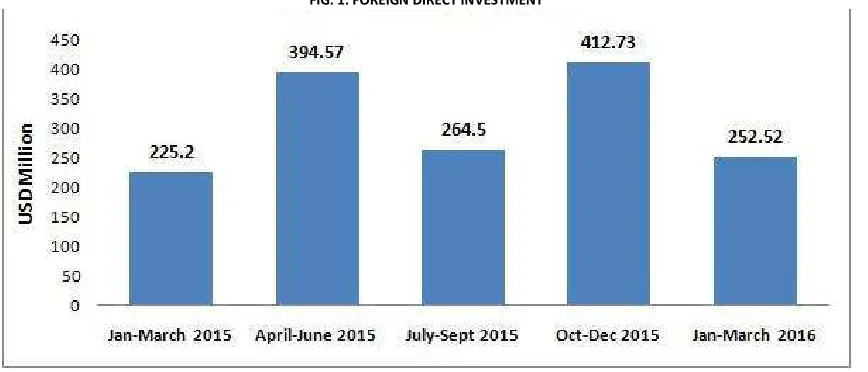
Telecom Sector is considered to be one of the most attractive sectors for Foreign Direct Investment (FDI) in the country. The Foreign Direct Investment (FDI) in all telecom services is currently allowed up-to 100% (automatic route) as per the current FDI policy, subject to observance of licensing and security conditions by licensee as well as investors as notified by the Department of Telecommunications (DoT) from time to time.
TABLE 1
Sr. No
sector/activity FDI
cap/ Equity
Entry route
1 Telecom services (including Telecom infrastructure Providers category-i) all telecom services including Telecom infrastruc-ture Providers category-i, viz. Basic, cellular, unified access services, unified license (access services), unified license, na-tional/ international long Distance, commercial V-sat, Public mobile Radio Trunked services (PMRTS), global mobile Per-sonal communications services (GMPCS), all types of isP licences, Voice mail/ audiotex/ ums, Resale of iPlc, mobile number Portability services, infrastructure Provider category – i (providing dark fibre, right of way, duct space, tower) except other service Providers.
100 % Automatic up to 49% Beyond 49% Through FIPB route
2 manufacture of Telecom Equipments 100% Automatic
V
OLUMEN
O.
7
(2017),
I
SSUEN
O.
09
(S
EPTEMBER)
ISSN
2231-5756
INTERNATIONAL JOURNAL OF RESEARCH IN COMMERCE, IT & MANAGEMENT
FIG. 1: FOREIGN DIRECT INVESTMENTPROMOTION OF DOMESTIC MANUFACTURING OF TELECOM EQUIPMENTS
The government has taken key measures for the promotion of domestic manufacturing and export of telecom Equipments:
5% Basic Customs Duty (BCD) on perform of Silica has been imposed in budget 2016-17 to give a fillip to the domestic manufacturing of this telecom item which is used in the manufacture of optical cable.
The Government has included the exporters of telecom products for availing the benefits under Interest Equalisation Scheme on Pre & Post Shipment Rupee Export Credit, announced on November 18, 2015 (to be effective from 1st April 2015), subject to the compliance with minimum value addition criterion issued by Department of Telecommunications vide notification dated 31.12.2016.
As per DGCIS data, the import of telecom equipments including mobile phones, parts and telecom cables during 2015-16 stands at `102,571 crores. Import during the period April – September, 2016 stands at `50,249 crores. The Export of Telecom equipments including mobile phones, parts and telecom cables during 2015-16 is `8,490 crores and from Apr’16 to Sept’16 is `4,883 crores.
INTERNATIONAL COOPERATION (IC)
The IC Division deals with activities of prime importance relating to WTO negotiations, Bilateral and multilateral agreements relating to telecommunications, Telecom Equipment and Services Export Promotion Council (TEPC), Telecommunications Standards Development Society of India (TSDSI), Telecom Centres of Excellence (TCOE India), Exhibitions/ Conferences and seminars relating to telecom. The year 2016-17 (April-December) was marked by several important activities in field of International Cooperation, which are broadly categorised as under:
i. India Telecom 2016
ii. Participation in RCEP (Regional Comprehensive Economic Partnership) on Telecom Services (SWG-TEL) meetings iii. Telecom Equipment & Services Export Promotion Council (TEPC)
iv. Telecommunications Standards Development Society of India (TSDSI) v. Telecom Centre of Excellence (TCOE), India (TCOE India).
CHALLENGES
Even though the Indian telecommunications sector has come a long way since the time of liberalization and promises growth, there are a number of issues which still pose a challenge to its progress. Two critical issues are:
High capital investments
Well-established players who have a nationwide network License fee
Continuously evolving technology Declining Average Revenue Per User Lack of Telecom Infrastructure
A wide variety of choices available to customers both in fixed as well as mobile telephony has resulted in increased bargaining power for the customers.
FUTURE GROWTH OPPORTUNITIES IN THE INDIAN TELECOM INDUSTRY
The Indian Telecom Industry has been considered as an essential tool for the socio- economic development and for growth of GDP in the country. The Indian mobile economy is growing rapidly. The Government had raised the FDI limit from 74% to 100% during August 2013 which has made the telecom industry one of the fastest growing and a top five employment opportunity generator in the country. The increase in FDI has been done to ensure continuous flow of investments in the industry to expand the reach of mobile operators.
The Indian Telecom industry has undergone a progressive shift from voice services to data services, thereby creating a new direction for the future of this industry. The Ministry of Communication and IT is planning to extend basic mobile coverage, including voice calling, in far flung areas of eight north eastern states, creating a more inclusive telecom network across the country. This industry is expected to provide more than 4.1 million jobs in the coming five years. Therefore, this will be favourable to professionals who aspire to pursue their career in this industry. The Indian Government has also decided to expand the basic telecom services in the rural areas for increasing rural tele-density in future.
The Indian Telecom industry has been growing at an average of 35% a year for close to two decades which is beneficial to the country. The industry has touched the lives of millions of Indians and will continue to remain a significant growth driver in the future also.
CONCLUSION
It can be concluded that the growth and development of Telecom sector of India has made it a key contributor in India’s economic and social up gradation. Every functional division and service provider of Telecom Sector of the country is trying to provide world class telecom infrastructure in its area of operation to give services to its customers and so, helping the country to progress in the global scenario.
REFERENCES
V
OLUMEN
O.
7
(2017),
I
SSUEN
O.
09
(S
EPTEMBER)
ISSN
2231-5756
INTERNATIONAL JOURNAL OF RESEARCH IN COMMERCE, IT & MANAGEMENT
2. Annual Report 2014-15, Cellular Operators Association of India. Retrieved from: http://www.coai.com/media-room/news..../coaiin.../coai-annual-report-2014-15.
3. “BSNL Status”, DOT-News Bulletin, BSNL Pensioners‟ Association Kerala Circle, Vol.4, November 2011 4. Chatterjee, Sumana (2009), An Economics Analysis of Foreign Direct Investment in India,
5. Clifford Alveres: “Dial the Right Stocks”, Intelligent Investor, August 9, 2000.
6. Consultation paper No: 7/2007, “Review of License Terms and Conditions and Capping of Number of Access Providers”, Telecom Regularly Authority of India, New Delhi, June 12, 2007.
7. Floyd Eugene Alonzo III: Dissertation Abstracts International, Vol.64, No 8, February, Ph. D. City University of New York, 2004.
8. Gamos Ltd: MC Komey Ki Scott N,etal: “Innovative Demand models for Telecommunications services”, The report of an earlier KaR study, Gamos Ltd for DFID, 2003.
9. K.R.G. Nair: “Telecommunications in India”, Productivity, Vol: 36, No: 2 July – September, 1995.
10. Kala Seetharam Sridhar and Varadharajan Sridhar: “Telecommunication and Growth, Causal Model Qualitative and Qualitative Evidence”, Economic and Political weekly, Issue No. 25, June 24, 2006.
11. Kumar, Nagesh (2005), “Liberalization and Foreign Direct Investments Flows and Development: Indian Experience in the 1990s”, Economic and Political Weekly, 40(14), pp. 1459- 1469.
12. op.cit. AnjanaPrachi,etal: “Telecom Industry-Business Environment Domain Study”, 2009, http//www.scribd.com,5.08pm, 6th January, 2012.
13. op.cit. Kala Seetharam Sridhar and Varadharajan Sridhar: “Telecommunication and Growth, Causal Model Qualitative and Qualitative Evidence”, Economic and Political weekly, Issue No. 25, June 24, 2006.
14. Rekha Jain: “WLL, Governance, Corporatization, and Swansi- A Review of Institutional Developments”, India Infrastructure Report, 2002, Oxford University Press, New Delhi.
WEBSITES
15. www.trai.gov.in
16. en.Wikipedia.org/wiki/telecommunication-in-india 17. www.dnb.co.in/IndiaTelecomIndustry/Owerview/I.asp 18. www.indiacallinginfo.com/india-telecom-circles
19. www.maps of India.com/maps/india/telecomnnetwork.htm 20. www.dot.gov.in/content/chairmans-desk
21. http://www.dnb.co.in/IndianTelecomIndustry/issues.asp. 22. http://www.eg.com/IN/en/Industries/Telecommunications