ISSN: 2008-8191. pp. 113-135
Modified Output in Task-based EFL Classes across
Gender
K. Sadeghi
Assistant Professor, TEFL Urmia University, Urmia email: [email protected]
S. P. Sajedi M.A, TEFL Urmia University, Urmia email: [email protected]
Abstract
The current study examined the modification devices (MDs) used by male and female non-native speakers (NNSs) learning EFL during dyadic task-based interactions. Three meaning-oriented tasks, namely picture-description, spot-the-difference, and opinion-exchange, were used to elicit data from 24 (12 male and 12 female, forming 4 male-male, 4 female-female, and 4 male-female dyads) Iranian (Azeri-speaking) EFL learners with intermediate language proficiency in English as L3. All interactions were video-taped and transcribed. For the sake of systematicity, only the first 150 sentences of transcribed data were analyzed to assess the effect of interlocutor’s gender on the usage of different types of modification devices using Mackey et al.’s (2003) model. The findings revealed that ‘confirmation check’ was the device mostly used by both genders. The results also demonstrated that ‘clarification check’ was the most frequently used strategy for negotiation among the students regardless of their gender. Analyses of the data propose that these modification devices facilitate comprehension of input and output and enhance the negotiation for both meaning and form. Further results and implications are discussed in the paper.
Keywords
: dyadic interactions, gender, Iranian EFL learners, modification
devices, modified output, task-based language teaching
1. Introduction
The history of second language acquisition (SLA) has been characterized by
an unending search for more efficient ways of teaching and learning second
or foreign languages. For decades, explorations carried out by linguists and
applied linguists in this regard have often centered on issues such as the role
of grammar in language teaching, as well as the development of accuracy
and fluency in language teaching. Deficiencies of the teaching methods and
syllabi have given rise to shifts in SLA research and practice which is
characterized by a movement from Methods to Post-Methods era (Richards
& Rodgers, 2001).
Over the past decades, this quest was mainly influenced by the theories
proposed for describing the nature of learning and the factors involved in the
process of learning. According to Gass (1999), language learning is
stimulated by the communicative pressure that one of its important
requirements is ‘input’. The precursors of such studies on input are those
which define it as auditory or visual linguistic environment that the learner
is exposed to (Carroll, 1999; Lightbown, 1985; Watanabe, 1997) or in other
words, the available target language (Ellis, 2006). Different theories have
been suggested regarding the importance of input, such as the theory which
considered input as the only factor leading to learning (Krashen,
1982).Other views have focused on the interaction between learners and the
input (as an external socio-cultural factor) as a requisite for language
learning (Carroll, 1999; Lee, 2002; Long, 1996).
Input is the prerequisite of interaction and one of its important features
is the role it plays in fostering meaningful communicative use in appropriate
contexts. According to Krashen’s input hypothesis (Krashen, 1985), a
person can learn language when he is exposed to linguistic input that is
comprehensible to him. A message will be intelligible when it is slightly
above the level of immediate comprehension of the learner, that is when it
has the status of I (interlanguage) +1. Based on this hypothesis, the most
important assumption is that speaking should not be taught in classroom at
early stages of language learning (Krashen, 1985).
Despite its significant influence on second language studies, this
hypothesis has been widely criticized for its lack of supportive evidence by
those believing that a learner’s exposure to the target language is not in itself
a sufficient condition for second language acquisition (Gass, 1988;
Lightbown & Spada, 1990; Long, 1988; Swain, 1985; White, 1987).The
opponents of this hypothesis believed that it ignored the actual values of
mental processes which are helpful for gleaning linguistic information that is
present inside the input and the values are obtained by different mental
processes such as feedback and interaction (Brown, 2001).
2006). It has long been argued that it is highly unlikely if not possible for the
learners to acquire second language communicative competence without
engaging in meaningful interaction (Adams, 2003). The hypothesis
emphasizes the role of input as a factor providing samples of positive
evidence (by means of requests for clarification or confirmation checks) of
how the language system works since the interactants’ involvement in
interaction provides the interactionally modified input for them. Thus, they
can comprehend the input and focus their attention on new or partially
learned vocabulary items and language structures which in turn enables their
acquisition.
However, Long (1996) also recognized that “meaning negotiation can
induce learners to modify their own output and this, too, may promote
acquisition” (Ellis & He, 1999, p. 286); therefore, any negative feedback,
explicit or implicit, including recasts, can provide learners with necessary
information they need to notice the gap between their own output and the
native-like language forms.
Long’s work directed the focus toward Swain's seminal work (1985) in
which she emphasizes the importance of dialogues as joint or inter-personal
activities which enable learners to verbalize their target language
knowledge. Swain conducted several studies in immersion contexts in
Canada, and based on these studies, she claimed that providing immersion
students merely with great amount of comprehensible input did not help
them abandon their off-target performance and that they were clearly
identified as non-native speakers or writers (Swain, 1985). Especially, she
perceived that "the expressive performance of these students was far weaker
than that of same aged native speakers" (cited in Shehadeh, 2003, p.156).
Therefore, Swain proposed a new hypothesis, in relation to the second
language learners' production, comparable to Krashen's comprehensible
input hypothesis and termed it ‘Comprehensible Output Hypothesis’ (Swain,
1985). Swain argued that “comprehensible output (CO) is the output that
extends the linguistic repertoire of the learner as he or she attempts to create
precisely and appropriately the desired meaning” (Swain, 1985, p. 252). She
further argued that the role of learner production of CO is independent of the
role of input.
Swain (1995) stated that, the act of producing output in a target
language (TL) will lead to second language development because of three
factors: noticing, hypothesis testing and internalizing metalinguistic
information (as cited in Adams, 2003).
In this vein, several studies examined the noticing function of output in
target language learning (Iwashita, 1999; Izumi, 2000, 2002; Shehadeh,
1999, 2001; Swain & Lapkin, 1995). Through these studies, it is
demonstrated that producing the target language is a mechanism that enables
learners to notice a gap in their existing language performance which they
may pay attention to by external feedback or internal feedback. More
noticing has been argued to lead to more learning (see Adams, 2003;
Basturkmen, 2006). But when interlocutors ignore a source of problem
(Shehadeh, 2001), the breakdown in comprehension or communication
cannot be detected and as a result, the learner who has made a mistake
cannot notice the gap between his output and the TL criterion. In other
words, negative feedback on unclear ideas pushes the learner to reformulate
the incomprehensible messages by trying out new structures. Thus, “pushed
output may assist the learner in acquiring L2” (Lee, 2002, p. 276).
In 1989, Pica and her colleagues investigated the learners’ processes of
modification of ungrammatical output in response to the feedback from NSs.
The main purpose of their study was to investigate the amount of modified
output in response to types of interactional moves such as clarification
requests and confirmation checks. They found that the effect of modification
moves on modified output was greater and more significant than the effect
of task types. In a similar vein, Nobuyoshi and Ellis (1993), who carried out
a small scale study with 3 learners, found that two of their participants
showed permanent accuracy improvement when pushed by the clarification
requests.
Mackey (1999) compared the effects of three learning conditions on
development of question forms. She found that only when learners
participated in interaction and modified their responses during the
interactive exchanges did they benefit the most.
Another similar study by Mackey, Oliver, and Leeman (2003) that is
related to the current study investigated the difference between frequency of
feedback, provision of opportunities for modified output, and rate of
produced modified output considering the offered opportunities based on the
interlocutor types: child versus adult, and native versus nonnative
interlocutor. Their study proved that participants in adult NS-NNS dyads
provided the most feedback (47%) and adult NNS-NNS dyads provided the
least amount of feedback (32%). However, it became clear that adult
NNS-NNS dyads offered the greatest amount of opportunities (98%) while child
NNS-NNS dyads offered least opportunities (86%), and for modified output,
child NNS-NNS dyads took the biggest share (41%). As this study
suggested, learners may encounter different linguistic environments
depending on interlocutor type. Knowing this point is beneficial to learners
and teachers as well as to researchers, a point which this study hoped to
clarify further.
Accordingly, the present study aimed to reveal commonly used
modification strategies used by students, the knowledge of which will assist
teachers in better dealing with language problems of their students. Students
themselves may also benefit from recognizing the types of modification
devices (MD) such as comprehension check, self correction and topic shift
that they use while interacting with their interlocutors so that they can adjust
their use of MD with the needs of community in which they are interacting.
Various studies have investigated the use of interactional moves in
interactions of learners to find out whether learners are able to provide some
linguistic feedback to other learners and most of them have found that the
use of MDs have different advantages such as increasing syntactization,
improving grammatical accuracy and pronunciation in the interactions of
adult non-natives (Iwashita, 2001, 1999; Lee, 2002; Shehadeh, 1999), of
child non-natives (Mackey & Oliver, 2002) and of non-natives with natives
(Iwashita, 2003). However, few have touched on the relationship between
the gender of partners in a dyad or pair and types of MD (or feedback
moves).
In a similar study, Shehadeh (1994) compared the performances of 35
adult participants across mixed-gender versus matched-gender dyads and
groups. Using three communicative tasks to collect the data, Shehadeh
found that for females, same gender dyadic interaction provided better
context to produce more comprehensible output and to self-initiate repairs,
whereas for males, mixed-gender interactions were more suitable.
In a recent study, Rassaei and Tavakoli (2011) investigated the effect of
gender on the effectiveness of the corrective feedback as they compared 15
male and 15 female Iranian learners. They compared learners’ performance
in matched- and mixed-gender dyads on post-tests and found a statistically
significant difference between learners’ performance in matched- and
mixed-gender dyads. They also predicted that the provided corrective
feedback in matched-gender dyads was more beneficial than the feedback
provided in mixed gender dyads. Their analysis which was undertaken based
on the students’ scores on posttests confirmed their hypothesis.
The present study was accordingly aimed at determining any significant
differences between male and female EFL learners' use of MD during dyadic
task-based interactions.
Is there any significant difference between male and female EFL
learners in their use of modification devices during dyadic task-based
interactions?
2. Methods
2.1 Participants
2.2 Instruments
To collect data, the researchers used three communicative tasks adapted
from similar studies on L2 development (Iwashita, 2001; Mackey & Oliver,
2002; Shehadeh, 2001). These tasks were used in a counterbalanced order
for 12 dyads participating in the study. The selected tasks included (a)
spot-the-difference (closed two-way), (b) picture-description (one-way) and (c)
opinion-exchange (open two-way) tasks. Spot-the-difference task required
the interactants to find the differences in two variations of one picture while
none of the participants was able to look at the other participants’ picture.
The following pictures (Figure 1) serve as an example of spot-the-difference
task:
Figure 1.
Spot-the-difference task sample
was not shown to the person drawing it. An example of the picture used for
this task appears below in Figure 2.
Figure 2.
Picture-description task sample
Finally, in the opinion-exchange task, both of the participants were
given a text entitled ‘Only a mad man would choose to live in a large
modern city’ (Adopted from the book “For and Against” by L.G. Alexander
(1968), p. 52) to read and give their opinions regarding the material they
read. These types of tasks were used because they are considered to provide
opportunities for interactional adjustments, such as clarifications of
meanings, to occur.
In order to provide for detailed transcriptions of the meaning-oriented
verbal interactions of the interlocutors, a Sony Model handycam was
employed to film the students’ performances during the given tasks.
Students were seated inside an empty classroom that was used as the
meeting room and the video-recorder was placed out of students’ views to
avoid causing any stress or negative feelings.
2.3 Data collection procedure
worth mentioning that no effort was made by the researchers to manipulate
the frequency or characteristics of modified output. The interactants were
not aware that the researcher in charge intended to examine the provision,
amount, nature of modified output and the types of interactional moves or
modification devices in their performance.
2.4 Context of the study
Urmia University’s Language Center started its work twelve years ago as a
medium for fostering language abilities of university students who need to
learn English for mainly academic purposes. To this end, the Language
Center established communicatively-oriented classes of not more than 15
students (to give them more opportunities to practice the language). The
books and other audio-visual materials used in this institute are provided by
Brock University, Canada, and help students develop familiarity with the
lexis and idioms of the major human topics. The books foster the four basic
skills of language and the academically designed syllabus enables the
students to progress in a rather short time in the meaning-focused class
environment.
One further reason why this institute was selected as the context of the
present study was that investigating the occurrence of modified output
across gender needed a co-educated institute and this institute was the only
co-educated language center in Urmia.
2.5 Data transcription
2.6 Data coding
Having transcribed the needed data, initial utterances were codified in
different categories. The first step of categorization entailed identifying the
target-like versus non-target-like utterances, which was carried out by two
assistants who held an MA in TEFL. Only non-target-like utterances were
included in the analysis of this study as exploring the provision and nature of
negative feedback was the goal of the present study.
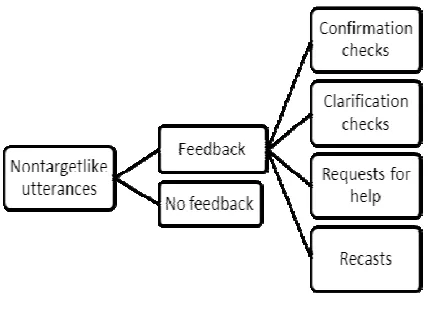
Then, according to the model used by Mackey et al. (2003) the
responses to non-target-like utterances were classified as feedback and no
feedback moves based on whether they provided negative feedback or not.
Confirmation checks, clarification checks, requests for help, and recasts
were all considered as negative feedback moves as they all alarm and warn
the interlocutor about the incomprehensibility of their messages. While
provision of negative feedback helps the interlocutors to modify their
message production toward comprehensibility, it is not always the case that
the conversation partners provide negative feedback; however, it can be
observed that sometimes the interactants prefer to continue the conversation
without trying to inform about the non-target-like nature of the original
utterance. In the present study, such ignorance was classified as no feedback.
The following examples, taken from the current study, show no feedback
and feedback moves, respectively:
Extract 1. (Male-Female dyad, grammatically non-target-like utterance
followed by no feedback)
Male: There is no leaves?
Female: No
Extract 2. (Female-Female dyad, grammatically and lexically non-target-like
utterance followed by negative feedback)
Female 1: There are floors on the jar.
Female 2: Flowers in the jar.
The example provided below (Extract 3) shows the total process
starting from a non-target-like utterance and ending in modified output:
Extract 3. (Male-Male dyad, modified output)
Male 2: There is three candies on the cake and two of them are burning?
Male 1: What?
Male 2: Candies, we put them on cakes and light them.
Male 1: Oh, three candles are on the cake.
In summary, data was categorized as is shown in Figure 3.
Figure 3. Data categorization framework adopted from Mackey et al. (2003).
3. Results
The notion of modified output is defined as the output of the speaker which
is modified by some notification made by the hearer originated from the
incomprehensibility of the uttered message. This incomprehensibility may
be because of grammatical errors, pronunciation mistakes or errors in
semantic incomprehensibility of that message. Whatever the reason for the
difficulty in understanding might be, interlocutors sometimes inform their
partners by giving negative feedback so that the producer of the
incomprehensible message may have the chance to correct or modify his
utterance toward comprehensibility by noticing.
3.1 Negative feedback
As stated earlier, the research question was concerned with whether there
was any significant difference between male and female EFL learners in
their use of specific MDs. First, the number of times interlocutors replied to
learner non-target-like utterances with negative feedback was tallied and
then tabulated. Table 1 shows the descriptive statistics in terms of feedback
regarding the three interactional structures.
Table 1. Feedback and No Feedback moves for Male and Female Students in
Different Gender-Based Dyads: Means, Standard Deviations, and Ranges
InteractionalOf the total number of non-target-like utterances (N=502) identified,
276 (55%) received feedback while the remaining 226 (45 %) utterances did
not receive any feedback. Figure 2 illustrates that generally there is a slight
variation between feedback provision and lack of providing feedback.
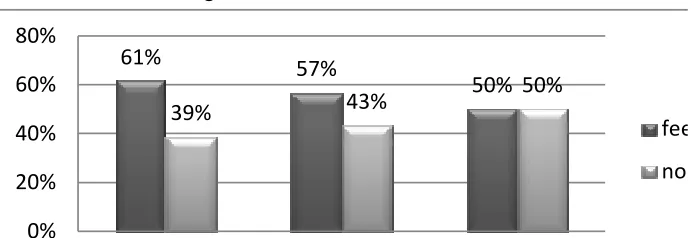
The following bar graph depicts the distribution of feedback in 3 pairings of
male and female students (see Figure 4).
Figure 4. Distribution of feedback
61%
57%
50%
39%
43%
50%
0%
20%
40%
60%
80%
l f
l
f
l f
l
l
l
feedback
no feedback
As Figure 4 indicates, the intra-pairing comparisons reveals that the most
amount of feedback provision belongs to the male-female dyads (61%)
whereas the least number of feedbacks (50%) was provided in male-male
dyads, and the students in female-female dyads provided 57% feedback.
3.2 Modification devices
Table 2. Categories, definitions and examples for modification devices
(taken from L. Lee, 2002)
Types of MDs Definition Example Confirmation Check To repeat parts of the statement “on the cake?”
to ensure understanding
Clarification check To express confusion or “which one?” ask for help due to “what?” unfamiliar words or
incomprehensible message
Request for help To request information for “a place for putting unknown lexical items things in it in the kitchen,
or expressions what do they call it?” Recast Repeating all or part of an “- why does they carry
incorrect utterance water?
- right, why do they carry water?”
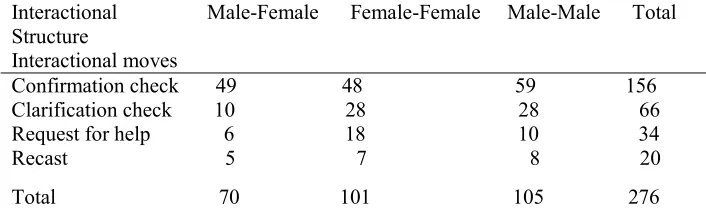
Hence, in the present study the research question intended to
investigate the existence of any significant difference among the three
pairings’ use of MDs during dyadic task-based interactions. In so doing, the
number of times that pairs used four types of MDs was counted and tallied
(Table 3).
Table 3. Interactional moves used by Male-Female, Female-Female, and
Male-Male dyads
Based on Table 3 and the following chart (Figure 5), with an intra-group
comparison it can be easily observed that the main type of modification
device that was used by all the pairs is confirmation check.
Interactional Male-Female Female-Female Male-Male Total Structure
Interactional moves
Confirmation check 49 48 59 156
Clarification check 10 28 28 66
Request for help 6 18 10 34
Recast 5 7 8 20
Figure 5. Distribution of MDs across dyads
Table 4. Chi-Square tests
a. 0 cells (.0%) have expected count less than 5. The minimum expected
count is 5.07.
Moreover, the chi-square analysis (Table 4) showed that there was
not any significant difference between male and female EFL learners’ use of
these MDs ((6, N= 24) = 11.34, p=.078). It shows that there is not any
significant difference between male and female EFL learners in their use of
modification devices during dyadic task-based interactions.
4. Discussion
4.1 The frequency of negative feedback
Negative or corrective feedback is considered as one of the salient features
of conversational interaction by which the interlocutors detect the existing
discrepancies in their output and try to resolve the communication
breakdowns. Lyster and Ranta (1997) believed that corrective feedback
encourages self-repair involving accuracy and precision as well as
comprehensibility. Lyster, Lightbown, and Spada (1999) criticizing
Value df Asymp.Sig. (2-sided) Pearson Chi-Square 11.339a 6 .078
Truscott’s recommendations evidenced that “corrective feedback is
pragmatically feasible, potentially effective, and, in some cases necessary”
(p. 457). In support of such claims, Lyster’s arguments (2001) can be taken
into account: he argued that this type of feedback, or simply the act of
signaling mismatches between target language production and
non-target-like production, facilitates peer- and self-repair. Moreover, Gass and
Varonis (1994) stated “that the awareness of the mismatch serves the
function of triggering a modification of existing L2 knowledge, the results
of which may show up at some later point in time” (p. 299).
One of the interesting results of the present study is that learners
received negative feedback, regardless of their pairings, in response to a
considerable number of their L2 non-target-like utterances; a total of 276
(55%) non-target-like utterances out of 502 received feedback. This is a bit
more than the findings of Mackey et al. (2003) that reported 209 (34.31%)
feedback instances out of 609. But these results are closer to the findings of
Oliver (2009), who found that students in NNS-NNS dyads received 42%
feedback regarding the rate of total non-target-like utterances. Although the
developmental effects of feedback were not investigated in the present
study, the achieved results do show that participation in task-based
interactions can provide learners in NNS-NNS dyads with exposure to
feedback in theoretically sufficient amounts, and they support claims
regarding the importance of feedback as one of the benefits of interaction
(Behnam & Davaribina, 2011; Gass, 1997; Long, 1996; Shehadeh, 2001;
Swain, 1995). Moreover, empirical research (Bruton & Samuda, 1980;
Long, 1996; Long & Porter, 1985; Pica, Lincoln-Porter, Panios & Linnell,
1996) suggests that NNS-NNS combinations tend to stimulate more
negotiated interaction (through feedback) than NS-NNS dyads.
However, although all dyads consistently provided negative feedback,
male-female dyads provided the most number of feedbacks in response to
the total number of non-target-like utterances in their own dyads. This is in
line with the findings of Rassaei and Tavakoli (2011) who found that error
correction in same-gender dyads were superior to opposite-gender dyads.
males both initiated and received more interaction (through feedback
provision) than females.
Although these findings appear to be conflicting at first, it should be
considered that the relationship between language and gender is mediated by
the social activities and practices of those particular speech communities
(Ehrlich, 2001) and also by the different attitudes and learning conditions
which are experienced by males and females (Saville-Troike, 2006). This
suggests that different second language behaviors of learners with different
genders can be attributed to their social contextualization.
4.2 Modification devices across dyads
The main concern of this study was verifying the MDs (or negotiation
moves) that learners of different genders provided in dyadic interactions of
different pairings. Interestingly, it was revealed that of the four corrective
feedback moves specified in this study (confirmation checks, clarification
checks, requests for help, and recasts) 57 percent belongs to confirmation
checks, while recasts occurred less than others. These outcomes can be
justified by what Oliver (2009) stated about the frequency of occurrence of
recasts and other negotiation strategies in NNS-NNS interactions. She
observed that rate of occurrence of recasts in NNS-NNS dyads was at least
half of their occurrence in NS-NNS dyads perhaps because of the
proficiency demands of these feedback forms. She also pointed out that the
joint construction of meaning in order to defeat communication breakdowns
requires negotiation strategies and that lower levels of proficiency of NNS
partners may be more conductive of this form of feedback.
In such a similar vein, Lee (2002) investigated the MDs that NNSs use
during synchronous online exchanges. She found that Spanish students used
request for help strategy more than clarification checks and clarification
checks more than confirmation checks, 17%, 16%, and approximately 10%,
respectively. The existing difference here may be attributed to the difference
between computer-mediated interaction and face-to-face interactions since
Varonis and Gass (1985) and Porter (1986) reported higher frequencies of
confirmation checks, clarification requests in face-to-face talk.
However, Ellis, Basturkmen, and Loewen (2001) proposed that the
differing contexts of the research on the varying rates of uptake may account
for these differences. Dissimilar language backgrounds of the participants,
varying language skill levels, differences in age, gender, motivation and
cognitive abilities of the students, different task types, and dissimilar
language settings, such as ESL, EFL, private or immersion contexts, may
also justify these diversities.
5. Conclusion
The current paper was concerned with investigating the quantity of
incorporation of negative feedback in dyadic interactions of Iranian Azeri
male and female students while performing tasks in pairs or dyads. It is
worth mentioning here that the participants’ differential L1 background can
affect their performance as well; however since all participants in this study
spoke the same L1 and were fluent in Persian (their L2) to a similar level,
any effect the L1 background could have on their performance could
therefore be equal to all candidates (males and females). That is why the role
of L1 background was not taken into consideration in this study. The main
purpose of the study was to examine the extent to which these male and
female students with intermediate level of proficiency in the EFL context
provide opportunities for their interlocutors to modify their output toward
comprehensibility and what types of negotiation moves they use while
interacting. Dyadic interaction of learners with their matched-proficiency
counterpart seems to be pedagogically influential in second language
learning and teaching as it provides learners with opportunities to interact
and attend to linguistic forms and meaning, in the context of
meaning-focused activities.
Given the extremely small body of previous research on modified
output production in matched- versus mixed-gender dyads and male-male
dyads versus female-female dyads and incorporation of modification devices
(negotiation moves) across way versus one-way tasks, and open
two-way versus closed two-two-way tasks, additional research on this issue, was
clearly warranted. Consequently, the present study, trying to address this gap
in the literature, investigated the provision of negative feedback, production
of modified output, incorporation of four types of modification devices
across genders of the interlocutors and task types.
classrooms to promote meaning negotiation by increasing the degree of
students-students interactions. Teachers can be encouraged to utilize more
meaning-focused activities by raising their awareness of its potential
advantages. Moreover, the plentiful use of confirmation checks in
interactions of intermediate students can be indicative of the fact that their
level of proficiency is an influential factor determining their choices of using
this particular type of modification device.
In spite of the conclusions drawn here regarding the potential value
of involving students in dyadic task-based interactions across gender, one of
the limitations of the study is its limited generalizability due to a small
sample size: the data were driven from a sample of only 24 EFL language
learners and using merely one example of three tasks over 10 hours of
interactions.
Another limitation of this study is that it did not pay attention to the
production of modified output and incorporation of modification devices in
terms of their linguistic coverage in recorded interaction to explore the types
of errors used by such learners. Moreover, while this research found that
there is no significant difference between male and female EFL learners in
their use of modification devices during dyadic task-based interactions, it
did not focus on the major types of errors language learners of different
genders produce. We recommend that future researchers take these points
into consideration designing a similar research study.
References
Adams, R. (2003). L2 output, reformulation, and noticing: Implications for
IL development. Language Teaching Rese\arch, 7, 347–376.
Aries, E. (1976). Interaction patterns and themes of male, female, and mixed
groups. Small Group Behavior, 7, 7-18.
Basturkmen, H. (2006). Ideas and options in English for specific purposes.
New Jersey: Lawrence Erlbaum Associates.
Behnam, B., & Davaribina, M. (2011). Dyadic interaction in writing:
On-line or off-On-line feedback? World Applied Sciences Journal, 13,
465-469.
Brown, H.D. (2001). Teaching by principles: An interactive approach to
language pedagogy (2nd Ed.). New York: Longman.
Bruton, A., & Samuda, V. (1980). Learner and teacher roles in the treatment
of oral error in group work. RELC Journal, 11, 49-63.
Carroll, S.E. (1999). Input and SLA: Adults’ sensitivity to different sorts of
cues to French gender. Language Learning, 49, 37-92.
Manoa: University of Hawai'i, The Center for Second Language
Classroom Research, Social Science Research Institute.
Ehrlich, S. (2001). Gendering the learner: Sexual harassment and second
language acquisition. In A. Pavlenko, I. Piller, A. Blackledge & M.
Deutsch (Eds.). Multilingualism, second language learning, and
gender (pp. 103-130). Berlin: Mouton de Gruyter.
Ellis, R. (2006). Current issues in the teaching of grammar: An SLA
perspective. TESOL Quarterly, 40, 83-107.
Ellis, R., & He, X. (1999).The roles of modified input and output in the
incidental acquisition of word meanings. Studies in Second Language
Acquisition, 21,285-301.
Ellis, R., Basturkmen, H., & Loewen, S. (2001). Learner uptake in
communicative ESL lessons. Language Learning, 51, 281–318.
Gass, S. (1988). Integrating research areas: A framework for second
language studies. Applied Linguistics, 9, 198-217.
Gass, S. (1997). Input, interaction and the second language learner.
Mahwah, NJ: Lawrence Erlbaum.
Gass, S. (1999). Discussion: Incidental vocabulary learning. Studies in
Second Language Acquisition, 21, 319-333.
Gass, S., & Varonis, E. (1986). Sex differences in nonnative
speaker-nonnative speaker interactions. In R. Day (Ed.). Talking to Learn:
Conversation in second language acquisition (pp. 327-51). Rowley,
MA: Newbury House.
Gass, S., &Varonis, E. (1994). Input, interaction, and second language
production. Studies in Second Language Acquisition, 16, 283-302.
Iwashita, N. (1999). Tasks and Learners’ output in nonnative-nonnative
interaction. In K. Kanno (Ed.). The acquisition of Japanese as a
second language (pp. 31-53). Amsterdam: John Benjamins’
Publishing Company.
Iwashita, N. (2001). The effect of learner proficiency on interactional moves
and modified output in nonnative-nonnative interaction in Japanese as
foreign language. System, 29, 267-287.
Iwashita, N. (2003). Negative feedback and positive evidence in task-based
interaction. Studies in Second Language Acquisition, 25, 1-36.
Izumi, S. (2000). Promoting noticing and SLA: An empirical study of the
effects of output and input enhancement on ESL relativization.
Unpublished doctoral dissertation, Georgetown
University
Q
Washington, DC.
Krashen, S. (1982). Principles and practice in second language acquisition.
Oxford: Pergamon Press.
Krashen, S. (1985).The input hypothesis: Issues and implications. Oxford:
Pergamon Press.
Lee, J. F. (2002). The incidental acquisition of Spanish: Future tense
morphology through reading in a second language. Studies in Second
Language Acquisition, 24, 55-80.
Lee, L. (2002). Synchronous online exchanges: a study of modification
devices on non-native discourse. System, 30, 275-288.
Lightbown, P. M. (1985). Input and acquisition for second-language learners
in and out of classrooms. Applied Linguistics, 6, 263-273.
Lightbown, P. M., & Spada, N. (1990). Focus on form and corrective
feedback in communicative language teaching: Effects on second
language learning. Studies in Second Language Acquisition, 12,
429-448.
Long, M. H. (1988). Instructed interlanguage development. In L. Beebe
(Ed.).
Issues in second language acquisition: Multiple perspectives
(pp. 115-141). Cambridge, MA: Newbury House.
Long, M. H. (1996). The role of the linguistic environment in second
language acquisition. In C. Ritchie & T. K. Bhatia (Eds.). Handbook
of Language Acquisition (pp. 413-468).
New York: Academic Press.
Long, M., & Porter, P. (1985). Group work, interlanguage talk, and second
language acquisition. TESOL Quarterly, 19, 207–228.
Lyster, R. (2001). Negotiation of form, recasts, and explicit correction in
relation to error types and learner repair in immersion classrooms.
Language Learning, 51, 265-301.
Lyster, R., Lightbown, P.M., & Spada, N. (1999). A response to Truscott’s
‘what’s wrong with oral grammar correction’. The Canadian Modern
Language Review, 55, 457-467.
Lyster, R., & Ranta, L. (1997). Corrective feedback and learner uptake:
Negotiation of form in communicative classrooms. Studies in Second
Language Acquisition, 19, 37-66.
Mackey, A. (1999). Input, interaction and second language development: An
empirical study of question formation in ESL. Studies in Second
Language Acquisition, 21, 557-558.
Mackey, A., & Oliver, R. (2002).Interactional feedback and children’s L2
development. System, 30, 459-477.
Nobuyoshi, J., & Ellis, R. (1993).Focused communication tasks and second
language acquisition. English Language Teaching Journal, 47,
203-210.
Oliver, R. (2009). How young is too young? Investigating negotiation of
meaning and feedback in children aged five to seven years. In A.
Mackey and C. Polio (Eds.). Multiple Perspectives on Interaction:
Second Language Research in Honour of Susan M. Gass (pp.
135-157). New York: Routledge.
Oliver, R., & Mackey, A. (2003). Interactional context and feedback in child
ESL classrooms. Modern Language Journal, 87, 519–533.
Pica, T., Holliday, N., Lewis, N., & Morgenthaler, L. (1989).
Comprehensible output as an outcome of linguistic demands on the
learner. Studies in Second Language Acquisition, 11, 63-90.
Pica, T., Lincoln-Porter, F., Panios, D., & Linnell, J. (1996). Language
learner interaction: How does it address input, output, and feedback
needs of second language learners? TESOL Quarterly, 30, 59-84.
Porter, P. (1986). How learners talk to each other: Input and interaction in
task-centered discussions. In R. Day (Ed.). Talking to learn:
Conversation in second language acquisition (pp. 200-222). Rowley,
MA: Newbury House.
Rassaei, E., & Tavakoli, M. (2011). Corrective feedback in the L2
classroom: Matched-gender and mixed-gender dyads in focus. Iranian
EFL Journal, 7, 157-166.
Richards, J.C., & Rodgers, T.S. (2001). Approaches and methods is
language teaching (2nd Ed.). Cambridge University Press.
Ross-Feldman, L.J. (2005). Task-based interactions between second
language learners: Exploring the role of gender. Georgetown
University Press.
Saville-Troike, M. (2006). Introducing second language acquisition.
Cambridge: Cambridge University Press.
Shehadeh, A. (1994). Gender differences and second language acquisition.
Research Journal of Aleppo University,
26,
73
‐
98.
Shehadeh, A. (1999). Non-native speakers’ production of modified
comprehensible output and second language learning. Language
Learning, 49, 627-675.
Shehadeh, A. (2001). Self- and other-initiated modified output during
task-based interaction. TESOL Quarterly, 35, 433-457.
Shehadeh, A. (2003). Learner output, hypothesis testing, and internalizing
linguistic knowledge. System, 31, 155-171
In S.M. Gass & C. Madden (Eds.). Input in second language
acquisition (pp. 235-252). Rowley, MA: Newbury House.
Swain, M. (1995). Three functions of output in second language learning. In
G. Cook & B. Seildlhofer (Eds.). Principles and practice in applied
linguistics: Studies in honor of H. G. Widdowson (pp.125-144).
Oxford: Oxford University Press.
Swain, M., & Lapkin, S. (1995). Problems in output and the cognitive
processes they generate: A step towards second language learning.
Applied Linguistics, 16, 370-391.
Varonis, E., & Gass, S. (1985). Non-native/Non-native Conversations: A
Model for Negotiation of Meaning. Applied Linguistics, 6, 71-90.
Watanabe, Y. (1997). Input, intake, and retention. Studies in Second
Language Acquisition, 19, 287-307.