Estimating the efficiency of different explants for direct
in
Vitro
multiple shoots development in chrysanthemum
Ratan Singh Telem
1, Raghunath Sadhukhan
2, Nirmal Mandal
3, Shabir Hussain Wani*
4,
Hemendra Kumar Sarkar
2and Brajendra Singh Naorem
51Farm Science Centre (Krishi Vigyan Kendra), Senapati District, Manipur- 795129, India
2Bidhan Chandra Krishi Viswavidyalaya, Department of Genetics & Plant Breeding Mohanpur, Nadia, West Bengal-741252, India 3 Bidhan Chandra Krishi Viswavidyalaya Department of Agricultural Biotechnology, Mohanpur, Nadia, West Bengal-741252, India 4*Sher-e-Kashmir University of Agricultural Sciences and Technology of Kashmir, Division of Genetics and Plant Breeding, Shalimar, Srinagar, Jammu and Kashmir, India
5Central Agricultural University, Department of Plant Breeding & Genetics, COA, Imphal, Manipur -795004, India Corresponding author: [email protected]
Paper No. 448 Received: 9 Dec 2015 Accepted: 20 June 2015
Abstract
Different explants of local chrysanthemum cultivars available in West Bengal including leaf, shoot tip and ray floret were employed to compare their efficiency for direct in vitro regeneration system. The explants were inoculated in Murashige and Skoog (MS) media supplemented with varied combinations of indole acetic acid (IAA), benzylaminopurine (BAP). The auxins indole -3-butyric acid (IBA) was used to induce rooting. Maximum multiple shoots production occurred at 1.0 mg/L BAP and 0.1 mg/L NAA for leaf explants, 2.0 mg/L BAP and 0.2 mg/L NAA combination for shoot tip explants and BAP (4.0 mg/L) + NAA (0.1 mg/l) for ray floret explants. Among the treatments, IBA 1.0 mg /L for both leaf and shoot tip regenerated plants and 0.5 mg /L for ray floret regenerates proved to be the best for promoting root regeneration as compared to the other treatments tried. Among the various carrier substrates tested for acclimatization, soil + sand + FYM (1:2:1) fortified with ½ strength MS plant salt mixture proved to be ideal substrate as maximum plant survived and a maximum of 82.3 % survivability was obtained from shoot tip derived plantlets. Therefore, shoot tip explants are the most suitable type of explants for plant regeneration of chrysanthemum through direct somatic embryogenesis. However, direct plant regeneration through ray floret explants will also be useful to recover the flower colour mutants. Highlights
• The commercial chrysanthemum cultivars are mostly propagated vegetatively through cuttings and suckers.
• Tissue culture, an important aspect of biotechnology can be implemented to enhance the yield of planting material through enhanced availability of distinguished planting stock possessing the useful characters.
• Different explants of local chrysanthemum cultivars including leaf, shoot tip and ray floret were employed to compare their efficiency for direct in vitro regeneration system.
• Shoot tip explants were the most suitable type of explants for plant regeneration of chrysanthemum through direct somatic embryogenesis.
Keywords: Chrysanthemum morifolium, MS medium, BAP, NAA, multiple shoots
DOI Number: 10.5958/2230-732X.2016.00045.0 ©2016 New Delhi Publishers. All rights reserved
BIOTECHNOLOGY
Chrysanthemum, commonly known as Autumn Queen belongs to the family Asteracea. It is globally one of the most important cut flower and pot plants
on commercial scale is Chrysanthemum morifolium
Ramat. It is a highly attractive and charming short day plant, which behaves both as an annual as well as a perennial flowering herb. The commercial cultivars are mostly propagated vegetatively through cuttings and suckers. Tissue culture, an important aspect of biotechnology can be implemented to enhance the yield of planting material through enhanced availability of distinguished planting stock possessing the useful characters. Micro propagation is the constant multiplication of preferred genotypes implying in vitro culture techniques. Therefore, this approach brings a sound platform for the generation of huge amount of genetically homogeneous disease free plants (Nalini 2012). In vitro culture of chrysanthemum was immensely helpful for large scale production of explants in a brief duration (Dao et al. 2006). Tissue culture approach in chrysanthemum are being utilised as a technique for mutation induction and also a way for micropropagation of macromutation and chimeric flowers favourably to generate new mutants in genuine form and promote generation of a large number of new chrysanthemum genotypes (Verma et al. 2012a). The present horticulture sector particularly the cut flower industry concievably vary from any other industrial sector as there is always in appeal for the need of novel varieties to regularly meet the extended users demands. Users preferences also advance and desire novel and noteworthy characters (Misra et al. 2003). Indirect regeneration via callus was stated from stem, petal and shoot tips, but adventitious shoot production from the initial callus phase may display somaclonal variation and chimeras while direct shoot regeneration from leaf or stem explants may remove this conditions (Verma
et al. 2012b). The regeneration of plants from tissue culture is an important and essential component of biotechnological research (Ju et al. 2011, Manchanda
et al. 2014). High frequency regeneration of plants from the in vitro cultured tissue is a pre-requisite for successful application of tissue culture techniques for crop improvement (Akter 2001, Guleria and Gowda 2015). The efficiency of recovery of multiple shoots in chrysanthemum differs due to many reasons including type of explants used (Zhou
et al. 2014, Naing et al. 2015). Therefore, the present study was undertaken to determine the efficiency of different explants including leaf, shoot tip and ray floret for direct in vitro multiple shoot regeneration.
Materials and Methods
Experimental site
The experiment was conducted at the Plant Tissue Culture Laboratory, Department of Agricultural Biotechnology, Faculty of Agriculture, Bidhan Chandra Krishi Viswavidyalaya, Mohanpur, Nadia, West Bengal, India, during 2011-2012 in completely randomized design (CRD) with three replications and each replication has five culture bottles with five explants in each bottle.
Explant preparation and surface sterilization
The leaf and shoot tip explants were collected from 4 months old chrysanthemum plant, grown at the experimental field of All India Coordinated Research Project (AICRP) on floriculture, Mandouri centre, BCKV, West Bengal, India. Ray florets from 10-15 days old flower heads were collected for the study. The collected materials were brought to the laboratory and washed thoroughly with running tap water for 20-30 min. Shoot tips of about 0.5-1 cm were then excised with the help of scalpel and forceps.The explants were washed in running tap water properly to remove any dirt and impurities and treated with 0.01% of antifungal bavistin (BASF, India) solution for 15 minutes. Later, the explants were dipped in 70% ethanol for 60 seconds and then rinsed with sterile water for 3-4 times. The explants were transferred to 0.1-1.0% of HgCl2 solution with 2-3 drops of Tween-20 for 2 minutes. Then the explants were rinsed four to five times in sterile distilled water with 5 min duration each.
Shoot regeneration
The basal medium consisted of Murashige and Skoog (1962) macro and micro salts, with 3% sucrose, 0.8% agar and 100 mg/l myoinositol for induction of shoot organogenesis. Its pH was adjusted to 5.8-6 and the medium was transferred to culture bottles (40 ml in each bottle) and autoclaved at 121°C for 30 min. The effect of different combinations of BAP (0, 1, 2, 3, 4, 5 mg/L) and NAA (0, 0.1, 0.2 mg/L) on induction of direct organogenesis from leaf, shoot tip and ray floret explants was tested by supplementation into MS medium in varied concentrations. The surfaced sterilized leaf explants were cut into 0.5 m2
cut to eliminate the HgCl2 affected tissue at the base and placed with the basal portion facing the culture medium and surface sterilized ray florets were given a small cut at the petiolar end to remove the HgCl2 affected tissue and mechanical wounding in the explants by brushing the ray floret surfaces was made and placed horizontally on the medium. All these operations were aseptically done inside the laminar airflow. The cultures were incubated in a growth chamber at temperature of 25 ± 2ºC under white fluorescent light (2000 lux) and photoperiodic regime of 16 hrs light and 8 hrs dark cycle.
For shoot regeneration, the data was recorded for different parameters including days for shoot formation, shoot formation percentage and average number of shoots per explants. Shoot formation percentage was calculated after one week, while all the other parameters were taken after eight weeks interval.
Root regeneration
The rooting media comprised of half strength MS ingredients devoid of vitamins. The sucrose level was also reduced to 20 g/l. For faster and better induction of rooting, Indole -3- butyric acid (IBA) was used. The well grown, elongated shoots were transferred to the rooting media containing different concentrations of IBA (0, 0.5, 1 mg/L) and the response was observed. The number of root per explant and root length was recorded at 3 weeks and 4 weeks intervals.
Acclimatization of Regenerated Plants
Eight weeks old rooted shoots or plants were first removed from the media bottles and washed thoroughly with sterile water to remove agar, and then dipped in an antifungal solution (Bavistin 0.01%). The plantlets were then transferred to clean plastic cups containing different carrier substrates viz. autoclaved soil, sand and soil + sand + FYM (1:2:1) and kept at hardening chamber at 25 ± 2ºC and 80% RH. After 4 - 5 weeks of hardening, plants were transferred to earthen pots and kept in the field. The survival percentage of the plantlets was recorded.
Statistical Analysis
The recorded data were analyzed statistically using analysis of variance technique (ANOVA) and means
were compared by Duncan’s multiple range test (Steel et al., 1997). The data were analyzed, using statistical analysis system (SAS) programme, version 6 (1985).
Results and Discussion
Responses of leaf explants on multiple shoot formation and rooting
From table 1 it is clear that there is highly significant response of leaf explants at different media combination for different parameters. The best results was obtained from MS media supplemented with 1.0 mg/L BAP + 0.1 mg/L NAA where days for shoot was obtained at a minimum period of 25.3 days, shoot formation percentage was maximum (24.4%) and also higher number of shoots per explants (15.6) followed by the combinations 1.0 mg/L BAP + 0.2 mg/L NAA. Results of the present study confirmed the works of Sivanesan and Murugesan (2008) who stated that a combination BAP and IAA is responsible for increased in shoot length. Similar results were also reported by Kumar
et al. (2004) in gerbera. On the other hand, adequate rooting (rhizogenesis) was observed in ½ MS without IBA, but the number and length of roots increased with increasing IBA concentrations with maximum number of roots and root length at 1mg/L (Table 2). The present findings are in close proximity with the reports of Karim et al. (2003) who observed that the maximum length of roots in half strength MS medium supplemented with 0.2 mg/l IBA.
Responses of shoot tip explants on multiple shoot formation and rooting
Maximum shoot production 12.6 at 2.0 mg/L BAP and 0.2 mg/L NAA (Table 1) and maximum shoot initiation of 92.6% was recorded using shoot tips as explants whereas minimum performance was shown by the controls. The result were in close proximity with the findings of Alizadeh
et al. (2004). Similar results were quoted by Karim
Table 1:
Effects of different combinations of BAP
and NAA
on shoot regeneration from different explants of Chrysanthemum
Media combinations
Leaf explant
Shoot tip explant
Ray floret explant
BAP mg/L NAA mg/L Days for shoot formation Shoot formation %
A
verage No. of shoot/ explant Days for shoot formation Shoot formation %
A
verage
No. of shoot/ explant Days for shoot formation Shoot formation %
A
verage No. of shoot/ explant
0 0 52.6a 11.2e 7.5e 40.2a 74.2f 4.0f 58.33a 7.12j 2.4g 1.0 0.1 25.3g 24.4a 15.6ab 28.4e 90.4ab 5.6e 57.00ab 17.23i 4.2a 2.0 0.1 28.2f 20.5bc 10.5d 20.3g 91.6a 10.5b 52.24de 30.26g 6.5b 3.0 0.1 30.5e 21.9b 12.7c 25.5f 88.4c 8.2c 50.42e 25.75h 7.2bd 4.0 0.1 34.0c 19.5c 9.7d 34.6b 87.2c 9.4b 30.26i 97.5a 14.3c 5.0 0.1 32.0d 18.7c 11.6cd 30.2d 84.5d 6.9d 55.46bc 52.34c 10.2ef 1.0 0.2 26.4g 22.4b 14.8b 26.4f 91.2a 5.4e 54.34cd 25.75h 6.8b 2.0 0.2 28.6f 20.6bc 12.7c 18.4h 92.6a 12.6a 40.57g 34.21f 8.3d 3.0 0.2 32.7d 21.5b 7.7e 27.5ef 85.6cd 7.7c 35.47h 50.23d 9.5e 4.0 0.2 35.4c 18.7c 8.3de 35.4b 84.7d 8.8bc 45.68f 70.14b 11.3f 5.0 0.2 37.6b 17.8cd 10.3d 32.5c 82.6e 7.0cd 55.46bc 43.12e 8.4d Mean 33.03 19.75 11.04 29.04 86.64 7.83 48.66 41.24 8.10 SEm + 2.27 1.03 0.82 1.96 1.59 0.74 2.85 7.75 0.99 CD 7.15 3.25 2.58 6.18 5.01 2.33 8.98 24.42 3.12
Means within a column followed by dif
ferent letters are significantly dif
ferent according to Duncan’
Table 2:
Effect of IBA
concentration on rooting at 2 w
eeks and 4 w
eeks after transfer
Treatments
Leaf explant
Shoot tip explant
Ray floret explant
½ MS + IBA (mg/L)
Root Number
Root Length
Root Number
Root Length
Root Number
Root Length
2 w
eeks
4 w
eeks
2 w
eeks
4 w
eeks
2 w
eeks
4 w
eeks
2 w
eeks
4 weeks
2 weeks
4 weeks
2 weeks
4 weeks
½ MS only
6.36b
8.67c
1.54a
2.72b
9.8c
15.6c
2.34b
3.52b
3.42c
4.56c
3.25c
4.24c
½ MS + 0.5 mg/L
8.25a
11.26b
1.26b
3.13b
12.5b
22.4b
2.85a
3.76a
9.56a
11.35a
10.56a
12.36a
½ MS + 1.0 mg/L
9.51a
13.24a
1.78a
3.57a
14.4a
25.2a
3.25a
4.26a
7.22b
8.44b
6.24b
7.23b
Mean
8.04
11.06
1.53
3.14
12.23
21.07
2.81
3.85
6.73
8.12
6.68
7.94
SEm
+
0.92
1.32
0.15
0.25
1.33
2.85
0.26
0.22
1.79
1.97
2.12
2.37
CD
5.60
8.03
0.91
1.52
8.09
17.34
1.58
1.34
10.89
11.99
12.90
14.42
Means
within
a
column
followed
by
differ
ent
letters
ar
e
significantly
differ
ent
according
to
Duncan’
s Multiple
Range
test
its effect in showing maximum roots per plantlet (25.2) and longest roots (4.26 cm) on the 4 weeks of innoculation. The results showed the supremacy of higher dose of IBA over lower dose. These results are also supported by the findings of Faisal and Amin (2000), Sarkar and Shaheen (2001), Nalini (2012).
Responses of ray floret explants on multiple
shoot formation and rooting
Highest number of shoots per microshoot (14.3) was recorded in the cultures on MS medium supplemented with BAP (4.0 mg/L) + NAA (0.1 mg/L) and also maximum shoot formation percentage of 97.5% followed by the combinations 4.0 mg/L BAP + 0.2 mg/L NAA. (Table 1). These results lend support from the report of earlier workers (Liu and Gao, 2007; Park et al. 2007). Maximum roots per plantlet (11.35) and root length (12.36 cm) was obtained in ½ strength MS supplemented with 0.5 mg/L IBA followed by 1.0 mg/L IBA treated media (Table 2). Among the treatments, IBA 0.5 mg /L proved to be the best for promoting root regeneration when compared to the other auxins tried. These findings corroborate the reports of Waseem et al. (2011); Minas (2008) in chrysanthemum.
Hardening of in vitro grown plants
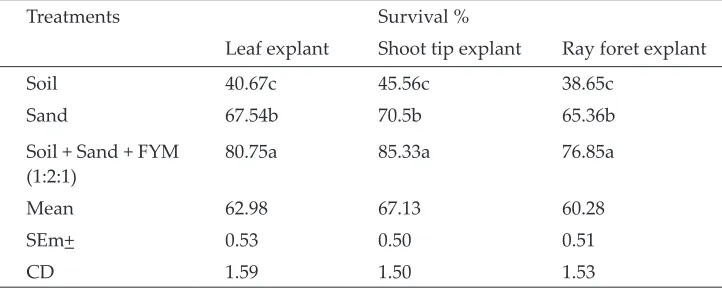
Among the various carrier substrates (Table 3)
tested for acclimatization, sterilized soil + sand + FYM (1:2:1) fortified with ½ strength MS plant salt mixture proved to be ideal substrate as maximum plant survival (85.33 %) in this substrate followed by sand (70.5%) and soil (45.56%) alone during the
study. These observations are quite close to the results of Mandal and Datta, 2005; Nahid et al. 2007. Similar result was also reported by Padmadevi et al. (2009) where highest survival (76.50%) was obtained in sand followed by sand + pot mixture (68%) in
in vitro regenerated chrysanthemum. During the
present investigation, it was also observed that the survival percentage of the plantlets derived from different explants varies. In general, plantlets obtained from shoot tip explants followed by leaf explants recorded maximum survival percentage across the various substrates used and minimum was recorded in ray florets derived plantlets. This may be due to difference in tissue differentiation as leaf and shoot tip are meristematic tissue they undergo only dedifferentiation while ray floret have to undergo both redifferentiation and dedifferentiation.
Conclusion
Plant hormones are among the most important physiological factors affecting the growth of plants
in vitro. The major differences in the response of different plants and different explants to tissue culture conditions lie in the ratio of auxins to cytokinins (Skoog and Miller, 1957). In the present study, although leaf explants produced maximum number of shoots per explants and shoot formation percentage, the survival percentage of the regenerated plants is less than the shoot tips regenerated plants. Therefore, shoot tip may be consider as an ideal explants for multiple shoot production. Standardization of a micropopagation protocol for chrysanthemum assumes significance
Table 3: Effect of substrate fortified with ½ strength MS solution on acclimatization of micropropagated plants
from different explants
Treatments Survival %
Leaf explant Shoot tip explant Ray foret explant
Soil 40.67c 45.56c 38.65c
Sand 67.54b 70.5b 65.36b
Soil + Sand + FYM
(1:2:1) 80.75a 85.33a 76.85a
Mean 62.98 67.13 60.28
SEm+ 0.53 0.50 0.51
CD 1.59 1.50 1.53
for crop improvement also, since a successful in vitro
regeneration protocol is an essential prerequisite for tissue culture based crop improvement programmes.
Acknowledgement
The authors are highly thankful to HeadDepartment of Agricultural Biotechnology, Bidhan Chandra Krishi Viswavidyalaya, Mohanpur, Nadia, West Bengal for support during the investigation.
References
Akter, N. 2001. Effect of different explants and concentrations of NAA on the callus induction and plant regeneration of brinjal cv. Uttara. Dissertation, Bangladesh Agricultural University, Mymesingh. 48-50.
Alizadeh, H., Naghavi, M.R., Omidi, M., Saatian, B. 2004. Effect of plant growth regulators on direct shoot regenration of wheat (Triticum aestivum). Crop Science 44: 1839-1846.
Dao, T.B., Nguyen, P.D., Do, Q.M., Vu, T.H., Le, T.L., Nguyen, T.K.L., Nguyen, H.D. and Nguyen, X.L. 2006. In Vitro mutagenesis of chrysanthemum for breeding. Plant Mutation Report 1(2): 26-27.
Faisal, S.M. and Amin, M.S. 2000. Rapid multiplication of two chrysanthemum cultivars through in vitro shoot tip culture. Plant Tissue Culture 10(2): 131-136.
Fay, M.P. 1992. Conservation of rare and endangered plants using in vitro techniques. In vitro Cellular and Developmental Biology 28: 1-4.
Guleria, N. and Gowda RPH 2015. An Efficient Regeneration and Genetic Transformation Protocol of Coleus forskohlii using Biolistic Gun. International Journal of Agriculture, Environment and Biotechnology 8(2): 227-235 Hutchinson, J.F., Kaul, U., Maheswaran, G., Moran, J.R.,
Craham, M.W. and Richards, D. 1982. Genetic improvement of floricultural crops using biotechnology. Australian Journal of Botany 40: 765-787.
Ju Yeon Song, Neil, S., Mattson, Byoung Ryong Jeong 2011. Efficiency of shoot regeneration from leaf, stem, petiole and petal explants of six cultivars of Chrysanthemum morifolium.Plant Cell Tissue and Organ Culture 107: 295–304.
Karim, M.Z., Amin, M.N., Azad, M.A.K., Begum, F., Islam, M.M. and Alam, R. 2002. Effect of different plant growth regulators on in vitro shoot multiplication of Chrysanthemum morifolium. Online Journal of Biological Science 3(6): 553-560.
Karim, M.Z., Amin, M.N., Asad, Z.U., Islam, S., Hassin, F.R. and Alam, R. 2003. Rapid multiplication of Chrysanthemum morifolium through in vitro culture. Pakistan Journal of Biological Science 5(11): 1170-1172. Kumar, S., Kanwar, J.K., Sharma, D.R. 2004. In vitro
regeneration of Gerbera jamesonii bolus from leaf and petiole explants. Journal of Plant Biochemistry and Biotechnology 13: 73-75.
Levin, R., Gaha, V., Tal, B., Hirsch, S., Denola, D. and Vasil, I. 1988. Automated plant tissue culture for mass propagation. Biotechnology 6: 1035-1040.
Liu, Z. and Gao, S. 2007. Micropropagation and induction of autotetraploid plants of Chrysanthemum cinerariifolium (Trev.) Vis. In vitro Cellular and Developmental Biology- Plant43: 404-408.
Manchanda P., Kaur A., Thind K. and Gosal S.S. 2015. Influence of ethylene inhibitor on shoot organogenesis and regeneration in sugarcane (Saccharum spp. hybrid) International Journal of Agriculture, Environment and Biotechnology 7(4): 759-764
Mandal, A.K.A., Datta, S.K. 2005. Direct somatic embryogenesis and plant regeneration from ray florets of chrysanthemum. Biologia Plant 49: 29-33.
Minas, G.J. 2008. Sanitation and in vitro mass micro propagation of chrysanthemum. Acta Horticulture 755. Murashige, T. and Skoog, F. 1962. A revised medium for rapid
growth and bioassays with tobacco tissue cultures. Physiologia Plantarum 15: 473-497.
Nahid, J.S., Shyamali, S., Kazumi, H., 2007. High frequency shoot regeneration from petal explants of Chrysanthemum morifolium Ramat. in vitro. Pakistan Journal of Biological Science 10(19): 3356-3361.
Naing, A.H., Park, K.I., Chung, M.Y., Lim, K.B., Kim, C.K., 2015. Optimization of factors affecting efficient shoot regeneration in chrysanthemum cv. Shinma. Brazilian Journal of Botany 1-10.
Nalini, R., 2012. Micropropagation of chrysanthemum (Chrysanthemum morifolium) using shoot tip as explants. International Journal of Food, Agriculture and Veterinary Science 2(2): 62-66.
Padmadevi, K., Jawaharlal, M., Kannan, M. and Ganga, M. 2009. Standardization of protocol for in vitro plant regeneration from ray florets of chrysanthemum (Chrysanthemum grandiflora Tzvelev). Journal of Ornamental Horticulture 12(4): 239-244.
Park, I.S., Lee, G.J., Kim, D.S., Chung, S.J., Kim, J.B., Song, H.S., Goo, D.H. and Kang, S.Y. 2007. Mutation breeding of a spray chrysanthemum ‘Argus’ by gamma-ray irradiation and tissue culture. Flower Research Journal 15: 52-57.
Sarker, R.H. and Shaheen, I. 2001. In vitro Propagation of Chrysanthemum (Chrysanthemum morifolium Ramat) through callus culture. Plant Tissue Culture 11(1): 85-91. Sivanesan, I. and Murugesan, K. 2008. An efficient regeneration
from the nodal explants of Withania somnifera Dunal. Asian Journal of Plant Science 7(6): 551-556.
Skoog, F. and Miller, C.O. 1957. Chemical regulations of growth and organ formation in plant tissue cultured in vitro. Symposia of the Societyfor Experimental Biology 11: 118-140.
Teixeira da Silva, J.A. 2003. Tissue culture and cryo-preservation of chrysanthemum: a review. Biotechnology Advances 21: 715-766.
Verma, A.K., Prasad, K.V. and Singh, S.K. 2012a. In vitro isolation of red coloured mutant from chimeric ray florets of chrysanthemum induced by gamma-ray. Indian Journal of Horticulture 69(4): 562-567.
Verma, A,K., Prasad, K.V., Janakiram, T. and Kumar, S. 2012b. Standardization of protocol for pre-treatment, surface sterilization, regeneration, elongation and acclimatization of Chrysanthemum morifolium Ramat. International Journal Horticulture 2(3): 7-12.
Waseem, K., Jilani, M.S., Khan, M.S., Kiran, M. and Khan, G. 2011. Efficient in vitro regeneration of chrysanthemum (Chrysanthemum morifolium L.) plantlets from nodal segments. African Journal of Biotechnology 10: 1477-84. Zhou, Y., Wang, Y., Song, Y., Gao, Z., Liu, Y., Fan, L., Hu, Q.