Guava (Psidium guajava L.) a member of family Myrtaceae, is an important fruit crop of tropical and subtropical regions. It is native to tropical America, an area comprising from Mexico to Peru. Guava excels other fruit crops in productivity and adaptability (Iqbalet al. 2009). It claims superiority and often called as “Poor Man’s Apple” by virtue of its high nutritive value, rich in vitamin C content, antioxidants, dietary fibres and minerals. It is also a potential source of pectin and oil from its seeds. Guava being a climacteric fruit, exhibits a typical increase in respiration and ethylene production during ripening. It softens readily and, therefore, has a very short shelf life, which in turn makes transportation and storage difficult. Therefore, to improve the quality
Changes in Antioxidant and Biochemical Constituents in
Guava (
Psidium guajava
L.) Fruit cv. Apple Colour during
Development and Ripening
Aparna Dube* and Pratibha Singh
Department of Biochemistry, College of Agriculture, N.D. University of Agriculture and Technology, Kumarganj, Faizabad - 224 229, U.P., India.
*Corresponding author: [email protected]
Abstract
Changes in antioxidant and biochemical constituents were studied in guava fruit cv.Apple colour to determine the optimum time of harvest. Fruits were analysed at 15 days interval at 30, 45, 60, 90, 105,120, 135 and 150 days after fruit set. Continous increase in TSS content was observed in guava cv. Apple Colour at different growth intervals (30 to 150 days) . Ascorbic acid content in guava varieties exhibited peculiarity, which firstly, increased from up to 120 days and then decreased at 150 days while titratable acidity in guava varieties increased from 30 days to 150 days and then decreased from 120 days to 150 days. Total sugars, reducing sugars and total carotenoid showed continous increasing trend from fruit development till ripening in guava cultivar. While anthocyanin content increased from 105 days to 150 days only.
Highlights
• Antioxidant and biochemical changes during fruit development and ripening of guava cv. Apple Colour were studied at 30, 60, 90, 105, 120, 135 and 150 days after fruit set (DAFS).
• A gradual increase in total soluble solids (TSS) was observed throughout development and ripening stageof the fruit. However, the amount of titratable acidity increased steadily in the beginning upto 105 days after fruit set and afterwards there was a continuous decrease till ripening.
• Ascorbic acid content in guava cultivar exhibited peculiarity, which firstly, increased from 15 to 120 days and then decreased at 150 days.
Keywords: Guava, apple colour, fruit development, biochemical changes
and processing characteristics of the guava fruit cv. Apple Colour, it is necessary to understand the growth patterns and also the physiological maturity to develop harvest maturity standards.
Materials and Methods
Antioxidant and biochemical changes
Fresh good quality guava fruits of different varieties were procured from Main Experiment Station, Horticulture Farm, NDUAT, Kumarganj. The experiment was laid out in completely randomized design with three replications. Guava cultivar namely Apple colour were Citation: IJAEB: 8(4): 855-859 December 2015
DOI Number: 10.5958/2230-732X.2015.00096.0
©2015 New Delhi Publishers. All rights reserved
Biochemistry
selected for this study. The selected tree were marked with metal tag for recording observations. The fully opened flowers were tagged with metallic labels on the day of anthesis. The fruits initially set were marked. Fifteen fruits were randomly harvested from each replication at 30, 45, 60, 90, 105,120 ,135 and 150 days after fruit set. The pulp was extracted from fruits by crushing and squeezing through muslin cloth. Total soluble solids of the juice was determined by using digital refractometer. (Ranganna,1997). The total pectin content of guava fruit was estimated by modified method of Ranganna (1997) in which pectin precipitated as calcium pectate from an acidified solution. The amount of pectin was recorded as calcium pectate and expressed in percent. Ascorbic acid content was determined by using 2, 6-Dichlorophenol-indophenol dye method (AOAC 1970). The amount of ascorbic acidwas recorded as mg ascorbic acid per 100 g of pulp. Acidity was determined by process of Ranganna (1997), known quantity of fruit pulp (10g) was crushed and diluted in small amount of distilled water and filtered through muslin cloth. The volume was made up to 100 ml. 5 ml aliquot was taken for titration against 0.1 N sodium hydroxide solution using phenolphthalein indicator. The appearance of light pink colour was marked as the end point.
Reducing sugar content was determined by the method of Miller (1959). Using DNS reagent and the calculation was done with the help of standard curve prepared from standard glucose solution and results were expressed as gram reducing sugar per 100 g of sample. The total sugar content was estimated by the method of Duboiset al. (1956) using phenol reagent. The intensity of colour was recorded at 480 nm on spectronic-20 against blank solution. The calculation was done with the help of standard curve prepared from standard glucose solution and results were expressed as gram total sugar per 100 g of sample. Total carotenoids were extracted and partitioned in organic solvents and measured colorimetrically by the procedure of Thimmaiah (1999). The absorbance was measured at 450 nm and the carotenoid content was calculated using a calibration curve against beta carotene. Anthocyanin was extracted with ethanolic HCL and measured colorimetrically by the procedure of Swain and Hillis (1959).
Results and Discussion
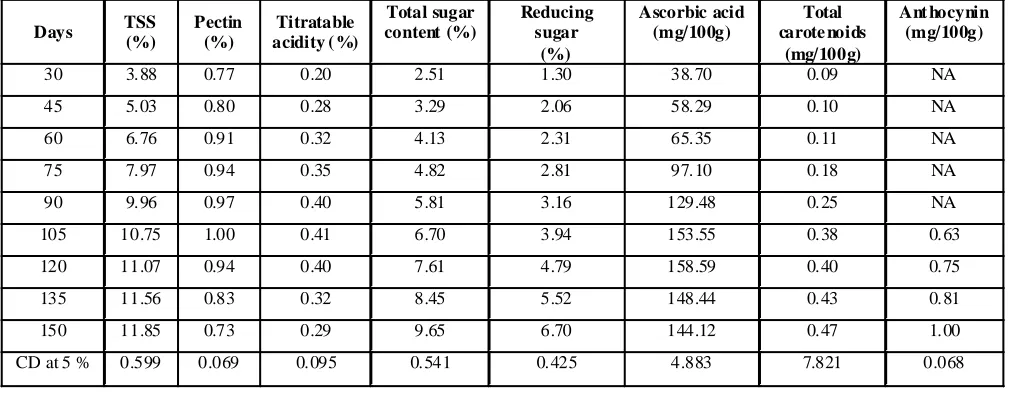
The data regarding biochemical changes have been given in Table 1.
Total soluble solids
It is revealed from the table that a gradual increase in
TSS content was observed in guava cv. Apple Colour at different growth intervals (30 to 150 days) during development and ripening and ranges from (3.88-11.85%), the increase being rapid between 75 to 150days. However, Singh and Jain(2007) witnessed maximum TSS (14.93%) at 150 days. Agrawalet al. (2002) exhibited 10.5 to 12.75%. Similar results were also supported Soares et al. (2007), Wanichkul and Pengpon (2011), Wafaa Aly (2013) and Patelet al.(2015). This inferences probably happened because of high consumption of sugars due to respiration rate. It is attributed mainly due to the hydrolysis of starch into sugar which subsequently increases the total soluble solid content (Naget al.2011).
Pectin content
Data in Table 1 reveales that pectin content showed significant variation among the guava varieties during investigation. The pectin content increased up to 105 days thereafter it declined rapidly. Pectin content increased from 0.77% to 1.00% from 30 to 105 days. In L-49, Jainet al.(2001) reported that pectin content was found to be more abundant in mature green fruits (1.11%) which decreased continuously up to overripe stage, suggesting that mature green fruits could be good source for preparing commercial pectin. Similar results regarding pectin content is also supported by Hegde and Chharia (2004), Suryakanth and Mukunda (2007). During ripening of fruits, the softening has been interpreted as the solubilisation of pectic substances from the middle lamella and hence an associated rise in soluble pectins. Pectin degradation is linked with ascorbic acid production and it is postulated that glacturonic acids are substrates needed in synthesis of ascorbic acid.
Titratable acidity
Ascorbic acid
The table exhibits peculiarity, as, ascorbic acid content in guava varieties firstly, increased from 30 days to 120 days (38.70mg/100g-158.59 mg/100g) and then decreased from 135 to 150 days. (148.44mg/100g-144.12 mg/100g). Agrawalet al.(2002) observed ascorbic acid content (118.53 to 199.26%) over the maturity period of guava cv. L-49. Hegde and Chharia (2004), Naget al. (2011) and Gull (2012) and Patelet al.(2013) also found same trend in guava cultivar. Period of ascorbic acid accumulation corresponded with decrease of pectin content in the fruit. It also appeared that active synthesis of ascorbic acid during fruit development and early ripening might be attributed to inactivation of ascorbic acid oxidase due to high content of phenols.
Sugar content
Table portrays that in contrast titratable acidity presence pattern in guava, total sugars, reducing sugars showed increasing trend during late maturity in guava cultivar. Climacteric fruits, in particular, may show considerable changes in sugar content during fruit ripening. Total sugar increased till 150 days showing the highest value of 9.65%. Reducing sugar recorded highest (6.70%) at 150 days which may be due to conversion of non-reducing sugar which may be attributed to the hydrolysis of starch into simple sugars and also by continuos mobilization of sucrose from leaves to the fruit. Results are in close consonance with various researchers as Nag et al. (2011), Jainet al. (2001) Wafaa Aly (2013) and Patel et al.(2013) in guava varieties.
Total carotenoid content
It is observed from the table that total carotenoid content in guava cv. Apple Colour increased during entire period from 30 days to 150 days. Highest value was recorded to be (0.47 mg/100g) at 150 days after fruit set. The reason might be in favour of inducing in the concentration of beta carotene as due to degradation of chlorophyll leads to accumulation of carotenoids in plastids is which favourably supported with Jainet al.(2001), Grosset al. (1976) and Kudachikaret al. (2001) .
Anthocyanin content
Data with respect to anthocyanin content was examined in cv. Apple Colour during both years and it increased from 105 days to 150 days. The findings are in close consonance with Siqueriaet al.(2011). The accumulation of anthocyanin was negligible during early developmental period. Ezhilarasi and Tamilmani (2009) stated that during maturation, the anthocyanins are synthesized at an increasing rate, especially near maturity, reaching a maximum in the fully ripe fruits. Anthocyanin are a diverse range of pigments localizes within the vacuole of plant cell and imparts various shades of blue and red to fruits. Extent of anthocyanin pigment may specifically found due to diverse in nature of fruit variety. Lower temperature and adaphic composition factors like pH which effects its degree of colouring/pigmentation.
Conclusion
Biochemical and antioxidant changes during development and ripening of guava fruit cv. Apple
Days TSS
(%)
Pectin (%)
Titratable acidity ( %)
Total sugar content (%)
Reducing sugar
(%)
Ascorbic acid (mg/100g)
Total carote noids
(mg/100g)
Ant hocynin (mg/100g)
30 3.88 0.77 0.20 2.51 1.30 38.70 0.09 NA
45 5.03 0.80 0.28 3.29 2.06 58.29 0.10 NA
60 6.76 0.91 0.32 4.13 2.31 65.35 0.11 NA
75 7.97 0.94 0.35 4.82 2.81 97.10 0.18 NA
90 9.96 0.97 0.40 5.81 3.16 129.48 0.25 NA
105 10.75 1.00 0.41 6.70 3.94 153.55 0.38 0.63
120 11.07 0.94 0.40 7.61 4.79 158.59 0.40 0.75
135 11.56 0.83 0.32 8.45 5.52 148.44 0.43 0.81
150 11.85 0.73 0.29 9.65 6.70 144.12 0.47 1.00
CD at 5 % 0.599 0.069 0.095 0.541 0.425 4.883 7.821 0.068
Colour were studied at 30, 60, 90, 105, 120, 135 and 150 days after fruit set. From above results it may be concluded that guava fruit cv. Apple Colour attains optimum maturity between 105-135 days after fruit set, it will be suitable to harvest the fruits at this stage for distant transportation to avoid post harvest losses, while 150 day stage is optimum for of fresh consumption of guava fruit.
References
Abu-Goukh, A. and Bashir, H. 2003. Changes in pectic enzymes and cellulose activities during guava fruit ripening.Food Chemistry 83(2): 213-218. Agarawal, R., Parihar, P., Mandhyan, B.L. and Jain, D.K.
2002. Physico-chemical changes during ripening of guava fruit (Psidium guajava L.). Journal of Fruit Science and Technology 39(1): 94-95. AOAC. 2000. Official method of analysis association of
official analytical chemist, Washington.
Deka, B.C., Sharma, S. and Borah, S.C. 2006. Post harvest management practices of mandarin. Indian Journal of Horticulture63: 251- 255.
Dhillon, W.S., Singh, A. and Singh, R. 2007. Biochemical changes in developing semi soft pear fruits.Indian Journal of Horticulture64: 81-83.
Dubois, M., Cilles, R.A., Hamilton, J.K., Robers, R.A. Amith, F. 1956. Use of phenol reagent for the determination of total sugar. Ann. Chem28: 35. Ezhilarasi, A. and Tamilmani, C. 2009. Influence of
paddy husk on the ripening of fruit ofZiziphus mauritiana L. Journal of Agricultural and Biological Science4(6): 29-42.
Ghosh, S.K., Dhua, R.S. and Mitra, S.K. 1985. Studies on the development of Mango fruit. Indian Food. Packer39: 46-50.
Gross, J., Carmon, M., Lifshitz, A. and Costes, C. 1976. Food Sci. Tech., 9: 211.
Gull, J., Sultana, B., Anwar, F., Naseer, R., Ashraf, M. and Ashrafuzzaman, M. 2012. Variation in Antioxidant attributes at three ripening stage of guava (Psidium guajavaL.) fruits from different geographical region of Pakistan. Molecules 17: 3165-3180.
Hegde, M.V. and Chharia, A.S. 2004. Developmental and ripening physiology of guava (Psidium guajava L.) fruit. I Biochemical changes.Haryana Journal of Horticultural Sciences 33(1/2): 62-64.
Iqbal, M., Khan, M.O., Jalal-ud-din, K.R. and Munir, M. 2009. Effect of foliar application of NAA on fruit drop, yield and physico-chemical characteristics of guava (Psidium guajava L.) Red Flesh cultivar. Journal of Agricultural Research47: 259-69.
Jain, N., Dhawan, K., Malhotra, S.P., Siddiqui, S. and Singh, R. 2001. Compositional and enzymatic changes in in guava (Psidium guajava L.) fruits during ripening. Acta Physiologiae Plantarum, 23(3): 357-362.
Kudachikar, V.B., Kulkarni, S.G., Keshava, P.M.N., Vasantha, M.S., Arvinda, P.B. and Ramana, K.V.R. 2001. Physico-chemical changes during maturity of mango (Mangifera indicaL.) variety “Neelam”. Journal of Food Science and Technology 38(5): 540-542.
Miller, J.L. 1959. Use of dinitro salicylic acid reagent for determination of reducing sugar, Ann. Chemical, 31: 426-428.
Nag, A.R., Chatterjee, D.D., Roy, T., Hossain, A.M.M.Z. and Haque, M.A. 2011. Study on chemical changes of different guava varieties during different ripening stage. Bangladesh Research Publications Journal 6(2): 217-224.
Patel, R.K., Maiti, C.S., Deka, B.C., Deshmukh, N.A. and Nath, A. 2013. Changes in sugars, pectin and antioxidants in guava (Psidium guajavaL.) fruits during fruit growth and maturity. Journal of Agricultural Science 83(10): 1017-21.
Patel, R.K., Maiti, C.S., Deka, B.C., Deshmukh, N.A., Verma, V.K. and Nath, A. 2015. Physical and biochemical changes in guava (Psidium guajava L.) during various stages of fruit growth and development .International Journal of Agriculture, Environment and Biotechnology 8(1): 75-80. Patel, R.M., Pandey, A., Dwuvedi, S.K. and Sharma, G.
2005. Studies on physico-chemical properties of guava (Psidium guajava L.) cultivars grown in Rewa (M.P.). Plant Archives 5(2): 597-600. Ranganna, S. 1997. Manual for analysis of fruit and
vegetable products.Tata. Mc. Graw Hill Co. Pvt. Ltd., New Delhi, 21-24.
Singh, P. and Jain, V. 2007. Fruit growth attributes of guava (Psidium guajava L.) cv. Allahabad safeda under agroclimatic conditions of Chattisgarh. Acta Horticulturae 735: 335-338.
Siqueria, A.M.A., Costa, J.M.C., Afonso, M.R.A. and Clemente, E. 2011. Pigments of guava Paluma cultivar stored under envoirnmental conditions. African Journal of Food Science5(6): 320-323. Soares, F.D., Pereira, T., Marques, M.M. and Monteiro,
A.R. 2007. Volatile and non-volatile chemical composition of the white guava fruit (Psidium guajava L.)at different stages of maturity. Food Chemistry 100: 15-21.
Swain, T. and Hillis, W.E. 1959.Journal of the Science of Food and Agriculture 10 : 63-68.
Thimmaiah, S.K. 1999. Standard methods of biochemical analysis, Kalyani Publications, p. 305.
Wafaa Aly Ahmed, Z.E.S. 2013. Evaluation of some genotypes of guava trees grown under Alexandria
Governorate condition II- compositional changes during ripening.World Applied Sciences Journal 28(6): 750-758.