R E S E A R C H
Open Access
Landweber iterative regularization
method for identifying the unknown source
of the modified Helmholtz equation
Fan Yang
*, Xiao Liu and Xiao-Xiao Li
*Correspondence:
[email protected] School of Science, Lanzhou University of Technology, Lanzhou, Gansu 730050, P.R. China
Abstract
In this paper, we consider the inverse problem of identifying the unknown source for the modified Helmholtz equation. We propose the Landweber iterative regularization method to solve this problem and obtain the regularization solution. Under thea priorianda posterioriregularization parameters choice rules, we all obtain the Hölder type error estimates between the exact solution and the regularization solutions. Several numerical examples are also provided to show that the Landweber iterative method works well for solving this problem.
MSC: 65M30; 35R25; 35R30
Keywords: modified Helmholtz equation; ill-posed problem; unknown source; Landweber iterative method
1 Introduction
The modified Helmholtz equation or the Yukawa equation which is pointed out in [] ap-pears in implicit matching schemes for the heat equation, in Debye-Huckel theory, and in the linearization of the Poisson-Boltzmann equation. The underlying free-space Green’s function is usually referred to as the Yukawa potential in nuclear physics. In physics, chem-istry, and biology, when Coulomb forces are damped by screening effects, this Green’s function is also known as the screened Coulomb potential. Especially in microstretch elas-tic materials [] and in the thermoelastodynamics of microstretch bodies [, ], the modi-fied Helmholtz equation has been applied widely. In recent years, there are much research results on the inverse problem of the modified Helmholtz equation. The Cauchy problems associated with the modified Helmholtz equation have been studied by using different nu-merical methods, such as the Landweber method with boundary element method and the conjugate gradient method [], the method of fundamental solutions (MFS) [], the it-eration regularization method [], Tikhonov type regularization [], Quasi-reversibility and truncation methods [–], Quasi-boundary regularization [, ], and so on. In-verse source problems arise in many branches of science and engineering, for example, heat conduction, crack identification, electromagnetic theory, geophysical prospecting, and pollutant detection. For the heat source identification, there have been a large num-ber of research results for different forms of heat sources [–], and so on. But to the best of the authors’ knowledge, there were few papers for identifying the unknown source
on the modified Helmholtz equation. In [, ], the authors used the quasi-reversibility method to identify the unknown source of the modified Helmholtz equation on half strip region and half infinite region. In [], the authors used the simplified Tikhonov regular-ization method to identify the unknown source for the modified Helmholtz equation. In [, ], the authors used the Tikhonov regularization method to identify the unknown source for the modified Helmholtz equation. But in [–], the regularization parame-ters are selected by thea priorirule. There is a defect for anya priorimethod, i.e., thea priorichoice of the regularization parameter depends on thea prioriboundEof the un-known solution. However, thea prioriboundEcannot be known exactly in practice, and using a wrong constantEmay lead to a badly regularized solution.
In this paper, we use the Landweber iterative method to identify the unknown source of the modified Helmholtz equation. The Landweber iterative method is a very popular algorithm and regularization method in inverse problem research. In [], the authors used the method of iterative method to solve linear inverse problems. Under the posterior regularization parameter choice rule, the convergence order of the regularization solution is obtained. In [], the authors used the iterative method to solve a nonlinear problems. We not only give thea priorichoice of the regularization parameter, but also give thea posteriorichoice of the regularization parameter which depends only on the measurable data. Moreover, we compare the effectiveness between thea posteriorichoice rule and the a priorichoice rule. To the best of the authors’ knowledge, there are few papers choosing the regularization parameter by thea posteriorirule for this problem. We consider the modified Helmholtz equation as follows:
⎧ ⎪ ⎪ ⎪ ⎪ ⎪ ⎨ ⎪ ⎪ ⎪ ⎪ ⎪ ⎩
u(x,y) –ku(x,y) =f(x), <x≤π, <y< +∞, u(,y) =u(π,y) = , ≤y< +∞,
u(x, ) = , u(x,y)|y→∞ is bounded, ≤x≤π,
u(x, ) =g(x), ≤x≤π,
(.)
whereg(x) is given function inL(,π), andf(x) is an unknown source. The constantkis the wave number. We use the additional conditionu(x, ) =g(x) to determine the unknown sourcef(x). Physically,g(x) can be measured, there will be measurement errors, and we assume the functiongδ(x)∈L(,π) as the measurable data which satisfies
g–gδ
L(,π)≤δ, (.)
where the constantδ> represents a bound on the measurement error, · isL(,π) norm andδis a noise level.
The remainder of the paper is organized as follows. In Section , we formulate some pre-liminary results. In Section , we present the Landweber iterative regularization method. The convergence estimates under ana prioriand ana posteriorichoice rules will be given in Section . Numerical examples are given to show the effectiveness of our method in Section . We give a brief conclusion in Section .
2 Some auxiliary results
Lemma . For≤h≤and n≥,the following inequalities hold:
( –h)nh≤ n+ , – ( –h)n
h ≤n.
(.)
Proof Denoteρ(h) = ( –h)nhandβ(h) = – ( –h)n–nh, then
ρ(h) = –n( –h)n–h+ ( –h)n,
ρ(h) = –n( –h)n–h+ ( –h)n,
β(h) =n( –h)n––n.
Settingρ(h) = , we have
h= n+ .
Note thatρ() =ρ() = ,ρ(h) has a unique maximal value ath=n+ . Therefore,
ρ(h) = ( –h)nh≤ n+ .
Becauseβ(h)≤ andβ() = , we can easily obtainβ(h)≤.
This ends the proof of the Lemma ..
Lemma . For <h≤, <α≤and n≥,Lemma.can be strengthened as the following inequalities:
( –h)nhα≤(n+ )–α,
– ( –h)n
hα ≤n α.
Proof In fact, using the established results (.), we can get
( –h)nhα≤( –h)nhα≤(n+ )–α, – ( –h)n
hα ≤
– ( –h)n
h
α
≤nα.
Lemma . For t≥,we have
–e–√t ≤. (.)
Lemma . For t≥,we have
t≤
–e–√t
t ≤
3 Landweber iterative regularization method
By the method of separation of variables, the solution of problem (.) is given by
u(x,y) = –
∞
n= –e–
√ n+ky n+k fnXn,
wherefn= (f,Xn) andXn=
πsin(nx) (n= , , . . .) is a set of standard orthogonal bases on the space intervalL(,π).
Usingu(x, ) =g(x), we obtain
g(x) = –
∞
n=
–e–√n+k n+k fnXn=
∞
n=
gnXn, (.)
wheregn= (g,Xn).
Define operatorK:f →g, then
g(x) =Kf(x) = –
∞
n=
–e–√n+k
n+k fnXn. (.)
The operatorKis a linear self adjoint compact operator, and its singular value is
μn= –
–e–√n+k
n+k ; (.)
we have
gn= –fn
–e–√n+k
n+k . (.)
Hence we obtain
fn= –gn
n+k
–e–√n+k (.)
and
f(x) =
∞
n=
fnXn= – ∞
n=
n+k
–e–√n+kgnXn=
∞
n=
μ–ngnXn. (.)
Whenn→ ∞,μ–
n =o(n), the exact data functiong(x) must be at least two times lower,
but thegδ(x), which belongs toL(,π), does not necessarily have the same negative power drop of . So problem (.) is ill-posed. Assume for the unknown sourcef(x) there exists ana prioribound as follows:
f(·)p≤E, p> , (.)
whereE> is a constant andf(·)pis defined as follows:
f(·)p=
∞
n=
n+kp(f,Xn)
Theorem . Iff(·)p≤E,p> ,then
f(·)≤CE p+g
p
p+, (.)
where C:= p p+.
Proof From (.), (.), Lemma . and the Hölder inequality, we get
f(·) =
∞
n= fn
=
∞
n= gn
n+k –e–√n+k
=
∞
n= g
p+
n
n+k –e–√n+k
g
p p+
n .
≤
∞
n= gn
n+k –e–√n+k
p+p+∞
n= gn
p p+
≤
∞
n=
fnn+kp
–e–√n+k
pp+∞
n= gn
p p+
≤CEp+g p p+,
whereC:= p p+.
We complete the proof of Theorem ..
Now, we use the Landweber iterative method to obtain the regularization solution for (.) and rewrite the equationKf =gin the formf = (I–aK∗K)f +aK∗gfor somea> . Iterate this equation, i.e.,
f(x) := , fm(x) =I–aK∗Kfm–(x) +aK∗g(x), m= , , , . . . , (.)
wheremis iterative step number, and is selected regularization parameter.ais called re-laxation factor, and satisfies <a<K. ForKbeing a self adjoint operator, we obtain
fm,δ(x) =a
m–
k=
I–aKkKgδ(x). (.)
Using (.), we get
fm,δ(x) =Rmgδ(x) = ∞
n=
– ( –aμ
n)m
μn
gnδXn(x), (.)
wheregδ
4 Error estimate under two parameters choice rules
In this section, we will give two convergence estimates under ana prioriregularization parameter choice rule and ana posterioriregularization parameter choice rule, respec-tively.
4.1 Ana prioriregularization parameter choice rule
Theorem . Let f(x)given by(.)be the exact solution of problem(.).Let fm,δ(x)given
by(.)be the regularization Landweber iterative approximation solution.Choosing the regularization parameter m= [z],where
z= E δ p+ , (.)
then we obtain the following error estimate:
fm,δ(·) –f(·)≤CE p+δ
p
p+, (.)
where[z]denotes the largest integer less than or equal to z,and C=
√
a+ (ap)p is a con-stant dependent on a,p.
Proof Due to the triangle inequality, we know
fm,δ(·) –f(·)
= ∞ n=
– ( –aμ
n)m
μn
gnδXn(x) – ∞
n=
μ–ngnXn(x)
≤ ∞ n=
– ( –aμn)m μn
gnδXn(x) – ∞
n=
– ( –aμn)m μn
gnXn(x)
+ ∞ n=
– ( –aμn)m μn
gnXn(x) – ∞
n=
μ–ngnXn(x)
=fm,δ(·) –fm(·)+fm(·) –f(·).
From condition (.) and (.), we have
fm,δ(·) –fm(·)
= ∞ n=
– ( –aμ
n)m
μn
gnδXn(x) – ∞
n=
– ( –aμ
n)m
μn
gnXn(x)
= ∞ n=
– ( –aμ
n)m
μn
gδ
n–gn
Xn(x)
≤sup
n≥
H(n)δ,
By Lemma ., we get
– ( –aμ
n)m
μn ≤
√
am, (.)
i.e.,
H(n)≤√am. (.)
So
fm,δ(·) –fm(·)≤√amδ. (.)
On the other hand, using (.), we have
fm(·) –f(·) =
∞
n=
– ( –aμ
n)m
μn
gnXn(x) – ∞
n=
μ–n gnXn(x)
=
∞
n=
( –aμ
n)m
μn
gnXn(x)
=
∞
n=
–aμnmn+k–p/n+kp/fnXn(x)
≤sup
n≥
Q(n)E,
whereQ(n) := ( –a(––e–
√
n+k
n+k ))m(n+k)– p . Using Lemma . and Lemma ., we have
Q(n)≤
– a (n+k)
m
n+k– p
. (.)
Lett:=n+k,
F(t) :=
– a (t)
m
t–p. (.)
LettsatisfyF(t) = , and we easily get
t=
a(m+p) p
. (.)
Thus
F(t) =
– p m+p
m
a(m+p) p
–p
≤
p a(m+ )
p
i.e.,
F(t)≤
p a
p
(m+ )–p. (.)
Thus we obtain
Q(n)≤
p a
p
(m+ )–p. (.)
Hence
fm(·) –f(·)≤
p a
p
(m+ )–pE. (.)
Combining (.) and (.), we choosem= [z], and get
fm,δ
(·) –f(·)≤CE p+δ
p
p+, (.)
whereC:=√a+ (ap) p .
We complete the proof of Theorem ..
4.2 Ana posterioriregularization parameter choice rule
We consider thea posterioriregularization parameter choice in the Morozov discrepancy, and construct regularization solution sequencesfm,δ(x) by Landweber iterative method. Assumeτ > is a given fixed constant. Stop the algorithm at the first occurrence ofm= m(δ)∈Nwith
Kfm,δ(·) –gδ(·)≤τ δ, (.)
wheregδ ≥τ δ.
Lemma . Letγ(m) =Kfm,δ(·) –gδ(·),then we have the following conclusions: (a) γ(m)is a continuous function;
(b) limm→γ(m) =gδ; (c) limm→+∞γ(m) = ;
(d) γ(m)is a strictly decreasing function,for anym∈(, +∞).
Lemma . For fixedτ > ,and Landweber’s iteration method with stopping rule(.), we can see that the regularization parameter m=m(δ,gδ)∈N
satisfies
m≤
(p+ ) a
E (τ– )δ
p+
. (.)
Proof From (.), we have the representation
Rmg= ∞
n=
– ( –aμ
n)m
μn
for everyg∈H( ) and thus
KRmg–g=
∞ n=
– –aμnmgnXn(x) – ∞
n= gnXn(x)
= ∞ n=
– –aμnmgnXn(x)
= ∞ n=
–aμnmgn.
From| –aμn|< , we conclude thatKR
m––I ≤.
We know thatmis the minimum value that satisfiesKRmgδ–gδ=Kfm,δ–gδ ≤τ δ.
Hence
KRm–g–g ≥KRm–gδ–gδ–(KRm––I)
g–gδ
≥τ δ–KRm––Iδ
≥(τ– )δ.
On the other hand, using (.), we obtain
KRm–g–g=
∞ n=
– –aμnm–gnXn(x) – ∞
n= gnXn(x)
= ∞ n=
– –aμnm–(g,Xn)
= ∞ n=
–aμnm–μn
n+k– p f
n
n+k p X n(x) ≤sup
n≥
–aμnm–μn
n+k– p E.
Let
S(n) := –aμnm–μn
n+k– p
, (.)
so
(τ– )δ≤S(n)E. (.)
Using Lemma ., we have
S(n)≤
–a
t
m–
t–p–. (.)
Let
G(t) =
–a
t
m–
supposet∗satisfyG(t∗) = , we easily get
t∗=
a(m+p– ) (p+ )
, (.)
so
G(t∗) =
– (p+ ) m+p–
m–a(m+p– ) (p+ )
–p+
≤
(p+ ) ma
p+
.
Combining (.) with (.), we obtain (.).
Theorem . Let f(x)given by(.)be the exact solution of problem(.).Let fm,δ(x)given
by(.)be the Landweber iterative regularization approximation solution.The regular-ization parameter is given by(.),then we have the following error estimate:
fm,δ(·) –f(·)≤C(τ+ ) p++C
Ep+ δ p
p+, (.)
where C= ((p+ ))(τ– )
p+ is a constant.
Proof Using triangle inequality, we obtain
fm,δ(·) –fm(·)≤fm,δ(·) –fm(·)+fm(·) –f(·). (.)
By (.) and Lemma ., we get
fm,δ(·) –
fm(·)≤√amδ
≤CE p+δ
p
p+, (.)
whereC= ((p+ )) (
τ–) p+.
For the second part of the right side of (.), we have
Kfm(·) –f(·) =
∞
n=
– –aμnmgnXn(x)
=
∞
n=
– –aμnmgn–gnδ
Xn(x) + ∞
n=
– –aμnmgnδXn(x).
Using (.) and (.), we have
Due to
fm(·) –f(·) Hp=
∞
n=
– –aμnmfnn+kp
≤
∞
n=
fnn+kp
≤E,
and using Theorem ., we have
fm(·) –f(·)≤C(τ+ ) p p+Ep+δ
p
p+. (.)
Therefore,
fm,δ(·) –f(·)≤C(τ+ ) p p++C
Ep+ δ p
p+. (.)
This completes the proof of Theorem ..
5 Numerical implementation and numerical examples
In this section, we present numerical results for examples cases to show the effectiveness of our proposed method.
By (.), we have
Kf(x)= –
∞
n=
–e–√n+k
n+k (f,Xn)Xn
= –
∞
n=
–e–√n+k n+k
π
f(s)
πsin(ns)ds
πsin(nx)
= –
π
π
∞
n=
–e–√n+k
n+k f(s)sin(ns)sin(nx)ds
=g(x). (.)
We use the formerNsum to approximate the infinite sum as follows:
–
∞
n= –e–
√ n+k
n+k f(s)sin(ns)sin(nx)≈–
N
n= –e–
√ n+k
n+k f(s)sin(ns)sin(nx). (.)
Letxi=(i–)Mπ,i= , , . . . ,M+ . The integral is discretized by the Simpson formula, then
(.) can be divided into
Kf(xj) = –
π
M+
i=
N
n=
–e–√n+k
So
–
M+
i=
N
n=
–e–√n+k
n+k f(xi)sin(nxi)sin(nxj)ωi=g(xj), (.)
where
wi=
⎧ ⎪ ⎪ ⎨ ⎪ ⎪ ⎩
M, i= ,M+ ,
M, i= , , . . . ,M,
M, i= , , . . . ,M– .
(.)
The matrix form of (.) is as follows:
Bf =g, (.)
where
Bij= – N
n= –e–
√ n+k
n+k sin(nxi)sin(nxj)ωi,
fj=
f(x),f(x), . . . ,f(xi), . . . ,f(xM+)
T
,
gj=
g(x),g(x), . . . ,g(xi), . . . ,g(xM+)
T
.
BecauseKis the adjoint operator,B∗=B. The corresponding Landweber iterative equa-tion is
fm,δ(x) =a
m
k=
I–aBk–Bgδ(x). (.)
In the computational procedure, we takep= . In discrete format, we takeM= ,N= to compute the direct problem for the forward problem and chooseM= ,N= to solve the inverse problem.
Example Through calculating, we know that the functionu(x,y) = ( –e–√ky)sin(kx)
and the function f(x) = –ksin(kx) are satisfied with the problem (.) with exact data g(x) = ( –e–
√
k)sin(kx), and thea prioribound is
E=f(·)p=
N
n=
n+kp(f,Xn)
. (.)
Noise data is generated by adding a random perturbation, that is,
gδ=g+εrandsize(g),
whereεis relative error level. The total error levelgis given by the following:
δ=gδ–g=
M+
M+
i=
gδ(x
i) –g(xi)
Figure 1 The comparison of numerical effects between the exact solution and its regularization solution for Example 1,k= 2: (a)ε= 0.001, (b)ε= 0.01.
Figure 2 The comparison of numerical effects between the exact solution and its regularization solution for Example 1,ε= 0.001: (a)k= 4, (b)k= 5.
Figure shows the numerical results ofk= ,ε= .,ε= ., respectively. In Figure , whenε= ., we takek= , to solve this problem.
It can be seen from Figures - that the Landweber iterative regularization method is very effective for solving the inverse problem of the unknown source identification of the modified Helmholtz equation. On the one hand, when the random disturbance increases, the result becomes worse. On the other hand, with the increase ofk, the results are slightly worse, which is also consistent with our error estimates.
Example Consider the following discontinuous function:
f(x) =
⎧ ⎪ ⎪ ⎪ ⎪ ⎪ ⎨ ⎪ ⎪ ⎪ ⎪ ⎪ ⎩
, ≤x≤π ,
πx– , π <x≤
π , –
πx+ , π <x≤
π, , π<x≤π.
(.)
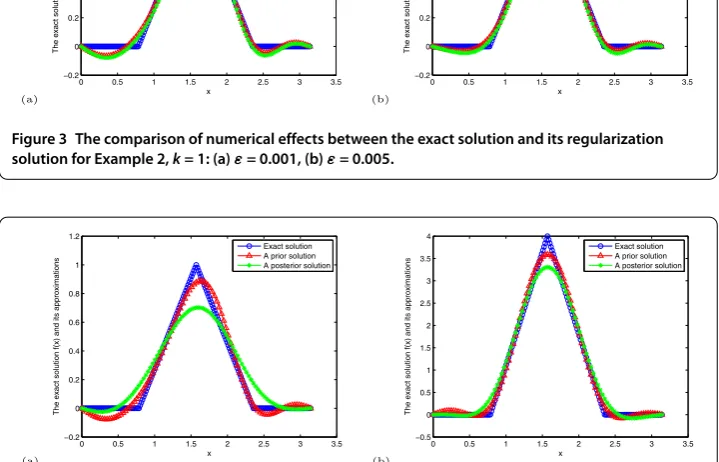
Figure 3 The comparison of numerical effects between the exact solution and its regularization solution for Example 2,k= 1: (a)ε= 0.001, (b)ε= 0.005.
Figure 4 The comparison of numerical effects between the exact solution and its regularization solution for Example 2,ε= 0.01: (a)k= 2, (b)k= 4.
Example Consider the following discontinuous function:
f(x) =
⎧ ⎪ ⎪ ⎨ ⎪ ⎪ ⎩
, ≤x≤π , , π <x≤π,
, π<x≤π.
(.)
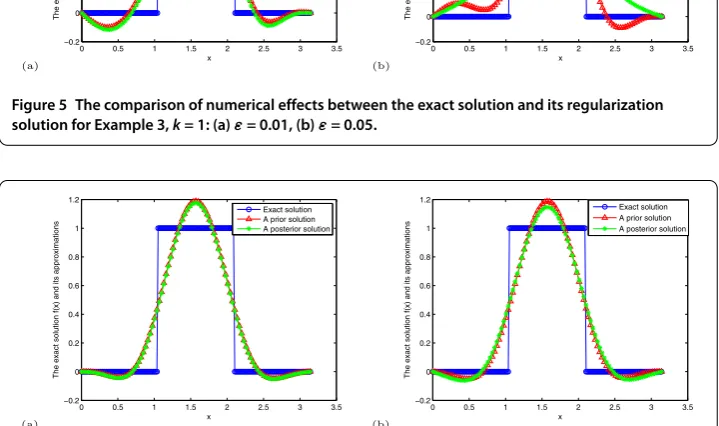
Figure shows the numerical results ofk= ,ε= .,ε= ., respectively. In Fig-ure , when the error isε= ., we takek= , to solve this problem. Figures - show the comparisons of the numerical effects between the exact solution and the regulariza-tion soluregulariza-tion for thea priorianda posterioriregularization parameter choice rule with Example .
From Figures -, we can find that the smallerε, the better the computed approximation is. Moreover, we can also easily find that thea posterioriparameter choice rule works bet-ter than thea prioriparameter choice rule. This is consistent with our theoretical analysis.
6 Conclusion
Figure 5 The comparison of numerical effects between the exact solution and its regularization solution for Example 3,k= 1: (a)ε= 0.01, (b)ε= 0.05.
Figure 6 The comparison of numerical effects between the exact solution and its regularization solution for Example 3,ε= 0.001: (a)k= 2, (b)k= 4.
respectively. Meanwhile, numerical examples verifies that the Landweber iterative method has efficiency and accuracy.
Acknowledgements
The authors would like to thanks the editor and the referees for their valuable comments and suggestions that improve the quality of our paper. The work is supported by the National Natural Science Foundation of China (11561045, 11501272) and the Doctor Fund of Lan Zhou University of Technology.
Competing interests
The authors declare that they have no competing interests.
Authors’ contributions
The main idea of this paper was proposed by Fan Yang and Xiao Liu prepared the manuscript initially and performed all the steps of the proofs in this research. All authors read and approved the final manuscript.
Publisher’s Note
Springer Nature remains neutral with regard to jurisdictional claims in published maps and institutional affiliations.
Received: 25 January 2017 Accepted: 25 May 2017
References
1. Cheng, HW, Huang, JF, Leiterman, TJ: An adaptive fast solver for the modified Helmholtz equation in two dimensions. J. Comput. Phys.211(2), 616-637 (2006)
2. Marin, M: A domain of influence theorem for microstretch elastic materials. Nonlinear Anal., Real World Appl.11(5), 3446-3452 (2010)
3. Marin, MI, Agarwal, RP, Abbas, IA: Effect of intrinsic rotations, microstructural expansion and contractions in initial boundary value problem of thermoelastic bodies. Bound. Value Probl.2014, 129 (2014)
5. Marin, L, Elliott, L, Heggs, PJ, Ingham, DB, Lesnic, D, Wen, X: Conjugate gradient-boundary element solution to the Cauchy problem for Helmholtz-type equations. Comput. Mech.31(3-4), 367-377 (2003)
6. Marin, L, Elliott, L, Heggs, P, Ingham, D, Lesnic, D, Wen, X: BEM solution for the Cauchy problem associated with Helmholtz-type equations by the Landweber method. Eng. Anal. Bound. Elem.28(9), 1025-1034 (2004) 7. Wei, T, Hon, Y, Ling, L: Method of fundamental solutions with regularization techniques for Cauchy problems of
elliptic operators. Eng. Anal. Bound. Elem.31(4), 373-385 (2007)
8. Cheng, H, Zhu, P, Gao, J: A regularization method for the Cauchy problem of the modified Helmholtz equzation. Math. Methods Appl. Sci.38, 3711-3719 (2015)
9. Qin, HH, Wen, DW: Tikhonov type regularization method for the Cauchy problem of the modified Helmholtz equation. Appl. Math. Comput.203, 617-628 (2008)
10. Qin, HH, Wei, T: Quasi-reversibility and truncation methods to solve a Cauchy problem of the modified Helmholtz equation. Math. Comput. Simul.80, 352-366 (2009)
11. Shi, R, Wei, T, Qin, HH: A fourth-order modified method for the Cauchy problem of the modified Helmholtz equation. Numer. Math., Theory Methods Appl.2, 326-340 (2009)
12. Xiong, XT, Shi, WX, Fan, XY: Two numerical methods for a Cauchy problem for modified Helmholtz equation. Appl. Math. Model.35, 4951-4964 (2011)
13. Nguyen, HT, Tran, QV, Nguyen, VT: Some remarks on a modified Helmholtz equation with inhomogeneous source. Appl. Math. Model.37(1), 793-814 (2013)
14. Li, GS: Data compatibility and conditional stability for an inverse source problem in the heat equation. Appl. Math. Comput.173, 566-581 (2006)
15. Dou, FF, Fu, CL: Determining an unknown source in the heat equation by a wavelet dual least squares method. Appl. Math. Lett.22, 661-667 (2009)
16. Yang, F, Fu, CL: A simplified Tikhonov regularization method for determining the heat source. Appl. Math. Model.34, 3286-3299 (2010)
17. Farcas, A, Lesnic, D: The boundary-element method for the determination of a heat source dependent on one variable. J. Eng. Math.54, 375-388 (2006)
18. Liu, CH: A two-stage LGSM to identify time-dependent heat source through an internal measurement of temperature. Int. J. Heat Mass Transf.52, 1635-1642 (2009)
19. Ma, YJ, Fu, CL, Zhang, YX: Identification of an unknown source depending on both time and space variables by a variational method. Appl. Math. Model.36, 5080-5090 (2012)
20. Hasanov, A: Identification of spacewise and time dependent source terms in 1D heat conduction equation from temperature measurement at a final time. Int. J. Heat Mass Transf.55, 2069-2080 (2012)
21. Cheng, W, Ma, YJ, Fu, CL: Identifying an unknown source term in radial heat conduction. Inverse Probl. Sci. Eng.20, 335-349 (2012)
22. Yan, L, Fu, CL, Yang, FL: The method of fundamental solutions for the inverse heat source problem. Eng. Anal. Bound. Elem.32, 216-222 (2008)
23. Yang, F, Fu, CL, Li, XX: The inverse problem of identifying the unknown source for the modified Helmholtz equation. Acta Math. Sci.32A(3), 557-565 (2012)
24. Li, XX, Yang, F, Liu, J, Wang, L: The quasireversibility regularization method for identifying the unknown source for the modified Helmholtz equation. J. Appl. Math.2013, Article ID 245963 (2013).
25. Yang, F, Guo, HZ, Li, XX: The simplied Thikhonov regulation method for identifying the unknown source for the modified Helmholtz equation. Math. Probl. Eng.2011, Article ID 953492 (2011)
26. Gao, JH, Wang, DH, Peng, JG: A Tikhonov-type regularization method for identifying the unknown source in the modified Helmholtz equation. Math. Probl. Eng.2012, Article ID 878109 (2012).
27. Zhao, JJ, Liu, SS, Liu, T: A comparison of regularization methods for identifying unknown source problem for the modified Helmholtz equation. J. Inverse Ill-Posed Probl.22(2), 1-14 (2014)
28. Wang, LJ, Han, X, Liu, J, Chen, JJ: An improved iteration regularization method and application to reconstruction of dynamic loads on a plate. J. Comput. Appl. Math.235(14), 4083-4094 (2011)