The effect of community-acquired
bacteraemia on return to workforce,
risk of sick leave, permanent disability
pension and death: a Danish
population-based cohort study
Michael Dalager-Pedersen,1,2Kristoffer Koch,2,3Reimar Wernich Thomsen,2 Henrik Carl Schønheyder,3Henrik Nielsen1
To cite:Dalager-Pedersen M, Koch K, Wernich Thomsen R,
et al. The effect of
community-acquired bacteraemia on return to workforce, risk of sick leave, permanent disability pension and death: a Danish population-based cohort study.BMJ Open2014;4: e004208. doi:10.1136/ bmjopen-2013-004208
▸ Prepublication history and additional material for this paper is available online. To view these files please visit the journal online (http://dx.doi.org/10.1136/ bmjopen-2013-004208).
Received 9 October 2013 Revised 13 December 2013 Accepted 9 January 2014
For numbered affiliations see end of article.
Correspondence to Dr Michael Dalager-Pedersen; [email protected]
ABSTRACT
Objectives:Little is known about the prognosis of
community-acquired bacteraemia (CAB) in workforce adults. We assessed return to workforce, risk for sick leave, disability pension and mortality within 1 year after CAB in workforce adults compared with blood culture-negative controls and population controls.
Design:Population-based cohort study.
Setting:North Denmark, 1996–2011.
Participants:We used population-based healthcare
registries to identify all patients aged 20–58 years who had first-time blood cultures obtained within 48 h of medical hospital admission, and who were part of the workforce (450 bacteraemia exposed patients and 6936 culture-negative control patients). For each bacteraemia patient, we included up to 10 matched population controls.
Primary and secondary outcome measures: Return to workforce, risk of sick leave, permanent disability pension and mortality within 1 year after bacteraemia. Regression analyses were used to compute adjusted relative risks (RRs) with 95% CIs.
Results:One year after admission, 78% of patients
with CAB, 85.7% of culture-negative controls and 96.8% of population controls were alive and in the workforce, and free from sick leave or disability pension. Compared with culture-negative controls, bacteraemia was associated with an increased risk for long-term sick leave (4-week duration, 40.2% vs 23.9%, adjusted RR, 1.51; CI 1.34 to 1.70) and an increased risk for mortality (30-day mortality, 4% vs 1.4%, adjusted RR, 2.34, CI 1.22 to 4.50; 1-year mortality, 8% vs 3.9%, adjusted RR, 1.73; CI 1.18 to 2.55). Bacteraemia patients had a risk for disability pension similar to culture-negative controls (2.7% vs 2.6%, adjusted RR, 0.99, CI 0.48 to 2.02) but greater than population controls (adjusted RR, 5.20; 95% CI 2.16 to 12.50).
Conclusions:CAB is associated with long duration of
sick leave and considerable mortality in working-age adults when compared with blood culture-negative controls, and an increased 1-year risk for disability pension when compared with population controls.
INTRODUCTION
Hospitalisation for community-acquired bac-teraemia (CAB) has increased markedly in recent decades, and more than 30% of hos-pitalisations for CAB are in working-age adults.1
Overall, CAB is associated with a 30-day mortality of 13–20% and a 1-year mortality of 25–45%,2–6 with a lower mortality in working-age adults, for example, a 30-day mortality of 11–16% in 15–64-year-old patients.4–7Apart from mortality, information is sparse on outcomes of bacteraemia in working-age adults. Only a few small cohort studies in hospitalised patients with infection have secondarily detailed the proportion of patients who returned to work, with confl ict-ing results: 68% of patients with pneumonia may return to work within 30 days,8 43% of survivors of septic shock within 1 year9 and 93% of survivors of severe sepsis within 3.5 years.10 None of these studies focused specifically on working-age patients, assessed risk for long-term sick leave or disability pension, accounted for retirement or
Strengths and limitations of this study
▪ To our knowledge, this is the first study to examine duration of sick leave and risk for per-manent disability pension after community-acquired bacteraemia.
▪ Strengths include the population-based design and the use of highly valid prospectively col-lected data on bacteraemia, comorbidity and workforce affiliation.
▪ When comparing patients with community-acquired bacteraemia and controls, residual and unmeasured confounding may account for some of the increased risk for sick leave, disability pension and death.
on September 22, 2020 by guest. Protected by copyright.
included a comparison group. To our knowledge, no study has examined the prognosis after CAB in working-age adults who are part of the workforce and no study has examined return to work after CAB. Because CAB is increasingly common in working-age adults, it is important for patients, families and the society to have detailed knowledge on the prognosis in this age group.
We conducted a 15-year population-based cohort study among 20–58-year-old Danes who were part of the work-force, to examine return to work and risk for sick leave, permanent disability pension and mortality after medical hospitalisation with CAB in comparison with blood culture-negative controls and matched population controls.
MATERIALS AND METHODS Setting
The study was conducted in healthcare region of North Denmark from 1996 to 2011. This area had a stable urban/rural catchment population of approximately 500 000 inhabitants who received universal tax-financed primary and secondary care, free at the point of delivery. Throughout the study period, Aalborg University Hospital was the only referral hospital and all regional hospitals relied on its department of clinical microbiol-ogy for blood culture analyses.
For this study, we used prospectively collected data from seven Danish population-based registries. The Civil Registration System (CRS),11 which is updated daily, was used for personal data, including date of birth and death, place of residence and marital status. Unique CRS numbers, which are recorded for all healthcare contacts, and in administrative databases, facilitated linkage between registries. We further used data from the North Denmark Bacteraemia Research Database,12 the regional microbiology information system (ADBact; Autonik, Sköldinge, Sweden),4 the DREAM register on social transfer payments,13 the Aarhus University Prescription database14 and the regional Hospital Discharge Registry (HDR).15Because data were acquired from registries which are generally available to Danish researchers, no informed consent was needed for this study.
Data on blood cultures
The bacteraemia database has registered all bacteraemia cases in the study area since 1981, prospectively since 1992.12 The microbiology information system has been used since 1995 and contains basic information on all blood cultures examined in the region.4 We used these databases for information on date of blood culture sam-pling, and also for information on infectious agent(s) and focus of infection in case of positive cultures. Throughout the study period, the blood culture system (BacT/Alert, bioMérieux, Marcy l’Etoil, France) was unchanged and is described in detail elsewhere.4 12
Data on social transfers
The DREAM database contains weekly information on social transfer benefits for all residents in Denmark who have received any such benefit, however, briefly, since 1991.13 16In Denmark, people who are part of the work-force (employed or unemployed) can receive sickness absence benefits ( paid sick leave) during temporary illness. Paid sick leave is possible for a maximum of 52 weeks (with the possibility for extension) within an 18-month period. People whose illness causes a lasting reduced ability to work can receive permanent disability pension. During the study period, people who were in the workforce could go on early voluntary retirement when they turned 60 and optional retirement with public pension was possible from age 67 (1996–1999) or age 65 (2000–2011). For the present study, DREAM codes were categorised as work-ready codes (employed and unemployed), sick leave codes and permanent dis-ability pension codes. DREAM codes are further detailed in online supplementary table S1. There is no universal definition of long-term sick leave; for this study and else-where, it is defined as a disease lasting at least four con-secutive weeks.17
Data on hospital admissions and comorbidity
We used the HDR for data on hospital admissions and comorbidity. The HDR has recorded complete diagnosis codes from all inpatient hospitalisations in Denmark since 1977, and from outpatient clinic contacts since 1995. Diagnoses were coded by physicians according to the WHO’s International Classification of Diseases (ICD)-8 until 1993 and ICD-10 thereafter).
We recorded the 19 disease categories in the Charlson Comorbidity Index (CCI) and alcohol-related disorders which we considered to be risk factors for death, sick leave and disability pension.18 19 The comorbidity level was categorised as low (CCI=0), medium (CCI=1–2) or high (CCI>2).
The Aarhus University Prescription database was used for information on preadmission medication use includ-ing disulfiram, antidiabetics, drugs for cardiovascular and pulmonary disease and systemic antibiotics.14It con-tains Anatomical Therapeutic Chemical (ATC) classifi ca-tion code data on all reimbursed prescripca-tions since 1991. ICD and ATC codes used in this study are detailed in online supplementary table S2.
Study subjects
We included study participants who were 20–58 years of age and were part of the workforce in the 4 weeks prior to admission, that is, did not receive permanent disabil-ity benefits, were not retired or on long-term sick leave (ie, received sickness absence benefits for a maximum of 3 weeks within 4 weeks prior to admission). Further eligibility criteria were no record of recent hospitalisa-tion ( previous 30 days), no previous blood culture draw (since 1995) or bacteraemia (since 1981) and residence within the study area for≥1 year.
on September 22, 2020 by guest. Protected by copyright.
We identified all inpatients who had afirst-time blood culture taken within 48 h of admission during 1996– 2010. We defined CAB as the presence of viable bacteria or fungi in the bloodstream, determined by blood cul-tures performed within 48 h of admission, among patients who were not admitted to the hospital within the previous 30 days. Study participants were categorised as patients with CAB or as blood culture-negative con-trols. Furthermore, for each patient with CAB, we sampled 10 eligible population controls, who were alive on the date of hospital admission of the patient with CAB and with no recent hospitalisation, matched on sex and year of birth.
Statistics
We followed all study participants from the date of blood culture draw until death, emigration from Denmark or completion of 1 year of follow-up, whichever occurred
first. Wefirst computed the median number and IQR of weeks that patients were on paid sick leave during the year before and after blood culture draw. We then com-puted the risk of being on sick leave (receiving sickness absence benefits) for at least 4 and for 52 consecutive weeks, respectively, beginning in the week of blood culture draw. Log-binomial regression20 21 was used to compute the risk difference (RD) and relative risk (RR) with 95% CI of 4-week and 52-week sick leave for patients with CAB versus culture-negative controls. In time-to-event analyses, we first constructed cumulative incidence curves for permanent disability pension and Kaplan-Meier curves for mortality. We used regression analyses based on pseudo-observations22 to compute RDs and RRs of permanent disability pension and mor-tality with 95% CIs for patients with CAB versus culture-negative controls and population controls. We considered death as a competing risk for permanent dis-ability pension in all time-to-event analyses. In regression analyses, we adjusted for potential risk factors for sick leave, disability pension and death: age, gender, CCI score, alcoholism-related disease (including disulfiram use), medication use (antidiabetics, drugs for cardiovas-cular disease and pulmonary disease), civil status and immigrant status.3 18 19 23–25 Because of few events among population controls, analyses concerning patients with CAB versus population controls were only adjusted for age and gender. In subgroup analyses, we examined the risk for long-term sick leave, disability pension and mortality according to etiological infectious agent and focus of infection. We also stratified analyses by gender, age group and employment status in the 4 weeks prior to admission. Because the management of CAB may have changed throughout the study period, we con-ducted up-to-date supplementary analyses pertaining to the latter half of the study period (2003–2011). Because previous antibiotic use could bias the risk estimates in our study when comparing patients with CAB and culture-negative controls, we conducted supplementary analyses in which we restricted to patients who had
blood culture draw performed on admission and no recent out-of-hospital antibiotic use.
Stata V.11.2 for Windows (Stata Corp, College Station, Texas, USA) was used for all data analyses.
RESULTS
Baseline characteristics
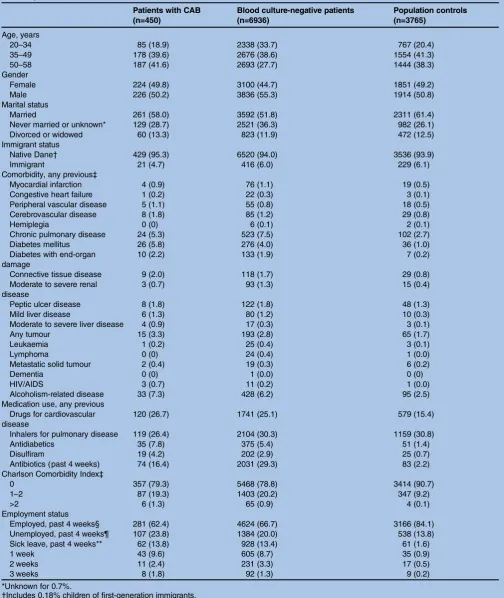
We included 7386 acutely hospitalised patients who were part of the workforce immediately before hospitalisation and had a first-time blood culture drawn within 48 h of admission, 450 patients with CAB and 6936 controls with negative blood cultures. Patients with CAB were matched to 4500 population controls, of whom 3765 were included in the study (see flow diagram in the online supplement). Baseline characteristics for study participants can be found in table 1. Patients with CAB were older than culture-negative controls (median age in years 47.7 vs 41.4, p<0.001) but the burden of pre-existing disease was similar and relatively low in both groups. Still, the disease burden was even lower among population controls. In the year before blood culture draw, study participants were on sick leave for a median of 0 weeks (IQR 0–1 week for patients with CAB and culture-negative controls, and 0–0 for population controls).
Return to work, duration of sickness leave and disability pension
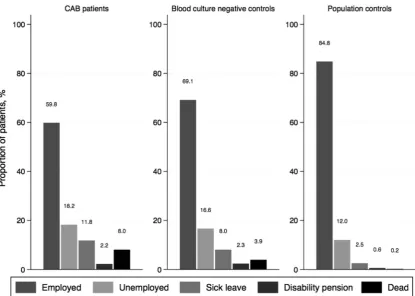
Exactly 1 year after blood culture draw 350 patients with CAB (78.0%), 5944 culture-negative controls (85.7%) and 3644 population controls (96.8%) were alive and part of the workforce, and thus free from sick leave and disability pension (figure 1). In the year after blood culture draw, 50% of patients with CAB were on sick leave for at least 4 weeks (median 4, IQR 0–14 weeks) and 50% of culture-negative controls were on sick leave for 0 weeks (median 0, IQR 0–7 weeks). When com-pared with blood culture-negative controls, CAB was associated with an increased risk of sick leave for≥4 con-secutive weeks (40.2% vs 23.9%, adjusted RR, 1.51; 95% CI 1.34 to 1.70) and ≥52 weeks (5.8% vs 2.6%, adjusted RR, 1.96; 95% CI 1.31 to 2.93; table 2). However, the 1-year risk for disability pension was similar in the two groups, 2.7% for patients with CAB and 2.6% for culture-negative controls (adjusted RR, 0.99; 95% CI 0.48 to 2.02), seetable 2 andfigure 2. When compared with population controls, CAB was associated with an increased risk for 1-year disability pension (2.7% vs 0.6%, adjusted RR, 5.20; 95% CI 2.16 to 12.50).
Mortality
Mortality rose sharply to 4% for patients with CAB within the first 30 days (see online supplementary figure S2), 1.4% for culture-negative controls (adjusted RR, 1.87; 95% CI 1.03 to 3.40; table 2) and 0 for population con-trols. Within 1 year the mortality was 8.0% for patients with CAB, 3.9% for culture-negative controls (adjusted
on September 22, 2020 by guest. Protected by copyright.
Table 1 Descriptive characteristics of workforce community-acquired bacteraemia patients and blood culture-negative controls, North Denmark, 1996–2010
Patients with CAB (n=450)
Blood culture-negative patients (n=6936)
Population controls (n=3765)
Age, years
20–34 85 (18.9) 2338 (33.7) 767 (20.4)
35–49 178 (39.6) 2676 (38.6) 1554 (41.3)
50–58 187 (41.6) 2693 (27.7) 1444 (38.3)
Gender
Female 224 (49.8) 3100 (44.7) 1851 (49.2)
Male 226 (50.2) 3836 (55.3) 1914 (50.8)
Marital status
Married 261 (58.0) 3592 (51.8) 2311 (61.4)
Never married or unknown* 129 (28.7) 2521 (36.3) 982 (26.1)
Divorced or widowed 60 (13.3) 823 (11.9) 472 (12.5)
Immigrant status
Native Dane† 429 (95.3) 6520 (94.0) 3536 (93.9)
Immigrant 21 (4.7) 416 (6.0) 229 (6.1)
Comorbidity, any previous‡
Myocardial infarction 4 (0.9) 76 (1.1) 19 (0.5)
Congestive heart failure 1 (0.2) 22 (0.3) 3 (0.1)
Peripheral vascular disease 5 (1.1) 55 (0.8) 18 (0.5)
Cerebrovascular disease 8 (1.8) 85 (1.2) 29 (0.8)
Hemiplegia 0 (0) 6 (0.1) 2 (0.1)
Chronic pulmonary disease 24 (5.3) 523 (7.5) 102 (2.7)
Diabetes mellitus 26 (5.8) 276 (4.0) 36 (1.0)
Diabetes with end-organ damage
10 (2.2) 133 (1.9) 7 (0.2)
Connective tissue disease 9 (2.0) 118 (1.7) 29 (0.8)
Moderate to severe renal disease
3 (0.7) 93 (1.3) 15 (0.4)
Peptic ulcer disease 8 (1.8) 122 (1.8) 48 (1.3)
Mild liver disease 6 (1.3) 80 (1.2) 10 (0.3)
Moderate to severe liver disease 4 (0.9) 17 (0.3) 3 (0.1)
Any tumour 15 (3.3) 193 (2.8) 65 (1.7)
Leukaemia 1 (0.2) 25 (0.4) 3 (0.1)
Lymphoma 0 (0) 24 (0.4) 1 (0.0)
Metastatic solid tumour 2 (0.4) 19 (0.3) 6 (0.2)
Dementia 0 (0) 1 (0.0) 0 (0)
HIV/AIDS 3 (0.7) 11 (0.2) 1 (0.0)
Alcoholism-related disease 33 (7.3) 428 (6.2) 95 (2.5) Medication use, any previous
Drugs for cardiovascular disease
120 (26.7) 1741 (25.1) 579 (15.4)
Inhalers for pulmonary disease 119 (26.4) 2104 (30.3) 1159 (30.8)
Antidiabetics 35 (7.8) 375 (5.4) 51 (1.4)
Disulfiram 19 (4.2) 202 (2.9) 25 (0.7)
Antibiotics (past 4 weeks) 74 (16.4) 2031 (29.3) 83 (2.2) Charlson Comorbidity Index‡
0 357 (79.3) 5468 (78.8) 3414 (90.7)
1–2 87 (19.3) 1403 (20.2) 347 (9.2)
>2 6 (1.3) 65 (0.9) 4 (0.1)
Employment status
Employed, past 4 weeks§ 281 (62.4) 4624 (66.7) 3166 (84.1) Unemployed, past 4 weeks¶ 107 (23.8) 1384 (20.0) 538 (13.8) Sick leave, past 4 weeks** 62 (13.8) 928 (13.4) 61 (1.6)
1 week 43 (9.6) 605 (8.7) 35 (0.9)
2 weeks 11 (2.4) 231 (3.3) 17 (0.5)
3 weeks 8 (1.8) 92 (1.3) 9 (0.2)
*Unknown for 0.7%.
†Includes 0.18% children of first-generation immigrants.
‡Based on ICD-codes that are detailed in the online supplement.
§Participants who were registered as employed and actively working during all 4 weeks before admission. ¶Participants who spent all 4 weeks as unemployed and participants who were employed/unemployed.
**Participants who were on sick leave for a maximum of 3 weeks in the previous 4 weeks, and otherwise employed or unemployed. CAB, community-acquired bacteraemia; ICD, International Classification of Diseases.
on September 22, 2020 by guest. Protected by copyright.
RR, 1.52; 95% CI 1.10 to 2.10; table 2) and 0.2% for population controls (adjusted RR, 37.83; 95% CI 15.67 to 91.29).
Subgroup and stratified analyses
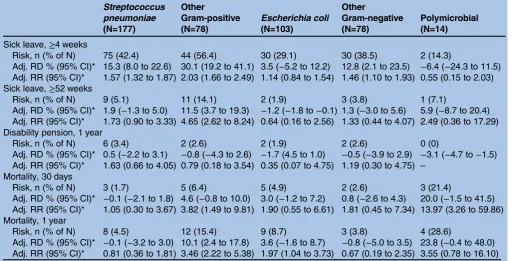
Subgroups of patients with pneumococcal or other Gram-positive infection had a higher risk for 4-week sick
leave, 52-week sick leave and 1-year disability pension after CAB than patients with Escherichia coliinfection or other Gram-negative infection (table 3). Of note, pneumococcal infection was associated with the lowest level of comorbidity (85% with CCI score of 0), the lowest 30-day (1.7%) and 1-year mortality (4.5%) and the highest 1-year risk for permanent disability pension Figure 1 Employment status and mortality at 1 year after blood culture draw. Note, the cumulative incidence of sick leave and disability pension within 1 year is higher than the proportion of patients that received either benefit at 1 year after blood culture draw (eg, some patients went on sick leave or became disability pensioners and later died during 1 year of follow-up).
Table 2 Sick leave, disability pension and mortality among patients with CAB (N=450) and blood culture-negative controls (N=6936)
Risk number of events
(% of N) Risk difference, % (95% CI) Relative risk (95% CI) patients
with CAB Controls Crude Adjusted Crude Adjusted
Sick leave*
≥4 weeks 181 (40.2) 1658 (23.9) 16.3 (11.7 to 21.0) 14.1 (9.5 to 18.7) 1.68 (1.49 to 1.90) 1.51 (1.34 to 1.70)
≥52 weeks 26 (5.8) 181 (2.6) 3.2 (1.0 to 5.4) 3.0 (0.8 to 5.2) 2.21 (1.48 to 3.30) 1.96 (1.31 to 2.93) Disability
pension
1 year 12 (2.7) 183 (2.6) 0.0 (−1.5 to 1.6) −0.5 (−2.1 to 1.0) 1.01 (0.57 to 1.80) 0.99 (0.48 to 2.02)
Mortality 30 days 18 (4.0) 99 (1.4) 2.6 (0.7 to 4.4) 2.2 (0.4 to 4.0) 2.80 (1.71 to 4.59) 2.34 (1.22 to 4.50) 1 year 36 (8.0) 271 (3.9) 4.1 (1.5 to 6.6) 3.1 (0.6 to 5.6) 2.05 (1.47 to 2.86) 1.73 (1.18 to 2.55)
*Sick leave for≥4 and≥52 consecutive weeks after blood culture draw.
Relative risk and risk difference computed by log-binomial regression (sick leave analyses) and regression analyses based on pseudo-observations (disability pension and mortality analyses). Estimates are adjusted for age, gender, Charlson comorbidity score, alcoholism-related disease, medication use, marital and immigrant status. Because of few events, 30-day mortality estimates were not adjusted for medication use, marital and immigrant status. Because of failure to converge, risk difference estimates for sick leave were not adjusted for immigrant status.
CAB, community-acquired bacteraemia.
on September 22, 2020 by guest. Protected by copyright.
(3.4%;table 3). Patients withStaphylococcus aureus bacter-aemia and polymicrobial bacterbacter-aemia had the highest levels of comorbidity (71% with CCI score of 0 in both groups) and also had the highest 30-day mortality (S aureus, 3/31, 9.7% and polymicrobial CAB, 3/14, 21.4%) and 1-year mortality (S aureus, 5/31, 16.1% and polymi-crobial CAB, 4/14, 28.6%). In these small subgroups with high mortality, a high proportion of patients were on sick leave for a long time after infection (eg, 6/31, 19.4% of patients withS aureusinfection were on sick leave for 52 consecutive weeks) but the 1-year risk for disability pension was 0. Irrespective of type of focus, CAB was asso-ciated with an increased risk for long-term sick leave when compared with culture-negative controls (eg, 40.2% of patients with CAB with respiratory tract infec-tion were on sick leave for at least 4 weeks, adjusted RR, 1.51; 95% CI 1.26 to 1.83). Mortality was particularly high among patients with an unknown focus or more than one focus of infection (30-day mortality of 14.3%), see online supplementary table S3.
When stratifying analyses according to age group and employment status, older age and unemployment were associated with the highest absolute risks for disability pension and mortality (see online supplementary table S4). When comparing patients with CAB to blood culture-negative controls in stratified analyses, CAB was consistently associated with an increased risk for 4-week sick leave, 52-week sick leave and for 30-day and 1-year mortality, table 4 in supplementary S4.
During 2003 to 2011, the association between CAB and study outcomes remained essentially unchanged when compared with culture-negative controls (4-week sick leave 37.7% vs 23.6%, adjusted RR, 1.40; 95% CI 1.18 to 1.66; 1-year disability pension 3.4% vs 2.4%, adjusted RR, 1.58; 95% CI 0.54 to 4.59; 30-day mortality 3.0% vs 1.1%, adjusted RR, 2.09; 95% CI 0.76 to 5.70 and 1-year mortality 7.6% vs 3.3%, adjusted RR, 2.14; 95% CI 1.29 to 3.52).
Analyses restricted to 352 patients with CAB and 4078 culture-negative controls who had no previous antibiotic therapy (blood culture draw performed on admission and no recent out-of-hospital antibiotic use) did not materially influence the association between CAB and 4-week sick leave (adjusted RR, 1.71; 95% CI 1.48 to 1.97), 1-year disability pension (adjusted RR, 1.00; 95% CI 0.06 to 16.82), 30-day mortality (adjusted RR, 1.73; 95% CI 0.68 to 4.41) or 1-year mortality (adjusted RR, 1.70; 95% CI 1.02 to 2.84).
DISCUSSION
In this large population-based cohort study of adults in the Danish workforce, we found that CAB was associated with a 40% risk for sick leave of at least 4 weeks duration and a nearly 6% risk for 52 weeks of sick leave. Compared with blood culture-negative controls, CAB increased the risk for long-term sick leave by 50–100% but the risk for permanent disability pension within 1 year was similar (∼2.7%). Compared with population controls, CAB was associated with a fivefold increased risk for disability pension. While CAB more than doubled the 30-day risk for death and remained asso-ciated with a 70% increased risk for death within 1 year when compared with culture-negative controls, the abso-lute mortality was low after CAB in this study (4% within 30 days and 8% within 1 year). One year after the blood culture draw, nearly 80% of patients with CAB were back in the workforce.
We are not aware of any study that has examined dur-ation of sick leave and risk for permanent disability pension after CAB. Very few previous studies have exam-ined return to work after severe bacterial infection, and in most of these studies this outcome has been a second-ary focus and examined in small subgroups of included patients. Poulsenet al9conducted a study of 172 Danish intensive care unit (ICU) patients with septic shock, and examined physical outcomes in a subgroup of 70 of 80 1-year survivors. At 1-year follow-up, 43% (10/23) of pre-viously employed patients had returned to work, which is considerably fewer than the approximately 80% of patients with CAB who were in the workforce after 1 year in our study. The discrepancy may relate to ICU patients with septic shock being more critically ill than average patients with CAB and it may be related to older study participants in the ICU-based study who may have had the possibility of public retirement pension during the follow-up. In a study from Scotland, Cuthbertson et al10 followed 439 ICU patients with sepsis and asked employment-related questions to survivors at 3.5 and 5 years. At 3.5 years, 93% (53/62 respondents) of previ-ously employed patients had returned to work, and at 5 years the proportion was 75% (46/58 respondents) with some reduction in employment due to retirement.
Return to work after community-acquired pneumonia has been described by Fine et al8 who followed 2287 patients for 30 days, including 539 previously employed Figure 2 Cumulative incidence of permanent disability
pension in workforce patients with community-acquired bacteraemia (CAB), blood culture-negative controls, and population controls in North Denmark, 1996–2011.
on September 22, 2020 by guest. Protected by copyright.
outpatients and 218 previously employed inpatients. Among less sick outpatients, nearly all (95.3%) of the previously employed had returned to work at day 30. In contrast, 68.1% of previously employed inpatients had returned to work at day 30 and the median time to return to work was 22 days, which is comparable with our findings of a median of 4 weeks on sick leave after CAB.
This is also the first study to examine the mortality after CAB in relatively healthy adults who belong to the workforce immediately before onset of CAB. Some previ-ous cohort studies have examined mortality after CAB according to age group. Søgaard et al3 found a 30-day mortality of 11% in 15–64-year-old patients with CAB, and Leiboviciet al5found a 1-year mortality of 29% after bacteraemia in patients with 18–60 years of age. In a Danish population-based cohort study of 8653 bacter-aemia patients aged 30–65 years, Koch et al7 examined mortality according to socioeconomic status and found the highest 30-day mortality (19.7%) in the subgroup with most disability pensioners (the lowest income group). As we excluded nearly 30% of 20–58-year-old patients with CAB because of disability pension or sick leave, the higher short-term and long-term mortality described in previous studies is likely due to the inclu-sion of multimorbid patients outside the workforce. Our study supports previous studies that have examined the economic costs of sepsis and bacteraemia and found
that the indirect costs ( productivity loss due to mortality, temporary and permanent morbidity) may outweigh the direct costs (eg, medical expenses associated with hospi-talisation) by as much as twofold, and that these severe infections place a high economic burden on individuals, families and the society.26 27
Physical and psychological stress is put on hospitalised patients with CAB, and may endure beyond the duration of hospitalisation. In surviving working-age patients, this may lead to prolonged sick leave or permanent disabil-ity. During hospitalisation, patients with severe infections are at risk for complications, including some that may be long-lasting/permanent (eg, renal impairment and cardiovascular disease).28 29 Patients with severe infec-tions may occasionally have abnormal vital signs and ongoing inflammatory activity at discharge.30 After dis-charge, they remain at high risk for mortality and for other diseases such as cardiovascular events, and may experience worsened cognitive status and quality of life.29 31–33
This study has several strengths. It is large, including more than 10 000 study participants, and it has complete and long follow-up of all study participants. Moreover, data were obtained from high-quality databases, in which they were prospectively recorded, which limits recall bias.
However, this study also has limitations. Sick leave of short duration is under-reported to the social services in Table 3 Risk for sick leave, permanent disability pension and mortality in CAB by aetiological agent compared with blood culture-negative controls
Streptococcus pneumoniae (N=177)
Other
Gram-positive (N=78)
Escherichia coli (N=103)
Other
Gram-negative (N=78)
Polymicrobial (N=14)
Sick leave,≥4 weeks
Risk, n (% of N) 75 (42.4) 44 (56.4) 30 (29.1) 30 (38.5) 2 (14.3)
Adj. RD % (95% CI)* 15.3 (8.0 to 22.6) 30.1 (19.2 to 41.1) 3.5 (−5.2 to 12.2) 12.8 (2.1 to 23.5) −6.4 (−24.3 to 11.5) Adj. RR (95% CI)* 1.57 (1.32 to 1.87) 2.03 (1.66 to 2.49) 1.14 (0.84 to 1.54) 1.46 (1.10 to 1.93) 0.55 (0.15 to 2.03) Sick leave,≥52 weeks
Risk, n (% of N) 9 (5.1) 11 (14.1) 2 (1.9) 3 (3.8) 1 (7.1)
Adj. RD % (95% CI)* 1.9 (−1.3 to 5.0) 11.5 (3.7 to 19.3) −1.2 (−1.8 to−0.1) 1.3 (−3.0 to 5.6) 5.9 (−8.7 to 20.4) Adj. RR (95% CI)* 1.73 (0.90 to 3.33) 4.65 (2.62 to 8.24) 0.64 (0.16 to 2.56) 1.33 (0.44 to 4.07) 2.49 (0.36 to 17.29) Disability pension, 1 year
Risk, n (% of N) 6 (3.4) 2 (2.6) 2 (1.9) 2 (2.6) 0 (0)
Adj. RD % (95% CI)* 0.5 (−2.2 to 3.1) −0.8 (−4.3 to 2.6) −1.7 (4.5 to 1.0) −0.5 (−3.9 to 2.9) −3.1 (−4.7 to−1.5) Adj. RR (95% CI)* 1.63 (0.66 to 4.05) 0.79 (0.18 to 3.54) 0.35 (0.07 to 4.75) 1.19 (0.30 to 4.75) –
Mortality, 30 days
Risk, n (% of N) 3 (1.7) 5 (6.4) 5 (4.9) 2 (2.6) 3 (21.4)
Adj. RD % (95% CI)* −0.1 (−2.1 to 1.8) 4.6 (−0.8 to 10.0) 3.0 (−1.2 to 7.2) 0.8 (−2.6 to 4.3) 20.0 (−1.5 to 41.5) Adj. RR (95% CI)* 1.05 (0.30 to 3.67) 3.82 (1.49 to 9.81) 1.90 (0.55 to 6.61) 1.81 (0.45 to 7.34) 13.97 (3.26 to 59.86) Mortality, 1 year
Risk, n (% of N) 8 (4.5) 12 (15.4) 9 (8.7) 3 (3.8) 4 (28.6)
Adj. RD % (95% CI)* −0.1 (−3.2 to 3.0) 10.1 (2.4 to 17.8) 3.6 (−1.6 to 8.7) −0.8 (−5.0 to 3.5) 23.8 (−0.4 to 48.0) Adj. RR (95% CI)* 0.81 (0.36 to 1.81) 3.46 (2.22 to 5.38) 1.97 (1.04 to 3.73) 0.67 (0.19 to 2.35) 3.55 (0.78 to 16.10)
*Risk difference and relative risk pertaining to patients with CAB versus blood culture-negative controls (absolute risk estimates for controls can be found intable 2). Risk difference and relative risk computed by log-binomial regression (sick leave analyses) and regression analyses based on pseudo-observations (disability pension and mortality analyses). Estimates are Adj for age, gender, Charlson comorbidity score and alcoholism-related disease (due to few events, 30-day mortality estimates are Adj for age and gender only).
Adj, adjusted; CAB, community-acquired bacteraemia.
on September 22, 2020 by guest. Protected by copyright.
Denmark and we may, therefore, underestimate the true duration of sick leave in hospitalised participants, espe-cially the lower quartile values of sick leave (0 weeks in both groups). However, data on sick leave of at least 15 days duration have been found to be highly valid.34 Another limitation is that Danes in their late 50s who have declining health may wait for voluntary early retire-ment instead of applying for disability pension.35 Since patients with CAB were older than controls, this could lead to falsely increased risk estimates for long-term sick leave and falsely decreased risk estimates for disability pension. In analyses of mortality by focus of infection, immortal-time bias may have prompted falsely low risks of death in patients with an identified focus of infection (and a high risk of death in patients with an unknown focus). Moreover, although we adjusted for many poten-tial confounders, residual and unmeasured confounding is a possibility. Finally, findings from the present study may not directly apply to other countries with dissimilar laws and regulations regarding the job market and social benefits.
In conclusion, our study highlights that CAB is a debilitating condition in adults who are part of the work-force. CAB is associated with long duration of sick leave, but in this relatively healthy population, a low risk for permanent disability and death.
Author affiliations
1Department of Infectious Diseases, Aalborg University Hospital, Aalborg, Denmark
2Department of Clinical Epidemiology, Institute of Clinical Medicine, Aarhus University Hospital, Aarhus N, Denmark
3Department of Clinical Microbiology, Aalborg University Hospital, Aalborg, Denmark
AcknowledgementsThe authors would like to thank Mrs Lena Mortensen, Department of Clinical Microbiology, Aalborg University Hospital, for meticulous assistance with the North Denmark Bacteraemia Research Database. They also thank Rikke Mortensen, Department of Clinical Epidemiology, Aarhus University Hospital, for helping with data preparation.
Contributors MD-P, KK, RWT, HCS and HN made substantial contributions to study conception and design, interpreted the data and critically revised the manuscript. MDP, RWT and HCS were responsible for acquisition of data. MDP analysed the data and drafted the manuscript. All authors approved the final version of the manuscript.
Funding This work was supported by the Karen Elise Jensen, Heinrich Kopp, Svend Andersen, and Helga and Peter Korning Foundations, and the North Denmark Health Sciences Research Foundation.
Competing interests None.
Ethics approval The study was approved by the Danish Data Protection Agency (2011-41-5864).
Provenance and peer review Not commissioned; externally peer reviewed.
Data sharing statement No additional data are available.
Open Access This is an Open Access article distributed in accordance with the Creative Commons Attribution Non Commercial (CC BY-NC 3.0) license, which permits others to distribute, remix, adapt, build upon this work non-commercially, and license their derivative works on different terms, provided the original work is properly cited and the use is non-commercial. See: http:// creativecommons.org/licenses/by-nc/3.0/
REFERENCES
1. Søgaard M, Nørgaard M, Dethlefsen C,et al. Temporal changes in the incidence and 30-day mortality associated with bacteremia in hospitalized patients from 1992 through 2006: a population-based cohort study.Clin Infect Dis2011;52:61–9.
2. Bearman GML, Wenzel RP. Bacteremias: a leading cause of death.
Arch Med Res2005;36:646–59.
3. Søgaard M, Schønheyder HC, Riis A,et al. Short-term mortality in relation to age and comorbidity in older adults with
community-acquired bacteremia: a population-based cohort study.
J Am Geriatr Soc2008;56:1593–600.
4. Søgaard M, Nørgaard M, Pedersen L,et al. Blood culture status and mortality among patients with suspected community-acquired bacteremia: a population-based cohort study.BMC Infect Dis
2011;11:139.
5. Leibovici L, Samra Z, Konigsberger H,et al. Long-term survival following bacteremia or fungemia.JAMA1995;274:807–12. 6. Laupland KB, Svenson LW, Gregson DB,et al. Long-term mortality
associated with community-onset bloodstream infection.Infection
2011;39:405–10.
7. Koch K, Nørgaard M, Schønheyder HC,et al. Effect of
socioeconomic status on mortality after bacteremia in working-age patients. A Danish population-based cohort study.PLoS ONE
2013;8:e70082.
8. Fine MJ, Stone RA, Singer DE,et al. Processes and outcomes of care for patients with community-acquired pneumonia: results from the Pneumonia Patient Outcomes Research Team (PORT) cohort study.Arch Intern Med1999;159:970–80.
9. Poulsen JB, Møller K, Kehlet H,et al. Long-term physical outcome in patients with septic shock.Acta Anaesthesiol Scand2009; 53:724–30.
10. Cuthbertson BH, Elders A, Hall S,et al. Mortality and quality of life in the five years after severe sepsis.Crit Care2013;17:R70.
11. Pedersen CB. The Danish Civil Registration System.Scand J Public Health2011;39:22–5.
12. Schønheyder HC, Søgaard M. Existing data sources for clinical epidemiology: the North Denmark Bacteremia Research Database.
Clin Epidemiol2010;2:171–8.
13. Lund T, Labriola M, Christensen KB,et al. Physical work environment risk factors for long term sickness absence: prospective findings among a cohort of 5357 employees in Denmark.BMJ2006;332:449–52. 14. Ehrenstein V, Antonsen S, Pedersen L. Existing data sources for
clinical epidemiology: Aarhus University Prescription Database.Clin Epidemiol2010;2:273–9.
15. Lynge E, Sandegaard JL, Rebolj M. The Danish National Patient Register.Scand J Public Health2011;39:30–3.
16. Hjollund NH, Larsen FB, Andersen JH. Register-based follow-up of social benefits and other transfer payments: accuracy and degree of completeness in a Danish interdepartmental administrative database compared with a population-based survey.Scand J Public Health
2007;35:497–502.
17. National Institute for Health and Clinical Excellence.Long-term sickness absence and incapacity for work. 2009. http://www.nice. org.uk/ph19 (accessed 8 Oct 2013).
18. Sidorchuk A, Hemmingsson T, Romelsjö A,et al. Alcohol use in adolescence and risk of disability pension: a 39 year follow-up of a population-based conscription survey.PLoS ONE2012;7:e42083. 19. Charlson ME, Pompei P, Ales KL,et al. A new method of classifying
prognostic comorbidity in longitudinal studies: development and validation.J Chronic Dis1987;40:373–83.
20. Cummings P. Methods for estimating adjusted risk ratios.Stata J
2009;9:175–96. http://www.stata-journal.com/article.html? article=st0162 (accessed 19 Aug 2013).
21. Cummings P. Estimating adjusted risk ratios for matched and unmatched data: an update.Stata J2011;11:290–8. http://www. stata-journal.com/article.html?article=st0162_1 (accessed 8 Oct 2013).
22. Parner E, Andersen P. Regression analysis of censored data using pseudo-observations.Stata J2010;10:408–22. http://www. stata-journal.com/article.html?article=st0202 (accessed 11 May 2013).
23. Johansson B, Helgesson M, Lundberg I,et al. Work and health among immigrants and native Swedes 1990-2008: a register-based study on hospitalization for common potentially work-related disorders, disability pension and mortality.BMC Public Health
2012;12:845.
24. Seymour CW, Iwashyna TJ, Cooke CR,et al. Marital status and the epidemiology and outcomes of sepsis.Chest2010;137:1289–96. 25. Beskæftigelsesministeriet [Ministry of Employment].Analyse af
sygefraværet [Analysis of sickness absence]. 2008. http://bm.dk/
on September 22, 2020 by guest. Protected by copyright.
~/media/BEM/Files/Dokumenter/Publikationer/2008/Sygefravaer. ashx (accessed 8 Oct 2013).
26. Chalupka AN, Talmor D. The economics of sepsis.Crit Care Clin
2012;28:57–76, vi.
27. Schmid A, Burchardi H, Clouth J,et al. Burden of illness imposed by severe sepsis in Germany.Eur J Health Econ2002;3:77–82. 28. Mackenzie I, Lever A. Management of sepsis.BMJ2007;335:929–32. 29. Corrales-Medina VF, Madjid M, Musher DM. Role of acute infection
in triggering acute coronary syndromes.Lancet Infect Dis
2010;10:83–92.
30. Yende S, D’Angelo G, Kellum JA,et al. Inflammatory markers at hospital discharge predict subsequent mortality after pneumonia and sepsis.Am J Respir Crit Care Med2008;177:1242–7.
31. Leibovici L. Long-term consequences of severe infections.Clin Microbiol Infect2013;19:510–12.
32. Winters BD, Eberlein M, Leung J,et al. Long-term mortality and quality of life in sepsis: a systematic review.Crit Care Med
2010;38:1276–83.
33. Semmler A, Widmann CN, Okulla T,et al. Persistent cognitive impairment, hippocampal atrophy and EEG changes in sepsis survivors.J Neurol Neurosurg Psychiatry2013;84:62–9.
34. Stapelfeldt CM, Jensen C, Andersen NT,et al. Validation of sick leave measures: self-reported sick leave and sickness benefit data from a Danish national register compared to multiple workplace-registered sick leave spells in a Danish municipality.BMC Public Health
2012;12:661.
35. Dansk Økonomi [Danish Economic Council].Efterløn [Early retirement]. 2005. http://www.dors.dk/sw1147.asp (accessed 8 Oct 2013).
on September 22, 2020 by guest. Protected by copyright.