Perinatal consequences of a category 1
caesarean section at term
Leah Grace,1Ristan M Greer,2Sailesh Kumar1,2
To cite:Grace L, Greer RM, Kumar S. Perinatal
consequences of a category 1 caesarean section at term.
BMJ Open2015;5:e007248.
doi:10.1136/bmjopen-2014-007248
▸ Prepublication history for this paper is available online. To view these files please visit the journal online (http://dx.doi.org/10.1136/ bmjopen-2014-007248).
Received 19 November 2014 Revised 30 June 2015 Accepted 2 July 2015
1Mater Mothers’Hospital, South Brisbane, Queensland, Australia
2Mater Research Institute— University of Queensland, South Brisbane, Queensland, Australia
Correspondence to Professor Sailesh Kumar; [email protected]. au
ABSTRACT
Objective:To characterise maternal demographics, obstetric risk factors and neonatal outcomes associated with term category 1 caesarean sections (CS).
Design and setting and main outcome measures:Retrospective study of term singleton pregnancies delivering at a major tertiary unit in Brisbane, Australia. Category 1 CS were defined as one that required a decision-to-delivery time interval of <30 min when there was an immediate threat to the life of a woman or fetus. Neonatal outcomes analysed were gestation at delivery, birth weight, Apgar scores, acidosis at birth, need for resuscitation, admission to neonatal intensive care and neonatal seizures and death.
Results:A total of 30 719 women delivering at term were included. Of these, 1179 (3.8%) women required a category 1 CS. A further 3527 women underwent non-category 1 CS. Most category 1 CS were
performed for non-reassuring fetal status (65.9%, 777/ 1179). The indications for non-category 1 CS were for failure to progress (46.5%, 1641/3527) and non-reassuring fetal status (19%, 671/3527). Maternal age, body mass index and medical disease did not differ significantly between the two cohorts. Caucasian women were equally as likely to undergo a category 1 CS as a non-category 1 CS, while indigenous women and women of Asian ethnicity were more likely to undergo a category 1 CS. Significantly higher ( p<0.001) perinatal complications were seen in the category 1 CS cohort—Apgar scores <7 at 1 min (20.4%, 241/1179 vs 10.7%, 377/3527) and 5 min (5.8%, 68/1179 vs 1.9%, 67/3527), umbilical arterial pH<7.2 (23.7%, 279/1179 vs 9.1%, 321/3527), neonatal resuscitation (59.9%, 706/1179 vs 51.8%, 1828/3527), neonatal intensive care unit admission (9.8%, 116/1179 vs 2.5%, 87/3527) and seizures (0.8%, 10/1179 vs 0.3%, 9/3527), respectively.
Conclusions:These results demonstrate significantly poorer outcomes associated with term category 1 CS compared with non-category 1 emergency CS.
INTRODUCTION
Perinatal outcomes following emergency cae-sarean section (CS) depend on the gestation that the CS is performed as well as the indi-cation for the emergent delivery. What is
clear is that women who undergo CS not sur-prisingly have higher rates of complications including infection and pain, repeat admis-sion, delayed mother–child bonding, diffi -culty in breast feeding as well as complications in future pregnancies.1–6 In addition to maternal complications, there are significant neonatal consequences as well, including increased rates of admission to hospital, respiratory and neurological mor-bidity and mortality.7–10 In the UK, almost two-thirds of CS performed were emergency cases.11 In high-income settings, electronic fetal monitoring, prenatal and intrapartum ultrasound, obstetric facilities with availability for immediate operative delivery and advanced neonatal care all help reduce the risk of an intrapartum event resulting in adverse neonatal outcomes. These resources are largely unavailable in low-income countries.
Classification of the degree of urgency of CS is generally based on one of four categor-ies:12 category 1—immediate threat to life (maternal or fetal); category 2—maternal or fetal compromise that is not immediately life-threatening; category 3—needing early deliv-ery but no maternal or fetal compromise or category 4—delivery at the convenience of the patient or obstetric team. Professional bodies such as the American College of Obstetrics and Gynaecology, National Institute of Clinical Excellence in the UK and the Royal Australian and New Zealand
Strengths and limitations of this study
▪ Large contemporary cohort from a tertiary centre.
▪ Clearly defined neonatal outcomes following a category 1 caesarean section at term.
▪ Results may help in identifying maternal/fetal risk factors that predispose to intrapartum compromise.
▪ Retrospective study.
▪ Not all neonatal outcomes were captured. ▪ Only relevant to term appropriately grown
babies.
on September 22, 2020 by guest. Protected by copyright.
College of Obstetricians and Gynaecologists all have broadly similar recommendations in that the decision-to-delivery interval for category 1 CS should be no longer than 30 min.
Category 1 CS, particularly in the setting of fetal com-promise, carry significant risks with higher rates of com-plications.13 14 While the mode of delivery may not influence outcomes at very preterm gestations because of the confounding influence of gestation, this is not the case for term deliveries. The aim of this study therefore was to investigate neonatal outcomes following a cat-egory 1 CS at term and to ascertain obstetric factors that might influence these outcomes.
METHODS
This was a retrospective observational study of category 1 CS for term (37–42 weeks) singleton deliveries at the Mater Mothers’ Hospital in Brisbane, Australia between May 2007 and June 2014. The Mater Mothers’ Hospital is the largest maternity hospital in Australia and delivers approximately one in six of all babies born in Queensland (approximately 60 000 births annually). A category 1 CS was defined as a CS that required a decision-to-delivery time interval of not more than 30 min for any indication that posed an immediate threat to the life of the woman or her fetus.
Maternal demographic data and perinatal outcome data were collected from the hospital’s maternity data-base and cross-referenced with the maternal and fetal medicine and neonatal databases to ensure robust data ascertainment for maternal demographics, gestation and mode of delivery and neonatal outcomes. Exclusion cri-teria included privately insured patients, multiple preg-nancy, known fetal demise at any gestation but prior to labour, known lethal abnormality or confirmed aneu-ploidy. Gestational age was calculated from either the last menstrual period or by the earliest ultrasound examination.
Demographic information collected included body mass index (BMI), maternal age, mode of conception (spontaneous vs assisted), maternal medical conditions (hypertension/preeclampsia, thyroid disease and dia-betes mellitus) and smoking history. Perinatal outcome data included low Apgar scores defined as <7 at 5 min, need for neonatal resuscitation or neonatal complica-tions as defined by the attending neonatologist (eg, respiratory distress), neonatal intensive care unit (NICU) admission, neonatal seizures and death prior to discharge. Neonatal death was defined as death in the
first 28 days following birth. This study did not investi-gate maternal outcomes or complications relevant to the mode of delivery. Data on the indication for CS (non-reassuring fetal status, failure to progress in labour, mal-presentation, failed instrumental delivery, antepartum haemorrhage (APH)/placenta praevia, maternal disease, and cord prolapse, repeat CS in labour and other) and incidence of postpartum haemorrhage were
also collected. The fetal heart rate patterns, defined as non-reassuring fetal status, were classified as either suspi-cious or pathological heart rate patterns as defined by the National Institute of Clinical Excellence.15It was not possible to discriminate between women admitted in spontaneous labour and those being induced.
Normally distributed variables were compared using a two sample t test or analysis of variance if there were three or more groups. Non-normally distributed vari-ables were compared using a Wilcoxon rank-sum test for two groups or the Kruskal-Wallis test if there were three or more groups. Frequencies were compared using a χ2 test. The proportion of infants in each category of indi-cation for CS was compared using a z test for two pro-portions. The level of significance was 0.05. Summary statistics are reported as mean (SD) or median (IQR) as appropriate. Statistical analysis for this study was per-formed using the Stata statistics program (http://www. stata.org).
RESULTS
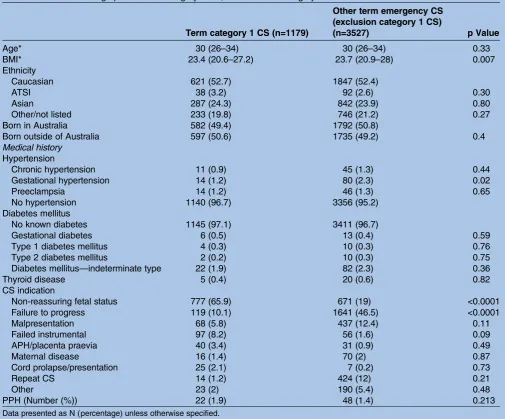
Over the study period, a total of 30 719 women fulfilling the inclusion criteria were included in the study. The overall emergency CS rate for term singleton pregnan-cies was 15.3% (4706/30 719). Of these, 1179 women (3.8%) required a category 1 CS for delivery and 3527 women (11.5%) had emergency CS for other indica-tions. Maternal demographics and indications for the CS are presented in table 1. Neonatal outcomes are shown intable 2. The median age for both cohorts was 30 years (IQR 26–34). Caucasian ethnicity was most common for both cohorts, accounting for 52.7% (621/1158) of the category 1 cohort and 52.4% (1847/3527) of the non-category 1 cohort,respectively. Country of birth, defined as either born in Australia, or born outside of Australia, was not significantly different between the two cohorts, with 49.4% of women (582/1158) born in Australia and 50.6% (597/1158) born outside of Australia for the cat-egory 1 cohort; and 50.8% (1792/3527) born in Australia and 49.2% (1735/3527) born outside of Australia for the non-category 1 cohort.
Women in the category 1 CS cohort had lower BMIs (23.4, IQR 20.6–27.2) compared with the non-category 1 cohort (23.7, IQR 20.9–28; p=0.007). There was no dif-ference in the rates of maternal medical conditions between the two groups. Within the category 1 cohort, the most common indication for delivery was non-reassuring fetal status (65.9%, 777/1179), followed by malpresentation (10.1%, 119/1158), and failed instru-mental (8.2%, 97/1158). Within the non-category 1 cohort, the most common indication for emergency CS was failure to progress (46.5%, 1641/3527), followed by non-reassuring fetal status (19%, 671/3527) and malpre-sentation (12.4%, 437/3527;table 1).
Median gestational age at birth was similar for both cohorts (40 weeks); however, the slight difference in dis-tribution (IQR 39–41 for category 1 CS compared with
on September 22, 2020 by guest. Protected by copyright.
http://bmjopen.bmj.com/
Table 1 Maternal demographics—term category 1 CS, and term non-category 1 CS
Term category 1 CS (n=1179)
Other term emergency CS (exclusion category 1 CS)
(n=3527) p Value
Age* 30 (26–34) 30 (26–34) 0.33
BMI* 23.4 (20.6–27.2) 23.7 (20.9–28) 0.007
Ethnicity
Caucasian 621 (52.7) 1847 (52.4)
ATSI 38 (3.2) 92 (2.6) 0.30
Asian 287 (24.3) 842 (23.9) 0.80
Other/not listed 233 (19.8) 746 (21.2) 0.27
Born in Australia 582 (49.4) 1792 (50.8)
Born outside of Australia 597 (50.6) 1735 (49.2) 0.4
Medical history
Hypertension
Chronic hypertension 11 (0.9) 45 (1.3) 0.44
Gestational hypertension 14 (1.2) 80 (2.3) 0.02
Preeclampsia 14 (1.2) 46 (1.3) 0.65
No hypertension 1140 (96.7) 3356 (95.2)
Diabetes mellitus
No known diabetes 1145 (97.1) 3411 (96.7)
Gestational diabetes 6 (0.5) 13 (0.4) 0.59
Type 1 diabetes mellitus 4 (0.3) 10 (0.3) 0.76
Type 2 diabetes mellitus 2 (0.2) 10 (0.3) 0.75
Diabetes mellitus—indeterminate type 22 (1.9) 82 (2.3) 0.36
Thyroid disease 5 (0.4) 20 (0.6) 0.82
CS indication
Non-reassuring fetal status 777 (65.9) 671 (19) <0.0001
Failure to progress 119 (10.1) 1641 (46.5) <0.0001
Malpresentation 68 (5.8) 437 (12.4) 0.11
Failed instrumental 97 (8.2) 56 (1.6) 0.09
APH/placenta praevia 40 (3.4) 31 (0.9) 0.49
Maternal disease 16 (1.4) 70 (2) 0.87
Cord prolapse/presentation 25 (2.1) 7 (0.2) 0.73
Repeat CS 14 (1.2) 424 (12) 0.21
Other 23 (2) 190 (5.4) 0.48
PPH (Number (%)) 22 (1.9) 48 (1.4) 0.213
Data presented as N (percentage) unless otherwise specified. *Data presented as median (IQR).
ATSI, Aborigional and Torres Strait Islanders; APH, antepartum haemorrhage; BMI, body mass index; CS, caesarean section; PPH, postpartum haemorrhage.
Table 2 Perinatal outcomes—term category 1 CS, and term non-category 1 CS
Term category 1 CS (n=1179)
Other term emergency CS (exclusion category 1 CS)
(n=3527) p Value
Gestation at delivery* 40 (40–41) 40 (38–41) <0.0001
Birth weight (g)* 3420 (3095–3770) 3550 (3190–3920) <0.0001
Apgar <7 at 1 min 241 (20.4) 377 (10.7) <0.0001
Apgar <7 at 5 min 68 (5.8) 67 (1.9) <0.0001
Umbilical arterial pH <7.2 279 (23.7) 321 (9.1) <0.0001
Respiratory distress 193 (16.4) 266 (7.5) <0.0001
Neonatal resuscitation 706 (59.9) 1828 (51.8) <0.0001
NICU admission 116 (9.8) 87 (2.5) <0.0001
Seizure 10 (0.8) 9 (0.3) 0.013
Data presented as N (percentage) unless otherwise specified. *Data presented as median (IQR).
CS, caesarean section; NICU, neonatal intensive care unit.
on September 22, 2020 by guest. Protected by copyright.
IQR 38–41 for non-category 1 CS) resulted in a statistic-ally significant difference, most likely due to the large numbers in each group. The median birth weight for babies delivered by a category 1 CS was 3420 g (IQR 3095–3770) compared with 3550 g (IQR 3190–3920) for the non-category 1 group. Perinatal outcomes, including Apgar scores at 1 and 5 min, umbilical arterial pH, respiratory distress, need for resuscitation and NICU admission, were significantly worse in the category 1 cohort (table 2). There were no intrapartum or neo-natal deaths in either the category 1 or non-category 1 cohorts.
DISCUSSION
The results from this study demonstrate the significantly worse perinatal outcomes for women who undergo a cat-egory 1 CS at term. Although the overall rates of emer-gency CS for non-reassuring fetal status in the entire cohort was relatively low (4.7%, 1448/30 719), it is in this category of cases that the most adverse neonatal out-comes occurred.
The predominant indication for delivery in this cohort was non-reassuring fetal status which occurred in almost two-thirds of all cases compared to 19% for non-category 1 cases. Not surprisingly, failed instrumental delivery, cord presentation/prolapse and APH/placenta praevia also featured more commonly in the category 1 group as all these indications have potentially significant fetal or maternal consequences if delivery is not achieved rapidly. Our study did not have any cases of intrapartum demise or neonatal death in either CS cohort. This may reflect the standard of obstetric, anaesthetic and neo-natal care in a major metropolitan teaching hospital with all the relevant facilities and expertise readily avail-able. Although babies that are growth restricted are at increased risk of intrapartum complications,16 we did notfind such an association in our study. Despite being statistically significant, the median birth weight discord-ance between category 1 and non-category 1 emergency CS (3420 g vs 3550 g) was small. This is unlikely to be of any clinical significance and does not suggest obvious significant suboptimal growth in either cohort. Although our study specifically looked at term fetuses and demon-strated a difference in neonatal outcomes, older studies did not show a similar difference in a term cohort when preterm newborns were excluded from analysis.
To improve care in labour, the American College of Obstetrics and Gynaecology,17 the Royal Australian and New Zealand College of Obstetricians and Gynaecologists18 and the National Institute of Clinical Excellence15 in the UK as well as professional bodies in other countries have all published guidelines for intrapartum fetal monitoring as well as recommendations for regular training for obstet-ric healthcare providers. There is some evidence that such guidelines and training programmes have resulted in a reduction in the incidence of serious complications such as hypoxic ischaemic encephalopathy.19 Nevertheless, the
ideal decision-to-incision interval remains controversial, particularly because of the lack of good evidence of adverse neonatal outcomes, despite many institutions failing to achieve the universal 30 min standard.20
Although acute intrapartum events severe enough to cause profound hypoxia or death in the fetus are fortu-nately relatively rare, suboptimal intrapartum care or failure to recognise signs of developing fetal comprom-ise is not. In the USA, it is estimated that the complica-tion rate during labour and delivery is 2.8%, with 27.7% of those attributed to negligence and nearly 10% of adverse events being associated with serious disability.21 Furthermore, current available evidence from both clin-ical and neuroradiologclin-ical studies suggests that most cases of neonatal encephalopathy are of peripartum origin.22–26
Although it is likely that better training and adherence to intrapartum monitoring guidelines will improve out-comes, it is clearly preferable to identify fetuses at risk of intrapartum compromise before labour. There is emer-ging evidence that in term, appropriately grown babies, the cerebroumbilical ratio and umbilical venous flow rate27 28may be helpful in stratifying pregnancies at risk of intrapartum compromise and of requiring emergency CS for delivery. The risks of birth are considerable and it has recently been demonstrated that the likelihood of death on the day of birth exceeds that of any other day until early in the tenth decade of life.29
The ability to identify women with pregnancies that are apparently low risk at first glance but who are actu-ally at high risk of intrapartum fetal compromise, may allow for these women to be offered alternative delivery options or enhanced monitoring in labour with recourse to early CS if any concerns developed intrapartum. This approach would have the benefit of obviating the risks associated with labour and reduce neonatal complica-tions associated with intrapartum hypoxia. Clearly, there would be a trade-off in terms of maternal operative risks; however, it is likely that the judicious use of appropriate obstetric intervention will result in an immediate decrease in intrapartum and neonatal mortality rates which are currently disproportionately over-represented in low-income and middle-income countries.30
In a thought-provoking hypothetical scenario, Hankins
et al31 demonstrated that if a near universal CS for all
women at 39 weeks was performed in the USA, this would theoretically prevent 6000 fetal deaths annually and would reduce by 83% the number of newborns with moderate or severe neonatal hypoxic encephalopathy. While this is clearly not a practical solution, it is not unreasonable to suppose that such an approach for a small segment of women who are at high risk of intra-partum fetal compromise may be one option to reduce neonatal morbidity and mortality. Conversely, in health-care settings with only limited resources for intrapartum monitoring, a more liberal use of CS to deliver babies that are at high risk of intrapartum compromise will cer-tainly increase the overall rates of operative delivery.
on September 22, 2020 by guest. Protected by copyright.
http://bmjopen.bmj.com/
This may not be such a bad thing, as in these countries operative delivery rates are probably too low and a slight increase in these rates could translate into tangible improvements in perinatal outcomes.
There has been much debate regarding the optimum CS rate that an institution or nation should aspire to with the WHO recommending that CS rates should not exceed 15%. Nevertheless, CS rates worldwide are stead-ily increasing with rates in the USA now >30%8 32 33with similar rises in Australia.34 Regardless of the debate of the optimal CS rate, as category 1 CS in high-income countries account for only <7% of all CS performed, in our view if reduction of the CS rate is the desired aim, then this is more likely to be achieved by improved man-agement of labour and a reduction in the rates of elect-ive CS for‘soft’indications.
Although a recent study35suggested that NICU admis-sion was a poor outcome measure for neonatal morbid-ity when comparing different birth settings, this is not particularly relevant to our study as our study was con-ducted in a single tertiary centre. Furthermore, we used a composite of various other measures of neonatal well-being at birth to enhance the rigour of outcome measure.
The results of this study demonstrate the need for careful consideration of antenatal and intrapartum risk factors that may lead to a category 1 CS. It may be pos-sible in the future to reduce the rates of emergency intrapartum CS for non-reassuring fetal status by pre-natally identifying babies at risk of intrapartum com-promise. Refinements of such techniques as well as early recognition of antenatal and intrapartum risk factors are important in order to optimise maternal and neonatal outcomes.
Contributors SK and RMG were responsible for the study design. LG, RMG
and SK were responsible for data analysis and the writing of the manuscript. All the authors approved the final draft.
Funding This research received no specific grant from any funding agency in
the public, commercial or not-for-profit sectors.
Competing interests None declared.
Ethics approval Ethical and governance approvals for this study were granted
by the Mater Human Research Ethics and Governance Committees (HREC/14/ MHS/63 and RG19 HREC/14/MHS/61), respectively.
Provenance and peer review Not commissioned; externally peer reviewed.
Data sharing statement No additional data are available.
Open Access This is an Open Access article distributed in accordance with
the Creative Commons Attribution Non Commercial (CC BY-NC 4.0) license, which permits others to distribute, remix, adapt, build upon this work non-commercially, and license their derivative works on different terms, provided the original work is properly cited and the use is non-commercial. See: http:// creativecommons.org/licenses/by-nc/4.0/
REFERENCES
1. Lydon-Rochelle M, Holt VL, Martin DP,et al. Association between method of delivery and maternal rehospitalization.JAMA
2000;283:2411–16.
2. Prior E, Santhakumaran S, Gale C,et al. Breastfeeding after caesarean delivery: a systematic review and
meta-analysis of world literature.Am J Clin Nutr2012; 95:1113–35.
3. Silver RM, Landon MB, Rouse DJ,et al. Maternal morbidity associated with multiple repeat caesarean deliveries.Obstet Gynecol2006;107:1226–32.
4. Azam S, Khanam A, Tirlapur S,et al. Planned caesarean section or trial of vaginal delivery? A meta-analysis.Curr Opin Obstet Gynecol
2014;26:461–8.
5. Visser GH. Women are designed to deliver vaginally and not by caesarean section: an obstetrician’s view.Neonatology
2014;107:8–13.
6. DiMatteo MR, Morton SC, Lepper HS,et al. Caesarean childbirth and psychosocial outcomes: a meta-analysis.Health Psychol
1996;15:303–14.
7. Silver RM. Implications of the first caesarean: perinatal and future reproductive health and subsequent caesareans, placentation issues, uterine rupture risk, morbidity, and mortality.Semin Perinatol
2012;36:315–23.
8. Menacker F, Hamilton BE. Recent trends in caesarean delivery in the United States.NCHS Data BriefMarch 2010;(35):1–8. 9. De Luca R, Boulvain M, Irion O,et al. Incidence of early neonatal
mortality and morbidity after late-preterm and term caesarean delivery.Pediatrics2009;123:e1064–71.
10. Essex HN, Green J, Baston H,et al. Which women are at an increased risk of a caesarean section or an instrumental vaginal birth in the UK: an exploration within the Millennium Cohort Study.
BJOG2013;120:732–42; discussion 42–3.
11. Thomas J, Paranjothy S. National Sentinel Caesarean Section Audit Report: Clinical Effectiveness Support Unit. RCOG Press, 2001.
12. Lucas DN, Yentis SM, Kinsella SM,et al. Urgency of caesarean section: a new classification.J R Soc Med 2000;93:346–50.
13. Zhang Q, Dunn C, Sia J,et al. Category one caesarean section: a team-based approach.Trends Anaes Crit Care2014 (4):97–101.
14. Pallasmaa N, Ekblad U, Aitokallio-Tallberg A,et al. Caesarean delivery in Finland: maternal complications and obstetric risk factors.
Acta Obstet Gynecol Scand2010;89:896–902.
15. NICE.Intrapartum care: care of healthy women and their babies during childbirth, 2007. http://www.nice.org.uk/guidance/cg55 16. Gilbert WM, Danielsen B. Pregnancy outcomes associated with
intrauterine growth restriction.Am J Obstet Gynecol
2003;188:1596–9; discussion 99–601.
17. American College of Obstetricians and Gynecologists. ACOG. Practice Bulletin No. 106—Intrapartum fetal heart rate monitoring: nomenclature, interpretation and general management principles.
Obstet Gynecol2009;114:192–202.
18. RANZCOG.Intrapartum Fetal Surveillance. Clinical Guideline. 3rd edn. 2014. https://www.ranzcog.edu.au/intrapartum-fetal-surveillance-clinical-guidelines.html
19. Byford S, Weaver E, Anstey C. Has the incidence of hypoxic ischaemic encephalopathy in Queensland been reduced with improved education in fetal surveillance monitoring?Aust N Z J Obstet Gynaecol2014;54:348–53.
20. Tolcher MC, Johnson RL, El-Nashar SA,et al. Decision-to-incision time and neonatal outcomes: a systematic review and meta-analysis.
Obstet Gynecol2014;123:536–48.
21. Schifrin BS, Cohen WR. The effect of malpractice claims on the use of caesarean section.Best Pract Res Clin Obstet Gynaecol
2013;27:269–83.
22. Berglund S, Norman M. Neonatal resuscitation assessment: documentation and early paging must be improved!Arch Dis Child Fetal Neonatal Ed2012;97:F204–8.
23. Cowan F, Rutherford M, Groenendaal F,et al. Origin and timing of brain lesions in term infants with neonatal encephalopathy.Lancet
2003;361:736–42.
24. Murray DM, O’Riordan MN, Horgan R,et al. Fetal heart rate patterns in neonatal hypoxic-ischemic encephalopathy: relationship with early cerebral activity and neurodevelopmental outcome.Am J Perinatol
2009;26:605–12.
25. Jonsson M, Agren J, Norden-Lindeberg S,et al. Neonatal encephalopathy and the association to asphyxia in labor.Am J Obstet Gynecol2014;211:667.e1–8.
26. Berglund S, Grunewald C, Pettersson H,et al. Severe asphyxia due to delivery-related malpractice in Sweden 1990–2005.BJOG
2008;115:316–23.
27. Prior T, Mullins E, Bennett P,et al. Prediction of intrapartum fetal compromise using the cerebroumbilical ratio: a
prospective observational study.Am J Obstet Gynecol2013; 208:124 e1–6.
on September 22, 2020 by guest. Protected by copyright.
28. Prior T, Mullins E, Bennett P,et al. Umbilical venous flow rate in term fetuses: can variations in flow predict intrapartum compromise?
Am J Obstet Gynecol2014;210:61 e1–8.
29. Walker KF, Cohen AL, Walker SH,et al. The dangers of the day of birth.BJOG2014;121:714–18.
30. Lawn JE, Blencowe H, Pattinson R,et al. Stillbirths: Where?
When? Why? How to make the data count?Lancet2011;377:1448–63. 31. Hankins GD, Clark SM, Munn MB. Caesarean section on request at
39 weeks: impact on shoulder dystocia, fetal trauma, neonatal encephalopathy, and intrauterine fetal demise.Semin Perinatol
2006;30:276–87.
32. Stavrou EP, Ford JB, Shand AW,et al. Epidemiology and trends for caesarean section births in New South Wales,
Australia: a population-based study.BMC Pregnancy Childbirth
2011;11:8.
33. Osterman MJ, Martin JA. Changes in caesarean delivery rates by gestational age: United States, 1996–2011.NCHS Data BriefJune 2013;(124):1–8.
34. Li Z, Zeki R, Hilder L,et al.Australia’s mothers and babies 2010 perinatal statistics series No. 27. Category No. PER 57. AIHW National Perinatal Epidemiology and Statistics Unit, 2012.
35. Wiegerinck MM, Danhof NA, Van Kaam AH,et al. The validity of the variable“NICU admission”as an outcome measure for neonatal morbidity: a retrospective study.Acta Obstet Gynecol Scand
2014;93:603–9.
on September 22, 2020 by guest. Protected by copyright.
http://bmjopen.bmj.com/