Analysis of the impact of different roof structures on the
insulation thickness optimality: A case study for three
Moroccan climates
Boujnah Mohamed
1, Jraida Kaoutar
2, Farchi Abdelmajid
3, Mounir Ilham
41, 2, 3
LIMM Laboratory, Faculty of Science and Technology of Settat, Morocco
4 High School of Technology of Safi University cadi Ayyad Safi, Morocco
Abstract — The sector of building has been increasingly recognized as one of the highest consumer of energy and carbon emission. Subsequently, improving the energy efficiency of buildings has become an important response to the global energy reduction targets. Thus, the aim of this work is to analyze the impact of different roof structures on the insulation thickness optimality for three types of insulation materials and three Moroccan cities. Accordingly, an optimization study was conducted based on degree-hours and P1-P2 methods.
Keyword — Roof, optimum thickness, Thermal insulation, Morocco.
Introduction
The global energy demand is growing significantly with an average of 1.4% per year from 2010 to 2020 [1]. Furthermore, the past few decades have been seen as a substantial environmental awareness, which led to an increase of the use of renewable energy and the improve of the energy efficiency. One of the concerned sectors was the building sector. In Morocco, both household and commercial buildings have a large environmental footprint using around 25% of total energy consumption [2]. Thus, energy-efficient housing construction stands out as one of the most urgent actions to be carried out in order to implement the national renewable energies and energy efficiency strategy. Important mitigation of the energy requirements can be achieved by using suitable construction materials and thermal insulation [3].
In this sense, one of the building envelope component that must be considered is the roof which was studied by several researches. The impact of cool and green roofs on the overall energy performance of buildings in different localities at Mediterranean latitudes was analyzed by Zinzi and Agnoli [4] using EnergyPlus software. The numerical comparative analysis shows that the annual energy savings vary from −13.7% to 41.7% by cool and green roofs. Using DesignBuilder software Jiandong Ran
et al [5] compared and analyzed the indoor temperature and energy consumption of the typical rural residence in Chongqing of different thermal insulation roofs. The results show that, with the combination of night time ventilation and intermittent air conditioning to cooling, the energy saving rate value of light insulation roofing on the top floor can be increased to 40%-50%. For heavy insulation roofing, the reasonable thickness of aerated concrete layer for the roof is 100-150mm, the heat transfer coefficient of roof is between 0.94 W / (m· K) and 1.25 W / (m· K). And the energy saving rate limit value of the aerated concrete roof is estimated below 40%. The determination of the optimum insulation thickness and the resulting energy savings and payback period for two typical roof structures and two types of insulation materials were investigated by using an efficient analytical dynamic model based on the Complex Finite Fourier Transform (CFFT) Daouas [6] studied the nonlinear longwave radiation (LWR) exchange with the sky. The obtained results show that the most economical configuration is the hollow terracotta-based roof insulated with rock wool, where the optimum insulation thickness is estimated to be 7.9 cm, with a payback period of 6.06 years and energy savings up to 58.06% of the cost of energy consumed without insulation.
The present study focuses on the analysis of the impact of different roof structures on the insulation thickness optimality for three types of insulation materials and three Moroccan cities, namely: Ifran (Cold climate), Casablanca (Mild climate) and Marrakech (Arid climate). An economic evaluation of the selected insulation materials has been performed in order to find the most cost effective thermal insulation measure depending on
the roof structure
.
Methodology
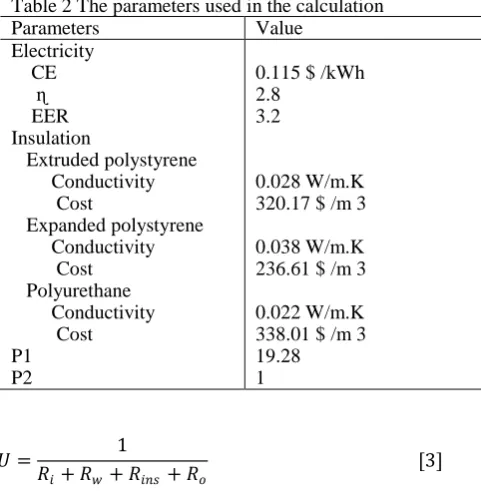
calculated using P1-P2 method. The parameters used in the calculations are shown in Table 1 and Table 2.
Table 1 Climate characteristics of referenced cities.
The annual energy consumption for heating per unit area of roof can be calculated by using heating degree-hour numbers [7]
𝐸ℎ =
10−3 𝑈 𝐻𝐷𝐻
𝜂 , [1]
Similarly, the annual cooling requirement per unit area of roof can be calculated as follows:
𝐸𝑐 =
10−3 𝑈 𝐶𝐷𝐻
𝐸𝐸𝑅 , [2]
Where ɳ is the efficiency of the heating system and EER is the energy efficiency ratio of cooling system and U is the overall heat transfer coefficient of roof (W/m² K) which can be calculated as follows:
Table 2 The parameters used in the calculation
Parameters Value
Electricity CE ɳ EER Insulation Extruded polystyrene Conductivity Cost Expanded polystyrene Conductivity Cost Polyurethane Conductivity Cost P1 P2
0.115 $ /kWh 2.8
3.2
0.028 W/m.K 320.17 $ /m 3
0.038 W/m.K 236.61 $ /m 3
0.022 W/m.K 338.01 $ /m 3 19.28 1
𝑈 = 1
𝑅𝑖+ 𝑅𝑤+ 𝑅𝑖𝑛𝑠+ 𝑅𝑜
[3]
Where, Ri and Ro the thermal resistance of interior and exterior air film respectively and Rw, the thermal resistance of non-insulated roof. Ri and Ro are set to be 0.1612 m²K/W and 0.0617 m²K/W, respectively [6].
The thermal resistance of insulation material can be calculated as follows:
𝑅𝑖𝑛𝑠 =
𝑥
𝑘 [4]
In the present study, the P1-P2 method is used for calculating the optimum insulation thickness. P1 is the ratio of life cycle cost (savings) to the first-year electricity cost (savings), which is equal to the present worth factor of a series of Ne future payment with the market discount rate d and inflation rate i. P1 can be calculated by the following equation [8]:
P1 = PWF Ne, i, d
= 1 + i
1 + d j
= 1
d − i 1 −
1 + i 1 + d
Ne i ≠ d
Ne
1 + i i = d Ne
j=1
[5]
P2 is the ratio of the life cycle expenditures incurred because of the additional capital investment to the initial investment and can be defined as [8]:
P2 = D + 1 − D PWF Nmin, 0, d
PWF NL, 0, m
+ Ms PWF Ne, i, d
− Rυ
1 + d Ne [6]
where D is the ratio of down payment to initial investment, Ms is the ratio of the first-year miscellaneous costs (insurance maintenance) to initial investment, Rv is the ratio resale value at the end of the analysis period to initial investment, NL is term of loan and Nmin is the year over which mortgage payments contribute to the analysis period. The cost of building insulation per unit area can be determined as in reference [9]:
𝐶𝑖𝑛𝑠 = 𝐶𝑖𝑥 [7]
where Ci is the cost of insulation ($/m3). Therefore, the total heating and cooling cost for the building as the present worth value for Ne years can be given by:
LCT = 10−3. 𝑃
1. 𝐶𝐸. 𝑈.
𝐻𝐷𝐻
𝜂 +
𝐶𝐷𝐻 𝐸𝐸𝑅
+ 𝑃2. 𝐶𝑖. 𝑥 [8]
where CE is the unit price of electrical energy ($/kWh). The energy saving cost for insulated building is the difference between the energy cost of non-insulated and insulated building, respectively.
LCS = 10−3. 𝑃
1. 𝐶𝐸. 1
𝑅𝑤−
1
𝑅𝑤+ 𝑥 𝜆 .
𝐻𝐷𝐻
𝜂 +
𝐶𝐷𝐻 𝐸𝐸𝑅 + 𝑃2. 𝐶𝑖. 𝑥 [9]
The value of the optimum insulation thickness is calculated by setting the derivative of Eq (9), with respect to x, equal to zero [10].
𝑥𝑜𝑝 =
10−3. 𝑃 1. 𝜆. 𝐶𝐸
𝑃2. 𝐶𝑖 .
𝐻𝐷𝐻
𝜂 +
𝐶𝐷𝐻 𝐸𝐸𝑅
− 𝑅𝑤. 𝜆 [10]
City Elevation
(m)
Longitude (deg)
Latitude (deg)
HDH CDH
Ifran 1663.8 -5.17 33.50 45764.40 12402.24
Casablanca 27 -7.61 33.58 30622.56 7073.76
Results
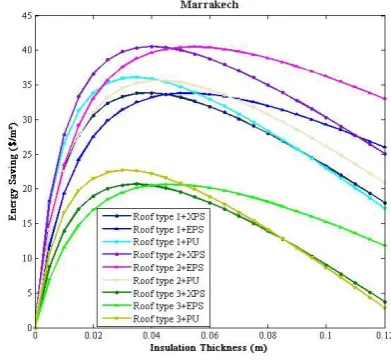
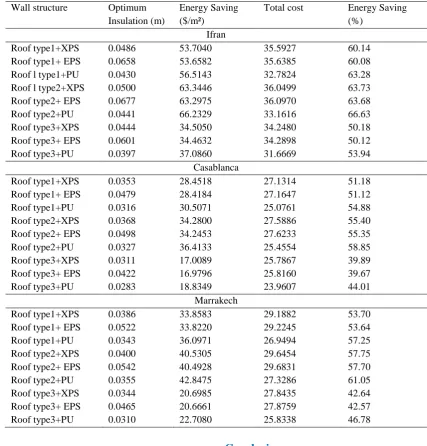
To highlight the impact of roof construction on the insulation thickness optimality, we performed a systematic comparison of the annual energy savings, the total cost and the optimum insulation thickness for three uninsulated roofs commonly found in Morocco under the climatic conditions of Ifran (Cold climate), Casablanca (Mild climate) and Marrakech (Arid climate). The investigated roof structures are shown in the Table 3. The results are presented in Figures 1-6 and Table 4 for nine different configurations. Each configuration is identified by the insulation material and the roof type.
In Figures 1-3 are illustrated the variation of the annual energy savings against the insulation thickness for all roof configurations and the selected cities. First, we note that an unlimited increase in the thickness of thermal insulation does not imply a better performance in all cases due to the cost factor. The maximum point of each curve presents the optimum insulation thickness. Additionally, the obtained results reveal that the effect of roof types is clearly visible. In fact, in all cities, it can be depicted that roof type 2 using polyurethane as insulation material achieved the highest energy savings in comparison to the rest of the configurations. While the roof type 3 using the expanded polystyrene as insulation material achieved the lowest energy savings.
The optimum insulation thickness with respect to different roof types and insulation materials for Ifran Casablanca and Marrakech is presented in Figures 4, 5 and 6, respectively. According to the obtained results, it is seen that Ifran requires thicker insulation thickness compared to the other cities, which can be demonstrated by the fact that Ifran has higher degree-hour than Casablanca and Marrakech. For example, for extruded polystyrene, an optimal thickness applied in the roof type 1 must be 0.0133 m and 0.01 m thicker than Casablanca and Marrakech, respectively. Moreover, it is seen that the roof type 3 using polyurethane as insulation material in the case of Casablanca city presents the lowest optimum insulation thickness. However, the highest optimum insulation thickness is registered in the case of Ifran city for the roof type 2 using expanded polystyrene as insulation material.
In more details, Table 4 summarizes the results of the optimum insulation thickness and the resulted energy cost and energy savings for the 9 different cases under each examined city. As it can be seen, the optimum insulation thickness is between 0.0283 and 0.0677, the total cost is between 23.9607 and 36.0970, and the energy saving is between 18.8349 and 63.2975, according to the roof type, insulation material and the selected city. For all, the best configuration, in minimum total cost perspective, is the roof type 3 with polyurethane as insulation material. However, the worst
Fig. 2 Variation of energy savings versus insulation thickness for Casablanca.
Fig. 1 Variation of energy savings versus insulation thickness for Ifran.
Table 3. Roof configurations and thermal properties.
Roof, type 1
Material Thickness
(m)
Conductivity (W/m.K)
Heat Capacity (J/Kg.K)
Density (Kg/m3)
Tiles 0.010 1.70 1000 2300
Cement mortar 0.100 1.15 840 1800
Concrete slab Plaster
0.160 0.020
1.23 0.351
1000 1000
1300 1500
Roof, type 2
Material Thickness
(m)
Conductivity (W/m.K)
Heat Capacity (J/Kg.K)
Density (Kg/m3)
Tiles 0.007 1.70 1000 2300
Mortar 0.050 1.15 840 1800
Concrete slab 0.040 1.23 1000 1300
hourdi 0.160 1.23 1000 1300
Plaster 0.010 0.351 1000 1500
Roof, type 3
Material Thickness
(m)
Conductivity (W/m.K)
Heat Capacity (J/Kg.K)
Density (Kg/m3)
Tiles 0.020 1.70 1000 2300
Cellular concrete 0.050 0.22 880 600
Heavy concrete 0.070 1.755 920 2300
Concrete block 0.150 1.23 650 1300
Plaster 0.010 0.351 1000 1500
configuration is the roof type 2 with expanded polystyrene as insulation material. For example, considering Marrakech city, the total cost obtained when the optimum insulation thickness is applied in the roof type 2 using expanded polystyrene as insulation material is 1.55% and 6.09% in excess of that of the roofs type 3 and type 1 using the same insulation material, respectively.
Fig. 4. Effect of roof configurations on the optimum thickness in Ifran.
Table 4. Optimum thickness and related energy savings and total cost for the studied roof configurations and cities.
Wall structure Optimum Insulation (m)
Energy Saving ($/m²)
Total cost Energy Saving (%)
Ifran
Roof type1+XPS 0.0486 53.7040 35.5927 60.14
Roof type1+ EPS 0.0658 53.6582 35.6385 60.08
Roof l type1+PU 0.0430 56.5143 32.7824 63.28
Roof l type2+XPS 0.0500 63.3446 36.0499 63.73
Roof type2+ EPS 0.0677 63.2975 36.0970 63.68
Roof type2+PU 0.0441 66.2329 33.1616 66.63
Roof type3+XPS 0.0444 34.5050 34.2480 50.18
Roof type3+ EPS 0.0601 34.4632 34.2898 50.12
Roof type3+PU 0.0397 37.0860 31.6669 53.94
Casablanca
Roof type1+XPS 0.0353 28.4518 27.1314 51.18
Roof type1+ EPS 0.0479 28.4184 27.1647 51.12
Roof type1+PU 0.0316 30.5071 25.0761 54.88
Roof type2+XPS 0.0368 34.2800 27.5886 55.40
Roof type2+ EPS 0.0498 34.2453 27.6233 55.35
Roof type2+PU 0.0327 36.4133 25.4554 58.85
Roof type3+XPS 0.0311 17.0089 25.7867 39.89
Roof type3+ EPS 0.0422 16.9796 25.8160 39.67
Roof type3+PU 0.0283 18.8349 23.9607 44.01
Marrakech
Roof type1+XPS 0.0386 33.8583 29.1882 53.70
Roof type1+ EPS 0.0522 33.8220 29.2245 53.64
Roof type1+PU 0.0343 36.0971 26.9494 57.25
Roof type2+XPS 0.0400 40.5305 29.6454 57.75
Roof type2+ EPS 0.0542 40.4928 29.6831 57.70
Roof type2+PU 0.0355 42.8475 27.3286 61.05
Roof type3+XPS 0.0344 20.6985 27.8435 42.64
Roof type3+ EPS 0.0465 20.6661 27.8759 42.57
Roof type3+PU 0.0310 22.7080 25.8338 46.78
Conclusion
The main purpose of this study was to determine the impact of roof configurations on the insulation thickness optimality for three cities in Morocco, namely; Ifran, Casablanca and Marrakech. An economic study based on the degree-hours and P1-P2 methods, for the evaluation of the optimum thickness and related energy savings and total cost, was addressed. three uninsulated roofs commonly found in Morocco and three thermal insulation materials were studied. The obtained results reveal that the effect of roof structures is clearly visible. For all cities and insulation materials, the roof type 2 shows thicker optimum thickness than the roof type1 and 3. Furthermore, it is seen that Ifran requires thicker insulation thickness compared to the other cities. For all, the best configuration, in minimum total cost perspective, is the roof type 3 with polyurethane as insulation material. However, the worst configuration is the roof type 2 with expanded polystyrene as insulation material.
Reference
[1] U.S. Energy Information Administration (EIA), International Energy Outlook 2011 page 93- DOE/0484 (2013); July 2013.
[2] AMEE (Moroccan Agency for Energy Efficiency). 2011. “Réglement thermique de construction au Maroc.” http://www.amee.ma/images/Text_Pic/Others/Reglement _thermique_de_construction_au_Ma roc.pdf.
[3] Jraida, K., Farchi, A., Mounir, B., & Mounir, I. (2017). A study on the optimum insulation thicknesses of building walls with respect to different zones in Morocco. International Journal of Ambient Energy, 38(6), 550-555.
[4] Zinzi, M., & Agnoli, S. (2012). Cool and green roofs. An energy and comfort comparison between passive cooling and mitigation urban heat island techniques for residential buildings in the Mediterranean region. Energy and Buildings, 55, 66-76.
[5] Jiandong, R; Mingfang, T; Lin, J & Xing, Z. (2017). Effect of building roof insulation measures on indoor cooling and energy saving in rural areas in Chogquing. Energy procedia.
[6] Daouas, N. (2016). Impact of external longwave radiation on optimum insulation thickness in Tunisian building roofs based on a dynamic analytical model. Applied Energy, 177, 136-148.
[7] Yu, J., Tian, L., Yang, C., Xu, X., & Wang, J. (2011). Optimum insulation thickness of residential roof with respect to solar-air degree-hours in hot summer and cold winter zone of china. Energy and Buildings, 43(9), 2304-2313.
[10] Nematchoua, M. K., Raminosoa, C. R., Mamiharijaona, R., René, T., Orosa, J. A., Elvis, W., & Meukam, P. (2015). Study of the economical and optimum thermal insulation thickness for buildings in a wet and hot tropical climate: Case of Cameroon. Renewable and Sustainable Energy Reviews, 50, 1192-1202.
[11] Ozel, M. (2013). Determination of optimum insulation thickness based on cooling transmission load for building walls in a hot climate. Energy conversion and management, 66, 106-114.