
Download complete issue:
60
0
0
Full text
(2) Internetworking Indonesia Journal. The International Journal of ICT and Internet Development in Indonesia ISSN: 1942-9703 The Internetworking Indonesia Journal (IIJ) is a peer reviewed semi-annual journal devoted to the timely study of Information and Communication Technology (ICT) and Internet development in Indonesia. The journal seeks high-quality manuscripts on the challenges and opportunities presented by information technology and the Internet in Indonesia. The IIJ is published electronically based on the Open Access Publication Policy. Journal mailing address: Internetworking Indonesia Journal, PO Box 397110 MIT Station, Cambridge, MA 02139, USA.. Co-Editors Thomas Hardjono, PhD (MIT, USA). Budi Rahardjo, PhD (ITB, Indonesia). Kuncoro Wastuwibowo, MSc (PT. Telkom, Indonesia). Editorial Advisory Board Prof. Edy Tri Baskoro, PhD (ITB, Indonesia) Mark Baugher, MA (Cisco Systems, USA) Lakshminath Dondeti, PhD (Qualcomm, USA) Paul England, PhD (Microsoft Research, USA) Prof. Svein Knapskog, PhD (NTNU, Norway) Prof. Merlyna Lim, PhD (Arizona State University, USA). Prof. Bambang Parmanto, PhD (University of Pittsburgh, USA) Prof. Wishnu Prasetya, PhD (Utrecht University, The Netherlands) Graeme Proudler, PhD (HP Laboratories, UK) Prof. Jennifer Seberry, PhD (University of Wollongong, Australia) Prof. Willy Susilo, PhD (University of Wollongong, Australia) Prof. David Taniar, PhD (Monash University, Australia). Technical Editorial Board Sulfikar Amir, PhD (NTU, Singapore) Moch Arif Bijaksana, MSc (IT Telkom, Indonesia) Teddy Surya Gunawan, PhD (IIUM, Malaysia) Brian Haberman, PhD (Johns Hopkins University, USA) Dwi Handoko, PhD (BPPT, Indonesia) Martin Gilje Jaatun, PhD (SINTEF, Norway) Mira Kartiwi, PhD (IIUM, Malaysia) Maciej Machulak, PhD (Newcastle University, UK) Bobby Nazief, PhD (UI, Indonesia). Anto Satriyo Nugroho, PhD (BPPT, Indonesia) Yanuar Nugroho, PhD (Manchester University, UK) Bernardi Pranggono, PhD (University of Leeds, UK) Bambang Prastowo, PhD (UGM, Indonesia) Bambang Riyanto, PhD (ITB, Indonesia) Andriyan Bayu Suksmono, PhD (ITB, Indonesia) Henri Uranus, PhD (UPH, Indonesia) Setiadi Yazid, PhD (UI, Indonesia). Manuscript Language: The primary language of the Internetworking Indonesia Journal (IIJ) is English due to its international readership. However the IIJ also accepts and publishes papers in Bahasa Indonesia. Manuscript Submission: • Manuscripts should be submitted according to the IEEE Guide for authors, and will be refereed in the standard way. • Manuscript pages should not exceed 7 pages of the IEEE 2-column format. It should be submitted as a Microsoft-Word file, using the IIJ Template document which can be found at the www.InternetworkingIndonesia.org website. • Manuscripts submitted to the IIJ must not have been previously published or committed to another publisher under a copyright transfer agreement, and must not be under consideration by another journal. • Papers previously published at conferences can be submitted to the IIJ, but must be revised so that it has significant differences from the conference version. • Authors of accepted papers are responsible for the Camera Ready Copy formatted using the same IIJ Template format. • Authors are advised that no revisions of the manuscript can be made after acceptance by the Editor for publication. The benefits of this procedure are many, with speed and accuracy being the most obvious. • Please email your papers (or questions) to: [email protected] Submission Guidelines: Please review the descriptions below and identify the submission type best suited to your paper. • Research Papers: Research papers report on results emanating from research projects, both theoretical and practical in nature. • Short papers: Short research papers provide an introduction to new developments or advances regarding on-going work. • Policy Viewpoints: Policy Viewpoints explore competing perspectives in the Indonesian policy debate that are informed by academic research. • Teaching Innovation: Teaching Innovation papers explore creative uses of information technology tools and the Internet to improve learning and education in Indonesia. • Book Reviews: A review of a book, or other book-length document, such as a government report or foundation report..
(3) Vol. 3/No. 2 (2011). INTERNETWORKING INDONESIA JOURNAL. 1. Introduction to the Special Issue on Social Implications of the ICTs in the Indonesian Context Merlyna Lim and Yanuar Nugroho . I. and communication technologies (ICTs), especially the internet, have become a ubiquitous part of people’s lives all over the world, including in Indonesia. Three decades since the internet was introduced to Indonesia via the first international connection made by the University of Indonesia in Jakarta (Lim, 2003:117), the number of Indonesian internet users has reached 39.6 million or approximately 16.1% of total population (Internet World Stats, 2011). That makes Indonesia one of 20 countries with the highest number of internet users. The more stunning fact comes from the usage of social media in the country. In 2011, there are around five million bloggers populated the Indonesian blogosphere. By December 2011, there are 41.7 million Facebook users in Indonesia, making it the second largest nation on Facebook after the United States (Socialbakers, 2011). In addition, the April 2011 data from Comscore (2011) reported that at 22% Indonesia ranks fourth of its Twitter population, behind the Netherlands, Japan and Brazil. The growing use of the internet, including social media, has not only implicated the ways Indonesians communicate, but also influenced the ways they connect to each other. With the developments of social media such as blogs, wikis, collaborative websites and other social networking tools to fulfill the personal, organizational, societal and political goals, and to influence the ways individuals work and live, it is important to understand the implications it brings. What is central here is the needs for a critical examination of the assumptions behind the internet adoption in Indonesia and the ways in which these impact, and are impacted by, the societal development. While innovations in internet technologies and social media have perhaps given new impetus for the reinvention of many activism in many fronts (i.e. government, business, and civil society organizations), more than often, not all of these technological adoption processes are deliberate and strategically designed by the users. Similarly, equal access to telecommunication infrastructure cannot be assumed as granted: digital divide (Norris, 2001) is real, particularly in developing worlds like Indonesia. Moreover, mobile and cable broadband penetration has been claimed to have bridged the divide (e.g. Roux, 2011) but most of its development simply follows the ‘market logic’ rather than its ‘universal service obligation’ (e.g. Rauen et al., 2011), leaving many deprived areas unconnected, as is the case in NFORMATION. The editors can be reached individually at the following email addresses. Merlyna Lim is at: [email protected]. Yanuar Nugroho can be reached at: [email protected].. Indonesia. In contexts like these, Morozov’s warnings (2011) on the over-exaggerated role of digital technology, particularly social media in social change, despite sounds too dystopian, are worth noting. We should always be critical to the notion of the internet being perceived as a causal agent having a pivotal role in social change. Echoing Lim and Kann (2008), we perceive the internet, as a technological artefact, as “both constituted by society and constituting society” (83). The impact and outcomes of the internet as well as its inherent limits and possibilities are, thus, constructed by “social arrangements and contexts around the technology” (Lim & Kann, 2008:83). We also note, not only is the adoption and use of the Internet and social media never straightforward, its integration into many organisational strategies often becomes problematic (for an example of internet adoption in civil society organizations (CSOs), see Nugroho, 2011). However, despite the exponential growth of the internet usage and the abovementioned challenges, scholarly work focusing on the relationship between the internet and society in Indonesia is still a rarity. As a research domain, the Indonesian internet study only started about one and half decade ago. The first known scholarly work in the field is Hill and Sen’s (1997) preliminary survey of the internet’s democratizing potential in Indonesian politics. With their study on the politics and culture of Indonesian cybercafe or warnet in Yogyakarta, Hill & Sen (1997) opened up a new terrain for exploration. Since then, a handful of scholars have emerged as the first generation of researchers who have conducted in-depth research in various social, political, and cultural aspects of the internet. Such research is exemplified by scholarly work on: the relationship between the internet and democracy (Hill & Sen, 2000; 2005; Lim, 2003; 2004a; 2006), roles of the internet in conflicts and in shaping collective identity (Hill, 2002; Brauchler, 2003; 2004; Lim, 2004b; 2005; 2011), online election (Hill, 2003), CSOs’ use of the technology (Nugroho, 2008; 2010a; 2010b; 2011; Nugroho and Tampubolon, 2008), urban spatiality of the internet development (Lim, 2002), internet adoption in educational institution (Kuntoro & Al-Hawamdeh, 2003; Thompson, 2004), e-government (Furuholt & Wahid, 2008), politics and culture of the blogosphere (Lim, 2009), and socio-economic aspect of the internet access (cybercafe or warnet) (Kristiansen et al, 2003; Wahid et al, 2006), among others. While these works can be considered as pioneering, certainly there are many other unexplored terrains in this novel field of study. This special issue aims to enrich the intellectual discussions much needed in the field. Five articles showcased here look at a wide variety of the uses of online media technologies and. ISSN: 1942-9703 / © 2011 IIJ.
(4) 2. INTERNETWORKING INDONESIA JOURNAL. platforms and what implications these uses have on people, organizations and society in the Indonesian context as the technology becomes more widely available. This issue also includes works that look at the other side of the coin, those who focus on the cultural, social and political shaping of the technologies by Indonesian society. We briefly introduce them in turn. In the first article, Tiastuti and Rakhmani investigate the relationship between Indonesia blogging culture and primordialism. Providing a rich analysis of the Indonesian blogosphere, these authors argue that in this new sphere nationality is shaped by old languages but mediated through new models. Further, they argue that the blogosphere emerges as a network that facilitates ethno-symbolism where the trace of ideological hegemony of nationalist ideology merges with the ethnic sentiment. Following this, in a comprehensive study of the broadband access in the country, the second article by Rohman and Bohlin attempts to identify the demand and supply factors that determine mobile broadband access. Findings from this study show that geographical characteristics play more important role than income in developing the broadband access. In the third article, Wayansari provides an interesting exploration of the role of Web 2.0 based websites in influencing politics in Indonesia’s new democracy. Through the case of Politikana.com, Wayansari demonstrates that usergenerated content platforms can potentially contribute to the widening of online public sphere by providing an “associational space” for rational and critical discourse. Widodo’s study of use of the Internet for public participatory democracy by non-governmental organizations (NGOs), in the fourth article, argues along the same line. The author demonstrates that citizen journalism or community-based journalism is an effective medium to develop participatory democracy. His findings, however, show that while there is a mutual relationship between internal and external use of the internet by NGOs, the advancement in workplace participatory democracy does not directly correlate with public participatory. Finally, Dewi shares her research on the application of local e-government in rural areas. Using the case of Terong village, the author demonstrates that the successful development of community based e-government in bureaucratic reform is determined not only by the application of the e-government system itself, but also influenced by the media convergence and structural factors such as strong leadership and good governance from the related local government. These articles sit nicely together and are complementary to each other. Through their cases, studies, analysis, and theorization, contributors of this issue together have contributed to a broader understanding of how the internet and society have mutually shaped each other and theoretical considerations of the links between social implications and the internet. It is our honor to edit such a collection. As editors, we are also proud to pronounce that the contributors are, predominantly, young Indonesian scholars who never published in peer-reviewed outlet before. We sincerely hope. Vol. 3/No. 2 (2011). that the launch of this special issue marks a significant milestone, not only for these young scholars, but also for the advancement of the Indonesian internet study. We thank the contributors for their hard work and extend our gratitude to Dr. Thomas Hardjono for his valuable support and assistance in finalizing this special issue. References Braeuchler, B. 2003. Cyberidentities at War: Religion, identity, and the Internet in the Moluccan conflict. Indonesia, 75(April):123-151. Braeuchler, B. 2004. Islamic Radicalism Online: The Moluccan mission of the Laskar Jihad in cyberspace. The Australian Journal of Anthropology, 15(3):267-285. Comscore. 2011. The Netherlands Ranks #1 Worldwide in Penetration for Twitter and Linkedin. http://www.comscore.com/Press_Events/Press_Releases/2011/4/The_Ne therlands_Ranks_number_one_Worldwide_in_Penetration_for_Twitter_ and_LinkedIn. Accessed on January 5, 2011. Furuholt, B. & Wahid, F. 2008. e-Government Challenges and the Role of Political Leadership in Indonesia: the Case of Sragen. Proceedings of the 41st Hawaii International Conference on the Sytem Sciences. Hill, D. T. & Sen, K. 1997. Wiring the Warung to Global Gateways: The Internet in Indonesia. Indonesia, 63(April):67-89. Hill, D. T. & Sen, K. 2000. Media, Culture and Politics in Indonesia. Melbourne: Oxford University Press. Hill, D. T. & Sen, K. 2002. Netizens in Combat: Conflict on the Internet in Indonesia. Asian Studies Review, 26(2):165-188. Hill, D. T. & Sen, K. 2005. The Internet in Indonesia’s New Democracy. London: Routledge. Hill, D. T. 2003. Communication for a new democracy: Indonesia’s fist online elections. The Pacific Review, 16(4):525-547. Internet World Stats. 2011. Top 20 countries with the highest number of internet users. http://www.internetworldstats.com/top20.htm. Accessed on January 5, 2011. Kristiansen, S., Furuholt, B., Wahid, F. 2003. Internet café entrepreneurs: pioneers in information dissemination in Indonesia, The International Journal of Entrepreneurship and Innovation, 4(1):251-263. Kuntoro, R. D. & Al-Hawamdeh, S. 2003. E-learning for Higher Education in Indonesia. Journal of Information & Knowledge Management, 2(4):361374. Lim, M. 2002. From Walking City to Telematic Metropolis: Changing Urban Form in Bandung, Indonesia. In T. Bunnell, L. B. W. Drummond & K. C. Ho (eds.), Critical Reflections on Cities in Southeast Asia, Singapore: Times Academic Press, 75-100. Lim, M. 2003. From Real to Virtual (and back again): Civil Society, Public Sphere, and Internet in Indonesia. In K. C. Ho, R. Kluver, & C. C. Yang. (eds.), Asia.Com: Asia Encounters The Internet, Routledge, 113-128. Lim, M. 2004a. Informational Terrains of Identity and Political Power: The Internet in Indonesia. Indonesian Journal of Social and Cultural Anthropology (Antropologi Indonesia), 27 (73):1-11. Lim, M. 2004b. The Polarization of Identity through the Internet and the Struggle for Democracy in Indonesia. Electronic Journal of Communication/La Revue Electronique de Communication, 14(3-4), 18 p. Lim, M. 2005. Islamic Radicalism and Anti Americanism in Indonesia: The Role of the Internet, Policy Studies Series, Washington DC/Honolulu: East West Center. Lim, M. 2006. Cyber-Urban Activism and Political Change in Indonesia. Eastbound, 1(1):1-19. Lim, M. 2009. Global Muslim Blogosphere: Mosaics of Global-Local Discourses. In M. McLelland and G. Goggin (eds.) Internationalizing Internet Studies: Beyond Anglophone Paradigms, London: Routledge, 178-195. Lim, M. 2011. Islamism in Indonesia and Its Middle Eastern Connections, The Middle East Review of International Affairs Journal, 15(02, June). Lim, M. & Kann, M. 2008. Networked Politics: Deliberation, Mobilization and Networked Practices of Agitation. In K. Varnelis (ed.) Networked Publics, Cambridge: MIT Press, 77-107.. ISSN: 1942-9703 / © 2011 IIJ.
(5) Vol. 3/No. 2 (2011). INTERNETWORKING INDONESIA JOURNAL. Morozov, E. 2011. The Net Delusion: How not to liberate the world. Penguin Books, London. Norris, P. 2001. Digital divide: Civic engagement, information poverty, and the Internet worldwide. Cambridge University Press, Cambridge. Nugroho, Y. 2008. Adopting Technology, Transforming Society: The Internet and the Reshaping of Civil Society Activism in Indonesia. International Journal of Emerging Technologies and Society, 6(22):77-105. Nugroho, Y. 2010a. Localising the global, globalising the local: The role of the Internet in shaping globalisation discourse in Indonesian NGOs. Journal of International Development, 28p. DOI: 10.1002/jid.1733 Nugroho, Y. 2010b. NGOs, The Internet and sustainable development: The case of Indonesia. Information, Communication and Society, 13(1):88120. Nugroho, Y. 2011. Opening the black box: The adoption of innovations in the voluntary sector – The case of Indonesian civil society organizations. Research Policy, 40(5):761-777. Nugroho, Y. & Tampubolon, G., 2008. Network Dynamics in the Transition to Democracy: Mapping Global Networks of Contemporary Indonesian Civil Society. Sociological Research Online, 13(5). Rauen, C.V., Hiratuka, C., Fracalanza, P.S., 2011. Universalization of telecommunications services: Public policies in the OECD and in Brazil. International Journal of Development Issues, 10(2):108-122. Rohman, I. K. & Bohlin, E. (this issue). Roux, C.J.B.L. 2011. Can cloud computing bridge the digital divide in South African secondary education? Information Development, 27(2):109-116. Sari, A. D. (this issues). Socialbakers. 2011. Top 5 countries on Facebook. Socialbakers. http://www.socialbakers.com. Accessed on January 5, 2011. Thompson, E. Internet Adoption and Use in the Indonesian Academy: Issues of Social and Institutional Hierarchy. Indonesian Journal of Social and Cultural Anthropology (Antropologi Indonesia), 28(73):20-31. Triastuti, I. & Rakhmani, I. (this issue). Wahid, F., Furuholt, B., Kristiansen, S. 2006. Information Development, 22 (4): 278-291. Wayansari, A. (this issue). Widodo, Y. (this issue).. Merlyna Lim is a faculty member of the School of Social Transformation and Consortium for Science, Policy and Outcomes at Arizona State University. Her research and teaching interests revolve around the mutual shaping of technology & society and socio-political history of technology, in relations to issues of globalization, democratization, and social equity, and has published extensively in these subjects. Lim is interested in theoretical challenges on how we understand how ideologies and power relations—between state, corporate economy, and civil society—being inscribed the production and uses of spaces, offline and online, at the local, regional, national, international and transnational level. In investigating these dynamics, she is interested in co-evolution of information (digital) technology and society and in the cultural and political implications of the production, consumption and exchange of information in both cyberspace and (physical) urban space. Professor Lim's past and current research projects are predominantly conducted in Asian setting, particularly Indonesia, and since 2008 also include Middle Eastern and North African (MENA) countries. Currently, Lim is leading three major projects: (1) The National Science Foundation funded project Cyber-Collective Movements: Novel Socio-Computational Approaches in Studying the Blogosphere (2011-2014) (2) The Office of Naval Research funded Blogtracker – Analyzing Social Media for Cultural Modeling (2010-2013) and (3) The Ford Foundation funded project Advancing Public Interest Media in Indonesia (2010-2012). More about her and her work see: http://www.merlyna.org.. ISSN: 1942-9703 / © 2011 IIJ. 3. Yanuar Nugroho is a Research Fellow with the Manchester Institute of Innovation Research (MIoIR) and core member of the Centre for Development Informatics (CDI) at Manchester Business School and School of Environment and Development, the University of Manchester, UK. He holds Hallsworth Fellowship in Political Economy 2010-2012 and was awarded the Outstanding Academic of the Year 2009 by the Manchester Business School. His research interests are concerned with technological innovation and in particular the adoption and diffusion of innovations in the third sector (nongovernmental and not for profit organizations); innovation, development, and sustainability; new communication media and social change; and knowledge and science dynamics. In particular, Yanuar focuses on the role of innovation in development, mostly in sustainable development and/in developing countries. He also investigates factors other than innovation (e.g. democracy, civic engagement, among others) that play important roles in the success of development and pays attention to intermediaries and intermediation process in the systems of innovation. He pays attention at the link between new media and information technologies and social change and their interaction in the fabric of societal life. Lastly, he looks at the mobility of researchers, impacts of research funding schemes, the influence of journal rankings in academic careers, and knowledge management in third sector organizations and services sectors..
(6) 4. INTERNETWORKING INDONESIA JOURNAL. ISSN: 1942-9703 / © 2011 IIJ. Vol. 3/No. 2 (2011).
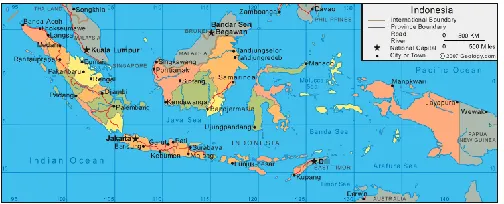
(7) INTERNETWORKING INDONESIA JOURNAL. Vol.3/No.2 (2011). 5. Cyber Taman Mini Indonesia Indah: Ethnicity and Imagi-Nation in Blogging Culture Endah Triastuti and Inaya Rakhmani University of Wollongong and Murdoch University, Australia . Abstract— Although the shift of paradigm in Post Authoritarian Indonesia has rearticulated the discourse of nationhood, the general notion that it is based on an imagined community remains an important consideration. Decades of ideological hegemony has been performed by the state through various socio-cultural constructions, embedding in the minds of its citizens the notion of a nation as a territorial space that undermines ethnicity in favor of the wholeness of ‘Indonesia’. This paper studies the community within the cyberspace, namely Blogger Communities, to explore collective identities that are shared in the minds of its members to re-conceptualize Indonesian nationhood. As a result of decades of hegemonic state oppression, Blogger Communities practice an extended construction of this hegemonic national consciousness in the blogosphere. These communities perform both the role of social agency that goes beyond the virtual through conforming to the shaped territorial space in general and ethnicity in particular – forming a cyber Taman Mini Indonesia Indah. Index Terms—cyberspace, nationhood, identity, ethnicity, blogging culture.. I.. INTRODUCTION. In the sky, there is no distinction of east and west; people create distinction out of their own minds and then believe them to be true. (Buddha). S. tudies on the role of media in the exercise of social power in general and nationhood in particular, have increasingly focused on how institutional media construct national identity [1], [2], [3]. In a country like Indonesia, where for years, the ‘nationalists’ struggled to unify more than 200 ethnic groups into this ‘imagined community’ of a nation, the role of a unifying media is important in constructing a Manuscript received April 20, 2011. Endah Triastuti is a PhD candidate from School of Social Science, Media and Communication , Faculty of Arts, University of Wollongong, a member of The Centre for Asia Pacific Social Transformation Studies (CAPSTRANS), and a lecturer at the Department of Communication Science, University of Indonesia (e-mail: [email protected] and [email protected]). Inaya Rakhmani is a PhD candidate from the Asia Research Centre, Murdoch University and a lecturer at the Department of Communication Science, University of Indonesia (e-mail: [email protected] and [email protected]). ‘national consciousness’. The idea is that media use allows a synchronized activity, rendering the receivers anonymous, as they are part of the ‘mass’. The cultures conveyed are as important as the isolated activities of the receivers in terms of constructing a fraternity of otherwise strangers, or in other words, an ‘imagined community’. The internet, on the other hand, emerged more as an alternative medium that found its way out from under the control of the state [3], [4]. There are contesting ideas surrounding whether or not the internet, particularly social media, is indeed a revolutionary tool, an extension for institutional media, or if it provides a connection with existing power holders [5], [6], [7]. Nevertheless, it is generally agreed that social media notably functions in different ways for its users. Such difference redefines the idea of a ‘mass audience’ and gives way to the re-conceptualization of the ‘media’s role’, or the ‘media’-tion of social relations, in constructing a national consciousness. With fewer identifiable power structures compared to institutional media, the internet provides a space that is shaped by its users. The notion of ‘space’ becomes an important consideration in order to understand this process; as nation building is a multifaceted dynamic through which – as the focus of this paper – nationhood is constructed through mediation and physical landscape. Studies on state ideology [8], [9], [10] argue that the powerful manipulate the subordinates to unwittingly adopt the ideology of the ruling class through various means of economic, political, and socio-cultural productions and reproductions. The subordinates unconsciously consent to the set of ideologies determined by the powerful, including undermining social and cultural fragmentation. Landscape and architecture can be seen as the ‘media within culture’ or a media archive that, in relation to the idea of a nation, is a representation of an erased ‘particular’ (i.e. ethnicity, geographical markers, territory, etc). (See Fig. 1). Fig. 1. Map of Indonesia.. ISSN: 1942-9703 / © 2011 IIJ.
(8) 6. INTERNETWORKING INDONESIA JOURNAL. A physical artifact of grandeur, monumental to the national culture project in Indonesia is the Taman Mini Indonesia Indah (or the “Beautiful Indonesia Miniature Park”, hereafter referred to as the TMII). Built under Suharto’s regime, the TMII embodies this ideological archive. In the TMII, the uniqueness of each ethnicity in Indonesia is highly accentuated and framed within the museum complex. It symbolizes the desire of the authoritarian regime (through the hegemony of nationhood) to control Indonesian local communities by providing a space that represents mental and physical boundaries. The Indonesian government maintained the locality of each ethnic group, allowing ethnic sentiments and nationalism to coexist.1 This visible ‘territorial marking’ is reinforced by institutional media, particularly through television, as part of a larger nation building scheme. The introduction of the internet, on the other hand, has blurred these markings. Data shows that in the rapid growth of local blogger communities – permitted by the increasing availability of the internet – they have name themselves by territorial ‘Indonesian’ markers. These reemployed markers, which were created by the authoritarian government, merge together the notion of ‘physical’ and ‘mediated’ space. These blogger communities, not unlike the TMII, are shaped and bordered by physical territorial names in cyberspace. Reading the list of names of local blogger communities is like reading the list of traditional houses built inside the TMII. This paper questions how local blogger communities practice and extended construction of national consciousness in Post Authoritarian Indonesia. Despite the end of the authoritarian regime, the boundaries that have been strategically created by the government are continually rehearsed. Even in the cyber practices of blogger communities, Indonesian netters maintain the imagined boundaries as an implication of decades of hegemonic oppression. II. SPACE, POLITICS AND NATION BUILDING IN TMII During the three decades of the Suharto regime, Indonesians were taught to value the geographical condition of the country – the string of 17,504 islands and its surrounding waters belong to Indonesia. On one hand, ethnicities that mark these territories are included as part of the national culture, namely the young Indonesian nationalists who had united into local/national ethnic union of the first Youth Pledge 2. On the 1. The state recognized mainly the ‘major ethnic and religious groups’ of the highest cultural achievement who also show evidence of ‘civilization’ as part of nation building. Ethnic and religious minorities who are not perceived as sharing this quality are clustered together as if sharing a common ‘primitive’ nature. See Colchester, M. (1986) “Unity and Diversity: Indonesian Policy Towards Tribal Peoples”, The Ecologist, 16. 2 The famous Sumpah Pemuda (Youth Pledge) was declared by local ethnic (and religious) groups (Jong Java, Jong Islamieten Bond, Jong Batak, Jong Celebes, Jong Ambon, Minahasa Bond, Madura Bond, Pemuda Betawi, etc) pledging themselves to the unity of a nation. The second Youth Pledge (Jakarta, 27-28 October 1928) was the first official event that constructs national awareness comprising of ethnic diversity. The second official event is the promulgation of Pancasila as a political philosophy in Indonesia (1 June 1945), where then President Sukarno set forth the Sanskrit words ‘Bhinneka Tunggal Ika’ (Unity in Diversity) as the essential slogan – stressing on national pluralism.. TRIASTUTI & RAKHMANI. other, ethnically distinct groups that live in various areas all over Indonesia are seen as a threat towards national pride [9], [10], [11], [12]. The denial of minor ethnicities shaped a banal national awareness, for it annihilated the awareness of Indonesia as a community comprising of particular groups in favor of shaping the idea of a community as a ‘whole’. Propagandist methods were used, through both physical landscape and through institutional media, to stress the issue of unity in diversity – including and instilling the hegemonic ideology3 of a limited and selected ethnicity and culture. The TMII embodied the notion of the annihilation of specific cultures and therefore constructed a banal national unity. The park was built in 1971 by former first lady Tin Suharto (“Ibu Tin”), who personally financed4 this giant project and who subsequently opened it to the public in 1977. The TMII is the brainchild of Ibu Tin who, after having visited Disneyland [13], aimed to raise a sense of nationalism in diversity by building an amusement centre in the form of a miniature Indonesia. The TMII includes a set of 26 traditional houses from each province in Indonesia. The park is surrounded by an artificial lake with extensive man-made islands in the centre – a physical map of the archipelago. The TMII is essentially a museum compound. Each traditional house is an individual museum, along with the other 16 museums located inside the TMII. (See Fig. 2) The miniatures function as a synopsis of virtual aspects of Indonesian life; representing cultures, natures and heritages of the Indonesian people. Hitchcock [14] argues that the TMII was built as a reproduction of the Pancasila, which emphasizes on the diversity of the Indonesian population.. Fig. 2. Map of TMII, which includes a miniature Indonesia at the centre.. The notion of the ‘museum’ considers the imagined forms of the Indonesian authority’s dominion [1]. Drawing from Anderson’s idea, we argue that the TMII is an imagination of how its creator forms the mental image of an empire. Although the TMII claims to portray the diversity of Indonesia, the majority of street names, gardens, theatres, and museums have been greatly influenced by Suharto’s own ethnic background, namely Javanese culture. The 3D theatre is named Keong Mas (Golden Snail) from Javanese folklore, the swimming pool is named Taman Renang Ambar Tirta coming from Javanese language (Tirta means water and Ambar means extensive), the playground is named Among Putra which comes from the Javanese language (Among means care and Putra means children), and in the main entrance of the TMII stands the Purna Bhakti Pertiwi museum in the form of a cone 3. There is a slight difference in practice between “building an awareness of national ideology” and “brainwashing to impose national ideology”, where Anderson (1992) uses the term “instilling of national ideology” (p. 163). 4 Although there were rumors of corruption during the establishment of the TMII..
(9) Vol.3/No.2 (2011). INTERNETWORKING INDONESIA JOURNAL. shape similar to tumpeng (the Javanese ceremonial yellow rice dice). (See Fig. 3 & 4). Fig. 3 & 4. Left: Nasi tumpeng present in a celebration. Right: The Purna Bhakti Pertiwi museum in the shape of tumpeng.. By using Javanese names, Suharto positions his own ethnicity at the centre of his vision of Indonesia. 5 This imagined dominion places Javanese culture at the centre of the universe (Indonesia), enforced by it being surrounded by markers of other cultural identities. Through the TMII, Suharto virtually marked the territory, ensuing his control of Indonesia. The TMII becomes more than a museum representing the variety of Indonesian cultures. It is a landscape of hegemony in the form of an amusement centre to naturalize an idea of ‘an empire’, emphasizing on the Indonesian government as the “ruling bloc” [13] tasked to maintain the reality of national unity through the inclusion of ethnic groups under one nation6. The TMII is a hegemonic space as it constructs a reality of unconscious everydayness that resulted from the art of domination, whose objects spontaneously accept the rules from the authority [13]. Paper [14] studied the use of architectural landscape as hegemonic tools to colonize its public’s consciousness as a false community7 and transfers a belief system with which they employ to ‘view the world’. The TMII’s display embodies the ideology of Indonesian nationhood. The architectural landscape has been used by the ruling bloc as an important medium in preserving the Indonesian people in oblivion of a hegemonic ideology. For more than 30 years, it has been compulsory for Indonesian students to have field trips to TMII as part of a school’s education programme, and for government employees to visit TMII as part of the familyfriendly benefits of the state department they work for. The wives of the Armed Forces members and government officials visit the TMII to exemplify their nationalism and to support their husbands’ career. The practice of visiting the TMII is a form of mental colonization through imparting the banal influence over 5. Studies show that the dominance of Javanese in Indonesian history has occurred long before its independence. In this paper however, we focus on how Suharto’s regime mainstreamed Javanese culture as part of the hegemonic national consciousness after the forming of the modern, nationstate. 6 A debate surrounds the concern of violent rebellions and separatist movements are rooted in the exclusion of ethnic groups in favor of ‘unity in diversity’ (Schefold 1998, Wee 2001, Christie 1992). 7 Egoz used the idiom ‘blind society’ to which we do not completely agree in the context of Indonesia. In this paper, we use the term false community instead to refer to Anderson’s (1983) imagined sense of fraternity and Marx’s false consciousness (in relation to the relationship between ‘class’, between the ruling and the ruled). The term deliberately excludes the agency of members as it focuses instead on disproportionate power distribution that undermines individual autonomy.. 7. Indonesian citizens of various cultural backgrounds, in order to ensure their loyalty to the NKRI (Negara Kesatuan Republik Indonesia or the United Nation of the Republic of Indonesia). The TMII is utilized to recreate and reinforce the invisible border in the minds of Indonesians to replace the preexisting visible border belonging to every ethnic group in Indonesia. The work of [12] also argued that this “nationbuilding” effort is one of the forms of political movement to guarantee against disloyalty to NKRI8: “State elites undertake “nation-building” efforts to create common bonds, foster common values, or craft a common culture that defines a new nation coincident with existing state boundaries. This form of state nationalism attempts to eliminate bonds to a prior national or ethnic group and to form new loyalties to the state based on membership of a new nation” [12]. The TMII is one of the cases in which the hegemonic ideology of Indonesian nationhood is crystalized as ‘reality’. The notion of “Bhinneka Tunggal Ika” becomes so commonsense that even in Post Authoritarian Indonesia, and through a space with virtually no government control, the blogger communities continue to name themselves by employing markers of Indonesian territories. This practice extends from and reinforces ‘common bonds, values and culture’ of the nation. The manner in which each blogger community identifies itself and the requirements they impose on new members to meet in person prior to joining emphasizes [15] the idea that “ ‘common sense’ becomes an exciting object of study as part of a constant struggle for the dominant, or hegemonic, ideology. It marks the moment at which an ideology triumphantly becomes ‘banal’.” (2003, p. 194) III. INDONESIAN BLOGGER COMMUNITY AS A CULTURAL ARTIFACT Cyberspace is eroding [national] borders, at least in terms of jurisdiction. In fact, nation and state are often irrelevant in the formation and conduct of online communities. Intellectual properties flow freely across the Net, knowing no borders. (Vince Guiliano) Data reveals that the phenomenon of blogging in Indonesia is one worth studying. The Asia Blogging Net (ABN)9 reported that there are 30,000 active blogs in Indonesia around mid 2007. By 2008, this number had multiplied10. Mass media predicted the active blogs in Indonesia reaching 1 million.11 8 Three most notable (but not limited to) provinces in Indonesia, D.I. Aceh, East Timor (now Timor Leste), and Irian Jaya (now West Papua) have been immune from hegemonic tools like the TMII (for more on national disintegration, see King 2004 and Bresnan 2005). 9 ABN or PT Asia Blogging Net is a company specialised in blogging and web 2.0 from Indonesia for the Asia region. 10 ABN to Launch Blog Network. Retrieved April 13, 2011 from Asia Blogging Net: http://asiablogging.com/blog/81/abn-to-launch-blog-network/. 11 2009, Jumlah Blogger Indonesia Diprediksi Tembus 1 Juta (2009, The number of Indonesian Bloggers Predicted to Reach 1 Million). Retrieved April 17, 2011 from Detiknet: http://www.detikinet.com/read/2009/01/09/122618/1065577/398/2009blogger-indonesia-diprediksi-tembus-1-juta. ISSN: 1942-9703 / © 2011 IIJ.
(10) 8. INTERNETWORKING INDONESIA JOURNAL. Figure 5 below shows Jakarta as one of the top 30 cities for blogs in the world.12 The data also reveals Jakarta as one of four representative cities in Asia for blogging practices; together with Beijing, Mumbai and Singapore. WordPress.com statistics emphasizes Indonesia’s blog booming by showing that Bahasa Indonesia is one of the top languages used by WordPress.com users after English, along with Spanish, Turkish, Brazilian Portuguese and Italian.13. Fig. 5. The Blog Belt: a map of cities around the world topping in blog postings.. The rising phenomenon led to the first Blogger Fest in October 2007 in Jakarta14. The first author of the current paper was present in both Indonesia blogger events. She was sitting alone in upper row of chairs and claimed that it was fascinating and enjoyable to observe how people, who have otherwise interacted in a mediated space, meet each other physically. The Blogger Fest accommodated the ‘crossingover’ from the ‘online world’ into the ‘offline world’. In her first Blogger Fest, it took Endah minutes to realize that several people commune together on the same spot. When new guests arrived, they would look around first before finding a seat – as if trying to find something. Not long after, friends waved and the newly arriving guest approached the group and cheerfully joined them by greeting each other using their ethnic vernaculars. At the Blogger Fest, the master of the ceremony introduced these communing groups of people as Blogger Bali, Blogger Bunderan HI, Blogger Angin Mamiri, Blogger Bandung, and so forth. Each group demonstrated a unique collective movement, several of them performing chants using their local vernaculars every time the master of ceremony introduced a group to the attendants. It was extremely surprising to see how intimate and familiar they having been with each other, in spite of their relationship, or community, was wielded almost exclusively online. ‘Community’ is a concept that is still undergoing scholarly debates. For the purpose of this paper, we refer to Cohen [15], 12 Graphic: The Blog Belt. Retrieved April 17, 2011 from Businessweek: http://www.businessweek.com/magazine/content/07_27/b4041402.htm 13 June Wrap-up. Retrieved April 13, 2011 from WordPress.com: www.en.blog.wordpress.com/2007/07/02/june-wrap-up/ 14 Minister of Communication and Information, Muhammad Nuh, announced 27 October as the Indonesian Blogger Day.. TRIASTUTI & RAKHMANI. who states that “community” is contextually developed and is dependent on how its member embeds the meaning of “community” into their life practices. However, the work of [16], with which we agree, notes that community develops in urban localities, virtual and physical. The concept of traditional community, in this sense, refers to a certain “real” territory (geography), with physical interaction where the members are able to interact face-to-face to each other [17], [18], [19]. For these scholars, community traditionally has been emphasized as something more “physical”: both geographically and in need of a physical presence. While on the contrary, the concept of modern community requires less physical interaction and more in the affection that binds its members. Modern community does not stress the importance of rigid environment boundaries [20] and it doesn’t emphasize cultural roots (i.e. ethnic, ideology, politics, region, government) [21]. The nonphysical on-line world fulfils the need of being a member of “community”, where member can immerse in the togetherness without space, time, or physical borders [15], [20], [22], [23], [24]. Virtual community, attributed to the late Harold Rheingold’s expression is not any different with what he had experienced in the “real world: everything in the online world is as ‘real’ as in the offline world. According to him [22], cyber community members pursue security by shifting their need from the sense of community belonging and space attachment to the sense of information sharing and possession. The distinctive factor differentiating modern communities and cyber communities is for the notion that the latter dwell in cyberspace: “a state of possibilities, a place where space and time lose meaning of barriers [25]. In modern communities, information re-enacts the ‘traditional’ requirement of social identity and it becomes the yeast of “community in the mind”. 15 Mediated social relationships extend from traditional customs that are apparent in traditional communities, whereas in cyber communities, it is the space itself – the place without barriers – that, in combination with the ‘traditional’ of modern communities, shape relationships vis-à-vis the community itself. Rheingold's imagined communities are voluntarily formed by its members, who expect benefit from others through information sharing, furthermore they expect that other members may benefit through their own information sharing. It gives more expression to reciprocal connections among the members that bears down on the information sharing.16. 15 Although he refers to Anderson’s Imagined Community – Rheingold narrowed his attention to “community in the mind”. The term refers to the notion that most members are anonymous to other members yet they share the same framework of community in their mind. What Rheingold refers to imagined communities has nothing to do with cultural roots in terms of nationhood. Rheingold’s imagined community is not a culturally ingrained group, formed by culture, history, and kinship as Anderson’s is. Anderson argues formed nationalism in the mind (imagined) of communities’ members, whereas Rheingold stresses on the shared framework in the minds of the members. 16 Compare Castell’s (200, 2001, 2002) network society as a form of modern society (i.e. whose activities involve the exchange of electronically processed information that are fully supported by electronic-based technologies) with Putnam’s (1993 and 2000) notion of civic virtue in social capital society (i.e. trusting and profitable relations among individuals will form a democracy because of its self-governing nature, where connections.
(11) Vol.3/No.2 (2011). INTERNETWORKING INDONESIA JOURNAL. Implementing the concept of the modern community into Indonesian Blogger Communities largely ignores the basic needs of humans as social beings, as the concept is built upon the notion that people shape communities mainly around institutions and economical practices [26], [27]. In relation to this, after 2001, Indonesian bloggers realize that several of them share the same territorial and ethnic background – with Bandung Blogger Village as the first regional blogger community founded on 5 July 2005. Contrast to scholars who argue that it is modern communities that dwell in cyberspace, where space and time lose its barriers; Indonesian blogger communities interact actively and simultaneously maintain the projected “territorial border” in their minds. In 2009, Candra listed blogger communities all around Indonesia17. Drawing from Candra’s findings, Indonesian blogger communities shape ethnic and/or territory-based online groups. These communities relate to the desire to share a collective identity among Indonesian bloggers where low commitment is unacceptable. In this case, applying to become a member is far from easy. Each blogger community requires a blogger to have at least one active blog and to meet other members (usually those who have been members for the longest period) off line to introduce themselves as well as to get to know community better 18. This physical meet and greet is mentioned as KOPi DARat19 (or kopdar). Kopdar is the main requirement for approval. Several blogger communities require additional conditions, which strongly reflect the aim to cultivate collective identity: applications must born/live in the same city/province and/or come from a similar ethnic background.20 However, the requirement of kopdar21 reflects the establishment of a surveillance system for blogger communities to control the verifiability or ‘stability’ of their online community, not unlike the notion of national stability during the Suharto era. Then, the ruling block established a well-structured social administration system which included, from the lowest level, Neighborhood Unit (Rukun Tetangga, RT), Community Unit (Rukun Warga, RW), Sub District (Kelurahan) continued up to the highest level such as Regency (Kabupaten) and Province. Similar to the notion of the multibetween individuals are motivated by social networks and the norms of reciprocity and trustworthiness arise from them). 17 He displayed the list on his blog, www.satusisi.com. The first writer, Endah Triastuti, tried to confirm these Indonesian blogger communities’ activities in 2010. She found that it was mentioned in a blogger community mailing list chat that other members questioned whether or not a blogger actually existed since he or she never attended a kopdar. However, based on an interview with Candra, several of the blogger communities’ websites are currently no longer active as he conducted the research in 2009. The fact is interesting because it takes into consideration that creating websites and/or blogging can be a temporary trend. Many website and/or blog owners abandon their sites not long after its creation. 18 Offline sociability, or – in Endah Triastuti’s terms: “for quality control purpose” 19 Kopi refers to the act of confirming the receipt of a message in HT radio contact, while darat refers to land which may relate to ‘landing’. 20 An example of such a restrictive requirement is apparent in Cah Andong Blogger Community and Palembang Blogger Community. 21 For instance Cah Andong Blogger Community (Yogyakarta) has weekly offline gathering programme, Bludging on Friday Midnight [JuMinTen, JUm’at MIdNight TENguk-tenguk]. Loenpia.net Blogger Community (Semarang) has weekly offline gathering programme, [JAMu, Jamuan Akhir MinggU).. 9. level structure of ‘community’ during Suharto’s regime where newcomers moving into a neighborhood must report themselves to the head of RT and RW (lapor diri), the requirement of kopdar reflects a similar establishment of a system to ensure that members, as a ‘citizen’, must report themselves to the authority in the blogger community. While early blogging activities emphasized blogging practice on the content of the weblog22 kopdar portrays the idea of blogging practice as part of networked activity, where members cultivate relationships through ‘bear and gear’ [28]. Not only is the interaction between members in cyberspace is strengthened by physical, face-to-face interaction [29], but the acceptance of new members extends on the social structure established during the Suharto era to abide to ‘affirmed local authority’ (i.e. RT/RW).23 The social bond is wielded by the blogging as a network for being “completely connected” 24, which reflects to the engagement between blogger communities going beyond the blog itself. “Friends urging friends to blog, readers letting bloggers know they were waiting for posts, bloggers crafting posts with their audience in mind, and bloggers continuing discussions with readers in other media outside the blog [30].” The notion of complete connectivity in blogging activity is groundbreaking because the idea suggests a strong interplay between cyberspace and physical space (‘real’ life). The Indonesian blogosphere goes beyond even this groundbreaking notion of blogging activity: Indonesian bloggers from a shared ethnic and/or territorial background commune into the same blogger community and name themselves after their ethnicity or region. There is interplay, a ‘bouncing back’, or ‘derestriction’ between the online and the offline. One is an extension of the other and vice versa, which functions according to its context and, we argue further in the paper, even beyond that. Blogging practices in Indonesia have literally and figuratively have become an extension to the existing and emerging forms of identity and identification between bloggers and, through kopdar, vice versa. Whether it is Loenpia Semarang, Angin Mamiri, Bunderan HI, or Cah Andong, the daily activities of the members is interconnected in both online and offline world. In Indonesia, blogging activities have, as they have interconnected online and offline ‘world’ empowered the. 22 For more on the idea of Web 1.0 features used in blogging activities, see Blood (2002). 23 A similar interrelation between ‘physical’ social structure and its reproduction through blogosphere is also apparent in the proliferation of warnet (Internet Café) in Indonesia. Warnet does not only facilitate online social relationships but also function as places to extend online and offline settings (see Lim, M. (2009) “Muslim Voices in the Blogosphere: Mosaics of Local-Global Discourse”, in M. McLelland and G. Goggin (eds.), Internet Studies: Beyond Angiophone. London: Routledge). Both cases, in this sense, illustrate that the community formed online both passes and criticizes the notion of economic determinism in ‘modern community’. Colchester, M. (1986) “Unity and Diversity: Indonesian Policy Towards Tribal Peoples”, The Ecologist, 16. 24 “Links are the social currency of this interaction, allowing webloggers to be aware of who is reading and commenting on their writings” (Marlow, 2004).. ISSN: 1942-9703 / © 2011 IIJ.
(12) 10. INTERNETWORKING INDONESIA JOURNAL. ‘agency’25 of its users. We use the term agency as the members of blogger communities set regular face-to-face meeting (kopdar) which resulted in education, humanity, political, economy programmes which does not only empower its members but also society in general. An interesting case that illustrates such agency is demonstrated by Aceh Blogger Community or ABC. ABC is the only Indonesian Blogger Community that owns a secretariat that organizes and plans various programmes. One of the programmes that is executed periodically is the Healthy Internet Campaign and Blogger Training. ABC also organizes an online Acehnese language online dictionary to introduce the language to non-Acehnese people and to preserve the Acehnese language. Another illustration is the Bali Blogger Community or BBC who periodically conducts blogging trainings and organizes blood donations. Loenpia.Net developed the Rotifresh programme which provides various trainings on the advantages of online financing. Angin Mamiri (Makassar) Blogger Community periodically conducts seminar programmes which provide information on education scholarships. These blogging practices in turn, reflect the local cultural index for particular localities [31] . Although most of the time this localized cultural blogging practices signals the collective identity of each Indonesia blogger community, but more specifically, it also demonstrates situated practices which roots from situated knowledge. Local culture operates to ensure community and/or society participation and furthermore the sustainability of networking. From this point of view, we offer the readers with an idea that blogging practices cannot be treated merely a practice. However, it is a pervasive cultural artifact that forms a blogging culture. The paradigm in approaching internet users as part of the “blogging culture” in Indonesia then shifts from its early definition of blogging practices that assumes users are ‘active’ to internet users as users and producers: produsers [32]26. The enthusiasm reflected by each Blogger Community in Indonesia for fixing societal problems is driven by ‘the vagaries of user-producer interest’[32]. The social agency of each Blogger Community, exemplified through action-planned social activities, is a result of the interaction within group membership. This membership is shaped through their identification with a collective idea that they share the same ethnic/territory. In this case, the ‘vagaries’ are a result of interaction between the embedding of 30 years of hegemonic ideology in ethnic/territorial identification with networked ‘complete connectedness’. Blogger Community members conduct the function of ‘produser’ in line with their identification to this false ‘sub-nationality’ (for being part of an ethnic and/or territorial group, they would need to be part of the ‘nation’). 25 The concept of agency we use here refers to Giddens’ (1984), which has been further developed by Orlikowski (1992) and, in the context of technology, Gillespie (2006), Castells (2000), Bruns (2008). 26 See also the book series written by Manuelle Castells (2001 and 2009). On a general note, Castells studies the producers/users of the internet and stated that the internet is a technologically open design. What he means by this is that there is no clear distinction between hackers, virtual communities, and entrepreneurs as everyone can practice on the internet, therefore they can also configure the internet. Please also compare with Giddens’ structuration and agency theory (1986).. TRIASTUTI & RAKHMANI. IV. INDONESIAN BLOGGING CULTURE AS BANAL NATIONALISM In general, blogging culture in Indonesia may reflect a prosocial image of bloggers as agency through the complete connectedness of each Indonesian Blogger Community. In particular, however, if we approach blogging as a cultural artifact it provides a different overview of the situation. In 2008, the Indonesian Blogger Fest Board announced Cah Andong as the blogger community winner for being the community which has conducted the most social activities. Not long after, a posting made by a member of the Angin Mamiri Blogger Community expressed dissatisfaction over the result. The posting revealed that Cah Andong’s victory was due to the board consisting of mostly Javanese; the majority are the ‘cronies’ of the Head of the Committee at the moment.27 The issue of ‘Javanization’ arose; ranging from the fact that the majority of committee members are Javanese until the committee uniform being batik (traditional Javanese cloth pattern). Consequently, the blog of this particular Angin Mamiri Blogger Community member became a battlefield to attack ethnic sentiment. The 2008 Blogger Fest became a momentum for a cold war, instilling the issue of Javanese and non-Javanese blogger into the Indonesian blogosphere. In this case, ethnic sentiment became a form of resistance [33], [34] towards the dominant ideology of Indonesian nationalism that positions Javanese culture at the centre of cyber TMII. The centralization of the media industry in general and the internet infrastructure in particular that is focused in Java was as a result of a long dominance of Suharto’s economic strategy. Theoretically, this dominant ideology, supported by the socio-economic practices of the internet infrastructure, becomes an ideological hegemony. However, the cold war that arose due to the issue of ‘Javanization’ shows the contrary. Blogging practices allowed members to form a resistance by information sharing and furthermore questioning other methods to ‘hegemonize’ the mosaic of ethnic groups that forms the Indonesian Blogger Community. Such resistance would not be made possible through institutional media, namely television, both in Authoritarian and/or Post Authoritarian Indonesia. During Suharto’s regime, television was strictly regulated by the Ministry of Information – therefore ethnic sentiments that are ‘counterproductive’ towards nation building were prohibited. In Post Authoritarian Indonesia, the power has shifted from the state to the industry, allowing only materials that are of ‘the majority’s interest’ (read: ratings) to be present in nationwide ‘mediated text’. Through blogging culture, the produsers [32] have rearticulated the power that constructs Indonesian nationness through comments, posts and criticism towards the ‘Javanization’. But at the same time, the ethnic identities that have become tools of counter-hegemony are the same territorial markers that are part of the (cyber) TMII. Virtual environments are valuable as places where we can acknowledge our inner diversity [35]. The act of imposing 27 The Head of 2008 Blogger Fest Committee is a member of Cah Andong Blogger Community..
(13) Vol.3/No.2 (2011). INTERNETWORKING INDONESIA JOURNAL. ethnic and/or territorial (or any other cultural) markers on cyberspace derives from the notion of the Indonesian Blogger Community as a cyber TMII. It shows how the bloggers are possessed by a hegemonic ideology of (sub) nationality, a form of commonsense or, more appropriately, common(non)sense. What is occurring in the Indonesian blogosphere represents the issue that has been addressed by [36] in which the tendency of individuals to form a group is a defense mechanism against insecurity and loneliness. Isaacs clarifies that, on one hand, gathering or joining a group gives a secure and comfortable feeling to protect us from outer threats (others). We would also like to stress that on the other hand, multi-ethnicity does not always result in a strained relationship leading to a rigid sense of in-group and out-group among plural ethnicities within a nation. Ethnic sentiment becomes a social identity that always distances in-group from out-group [37]. The debate in the Angin Mamiri Blogger Community member’s blog became a site for a combination between an identity clash in cyberspace and a primordialistic identity clash. Network became very personal in many aspects in which it provided a space of ethno-symbolism [38]. Each ethnic/territorially marked blogger community constructed a shared memory integral to every member’s cultural identity – forming a line between ingroup and out-group. It is a delicate connection for the outsider who longs for person-to-person connections or are being ‘distanced’ from individuating information within the in-group. However, distance is not a matter of ‘place’, yet an issue of being a member of the out-group. For some, they are obviously the online community’s outgroup longing the person-to-person connection and furthermore not belonging to the ‘inner’ network. It is generally an accepted idea among scholars that compared to other (Western) societies, Indonesia is a collectivist nation [39] which cultivate the relationship of its members based on close, long-term commitment to the group they are a member of. In terms of online communities, cultivating relationships relate to the notion of ‘bear and gear’ [28] where the interaction in cyberspace is reinforced or strengthened by regular face-to-face interaction. The mandatory regular physical interaction implies that only those living in the same area can afford such contact. Information sharing in blogging culture depends on the consistency in the members’ participation in both online and offline activities. A member that is active online but does not participate in kopdar or a member that is active offline but does not participate online implicates their bond and membership intimacy. Prior to the Internet, communities that are part of ‘Indonesia’ succumbed to higher political ideas; that as a sovereign nation, a community must be part of a ‘whole’. Through various spaces and methods the authoritarian regime succeeded in maintaining unity and the enforcement of a collective identity in many forms of social action. Among others, through banal nationalism such as TVRI (state owned Television of the Republic of Indonesia or Televisi Republik Indonesia), batik clothing, the Indonesian language, routine Monday flag ceremonies in state and education institutions, singing the national anthem, etc. The essence of a collective social action lies in the ‘one-ness’ or ‘we-ness’ [40], which in the case of banal nationalism is the construction of a shared. 11. national culture overriding (sub) national ones such as ethnicity. Whether it is real or imagined, the collective identity strengthens its form through shared attributes and experiences among its members, subsequently developing a sentiment of the ‘insider’ and ‘outsider’ or other (i.e. people from outside the community). In Authoritarian Indonesia, the government had supervised the citizens, ensuring that they practice the determined collective identities beneficial to the projection of national culture. Suharto was one of Indonesia’s leaders whose rules were characterized by repressive control over the country’s unity. Lim [4] has outlined how Suharto’s regime carried out the rigid reign to have a lock on the national unity through all kind of rules to control ‘physical spaces as well as mental spaces’. We believe not all Indonesian citizens voluntarily practiced the imposed collective identity; they just did not have any choice but to practice them to avoid both legal and social punishments. In Post Authoritarian Indonesia, the imposition of a collective national identity brings two consequences to the Indonesian people. Firstly, the practice gradually becomes something inherent, a layer of (cultural and national) identity. It extends to the political, economy, socio-cultural practices in daily lives. Many scholars studying identity have abandoned the notion that identity is essential, that it’s fluidity means that the construction is more a process than a fixed property [41], [42], [43]. But the Indonesian government has constructed one that is ‘hegemonic’ and that this hegemony forms a grand discourse for the citizens, crystalised into a taken-for-granted reality in their daily lives. Like or dislike, unconscious or consciously, many of Indonesian people practice their collective national identities within their social interaction in cyberspace that remains an extension of the authoritarian regime’s national culture project. Secondly, the pride of diversity and the urge to unite as one nation is a double-edged sword. National identity has been constructed as a whole-ness or unity of otherwise fragmented groups, while its territory includes a pluralistic district consisting of hundreds of dialects and ethnicities. Constructing a sense of unity would invariably include the erasing of specificity. The late Professor Nurcholis Mardjid, former rector of Paramadina Mulya University, Indonesia, and advocate of pluralism says that the nation-building strategies have disregarded the true condition of Indonesia: ‘The practice of homogenization or equalization conducted by the New Order administration for the past 30 years has inattentively denied Indonesian identity as a pluralistic nation’ (Kompas, March 2000). Despite the fact that the territories within the archipelago falls within the jurisdiction of one nation (NKRI), distance (literally and figuratively) become one of the hindrances to bring about ‘total unity’ into reality – leaving the locality of ethnicity as a dominant issue in ‘Indonesian’ blogosphere. The work of [44] once emphasizes how Indonesian people differ themselves as citizens and as member of an ethnic community; which means that ethnic communities that has formed in the Indonesian blogosphere have never fully submitted to the idea of a nation. Or more precisely, the idea of an Indonesian. ISSN: 1942-9703 / © 2011 IIJ.
(14) 12. INTERNETWORKING INDONESIA JOURNAL. nationhood includes the idea that it overrides local ethnicities, as local practices are closer to every ethnicity’s daily activities. Nationalist efforts to achieve such unity at the same time stimulate enthusiasm towards the local. Although the state echoes the saying ‘Bhinneka Tunggal Ika’ (many and varied but one), it is easier, and much more reflective towards the phenomenon in Indonesian blogging culture, to emphasize more on the single term ‘Bhinneka’ (many and varied). These two issues, the history of ideological hegemony on one hand and ethnic sentiment on the other, surround the phenomenon of Indonesian cyber culture. In this case, the blogging culture of Indonesian netters. These characteristics have shaped the way they’ve established communities in cyberspace.. (power) interplay is centered on the relationship between the characteristics of the internet and the geographical and cultural conditions in Indonesia. Rheingold’s [21] modern imagined communities consider the important role of the internet. The notion stresses more in the substance of information than it does on bordered territories and identity. 28 REFERENCES [1] [2] [3]. V. CONCLUSION Despite the fundaments to Indonesia is largely related to its slogan ‘Bhinneka Tunggal Ika’ and that one of the most basic characteristics of Indonesian culture lies in the (ethnic, cultural, religious) diversity itself, Indonesian nation-ness historically has been shaped by those in power (hegemonic ideology). The roots to the nation [1] that lie in ethnic and cultural identity of its members interplay with hegemonic forces (Authoritarian state). It has been a long effort made by the state to downplay ethnic sentiments in favor of a wholeness of a nation. In this paper, we posit that the internet, by means of exploring Indonesian blogging culture, has played a great role in rearticulating the power discourse within the country’s notion of Post Authoritarian nationhood. Based on findings, we argue that that a ‘modern community’, one that is shaped by pragmatic institutional and economical practices, is not the case in the Indonesian blogging culture. The ‘networking’ function provided by blogging does not undermine the pagan lifestyle of its users: primordialism. We agree with Anderson’s [1] notion on the roots to nationalism, even though he did not yet speak of the internet and consider its distinctive features and notion of ‘space’ compared to institutional media. Anderson argues that nationality is shaped by old languages but mediated through new models. What differs in our stance compared to him lies in the notion of ‘simultaneity’; as he argues that it is the collective behavior and the consciousness of an invisible simultaneous media practice that helps shape nationhood. Blogging culture becomes an important case study as its communities are shaped based on the ethnic/territorial markers established under the large scheme of Suharto’s national culture project. Ethnic groups are only as powerful as it is part of the nation. The Blogger Fest exemplifies this idea; local blogger communities become sub national groups as they become part of a larger whole-ness. However, in particular cases, such as the criticism towards the ‘Javanization’ of the Indonesian Blogger Community, ethnic sentiments override national unity – because the hegemonic ideology is limited to bordering the spaces but does not extend to undermining the ‘community in the mind’. According to Anderson, to which we agree, nationalism is less related to ideology or the politics of a nation, rather it punctuates more on fraternity, power and time together (community moving steadily through history). The idea of a community that is built around ethnic sentiment shows that the. TRIASTUTI & RAKHMANI. [4] [5] [6] [7] [8] [9] [10] [11] [12] [13] [14] [15] [16] [17] [18] [19]. [20] [21]. [22] [23]. B. Anderson., Imagined communities: Reflections on the origins and spread of nationalism. . New York: : Verso, 1983. P. Kitley., Television, Nation And Culture In Indonesia. Ohio: Ohio University Center for International Studies,, 2000. K. Sen. and D. T. Hill., Media, culture and politics in Indonesia. . Australia: Oxford University Press, 2002. M. M. Lim, ‘Cyber-civic space in Indonesia: from panopticon to pandemonium?,’ International Development Planning Review, vol. 4, pp. 383-400, 2002. . T. B. Indonesia, ‘The Web as a Weapon,,’ Development Dialogue 2: The Southeast Asian Media in a Time of Crisis, 1998. D. L. Marcus., ‘Indonesia revolt was net driven,’ in The last days of President Soeharto, E. Aspinall, et al., Eds., ed Australia: Monash Asia Institute., 1999, pp. 73-75. M. Lim., ‘From War-net to Net-War: The Internet and Resistance Identities in Indonesia,’ The International Information & Library Review, vol. 35, pp. 233-248, 2003. N. K. Denzin and Y. S. Lincoln., Strategies of qualitative inquiry. California Thousand Oaks, 2003. J. Purdey., ‘Political change reopening the asimilasi vs integrasi debate: ethnic chinese identity in post-Suharto Indonesia,’ Asian Ethnicity, vol. 4, pp. 421-437, 2003. M. M. Jacobsen, ‘Nation-making and the Politicisation of Ethnicity in Post-Suharto Indonesia. ,’ Working Paper Series: Southeast Asia Research Centre, vol. 26, 2002. B. L. Wardhani., ‘Indonesia’s foreign policy and the issue of secessionism.,’ presented at the Southern Political Science Association, Hotel Intercontinental, New Orleans, 2009. J. J. Bertrand, Nationalism and ethnic conflict in Indonesia. Cambridge:: Cambridge University Press, 2004. R. Shepherd., ‘UNESCO and the politics of cultural heritage in Tibet.,’ Journal of Contemporary Asia, vol. 36, pp. 243-257,, 2006. M. Hitchcock., ‘Tourism, ‘taman mini’, and national identity.,’ Indonesia and the Malay World, vol. 26, pp. 124-135, 1998. A. P. Cohen, he Symbolic Construction of Community. London: Routledge. G. Delanty., Community. London, New York:: Routledge, 2003. M. C. Papadakis., People can create a sense of community in cyberspace. Arlington, Vancouver: SRI International, 2003. F. Weinreich., ‘Establishing a point of view towards virtual communities.,’ Computer-Mediated Communication, vol. 3, 1997. J. Lee and H. Lee., ‘Computer Mediated Communication Network: Exploring the Linkage Between Online Community and Social Capital,’ in the International Communication Association, Dresden International Congress Centre,, Dresden, Germany, 2006. R. Oldenburg., The Great Good Places. New York: Paragon House, 1989. H. Rheingold., ‘A Slice of Life in my Virtual Community.,’ in In Highnoon on the Electronic Frontier: Conceptual Issues in Cyberspace, P. Ludlow, Ed., ed Cambridge: The MIT Press, 1996, pp. 413-444. H. Rheingold., The virtual community: Homesteading on the electronic frontier. Reading, MA: Addison-Wesley Pub. Co, 1993. K. A. Cerulo., ‘Identity construction: New issues, new directions.,’ Annual Review of Sociology, vol. 23, pp. 285-409, 1997.. 28 We formulate this sentence with ‘less’ and ‘more’ because it has not been blurred to a point of misrecognition of the bordered territories. As an illustration, members are permitted to use pseudonyms, but they are still interviewed (by invitation)..
Figure



+7
Related documents
The Directive requires Member States to carry out surveys of their waters to determine where they are adversely impacted by secondary treated discharges and potentially in need
There was a motion, second and all were in favor of limiting Brilinta to its approved indication, to reduce thrombotic cardiovascular events in patients with acute coronary
The method of claim 11, Wherein the holographic pro ?le in step c is a real time pro?le of ocular aberration, said. method being used during refractive surgery
A control issue relating to any fraud committed by any member of senior management or any manager who plays a significant role in the financial reporting process Actual
Insurance penetration, the ratio of premiums to GDP is produced. To increase the penetration and the development of the insurance industry, new products should
These results fit past research which finds that individuals who are promotion focused generate more creative and original ideas (Friedman & Forster, 2001; Lam & Chiu,
HÅG SoFi 7310* black frame Black aluminium and black plastic parts. Here shown in fabric Remix
Kim N (2008) Butein sensitizes human leukemia cells to apoptosis induced by tumor necrosis factor-related apoptosis inducing ligand (TRAIL).. Deeb D, Xu YX, Jiang H, Gao X,
