Available Online at www.ijpret.com 1448
INTERNATIONAL JOURNAL OF PURE AND
APPLIED RESEARCH IN ENGINEERING AND
TECHNOLOGY
A PATH FOR HORIZING YOUR INNOVATIVE WORK
STUDY OF HASH BASED BLOCK MATCHING FOR MOTION ESTIMATION
KU. DIPTI V. JILHARE, DR. S. Y AMDANI Computer Department, BNCOE, Pusad,INDIA
Accepted Date: 15/03/2016; Published Date: 01/05/2016
\
0
Abstract: With the increasing popularity of technologies such as Internet streaming video and video conferencing, video compression has became an essential component of broadcast and entertainment media. Motion Estimation (ME) and compensation techniques, which can eliminate temporal redundancy between adjacent frames effectively, have been widely applied to popular video compression coding standards such as MPEG-2, MPEG-4. A motion estimation algorithm is to improve the performance of the existing searching algorithms at a relative low computational cost.In this paper will be provide survey of fastest block matching algorithm in motion estimation. Concentrate on study of “Hash based block matching in motion estimation. We propose a hash-based block matching scheme for the motion estimation process, which enables frame level block searching. In the proposed scheme, the blocks sharing the same hash values with the current block are selected as prediction candidates. Then the hash-based block selection is employed to select the best candidates. Achieve best coding efficiency. The proposed scheme, bit rate saving and time reduction.
Keywords: Motion estimation, Hash based block matching, Motion compensation, HEVC.
Corresponding Author: KU. DIPTI V. JILHARE Access Online On:
www.ijpret.com
How to Cite This Article:
Ku. Dipti V. Jilhare, IJPRET, 2016; Volume 4(9): 1448-1458
Available Online at www.ijpret.com 1449
INTRODUCTION
Due to the limitations in the available bandwidth and storage space for high quality multimedia content like - video broadcasting and DVD video data, video compression has become very much necessary to keep up the ever growing demand, by maintaining the quality in decoded video. The purpose of the motion estimation (ME) and compensation is reduction of redundancy caused by interframe correlation of movement objects. However, the estimation and coding of movement vectors should be appropriated to computational costs and bit rates at the perspective high compression systems. That’s why relationship between accuracy of movement estimation and simplicity of the description vector fields is very important. Better motion estimation means higher space decorrelation of prediction errors in time area.
In this paper, we present a hash-based block matching scheme to enable large range block search in motion estimation of HEVC. In the proposed scheme, the hash value of every block is obtained using a carefully designed hash function .Then the blocks sharing the same hash values with the current coding block will be selected as candidates. Finally, hash-based block selection is designed to find the best matching blocks for the current block
There are four advantages in the proposed scheme. First, the coding efficiency of HEVC range extension on screen contents is significantly improved by enabling full-frame level block searching. Second, by using the hash-based block matching, the proposed scheme will not bring great computation burden. Third, RDO based block matching proposes a more efficient block matching solution which is suitable for devices with high performance. Fourth, the proposed scheme doesn’t change the syntax of HEVC range extension, which makes it compatible with existing standards.
2. BLOCK MATCHING ALGORITHM
Available Online at www.ijpret.com 1450
3. FULL SEARCH METHOD
Many ME algorithms already exist, among all the estimation algorithms, full-search (FS) block-matching algorithm is a popular ME algorithm. The concept of block block-matching algorithm to find the movement of each block between the previous and current frame called displacement
vectors (MVs) is depicted in Figure 1.
In Full search algorithm motion vector is calculated in two stages, namely the calculation of the SAD for each displacement vector, followed by methods for finding the smallest SAD values[2]. In general, the common feature in all fast BMAs is the trade-off between quality and search speed. Increasing speed as much as possible, while preserving quality, is the major goal of all fast BMAs.
Available Online at www.ijpret.com 1451
4. STUDY ON HASH-BASED BLOCK MATCHING IN MOTION ESTIMATION
To address the above issues, we have proposed modified Hash based block matching scheme in motion estimation with search step is frame level block searching compared to the traditional search. This results in skipping of a certain number of blocks. To further speed up, a trace and off diagonal sum of the current frame block and the reference frame block is matched to find the nearly matching block.
The basic idea of the hash-based block matching scheme is to find the prediction block for the current block by comparing the hash values of the current block with the hash values of the blocks in the reconstructed regions or reference frames. The first-level and second-level hash values of the current block are first generated[3]. Then the hash values of the blocks in the reconstructed regions are compared with those of the current block. The first-level hash value is first used to find the candidates approximated to the current block. If more than one block is found, the best prediction block is chosen from the candidates by comparing the second-level hash values. The current block is then encoded and reconstructed using the selected block as prediction. After that, there constructed block is updated to the reconstruction buffer. Then all newly available blocks in the reconstruction regions are hashed and updated to the hash dictionary. The hash dictionary constructed during the encoding process of the current frame will be used for inter motion estimation[3].
So it needs variety combination of techniques, such as motion starting point, motion search patterns and adaptive search control to terminate the search and many more that makes ME a robust. Hence there is a requirement for improved algorithms and hardware architectures which are suitable for real time applications. To find the state-of-the-art method, a literature survey is carried out[3].
5. LITERATURE SURVEY:
Available Online at www.ijpret.com 1452
techniques in the first and second categories can be combined to further improve the efficiency and this kind of hybrid methods are classified as the third category [4].
Block based Motion Estimation has been adopted [2-5] to reduce the temporal redundancy between frames.
Full search involves the computation of SAD at each location in the search window. For a search window of size +/- P pixels, the number of search locations is (2P+1)2. For a search window of 32x32 and a block size of 16x16, a total of 289 locations is searched to find the best match with the minimum SAD value. This results in significant computational complexity.
Many algorithms have been proposed to reduce the computational complexity of full search motion estimation. Some of the popular ones are the Three Step Search (TSS [5]), the New Three Step Search (NTSS [6]), the Four Step Search (4SS [7]), the Diamond Search (DS [8]) and the Adaptive Rood Pattern Search (ARPS [9-10]). These algorithms try to do Small Square (TSS, NTSS, 4SS) or diamond shaped (DS) search around a search center, and refine the search around the best matching block. Early termination techniques based on the SAD threshold values are used to reduce the computation cost. Algorithms like ARPS employ sophisticated search center prediction as the start point. Though these algorithms address computational cost well, but the performance in terms of PSNR is close to FS algorithm[10-13].
Concerning the VLSI implementation, most of these fast algorithms, e.g., the three-step search (TSS) [5], have the drawbacks of irregular data flow and high control overhead, while the full-search BMA has the advantages of regular data flow and low control overhead [11]. Recently, a number of algorithms with regard to the pattern matching problems[12-15] make use of integral projections to simplify the computational complexity of the pattern matching operation. However, all of the previous research work on motion estimation using integral projections has never provided any optimality preserving ability like the FBMA. Integral projections are good features describing the block mean intensity and the edge location and orientation in a block of pixels, and are most likely to be different for different blocks[11-17].
Available Online at www.ijpret.com 1453
6. LONG RANGE MOTIONS IN INTER FRAMES
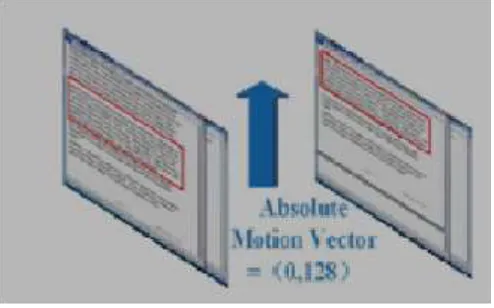
Motion estimation and motion compensation are main techniques to remove the redundancy of inter frames. In HEVC and its range extension, the default search range of motion estimtion is (64*2+w)*(64*2+h), where w and h are the width and height of the current prediction unit respectively. In sequences with natural contents, even when the object is moving fast, the motion range between successive frames is relatively small. However, long range motions as large as half a frame of ten happen in the scenarios like we be browsing and document editing. As shown in Fig. 2, the texts (boxed by red rectangles) move up 128 pixels between two successive frames. The matched blocks will not be found using the default search range[18-21].
Fig.2. long range motion from two frame 1
7. HASH-BASED BLOCK MATCHING SCHEME
A. FRAMEWORK OF HASH-BASED BLOCK MATCHING
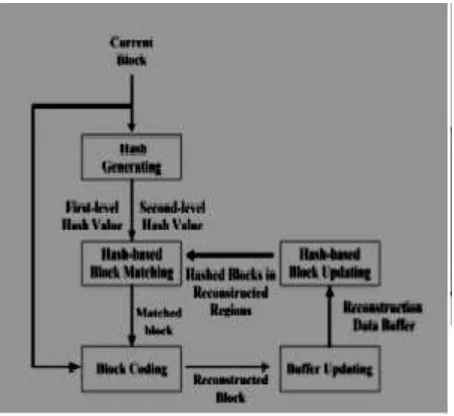
The basic idea of the hash-based block matching scheme is to find the prediction block for the current block by comparing the hash values of the current block with the hash values of the blocks in the reconstructed regions or reference frames. As shown in Fig. 3, The first-level and second-level hash values of the current block are first generated. Then the hash values of the blocks in the reconstructed regions are compared with those of the current block. The first-level hash value is first used to find the candidates approximated to the current block.
Available Online at www.ijpret.com 1454
and updated to the hash dictionary. The hash dictionary constructed during the encoding process of the current frame will be used for inter motion estimation [19-20].
B. HASH-BASED BLOCK SELECTION
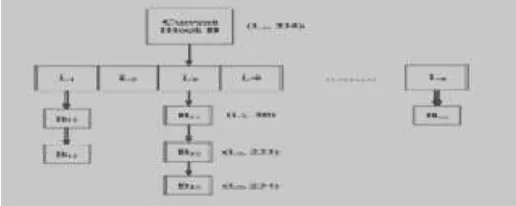
Let be the hashed blocks in the reconstructed regions of the current frame or the reference frames, where is the block and is the number of hashed blocks. Let be all possible first-level hash values. The hashed blocks are organized using a hash dictionary based on their first-level and second-level hash values.
Fig 3. Framework of the proposed system
Available Online at www.ijpret.com 1455
C. HASH FUNCTION DESIGN
Two hash functions are adopted in the proposed scheme to find the best prediction block. The first hash function used in the hash-based block matching is designed to find the prediction blocks approximated to the target block. However traditional hash functions like CRC [20] can only be used to find blocks identical to the input block. As a result, traditional hash functions do not help to find blocks which approximates to the input block.
Fig 4. Hash based block matching
Available Online at www.ijpret.com 1456
Finally the three components µ,r,c are combined together to generate the hash value which can be calculated as follows
h=(µ<<16)+(r<<8)+c
where << denotes the left shift operator .
The second hash function is used to locate the identical blocks. The CRC[20] with 8bits, which is very suitable for filtering out identical blocks from candidates, is used as the second-level hash function in the proposed scheme[22].
8. CONCLUSION
Screen content has emerged as an important category of video source. High compression efficiency of screen on extent is highly desired. Among the all motion estimation methodologies, the block matching received very much attention by researcher because of their simplicity and regularity. In this paper, motion estimation, criteria for movement estimation performance. Then propose a hash-based block matching scheme for the motion estimation process, which enables frame level block searching. In the proposed scheme, the blocks sharing the same hash values with the current block are selected as candidates. Hash-based block selection is employed to select the best candidates to achieve the best coding efficiency.
9. REFERENCS
1. Chung-Ming Kuo, Nai-Chung Yang, I-Chang Jou1 and Chaur-Heh Hsieh, “A Novel
Prediction-Based Asymmetric Fast Search Algorithm for Video Compression”, Ming Chung University Gui-Shan, 333, Taoyuan, Taiwan, R.O.C.
2. Manu T. M, Linganagoud Kulkarni and Basavaraj S. Anami “A Fast Trace Based Spiral Search
Available Online at www.ijpret.com 1457
3. Weijia Zhu, Wenpeng Ding, Jizheng Xu, Yunhui Shi, and Baocai Yin “Hash-Based Block
Matching for Screen Content Coding” IEEE TRANSACTIONS ON MULTIMEDIA, VOL.17, NO.7, JULY 2015 935.
4. Yong-Sheng Chen, Yi-Ping Hung, and Chiou-Shann Fuh “Fast Block Matching Algorithm Based
on the Winner-Update Strategy” IEEE TRANSACTIONS ON IMAGE PROCESSING, VOL. 10, NO. 8,
AUGUST 2001 http://dx.doi.org/10.14257/ijctsns.2015.3.1.03 ISSN: IJCTSNS Copyright ⓒ 2015
SERSC.
5. I. Ahmad, W. Zheng, J. Luo, and M. Liou, "A fast adaptive motion estimation algorithm," IEEE
Trans. on Circuits and Systems for Video Technology, vol. 16, (2006) March, pp. 4280-438.
6. W. I. Chong, B. Jeon, and J. Jeong, “Fast motion estimation with modified diamond search for
variable motion block sizes,” inProc. Int.Conf. Image Process. , vol. 3, (2003) September, pp. 371– 374.
7. R. Li, B. Zeng, and M. L. Liou, “A new three-step search algorithm for block motion estimation,”
IEEE Trans. Circuits Syst. Video Technology, vol. 4, no. 4, (1994) August, pp. 438–442.
8. L. M. Po and W. C. Ma, “A novel four-step search algorithm for fast block motion estimation,”
IEEE Trans. Circuits Syst. Video Technol., vol. 6, no. 3, June, pp. 313–317.
9. A. W. Zheng, J. Luo, and M. Liou, “A fast adaptive motion estimation algorithm,” IEEE Trans.
Circuits Syst. Video Technol., vol. 16, no. 3, (2006) March, pp. 420–438.
10. S. Goel, Y. Ismail, and M. A. Bayoumi, “Adaptive search window size algorithm for fast motion
estimation in H.264/AVC standard,” in Proc. Midwest Symp. Circuits Syst., (2005) August, pp. 1557–1560.
11. Yih-Chuan Lin and Shen-Chuan Tai “Fast Full-Search Block-Matching Algorithm for
Motion-Compensated Video Compression” IEEE Transactions On Communications, Vol. 45, No. 5, May 1997 527.
12. J. S. Kim and R. H. Park, “A fast feature-based block matching algorithm using integral
projections,” IEEE J. Select. Areas Commun., vol. 10, pp. 968–971, June 1992.
13. Y. H. Fok and O. C. Au, “An improved fast feature-based block motion estimation,” in Proc.
IEEE 1994 Int. Conf. Image Processing, 1994, pp. 741–745.
14. H. B. Park and C. Wang, “Image compression by vector quantization of projection data,” IEICE
Trans. Inform. Syst., vol. E75-D, pp. 148–155, Jan. 1992.
15. K. H. Jung and C. Wang, “Projective image representation and its application to image
compression,” IEICE Trans. Inform. Syst., vol. E79-D, pp. 136–142, Feb. 1996.
16. MVC Software Reference Manual JMVC 8.2,ISO/IECMPEG,ITU-T VCEG, May 2010.
17. N. Purnachand, L .N. Alves, and A. Navzrro, “Fastmotion estimation algorithmforHEVC,” in
Available Online at www.ijpret.com 1458
18. C.-M. Kuo, Y.-H. Kuan, C.-H. Hsieh, and Y.-H. Lee, “A novel prediction-based directional
asymmetric search algorithm for fast block matching motion estimation,” IEEE Trans. Circuits Syst. Video Technol., vol. 19, no. 6, pp. 893–898, Jun. 2009.
19. W. Zhu, W. Ding, J. Xu, Y. Shi, and B. Yin, “2-D dictionary based video coding for screen
contents,” in Proc. Data Compression Conf., 2014, pp. 43–52.
20. A. D. Houghton, “Cyclic redundancy checking,” in The Engineer’s Error Coding Handbook.