Available Online at www.ijpret.com 1296
INTERNATIONAL JOURNAL OF PURE AND
APPLIED RESEARCH IN ENGINEERING AND
TECHNOLOGY
A PATH FOR HORIZING YOUR INNOVATIVE WORK
ROUTE OPTIMIZATION IN WIRELESS SENSOR NETWORK USING ACO
AKANKSHA D. KANSE, PROF. S. P. AKARTE
Computer Science and Engineering, Prof. Ram Meghe Institute of Technology and Research, Badnera.
Accepted Date: 05/03/2015; Published Date: 01/05/2015
Abstract:Wireless Sensor Networks are characterized by having specific requirements such as limited energy availability, low memory and reduced processing power. On the other hand, these networks have enormous potential applicability, e.g., habitat monitoring, medical care, military surveillance or traffic control. Many protocols have been developed for Wireless Sensor Networks that try to overcome the constraints that characterize this type of networks. Ant based routing can add a significant contribution to assist in the maximization of the network life-time. Data aggregation is an essential paradigm for energy efficient routing in energy constraint wireless sensor networks. Ant colony system, a population-based algorithm, provides natural and intrinsic way of exploration of search space in optimization settings in determining optimal path. We present the application of the Ant Colony Optimization Meta heuristic to solve the routing problem in wireless sensor networks. A basic ant-based routing algorithm is used, and several improvements, inspired by the features of wireless sensor networks were considered and implemented. Ant based solution for the Optimal Routing Problem has been implemented.
Keywords: Wireless Sensor Network, Data aggregation, Ant Colony Optimization, Ant Colony Algorithm and Network Simulator Tools.
Corresponding Author: MS. AKANKSHA D. KANSE
Access Online On:
www.ijpret.com
How to Cite This Article:
Available Online at www.ijpret.com 1297
INTRODUCTION
Wireless sensor network consisting of nodes with limited power are deployed to gather useful information from the field. The main characteristics of a WSN include power consumption constrains for node using batteries or energy harvesting. The lifetime of a WSN significantly depends on the batteries of nodes and a long lifetime is vital in most of WSN applications. Therefore, energy efficient routing is important in WSN. Here, we are designing Ant Colony Optimization (ACO) algorithm for energy efficient routing in WSN. Data aggregation is important in energy constraint wireless sensor network which exploits correlated sensing data and aggregates at the intermediate nodes to reduce the number of message exchanged in network. ACO algorithm assigns ants to the nodes to explore paths from the node. The concept of “pheromone following” is used to follow the optimized path by other ants. Distance from source node to destination node is calculated by applying ACO algorithm and without applying ACO algorithm. The minimum cost path will be the optimized path for the routing. Whenever similar data happen to meet at same node in the tree, the copies of similar data are replaced by a single message which will achieve the concept of aggregation.
Let’s see the introductory contents related to Wireless Sensor Network, Data Aggregation and Ant Colony System.
1.1 Wireless Sensor Network
Wireless Sensor networks are composed of a large number of small nodes deployed spatially with sensing, computation, and wireless communication capabilities as shown in following figure1.1
Figure1.1: Wireless Sensor Network
Available Online at www.ijpret.com 1298 A wireless sensor network operates in an unattended environment, with limited computational and sensing capabilities capable of sensing, computing and wirelessly communicating. In order to effectively utilize wireless sensor nodes, we need to minimize energy consumption in the design of sensor network protocols and algorithms. Since the sensor nodes have irreplaceable, batteries with limited power capacity, it is essential that the network be energy efficient in order to maximize the life span of the network [1].
In this network, two types of transmission can be performed: Direct transmission and Multi-hop transmission. Here, large numbers of sensor nodes have to be networked together. direct transmissions from any specified node to a distant base station is not used, as sensor nodes that are farther away from the base station will have their power sources drained much faster than those nodes that are closer to the base station. On the other hand, minimum energy multi-hop routing scheme will result in rapidly drain energy resources of the nodes, since these nodes engage in the forwarding of a large number of data messages to the base station.
The sensors periodically sense the data, process it and transmit it to the base station. Data gathering is defined as the systematic collection of sensed data from multiple sensors to be eventually transmitted to the base station for processing. Since sensor nodes are energy constrained, it is inefficient for all the sensors to transmit the data directly to the base station. Data generated from neighboring sensors is often redundant and highly correlated. In addition, the amount of data generated in large sensor networks is usually enormous for the base station to process.
Hence, we need methods for combining data into high quality information at the sensors or intermediate nodes which can reduce the number of packets transmitted to the base station resulting in conservation of energy and bandwidth. This can be accomplished by data aggregation.
1.2 Data Aggregation
Available Online at www.ijpret.com 1299 Ant colony system were first proposed by Marco Dorigo in 1992 in his dissertation, a multi-agent approach t difficult combinatorial optimization problems like the travelling salesman problem (TSP)[3].
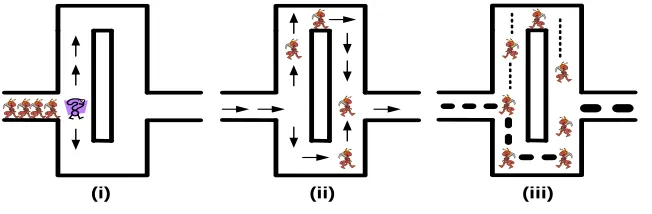
Ant colony system was inspired by the foraging behavior of real ants. This behavior enables ants to find shortest paths between food sources and their nest. Initially, ants explore the area surrounding their nest in a random manner. As soon as an ant finds a source of food, it evaluates quantity and quality of the food and carries some of this food to the nest. During the return trip, the ant deposits a pheromone trail on the ground. The communication among individual ants, or between individuals and the environment, is based on the use of chemicals produced by the ants. These chemicals are called pheromones. The quantity of pheromone deposited, which may depend on the quantity and quality of the food, will guide other ants to the food source. The indirect communication between the ants via the pheromone trails allows them to find the shortest path between their nest and food sources. This functionality of real ant colonies is exploited in artificial ant colonies in order to solve Optimization problems.
Figure 1.2: i. Ants don’t know where to go initially, choose paths randomly
ii. Ants talking the “shortest path” will reach the destination before the those taking a long route. The path is marked with pheromone.
iii. There after the number of ants using the shortest path will keep increasing, since more pheromone is laid on the path.
In Ant Colony System, ants can be thought of as having two working modes: forward and backward. They are in forward mode when they are moving from the nest toward the food, and they are in backward mode when they are moving from the food back to their nest. Once an ant in forward mode reaches its destination, it switches to backward mode and starts its travel back to the source.
Available Online at www.ijpret.com 1300 Forward ants build a solution by choosing probabilistically the next node to move to among those in the neighborhood of the graph node on which they are located. The probabilistic choice is biased by pheromone trails previously deposited on the graph by other ants .The use of an explicit memory allows backward ant to retrace the path it has followed while searching the destination node. While moving backward, ants leave pheromoneon the arcs they traverse.
To determine optimal in-network data aggregation points in sensor network. The optimal aggregation tree in sensor network is shown to be NP-Hard in [4] due to combinatorial search space. Swarm intelligence based technique is used in optimal data aggregation problem.
The problem of determining optimal data aggregation is modeled as Ant system optimization .Ant-aggregation algorithm, constructs iteratively aggregation tree in network which converges to an optimal (minimum) cost solution. Optimal aggregation is compared, with opportunistic aggregation and greedy incremental aggregation algorithms.
2. Literature Survey
Routing is a process of forwarding the data from a known source to the destination. In this process, the data may travel through several intermediate paths, and there exist a need to select the best possible optimal nodes to forward the data. This optimal selection of nodes will enable to achieve a high performance in the network. Large amount of worked has been carried out to find the optimal path in the network routing to improve its efficiency and to remove congestion problems. A good routing algorithm should be able to find an optimal path and it must be simple. It also must have low overhead, and be robust and stable, converging rapidly, and must remain flexible. There exists a lot of routing algorithm which have been developed for specific kind of network as well as for general routing purpose. First we see some of the best optimal path techniques as follows,
3. Techniques for finding optimal path in network:
There are many optimization techniques for finding optimal path and these are defined as below:
Particles Swarm Optimization (PSO):
Available Online at www.ijpret.com 1301 performed by updating the particle velocities, in every iteration, the fitness of each particle’s position is determined by fitness measure and the velocity of each particle is updated by keeping track of two “best” positions[5].
Tabu Search:
It is an iterative search that starts from some initial feasible solution and attempts to determine the best solution in the manner of a hill-climbing algorithm. The algorithm keeps historical local optima for leading to the near global optimum fast and efficiently. During these search procedures the best solution is always updated and stored aside until the stopping criterion is satisfied. The two main components of the tabu search algorithm are the tabulistrestrictions and the aspiration criterion[6]. TS uses short-term and/or long-term memory while making moves between neighboring solutions. It is essential for a local search to be balanced in terms of quality of solutions and computing time of these solutions. In that sense, a local search does not necessarily evaluate all neighborhood solutions. Generally, a subset of solutions is evaluated. If the optimal score is unknown (which is usually the case), it must be told when to stop looking (for example based on time spend, user input, ...).
Dijkstra's Algorithm:
Dijkstra’s algorithm is a graph search algorithm that solves the single-source optimal path problem for a graph with nonnegative edge path costs, producing an optimal shortest path tree. This algorithm is often used in routing and as subroutine in other graph algorithms. It can also be used for finding costs of shortest paths from a single vertex to a single destination vertex by stopping the algorithm once the optimal path to the destination vertex has been determined.
The major disadvantage of the algorithm is the fact that it does a blind search there by consuming a lot of time waste of necessary resources. Another disadvantage is that it cannot handle negative edges. This leads to acyclic graphs and most often cannot obtain the right shortest path.
Floyd-Warshall’s Algorithm:
Available Online at www.ijpret.com 1302 from node i to node j. Furthermore a matrix Next can be computed where Next[i; j]represents the successor of node i on the shortest path from node i to node j.
Greedy Algorithm:
A greedy algorithm is a method for finding an optimal solution to some problem involving a large, homogeneous data structure (such as an array, a tree, or a graph) by starting from an optimal solution to some component or small part of the data structure and extending it, by considering additional components of the data structure one by one, to an optimal global solution. A greedy algorithm assumes that a local optimum is part of the global optimum. A Greedy Algorithm is any algorithm that follows the problem solving meta heuristic of making the locally optimal choice at each stage for finding the global optimum. Greedy algorithms produce good solutions on some mathematical problems, but not on others.
Ant Colony Optimization(ACO):
Ant colony optimization technique is used to find the shortest path finding algorithm in spite of GPS (global position satellite) or any other method. ACO is a class of optimization algorithms modeled on the actions of an antcolony. Ant Colony Optimization (ACO) studies artificial systems that take inspiration from the behavior of realant colonies and which are used to solve discrete optimization problems [7]. Our arena which is randomly created has white pixels showing clear area and black one for restricted entry. Different steps of a simple ant colony system algorithm are as follows: Initialization:
To create an arena by creating image of certain pixels and introducing noise randomly acting as hurdles for the path. This noise is known as salt and pepper noise, it will be introduced in R, G, and B format of image.
Random Points:
Taking two random points in image to define the path and making straight line between them using loop. Straight line defines the possible hurdles coming in way.
Routing:
Defines the possible routes to reach the destination.
Available Online at www.ijpret.com 1303 Each object will be taken separately in a dummy image and will be dilated and eroded to fill the holes .It will be repeated for every object.
Finding Nearest Points:
Nearest points are taken by forming the matrices defining rows and column. Then loop starts for finding the shortest path through the hurdles and finally nearest points are attached to their startup and end point. ACO can be used to find the solutions of difficult combinatorial optimization problems and it enjoys a rapidly growing popularity. Although ACO has a powerful capacity to find out solutions to combinatorial optimization problems, it has the problems of stagnation and premature convergence and the convergence speed of ACO is always slow. Those problems will be more obvious when the problem size increases. Therefore, several extensions and improvements versions of the original ACO algorithm were required [8].
Scientific literature is prolific both on exact and on heuristic solution methods developed to solve optimization problems. Although the former methods have an indisputable theoretical value when it comes to solve large realistic combinatorial optimization problems they are usually associated with large and even prohibitive running times. Heuristic methods do not guarantee to determine a global optimal solution for a problem but are usually able to find a good solution rapidly, perhaps a local optimum, and require less computational resources. Ant Colony Optimization (ACO) algorithms belong to a class of heuristics based on the behavior of nature ants. These algorithms have been used to solve many combinatorial optimization problems and have been known to outperform other popular heuristics such as Genetic Algorithms. Therefore, we believe that the number of ACO based algorithms will continue to grow for a long time. The contribution of this work is to provide the reader with a sort of consultation guide for developing ACO algorithms, by presenting a collection of different approaches that can be found in literature, regarding the ACO building blocks.
Ant Aggregation System:
Available Online at www.ijpret.com 1304 sensor network aims for finding efficient approximation algorithms for optimal aggregation problem. Optimal aggregation is modeled as combinatorial
Optimization problem which is solved using population based metaheuristic approach Ant Colony Optimization (ACO). The ACO has been used in prior works for routing in sensor network [10]. This is first attempt to the author’s knowledge of applying ACO for optimal aggregation problem in sensor network. The proposed Ant-aggregation determines optimal aggregation in network using ant colony system heuristics. The behavior of ants modeled as artificial ants, is natural to use to solve this combinatorial optimization problem.
Circular topology
A network topology that is set up in a circular fashion in which data travels around the ring in one direction and each device on the ring acts as a repeater to keep the signal strong as it travels. Each device incorporates a receiver for the incoming signal and a transmitter to send the data on to the next device in the ring. The network is dependent on the ability of the signal to travel around the ring. When a device sends data, it must travel through each device on the ring until it reaches its destination.
Advantages
Easy to manage.
Enables reliable communication.
Handles high-volume network traffic
Disadvantages
Expensive
Ant Colony Algorithm for data aggregation
Input: weighted graph, neighborhood info.
While termination not met do
Compute-initial pheromone, node dist potential
Schedule activities
Available Online at www.ijpret.com 1305 Pheromone update
Node distance potential update
End activities
Best <-best solution in population of solution
Output: Best, candidate to optimal solution
Ant Colony Optimization for Optimal Aggregation Tree
The Algorithm is runs in two passes. In forward of the algorithm, the route is constructed by one of the ants in which other ants search the nearest point of previous discovered route. The points where multiple ants join are aggregation nodes. In the backward pass nodes of the discovered path are given weight in form of node potential which indicates heuristics for reaching to destination(for the first ant or other nodes) or nearest aggregation point(for other ants) and pheromone trails is the heuristics to communicate other ants of the route discovered. Ants tries to follow the route to get pheromone eventually converges to the optimal route. Non-optimal route pheromone gets evaporated with time. The aggregation points on the optimal tree identify data aggregation. The indicator in data aggregation points gives estimate of number of paths aggregates in it.
4. Technique:
In this paper we are introducing Ant Colony Optimization Algorithm Network Simulator tool. By using Network Simulator (NS2), we developed code by using Tcl (Tool Command Language), which is the front end of NS2. It has C++ as back end. There are some special features of NS2 as follows:
NS2 is an event driven simulator designed by Steve McCanne in 1996-97.
NS2 uses OTcl which requires less recompilation time as compare to C++.
OTcl is easy to learn and modify.
It creates a virtual environment; it doesn’t require the actual hardware.
The output produced is transferable.
Available Online at www.ijpret.com 1306 It is compatible with many platforms
Free
NS2
The version of NS2 are free available for some period. In this version of NS2 provide programming environment as well as simulation concept.
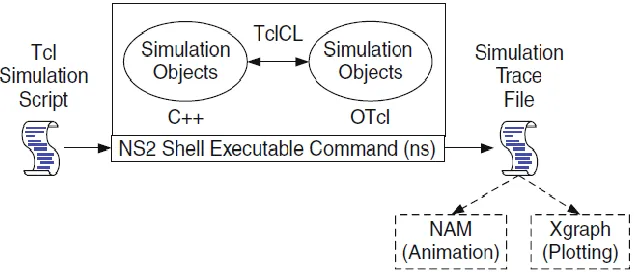
Figure 1.3: Working of Network simulator
Above diagram shows the working of NS2 in which the Tcl simulation script is given as input. The OTcl interpreter links the OTcl code with C++ libraries and provides two output files that are:
NAM file: It includes the animation.
TRACE file: It includes complete trace of the network.
Trace File
Available Online at www.ijpret.com 1307 The above snapshot shows the basic format of trace file which contains the following fields:
1. event: event specifies the condition or event, at which the trace file must be triggered, i.e., what function it performs. It is also known as “type identifier”. The different events are listed below:
“+”: a packet enque event.
“-“: a packet deque event.
“r”: a packet reception event.
“d”: a packet drop (e.g., sent to drop Head) event.
“c”: a packet collision at the MAC level.
2. time: time field specifies the time at which the packet tracing is created.
3. from_node: This field shows the source node id of tracing object.
4. to_node: This field shows the destination node id of tracing object.
5. pkt_type: It describes the type of packet being transmitted (e.g.: ack, udp, cbr, etc.).
6. pkt_size: It signifies the size of packet transmitted in bytes.
7. flags: A 7-digit flag string
“-“: disable
Available Online at www.ijpret.com 1308 2nd = “P”: The priority in the IP header is enabled.
3rd: Not in use.
4th=”A”: Congestion action.
5th=”E”: Congestion has occurred.
6th=”F”: The TCP fast start is used.
7th=”N”: Explicit Congestion Notification (ECN) is on.
8. fid: fid specifies the flow id.
9. scr_addr: The format of this field is “a.b”, where “a” is the address and “b” is the port.
10.dst_addr: The format of this field is “a.b”, where “a” is the address and “b” is the port.
11.seq_num: This field gives the sequence number.
12.pkt_id: This signifies the packet unique ID.
CONCLUSION
Many protocols have been developed for Wireless Sensor Networks that try to overcome the constraints that characterize network. Ant based routing added a significant contribution to assist in the maximization of the network life-time. We used the application of the Ant Colony Optimization Meta Heuristic to solve the routing problem in wireless sensor networks. Ant based solution for the Optimal Routing Problem has been implemented and investigated.
Extensive simulation is carried out for finding optimal path and data aggregation. The resulting Ant Colony Algorithm used scout ants to find routing paths between the sensor nodes and the sink nodes, which are optimized in terms of distance and energy levels. These special ants minimize communication loads and maximize energy savings, contributing to expand the lifetime of the wireless network. The experimental results showed that the algorithm leads to very good results in different WSN scenarios.
Available Online at www.ijpret.com 1309
REFERENCES
1. Rajiv Misra, and Chittaranjan Mandal,” Ant-aggregation: Ant Colony Algorithm for optimal data aggregation in Wireless Sensor Networks “.
2. Kiran Maraiya, Kamal Kant, NitinGupta,”Wireless Sensor Network: A Review on Data Aggregation “.
3. Marco Dorigo and Thomas Stutzlre,”Ant colony Optimization”.
4. Hongyan Cui, Jian Li, Xiang Liu, Yunlong Cai, “Particle Swarm Optimization for Multi-constrained Routing in Telecommunication Networks”, I. J. Computer Network and Information Security, 2011, 4, 10-17 Published Online June 2011 in MECS
5. Hongyan Cui, Jian Li, Xiang Liu, Yunlong Cai, “Particle Swarm Optimization for Multi-constrained Routing in Telecommunication Networks”, I. J. Computer Network and Information Security, 2011, 4, 10-17 Published Online June 2011 in MECS
6. Anant Oonsivilai, Wichai Srisuruk, Boonruang Marungsri, ThanatchaiKulworawanich pong;“Tabu Search Approach to Solve Routing Issues in Communication Networks” , World Academy of Science, Engineering and Technology 29 2009
7. Dilpreet kaur, Dr. P. S Mundra, “Ant Colony Optimization: A Technique Used For Finding Shortest Path”, International Journal of Engineering and Innovative Technology (IJEIT), Volume 1, Issue 5, May 2012.
8. Zar Chi Su SuHlaing and May Aye Khine, Member, IACSIT “Solving Traveling Salesman Problem by Using Improved Ant Colony Optimization Algorithm”, International Journal of Information and Education Technology, Vol. 1, No. 5, December 2011
9. Al-Karaki, J. N., R. Ul-Mustafa and A. E. Kamal, "Data Aggregation in Wireless Sensor Networks - Exact and Approximate Algorithms", in the proceedings the International Workshop on High-Performance Switching and Routing, Phoenix, AZ, April 2004.