http://revistas.ua.pt/index.php/impar
EDITORIAL BOARD
Vol.2, n.1| Music for and by children | 2018
Editors
Jorge Manuel Salgado de Castro Correia, Universidade de Aveiro, INET-md Clarissa Foletto, Universidade de Aveiro, INET-md, Portugal
Associate Editors
Alfonso Benetti, Universidade de Aveiro, INET-md, Portugal Aoife Hiney, Universidade de Aveiro, INET-md, Portugal Gilvano Dalagna, Universidade de Aveiro, INET-md, Portugal
Advisory Board
Jostein Gundersen, University of Bergen, Grieg Academy, Norway Luk Vaes, Orpheus Institute, Belgium
Rui Penha, Faculdade de Engenharia da Universidade do Porto, Portugal
Stefan Östersjö, Malmo Faculty of Fine and Performing Arts, Lund University, Sweden
Cover
Ana Luz
Volume 2 | Number 1 Music for and by children | 2018
Editorial 1
Clarissa Foletto Jorge Salgado Correia
The polarity "cooperative vs collaborative" as a conceptual tool to observe young children's
creative interactions in group music making 3
Andrea Sangiorgio
Challenging Creativity: Inclusive Composition 19
Oliver Iredale Searle
György Kurtág's Játékok: a tool to learn the piano 34
Pascal Terrien Emmanuelle Huart
Tales of a Talking Piano: Performing for childlike adults or adultlike children 49
Ann-Kristin Sofroniou
Interview
__________________________________________________________________________________ The Fukushima project for child composers: An interview with Dai Fujikura at Muschildren’17: 63
Editorial
This third issue of ÍMPAR: Online Journal for Artistic Research in Music is a thematic publication and a special one, as it features research focused on artistic projects developed with and by children. The authors were selected from the delegates who participated in the first edition of the international conference Musichildren - Music for and by Children:
Perspectives from Children, Composers, Performers and Educators, which took place at the University of Aveiro in October 2017
Why should a journal for artistic research adopt such a theme? Apart from analyzing a given reality, artistic research involves exploring possibilities. Of course, creativity and imagination are required for both analyzing realities and exploring possibilities, but the imaginings that emanate from concrete artistic practices belong to the subjective realm of our games of make-believe. Our capacity for this imaginative activity and specifically for exercising our imagination involving "props" is, doubtlessly, a sine qua non condition for any kind of
aesthetic experience to occur (Walton, 1990). In many cultures, children devote a great deal of time to games of make-believe and this continuous effort does not simply disappear when they grow up. Most probably, as Walton (1990) argued, make-believe continues in our interaction with representational works of art and, we add, in our artistic practice. Indeed, the imaginings induced during musical practice by children constitute the genetic core of future mythopoetic inventions. Since we understand that artistic research should correspond to an act of criticism that both deconstructs an old mythopoetic configuration and constructs a new mythopoetic configuration, we felt that the opportunity to bring the theme of music with and by children to the debate should be welcomed, presenting different proposals and
approaches.
This number opens with two articles that discuss creativity and inclusive composition in projects involving children. The first one, ‘The polarity cooperative vs collaborative as a conceptual tool to observe young children's creative interactions in group music making,” by Andrea Sangiorgio, presents a theoretical framework that aims to explain the possible
interactions in the creative music making of early primary school level children when they are engaged in a group. As the title reveals, the study explores the dichotomy "cooperative vs collaborative" as a useful conceptual tool to interpret how children organize the process and the final product of their collective work. The second article “Challenging Creativity: Inclusive Composition,” written by Oliver Searle, discusses the processes of integrating several inclusive music technologies in recent composition projects, as well as the development of creative methods when working with individuals with Additional Support Needs.
The final contribution to this special thematic edition of ÍMPAR is an interview with the composer Dai Fujikura, the keynote speaker at the Musichildren conference. The interview, conducted by Sara Carvalho and Filipe Lopes, focuses on a composition project for children in Japan that promotes composer-performer collaboration and experimentation.
With this publication, apart from sharing the individual contribution of each of the selected papers, the editors hope to reinforce that which they all have in common, namely the dissemination of research that triangulates music composition, performance, music
education and artistic research. The articles that comprise the present edition were selected from a set of proposals assessed by a panel of peer reviewers who focused their analyses, on the implications brought to light by this triangulation.
Clarissa Foletto and Jorge Salgado Correia
The polarity "cooperative vs collaborative" as a conceptual tool to
observe young children's creative interactions in group music
making
Andrea Sangiorgio1
Elemental Music Education,University of Music and Performing Arts Munich, Germany
Abstract: This article presents some findings of a doctoral study on children's collaborative creativity in music. The study intended to develop a theoretical framework for understanding the ways in which early primary children interact when they engage in group creative music making. The focus of the research questions was on creative interactions and, more specifically, on the different kinds of interactions emerging in the group, the component aspects of group work influencing children's collaboration, the meanings that children ascribe to their experience, and the educational value of creative interactions. This exploratory, interpretive enquiry was framed by sociocultural perspectives on learning and creativity. A qualitative research methodology was adopted, which combined elements derived from case study research,
ethnographic approaches, and practitioner research. The data collection was carried out in a music school in Italy, where a group of 5-7-year-old children were involved over eight months in a range of creative music and movement activities. I was the teacher researcher and worked with a co-teacher. Data collection methods included participant observation, videorecording of sessions, documentation, and strategies for eliciting children's meanings. Thematic analysis, both theory-driven and data-driven, was conducted in order to identify relevant issues. This paper concentrates on a slice of the findings, relevant to the categorisation and analysis of children's creative interactions. In agreement with similar distinctions in the research literature, the study identified the polarity "cooperative vs collaborative" as a useful conceptual tool to interpret how children organise the process and the product of their collective work. Some exemplary episodes of creative interactions in children's group work in music are presented and discussed.
"Cooperative" and "collaborative" can be seen as the extremes of a continuum of possibilities ranging from "working separately and then assembling the parts into a whole" to "jointly generating and developing ideas all along the process". This conceptual distinction helps to identify the varying degrees of interactivity in the group's creative work, the different kinds of division of labour and the decision-making strategies that the group may adopt in tackling the creative task. Based on the findings, implications for the pedagogical practice are drawn.
Keywords: collaborative creativity; children; music; creative group work; cooperative/collaborative
Introduction
Two aspects of (music) learning appear to be foundational: the group aspect and the creative aspect, i.e. how it is that we learn with/through others, and how it is that together with others we invent something new. In this sense, 'creative interactions' represent a most relevant theme both for research and practice. Indeed, collaborative creativity constitutes a transversal, interdisciplinary issue – perhaps 'the' issue of the present cultural-historical period – cutting across different domains, fields and theoretical perspectives, both in education and beyond (Sawyer, 2006). Creative interactions can be considered as a particular kind of social processes in which something new, original, unforeseeable and valuable is generated in the 'space-in-between' two or more partners. With specific regard to music, this 'area of shared meaning' (Jordan, 2009) could be a joint activity, an emotional-relational space, a dialogue, a common mental representation, a physical interchange, a musical relationship, or an abstract space of formal relationships. In order to foster children's creative and social development, it seems important to investigate such a complex and multifaceted phenomenon and understand how creativity emerges in these spaces of intersubjectivity.
In the first part of this paper I introduce some relevant theoretical perspectives about
collaborative creativity and creative processes in education. I then outline the main features
of the doctoral study with young children from which this article is derived. Subsequently, a slice of the findings are presented, which exemplify the idea of categorising creative group interactions as distributed along a continuum between 'cooperative' and 'collaborative' ways of working together. These findings are then discussed and some implications for the teaching practice are drawn in the conclusion.
1. Theoretical perspectives on collaborative creativity
Collaborative creativity is becoming a central theme in research. Since the 1990s creativity is increasingly understood as a social interaction process aiming at the production of novel ideas acknowledged by a group or by society at large (Amabile, 1996; Sternberg, 1999). From the individualist approaches of the 1960s-80s – dealing with basic components of creativity as occurring in the individual – the focus of research gradually shifted towards a multidimensional, sociocultural approach which recognised the complexity, specificity, and social and cultural situatedness of any creative activity (Glăveanu, 2010; Sawyer, 2012). This new orientation offers in-depth explorations of the multiplicity of individual, collective,
cognitive, emotional, relational and cultural aspects involved in the creative co-construction of knowledge (Craft, 2008; Csikszentmihalyi, 1996, 1999). Since the 2000s socioculturally oriented research on creativity has focused more directly on diverse aspects of collaboration in creativity in fields such as the arts and science (John-Steiner, 2000), jazz and theatre improvisation (Black, 2008; Kenny, 2014; Sawyer, 2003), business and organisations (Henry, 2004; Sawyer, 2007), education (Craft, 2008; Hämäläinen & Vähäsantanen, 2011; Littleton, Rojas-Drummond, & Miell, 2008) and in music education (Burnard, 2007; Rojas-Drummond, 2008).
Collaborative creativity is viewed here as an inherently social phenomenon emerging from the interaction with significant others within a sociocultural context (John-Steiner, 2000). Through interchange, partners jointly generate new ideas and are able to construct multiple perspectives. The juxtaposition of alternative positions is a productive resource for partners in order to build an elaborated understanding of a topic. Division of labour based on working styles, disciplinary knowledge and personal expertise enriches the opportunities of the
partnership. Conceptual complementarity – the dynamic tension between conflicting visions – deepens, widens, and transforms the partners' habitual modes of thought. In successful creative collaborations, divergences are balanced through the focus on a shared vision or common purpose, and a "unity-in-diversity" is achieved (p.39). The integration of differences is crucial to the construction of creative syntheses. In Vygotskian (1978) terms, through collaboration partners create mutual zones of proximal development, and can transcend the limitations of their isolated skills and knowledge.
Expanding the notion of ZPD to the affective sphere, John-Steiner (2000) suggests that the 'emotional scaffolding' between partners creates a safe zone of mutual care-taking, trust, belief in each other, and constructive criticism which heightens their willingness to take risks in the face of the uncertainties or failures of creative undertakings. The creative
Reciprocal support between partners, however, does not mean that collaboration is immune to tensions. There can be a marked discrepancy between the promise and the reality of creative collaborations (Eteläpelto & Lahti, 2008), which can also result in disputational talk, dominance of one of the partners, or lack of a true dialogical process. Nevertheless, tensions are vital in terms of discussion and negotiation of opposing views, as the goal is not to reach a superficial consensus, but to work out and evaluate creative solutions through critical argumentation. Taking as a precondition the fundamental value of tolerance of diversity, "collaboration is not absence of tension, but fruitful cultivation of tension" (Moran & John-Steiner, 2004, p.12).
2. Children's collaborative creativity
In the field of education, a basic rationale behind the urgency of investigating and
implementing "creativity in relationship" (Craft, 2008, p.242) is that, well beyond transmitting established knowledge and skills, schools have to prepare future generations to work
creatively in teams, as innovation relies on the capacity of creative people and organisations to collaboratively engage in improvisational processes of knowledge building (Sawyer, 2006). This shift in perspective from the individual to the social almost naturally brought about a confluence of research interests in group creativity on the one hand and, on the other, of sociocultural studies on learning as a social phenomenon (Vygotsky, 1978; Lave & Wenger, 1991; Rogoff, 2003) and on cooperative / collaborative learning (Blatchford, Kutnick, Baines, and Galton, 2003; Howe & Mercer, 2007).
Recent research in music education reflects these new assumptions and perspectives. Following a similar pathway as described above, since the 1990s there has been a shift from research on individualistic approaches to musical creativity, mostly oriented to cognitive aspects (Gordon, 2012; Pressing, 1988; Swanwick & Tillman, 1986; Webster, 2002) towards sociocultural conceptions of musical creativity as a culturally situated phenomenon (Barrett, 2011; Burnard, 2006, 2007; Elliott, 1995; Glover, 2000; MacDonald, Hargreaves, & Miell, 2002), and an increasing interest in how musical creativity develops in learning contexts through the interaction in a group (Burnard, 1999, 2002; Espeland, 2006; Faulkner, 2003; Fautley, 2005; Kanellopoulos, 1999; Morgan, 1998; Wiggins, 1999/2000; Young, 2008).
Research on children's group musical creativity is as yet a developing field and there seems to be relatively little research on the topic, especially with regard to the age range of early primary children considered here (5-7 years old). This particular study is situated in this wider context, at the intersection of different lines of investigation: children's learning in social contexts, creativity, collaboration and music.
3. Categorising creative interactions
Broadhead's (2010) Social Play Continuum organises the observation and interpretation of interaction in young children's play along a continuum of four categories, from Associative Play and Social Play – characterised by low levels of shared understanding and little development of play ideas – to Highly Social Play and Cooperative Play – characterised by stronger shared understanding of goal orientation and extension of ongoing play. From the line of research on group work in primary education, as a possible criterion for the distinction between 'collaborative' and 'cooperative' learning, Dillenbourg (1999), Galton and Williamson (1992), and Ogden (2000) indicate the kind of division of labour among the group members: in cooperative learning, which is often highly structured in its procedures, students solve sub-assignments separately and eventually put them together into the final outcome – see for example Slavin's (1991) jigsaw technique – whereas in collaborative learning all members share the same task and produce a joint output.
Importantly, the investigation of creative interactions in group creative music making has to include verbal as well as musical and bodily/nonverbal interactions, as the emergence of an intersubjective space can occur at different levels and through different media of
communication. In this perspective, I find helpful the notion of 'transactive communication', which Miell and MacDonald (2000) used in order to investigate the influence of social variables on the nature and quality of 11-12-year-old children's collaboration on creative tasks. Transactive communication, in relation to talk and verbal interactions, refers to the attitude of building on, extending and elaborating on each other's ideas, as opposed to offering just unelaborated agreements or disagreements with the others. In music,
transactive communicative actions consist in producing musical refinements, extensions or elaborations of previously presented musical material or responding musically to earlier verbal questions or suggestions from the partners, as opposed to non-transactive playing for themselves, just repeating musical ideas, or not being engaged with or oriented to the partner through music. The main idea is that, in order to be 'transactive', the interaction must bring the discourse forward, either through music or talk, or both. In a similar perspective, gathering evidence from research with primary school children, Wiggins (1999/2000) defines the characteristics of shared understanding in collaborative composition in terms of the children's ability to construct a common vision of the problem at hand and of the strategies necessary to solve it, based on their culturally situated knowledge of music and on their personal interpretation of possible solutions to the task.
In conclusion, taking this 'holistic view' brings the focus of the investigation a bit further than just the observable interactive behaviours and includes the analysis of the partners' broader communicative intention, seeking to capture basic characteristics of human interaction, such as 'intersubjectivity' (Rogoff, 1990), attunement, mutual engagement, or shared
understanding.
4. The study
attribute to their creative experiences, and the educational and ethical values that creative interactions have for children's learning.
A group of eight 5-7-year-old children were involved over a school year in 30 weekly
sessions centred on group creative music activities, which took place in 2013-14 in a private music school in Rome. My role in the project was that of teacher researcher and I worked with a co-teacher. The typical structure of a session comprised as its most significant part some creative music and movement activities which were intended to cover quite a wide range of approaches to inventing individually and/or in collaboration with others. The focus of the study and of our pedagogical approach was on moments in which children jointly
generate ideas, and not so much on finalising reproducible pieces. Thus, children were guided through a playful process of ongoing exploration of creative themes which yielded each time new pieces, often largely provisional and improvisational, or at best good second or third renditions of an evolving piece.
Given the naturalistic context and the kind of exploratory questions posed, a qualitative research methodology was adopted, which combined elements derived from case study research, ethnographic approaches and practitioner research. Data collection methods included participant observation, videorecording of sessions, documentation and strategies for eliciting children's meanings. Thematic analysis, both theory-driven and data-driven, was conducted in order to identify relevant issues, to uncover essential relationships, concepts and understandings, and to construct a consistent portrait of the phenomenon under investigation (Bazeley, 2013). Within the learning activities taken as the unit of analysis I could identify relevant phases of creative interaction between children (around 300 items in total) and within those a number of interesting critical incidents or revealing anecdotes, i.e. moments of major significance in relation to the object of the study. One of the aims of the analysis was (following Kanellopoulos, 1999) to identify those key incidents which were representative 'instances of abstract principles' underpinning children's creative interactions in music. Indeed, my intention was to rise from the local and particular examples towards some more abstract conceptual models – such as the one presented in this paper – about how these interactions work. However, based on the qualitative approach of the study it is clear that the kind of transferability of these findings has to be intended at best as 'naturalistic generalisation' (Stake, 1995), implying that the conclusions drawn and the interpretations made here may – but not necessarily will – be referable to other contexts. The aspiration is that relevant perspectives emerging from this enquiry can be useful to other interested researchers and practitioners in understanding and making judgements about their own particular contexts.
In the following I present and discuss a few instances of children's creative joint activity, which exemplify distinct forms of interaction as identified in the study.
5. 'Cooperative vs collaborative' as a conceptual tool to observe children's creative interactions
The first research subquestion of the study focused on the nature of children's creative interactions in group music making, that is it looked at possible categories for description and analysis in relation to a rich body of collected data. In the first place, the findings identified three interrelated kinds of interaction according to the communicative media used, namely
movement/dance – embodied musical communication), musical interactions (behavioural strategies for interaction in music), and verbal interactions (talk – task-related or off-task interactions). A further viewpoint was on interpersonal relationships, emotional and relational aspects of creative collaboration, group dynamics and power relationships. A third useful category to describe children's interactions – which is the focus of this paper – was partly derived from the literature and partly emerged from the data as a significant finding in the course of the research process, and regards the degree of interactivity in the partners' actions.
5.1. Division of labour and decision-making strategies
Group work encompasses diverse ways in which children can work as a group. As
mentioned above, some researchers (Dillenbourg, 1999; Galton & Williamson, 1992; Ogden, 2000) distinguish 'cooperating' as opposed to 'collaborating' in order to make clear the kind of division of labour and the decision-making strategy that the group adopts in tackling the task. I take these as two polarities that define a continuum of possibilities ranging from 'working separately and then assembling the parts into a whole' to 'jointly generating and developing ideas all along the process'. The distinction 'cooperative – collaborative' can serve as an effective conceptual tool to better identify and understand the different strategies that the children of this study used in working together and the ways in which they related to each other and to the task in the course of the activity. Here are some exemplary episodes that offer a more detailed picture of the issue and provide a good basis for discussion (videos are accessible online – password: res).
5.2. Cooperative Interactions
a) Taking turns (one after the other)
In the project children often used the strategy of 'taking turns' as a way to structure the pieces they cooperatively invented, as in the following example:
Taking turns in cooperation: "The bear"
Chiara and Sandra represent a bear walking and sleeping by differentiating their roles. Sandra plays on the drum a rather regular ostinato | du dude dude |, then Chiara plays fast glissandos on the glockenspiel, some random staccato notes and a concluding stroke on the floor. They alternate this way a few times, following an ABABABA rondo form. With a quick nod and gaze Chiara gives the sign for the closure. (https://vimeo.com/104223535)
s.18/30 20140219 C,SA
b) Playing in parallel (alongside each other)
In order to present the next category of interactive strategies I first need to introduce a pedagogical idea which was intended to guide and enrich children's collaborative creative endeavours, that of "figure-ground relationship". The activity is centred on the idea of interaction as co-presence of two contrasting elements, namely a background and a foreground figure standing against it. Pairs of concepts such as melody / harmony, solo / accompaniment, or main rhythm / background metre can be understood as types of figure-ground organisation of the musical material.
In the context of the research project we introduced this concept to children both as a
perceptual principle – a way to listen to music – and a constructive principle – a way to invent music. Our goal for children was to analyse music as a whole made of interrelated parts and to create musical structures made of two distinct elements, by taking on opposing roles in terms of timbre, pitch, texture and duration, and integrating them as parts of a unitary action. By working on 'figure-ground compositions' our pedagogical intention was to go beyond the experience of musical interaction as linear succession of isolated chunks (as in the preceding example), and to bring children to interact together based on a visual or narrative relationship between two different elements that belong to a common context.
In quite a few instances, however, children did not go much beyond deciding the respective contributions and playing them just alongside each other. They adopted a cooperative
strategy in the simultaneous/vertical performance of music which I would define as 'playing in parallel', i.e. each child plays their own thing without a clear connection to what the other is doing, as in the following episode:
Playing in parallel: pair composition "Moon and stars"
Sonia begins with a light background of maracas (moon), on which Alessandra plays soft, random tones on the odd bars of the alto metallophone (stars). Alessandra is absorbed in her own exploration, then realises that Sonia has just finished and adds an ending, gbd'c.
(https://vimeo.com/104224552)
s.25/30 20140416 AL,S
In the group work phase they have decided together what image to invent and what instruments to use, but then, while playing, each of them goes their own way, and there is almost no direct, interactive relationship between them (but for one gaze on the part of Sonia towards the end). They simply co-exist and play next to each other, also facilitated by the ametric nature of the musical material. Their way of working is more cumulative or additive than transactive (Miell & MacDonald, 2000) and, in this sense, can be defined
as more cooperative than collaborative – a sort of 'creative musical jigsaw', so to say (Slavin, 1991).
than with each other. The findings of this study corroborate her observations with regard to 6-7-year-olds' group instrumental work:
Centred as they still are very much in their own music-making activity, there is some variability in the degree to which they are able to manage their own music at a genuinely interactive level with another player. Music can arise which is co-operative in intent, but with each player pursuing his or her own musical structuring in parallel to, rather than interaction with, the others (Glover, 2000, p.70 – italic mine).
5.3. Collaborative interactions
As I am using it here, the term 'collaboration' implies that children jointly generate and
develop an idea, which they perform in tight interconnection with each other. In the study this occurred both as a horizontal string of events which are performed in unison, and as a vertical superimposition of different rhythms in a layered ostinato, as illustrated in the two examples below.
a) Planning and doing the same thing together
The following episode illustrates how the girls worked as a group to shape the idea of a metrical structure. We had been working for a while on 'rhythm structures', i.e. strings of timbrically different strokes on a pulse which generate metrical patterns (e.g. OOXX, OXX, OO. XXX., etc). By placing different combinations of objects on the floor (e.g. O=triangles X=castanets) children could build a notation and perform it with the voice, body percussion and instruments. This is a 'combinatorial' or 'modular' approach to rhythm in which basic elements are combined and permutated in various ways to form higher-level structures – a 'bottom-up' approach to composition, leading from the parts to the whole. Prior to this episode children had already explored a number of rhythm structures. This time, the task was to decide together a structure with the objects/notation, then play it with voice and gestures or body percussion, and finally perform it with the instruments.
Planning and doing the same thing together: group composition "rhythm structure"
In the small group work phase, Sonia initially proposes OOOO.XXXX., but Chiara then takes the lead and decides to change it, removing the triangles and castanets to form the new structure OOO. XXX. Sonia reads it and finds the syllable association ("glin glin glin toc toc toc"). Sandra specifies that the hand gesture should also be different, i.e. flat hand on glin and knocking fist on toc. They have now fulfilled the task and rehearse it four times in a row. (https://vimeo.com/104223586)
Based on this preparatory work with voice and movement, the next step is then a further group work phase aiming to transfer this voice/body percussion sequence onto the instruments. The girls re-arrange their string to OOO.OOO.XXX., adapting it to the instrumental actions they have found. (https://vimeo.com/104223674)
s.18/30 20140219 AL,C,S,SA
the role of a participant-observer, in that she follows well the activity, but does not take any initiative. Thanks to the scaffolding role of the notation with objects, children can literally manipulate signs and concepts and it is always very clear for the group what the common focus is. Further, by using their voices children synchronise better – in fact, though at the beginning they are not really together, the joint rhythmical pronunciation of the speech helps them gain a precise alignment already by the third repetition of the sequence. The girls were obviously very happy with the outcome. The process appropriately balances the challenge of the task with the skill level of these children. This kind of procedure lends itself well to a collaborative creative task, as it provides enough structure to channel a series of group decisions leading to a unison performance, with the whole group working together on the same musical idea. Both the process and the final product show a high degree of interactivity in the group.
b) Planning and doing together different but related things (weaving polyphonic textures)
The last and most complex form of musical interaction consists in building a polyphonic texture in which different simultaneous parts are intertwined to form a coherent musical structure. Here is a successful example of figure-ground composition, where Chiara and Sandra engage in a simple but effective rhythm ostinato as vertical interaction of contrast:
Vertical interactions: two-voices layered ostinato with bells and drum
Sandra on the darbukka repeats a regular ostinato | du du du dude | and Chiara follows her first two macrobeats with two bells with a right-left movement, which due to the bouncing pitched sounds of the bells casually produces interesting variations of a melodic phrase on two tones. Sandra has a closing formula, too: | du du du dukade |.
(https://vimeo.com/104224513)
s.24/30 20140409 C,SA
This is one of the most crystal clear examples of a figure-ground relationship and is a rare example, relative to this project, of a finished and well-performed piece of rhythm polyphony. The children have constructed two different musical objects and put them together,
connecting them rhythmically. They deeply listen to each other throughout the performance – Chiara's continuous gaze on her partner makes it easier to synchronise with her. Such behaviours may be related to Black's (2008) characterisation of 'listening' among jazz musicians as 'interactive attentiveness', and to Gratier's (2008) notion of 'grounding' as a basic strategy to establish intersubjectivity in a communicative interchange. Indeed, in the process of moment-to-moment monitoring of their 'common ground' during the performance Chiara and Sandra use eye contact, head-nods and gestures alongside the playing to display their mutual understanding.
6. Conclusions and implications for practice
(2000). It also relates to John-Steiner's (2000) differentiation between complementary and integrative forms of creative collaboration and to Broadhead's (2010) categorisations of children's interactions in play along a continuum ranging from Associative, to Social, to Highly Social, and Cooperative Play.
In this study, the two categories 'cooperative vs collaborative' are conceptualised as extremes of a continuum of possibilities between qualitatively different strategies in
organising the division of labour and the decision-making process in the group. At one pole children cooperatively produced separate parts that were then assembled as in a 'musical creative jigsaw' (Slavin, 1991). Cooperative strategies were those in which children were 'taking turns', i.e. playing each their own thing one after the other, or 'playing in parallel', i.e. one simultaneously to the other but with reduced interaction. At the opposite pole, children adopted collaborative strategies when they were working with the other and generating ideas together all along the process. They shared the ownership and the responsibility of the whole while they co-constructed unison structures, i.e. 'playing the same', or polyphonic textures, i.e. 'weaving different but related ideas'. The episodes reported in this paper provide illustrative examples of these different interactive strategies.
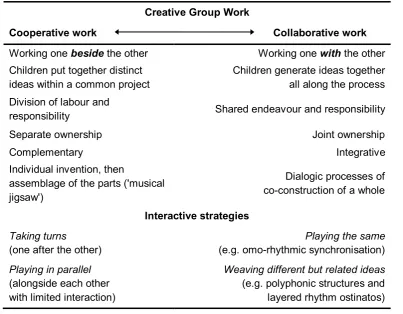
Table 1 summarises the main traits of children's cooperative vs collaborative interactions in creative group work, as identified in the findings of the study. The arrow points to the fact that these concepts represent two polarities between which an array of varied and intermediate situations can be positioned.
Table 1. Characteristics of cooperative versus collaborative interactions in creative group work
Creative Group Work
Cooperative work Collaborative work
Working one beside the other Working one with the other Children put together distinct
ideas within a common project
Children generate ideas together all along the process Division of labour and
responsibility Shared endeavour and responsibility
Separate ownership Joint ownership
Complementary Integrative
Individual invention, then
assemblage of the parts ('musical jigsaw')
Dialogic processes of co-construction of a whole
Interactive strategies
Taking turns
(one after the other)
Playing the same
(e.g. omo-rhythmic synchronisation)
Playing in parallel
(alongside each other with limited interaction)
Weaving different but related ideas
Based on the findings, a few concluding considerations can be made and some implications for practice drawn. Firstly, the distinction between cooperative and collaborative interactions in creative group work regards both the process of building up a joint musical action –
exploring and developing ideas in the group work phase – and the product – the presentation of the outcome and children's interactions in it.
Secondly, there seems to be a progression 'from cooperative to collaborative' and the latter is somehow more advanced. Indeed, from a developmental point of view one may presume that this is the case and that collaborative skills build on cooperative skills. In practice, however, these are just distinct strategies of interacting with others, which can be
appropriate, possible or desirable in relation to different moments, partners, contexts and pursued goals implied in the activities.
Thirdly, cooperative or collaborative ways of interacting creatively can originate in children's preferred modalities to work in/as a group. In fact, children can show heterogeneous
attitudes: some children may ideally have a high relational attitude and cover the whole spectrum between cooperative and collaborative, being able to adapt flexibly to different partners and circumstances. Other children, instead, may mostly tend to work one beside the other, at times almost on their own. They might be more immersed in their own processes than attentive to what the others are doing. In such a case, the continuum proposed here should actually be extended to the left of the 'cooperative' side to include the possibility of very limited interaction or individual, self-centred play (as Broadhead, 2010, does). Naturally – and this counts as an implication for practice – the teacher plays an essential role as mediator of communication in the group, supporting the growth of a proactive and responsive network of relationships among the children, fostering their identity as community of creators and helping them develop a micro-culture of creative collaboration.
Finally, the kind of interactions that are established in the group work also depend on how the task is designed. In relation to the instances presented here and to other similar
examples in the study, the relevant finding is that – to a certain extent – the task assignment does affect the nature and quality of the interaction among players. Indeed, how the goals and the contents of the group work are structured by the task influences the ways in which participants interact, and this interaction pattern, in turn, impacts on the outcomes of the activity. In this perspective, some task assignments can be defined as more 'interactive' than others, because they require and activate higher levels of positive interdependence (Johnson & Johnson, 1999). Again, it must be stated that cooperative is not necessarily less or worse than collaborative: in fact, for children, who for whatever reasons appear to be less able or willing to interact, a cooperative rule may advantageously be more inclusive and facilitative for their being 'with the others', in that they can even remain in their own space and still be involved as legitimate members of the community of learners.
This issue relates back to the necessity of a dialogic and co-constructive attitude on part of the teacher when dealing with children's unanticipated or surprising responses.
The educational implication here is to design creative tasks that can act as an
open-framework (in the sense of Siraj-Blatchford, 2009) in which a flexible structure is provided to guide children's interactions with the material and the partners, which at the same time is open enough for them to self-regulate the kind and degree of engagement in their joint activity. Starting from there, the aim is to offer to children a carefully structured learning pathway through which they can witness, experience and reflect on a number of strategies about how to initiate a musical dialogue, how to mutually scaffold each other in the music making process, how to respond to somebody else's contributions and how to give shape to a musical idea as a group – in short, how to creatively interact with others.
Acknowledgements
I would like to express my gratitude to my mentor, Sarah Hennessy, and to my partner in work and life, Valentina Iadeluca. The research has been supported by a generous grant of the College of Social Sciences & International Studies of the University of Exeter, UK.
References
Amabile, T.M. (1996). Creativity in context. Update to the social psychology of creativity.
Boulder, CO: Westview Press.
Barrett, M.S. (Ed.) (2011). A cultural psychology of music education. New York: Oxford University Press.
Bazeley, P. (2013). Qualitative data analysis. Practical strategies. London: Sage.
Black, S. P. (2008). Creativity and learning jazz: The practice of "listening". Mind, Culture, and Activity, 15(4), 279–295.
Blatchford, P., Kutnick, P., Baines, E., & Galton, M. (2003). Toward a social pedagogy of classroom group work. International Journal of Educational Research, 39(1-2), 153–172.
Broadhead, P. (2010). Cooperative play and learning from nursery to year one. In P. Broadhead, J. Howard, & E. Wood (Eds.), Play and learning in the early years. From research to practice (pp. 43–60). London: Sage.
Burnard, P. (1999). Into different worlds: Children's experience of musical improvisation and composition. Unpublished doctoral dissertation, University of Reading, Reading, UK.
Burnard, P. (2006). The individual and social worlds of children's musical creativity. In G.E. McPherson (Ed.), The child as musician. A handbook of musical development (pp. 353–374). New York: Oxford University Press.
Burnard, P. (2007). Routes to understanding musical creativity. In L. Bresler (Ed.),
International handbook of research in arts education (pp. 1199–1224). Dordrecht, The Netherlands: Springer.
Craft, A. (2008). Studying collaborative creativity: Implications for education. Thinking skills and creativity, 3(3), 241–245.
Csikszentmihalyi, M. (1996). Creativity: Flow and the psychology of discovery and invention. NewYork: Harper Collins.
Csikszentmihalyi, M. (1999). Implications of a systems perspective for the study of creativity. In R. Sternberg (Ed.), Handbook of creativity (pp. 313-335). Cambridge: Cambridge
University Press.
Dillenbourg, P. (1999). What do you mean by collaborative learning? In P. Dillenbourg, (Ed.),
Collaborative learning: Cognitive and computational approaches. Oxford: Elsevier. Retrieved July 10, 2012, from http://halshs.archives-ouvertes.fr/docs/00/19/02/40/PDF/Dillenbourg-Pierre-1999.pdf
Elliott, D.J. (1995). Music Matters: A New Philosophy of Music Education. New York: Oxford University Press.
Espeland, M. (2006). Compositional process as discourse and interaction. A study of small group music composition processes in a school context. Unpublished doctoral dissertation. Danish University of Education, Copenhagen.
Eteläpelto, A., & Lahti, J. (2008). The resources and obstacles of creative collaboration in a long-term learning community. Thinking skills and creativity, 3(3), 226–240.
Faulkner, R. (2003). Group composing: Pupil perceptions from a social psychological study.
Music Education Research, 5(2), 101–124.
Fautley, M. (2005). A new model of the group composing process of lower secondary school students. Music Education Research, 7(1), 39–57.
Galton, M., & Williamson, J. (1992). Group work in the primary classroom. London: Routledge.
Glăveanu, V.P. (2010). Paradigms in the study of creativity: Introducing the perspective of cultural psychology. New ideas in psychology, 28(1), 79–93.
Gordon, E. (2012). Learning sequences in music. A contemporary music learning theory (8th ed.). Chicago: GIA.
Gratier, M. (2008). Grounding in musical interaction: Evidence from jazz performances.
Musicae scientiae, 12(1 suppl), 71–110.
Hämäläinen, R., & Vähäsantanen, K. (2011). Theoretical and pedagogical perspectives on orchestrating creativity and collaborative learning. Educational Research Review, 6(3), 169– 184.
MacDonald, R.A., Hargreaves, D.J., & Miell, D. (Eds.) (2002), Musical identities. New York: Oxford University Press.
Henry, J. (2004). Creative collaboration in organisational settings. In D. Miell, & K. Littleton (Eds.), Collaborative creativity. Contemporary perspectives (pp. 158–174). London: Free Association Books.
Howe, C., & Mercer, N. (2007). Children's social development, peer interaction and classroom learning (Primary Review Research Survey 2/1b). Cambridge: University of Cambridge, Faculty of Education.
Johnson, D.W., & Johnson, R.T. (1999). Making cooperative learning work. Theory into practice, 38(2), 67–73.
John-Steiner, V. (2000). Creative collaboration. New York: Oxford University Press.
Jordan, B. (2009). Scaffolding learning and co-constructing understandings. In A. Anning, J. Cullen, & M. Fleer (Eds.), Early childhood education. Society and culture (2nd ed., pp. 39–52). London: Sage.
Kanellopoulos, P.A. (1999). Children's conception and practice of musical improvisation.
Psychology of Music, 27(2), 175–191.
Kenny, A. (2014). "Collaborative creativity" within a jazz ensemble as a musical and social practice. Thinking Skills and Creativity, 13, 1–8.
Lave, J., & Wenger, E. (1991). Situated learning: Legitimate peripheral participation.
Cambridge: Cambridge University Press.
Littleton, K., Rojas-Drummond, S., & Miell, D. (2008). Introduction to the special issue: "Collaborative creativity: Socio-cultural perspectives". Thinking Skills and Creativity, 3(3), 175–176.
Moran, S., & John-Steiner, V. (2004). How collaboration in creative work impacts identity and motivation. In D. Miell & K. Littleton (Eds.), Collaborative creativity: Contemporary
perspectives (pp. 11–25). London: Free Association Books.
Morgan, L.A. (1998). Children's collaborative music composition: Communication through music. Unpublished doctoral dissertation. University of Leicester, Leicester, UK.
Ogden, L. (2000). Collaborative tasks, collaborative children: An analysis of reciprocity during peer interaction at Key Stage 1. British educational research journal, 26(2), 211–226.
Pressing, J. (1988). Improvisation: Methods and models. In J. Sloboda (Ed.), Generative processes in music: The psychology of performance, improvisation and composition (pp. 129–178). New York: Oxford University Press.
Rogoff, B. (1990). Apprenticeship in thinking. Cognitive development in social contexts.
Oxford: Oxford University Press.
Rogoff, B. (2003). The cultural nature of human development. Oxford: Oxford University Press.
Rojas-Drummond. (2008). Editorial introduction (to the special issue on collaborative music making and music education). International Journal of Educational Research, 47(1), 1–12.
Sangiorgio, A. (2016). Collaborative creativity in music education: Children's interactions in group creative music making. Doctoral dissertation, University of Exeter, UK. Available at http://hdl.handle.net/10871/20648
Sawyer, R.K. (2003). Group creativity: Music, theatre, collaboration. Mahwah, NJ: Lawrence Erlbaum Associates Publishers.
Sawyer, R.K. (2006). Educating for innovation. Thinking Skills and Creativity, 1(1), 41–48.
Sawyer, R.K. (2007). Group genius: The creative power of collaboration. New York: Basic Books.
Sawyer, R.K. (2012). Explaining creativity: The science of human innovation (2nd ed.). New York: Oxford University Press.
Siraj-Blatchford, I. (2009). Quality teaching in the early years. In A. Anning, J. Cullen, & M. Fleer (Eds.), Early childhood education. Society and culture (2nd ed., pp. 147–157). London: Sage.
Slavin, R.E. (1991). Synthesis of Research of Cooperative Learning. Educational leadership, 48(5), 71–82.
Stake, R.E. (1995). The art of case study research. Thousand Oaks, CA: Sage.
Swanwick, K., & Tillman, J. (1986). The sequence of musical development: A study of children's composition. British Journal of Music Education, 3(3), 305–339.
Vygotsky, L. (1978). Mind in society. The development of higher psychological processes.
Cambridge, MA: Harvard University Press.
Webster, P. (2002). Creative thinking in music: Advancing a model. In T. Sullivan, & L. Willigham (Eds.), Creativity and music education (pp. 16–34). Toronto: Canadian Music Educators' Association.
Wiggins, J.H. (1999/2000). The nature of shared musical understanding and its role in empowering independent musical thinking. Bulletin of the Council for Research in Music Education, 143, 65–90.
Challenging Creativity: Inclusive Composition
Oliver Iredale Searle1
School of Music, Royal Conservatoire of Scotland, UK
Abstract: In this paper, I discuss processes surrounding the integration of a number of inclusive music technologies in recent composition projects, as well as adaptations to creative methods when working with individuals with Additional Support Needs2, and my involvement with an organisation that specialises in working with musicians with disabilities – Drake Music Scotland. I will extrapolate initial compositional ideas, demonstrating how they may translate into completed musical material, detailing any alterations to working methods through experiences gained in collaborating with performers within a live context, and highlighting specific examples through score excerpts; individual sections of new work are presented, introducing musical influences, and highlighting the challenges of working with a new ensemble of musicians, playing both acoustic and digital instruments. This work has also impacted directly upon my teaching role at the Royal Conservatoire of Scotland, with the formation of a new course component (module), available to students from a wide variety of disciplines across the building. The rationale for the creation of this module will be discussed, along with the broader aims for intended student experience, learning methods and outcomes.
Keywords: Composition; inclusion; digital; technologies; disabilities
As a professional composer, I seek to create high-quality, new music for a range of instrumentalists, performers, and performance environments, with an additional aim of offering potential templates for future working practices to student musicians and other professionals. Although aspects of my work could be identified as ‘Community Music’ (for example, as defined by the third perspective of Higgins, 2012, p.4), this is not a principle goal, instead focusing on creating music that is largely scored, at times harmonically and rhythmically progressive, drawing on a range of ancient and modern influences, and reliant on abstract forms and structures, whilst offering a listening experience and artistic challenge for any attending audience members.
In this paper, I aim to demonstrate that high-quality, virtuosic new music can be written for new digital instruments, and that the inclusion of assistive technologies for individuals within an ensemble can inspire a professional approach to learning, rehearsing and performing new music, offering a wide variety of possibilities for musical expression, whilst extrapolating a development of working methods from the initial project introduced here – Technophonia – through to the creation of a definitive, live performance of Microscopic Dances.
Technophonia, and explorations of inclusivity through composition
In 2012, I became professionally involved with Drake Music Scotland3 (DMS); the
organisation’s vision is to ‘transform people’s lives through the power of music’ (the aim, as set out on their website), through commissioning and performing new music featuring musicians with disabilities, whilst acting as a centre of expertise in inclusive music technologies.
I had been aware of the varied work of this organisation for some time, and had collaborated on a number of music projects for deaf people with a company in Austria that designs
2 https://beta.gov.scot/publications/supporting-childrens-learning-statutory-guidance-education-additional-support-learning-scotland/pages/3/
Cochlear Implants and hearing systems: MED-EL4. Previous projects included the Mu.S.I.C Test5 (a music perception test for cochlear implant users, currently utilised by audiologists and clinicians around the world), and Noise Carriers6 (a recorded concert of music for adults with cochlear implants). The final project I developed with the company was a music/theatre show for young children with cochlear implants, involving 2 actors and six musicians, entitled
The Farmer’s Cheese7, which toured the UK, the USA and South Africa between 2009-2011.
DMS applied to the Performing Rights Society New Music 20x128 Biennial – in collaboration with a number of young musicians from The City of Edinburgh music school – for a project that would become part of the cultural Olympiad in London in 2012 (a large cultural festival, running alongside the Olympics that year): Technophonia9. DMS were interested in utilising a number of different technologies within the project, then working with a composer to create new musical material for the instruments, as at the time, there was very little new repertoire in existence for the technologies they wished to incorporate into the final performances.
When I began to work directly with the performers involved in Technophonia, I began to consider the effort and control involved in producing sound, and what musicians must do to produce it. This is often not visible; musicians may be contributing to a loud orchestral chord and outwardly it may seem as if there is little physical activity involved in the production of this sound. For some individuals in particular (in this case, a number of the musicians participating in these projects), the control of finer body movements may be exceptionally difficult – if a person has been diagnosed with Cerebral Palsy, for example.
Through my working processes, and discussions with various individuals, I became acutely aware of how rarely I had witnessed people with disabilities being offered a musical
challenge in performance, and being presented with activities that they might find initially difficult, requiring repeated practice and learning to complete (and thus allowing for the opportunity to improve specific, musical performance capabilities on a certain instrument). The challenge for me as a composer/musician lay in stretching not only participants’ skills and abilities, but also the technologies involved, discovering what they may be capable of achieving, and what this may offer for their development and improvement within inclusive music projects, as well as for wider use in live performance.
Technology and Technophonia
In Technophonia, I composed new music for a number of digital instruments, including:
Soundbeam10: this instrument has existed for a number of years (an ultrasonic beam, acting
as a MIDI trigger for pre-set sounds); I experimented with a number of different hand movements to break the beam with one of the young performers, who performed using the Soundbeam and another instrument – Roland HandSonic11, similar to an extended electric
4www.medel.com/uk/
5https://www.karger.com/Article/Pdf/262598
drum pad. As with many inclusive technologies, few composers at the time of writing have explored the sonic/expressive capabilities of such instruments within a concert-music setting.
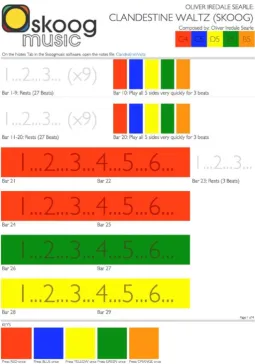
Skoog12 – this instrument, consisting of a pliable cube with a number of large, coloured buttons, acting as a tactile MIDI controller (the result of a research project at the University of Edinburgh, Scotland), was on this occasion played using a type of colour-coded Skore13 – entitled by the company who created the instrument – realising a series of up to 5 different pitches at a time, and aiding the interpretation of musical notation for some individual performers (see Figure 1).
Figure 1 Excerpt from Clandestine Waltz; Technophonia
12http://www.skoogmusic.com
Brainfingers14 – detecting electrical signals from facial muscles through a headband fitted with sensors, which is then converted via software into computer controls, Brainfingers can be customised to control a variety of programmes. In this case, it was used to act as the conductor within Notion15software, enabling the performer to play through complex fragments of especially-composed musical material, also allowing for frequent changes of instrumentation between sections of the new piece, as called upon within the scored part; as a composer, this offers a large amount of creative freedom, in imagining any set of
instrumental forces that might join or augment the existing, live ensemble.
Microscopic Dances
Considering the aforementioned issues of effort and control of musical expression,
inextricably tied with the creation of sound for musicians, I initially wrote the following text as my starting concept for the composition:
Music psychologists tell us regularly about the fantastically complex series of procedures that your brain goes through on its way to performing music. We must interpret pitches, rhythms, dynamics and articulations from a page of music, itself a type of complex language, then begin to realise these through a number of minuscule muscle movements, making decisions about the attack and sustain of individual notes, before moving to the next one.
With or without sheet music, we are looking at others around us, perhaps focusing on a conductor/director, using our ears to decide when to join in with other musicians, altering our pitch by the smallest of microtonal increments and balancing our sound to produce a musical performance.
These tiny movements and processes (many of which are only barely noticeable, or often completely invisible to the human eye), seem to me to be a number of microscopic dances
between our neural processes and motor skills.
I therefore started composing a set of Microscopic Dances16, within which sections of the work are inspired by fragments of dances – often disguised, hidden or warped, hence the title of each section below – which subsequently offered me the opportunity to draw on a number of musical influences, such as Ragtime, Jazz, Scottish Traditional Music, Rock, amongst others, often mixed with Classical Music forms:
Clandestine Waltz Secluded Charleston Secret Cakewalk Atomic Jive Portable Polka Invisible Fandango Veiled Sarabande Concealed Reel
Microscopic Dances 2017
In 2017, I was offered the opportunity to create and develop a new set of Microscopic Dances (extending my knowledge and experiences of working on the previous set), for
performance in the Edinburgh Festival Fringe17 in August 2017, in collaboration with the DMS Digital Orchestra18 – a newer, larger collective of performers of digital instruments – and the National Youth Orchestra of Scotland, with their dedicated new music ensemble, NYOS: Futures19.
A week was spent rehearsing material with the musicians/ensemble, concluding in two performances on the final afternoon, drawing in members of the general public. I recognised that viewing the DMS Digital Orchestra performance in a live context presents a new concert experience for many of those in attendance, (not least of all that it can be challenging to identify the exact source of particular sounds/musicians in performance when newer, digital instruments are incorporated), from which we have begun to develop a best-practice habit of adding discussion between the Artistic Director of DMS and myself after an initial
performance, followed by a further airing of the new work to aid clarification of the musical activity; close-up camera footage of Digital Orchestra performers has also been displayed on a large screen in the past, to encourage audience members to associate certain sounds with individual performers or instruments.
The second instalment of Microscopic Dances was undoubtedly a different working environment from that of before. This was my first opportunity to work with the Digital Orchestra in full (which did not exist in its present form in 2012), in the largest ensemble DMS had worked with so far in a live setting.
I began to consider a number of alterations to my collaborative processes for this latest project – what I had learned from Technophonia and which of the working methods might I develop?:
- Leader of the ensemble – I wanted to provide the opportunity for a number of
individuals to take on this role (rather than relying solely upon myself as conductor/director to make musical decisions).
- Flexibility of tempo and metre – as a number of individuals in the Digital Orchestra
find the sustaining of repetitive, pulse-driven musical material more challenging, I explored a number of ways in which a flexibility of tempo might be incorporated into ensemble performance (for example, two consecutive bars of 4/4 may not be of equal duration), whilst retaining a musical reason for such fluctuations of metre – this might offer further, musically expressive possibilities (e.g. equal to the addition of rubato).
- Integration of digital instruments into larger ensemble – a number of potential
layouts of the overall group were considered, to avoid a situation where it may appear as if a group of digital soloists are sitting in front of accompanying, acoustic soloists (and therefore attempting to eliminate any perceived barriers/hierarchies for all musicians involved).
- Performers controlling duration and direction of musical material – a number of
improvisatory elements existed within the work, once again encouraging the players to explore a number of methods of musical leadership; I offered a number of more open sections in the score, where performers could choose pitches from suggested
17 https://www.eventbrite.co.uk/e/microscopic-dances-a-nyos-futures-and-drake-music-scotland-collaboration-tickets-35630778618#
modes/scales; there also exist a number of repeated sections, for which I have not specified an exact number of repetitions, instead requiring musicians to respond as an ensemble to any structural changes as they arise.
- Roles of instruments and how they might change over time – a number of
different ‘personalities’ were explored for each performer (see below for further details), and the various roles that we find ourselves adopting as musicians.
In considering these changing roles that we may encounter as musicians, I began to make an informal list of aspects of musical performance:
- Sometimes you have a melody to play
- Sometimes you are providing a less prominent melodic line - Sometimes you are accompanying someone else
- Sometimes you play something that contributes to a texture - Sometimes you have to follow someone else’s tempo - Sometimes you have to play slightly quieter than others
- Sometimes you play something that is almost inaudible to you when everyone else is playing
- Sometimes you have to listen to someone across the room (occasionally at the furthest point) from you
- Sometimes you have to make eye contact with someone (occasionally with more than one person at a time), and be aware of what they are doing and how your part
coincides with another musician’s - Sometimes you have to count bars rest
Arguably, these aspects are inextricably tied to an ultimate goal of achieving musical expression in performance; within this latest incarnation of Microscopic Dances, I believe I have allowed all musicians involved to experience each of these aspects at least once.
There was a total of 22 performers onstage for the performances:
NYOS (12 musicians): Flute, Saxophone, Bassoon, Horn in F, Trumpet in Bb, 2 Percussionists, 2 Violins, Viola, 'Cello, Double Bass
Digital Orchestra (10 musicians, each with multiple roles within the ensemble): Keyboards,
iPads, Notion, Handsonic, Drumkit, Percussion, Voice
We had hoped to include as close to a 50:50 split from each organisation in the project as possible – an important goal for us – to aid our work towards equity within the performance environment; this was unfortunately not completely achieved on this occasion due to the illness of two musicians from the Digital Orchestra, shortly before the commencement of rehearsals.
A new addition to the ensemble – since Technophonia – was the iPad, utilising the
Thumbjam20 App, and allowing performers to alter a number of parameters more easily on a
sequence, then leave decisions about the direction of solo material to the discretion of an individual performer, or set small fragments to be read, copied, or extended by musicians. The iPad has arguably changed the role of a digital instrument, offering a broader range of creative and musical possibilities, with fewer limitations over the number of parameters that can be altered in real-time by performers.
As part of the rehearsal process, I relayed several musical fragments aurally to performers, as well as exploring a variety of methods of simplified notation, including some parts adapted with the use of Figurenotes21 for keyboard players (a notation system originating in Finland, which correlates pitches and rhythms to coloured shapes on an instrument). One of the challenges for the Digital Orchestra musicians arose from navigating around a complex, extended piece, with a myriad of different sections, movements and structural changes, much of which individual performers had learned by ear. The role of conductor/director was therefore also extended to include indications for changes in instrumental settings between and during sections, and careful reminders for structural ‘landmarks’ within the new piece as they arose during performance. Standard hand gestures and visual cues were employed to encourage performers to establish eye contact between myself and each other when beating a pulse (especially for those less experienced in watching a conductor while performing), and in sections that were intended to be less reliant upon perfectly synchronised rhythm, simple reminders of dynamic information and structure were indicated (typically with a
raised/lowered hand, or an occasional downbeat to demonstrate arrival at a specific point in the score).
Microscopic Movements
In keeping with the initial concept of Microscopic Dances, I created aselection of new dances between February and July of 2017, some of which suggest a set form in
themselves, with others having strong suggestions of style, movement, or musical starting points for me to explore in a number of ways:
Jimp Jitterbug22 – Jitterbug23 as a dance, seems to have appeared from the 1920s onwards, often characterised by a fast walking bass, repeated drum rhythms, regular chord changes and virtuosic solo instrumental lines. For my own purposes, I coupled this with an archaic, Scots adjective: Jimp24(the alliteration was also appealing); this term is used in relation to someone donning an item of clothing which may appear slightly too small. I had the mental image of a person attempting to dance a Jitterbug while being restricted by trousers that were too tight; this humorous metaphor and visual movement allowed me a mechanism to explore unsettled rhythms, searching for a musical means to incorporate the aforementioned aspect of a flexibility of tempo/metre.
Aside from exploring a higher tempo marking and rhythmic patterns, I also identified sudden changes in the texture/structure of a piece of music as one of the more challenging aspects for the Digital Orchestra musicians – included within this were the acts of preparing to play at a specific point, synchronising with others, or stopping at a set point. To prepare for some of
21https://www.figurenotes.org/
22https://www.youtube.com/watch?v=8QcJzameeBU 23https://www.britannica.com/art/jitterbug
these challenges, I presented the piece in compartmentalised fragments of musical material (that could exist in their own right, or with whatever came before/after), in sections that might be repeated/extended as required.
I was also drawn to the act of placing acoustic and virtual instruments together (the
vibraphone, for example). In Figure 2, a vibraphone line on Notion software is accompanied by an acoustic vibraphone player; the drum rhythm continues at a set tempo, recognising possible fluctuations of tempo from the Notion performer, but allowing the underlying, incessant rhythmic feel of the Jitterbug dance to quietly continue throughout the movement (n.b. exaggerated differences between dynamic markings act as an indicator of the
importance of various lines within the overall texture).
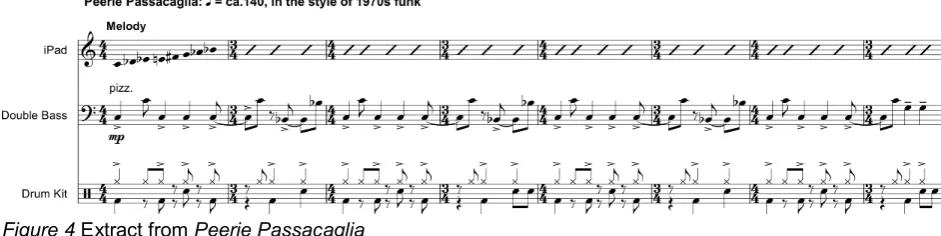
Figure 2 Extract from Jimp Jitterbug
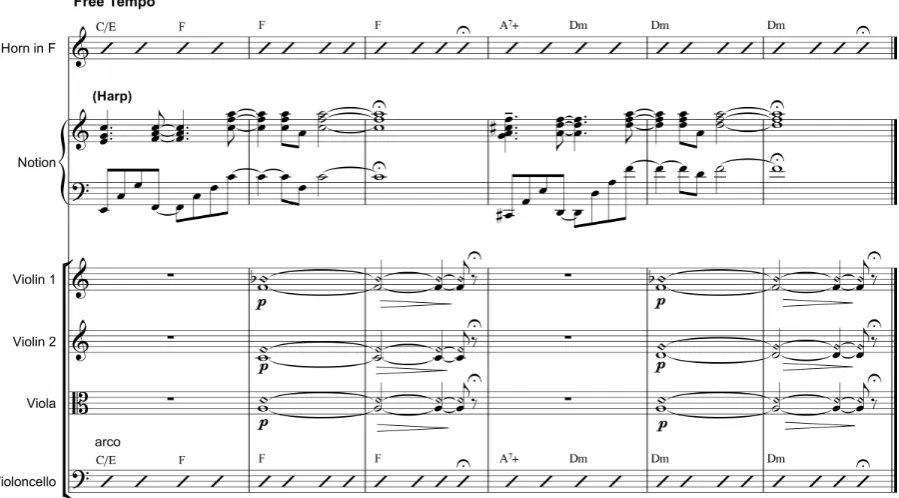
As in standard orchestration practice, these sounds may combine to create something timbrally new or interesting; after meeting one of the Digital Orchestra performers who demonstrated a strong sense of rhythm and memory for the material, I included an electronic string sound on an iPad, doubling a solo violin to highlight a particular melodic line in the texture; similarly, Brainfingers/Notion provided a bassline later in the Jitterbug – this not only offered a rhythmic and structural challenge for the performers, but the
electronically-synthesised sounds add a welcome extension to the acoustic timbres at points in the opening movement.
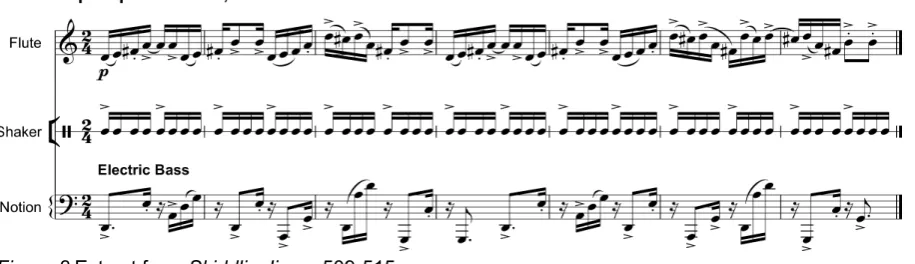
Infinitesimal Tango25 – drawing on the strong stylistic and atmospheric mood of the tango, this section is coupled with the concept of an infinite cycle downwards; a repeating,