Dott. Marco Frego
NUMERICAL METHODS
FOR OPTIMAL CONTROL PROBLEMS
WITH APPLICATION TO AUTONOMOUS VEHICLES
Prof. Enrico Bertolazzi
Prof. Francesco Biral
Numerical Methods for Optimal Control Problems with Application to Autonomous Vehicles
Ph. D. Head’s Prof. Davide Bigoni
Final Examination 07 / 04 / 2014
Board of Examiners
In the present PhD thesis an optimal problem suite is proposed as benchmark for the test of numerical solvers. The problems are divided in four categories, classic, singular, constrained and hard problems. Apart from the hard problems, where it is not possible to give the analytical solution but only some details, all other problems are supplied with the derivation of the solution. The exact solution allows a precise comparison of the performance of the considered software. All of the proposed problems were taken from published papers or books, but it turned out that an analytic exact solution was only rarely provided, thus a true and reliable comparison among numerical solvers could not be done before. A typical wrong conclusion when a solver obtains a lower value of the target functional with respect to other solvers is to claim it better than the others, but it is not recognized that it has only underestimated the true value.
In this thesis, a cutting edge application of optimal control to vehicles is showed: the optimization of the lap time in a race circuit track considering a number of realistic constraints. A new algorithm for path planning is completely described for the construction of a quasiG2fitting of the GPS data
with a clothoid spline in terms of theG1Hermite interpolation problem. In particular the present
algorithm is proved to work better than state of the art algorithms in terms of both efficiency and precision.
In questa tesi di dottorato di ricerca viene presentata una suite di problemi di controllo ottimo per effettuare un confronto tra software che li risolvono numericamente. I problemi sono stati divisi in quattro categorie, classici, singolari, vincolati e difficili. Tranne che per i problemi difficili, per i quali non `e possibile trovare la soluzione analitica a parte qualche dettaglio, tutti gli altri sono stati corredati con la derivazione della soluzione esatta. La sua conoscenza permette di effettuare un confronto preciso sulla performance dei software testati. Tutti i problemi proposti sono stati raccolti da articoli pubblicati o da libri, tuttavia ne `e emerso che solo raramente ne veniva presentata anche la soluzione esatta, dunque finora un confronto realistico e corretto non `e ancora stato possibile. Una conclusione errata tipica `e quella di considerare migliore un software che fornisce un valore del target minore di quello dato da altri, non riconoscendo che sta solamente sottostimando il valore corretto.
In questa tesi `e presentata anche un’applicazione di punta del controllo ottimo applicato a veicoli: l’ottimizzazione del tempo minimo sul giro di un veicolo su un tracciato di gara considerando diversi vincoli realistici. Si descrive anche un nuovo algoritmo per il path planning che costruisce un fitting quasiG2 con clotoidi1 dei dati GPS sfruttando la soluzione del problema di Hermite di interpolazioneG1. In particolare il presente algoritmo `e dimostrato essere migliore degli altri
algoritmi stato dell’arte sia in termini di efficienza sia in termini di precisione.
with Application to Autonomous Vehicles
Tutors:
prof. Enrico Bertolazzi:
prof. Francesco Biral:
Ph.D. candidate:
1 Introduction and Scope 1
1.1 State of Art of Numerical Methods for OCPs 1
1.1.1 Indirect Methods 2
1.1.2 Direct Methods 2
1.1.3 Dynamic Programming 3
1.2 Scope of the Thesis 3
2 Static and Dynamic Optimization 7
2.1 Functions of Real Variable 8
2.1.1 One Real Variable 8
2.1.2 Many Real Variables 10
2.2 Functionals 19
2.2.1 Gˆateaux Variations 22
2.2.2 Convexity 23
2.2.3 The Two Equation of Euler-Lagrange 28
2.2.4 Fr´echet Derivatives 32
2.2.5 Transversal Conditions 34
2.2.6 Integral Constraints 35
2.2.7 Equality Constraints 36
2.2.8 Extension toC1Piecewise Functions 36
2.2.9 Necessary Conditions for Minima 42
2.2.10 Sufficient Conditions for Minima 44
3 Optimal Control 47
3.1 The problems of Mayer, Lagrange and Bolza 48
3.1.1 The Problem of Mayer 48
3.1.2 The Problem of Lagrange 49
3.1.3 The Problem of Bolza 49
3.1.4 Equivalence of the Three Problems 49
3.2 Hamiltonian Formalism 50
3.3 The First Variation 51
3.4 The Second Variation 53
3.5 Sufficient Conditions 55
3.5.1 The Convex Case 56
3.5.2 The General Case 56
3.6 Interpretation of the Multiplier 59
3.7 Different Initial/Final Conditions 60
3.7.1 Free Initial Point 60
3.7.2 Free Final Point 60
3.7.4 Autonomous Problems 61
3.7.5 Minimum Time 61
3.8 Constrained Problems 63
3.8.1 Initial or Final State Constraints 64
3.8.2 Integral Constraints 64
3.8.3 Equality Constraints 65
3.8.4 Inequality Constraints 67
3.8.5 Jump Conditions 69
4 Problems affine in the control 73
4.1 The Hamiltonian Affine in the Control 73
4.2 Bang-Bang Controls 75
4.3 Singular Controls 77
4.3.1 Necessary Condition for Singular Controls 78
4.4 Chattering 82
4.4.1 Sliding Mode 83
4.4.2 Fuller Phenomenon 85
5 Benchmarks on a problem suite 91
5.1 Classic Problems 91
5.1.1 The Brachistochrone 91
5.1.2 Single Integrator Plant 95
5.2 Singular Problems 98
5.2.1 Dubins Car 98
5.2.2 An OCP with Singular Controls 102
5.2.3 Luus n.1 104
5.2.4 Luus n.2 106
5.2.5 Luus n.3 110
5.2.6 Fuller-Marchal 116
5.2.7 Economic Growth 118
5.3 Constrained Problems 122
5.3.1 Constrained Car 122
5.3.2 A Singular Constrained Problem 124
5.4 Hard Problems 126
5.4.1 Hang Glider 126
5.4.2 Luus 4 129
5.4.3 Underwater Vehicle 135
5.4.4 Minimum Lap Time 138
6 Clothoids for Road design 143
6.1 Motivation 144
6.2 Some properties of Fresnel integrals 145
6.3 The Fitting Problem 146
6.4 Recasting the Interpolation Problem 147
6.5 Computing the Initial Guess for Iterative Solution 149
6.6 Accurate Computation of Fresnel Momenta 150
6.6.1 Accurate Computation with Small Parameters 152
6.7 Theoretical Development 154
6.7.1 Symmetries of the Roots ofg(A) 154
6.7.2 Localization of the Roots ofg(A) 155
6.8 Numerical Tests 159
6.10 Conclusions 164
6.11 Algorithms for the Computation of Fresnel Momenta 164
6.11.1 Pseudocode for the computation of generalized Fresnel integrals 164
6.12 Appendix: the fitting with Bezier cubics 167
6.12.1 Introduction to the problem 167
6.12.2 Minimizing single Bezier curves 167
6.12.3 Minimizing piecewise Bezier curve 168
6.12.4 Proof of the theorem 169
6.12.5 An Example: reconstruction of the track of Spa-Francorchamps 173
7 Conclusions 177
1
I N T R O D U C T I O N A N D S C O P E
1.1 S TAT E O F A R T O F N U M E R I C A L M E T H O D S F O R O C P S
The concept of dynamic optimization is the natural extension of the theory of static optimization. Some classic examples of static optimization problems are represented by the Linear Programming (LP), the Quadratic Programming (QP), the integer/mixed integer programming (MIP), and the most famous case of Nonlinear Programming (NLP). In all these problems, the unknowns variables are defined over the real or integer numbersR,Z. The theory of dynamic optimization looks instead at
problems whose unknowns are real functions. The solution of this kinds of problems goes back to the origin of differential calculus and has become an independent branch of research, first in the Calculus of Variations, and nowadays, in the Optimal Control. The first results are due to Leonhard Euler and to the Bernoulli brothers, who gave the foundations of the calculus of variations. In the second half of the XIX century, other important names of Mathematics contributed to theorems of existence as Jacobi and Weierstrass. The passage from calculus of variations to optimal control, is attributed to the Russian mathematician Lev Pontryagin and to the American Richard Bellman in the Fifties of the last century. The first is the founder of theindirectmethods based on variational observations, the second discovered the Dynamic Programming Principle of optimality (Dpp) which gave birth to Dynamic Programming (DP). Later, a new family of numerical methods for the solution of optimal control problems was introduced, it is the family ofdirectmethods based on the direct transcription of the optimal control problem (Figure1.1). Suppose to tackle the following optimal
Numerical Methods for OCP
Direct Methods Indirect Methods DPP Methods
Direct Shooting
Multiple Shooting
Collocation
BVP IDP
Figure 1.1: The main subdivision of numerical methods for optimal control problems.
control problem, consider the time interval[a, b]and a finite sequence of transition points (corner
points)a <s1˜ <s2˜ <· · ·<s˜nd < band a functional to be minimized
minimize: J =ψ(x(a),x(b),p) +
nd
X
k=1
ψk(x+(˜sk),p) +
Z b
a F
(x(s),u(s),p, s) ds,
ODE: f(x,x0,u,p, s) =0,
BC: b(x(a),x(b),p) =0,
at corner points there can be jump/transition conditions or various type of constraints
S(x−(˜sk),x+(˜sk),s˜k) = 0, k= 1,2, . . . , nd,
Pk(x+(˜sk),p,s˜k) = 0, k= 1,2, . . . , nd
where
x+(˜sk) = lim
h→0+x(˜sk+h), x −(˜s
k) = lim
h→0+x(˜sk−h).
S(x−(˜sk),x+(˜sk),s˜k) = 0, k= 1,2, . . . , nd,
Pk(x+(˜sk),p,s˜k) = 0, k= 1,2, . . . , nd
1.1.1 Indirect Methods
The indirect methods are based on the classic theory of calculus of variations and on the famous Pontryagin’s Maximum (Minimum) Principle (PMP). Starting from the necessary first order optimality conditions they obtain a two-point (in general a multi-point) boundary value problem. It is derived from the first variation of the Lagrangian function associated to the optimal control problem. An equivalent derivation is possible taking derivatives of the Hamiltonian function. The boundary conditions of this BV problem are given by the initial/final condition given by the problem itself, other are yielded from the transversal condition of the adjoint variables. Of course, by the intrinsic nature of the optimal control problems, a closed form analytical solution is seldom obtained, but the indirect methods can produce it. In presence of path constraint or inequalities it is difficult to apply the PMP to solve for an explicit formula for the control, this leads to state dependent switches. The claimed disadvantage of the indirect method is that the resulting BV problems are difficult to solve. This is not completely true, because today there are various techniques to solve systems of differential equations. It is also mandatory to analyse the computed solution, because it is only extremal but not necessary a minimum. This can be accomplished inspecting the problem (convexity, second variation, etc). The advantages are given by the underlying philosophy of “first optimize, then discretize”: the boundary value problem has dimension2×nxwherenx is the
number of state variables, therefore even large scale systems are feasible.
1.1.2 Direct Methods
a plethora of state of art solution algorithms are available. Moreover it is easier to treat inequality constraints because they have their natural equivalent form in the associated NLP problem. The principal disadvantage is that direct methods produce only suboptimal or approximate solutions. Nowadays they are very popular because they are easy to understand and apply (no calculus of variations needed), they are also robust.
1.1.3 Dynamic Programming
The third family of numerical methods to solve an optimal control problem is given by algorithms that make use of the Hamilton-Jacobi-Bellman equation. The idea behind this algorithms is the Principle of Optimality, which states that any subarc of an optimal trajectory is also optimal. A grid
a=t0< . . . < tN =bis introduced over the time interval[a, b], and by the principle of optimality,
on each subinterval[tk, tk+1]the restriction of the functional on that interval is optimized. The
resulting partial differential equation is solved recursively backwards starting at the end of the time interval. Advantages of this method are that it searches the whole state space giving a global optimum, can have optimal feedback controls precomputed, admits some analytical solutions (for linear systems with quadratic cost), the so calledviscosity solutionsexist and are feasible for a quite general class of nonlinear problems. The main disadvantage of Dynamic Programming is that the resulting partial differential equation is in a high dimensional space and is in general non tractable. This is what Bellman called the “curse of dimensionality”.
1.2 S C O P E O F T H E T H E S I S
The aim of the present PhD thesis is to propose a suite of optimal control problems together with the derivation of their analytical solution in order to compare the quality of the numerical results given by software numerical solvers. Those analytical solutions allow to understand the difficulties faced by the solvers on some families of problems and give the insight for the design of strategies that enhance the convergence of the numerical methods. The motivation of this study was the validation of the OCP solver XOptima, proposed by the Mechatronic Research Group of the University of Trento. The comparison was done with other three open source software, Acado [HFD11], Gpops [RBD+10], Iclocs [FKvW10]. Acado is developed by the research group lead
by M. Diehl at the University of Leuven; Gpops is the solver proposed by A. Rao and his group at the University of Florida, Gainesville and is used, among the others, by NASA; Iclocs is the software presented by F. Falugi of Imperial College London; XOptima is presented by E. Bertolazzi and F. Biral [BBDL03,BBDL05,BBDL07] and the focus of the thesis is to perform a deep test of its features, starting from the easiest classic problems to the well known hardest problems like the Hang Glider Problem [BNPS91], the third order singular problem proposed by Luus [Luu00] that exhibits the chattering phenomenon discovered by Fuller, the optimization of the minimum lap time for a high performance vehicle on a circuit track, the minimum time manoeuver for an underwater vehicle [CSMV04]. With respect to these problems, it is possible to derive the analytic exact solution only for the second one, for the hang glider it is only possible to compare the solution with two cases1found in literature (only [BNPS91] and [Bet01]), while for the minimum lap time, we can compare the results with the real laps performed by professional drivers and pilots. A relevant part of the thesis is devoted to the study of singular problems in sight of the analysis of the Fuller problem of third order and its numerical treatment from the Sixties until nowadays. It turns out that the formulation proposed by some authors since the Seventies can not exhibit the chattering phenomenon as claimed, this is shown in the section of the problem Luus n.4. In the present thesis it is recognized, for the first time, that the problem proposed in [FO77] is in facts the
1There are other numerical solutions for the Hang Glider problem on the user manuals of other software. They are
third order Fuller problem with an important modification, and that the solution of Luus is not just a suboptimum, but is instead the true minimum. Finally, analytic and numeric details for a whole family of singular problems are given.
Another contribution was the theoretical study of the second variation (taking into account general initial and final conditions) of the functional to be minimized. The second variation leads to sufficient conditions of optimality that can be checkeda posteriori to ensure the presence of the minimum point. It would be interesting, as a future work, to implement the derived second order conditions. While solving OCPs, emerged a new idea on how to solve them with a different approach, which tries to collect the main advantages of the three families of methods described above. As starting point, it is desirable to split the single OCP in segments in order to solve moresmaller problems (calledboxes). This is the idea of the DPP and of the direct methods, what they do not have is the possibility to precompute theglobalcontrol once and for the whole problem. The control is obtained via the Pontryagin’s Maximum Principle or by solving explicitly the equation∂H/∂u= 0(whereH
is the Hamiltonian of the problem), when possible. Another benefit inherited by the indirect method is the additional knowledge of the adjoint variables (costate), that are not considered in the DPP or in some direct methods. They provide a richer differential structure that can be exploited in the solution of the problem.
The single boxes optimize many smaller optimal control problems, while the optimal control is fed
Global Controlu(t) via Pontryagin’s PMP
(x(t),λ(t)) (x(t),λ(t)) (x(t),λ(t)) (x(t),λ(t))
Least Squares
Figure 1.2: The three logical layers of the proposed method.
globally by the Pontryagin’s Maximum Principle. The continuity of the functions and the satisfaction of the various constraints are left to the low-level least squares optimizer. In this way, all the knowledge available on the problem is used, everything will be contained in the boxes that will have a fast feedback. The algorithm works like many black boxes that solve a piece of the original OCP only on a small time interval. The boxes are connected in sequence imposing a nonlinear least square problem to provide continuity of the global solution. The aim is to have very efficient boxes that provide quick solutions for high speed computation of manoeuvers for vehicles. This new algorithm is not described here because it is still improving and under verification. We limit ourselves to report the numerical results obtained for some of the benchmark tests with the label “present method”.
The third scope of this thesis is the application of the techniques described to the field of au-tonomous vehicles, XOptima was born to solve the optimization problems that arose while op-timizing the models of vehicles and the related environment. In the field of intelligent vehicles the optimal control can be used to formulate and solve many interesting problems such as the motion planning and optimal manoeuver tracking in a receding horizon scheme [BBDL+14]. The
first problem (Optimal motion planning) finds the optimal way to drive a vehicle from a pointAto
pointB along a strip of road. It turned out that the description of the road in curvilinear coordinates
(i.e. arc length and curvature) is efficient and quite convenient to impose the path constraints. One common way to describe the road shape in curvilinear coordinates is using a clothoid spline which has some good properties, the most important is that the curvature varies linearly with the arc length, making a clothoid spline superior over other polynomial splines. In facts, it was soon recognized, when using polynomials, that the curvature at the extrema of the intervals of the subdivision was unacceptable. Clothoids are widely used in highways design and are herein applied for the description of the geometry of the road. The problem with this transcendent curve is that the numerical computation of its parameters is very unstable (see [BF14]). The quasiG2
from the practical point of view, the road shape can be derived from the GPS points in cartesian coordinates. The cloud of points is then clustered and fitted with a spline of cubic Bezier curves. From the Bezier spline theG1information is gathered and furnished to the clothoid fitting algorithm.
The complete solution of theG1Hermite interpolation problem with clothoids and with the quasiG2
interpolation with clothoids is exposed in Chapter6and can be found in [BF14]. An open source implementation in Matlab can be found in [BF13].
2
S TAT I C A N D DY N A M I C O P T I M I Z AT I O N
2.1 Functions of Real Variable 8
2.1.1 One Real Variable 8
2.1.2 Many Real Variables 10
2.2 Functionals 19
2.2.1 Gˆateaux Variations 22
2.2.2 Convexity 23
2.2.3 The Two Equation of Euler-Lagrange 28
2.2.4 Fr´echet Derivatives 32
2.2.5 Transversal Conditions 34
2.2.6 Integral Constraints 35
2.2.7 Equality Constraints 36
2.2.8 Extension toC1Piecewise Functions 36
2.2.9 Necessary Conditions for Minima 42
2.2.10 Sufficient Conditions for Minima 44
The concept ofoptimizationis nowadays universal. Among the various way we can perform an action, we are looking to the best way to do it, where the idea of “best” can change from situation to situation. In mathematics optimization makes sense if we can describe the object of our investigation with a model, that is, some equations or expressions. In sight of theOptimal Control Problemwe start with some basic definitions that will help in understanding the successive topics. Once we have a model, depending on the situation, we can be interested in finding maximum or minimum points (or more in general, trajectories) that optimize the model. They are calledextremal values but they do not need to exist. For example, onR, the functionf(x) =xis unbounded and
on the open interval(−1,1), although limited, does not have extremal points. On the other side, on
the interval[−1,1],f assumes both maximum and minimum values. Another important remark
arises noticing that it is not enough to restrict the image to a limited set. In facts, depending on the interval considered, a function can have only one extremal value or can assume it at more than one point. The previous examples show that neither compactness nor continuity can alone ensure the existence of extremal values. The presence of both these conditions leads to the theorem of Weierstrass, which can be weakened for the case of semi continuous functions.
It is clear that even with simple functions we need some necessary and sufficient conditions to ensure thatf has a minimum or a maximum. The problem of finding the maximum off is the
same of the problem of minimum of−f, so we focus only on minimum problems, see Figure2.1.
Let us begin with the discussion on function classes from one to many real variables and then to functionals.
f(x)
x
maxf(x)
min−f(x)
Figure 2.1: The maximum offis the minimum of−f.
2.1 F U N C T I O N S O F R E A L VA R I A B L E
The space of work will beRn or a subsetΩ⊆Rn. We writex∈Rfor a real variable, and use
bold for vectors or matrices,x∈Rn. The components of vectorxarex= (x1, . . . , xn)T, that is,
we consider column vectors with the only exception of the gradient of a functionf :Rn→R, in
that case∇f(x) =
∂f
∂x1, . . . , ∂f ∂xn
is a row vector. In general, the domain is described by some equalitiesh(x) =0withh:Rn→Rnh and some inequalitiesg(x)≥0withg :
Rn →Rng. The
setΩis also called thefeasible set and is defined as
Ω ={x∈Rn |h(x) =0, g(x)≥0}.
Depending on the context, we can have two main classes of functions: smooth and non smooth functions. The first one, splits in continuous functionsC0(Ω,
R), with continuous firstC1(Ω,R) or
secondC2(Ω,
R) derivatives. In particular cases we can have even higher derivatives orC∞(Ω,R)
functions. We will give only a brief survey of the non smooth case, because in our application there will be some regularity. When dealing with Taylor’s expansions, we adopt here thesmallonotation.
Definition 2.1(smallo). Assumeg(x)6= 0for allx6=x0in some interval containingx0, the notation
f(x) = o(g(x)) asx→x0
means that
lim
x→x0
f(x) g(x) = 0.
Some texts use thebigOnotation for the remainder, this means the following. For a function
g(x)6= 0for allx6=x0in some interval containingx0, we say thatf(x) =O(g(x))asx→x0if and
only if there exist a constantAsuch that|f(x)| ≤A|g(x)|for allxin a neighbourhood ofx0.
2.1.1 One Real Variable
Definition 2.2. The functionf has alocal minimumat pointx0if for allx∈(x0−δ, x0+δ)with
δ >0 isf(x) ≥f(x0). The function f has aglobal minimumat pointx0 on an interval[a, b] if
In this definition there are no differentiability nor continuity assumptions. An easy necessary condition for the smooth case is the following proposition.
Proposition 2.3(Necessary condition). The necessary condition for a differentiable functionf(x)
to have a local minimum atx0is
f0(x0) = 0.
An useful sufficient condition to ensure a minimum is given by the next proposition.
Proposition 2.4(Sufficient condition). The sufficient condition for a twice differentiable function
f(x)to have a local minimum atx0is
f0(x0) = 0, f00(x0)>0.
From these easy examples we see that even for a smooth function in one real variable there is not a criterion for a local minimum both sufficient and necessary.
In some situations we do not have smooth functions, not even continuous functions, therefore we need a way to characterize their minima. Loosing for the moment the hypothesis of continuity, we observe thatf :I→R, whereI⊂R, has a minimum atx0if
inf
I f =f(x0).
It follows thatf limited is a necessary condition, but we need aminimizing sequence{xn} ⊂I
such thatxn→xwith
lim
n→∞f(xn) = infI f
such that there is a convergent subsequence tox0. We also need a second property,f has to be
lower semi-continuousatx0(see Figure2.2), i.e. for everyε >0there exists a neighbourhoodU
ofx0such thatf(x)≥f(x0)−εfor allx∈U, this can be written as lim inf
x→x0
f(x)≥f(x0).
Sequential compactness and lower semi-continuity should be both present to ensure the existence
x
0f
(
x
)
x
Figure 2.2: A lower semi-continuous function
Theorem 2.5(Weierstrass). If a functionf : [a, b] →(−∞,∞]is lower semi-continuous in[a, b]
thenf is bounded below and attains its minimum.
Looking at a computational approach, these results only give existence of the minimum, but in order to find it, when possible, we try to solvef0(x) = 0and check the nature of the stationary
points. Thecalculus of variationsarises as a generalization of these concepts, and applies to functionals. Before introducing functionals and optimal control, we discuss further the minimum problems of real functions.
From standard calculus, using the Taylor expansion of a continuously differentiable functionf(x),
we have
f(x+ ∆x) =f(x) +f0(x)∆x+ o(∆x),
whereo(∆x)is the Peano’s remainder which means that
lim ∆x→0
f(x+ ∆x)−f(x)−f0(x)∆x
∆x = 0.
This expansion extends to functions havingmcontinuous derivatives.
f(x+ ∆x) =f(x) +f0(x)∆x+1 2f
00(x)∆x2+
· · ·+ i m!f
(m)(x)∆xm+ o(∆xm).
Iff is twice differentiable, the conditions of minimum can be retrieved as follows,
f(x+ ∆x)−f(x) =f0(x)∆x+1 2f
00(x)∆x2+ o(∆x2).
The right-hand side has the form of a quadratic in∆x,a∆x2+b∆x+ o(∆x2). Ifb =f0(x)6= 0, for∆xsmall enough, the sign off(x+ ∆x)−f(x)is determined by that of b∆x. If b > 0 we
havef(x+ ∆x)−f(x)>0and we arrive back to the necessary condition. Suppose now that b = f0(x) = 0, then the term f00(x)∆x2 defines the value of the right-hand side when∆xis
sufficiently small. Sof00(x)>0is enough to ensure the presence of a minimum.
2.1.2 Many Real Variables
Now we extend some of the previous results and definitions to functions ofnreal variables. Let x= (x1, . . . , xn)T.
Definition 2.6. The functionf :Rn→Rhas a global minimum inx0if
f(x0)≤f(x0+∆x)
holds for all nonzero∆x= (∆x1, . . . ,∆xn)∈ Rn. Pointx0 is a local minimum if there exists a
radiusr >0such thatf(x0)≤f(x0+∆x)whenever||∆x||< r.
Proposition 2.7(Necessary condition). The necessary condition for a differentiable functionf(x)
to have a local minimum atx0is
∂f ∂xi
(x)
x=x
0
To express the sufficient second order condition, we need the extension of Taylor formula ton
variables. Letf(x)possess all continuous derivatives up to second order in some neighbourhood
of a pointxand supposex+ ∆xlies in this neighbourhood, then
f(x+t∆x) = f(x) + df(x+t∆x) dt t =0 t+1
2
d2f(x+t∆x) dt2 t =0
t2+o(t2)
=f(x) +
n
X
i=1 ∂f(x)
∂xi
∆xi+
1 2
n
X
i,j=1
∂2f(x) ∂xi∂xj
∆xi∆xj+ o(||∆x||2).
Proposition 2.8(Sufficient condition). The sufficient condition for a twice differentiable function
f(x)to have a local minimum atx0is
d2f(x0+t∆x) dt2 t=0 >0
for||∆x||small enough. The associated quadratic form in the variables∆xiis
1
2 ∆x1 ∆x2 · · · ∆xn
∂2f(x) ∂x1∂x1 . . .
∂2f(x) ∂x1∂xn
..
. . .. ...
∂2f(x) ∂xn∂x1 · · ·
∂2f(x) ∂xn∂xn
∆x1 ∆x2 .. . ∆xn = 1 2∆x TH∆x.
The matrixH(x)is theHessian matrix1. A sufficient condition for a local minimum is thatH(x0)is Symmetric Positive Defined (SPD).
2.1.2.1 Constrained Optimization
We need further theory when searching for minima on a constrained domainΩ⊂Rn.
Definition 2.9(Active constraint). An inequality constraintgi(x)≥0is called active constraint
atx0 ∈Ωif and only ifgi(x0) =0, and otherwiseinactive. The index setA(x0)⊂ {1, . . . , ng}of
active constraints is calledactive set.
Definition 2.10(Constraint qualification). Thelinear independence constraint qualificationholds atx0∈Ωif and only if all vectors (for the equalitiesh)∇hj(x0)forj= 1, . . . nhand∇gi(x0)for
i∈ A(x0)are linearly independent.
We can now state the famousKarush-Kuhn-Tucker optimality conditionsas first order necessary and second order sufficient conditions. We introduce here also theLagrangianfunction. Consider the constrained minimization problem
minimize: f(x)
subject to: hi(x) = 0 i= 1,2, . . . , m
The solution algorithm prescribes to form the Lagrangian function
L(x,λ) =f(x)−
m
X
k=1
λkhk(x)
and to solve the nonlinear system∇xL(x,λ) = 0T withh(x) = 0. The for each solution point
(x?,λ?)compute
∇h(x?)and check it is full rank, e.g. the rows are linearly independent. Compute
the matrixK, the kernel of ∇h(x?), i.e.
∇h(x?)K = 0. Then project the reduced Hessian
∇2
xL(x?,λ?)in the kernel of the constraintsK:
H=KT
∇2
xL(x
?,λ?)K,
Anecessary condition of optimality is thatHis semi positive definite, asufficientcondition is that
His positive defined, briefly written, the two conditions are respectivelyH0andH0. The
next theorem proves those conditions.
Theorem 2.11(Lagrange multipliers). Letf ∈C2(
Rn,R)a map andx?alocal minimumoff(x)
satisfying the constraintsh∈C2(
Rn,Rm), i.e. h(x?) =0. If∇h(x?)isfull rank, then there exists
mscalarsλk such that
∇xL(x?,λ) =∇f(x?)−
m
X
k=1
λk∇hk(x?) =0T (A)
moreover, for allz∈Rnwhich satisfy∇h(vX(s))z=0it follows
zT∇2
xL(x
?
,λ)z =zT ∇2f(x?
)−
m
X
k=1
λk∇2hk(x?)
!
z≥0 (B)
in other words the matrix∇2x f(x?)−λ·h(x?)
is semi-SPD in the Kernel of∇h(x?).
Proof. Letx?be a local minimum, then there existsε >0such that
f(x?)
≤f(x), for allx∈B withh(x) =0, (2.1)
whereB={x | kx−x?
k ≤ε}. Consider thus, the functions sequence fk(x) =f(x) +kkh(x)k
2
+αkx−x?k2, α >0 (2.2)
with the corresponding sequence of (unconstrained) local minima inB: xk =argmin
x∈B
fk(x).
The sequence xk is contained in the compact ball B and from compactness, there exists a
converging sub-sequencexkj →x¯∈B. The rest of the proof is to verify thatx¯=X(s)and it is a
minimum.
Step 1:h( ¯x) =0. Notice that the sequencexksatisfyfk(xk)≤f(x?), in fact
fk(xk)≤fk(x?) =f(x?) +kkh(x?)k
2
+αkx?
−x?
k2=f(x?).
and by definition (2.2) we have
kj
h(xkj)
2 +α
xkj −x
?
2
≤ f(x?)
−f(xkj)
≤ f(x?)
−min
x∈Bf(x) =C <+∞
(2.3)
so that
lim
j→∞ h(xkj)
= 0 ⇒ h lim
j→∞xkj
=kh( ¯x)k= 0 ⇒ h( ¯x) =
Step 2:x¯ =x?. From (2.3)
α
xkj −x
?
2
≤f(x?)
−f(xkj)−kj
h(xkj)
2
≤f(x?)
−f(xkj)
and taking the limit
α
jlim→∞xkj −x
? 2
≤αkx¯−x?k2≤f(x?)− lim
j→∞f(xkj)≤f(x
?
)−f( ¯x)
Fromkh( ¯x)k= 0it follows that from (2.1) thatf(x?)
≤f( ¯x)and αkx¯−x?k2≤f(x?)−f( ¯x)≤0
and, thusx¯=x?.
Step 3: Build multipliers. Becausexkj areunconstrained local minimaforfkj(x), it follows that ∇fkj(xkj) =∇f(xkj) +kj∇
h(xkj)
2
+α∇
xkj −x
?
2 =0.
Recalling that
∇ kxk2 =∇(x·x) = 2xT,
∇ kh(x)k2 =∇(h(x)·h(x)) = 2h(x)T
∇h(x),
it follows (after transposition)
∇f(xkj)
T + 2k
j∇h(xkj)
Th(x
kj) + 2α(xkj−x
?) =0. (2.4)
Left multiplying by∇h(xkj) ∇h(xkj)
∇f(xkj)
T + 2α(x kj −x
?)
+ 2kj∇h(xkj)∇h(xkj)
Th(x kj) =0.
Now∇h(x?)
∈Rm×n is full rank forjlarge by continuity,∇h(xkj)is full rank and thus the matrix ∇h(xkj)∇h(xkj)
T
∈Rm×mis nonsingular, thus
2kjh(xkj) =− ∇h(xkj)∇h(xkj)
T−1
∇h(xkj)
∇f(xkj)
T + 2α(x kj −x
?)
taking the limit forj → ∞
lim
j→∞2kjh(xkj) =− ∇h(x
?)
∇h(x?)T−1
∇h(x?)
∇f(x?)T =
−λ (2.5)
and taking the limit of (2.4) with (2.5) we have∇f(x?)T
− ∇h(x?)Tλ=0.
Step 4: Build a special sequence ofzj. We need a sequencezj →zsuch that∇h(xkj)zj=0
for allj. The sequencezj is built as the projection ofzinto the kernel of∇h(xkj), i.e.
zj=z− ∇h(xkj)
T
∇h(xkj)∇h(xkj)
T−1
∇h(xkj)z,
in facts
∇h(xkj)zj = ∇h(xkj)z− ∇h(xkj)∇h(xkj)
T
∇h(xkj)∇h(xkj)
T−1
∇h(xkj)z
consider now the limit
lim
j→∞zj =z−jlim→∞∇h(xkj)
T
∇h(xkj)∇h(xkj)
T−1
∇h(xkj)z
=z− ∇h(x?)T
∇h(x?)
∇h(x?)T−1
∇h(x?)z
and thus, ifzis in the kernel of∇h(x?), i.e.
∇h(x?)z=0we have
∇h(xkj)zj =0 with jlim
→∞zj =z.
Step 5: Necessary conditions. Because xkj are unconstrained local minima for fkj(x), it
follows that matrices∇2f
kj(xkj)are semi positive defined, i.e. zT∇2f
kj(xkj)z≥0, ∀z∈R
n
moreover
∇2f
kj(xkj) = ∇ 2f(x
kj) +k∇ 2
h(xkj)
2
+ 2α∇(xkj −x
?
)
= ∇2f(x
kj)
T+k
∇2
m
X
i=1
hi(xkj)
2+ 2αI (2.6)
using the identity
∇2h(x)2=
∇(2h(x)∇h(x)T) = 2
∇h(x)T
∇h(x) + 2h(x)∇2h(x)
in (2.6)
∇2fkj(xkj) =∇ 2f(x
kj) + 2kj
m
X
i=1
∇hi(xkj)
T
∇hi(xkj) + 2kj
m
X
i=1
hi(xkj)∇ 2h
i(xkj) + 2αI.
Letz ∈Rn, then0≤zT∇2fkj(xkj)z, that is
0≤zT∇2f(x
kj)z+
m
X
i=1
(2kjhi(xkj))z
T
∇2h
i(xkj)z+ 2kj
∇h(xkj)z
2
+ 2αkzk2.
The inequality is true for allz∈Rn and thus for anyzin the kernel of∇h(x?). Choosingzin the
kernel of∇h(x?), from the previous step, the sequencez
jsatisfies
0≤zT
j∇2f(xkj)zj+
m
X
i=1
(2kjhi(xkj))z
T
j ∇2hi(xkj)zj+ 2αkzjk 2
and taking the limitj→ ∞with (2.5)
0≤zT
∇2f(x?)z+ m
X
i=1
λizT∇2hi(x?)z+ 2αkzk
2 .
The value ofα >0can be chosen arbitrarily, therefore
0≤zT
∇2f(x?)z
− m X i=1 λi zT
∇2h
i(x?)z
It is possible to adapt theorem2.11for inequality constraints. Consider the NLP problem
minimize: f(x)
subject to: hi(x) = 0 i= 1,2, . . . , m
gi(x)≥0 i= 1,2, . . . , p
introducing theslackvariablesei,i= 1,2, . . . , pandyT = (xT,eT)the new problem
minimize: f(y) =f(x)
subject to: hi(y) =hi(x) = 0 i= 1,2, . . . , m
hi+m(y) =gi(x)−e2i = 0 i= 1,2, . . . , p
with the Lagrangian function:
L(x,e,λ,µ) =f(x)−
m
X
k=1
λkhk(x)− p
X
k=1
µk gk(x)−e2k
The first order condition becomes
∇xL(x?,e,λ,µ) = ∇f(x?)−
m
X
k=1
λk∇hk(x?)− p
X
k=1
µk∇gk(x?) =0T,
∇eL(x?,e,λ,µ) = 2(µ1e1, . . . , µpep) =0T,
hk(x?) = 0,
gk(x?) = e2k≥0,
and the second order condition becomeszT
∇2 (x,e)L(x
?,e,λ,µ)z
≥0for z in the kernel of the
matrix
∇xh(x?) 0
∇xg(x?) 2diag(e1, . . . , ep)
(2.7)
where
∇2
(x,e)L(x?,e,λ,µ)z=
∇2
xL(x?,e,λ,µ) 0
0 ∇2eL(x?,e,λ,µ)
(2.8)
and∇x∇TeL(x?,e,λ,µ) =0, moreover
∇2xL(x
?,e,λ,µ) =
∇2f(x?)
−
m
X
k=1
λk∇2hk(x?)− p
X
k=1
µk∇2gk(x?),
∇2
eL(x
?,e,λ,µ) = 2diag(µ1, µ2, . . . , µ p).
Notice thatµkek = 0is equivalent ofµke2k = 0and thusµkgk(x?) = 0. So that whengk(x?)>0
thenµk= 0. Up to a reordering, we splitg(x) =
g(1)(x) g(2)(x)
where
gk(x?) = e2k = 0, k= 1,2, . . . , r
and thus (2.7) becomes
∇xh(x?) 0 0
∇xg(1)(x?) 0 0
∇xg(2)(x?) 0 E
, 2diag(ek+1, . . . , ep) =E. (2.9)
and
∇2
eL(x
?
,e,λ,µ) =
M 0
0 0
, M = 2diag(µ1, µ2, . . . , µr) (2.10)
The group of constraintsg(1)(x?)that are zeros are the active constraints. The kernel of (2.9) can
be written as
K=
K 0
0 I
−E−1∇
xg(2)(x?)K 0
, (2.11)
whereKis the kernel of the matrix
∇xh(x?)
∇xg(1)(x?)
thuszcan be written as the scalar productKdand thus the second order necessary condition zT
∇2
(x,e)L(x?,e,λ,µ)z≥0becomes 0≤dThKT
∇2(x,e)L(x
?,e,λ,µ)Kid, d
∈Rs
and using (2.11) with (2.8) and (2.10)
h
KT∇2(x,e)L(x?,e,λ,µ)Ki = KT
∇2
xL(x?,e,λ,µ) 0 0
0 M 0
0 0 0
K,
=
KT
∇2
xL(x?,e,λ,µ)K 0
0 M
.
Using the solution algorithm of the equality constrained problem, we have
• Necessary condition: the matrices KT∇2
xL(x
?
,e,λ,µ)K, and M
must be semi positive defined. This implies thatµk≥0fork= 1,2, . . . , p
• Sufficient condition: the matrices KT
∇2
xL(x?,e,λ,µ)K, and M
must be positive defined. This implies thatµk>0for the active constraints.
Consider the constrained minimization problem NLP
minimize: f(x)
subject to: hi(x) = 0 i= 1,2, . . . , m
gi(x)≥0 i= 1,2, . . . , p
(2.12)
• Compute the Lagrangian function:
L(x,λ,µ) =f(x)−
m
X
k=1
λkhk(x)− p
X
k=1
µkgk(x)
• Solve the nonlinear system
∇xL(x,λ,µ) = 0T
hk(x) = 0 k= 1,2, . . . , m
µkgk(x) = 0 k= 1,2, . . . , p
and keep only the solutions withµ?
k≥0andgk(x?)≥0.
• For each solution point(x?,λ?,µ?)compute
∇h(x?)with
∇gk(x?)wheregk(x?) = 0are the
active constraints withµk>0and check they are linearly independent.
• Compute matrix K the kernel of∇h(x?) with
∇gk(x?)where gk(x?) = 0are the active
constraints withµk>0.
• Compute the reduced Hessian
H=KT
∇2xL(x
?,λ?)K,
– Necessary condition:His semi-positive definite.
– Sufficient condition:His positive definite andµk >0for all the active constraints.
The following theorem (see [Joh48]) give the necessary conditions for constrained minima. Notice that no condition on the constraints are necessary.
Theorem 2.12 (Fritz John). If the functions f(x), g1(x),. . . , gp(x), are differentiable, then a
necessary condition forx?to be a local minimum to problem:
minimize: f(x)
subject to: gi(x)≥0 i= 1,2, . . . , p
is that there exist scalarsµ?
0,µ?1,µ?p, (not all zero) such that the following inequalities and equalities
are satisfied:
∇xL(x?,µ∗) = 0T
µ?kgk(x?) = 0, k= 1,2, . . . , p;
µ?
k ≥ 0, k= 0,1,2, . . . , p;
where
L(x,µ) =f(x)−
p
X
k=1
µkgk(x)
Definition 2.13(Constraints qualification LICQ). Let the unilateral and bilateral constraints beg(x)
andh(x), the pointX(s)is admissible if
gk(x?)≥0, hk(x?) = 0.
The constraintsg(x)andh(x)arequalifiedatx?if the pointx?is admissible and the vectors
{∇gk(x?) : k∈ A(X(s))}
[
{∇h1(x?),∇h2(x?), . . . ,∇hm(x?)}
arelinearly independent.
Definition 2.14(Constraint qualification (Mangasarian-Fromovitz)). The constraintsg(x)andh(x)
arequalifiedatx?, if the pointx?is admissible and it does not exists a linear combination m
X
k∈A(x?)
αk∇gk(x?) + m
X
k=1
βk∇hk(x?) =0
withαk ≥0fork∈ A(x?)andαkwithβknot all0. In other words, there is not a non trivial linear
combination of the null vector such thatαk≥0fork∈ A(x?).
The next theorems are taken from [NW06].
Theorem 2.15 (First order necessary conditions). Let f ∈ C1(
Rn) and the constraints g ∈
C1(
Rn,Rp) and h ∈ C1(Rn,Rm). Suppose that x? is a local minimum of (2.12) and that the
constraints qualification LICQ holds atx?. Then there are Lagrange multiplier vectorsλandµ
such that the following conditions are satisfied at(x?,λ,µ)
∇xL(x?,λ?,µ?) = 0T
hk(x?) = 0, k= 1,2, . . . , m;
µ?
kgk(x?) = 0, k= 1,2, . . . , p;
µ?
k ≥ 0, k= 1,2, . . . , p;
where
L(x,λ,µ) =f(x)−
m
X
k=1
λkhk(x)− p
X
k=1
µkgk(x)
Theorem 2.16 (Second order necessary conditions). Letf ∈ C2(
Rn)and the constraintsg ∈
C2(
Rn,Rp)andh∈C2(Rn,Rm). Letx?satisfying the First order necessary conditions, a
neces-sarycondition forx?be alocal minimumis that them+pscalars (Lagrange Multiplier) of the first
order necessary condition satisfy:
dT∇2
xL(X(s),λ∗,µ∗)d≥0
for alldsuch that
∇hk(x?)d= 0, k= 1,2, . . . , m
∇gk(x?)d= 0, ifk∈ A(x?)andµk >0
Remark 2.17. The conditions
∇gk(x?)d= 0, ifk∈ A(x?)andµk >0
∇gk(x?)d≥0, ifk∈ A(x?)andµk = 0
restrict the space of direction to be considered. If changed with
∇gk(x?)d= 0, ifk∈ A(x?)
theorems2.16is still valid because the necessary condition is tested in a smaller set.
Theorem 2.18 (Second order sufficient conditions). Let f ∈ C2(Rn) and the constraints g ∈
C2(
Rn,Rp)andh∈C2(Rn,Rm). Letx?satisfy the First order necessary conditions, asufficient
condition forx?be alocal minimumis that them+pscalars (Lagrange Multiplier) of the first order
necessary condition satisfy:
dT
∇2xL(x
?,λ?,µ?)d>0
for alld6=0such that
∇hk(x?)d= 0, k= 1,2, . . . , m
∇gk(x?)d= 0, ifk∈ A(x?)andµk >0
∇gk(x?)d≥0, ifk∈ A(x?)andµk = 0
Remark 2.19. The condition
∇gk(x?)d≥0, ifk∈ A(x?)andµk= 0
restrict the space of direction to be considered. If omitted, theorem2.18is still valid because the sufficient condition is tested in a larger set.
2.2 F U N C T I O N A L S
The generalization of the concept of function, that is a special function in which the independent variable is a function itself, is called afunctional. The object of the calculus of the variations is to find the functions that minimize a given functional. A classic example of a functional is the length of a curve. If we consider a curve in the(x, y)⊂R2plane, i.e. a function in the formy=y(x), the
total length of the curve in the interval[a, b]is the integral
J(y) =
Z b
a
p
1 +y0(x)2dx.
The general form of a functional in calculus of variations will depend not only on the value of the functiony(x)itself, but also on its derivativey0(x),
J(y) =
Z b
a
f(x, y, y0) dx:=
Z b
a
f[y] dx. (2.13)
discontinuities produce bang-bang controls.
We consider the functionalJ defined on a subsetDof a linear spaceY. We have to put some care
in the choice of the subsetD, because, for exampleD={y ∈C[a, b]|y(a) = 0, y(b) = 1}is not
a linear space, while the subsets of vector valued functions with components inC(R)are linear.
When in equation (2.13),f ∈C([a, b]×R2), then J is defined onY =C1[a, b], because for each
functiony∈ Y,f(x, y, y0)∈C[a, b]. But whenf ∈C([a, b]×D), whereD⊂R2, thenJ is defined
only on a subset ofD={y∈C1[a, b]
|(y, y0)∈D ∀x∈[a, b]}. This shows that there are various situations when we try to optimize a functionalJ over a subsetDofY. It is not strange that the natural domain ofJ can be larger thanDand can beYitself.
IfY is the vector spaceRn it is routine to associate each vector to a real number, given by a
norm. IfY=C[a, b]there are various choices for a norm,||y||M = maxx∈[a,b]|y(x)|determines the
maximumnorm (see Figure2.3,||y||1=R
b
a|y(x)|dxis also common, the Euclidean norm||y||2
is difficult to employ because it is nontrivial to apply. Once we have chosen a norm, we define continuity of a functional as follows.
f(x)
x δ
δ
f−δ f1
f f2
f+δ
Figure 2.3: The graph of a family of functionsfi∈ Y=C[a, b]uniformly bounded withinδwith respect to the graph off.
Definition 2.20(continuity for functionals). In a normed linear spaceY, ifD ⊂ Y, a functional
J : D → R is continuous at y0 ∈ D if and only if for each ε > 0 exists a δ > 0 such that
|J(y)−J(y0)|< εfor ally∈ Dwith||y−y0||< δ.
In sight of the equivalent version of the theorem of Weierstrass for functionals, the next lemma yields a general result on continuity.
Lemma 2.21. If K is a compact set in a normed linear spaceY, then a continuous functional
J :K →Risuniformlycontinuous onK, that is, forε >0there existsδ >0such thaty, y0∈K
with||y−y0||< δimply that|J(y)−J(y0)|< ε.
It is not a surprise that a continuous functional on a subset of a linear space need not to admit neither a maximum nor a minimum value on this subset, unless compactness is present.
Theorem 2.22(Weierstrass for functionals). LetJ : K →Rbe a continuous functional on the
compact setK, thenJ assumes both maximum and minimum values at points inK, in particular these values are finite.
maximum norm is not compact, e.g.J(y) =y(1)is unbounded. In facts the sequence given by yn(x) =nxforx∈[0,1], for whichJ(yn) =n→+∞diverges.
As with in the static optimization problems, we are interested in the extremal (minimum) values of a functionalJ, they occur aty0∈ Dwhen
J(y0)≤J(y) ∀y∈ D.
As said before, maximum points ofJ can be obtained from−J(y0)≤ −J(y), we can focus only on
minimum points.
Proposition 2.23. An elementy0∈ Dminimizes (globally)J onDif and only if
J(y0+v)−J(y0)≥0 ∀y0+v∈ D, (2.14)
the equality holds if and only ifv = 0. Moreover if c0, c 6= 0 are constants,y0 minimizes also
c2J+c0.
Example 2.24. This proposition has interesting applications, consider the functional J(y) =
Rb
ay0(x)
2dxon the set
D= {y ∈ C1[a, b]
|y(a) = 0, y(b) = 1}. It is clear thatJ ≥ 0and that
J(y) = 0fory0 = 0, buty =kwithkconstant is not an element ofD, therefore we should use equation(2.14):
J(y0+v)−J(y0) =
Z b
a
(y00(x) +v0(x))2−y00(x)2dx
=
Z b
a
v0(x)2dx+ 2
Z b
a
y00(x)v0(x) dx
≥2
Z b
a
y00(x)v0(x) dx.
Observing that0 = y0(a) = (y0+v)(a) =y0(a) +v(a) = 0, we have thatv(a) = 0and with the same argumentv(b) = 0. If we tryy0
0(x) =kfor a constantk, the last integral becomes
Z b
a
y00(x)v0(x) dx=k
Z b
a
v0(x) dx=k(v(b)−v(a)) = 0 ∀v.
This shows that equation(2.14)is satisfied, and one can show that the minimizing function is
y0(x) = x−a
b−a. The equality is also satisfied because it is required thatv0(x)
2 = 0 =⇒ v(x) =
const = v(a) = 0, hencev = 0. The second part of the proposition shows that y0 minimizes uniquely also
˜ J(y) = 2
Z b
a
y0(x)2−exdx= 2
Z b
a
y0(x)2dx+ 2
Z b
a
exdx=c2J(y) +c0.
The minimization of functional constrained to the level set of a vector valued functionh=0
reflects the technique of the Lagrange multiplier for static optimization. We transform the original functional in an augmented one without constraints.
Proposition 2.25. If the functionalJ and the functionh= (h1, . . . , hN)T are defined onD, and
for some constantsλ1, . . . , λN the functiony0minimizesJ1=J+λ1h1+. . .+λNhN onD, then
2.2.1 G ˆateaux Variations
In order to further characterize the extremal values of a functional, we have to introduce the analogue of the partial derivatives for real valued functions. In general we will not have partial derivatives but only directional derivatives, which are called Gˆateaux Variations.
Definition 2.26. The G ˆateaux variation ofJ atyin the directionvfory, v∈ Y is
δJ(y;v) := lim
ε→0
J(y+εv)−J(y)
ε =
d
dεJ(y+εv)
ε=0
,
assuming that the limit exists.
The existence of the limit relies on the definition ofJ(y)andJ(y+εv)for sufficently smallε, and
on the existence of the ordinary derivative inε. The variation need not to exist in any direction or it
may exist only in some directions. It has the properties of linearity of the standard derivatives. When J is a real function, y,v real vectors, then δJ(y;v) = ∇J(y)·v is just the directional
derivative ofJ whenvis a unit vector.
Definition 2.27. In a normed linear spaceY, the G ˆateaux variations δJ(y;v)of a real valued functional are said to beweaklycontinuous aty0∈ Yif for eachv∈ Ywe have thatδJ(y;v)→ δJ(y0, v)asy→y0.
Example 2.28. ConsiderY=C[a, b]and the functional,J =Rb
a y
2(x) +exdxwhich is defined for
ally∈ Y. For fixedy, v∈ Y andε6= 0we have that alsoy+εv∈ Ybecause it is a linear space, hence
J(y+εv) =
Z b
a
(y+εv)2(x) +exdx
is well defined. After some manipulations we have
J(y+εv)−J(y)
ε =
1 ε
Z b
a
(y+εv)2(x)−y2(x) dx
= 1 ε
Z b
a
y2(x) + 2εy(x)v(x) +ε2v2(x)
−y2(x) dx
= 2
Z b
a
y(x)v(x) dx+ε
Z b
a
v2(x) dx.
Whenε→0, the variation becomes
δJ(y;v) = 2
Z b
a
y(x)v(x) dx ∀y, v∈ Y.
The other way to computeδJ(y;v)is to make use of the explicit formula given in the definition of
variation d
dεJ(y+εv)
ε=0
and compute
J(y+εv) =
Z b
a
(y+εv)2(x) +exdx
=
Z b
a
y2(x) +exdx+ 2ε
Z b
a
y(x)v(x) +ε2
Z b
a
v(x)2dx.
For fixedy, vthe derivative of the previous expression becomes
d
dεJ(y+εv) = 2
Z b
a
y(x)v(x) dx+ 2ε
Z b
a
thus the variation is
δJ(y;v) = 2
Z b
a
y(x)v(x) dx.
Although the second method is technically easier, because of the familiarity with usual differenti-ation methods, it requires that d/dεJ exist for smallε6= 0and that it be continuous atε= 0. The
first method requires only the existence of the derivative atε= 0.
We collect in the next table some remarkable variations of functionals that are often encountered. Supposef or(x(t), y(t))are continuous functions over the appropriate domain.
J(y) δJ(y;v)
Z b
a
f(x)p1 +y0(x)2dx
Z b
a
f(x)y0(x)v0(x)
p
1 +y0(x)2 dx
Z b
a
f[y(x)] dx
Z b
a
fy[y(x)]v(x) +fy0[y(x)]v0(x) dx
Z b
a
siny(x) dx+y2(b)
Z b
a
v(x) cosy(x) dx+ 2y(b)v(b)
Z 1
0
x(t)y(t) dt
Z 1
0
x(t)v0(t) +y0(t)u(t) dt
Z b
a
f(x,y(x),y0(x)) dx
Z b
a
fy[y(x)]v(x) +fy0[y(x)]v0(x) dx
Z
D
q
1 +u2
x+u2ydA
Z
D
uxvx+uyvy
q
1 +u2
x+u2y
dA
Z b
a
f(x, y, y0, y00) dx
Z b
a
fy[y]v(x) +fy0[y]v0(x) +fy00[y]v00(x) dx
We conclude this section with some properties of the Gˆateaux variations.
Proposition 2.29. IfδJ(y;v)andδJ1(y;v)both exist fory, v∈ Y and supposingf ∈C1(
R), then
• δ(JJ1)(y;v) =δJ(y;v)J1(y;v) +J(y;v)δJ1(y;v),
• δ(J/J1)(y;v) = δJ(y;v)J1(y;v)−J(y;v)δJ1(y;v)
J1(y;v)2 ,
• δ(f(J))(y;v) =f0(J(y))δJ(y;v).
• IfJ is a linear functional onY, its variation is simplyδJ(y;v) =J(v).
2.2.2 Convexity
More about the existence of a minimum point can be said when there is the condition of convexity. We introduce the matter on sets and functions first, then we generalize it to functionals.
Definition 2.30(Convex set). A setAis convex if the line segment between any two points inA
lies inA, that is, for anyx1, x2∈Aand for anyα∈[0,1],
αx1+ (1−α)x2∈A.
A pointxof the formx=α1x1+. . .+αnxn whereα1+. . .+αn= 1withαi≥0andxi∈Ais
called a convex combination of the pointsxi. A set is convex if and only if it contains every convex
combination of its points. The convex hull of a setAis the set of all convex combinations of points
inA, formally
By definition, the convex hull of a set is convex, see Figure2.4. Some easy examples of convex
Figure 2.4: Left: the setA(non convex). Right: convex hull ofA,convA(convex).
sets ofRn are the empty set, every singleton, the whole space, a line or line segment, a linear
subspace.
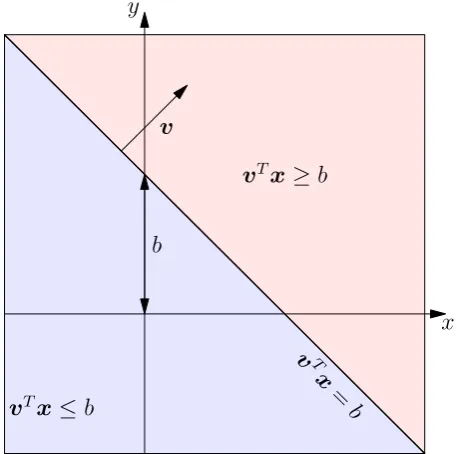
A hyperplane is a set of the form{x|vTx=b
}forv∈Rn,v 6=0andb∈R, i.e. is the solution
of a linear equation among the components ofx. It can be thought as the set of points that are
orthogonal to the vectorvandbis the offset of the hyperplane from the origin. Finally, a hyperplane
divides the space in two halfspaces, see Figure2.5. Intersection of convex sets is still convex, as a
y
x
v
b
v
Tx
≥
b
v
Tx
≤
b
v
Tx
=
b
Figure 2.5: The hyperplanevTx=bcuttingR2in two halfspaces.
direct consequence, a polyhedron obtained as the intersection of halfspaces and hyperplanes is convex. Convexity is also preserved by isometries, that is, scaling and translation. The projection of a convex set onto some of its coordinates is convex.
A basic property that connects convex sets with hyperplanes is the theorem of Hahn-Banach, or separating hyperplane theorem.
Theorem 2.31. IfCandDare two convex sets that do not intersect,C∩D=∅, then there exists
v6=0andbsuch thatvTx
≤bfor allx∈CandvTx
≥bfor allx∈D. The hyperplanevTx=bis
called a separating hyperplane.
supporting hyperplane. If a set is closed with nonempty interior and has a supporting hyperplane at every point in its boundary, then it is convex.
It is now natural to introduce convex functions: there are various definition that employ weaker or stronger conditions on the function. We choose a definition that does not require differentiability and is intuitive.
Definition 2.32(convex function). A functionf :Rn→Ris convex if the domain off is a convex
set and if for allx,yand for all0≤α≤1holds
f(αx+ (1−α)y)≤αf(x) + (1−α)f(y)
which is called theJenseninequality. A functionf is said to be concave if−f is convex. If the Jensen inequality is strict, thenf is called strictly convex.
The inequality can be extended to any convex combination of points, iff is convex, forx1, . . . ,xn
in its domain, and for scalarsα1, . . . , αn such thatαi≥0andα1+. . .+αn= 1, then
f(α1x1+. . .+αnxn)≤α1f(x1) +. . .+αnf(xn).
Remark 2.33. From this inequality, many inequalities can be derived, for example the simple arithmetic-geometric mean, fora, b ≥ 0, √ab ≤ (a+b)/2; H ¨older inequality, forx,y ∈ Rn and
p, qdual norms,||x·y||1 ≤ ||x||p||y||q; the general arithmetic-geometric mean, fora, b≥0and
0≤α≤1,aαb1−α
≤αa+ (1−α)b.
From a geometric point of view, a convex function has every chord fromf(x)tof(y)above its
graph. A useful property of convex functions is that they remain convex when restricted to any line intersecting their domains. Thusf is convex if and only if for allvthe functiong(t) =f(x+tv)is
convex. This represents a practical test to check convexity, allowing to consider only the restriction to a line of a certain function.
Whenf is defined on a convex set and is also differentiable, then the condition of convexity can be
stated with the inequality
f(y)≥f(x) +∇f(x)T(y
−x).
The right hand side represents the Taylor expansion of first order, or, geometrically, the supporting hyperplane atx. As before, if the inequality is strict, then we speak of strict convexity. For a
concave function, the previous inequality changes the sign.
Iff is twice differentiable, defined on an open convex domain, convexity is assured if ∇2f(x)0.
The information given by the Hessian matrix is about the local curvature off: positive eigenvalues
are equivalent to positive curvature, hence they imply the presence of a minimum point. Strict convexity and concavity follow in the same way. We must point out that∇2f 0implies convexity,
but the converse is not true, as the simple functionf(x) =x4shows: it is strictly convex but has f00(0) = 0.
Remark 2.34. The hypothesis that the domain off is convex is important for first and second order conditions, for examplef(x) =x12 forx6= 0satisfiesf00(x)>0but it is not convex.
Some examples of elementary convex functions are the exponentialex; the powersxpfor positive
xandp≥1orp≤0(concave for0≤p≤1); the logarithm is concave. Some important convex
functions are the norms ofRn; the maximum function ofRn max{x1, . . . , xn}; squared functions
over linear function as x2/y on domain of kind
{(x, y) | y > 0}; the Log-Sum-Exp function log(ex1+. . .+exn); the geometric mean(Qn
From those simple functions we can build new convex functions via operations that preserve convexity: non negative weighted sums, for non negative weightswi≥0,f =w1f1+. . .+wnfn;
similarly, a non negative weighted sum of concave functions is concave; iff(x, y)is convex inxfor
eachyandw(y)≥0, theng(x) =R
w(y)f(x, y)dyis convex; the image of a convex set under a
linear map is convex. The compositiong(x) =f(Ax+b)of a convex functionf with an affine map Ax+bis also convex. The pointwise maximum or supremum of two convex functions is convex, f(x) = max{f1(x), f2(x)}; this property can be generalized to the maximum or supremum ofn
convex functions. An application of the last point is the distance to farthest point of a set (in any norm).
An important application is devoted to least squares. Letx,v1, . . . ,vn,b1, . . . ,bn ∈Rm, minimize
the objective function
n
X
i=1
wi(vTi x−bi)2
where thewi are the weights that can be negative. Defining
g(w) = inf
x n
X
i=1
wi(viTx−bi)2,
gis the infimum of a family of linear functions ofwand is a concave function ofw(see [BV04]).
Another remarkable example is the norm of a matrix (convexity follows from the supremum of linear functions).
We give now some general results of convexity when composing functions, we begin with the scalar case. Leth, g:R→R, for twice differentiablegandh. Definef(x) = (h◦g)(x) =h(g(x)). Thef
is convex if and only iff00(x)≥0 ∀ x. This can be expanded as f00(x) =h00(g(x))g0(x)2+h0(g(x))g00(x).
It can be proved the next result, which it turns out to hold in the general case ofg:Rn →Rand
h:R→R(with the note thathshould be monotone and extended-valued to+∞for points not in
its domain):
h g f
convex and nondecreasing convex =⇒ convex
convex and nonincreasing concave =⇒ convex
concave and nondecreasing concave =⇒ concave
concave and nonincreasing convex =⇒ concave
(2.15)
Example 2.35. As an example considerg :R →R,g(x) =x2and h: [1,2]→R, h(x) = 0. In
this caseg is convex andhis convex nondecreasing. Definef =h◦g, which has the domain
[−√2,−1]∪[1,√2]and isf(x) = 0. Heref is not convex because the domain is not convex, the problem here is thathis not nondecreasing outside its domain, that is, theextended valuedh
should be nondecreasing, not just over its domain.
We turn now to the general vector composition, leth:Rk→Randgi:R→Rwhere
f(x) =h(g(x)) =h(g1(x), . . . , gk(x)).
The formal expression of the condition of convexity can be expressed as
f00(x) =g0(x)T
The conclusion of table (2.15) are still valid, but consideringgconvex/concave in each component.
We extend the concept of convex function to functionals: the directional derivatives are substituted by the Gˆateaux variations. In the case off ∈ C1(
R3), we have already seen that δf(y;v) =
∇f(y)·v, and convexity is provided by the condition
f(y+v)−f(y)≥ ∇f(y)·v=δf(y;v).
Strict convexity is present if the previous relation in an equality if and only ifv=0.
Definition 2.36(convexity for functionals). A real valued functionalJ defined onDin a linear spaceYis said to be convex onDprovided that whenyandy+v∈ DthenδJ(y;v)is defined and
J(y+v)−J(v)≥δJ(y;v). (2.16)
Definition 2.37(strict convexity for functionals). Jisstrictlyconvex if(2.16)is an equality if and only ifv=0.
An useful property of convex functionals is that ifJ andJ1are convex andc∈R,c >0, then
J+J1andcJare also convex.
Proposition 2.38. IfJ is convex onD, then eachy∈ Dfor whichδJ(y;v) = 0minimizesJ onD. Moreover, ifJ is strictly convex, then the minimizer is unique.
Example 2.39. ConsiderY=C[a, b]and the functional,J =Rb
a y
2(x) +exdx.J is strictly convex
becauseδJ(y;v) = 2Rb
ay(x)v(x) dxand
J(y+εv)−J(y) = 2
Z b
a
y(x)v(x) dx+
Z b
a
v2(x) dx≥2
Z b
a
y(x)v(x) dx=δJ(y;v).
The equality holds if and only ifRb
av
2(x) dx= 0, that isv= 0. Therefore, for the previous proposition
the functionysuch thatδJ(y;v) = 0minimizes uniquely the functional.
It is an application of the definition to obtain that a linear functional is convex but not strictly convex.
The general case is a convex integral functional of the form
F(y) =
Z b
a
f[y(x)] dx:=
Z b
a
f(x, y(x), y0(x)) dx,
which has the variation
δF(y;v) =
Z b
a
fy[y(x)]v(x) +fy0[y(x)]v0(x) dx.
Convexity implies thatJ(y+v)−J(v)≥δJ(y;v), i.e.
Z b
a
f[y(x) +v(x)]−f[y(x)] dx≥
Z b
a
fy[y(x)]v(x) +fy0[y(x)]v0(x) dx, (2.17)
this yields the pointwise relation
f[y(x) +v(x)]−f[y(x)]≥fy[y(x)]v(x) +fy0[y(x)]v0(x).
This shows thatf

![Figure 2.3: The graph of a family of functions fi ∈ Y = C[a, b] uniformly bounded within δ with respect to thegraph of f.](https://thumb-us.123doks.com/thumbv2/123dok_us/540579.2053536/32.595.205.388.295.477/figure-graph-family-functions-uniformly-bounded-respect-thegraph.webp)