Application of Artificial Neural Network (ANN) in predicting
mechanical properties of canola stem under shear loading
Mohsen Azadbakht
*, Mohammad Vehedi Torshizi, Armin Ziaratban,
Ehsan Ghajarjazi
(Department of Bio-System Mechanical Engineering, Gorgan University of Agricultural Sciences and Natural Resources, Gorgan, Iran)
Abstract: In this study, at first the shear parameters including the maximum shear force, shear strength, shear energy and power consumption of canola stem were calculated through force-deformation curve; and then these mechanical properties were determined and predicted using artificial neural network. For the tests, testing machine Instron (Model Santam STM-5) with 50 N load cell was used. Stems were cut at 3 diameter levels (1 to 3, 3 to 5 and more than 5 mm), 3 cutting speed levels (75, 115 and 150 mm/min ), 3 cutting angles (0°, 30° and 60°) and three replicates. Cutting parameters including maximum cutting force, shear strength; cutting energy; consumed power and cutting work were examined. Tests lasted for each stem until the full cut. Data requirements were obtained from Force-Deformation curve. The results showed that by increasing the diameter and cutting angle, cutting force values, shear strength, cutting energy, cutting power and cutting work increased. Additionally, with increasing cutting speed, the cutting force, shear strength, cutting energy, cutting power and cutting work declined. Feedforward network was employed to predict some of the mechanical properties of canola stem. The results of statistical analysis using artificial neural network showed that the best values for shear energy, shear force, shear strength, shear power and shear work in canola stem were, respectively, in the epochs of 194, 2000, 275, 92 and 350 and also showed that neural networks can be used in intelligent cutting mechanisms and predicting mechanical properties of crops stem.
Keywords: canola, cutting energy, stem, shear strength, power consumption, Artificial Neural Network (ANN)
Citation: Azadbakht M., M.V. Torshizi, A. Ziaratban, and E. Ghajarjazi. 2016. Application of Artificial Neural Network (ANN) in predicting mechanical properties of canola stem under shear loading. Agricultural Engineering International: CIGR Journal, 18 (2):413-425.
1 Introduction
1The scientific name of canola is Brassica napus (L.)
and considered as one of the crop plants of cabbage family found in both autumn and spring types. It can be grown in different soils and climatic zones (Pasban Eslam, 2009) (Hazbavi and Minaei, 2008). These characteristics have turned Canola to one of the most important agricultural products, in the field of industrial and food uses in the world, both its seed and oil can be used. In addition to the above-mentioned cases, Canola is the world's largest source of biodiesel production and
Received date: 2016-04-13 Accepted date: 2016-05-19
*Corresponding author: Mohsen Azadbakht, Department of Bio-System Mechanical Engineering, Gorgan University of Agricultural Sciences and Natural Resources, Gorgan, Iran. Email: [email protected]. Tel Fax: +981732440870
the products such as Margarine (Imanmehr et al., 2007). It is currently the world's third largest oil plant and is the world's second food storage product after grain (Hazbavi and Minaei, 2008).
Given the many advantages of Canola, machineries suitable for harvesting, processing, transportation and storage should be designed to enhance work efficiency and avoid losses that occur during labor. For the design of machines, knowing their physical, resistive, mechanical and aerodynamic properties is important (Imanmehr et al., 2007). The mechanical properties also include any different force applied to the plant (Azadbakht et al., 2015).
414 June, 2016 AgricEngInt: CIGR Journal Open access at http://www.cigrjournal.org Vol. 18, No.2
important criterion for the design of desired machines (Hoseinzadeh and Shirneshan, 2012). There are several studies in this area and some of which are pointed out: researchers noted on designing a machine to harvest wheat that the type of machine and the blades and their speed is very important and they proposed a 30° angle to cut the stems of 2-5 cm (Ghahrae et al., 2008). Other researchers studied on cutting and bending properties of the Canola stalk and reported that with the increase in stem diameter, the bending stress and Young's Modulus reduce and shear strength increases (Hoseinzadeh and Shirneshan, 2012). Other scholars studied the energy used for Canola stalk cutting, and reported that with increasing humidity, cutting energy increased and with increasing altitude, cutting energy decreased (Azadbakht et al., 2015). Ghozhedi et al. (2010) conducted an experiment on the properties of saffron stem and reported that cutting force of the stem is affected by factors such as variety, speed and the type of blade and observed that with increasing cutting speed from 20 to 200 mm/min, shear strength and energy consumption for cutting per unit area of stem declined, while with a further increase in speed, shear strength, and energy consumption did not declined (Ghozhedi, et al., 2010). According to researchers’ experiments on the ultimate shear strength of Alfalfa, it was announced that the shear strength has been variable between 0.6-17.95 MPa (Halyk and Hurlburt, 1968). A researcher showed that the cutting speed has a significant impact on cutting energy, and by increasing the moisture content throughout the stalk, its shear strength is reduced and the higher moisture content must lead to higher cutting force and the increased stem diameter must lead to increased cutting force. But the cutting force is inversely related to jump height and whatever stem cutting reduces, cutting energy increases (Persson, 1987). Other researchers studied the effect of the number of stems and blades type on the cutting force of rice straw. The maximum cutting force was measured for 6, 12 and 24-category of stems in two types of serrated and non-serrated blade. Increasing the number of stems
enhanced the cutting force, but the number of stems and cutting force were not increased proportionally, the average maximum force in smooth type blade was 139 N and in serrated type blade was 135 N (Chancellor, 1967). Prasad and Gupta (1975) investigated the mechanical properties of corn associated with corn harvest using an Impact Cutter Device and reported the value of 55° for the cutting angle and 2.65 m/s for the cutting speed (Prasad and Gupta, 1975). Other researchers also showed that with increasing humidity and angle, cutting energy level increases and an increase in cutting speed reduces cutting energy (Hosseinzadeh, Eshaghbeigi, and Raghami, 2009).
Nowadays, mechanical devices are controlled and optimized by artificial intelligence techniques such as artificial neural networks inspired by the model of the human brain, which besides of implementation of the educational process, save information related to data on the network and do not consider any preconditions on the relationship among data; hence, ANN can be as a suitable alternative to the conventional empirical modeling based on the regression as polynomial and linear regression(Behroozi Khazaie, 2008). Given that the need for comprehensive information about the mechanical properties of agricultural crops and forage plants are necessary, the aim of this study was to determine the parameters of the Canola stalk cutting influenced by various factors such as cutting speed, cutting angle and stem diameter in order to design harvesting machines with high efficiency and the lowest energy consumption as well as reducing damage to plants during harvest.
2 Materials and methods
2.1 Sample preparation
then their moisture was measured in this experiment according to the standards (Chandio et al., 2013).
2.2 Mechanical properties of the stalk
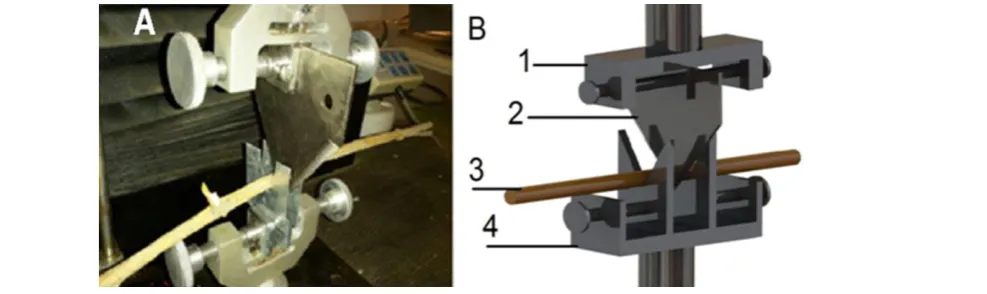
For mechanical testing, Instron machine (Model Santam-STM5) was used with a 50 N load cell. A saw-serrated cutting blade was attached to Instron
Movable Cutting Jaw according to Figure 1. Stalks were cut at 3 diameter levels of (1 to 3, 3 to 5 and more
than 5 mm), 3 positioning angles on the Instron fixed
cutting Jaw ( ، ، ) and 3 levels of cutting speed (75, 115, 150 mm/min) in three replications. Tests for each stalk lasted until the full cut. Data requirements were obtained from Force-Deformation curve. And data analysis was conducted using a factorial experiment in a Completely Randomized Design with the help of SAS software and LSD (Least Significant Difference ) test.
2.3 Principles of theory
2.3.1 The maximum cutting force
By moving the movable jaw, cutting operation was performed and Force-Deformation curve was plotted by Instron (Figure 2). According to diagram, maximum cutting force of stalk was obtained (Khazaei et al., 2002).
Figure 2 Force-Deformation diagram at canola stalk cutting
2.3.2 Shear strength
According to the maximum cutting force and the area of cutting, shear strength of stalk was calculated according to Equation (1) (Heidari et al., 2012):
(1)
Where, F = Cutting Force (N); A = Surface area of cut (mm2); = Shear Strength (Mpa).
Cutting area surface was measured by Image J software which is powerful software for image analysis and has various applications. This software is able to carry out statistical calculation of area values and the pixels in the parts were selected from the image by the user. Determination of the stem`s surface area includes software and hardware. Camera was connected to the computer. First, the stem`s imaging was done by a very high quality and resolution camera in a way that all the color differences between surface of the stem and the bottom plate were clear. The images were saved in a permanent memory of a pc which had windows 8 and 8 GB of RAM (Hoseinzadeh and Shirneshan, 2012). 2.3.3 Shear energy
Cutting energy was obtained by calculating the area under the Force – Deformation graph from the starting point of load to cut-off point (Mahdavian, Banakar, Figure 1- A: Optimum placement and stalk cutting B: 1- Instron movable jaw 2. Cutting blade 3- canola
416 June, 2016 AgricEngInt: CIGR Journal Open access at http://www.cigrjournal.org Vol. 18, No.2
Mohammadi, Beigi, and Hosseinzadeh, 2012). Graphs area was calculated by the Image J software (Ghajarjazi et al., 2015).
2.3.4 Power consumption
To calculate the power consumption, Equation (2) was used (Olaniyan and Oje, 2002).
Where, P = Power Consumption (W); = The total shear energy (mJ); V = Blade Speed (mm/min); D = Maximum Displacement (D).
2.3.5 Work of cutting
The work of cutting was calculated by Equation (3) (Bernacki et al., 1972).
Where, H = Total Displacement (mm) ; = Displacement to a maximum cutting force (mm); =
The amount of force at the moment of cutting; A1 = The
work of cutting,m.J.
2.3.6 Artificial Neural Network
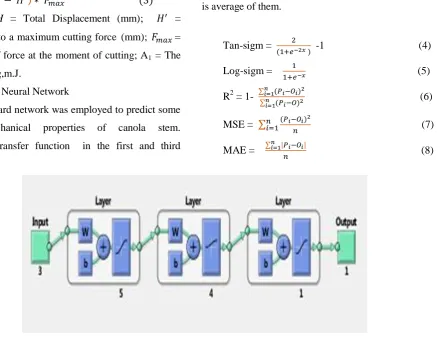
Feedforward network was employed to predict some of the mechanical properties of canola stem. Tan-sigmoid transfer function in the first and third
hidden layers as well as log-sigmoid function in the second hidden layer were applied in network created using software matlab R2014 a (8.3.0.532), which the relevant Equations have been shown in Equations (4) and (5) that in these Equations x is input data. Stem diameter, speed and angle of the blade were considered as inputs; force, energy, work and power of cutting off as well as shearing strain were independent outputs. Five, four and one neurons were placed in layers of first, second and third, respectively. The calculated values of R2, Mean Square Error (MSE), and Mean Absolute Error (MAE) have been shown, which the relevant Equations have been presented in Equations (6), (7) and (8) which in them is predicted data and is observed data and o is average of them.
Tan-sigm = -1 (4)
Log-sigm = (5)
R2 = 1- ∑∑
(6)
MSE = ∑ (7)
MAE = ∑ | | (8)
3 Results and discussion
Analysis of variance for changes in diameter, speed,cutting angle, mechanical properties of the Canola stalk under cutting are represented in Table 1.
3.1 Cutting force
According to Table 1, diameter, speed and angle changes at the 1% level is effective on cutting force. Moreover, the mutual interaction between diameter and
speed, as well as the diameter and the angle are significant at the 5% level of cutting force.
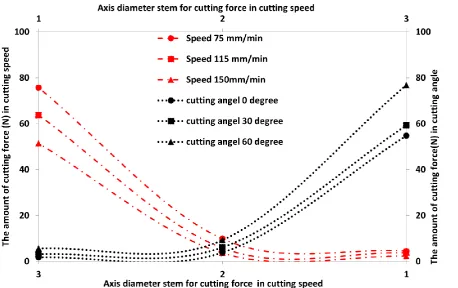
So, the means were compared by LSD-test and the results are represented in Figure 4.
3.1.1 Interaction between diameter and speed
According to Figure 4, maximum and minimum amount of cutting force is 75.67 N and 2.27 N, at speed of 75 mm/min and a diameter of at least 5 mm and the speed of 150 mm/min and the diameter of 1-3 mm.
According to Figure 4, by increasing the diameter, the cutting force increases because whatever the cross section is larger, the contact surface area is larger too, and thus more friction between blade surface and stem material is observed. Moreover, with increasing speed, the cutting
Table 1 Analysis of variance of the diameter, cutting angle and loading speed effects on the mechanical
properties of the canola stalk
Cutting workmJ Cutting powerW
Cutting EnergymJ Shear strength Mpa
cutting forceN Source of Variance
76375.56** 0.075**
3666034.93** 0.382**
31008.22** Diameter
18298.38** 0.001*
216782.24** 0.027*
801.01** Speed
17529.89* 0.004**
114235.54* 0.066**
794.46** Cutting angle
13997.87** 0.0008ns
167204.12** 0.004ns
313.34* Diameter × Speed
10499.48** 0.002**
58063.38* 0.020**
265.52* Diameter × angle
2912.14ns 0.00008ns
11132.65ns 0.011ns
30.62ns Speed × angle
2386.07 0.00041
22300.48 0.0053
67.21 Error
** and * represent significant difference within probability level of 1% and 5% (LSD) and ns represents the lack of significant difference
418 June, 2016 AgricEngInt: CIGR Journal Open access at http://www.cigrjournal.org Vol. 18, No.2
force is reduced. At low cutting speed, the stalk is firstly compressed by blade and then cut. While at high speeds, due to the viscoelastic properties of the plant materials, stem is less compressed. In other words, in high speeds of cutting elastic wall of cell, there is not sufficient time for the transmission of force to the viscose fluid inside the cell, and therefore, it is cut with less cutting force. Our results are consistent with Khazaei et al., (2002) observations on pyrethrum stalk and Dange, Thakare, Bhaskara, (2011) results on the pea stem (Khazaei et al., 2002) ( Dange et al., 2011).
3.1.2 Interaction between the diameter and cutting angle According to Figure 4, maximum and minimum amount of cutting force of stem is equal to 76.811 N and 1.74 N, occurred at an angle of 60 °, diameter of 5 mm and an angle of 0° and the diameter of 1-3 mm. According to Figure 4, with an increase in cutting angle
and stem diameter, the cutting force is increased, because by increasing the oblique angle, the displacement of the moving blade increases for full cutting. However, in this case, the stem slip occurs on the sharp edges too. In general, these causes lead to much displacement of blade during the cutting process, which is due to increasing cutting force. Other researchers have also provided similar report on the pyrethrum stalk (Khazaei et al., 2002).
3.2 Shear strength
According to Table 1, changes in diameter and angle are effective at the 1% level on shear strength of cutting.
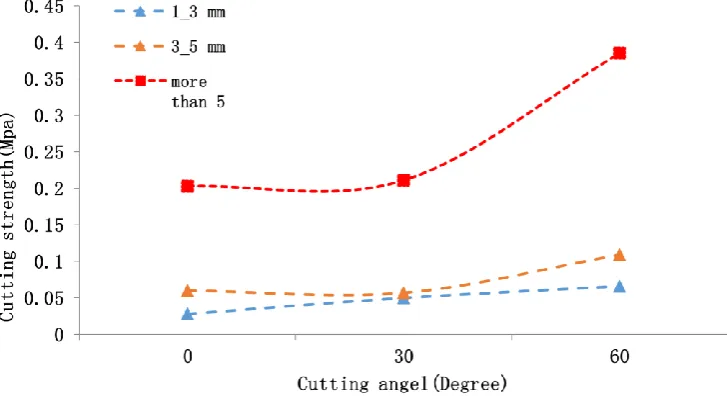
And the speed at the 5% level has been significant. Moreover, the interaction of diameter and cutting angle is significant on shear strength at the 1% level. Accordingly, the means were compared by LSD-test and the results were provided in Figure 5.
3.2.1 Interaction between the diameter and cutting angle According to Figure 5, the maximum and minimum shear strength is 0.385 Pa and 0.028 Pa, occurred at the angles of 60 ° and 0 ° and a diameter of at least 5 mm and a diameter of 1-3 mm. According to Figure 5, by increasing the cutting angle from 0 to 60 °, shear strength increased. Besides, with increasing stalk diameter, shear strength increased. Shear strength is directly correlated
with cutting force and inversely correlated with basal area. By increasing the cutting angle, cutting force and the cutting cross-section increase. We can say that the impact of cutting force on shear strength is far greater than the cross section. These results correspond with other scholars studies on the mechanical properties of corn reported in 1975 (Prasad, Gupta, 1975).
Also according to Figure 6, with increasing cutting speed, the shear strength is reduced, and the maximum value of shear strength at speed of 75 mm/min is equal with 0.16 Pa, and the lowest value in 150 mm/min is equal to 0.097 Pa. The reason is that with increasing speed, cutting force is reduced and shear strength is
directly proportional to the cutting force. Moreover, the reason for low shear strength at high speeds is reduction of friction between surface of the blade and stem material (Mcrandal and Mcnulty, 1980). These results are similar to results in 1975 reported by researchers have on mechanical properties of corn (Prasad and Gupta, 1975).
3.3 Cutting energy
According to Table 1, the diameter and speed changes at the 1% level are effective on cutting energy, and the angle changes were significant at the 5% level.
Besides, the interaction of size and speed at the 1% level and the diameter and angle at the 5% level are significant on cutting energy. So the means were compared by LSD-test and the results are represented in Figure 7. Figure 6 Effect of loading speed on shear strength.
June, 2016 AgricEngInt: CIGR Journal Open access at http://www.cigrjournal.org Vol. 18, No. 2 420
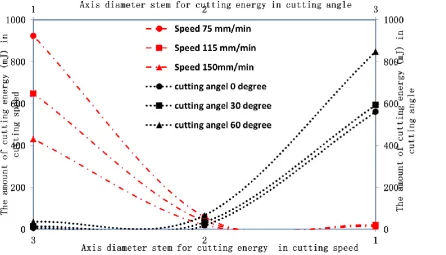
3.3.1 Interaction between the diameter and cutting speed According to Figure 7, the maximum and minimum cutting energy of stalk are 923.0 mJ and 14.97 mJ at speed of 75 mm/min and 150 mm/min and the diameter of greater than 5 mm and 1-3 mm respectively. According to Figure 7, with increasing cutting speed, cutting force falls, because the cutting energy is cut and since cutting energy is influenced by cutting force, energy is also reduced. Other researchers reported similar results on peas stem (Dange et al., 2011).
3.3.2 Interaction between the diameter and cutting angle According to Figure 7, the most and least amount of cutting energy of stem is 6.137 mJ and 847.8 mJ that occur at 60 ° and the diameter of greater than 5 mm, and the angle of 0 and the diameter of 1-3 mm.
According to Figure 7, by increasing the diameter
and cutting angle, cutting energy increases. Cutting energy is equal to the area under the Force – Displacement graph, thus with increasing the cutting and displacement force, cutting energy increases. By increasing the diameter, cutting force and displacement increased, thus cutting energy also rose. With increasing angle, cutting force increases, and therefore energy increased. The observed results were similar to other scholars (Tavakoli et al., 2010).
3.4 Cutting power
According to Table 1, the changes in diameter and the angle at the 1% level, and the speed at the 5% level, are significant on cutting power. Moreover, the interaction between diameter and angle was significant at the 1% level. Therefore, the mean were compared by LSD-test and the results were represented in Figure 8.
3.4.1 Interaction between the diameter and cutting angle According to Figure 8, the highest and lowest stem cutting power are equal to 0.002 W and 0.13 W at cutting angle of 60° and 0° and diameters greater than 5 mm and 1-3 mm respectively.According toFigure 8, with an increase in stem diameter, cutting power increases too.
Cutting power is directly correlated with cutting energy and inversely proportional to the displacement of cutting.
By increasing the diameter, cutting energy and
displacement increase, but the impact of cutting energy was far more than the displacement. Also with increasing cutting angle, cutting power increased too, because given that cutting power is directly proportional to cutting energy and cutting speed, it can be said that with increasing cutting angle, energy increases and thereby cutting power increases too.
Also according to Figure 9, with increasing cutting speed, cutting power amount reduces and the maximum Figure8 Interaction of diameter and cutting angle on cutting power
value of cutting power that occurs at speed of 75 mm/min is equal to 0.045 W and the lowest in 150 mm/min is equal to 0.03. As previously mentioned, with increasing speed, the cutting energy decreases and considering that
the cutting power is directly proportional to the cutting energy, it can be said that with increasing speed, cutting energy and as a result, cutting power decreases.
3.5 Cutting work
According to Table 1, diameter and speed change at the 1% level and the angle at the 5% level are significant on cutting. Moreover, the interaction of diameter and
speed as well as the diameter and the angle are significant at the 1% level. So the means were compared by LSD-test and the results are represented in Figure 10.
3.5.1 Interaction between the diameter and the cutting speed
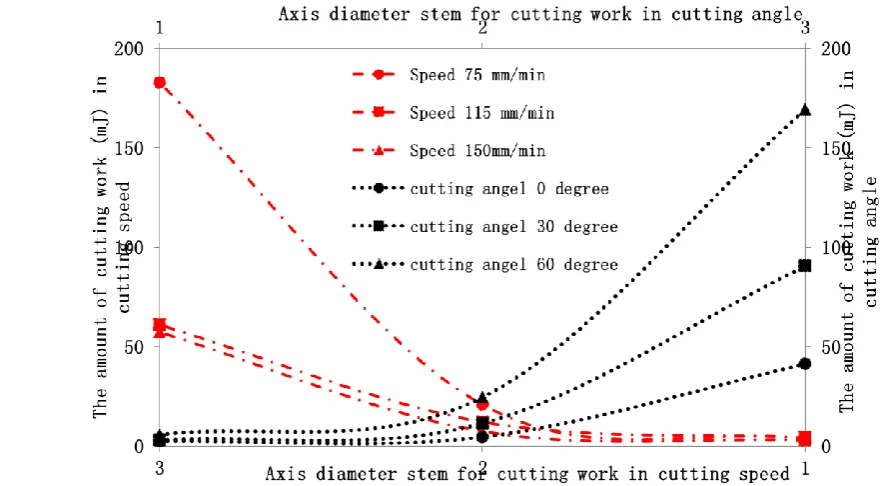
According to Figure 10, the most and least amounts of stem-cutting work are equal to 182.80 mJ and 3.08 mJ at speeds of 75 mm/min and 150 mm/min respectively Figure 9 Effect of loading speed on the cutting power.
422 June, 2016 AgricEngInt: CIGR Journal Open access at http://www.cigrjournal.org Vol. 18, No.2
and at diameters greater than 5 mm and 1-3 mm. According to Figure 10, with increasing speed, the amount of cutting work declined and with increasing diameter, cutting work increased. According to Formula 3, cutting work has a direct relationship with cutting force and energy consumption. According to the achieved results stating that by increasing the speed at a constant diameter, cutting force and cutting energy decreases, thus with increasing the speed, cutting work is also reduced. Also by increasing the diameter, energy consumption and cutting force increase, thereby the cutting work increases. 3.5.2 Interaction between diameter and cutting angle According to Figure 10, the most and least amounts of cutting work of stem are equal to 169.36 and 2.509, occurred at angles of 0° and 60° and at diameters greater than 5 mm and 1-3 mm. According to Figure 10, with the increase of diameter at a constant angle, cutting work increased. Cutting work is directly related to cutting force and energy. By increasing the cutting angle and stem diameter, cutting force and energywere up, thus cutting work has also increased.
3.6 Statistical analysis using artificial neural network
Faster algorithms such as Levenberg-Marquardt (LM) use standard numerical optimization techniques. LM method is in fact an approximation of the Newton’s
method. The LM algorithm uses the second-order derivatives of the cost function so that better convergence
behaviour can be obtained. High levels of R2 in the model created to predict the mechanical properties of the canola showed the superiority of based on artificial intelligence on mathematical and statistical methods to predict the mechanical properties of agricultural products (Behroozi and Khazaie, 2008).
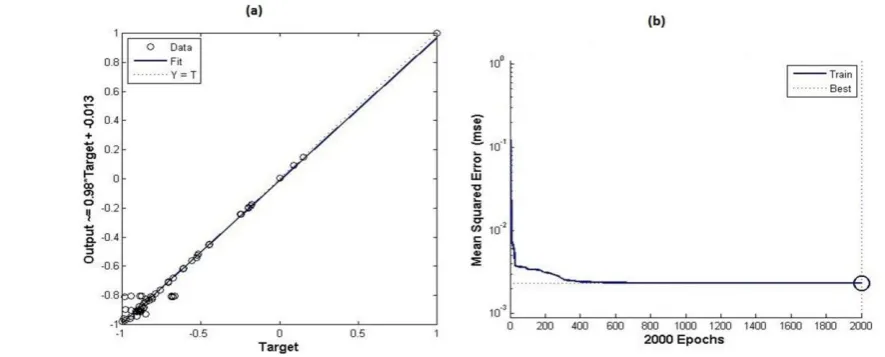
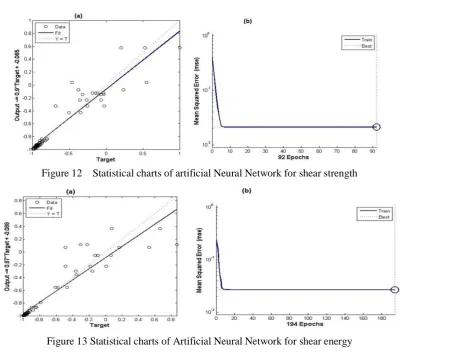
Table 2 shows the values of MSE, MAE and R2 in mechanical properties of canola stem. Figures 11, 12, 13, 14 and 15 illustrate statistical charts of Artificial Neural Network for shear force, shear strength, shear energy, shear power and shear work in canola stem. Part (a) is indicative of the predicted output against the target and the vertical axis represents the relationship among predicted output and target. As part (b) indicates the ratio of MSE declined sharply over time and performing epochs in the beginning and then remained steady. The best values for shear energy, shear force, shear strength, shear power and shear work in canola stem were respectively, in the epochs of 194, 2000, 275, 92 and 350.
Table 2 The values of MSE, MAE and R2 in
mechanical properties of canola stem
MAE MSE R2
Cutting force 0.0245 0.0023228 0.9906
Shear strength 0.0813 0.021663 0.92066
Cutting energy 0.0730 0.026896 0.93296
Cutting power 0.13 0.021244 0.94816
Cutting work 0.0506 0.016682 0.94463
Figure 12 Statistical charts of artificial Neural Network for shear strength
Figure 13 Statistical charts of Artificial Neural Network for shear energy
Figure 14 Statistical charts of Artificial Neural Network for shear power
424 June, 2016 AgricEngInt: CIGR Journal Open access at http://www.cigrjournal.org Vol. 18, No.2
4 Conclusions
In investigating cutting parameters of canola including the maximum cutting force, shear strength, cutting energy, power consumption and cutting work, the following items were concluded:
1) The diameter, speed and angle changes at the level of 1% and the interaction between diameter and speed as well as the interaction between the diameter and the angle at the 5% level are significant on cutting force.
2) Diameter and angle changes at the 1% level are effective on shear strength and the speed is significant at the 5% level. Moreover, the interaction of diameter and cutting angle is significant on cutting strength at the 1% level. The speed at the 5% level has been significant. The interaction of diameter and cutting angle on shear strength is significant at the 1% level.
3) Changes in diameter and speed at 1% are effective on cutting energy and changes of angle were significant at the 5% level. Furthermore, the interaction of diameter and speed at the 1% level and the interaction between diameter and angle are significant on cutting energy at the 5% level.
4) Changes in diameter and angle are significant at the 1% level and speed changes at the 5% level on cutting power. Besides, the interaction between the diameter and the angle are significant at the 1% level.
5) Changes in diameter and speed at the 1% level and angle changes at the 5% level are significant on cutting work. Moreover, the interaction between diameter and speed as well as diameter and angle are significant at the 1% level.
6) With increasing diameter and cutting angle, cutting force values, shear strength, cutting energy, cutting power and cutting work increased.
7) With increasing cutting speed, cutting force, shear strength, cutting energy, cutting power and cutting work declined.
8) Mathematical modeling and finite element methods are able to simulate a real mechanical system.
However, these techniques require knowledge of the key parameters of a process and also long and complex calculations. The results demonstrated that, given some data had considerable scatter, the network created by learning the patterns of relationships among data had appropriate capability in predicting the mechanical properties of canola stem. Determining and calculating the mechanical properties of agricultural products could have an important role in the calculation of agricultural machinery design. Hence, artificial intelligence can be useful for detecting the mechanical properties. Artificial Neural Network is preferred compared with conventional methods of mathematical modeling due to the reduced volume of calculations and capability of learning in the relationship among data.
References
Azadbakht, M., E. Esmaeilzadeh, and M. Esmaeili-Shayan. 2015. Energy consumption during impact cutting of canola stalk as a function of moisture content and cutting height. Journal of the Saudi Society of Agricultural Sciences, 14(2): 147–152.
Behroozi Khazaie N. 2008. Prediction of dried grape quality by Artificial Neural Network. Thesis Submitted in Partial Fulfillment of the Requirements for The Degree of Master of Science (M.Sc.) in Agricultural Machinery Engineering. Tarbiyat Moddars University.
Bernacki, H., J. Haman, and C. Z. Kanafojski. 1972. Agricultural machine theory and construction, Vol 1. U. S. Department of commerce spring field, USA.
Chancellor,W. J. 1965. An experiment on force and energy requirements for cutting paddy stalks. The Malaysian Agricultural Journal, 45(2): 200-205.
Chandio, F.A., C. Yi, A.A. Tagar, I.A. Mari, C. Arslan, D.M. Cuong, and H. Fang. 2013. Effect of loading rate on mechanical characteristics of wheat and rice Straw. Bulgarian Journal of Agricultural Science, 19(6): 1452-1458.
Dange, A.R., T S.K. hakare, and Rao I. Bhaskara, 2011. Cutting energy and force as required for Pigeon pea stems. Journal of Agricultural Technology, 7(6): 1485-1493.
Ghajarjazi, E., M. Azadbakht, and F.Ghaderifar. 2015. Determination of the mechanical properties of unbroken canola pods. Agric Eng Int: CIGR Journal, 17(3): 392-403.
Ghozhedi, Vale., S.R. Hassan Beygi Bidgoli, M.H. Saeidirad, and M.H. Kianmehr. 2010. Shear strength of stem and picking force for saffron flowers. Journal of Agricultural Engineering Research, 11(3):, 41-54
Halyk, RM., and L.W. Hurlburt. 1968. Tensile and shear strength characteristics of alfalfa stems. Transaction of the ASAE, 11(1): 256-257.
Hazbavi, E., and S. Minaei. 2008. Determination and investigation of some physical properties of seven variety rapeseed. Iranian Journal of Food Science and Technology,5(4): 21-28.
Heidari, A., G. Chegini, M.H. Kianmehr, S.R. Hassan-Beygi, and J. Khazaei. 2012. Influence of knife bevel angle, rate of loading and stalk section on some engineering parameters of lilium stalk. Iranica Journal of Energy & Environment, 3(4): 333-340.
Hosseinzadeh, B., A. Eshaghbeigi, and N. Raghami. 2009. Effect of moisture content, bevel angle and cutting speed on shearing energy of three wheat varieties. World Applied Sciences J, 7(9): 1120-1123.
Hoseinzadeh, B., and A. Shirneshan. 2012. Bending and shearing characteristics of canola stem. American-Eurasian Journal of Agricultural & Environmental Sciences, 12 (3): 275-281.
Imanmehr, A., B. Ghobadian, S. Minaei, and J. Faradmal. 2007. Determination of some physical properties of canola seed
(licord cultivar). Journal of Agricultural Engineering Research, 7(29): 119-128.
Khazaei, J., H. Rabani, and F. Golbabaei. 2002. Determining the shear strength and picking force of pyrethrum flower. Iranian Journal of Agriculture Science, 33(3): 433-444. Mahdavian, A., A. Banakar, A. Mohammadi, M. Beigi, and B.
Hosseinzadeh. 2012. Modelling of shearing energy of canola stem in quasi-static compressive loading using artificial neural network (ANN). Middle-East Journal of Scientific Research, 11(3): 374-381.
Mcrandal, D.M., and P.B. Mcnulty.1980. Mechanical and physical properties of grasses. Transactions of the ASAE, 23(4): 816-821.
Olaniyan, A. M., and K. Oje. 2002. PH—Postharvest Technology: Some aspects of the mechanical properties of shea nut. Biosystems Engineering, 81(4): 413-20.
Pasban Eslam, B. 2009. Study of yield in winter oilseed rape cultivars during different sowing dates. Quarterly Journal of Crop Ecophysiology (Agriculture Science) , 3(10):1-10.
Persson, S. 1987. Mechanics of cutting plant material. Michigan, ASAE Publications
Prasad, J., and C.B. Gupta. 1975. Mechanical properties of maize stalks as related to harvesting. Journal of Agricultural Engineering Research, 20(1): 79-87.