Influence of the grinding method on the flow properties of barley
Thomas Hoffmann
*, Christian Fürll
(Leibniz Institute for Agricultural Engineering Potsdam-Bornim, Max-Eyth-Allee 100, 14469 Potsdam, Germany)
Abstract: Hammer mills or roller mills are used to grind grain for feed for animal husbandry. The grinding process in hammer mills is based on impact stress on the grain kernels. Roller mills, however, apply pressure and shear stress. The different working principles in hammer mills and roller mills lead to different physical properties of the ground material. The aim of the project was to quantify the physical properties of barley which was ground by a hammer mill or a roller mill. Therefore, the particle size distributions of the ground material were determined by sieving. The particle form was characterized by a form factor. Shear experiments according to Jenike were carried out to determine the flowability. The bulk density was obtained from the quotient of the filling weight and the filling volume of a test vessel. The angle of repose was observed on bulk material, which was flowed from a hopper onto a round plate. In the result, the material from the hammer mill shows an increasing flowability with increasing particle sizes and a direct correlation between bulk density and the particle size class. The values of the angle of repose become smaller with increasing particle size. The material from the roller mill shows the same tendencies but to a less extent.
Keywords: flow properties, particle size, hammer mill, roller mill
Citation: Hoffmann, T., and C. Fürll. 2015. Influence of the grinding method on the flow properties of barley. Agric Eng Int: CIGR Journal, 17(4): 354-358.
1 Introduction
1Grain is increasingly being processed worldwide to
produce feed for animal husbandry. The changes taking
place in eating habits contribute to this situation. In order
to lower the energy consumption involved, less use is
being made of impact stress with the help of hammer
mills to reduce grain particle sizes. This is because far
less energy is required when pressure and shear stresses
are applied in roller mills (Fürll et al., 1996; Hoffmann et
al., 2011). However, what is interesting here is whether
the different kinds of stress lead to changes in the
physical properties of the ground product that than need
to be taken into account when dimensioning plant and
equipment. As barley represents a significant
component in dry compound feed formulations, studies
were first conducted with this cereal.
Received date: 2015-07-30 Accepted date: 2015-09-30 *Corresponding author: Thomas Hoffmann, Leibniz Institute for Agricultural Engineering Potsdam-Bornim, Max-Eyth-Allee 100, 14469 Potsdam, Germany. Email: [email protected]
Since about the mid-1950s, in dry compound feed
production grain size has largely been ground with the
help of hammer mills. Methods using pressure and
shear stress were hardly used anymore. The advantages
of hammer mills by comparison with roller mills lie in the
lower investment requirement and the higher mass flow
rates, but they have the disadvantage of far higher
specific energy requirements and the relatively large
share of particles in the range <500 μm (Löwe and Feil,
2011). As energy is now becoming increasingly more
expensive, thus driving up the cost burden of the end
product, roller mills and comparable machines are being
used more frequently in practice again (Fürll et al., 1996;
Hoffmann et al., 2011). There are virtually no
objections to this from the standpoint of animal nutrition,
as it is above all the particle size and size distribution
parameters that are crucial for the performance
parameters and the effects on animal health (Wolf, 2012).
It is known that these two size reduction methods do
not lead to the same particle size distribution and particle
form of the ground product (Löwe and Feil, 2011).
(Fürll, 2006; Fürll, 2007; Fürll and Hoffmann, 2012; Fürll
and Hoffmann, 2013).
In order to quantify the physical properties of the
ground barley for the grinding methods impact stress
(hammer mill) and pressure/shear stress (roller mill),
examinations are being conducted to determine the
following relationships:
- flow properties depending on the particle size
and grinding method
- angle of repose as a function of the particle size
and grinding method
- bulk density as a function of the particle size and
grinding method.
2 Materials and methods
2.1 Experimental material
The experimental material is barley, which accounts
for a large share in the formulations of dry compound
feed. The size reduction was performed in each case
with a laboratory roller mill “QC-109 Pionier” of the company “Labor” MIM Budapest (Hungaria) and a laboratory hammer mill “RECORD A” of the company
Jemlich (Germany). The dry matter content was a
uniform DM = 85.5%. In order to be able to determine
the influence of the particle size, after grinding samples
with the following size fractions were produced with the
help of a flat screening machine:
315 μm > x > 250 μm 250 μm > x > 200 μm 200 μm > x > 160 μm 160 μm > x > 100 μm
All the samples lie in the fine-grain size range.
This was intentional because even slight shares of
cohesive fines affect the flow behaviour of the entire
material system (Fürll, 2007; Fürll and Hoffmann, 2012;
Fürll and Hoffmann, 2013). Above all, the physical
properties of the fine material are of interest.
2.2 Experimental methods
2.2.1 Determining the flow properties
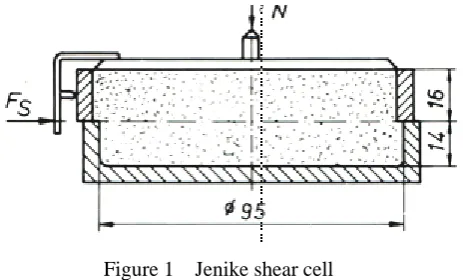
The flow properties are determined with the help of
shear strength measurements for which the Jenike shear
cell is ideally suited in the particle size range x < 1.0 mm
(Figure 1):
Figure 1 Jenike shear cell
In the performance of the experiment, the normal
stress σ*
N for a certain material sample of constant
density at which the shear stress remains constant
throughout the shearing and the material flows at a
constant sample volume is sought. The point with the
associated shear stress (σ*
N, τe) represents the end point of
a yield locus. In all further experiments, pre-shearing is
first carried out at the normal stress σ*
N until the upper
ring of the Jenike shear cell moves from the original
eccentric position into the centric position. Then the
normal stress is reduced to σNi< σ*N and the sample is
sheared off. If this is repeated several times with shear
stresses reduced step by step, a complete flow locus
results. Further yield loci of a family of yield loci are
obtained for other constant product densities. The
maximum main stress of the Mohr circle that is tangential
to the end point of a flow locus is the consolidation stress
σ1. The maximum main stress of the Mohr circle that is
tangential to the yield locus and of which the second main
stress has the value zero is the unconfined yield strength
σc. The ratio of these two sizes is the flowability ffc to
Jenike:
c 1 c
ff
(1)To determine the bulk density, a test vessel with an
inner diameter of di = 55 mm is filled. With this
diameter, the fault existing as a result of the edge
influence that occurs at insufficient values of the inner
diameter can be neglected. The value for the bulk
density is obtained from the quotients of filling weight
and filling volume.
2.2.3 Determining the angle of repose
From among the many methods described in
literature, a method in which the bulk material flows
continuously from a hopper onto a circular plate arranged
beneath it was selected. A material cone forms on the
plate and its angle of repose is measured (Figure 2):
Figure 2 Determining the angle of repose
α angle of repose
hK hight of material cone
rp radius of the base area of the material
cone
p k
r
h
tan
2.2.4 Particle form
The literature contains a whole series of suggestions
for characterising the particle form (Saad et al., 2011).
For the following examinations, the ratio of particle
length a to particle width b was selected as form factor FF
(elongation). As 60 particles were measured for each
sample, the central value FF50;0, the modal value FFh and
the standard deviation σζFF could be taken from this as
distribution parameters of a logarithmic normal
distribution.
Furthermore, the particle form was characterised by
determining the fractal dimension D. It is determined by
approximating the actual circumference of a particle by
the length L of a polygon course with the side length η:
D 1
K
L
(2)The two constants K and D characterise the
irregularity of the particle contour. D lies between 1 and
2 and is larger the more irregular and rougher the contour
is (Tomas, 2015).
3 Results and discussion
3.1 Flowability
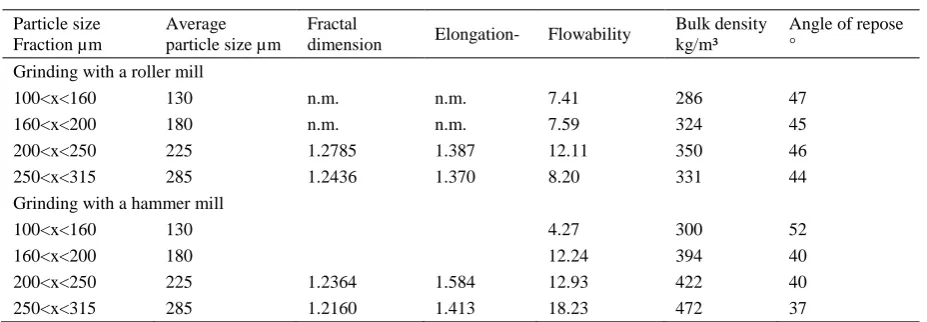
With the exception of the smallest particle size
fraction, the flowability according to Jenike calculated
with Equation (1) from the results of the shear
experiments shows clear dependence on the particle size
and the grinding method (Table 1) (Figure 3):
Table 1 Experimental results
Particle size Fraction µm
Average particle size µm
Fractal
dimension Elongation- Flowability
Bulk density kg/m³
Angle of repose °
Grinding with a roller mill
100<x<160 130 n.m. n.m. 7.41 286 47
160<x<200 180 n.m. n.m. 7.59 324 45
200<x<250 225 1.2785 1.387 12.11 350 46
250<x<315 285 1.2436 1.370 8.20 331 44
Grinding with a hammer mill
100<x<160 130 4.27 300 52
160<x<200 180 12.24 394 40
200<x<250 225 1.2364 1.584 12.93 422 40
250<x<315 285 1.2160 1.413 18.23 472 37
While the values of the flowability for both grinding
methods are relatively close together for the particle
fraction 100 < x < 160 µm, with increasing particle size
flowability improves distinctly for the samples ground in
a hammer mill.
Figure 3 Dependence of the flowability to Jenike of the
ground barley on particle size and grinding method
The lower values for the larger particle size fractions
in the samples ground with a roller mill with are very
probably attributable to the higher values of the fractal
dimension, although the elongation values for the samples
after grinding in a hammer mill are larger (Table 1).
This means that the flowability is shaped above all by the
roughness of the particle surface.
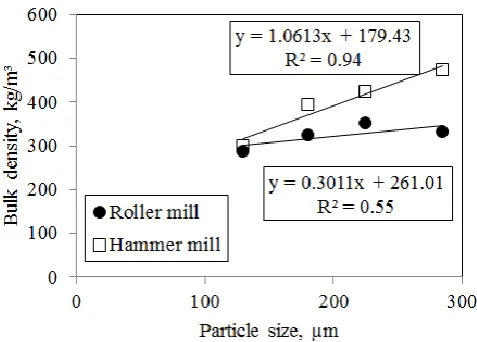
3.2 Bulk density
The courses of the bulk density values as a function
of the particle size correspond to those for the flow
properties. For the smallest fraction 100 < x < 160 µm,
the bulk densities for the samples of both grinding
methods are the same. This in turn is due to the
certainly higher value of adhesive force/mass force.
With further increasing particle size, the rise in bulk
density values for samples ground in a hammer mill is
larger than for samples ground in a roller mill (Figure 4).
This too can be attributed to the rougher particle surface,
expressed by the fractal dimension. The elongation
evidently exerts less influence in this sector.
Figure 4 Dependence of the bulk density of the ground
barley on the particle size and the grinding method
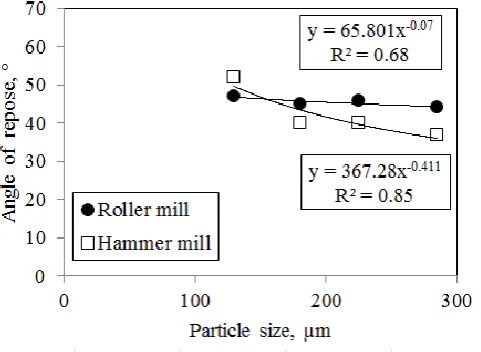
3.3 Angle of repose
The courses of the angles of repose as a function of
the particle size also correspond to those of the flow
properties and the bulk density. In the case of the
smallest particle size fraction 100 < x < 160 µm, the
values of the angles of repose are similarly high for both
grinding methods. With increasing particle size, the
angle of repose for the samples after grinding with a
hammer mill is reduced more than for the samples after
grinding with a roller mill. This too can be explained in
line with the fractal dimension by the greater surface
roughness of the particles after grinding with the roller
mill (Table 1) (Figure 5):
4 Conclusions
The studies of the influence of the size reduction
method on the physical properties of ground barley were
conducted using four particle size fractions in the range
100 < x < 315 µm. The elongation and the fractal
dimension were determined to characterise the particle
form. For the fraction 100 < x < 160 µm, the influence
of the small particle size prevails in the physical
properties examined. In this range it is to be assumed
that the ratio of adhesive forces to weight forces is higher
Figure 5 Dependence of the angle of repose of the
ground barley on the particle size and the grinding
method
This makes the values for the flowability according
to Jenike, the bulk density and the angle of repose almost
identical for the samples produced with both grinding
methods. In the three larger particle fractions the values
of the flowability and the bulk density increase with
larger particle sizes. Here the increase is greater for the
samples ground with a hammer mill than for the particles
ground with the roller mill. The values of the angles of
repose become smaller with increasing particle size, with
the decline being larger for samples ground with a
hammer mill. It can be assumed that this behaviour is
caused by the larger surface roughness of the particles
after grinding with a roller mill.
As the use of hammer mills for grinding is now
declining for reasons of energy saving, it should be noted
when planning technical installations that the material
ground with roller mills displays lower flow properties.
References
Fürll, C., K. Gottschalk, K., and H. Hempel. 1996. Energiesparendes Zerkleinern von feuchtem Wirtschaftsgetreide. Landtechnik, 51(6): 326-327. Fürll, C. 2006. Beurteilung der Fließeigenschaften von
Getreideschrot mit Hilfe einfach bestimmbarer Schüttgutkenngrößen. Mühle+Mischfutter, 143(1): 17-22.
Fürll, C. 2007. Influence of the granulometric condition on the flow properties of crushed grain products. Bulk Solids & Powder Science & Technology, 2(1): 55-62.
Fürll, C., and T. Hoffmann. 2012. The Influence of the granulometric condition on the flow characteristics of shredded grain products in their dependence on the duration of storage. Powder Technology, 235, 307-311.
Fürll, C., and T. Hoffmann. 2013. Flow properties of components for dry compound feed. Powder Technology, 235, 838-841.
Hoffmann, T., C. Fürll, and H. Hempel. 2011. Energiesparendes Zerkleinern von Getreide mit einem Keilscheibenzerkleinerer. Chemie Ingenieur Technik, 83(5): 699-703.
Löwe, R., and A. Feil. 2011. Technologische Aspekte der Futtermittelzerkleinerung zur Herstellung grober Strukturen mittels Hammer- und Scheibenmühle. Mühle+Mischfutter, 148(2): 34-40.
Saad, M., A. Sadoudi, E. Rondet, and B. Cuq. 2011. Morphological characterization of wheat powders, how to characterize the shape of particles? Journal of Food Engineering, 102: 293-301.
Tomas, J. 2015. Mechanische Verfahrenstechnik-Partikeltechnik.
Lecture notes.
www.mvt.ovgu.de/mvt_media/Vorlesungen/VO.../MV T_e_1.doc. (access on 2015.02.25)