NSW Government
No. 10 Freshwater flows to estuaries
and coastal waters
Importance of freshwater flows
Freshwater inflows from the upper catchment influence estuaries and coastal waters in many ways. They are a major determinant of the environmental conditions in estuaries due to their impact on salinity gradients, estuarine circulation patterns, water quality, flushing, productivity and the distribution and abundance of many species of plants and animals.
Considering the scope of its effects, freshwater inflow is one of the more important factors influencing estuary health today.
Freshwater flows also affect the availability of food for organisms at the base of an estuary's food web. They do this in at least two ways: (1) by influencing the abundance and distribution
of primary organisms within an estuary's waters, and
(2) by affecting the influx of organic carbon and freshwater to the estuary and coastal waters from outside sources.
As a result, estuaries are diverse, dynamic, productive and highly valued ecosystems.
When sea level rose to its current level 6,500 years ago, it drowned coastal river valleys and bays to form a wide variety of estuaries. A unique feature of estuarine environments, one that distinguishes them from all other ecosystems, is the mixing of salt water from the sea with freshwater from the upper catchment.
The dynamic nature of the area where mixing occurs contributes to the high levels of habitat diversity and biological productivity in estuarine and coastal ecosystems. Freshwater inflows also influence the dynamics of estuary entrances and the characteristics of tidal flushing. In some
estuaries, especially the smaller coastal lakes and lagoons, the entrance may close off completely during periods of low river flows.
The volume and timing of freshwater inflows to estuaries and coastal waters is strongly influenced by the size, shape and rainfall patterns of a catchment. In northern NSW, estuaries tend to be characterised by larger rivers with entrances that are open most of the time due to higher rainfall and river flows.
As rainfall declines to the south, coastal lakes and lagoons tend to form, some with intermittently opening entrances. Evaporation can also play an important role in determining salinity with some estuaries becoming hyper-saline during dry periods.
When freshwater inflows occur they tend to be large and sporadic reflecting the variability in rainfall. Intermittent extreme events tend to dominate the dynamics of coastal catchments, particularly in the north. As a result, estuaries are rarely in a steady state.
What is a tidal pool?
In general terms, tidal pools are the upper fresh water or brackish water sections of estuaries. Under normal freshwater inflow conditions they usually extend downstream from the tidal limit to an area near the upstream limit of mangroves.
For the purposes of this advisory note, tidal pools refer to the parts of estuaries that are
periodically subject to:
! tidal water level fluctuations; and
Some examples of tidal pools in larger coastal catchments include:
! the Richmond/Wilson Rivers downstream of Casino and Lismore to Coraki;
! the Clarence River between Copmanhurst and Brushgrove;
! the Bellinger River between Bellingen and Fernbank;
! the Manning River downstream of Abbots Falls to Taree;
! the Hunter River downstream of Bolwarra and Patterson towards Raymond Terrace;
! the Hawkesbury River downstream of Yarramundi; and
! the Shoalhaven River downstream of Burrier.
Many smaller coastal catchments and other types of estuaries such as coastal lakes and lagoons have tidal pools in the lower sections of their
contributing rivers and creeks. The extent of tidal pools is highly variable - of limited size during extended periods of low flow, and extending to the mouth of an estuary during floods or high flow conditions.
In some instances the tidal pool has been removed completely due to the construction of a tidal barrage. In other cases the salinity limit may coincide with the tidal limit.
Management
There is a range of broad state policies which relate to or impact on the management of estuarine and coastal waters. These include the State Rivers and Estuaries Policy, the NSW Coastal Policy, and the State Wetlands Policy. The river flow and water quality objectives also apply to the lower sections of coastal catchments and need to be addressed in a water sharing plan. As well there needs to be consistency with any local estuary management plans and the protection of estuarine wetlands covered under the SEPP 14 on wetland protection. Marine vegetation, such as mangroves and seagrass, is protected under the Fisheries Management Act 1994.
Some estuaries and adjacent coastal waters are also managed as marine protected areas with the aim of protecting aquatic biodiversity. A
representative sample of marine protected areas are being established under the Marine Parks Act 1997 and the Fisheries Management Act 1994. These include marine parks, aquatic reserves,
and/or the marine or estuarine components of National Parks or nature reserves.
Issues and threats
The environmental threats posed by water extraction from the lower catchment and tidal pools are closely inter-connected with the threats resulting from changes to the volume, timing and quality of freshwater inflow from the upper catchment.
A
ltered flow regimes can impact upon the very habitats that marine protected areas are attempting to conserve.It is for this reason that coastal catchments need to be considered and managed as whole systems that extend from the upper catchment down and out into coastal waters. The extraction of water from sub catchments or specific reaches such as the tidal pools should not be looked at in isolation.
Principle 1
Coastal catchments must be considered and managed as whole systems that extend from the upper catchment down to the offshore waters.
Today, development activities in coastal
catchments and water extraction for agriculture, town water supply and industry have altered the volume, quality, timing and mixing characteristics of freshwater flows reaching estuaries.
Catchment clearing and urban development may have changed runoff characteristics, while reservoirs and farm dams have harvested
additional water. These changes in catchment land use and water use are combining to alter the flow regime of water entering estuaries.
The potential impact of the range of activities outlined in this advisory note is that the zone of mixing and salinity gradient may have moved upstream during periods of low flow. This may increase salinities in upstream aquatic habitats, coastal wetlands, riparian zones and groundwater dependent ecosystems.
Principle 2
The level of water extraction from coastal catchments and tidal pools is a growing concern in some areas. Water is taken opportunistically from the tidal pool areas when the salinity levels are suitable for the end use.
In some areas there is potential for water extraction to increase over time putting pressure on the health of estuaries and posing a threat to the ecological conditions of the coastal waters. This could also impact on nearby groundwater resources.
It is considered that additional extraction may exacerbate many of these threats by altering the volume of freshwater inflow, especially during low flow conditions.
Principle 3
River flows should be managed so that a sufficient share of the total freshwater in a catchment is protected as inflows to estuaries to maintain and protect the biophysical processes and biodiversity of estuarine and coastal ecosystems.
In many areas, existing extractions from tidal pools have not been licensed in the same way as extractions from freshwater areas – rivers and groundwater. This provides no control over water extractions from tidal pools. Previous legislation exempted these areas from licensing and this was removed with the introduction of the Water Management Act 2000.
Managing water extractions from tidal pools should be closely linked to conditions governing access to the river flows. This is likely to include
establishing limits on diversions. It will also be appropriate to link the management of extractions to the same access rules governing freshwater rivers.
It is also likely to be necessary to control any increases in extraction from tidal pool areas, at least for an interim period until the significance of freshwater inflow is better understood. This may include licence embargoes in some areas.
Principle 4
All water extractions from tidal pools will be licensed and conditions of access carefully
assessed. This may include limits on diversions and will be linked to river access rules.
Very limited information is available about the current level of water extraction from coastal
catchments and its impacts on estuarine
ecosystems along the NSW coast. It is likely that there will be increasing pressure for additional water extraction, especially to address the requirements of predicted population growth and development.
Due to the complex and variable relationship between freshwater inflows, tidal flows and estuary type, it is considered that one set of simple access rules may not be appropriate for all coastal catchments.
Principle 5
Where scientific knowledge is lacking, the
precautionary principle should be applied to protect estuarine ecosystems. The development of
adaptive management systems and research to improve understanding of the impact of freshwater extraction on estuarine and coastal ecosystems is essential for their management.
Government role
The NSW Government will:
! assist the Water Management Committees to incorporate access rules in their management plan to address issues raised in this advisory note; and
! prepare, update, and promote manuals and guidelines that assist landowners, managers, local government and private developers in planning and managing water extraction; and
! assist Water Management Committees and individual landholders to consider the environmental needs of estuaries and coastal waters during the preparation and
implementation of management plans.
Committee role
Water Management Committees, in preparing their recommendations for the draft water sharing plans, need to consider the importance of
freshwater inflow to estuaries and coastal waters, their conservation status, extraction of water from tidal pools, and how water is to be provided to meet environmental needs.
implementation of River Flow Objectives 2, 3, 4, 6, 7, 9 and 12 can positively influence estuary health.
Committees also need to identify the location of tidal pools and consider how water is to be provided to protect and meet the environmental needs of estuarine and coastal ecosystems.
Committees should consider the need for a limit on extraction from tidal pools and any conditions that may need to be attached to licenses to protect the functions and integrity of riparian, aquatic and marine ecosystems.
Consideration may be given to linking extraction conditions to the access conditions applying to rivers, until the relationship between freshwater inflow and estuary and coastal functioning is better understood.
Potential opportunities for rehabilitation of estuarine wetlands should also be considered by the committee before allowing extraction from tidal pools (eg management of tidal
barrages/floodgates for improved water quality and fish passage).
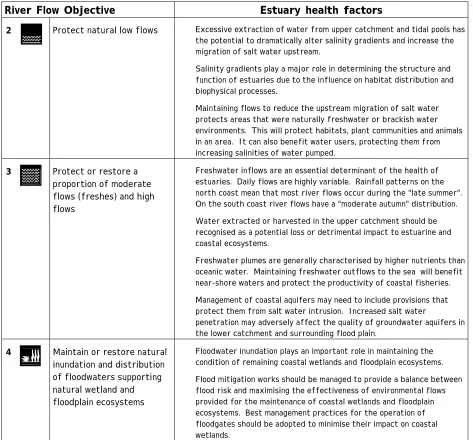
Table 1 Estuary health benefits of implementing the River Flow Objectives
River Flow Objective
Estuary health factors
2 Protect natural low flows " Excessive extraction of water from upper catchment and tidal pools has the potential to dramatically alter salinity gradients and increase the migration of salt water upstream.
" Salinity gradients play a major role in determining the structure and function of estuaries due to the influence on habitat distribution and biophysical processes.
" Maintaining flows to reduce the upstream migration of salt water protects areas that were naturally freshwater or brackish water environments. This will protect habitats, plant communities and animals in an area. It can also benefit water users, protecting them from increasing salinities of water pumped.
3 Protect or restore a proportion of moderate flows (freshes) and high flows
" Freshwater inflows are an essential determinant of the health of estuaries. Daily flows are highly variable. Rainfall patterns on the north coast mean that most river flows occur during the "late summer". On the south coast river flows have a "moderate autumn" distribution.
" Water extracted or harvested in the upper catchment should be recognised as a potential loss or detrimental impact to estuarine and coastal ecosystems.
" Freshwater plumes are generally characterised by higher nutrients than oceanic water. Maintaining freshwater outflows to the sea will benefit near-shore waters and protect the productivity of coastal fisheries.
" Management of coastal aquifers may need to include provisions that protect them from salt water intrusion. Increased salt water
penetration may adversely affect the quality of groundwater aquifers in the lower catchment and surrounding flood plain.
4 Maintain or restore natural inundation and distribution of floodwaters supporting natural wetland and floodplain ecosystems
" Floodwater inundation plays an important role in maintaining the
condition of remaining coastal wetlands and floodplain ecosystems.
6 Maintain or mimic natural flow variability in all streams
" Freshwater flows affect the availability of food at the base of the food web by influencing the abundance and distribution of primary producers within an estuary's waters and by affecting the influx of organic carbon
" In poorly flushed estuaries, reducing the volume of freshwater inflows changes tidal flushing times. Increased water residence times may exacerbate poor water quality and lead to detrimental effects on estuarine ecosystems.
" Maintaining freshwater inflows may:
• reduce the residence time for pollutants,
• improve sediment geochemistry, and • decrease the probability of algal blooms
9 Minimise the impact of instream structures
" NSW Fisheries has identified 1037 floodgates, 96 weirs, 78 causeways and 36 fords that are impeding tidal flows. These figures do not include the large number of temporary bunds and dams constructed during low flow periods. A weir review process is now underway to examine the environmental impact of these structures and options for their future management.
" Dams, weirs and tidal barrages should be managed to maximise the effectiveness of environmental flows provided for the maintenance or improvement of riparian, aquatic and marine ecosystems. Structures that impede tidal flows should also be managed to minimise their impact on fish habitats, particularly nursery habitats.
12 Maintain or rehabilitate estuarine processes and habitats
" The timing and volume of freshwater flows is important to the natural functioning and processes of an estuary – which in turn provides significant habitat, biological, commercial, tourism and aesthetic values. Changes to freshwater inflows may influence:
• the abundance, distribution and diversity of fish and prawns;
• the timing and success of fish spawning, recruitment and migration; and
• water quality, fish habitats and algal blooms.
" In 1999, commercial fish production in estuaries of finfish, prawns and oysters was valued at over $45 million pa. [Ref: NSW Fisheries 1998/99 Status of Fisheries Resources, NSW Fisheries Research Institute, 2000]
" Over 250 000 anglers were involved with recreational fishing on the coast spending an estimated $580 million pa. [Ref: Australian National Sportfishing Association website www/ansa.com.au/sportfishing]. . Coastal tourism and recreation is estimated to be generating several $ billion in gross expenditure and creating thousands of jobs.
" There is pressure in some areas to artificially open entrances of estuaries and coastal lagoons. This is mostly prompted by urban related issues such as local flooding and perceptions about water quality.
" In intermittently opening estuaries, entrance closure may lead to a break down of salinity gradients in the upper estuary due to mixing, raised water levels or evaporation.
Note:
i. Estuaries vary in size and shape from large coastal river systems to intermittently opening coastal lakes and lagoons. As a consequence, the response to changes in freshwater inflows can be highly complex and uncertain.
ii. There is very limited data about the size, location, condition or dynamics of estuaries in NSW. There is a critical lack of information on key biophysical functions and processes that are affected by freshwater inflows.
iii. A significant proportion of freshwater extraction in coastal catchments and tidal pools has been unlicensed. Records of how much water (ie. volumes) has been extracted are generally poor.