Modification and performance evaluation of a dual-function okra
processing device
Raphael Segun Bello*, Ejikeme Paul
Onyeanula, Ephraim Ugochukwu Nebo
(Department of Agricultural & Bioenvironmental Engineering Technology, Federal College of Agriculture, Ishiagu, 840001 Nigeria)
Abstract: The performance evaluation of a dual-function device for slicing and drying Okra developed at the Federal College of Agriculture, Ishiagu Nigeria was carried out and reported. The device was designed to slice and dry okra in one single-sequence operation. To evaluate the device, some physical characteristics including the axial length, mean equivalent diameters and sphericity of okra samples were measured to determine slicing blade characteristics and other machine considerations. The results showed that the mean axial length, equivalent diameters and sphericity determined for each okra sample categorized as big (A), medium (B) and small (C) are; axial length: 74.62, 59.7 and 44.03mm, equivalent diameters: 24.54mm, 19.20mm and 15.79mm, sphericity: 0.56, 0.55, 0.62 respectively. Evaluating the performance of the device, the overall slicing efficiency is 95.29%, with a maximum efficiency of 97.50% recorded while slicing small size okra. The overall machine capacity is 12.59 kg h-1 while the average chip length, width and thickness are 19.56mm, 7.52mm and 3.39mm, respectively while the drying efficiency of 87.68% was obtained within the drying chamber. The results showed significant improvement in modified machine performance over the existing machine in terms of slicing efficiency and output capacity.
Keywords: Okra, slicing, drying, efficiency, sphericity, device
Citation: Bello, R. S., E. P. Onyeanula, E. U. Nebo 2020. Modification and performance evaluation of a dual-function okra processing device. Agricultural Engineering International: CIGR Journal, 22(1):76-84.
1 Introduction
Okra is a dicotyledonous horticultural plant grown
throughout the tropics and warm temperate regions for its
fruit suitable for human consumption and a high source of
energy (4550 kcal kg-1) (Sengkhamparn et al., 2009;
Owolarafe et al., 2011; Ngbede et al., 2014). Because of the
high perishability of fresh okra and relatively poor storage,
handling after harvest, it’s processing and preservation has
become imperative. Okra is a major component of today’s
Received date: 2019-03-14 Accepted date: 2019-12-01 *
Corresponding author: R. S. Bello, Ms. Lecturer/Senior research fellow of Department of Agricultural & Bioenvironmental
Engineering Technology, Federal College of Agriculture, Ishiagu 840001, Nigeria. Email: [email protected]. Tel: +234-8068576763.
meal and with its high market demand, its processing is
profitable and can serve as source of revenue for
households. However, insufficient buyers of freshly
harvested fruits, lack of storage and processing facilities
constraints could be alleviated by providing efficient
machines to process fresh fruits produced into more durable
finished products. Among several technological processes
employed in processing and preservation of fresh (Okra),
slicing and drying are most critical. Slicing is a form of size
reduction by mechanical means without change in material
chemical properties, uniformity in size and shape of
individual units of the end product (Leo and Balogun, 2009;
Kamaldeen et al., 2016) while drying is the reduction of
product moisture content to a final value at which the
material can be stored. These processes can be achieved
traditionally and mechanically.
Traditionally, Okra are sliced with kitchen knife; a
considerably slow and tedious process, after which it will
be spread in flat basket or tray pan exposed to sunlight on
roof top of low buildings and open spaces. This practice is
found to be dangerous as well as time consuming with low
output. A new approach is required. The manual method of
slicing is affected the farmer’s productivity (output) and
time loss, danger of knife cut, and possibility of product
contamination etc. A manually operated device developed
by Owolarafe et al. (2007) adopted as a unit of an
integrated system for Okra processing by rural women in
South-Western Nigeria because it reduced the drudgery
associated with manual slicing appreciably.
Olajide et al. (1997) evaluated an Okra slicer and found
that there was higher loss in the traditional method of
slicing than in the mechanical slicer. He reported a 65%
slicing efficiency and 312 kg hr-1 capacity. Ogbobe et al.
(2007) designed a motorized Okra slicer with 42.8 kg hr-1
capacity and 95% efficiency when compared with hand
slicing and manually operated machine methods. It
produced slices of uniform thickness with deviation and
variance of 0.13 and 0.14, respectively. Kamaldeen and
Awagu (2013) designed a manual tomato slicing machine
to cut tomatoes at 2cm thickness. The capacity of the
machine was 540.09 g min-1 and its slicing efficiency was
rated 70%.
Various drying methods had been employed in drying
different agricultural products with varying advantages and
limitations. Many of such systems utilized both direct and
indirect solar radiation (Rossello et al., 1990): Direct solar
drying of whole pods or sliced pieces using a kitchen knife
at near-regular sizes is done by spreading out on trays
exposed to sun radiation. This method predisposes the
product to losses both in quantity and quality because of the
dependence on direct solar drying and exposure of the
vegetable to disease infestation and contamination. Indirect
solar drying utilizes heat from the sun to heat a collector
surface to either heat air or in direct contact application on
the product. Choosing the right drying system for fruits and
vegetables is thus important for more uniform, hygienic and
attractively coloured dried product with promising results
in postharvest losses prevention and prolonged shelf lives.
Traditionally, drying of Okra can be achieved by
combined effect of drying time and slice thickness on the
solar drying. A study by Adom et al. (1997) concluded that
solar drying was an effective method for producing dried
Okra at shorter drying periods compared with the
traditional open-air sun drying method. From this study, it
was observed that the thicker the slice, the more the drying
time required and the organoleptic evaluation of dried
products showed that the drying limit of Okra could be
determined when the Okra pods became brittle on slight
pressure application.
Several devices in Okra processing had equally been
developed for unit operations. However, considerations
have also been given to integrated system approach in
combines process operations such as slicing and drying.
Such efforts had yielded the experimental machine used for
this research work. Preliminary evaluation of this device
indicated a slicing efficiency of 89.41% while the machine
capacity was 20.15 kg hr-1. The average slice thickness of
samples obtained is 8.6 mm. The drying chamber at no-load
condition reached a temperature of about 50C and due to
convective heat transfer, it takes approximately 4.5 minutes
for the compartment above the tray to experience
temperature increase. Efficient performance of engineering
machinery is the hallmark of engineering profession and an
integral part of research innovations in technological
development, hence this performance can be improved on
which is a major objective of this research.
2 Materials and method
2.1 Material selection
Two major materials of consideration are: the crop
material consideration and the materials for machine
construction based on material properties, availability,
physical, mechanical and economic considerations.
Crop material considerations: Freshly harvested Okra
institution; dark green coloured fruits were selected for the
study (Figure 1). The average dimensions (length and mean
diameter) of the fruits were taken. Due to the variations in
okra physical characteristics from specie to specie, which
affects machine performances, the selected sample specie
(Abelmoscus esculentus L) were sorted for rejects and
particulate materials. The sample fruits categories were
thoroughly washed and sliced using the developed machine.
Figure 1 Fresh Okra fruit samples (Abelmoscus esculentus L.)
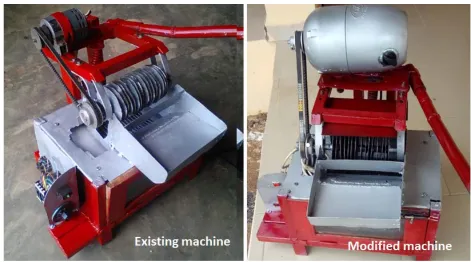
Machine considerations: The experimental device is a
dual-process okra slicing and drying device developed at
the Department of Agricultural and Bio-Environmental
Engineering Technology, Federal College of Agriculture,
Ishiagu. The machine shown in Figure 2 (existing and
modified)) is a dual function assembly comprising two
compartments, the slicing and drying units; each
performing different functions of slicing and drying,
respectively. Each component is described as below.
Figure 2 The existing experimental machine before and after modification
a. Slicing unit: The slicing unit comprises the hopper,
the slicing unit, a G-frame and an ac/dc electric motor. The
hopper constructed of a 2 mm galvanized steel sheet is a
rectangular shaped platform opening into the slicing
chamber. Okra is fed at controlled feed rate into the slicing
chamber where a set of rotary disc blades slices through the
Okra. The angle of repose of Okra plays a significant role
in ensuring a self-feed arrangement. The slicing unit
comprises the cutter assembly which is a set of 15-piece
galvanized discs 80mm diameter cutting disc, arranged in
gang on a shaft simply supported on two pressure
non-fibrous Okra pods into slices. The sliced Okra passes
through the slots into the drying grills below. The
operational lever is a 500mm long mild steel pipe attached
to the carriage to provide leverage for slicing assembly
during loading and unloading operations. An ac/dc
induction coil driven by a belt and pulley drives the slicing
assembly mounted on two pressure lubricated ball bearings.
b. The drying unit: The drying unit comprises a drying
and heating chambers and electrical control units. The
drying chamber consists of a heating element, a contactor, a
regulator, thermostat sensor and temperature control and
the drying chamber (a drying grill, wood insulated housing)
and an outer wall with heat reflective galvanized mild steel.
The heating element converts electricity into heat through
the process of joule heating to remove moisture for the
Okra at a controlled rate. The drying tray is a grill which
offers a more rapid moisture removal from the sliced
product. The electrical control unit consists of a heat
regulator, thermostat and thermocouple sensor WHILE The
regulator controls the temperature of the dryer at desired set
point. The thermostat regulates the quantity of heat flow
into the drying chamber by controlling the switching on and
off of the heating element as needed to maintain the correct
temperature. Thermostats can be constructed in many ways
and may use a variety of sensors to measure the
temperature. The output of the sensor then controls the
heating or cooling of the element. The type of thermostat
used in this design is an electronic thermostat.
2.2 Methodology
(1) Determination of physical characteristics of okra
samples: The weight, mean axial length, diameter, density,
volume, sphericity and roundness of the fruits were
measured using a venier caliper for each sample and the
approximate values calculated using the following
procedures and equations.
a. Determination of crop sample weights: The
samples were graded into three size categories of small size
fruits (sample A), medium size fruits (sample B) and big
size fruits (sample C) (Figure 1). Each category was
weighed using a precision electronic weighing scale
(SF-400, capacity 5000g x 1g), and the number of fruits noted.
b. Mean axial length of okra: The mean axial length,
butt diameter (a), intermediate (b) and apical (c) diameters,
weight of 20 randomly selected fruits from each sample
categories were measured and the mean of three sample
replicate readings were taken for each sample and recoded.
c. Okra mean diameter: The okra mean diameters
were determined by measuring the dimension of the
principal axis; butt (major), intermediate and minor (apical)
diameters of randomly selected fruits samples using venire
calliper. The major, minor and intermediate axes for okra
are shown in Figure 3.
Figure 3 The measured dimensions of okra fruits
The mean diameter dp in mm was calculated using the
following expression (Mohsenin, 1986; Bello and Odey,
2011):
3 p
a b c
d = + + (1)
Where
a= Butt (major) diameter of okra
b= Minor (apical) diameter of okra
c= Intermediate diameter of okra
d. Sphericity of okra fruit: Sphericity (φ) is defined as
the ratio of the surface area of the sphere having the same
volume as that of the fruit to the surface area of the fruit,
determined through equation (Mohsenin, 1986; Dursun and
1 3 [ abc ] Sphericity( )
a
φ = (2)
e. Volume of okra fruit: Fruit volume (V) was
calculated using the equation given by Al-Mahasneh and
Rababah (2007), Bello et al. (2018):
2 2
6 2
b a V
( a b ) π
=
− (3)
(2) Device modification factor: The following
considerations were used as basis for the modifications.
a. Power supply: The machine was evaluated to
determine if the power available is adequate to sufficiently
power the machine.
b. Effectiveness of cutting mechanism: The machine
capacity to slice fed okra. The machine was also observed
to determine the efficiency.
c. Performance of drying mechanism: The drying unit
was also investigated to determine power supply and
scheduling between the cutting unit and the drying unit.
d. Other considerations: Other considerations include
safety of operation, maintainability, user friendliness and
ease of operation.
2.3 Machine performance indicator
Testing is a vital step in machine process development.
The following indicators were used to measure the
performance of the machine.
a. Slicing efficiency: Slicing efficiency is expressed as
the effectiveness of machine slicing a unit feed of Okra
compared to known machine performance. The slicing
efficiency is given by the following expression
(Balasubramaniam et al., 1993):
Number (mass) of okra effectively sliced 100% Total number (mass) of okra fed
α= × (4)
Also,
T D 100 T
N N
% N
α= − × (5)
Where: α = slicing efficiency (%), NT = Total number of okra fed into machine, ND = Number of total Okra sliced
b. Machine capacity: Actual capacity/throughput of
the machine was also determined by feeding Okra into the
machine and finally weighing all the slices irrespective of
damage. Machine capacity expressed as the quantity of
Okra sliced per unit time of measurement:
Machine capacity=Total weight of pkra sliced kg( ) Time taken hr (6)
c. Slice thickness: Three randomly drawn samples of
each category, containing 30 slices were used for
determination of slice thickness, uniformity and shape.
Slice thickness was determined at four points around the
periphery of the slice using micrometer screw gauge.
d. Dryer performance evaluation: The dryer was
evaluated at both load and loading conditions. In the
no-load test condition, the thermostat of the dryer was set at
temperatures of 50 and 70ºC and the temperature monitored
over time at the two trays levels (upper and lower) in the
dryer. 50 g of the samples was dried in the chamber until a
constant weight was obtained. The effect of temperature,
slice thickness and tray position was then observed.
e. Product evaluation: After machine test, the product
samples were sorted into three categories: whole sliced,
chopped slice and unsliced. The mean sample of each
product sizes were determined.
3 Results and discussions
Geometric properties
The diameters and axial lengths of randomly sampled
20 Okra fruits picked from the three categories (A, B, and C)
were measured with a mean average butt diameter of 28.10,
22.65, 19.23 mm for A, B and C, respectively; intermediate
diameters of 32.81, 26.45, 21.48 mm for A, B and C,
respectively, and apical diameters of 13.14, 8.95, 7.16 mm
for A, B and C, respectively. The mean axial lengths of
74.62, 59.7 and 44.03 mm were also determined for A, B
and C, respectively. From these results, it is evident that the
okra specie has a larger diameter at the intermediate section
than the butt and the apex. The geometric mean
characteristics of okra were determined and presented in
Table 1 with mean equivalent diameters for sample
categories A, B, and C equals; 24.54, 19.20 and 15.79 mm,
respectively. The measured sphericity for each sample are
sphericity of 0.58. This is an indication that all the samples
have an oval shape with the fruits at rest along the
longitudinal axis. By implication, the okra will approach
the blades in longitudinal axis, hence increasing the
tendency of uniform slice.
Table 1 Geometric mean characteristics of all sampled Okra
Okra sample Mean axial length Equivalent diameter Sphericity
A B C A B C A B C
81.10 68.20 46.30 25.22 20.25 14.99 0.50 0.50 0.60
76.20 63.30 42.30 25.53 21.75 17.01 0.60 0.60 0.60
71.30 56.20 42.10 24.98 16.88 15.56 0.60 0.50 0.60
90.10 58.20 50.20 24.01 20.31 17.29 0.50 0.60 0.60
64.30 67.20 52.30 24.13 19.91 16.65 0.60 0.50 0.60
74.20 49.10 47.20 22.53 16.43 15.72 0.50 0.60 0.60
73.30 64.20 44.30 24.98 20.43 14.71 0.60 0.50 0.60
65.20 58.20 45.20 26.33 17.60 17.00 0.60 0.50 0.60
77.20 56.20 35.20 24.11 19.06 14.70 0.50 0.60 0.70
73.30 56.20 35.20 23.62 19.38 14.29 0.60 0.60 0.70
Mean 74.62 59.70 44.03 24.54 19.20 15.79 0.56 0.55 0.62
Modifications made on device: The modifications made on the machine were tabulated in Table 2.
Table 2 Modifications on the experimental machine
Units Observations Modifications
Slicing chamber Okra freely jump out of the chamber unsliced
High risk if injury from exposed blades while in operation
A stopper plate introduced above the chamber which stretched above the blades.
Electric motor Existing motor could not power the machine under load A higher capacity induction coil was used to replace
the initial one
Carriage The carriage base could not support the electric motor The carriage was modified to carry the electric motor
Control system The carriage base could not support the electric motor Bye-pass circuit introduced
The contactor changed
4.1 Machine performance evaluation
Slicing unit performance tests: The machine
performance evaluation on the basis of the slicing
efficiency and the output capacity after modification
indicates improved power development with the coil was
able to effectively power the slicing assembly under load.
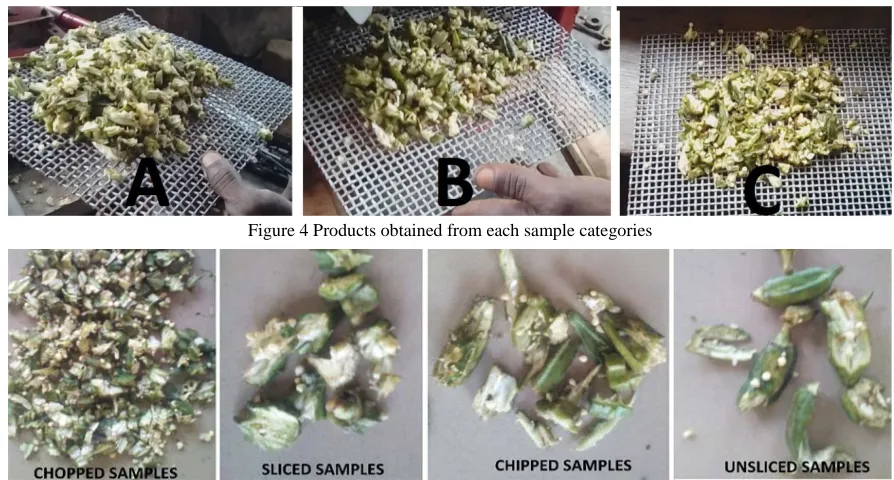
The product samples obtained from the slicing
operation were sorted and categorized into three:
well-sliced, unsliced and chopped as shown in Figure 4. Figure 5
shows different products obtained from the products
ranging from chopped, sliced, chipped and unsliced
samples.
Figure 4 Products obtained from each sample categories
Ten pieces of sliced, chopped and unsliced okra were
randomly but carefully sorted from the chipped samples in
each of the three categories and the length and width of
each chip/sliced samples measured and the slicing
efficiency calculated on the basis of chip slices (Table 3).
Table 3 Mean sizes of sliced, chopped and unsliced okra
Chip Replicates
Chopped sample Well-sliced sample Unsliced sample
Length Width Length Width Thickness Length Width
1 31.10 8.20 18.10 7.10 3.12 38.10 9.10
2 21.10 10.10 27.20 6.10 2.74 33.10 11.10
3 18.20 10.10 27.10 8.10 4.21 42.10 17.10
4 31.10 11.10 17.20 8.10 2.78 35.10 13.10
5 35.10 9.20 17.10 8.10 3.52 40.20 16.10
6 26.10 9.10 15.20 8.10 4.36 36.10 19.10
7 29.20 11.10 24.20 8.20 3.44 52.20 12.10
8 29.20 14.10 15.20 7.20 2.87 50.20 22.20
9 23.20 9.10 16.20 6.10 3.65 35.10 10.10
10 22.10 8.10 18.10 8.10 3.23 56.20 7.20
Mean 26.64 10.02 19.56 7.52 3.39 41.84 13.72
The chopped slices are unevenly sliced and have greater
number of shredded pieces, while the well-sliced samples
have relative uniformity in width and thickness. More of
the unsliced samples are found among the small size
categories. The chopped sizes have wide variation in
lengths (31.10-22.10) mm with an average of 26.64mm, the
width range is (8.10-11.10) mm with an average of 10.02
mm, while the well-sliced sample has an average thickness
of 3.39 mm.
Slicing efficiency: The effectiveness of the slicing unit
is presented in Table 4. The overall slicing efficiency of the
slicing is 90.76%.
Table 4 Slicing efficiency of modified machine
Trials Total pods fed No. well sliced Number unsliced Efficiency (%)
1 55 51 4 85.46
2 77 74 3 92.21
3 80 78 2 95.00
4 40 38 2 90.00
5 90 86 4 91.11
Total 342 327 15 90.76
Machine capacity: The through-put (capacity) of the
machine was obtained as a ratio of the weight of Okra pods
sliced to the time it takes to slice the pods completely.
Table 5 shows a mean capacity is 12.40 kg hr-1. There are
no significant differences between the output capacity of
the existing (11.97 kg h-1) and modified machine.
Table 5 Slicing unit machine capacity
No of
trials
Weight of pods fed
(kg)
Time taken
(min)
Machine capacity
(kg hr-1)
1 0.48 2.00 14.55
2 0.67 3.00 13.40
3 0.77 4.00 11.00
4 0.96 5.40 10.67
5 1.15 5.60 12.37
Total 4.03 3.80 12.59
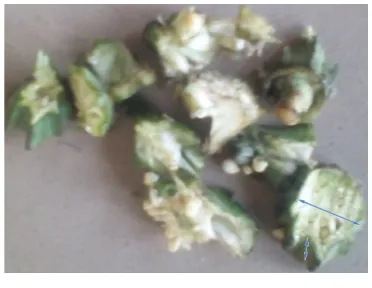
Slice thickness: The uniformity of slice thickness is
examined by randomly examining sample slices (Figure 6)
from the cut bulk. There are notable variations in thickness
of the slices with average slice samples of 8.6mm.
Figure 6 The sliced okra chips
Dryer performance tests: The energized drying chamber
receives sliced okra directly from the slicing chamber while
drying commenced at a regulated temperature of 80°C for
chamber is effectively regulated by the thermostat and
sensor. The chamber can be operated at a stable drying
temperature using these features.
Product quality and acceptability: The chopped samples
are exceptionally preferred for direct soup making while the
unsliced samples are either dried directly for storage or
returned to the machine for re-slicing. The well-sliced are
more valuable and marketable when-dried for preservation.
Figure 7 shows the sliced and dried samples in two batch
operations. The colour changes from light green to
light-golden brown after the drying process. Dried products from
the drying chamber has golden brownish colouration, which
is generally an acceptable quality of dried okra.
Figure 7 Sample okra dried in the modified experimental machine
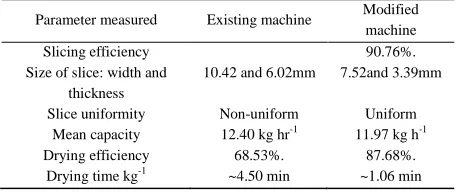
Comparison between existing and modified machine:
Comparative analysis of the existing and the modified
machines. Table 6 below compares the performances of the
modified machine with the existing machine.
Table 6 Comparison between existing and modified machine
Parameter measured Existing machine Modified
machine
Slicing efficiency 90.76%.
Size of slice: width and thickness
10.42 and 6.02mm 7.52and 3.39mm
Slice uniformity Non-uniform Uniform
Mean capacity 12.40 kg hr-1 11.97 kg h-1
Drying efficiency 68.53%. 87.68%.
Drying time kg-1 ~4.50 min ~1.06 min
4 Conclusions
The existing okra slicing and drying device has been
successfully modified and its performance is evaluated. The
modified device is suitable for slicing and drying fresh okra
for household cooking for storage. Some engineering
properties of fresh Okra were also studied. The mean
equivalent diameters for each sample category A, B and C
are 24.54, 19.20 and 15.79 mm, respectively. The
maximum slicing efficiency of the modified device is 95.00%
with an overall efficiency of 90.76%, the overall machine
capacity is 12.59 kg hr-1 while the average chip length,
width and thickness are 19.56mm, 7.52mm and 3.39mm
respectively. The drying efficiency of the device is 87.68%
at a drying temperature of 80°C and 30-minute duration.
There is a significant improvement in the slicing and drying
efficiencies, size of slice, uniformity, capacity of the
modified machine compared to the existing machine.
References
Adom, K. K., V. P. Dzogbefia, and W. O. Ellis. 1997. Combined effect of drying time and slice thickness on the solar drying of Okra. Journal of the Science of Food and Agriculture, Vol.73, 315-320.
Al-Mahasneh, M. A., and T. M. Rababah. 2007. Effect of moisture content on some physical properties of green wheat. Journal of Food Engineering, 79(4): 1467–1473.
Balasubramaniam, V. M., V. V. Sreenarayan, R. Vishwanathan, and D. Balasubramaniam. 1993. Design development and evaluation of cassava chipper. Journal of Agricultural Mechanization in Asia, Africa and Latin America, 24: 60–64. Bello, R. S., and S. O. Odey. 2011. Development, system analysis
and performance evaluation of a household grain cleaner. In Proceedings of the 32nd Annual Conference of the Nigerian Institution of Agricultural Engineers, 572-580. Nigeria, Ilorin, Kwara State.
conference of the Nigeria Institution of Agricultural Engineers, 472-482. Nsukka, South East Region (NIAE-SER), 27-30 October .
Dursun, E., and I. Dursun. 2005. Some physical properties of caper seed. Biosystems Engineering, 92(2): 237–245.
Kamaldeen, O. S., and E. F. Awagu. 2013. Design and development of a tomato manual slicing machine, Nigerian stored products research institute. International Journal of Engineering and Technology, Vol 2.: 57-60.
Kamaldeen, O. S., K. A. Arowora, J. S. Abioye, and E. F. Awagu. 2016. Modification of manually operated tomato slicing machine. research article. International Journal of Engineering Science and Computing (IJESC), 6(7): 1933-1938.
Leo, A., and A. Balogun. 2009. Design and Performance Evaluation of a Multi-Crop Slicing Machine. In proceedings of the 5th CIGR section VI International Symposium on Food Processing, monitoring technology in Bioprocesses and Food quality management, 622-640. Potsdam, Germany 31 August - 02 sept 2009
Mohsenin, N. N. 1986. Physical Properties of Plant and Animal Materials. New York: Gordon and Breach Science Publishers. Ngbede S. O., H. N. Ibekwe, S. C. Okpara, and L. Adejumo. 2014.
An overview of okra production, processing, marketing,
utilization and constraints in Ayaragu in Ivo local government area of Ebonyi State, Nigeria. Greener Journal of Agricultural Sciences, 4(4): 136-143.
Ogbobe, P. O., B. O. Ugwuishiwu, C. O. Orishagbemi, and A. O. Ani. 2007. Design, construction and evaluation of motorized okra slicer. Nigerian Journal of Technology, 26(2): 42-49. Olajide, T. D., M. M. Olowonibi, and P. Onwualu. 1997. Testing and
evaluation of manually operated okra slicer. Journal of Agricultural Engineering and Technology, 20(2): 257-263. Owolarafe, O. K., O. A. Muritala, and B. S. Ogunsina. 2007.
Development of an Okra slicing device. Journal of Food Science and Technology, 44(4): 426-429.
Owolarafe, O. K., S. O. Obayopo, S. O. Obayopo, O. A. Amarachi, O. Babatunde, and O. A. Ologunro. 2011. Development and performance evaluation of an okra drying machine. Research Journal of Applied Sciences, Engineering and Technology, 3(9): 914-922.
Rossello, C., A. Berna, and A. Mulet. Solar drying of fruits in a Mediterranean climate. Drying Technology, 8(2): 305-321. Sengkhamparn, N., R. Verhoef, H. A. Schols, S. Tanaboon, and G. J.