Internet of Things for Surgery Process
Using Raspberry Pi
https://doi.org/10.3991/ijoe.v16i10.15553
Rafeek Mamdouh () BADR University, Cairo, Egypt Mansoura University, Mansoura, Egypt
Hazem M. El-Bakry, Alaa Riad Mansoura University, Mansoura, Egypt
Nashaat El-Khamisy Sadat Academy, Cairo, Egypt
Abstract—The development of the internet of things makes all objects inter-connected, making it the next technical revolution. It has been applied extensively in various sectors, including agriculture, smart parking, and industrial places, and most importantly, in the health monitoring process.[1] To monitor or its applica-tion in surgery procedure is one of its uses in healthcare. This project proposes a system aimed to solve sudden occurrences and emergencies during the operation process. The system's objective is to minimize deaths and other possible effects of the phenomena by connecting the surgeon with an online specialist all over the world. The proposed system architecture is based on medical sensors measuring the patient's physical parameters utilizing wireless sensor networks. The sensors send the parameters to the Raspberry Pi, which converts them to digital data. The digital data is transferred over the wireless network to the server, which is then sent to the cloud environment using the internet of things. Additionally, In case of any problem, the system works by sending the surgeon a voice signal to open the system and record the message and send it with the video that was recorded by the Raspberry pi cameras through the server to all the surgeons involved in the system through the Internet of things all over the world. Then the surgeons from across the globe communicate according to his specialty of assistant surgeon to communicate with the surgeon inside the operating room through headset and microphone.
1
Introduction
The Internet of Things (IoT) topic in recent years has been on the high rise especially in economic, social, and technical importance. Internet of Things using processors, mi-crocontrollers, and sensors with accessories used for communication via the internet and has turned to be the constitutive part of the internet. IoT is developed with a proto-col that aids communicating as well as interacting with each other and the user respec-tively [2][3]. The communication through the internet helps to identify a lot of applica-tions which are built grounded on the Internet of Things technology where every phys-ical object such as sensor devices is linked to the internet.
One of the industries that play a vital role in the Internet of things is the healthcare sector. The adaptation of this technology in different systems of healthcare has helped to minimize the difficulty experienced by the physicians or the doctors including other health professionals and the clients, who are the patients — starting from providing homecare replacing the expensive clinical care as well as prevention a substitute which is efficient in delivering healthcare service. One of the benefits related to the use of the internet of things is an increase in supporting the patient quality life, cost, and ensuring the life span of patients with appropriate medication. Additionally, in conventional health care, the undetected health problems can be determined and resolved via the use of IoT technology ensuring healthcare services through digital identity maintenance for every patient complication to be significantly reduced.[3]
The constant communication between the health sensors device and the smartphone or computer having the default capability to communicate with the server makes the entire system reduce the cost and the complexity of the system. Given that the internet of things is termed as the physical system's network it allows parameters to be sensed or else be controlled remotely across network infrastructure, therefore, creating chances for more physical world integration to computer-based systems. This integration results in enhanced accuracy, efficiency, and economic advantages also reduced human inter-vention. On the other hand, in healthcare or medical systems both software and hard-ware devices need some investigations when it comes to the internet of things concept.
2
Problem Statement and Objectives
The wireless sensor technology can be used to receive information concerning the patient body temperature, heartbeat, blood pressure, and other significant parameters during operation exercise. This is attainable through the internet of things platform via the internet. This paper offers the health monitoring system during the operation proce-dure that determines critical human conditions for instance heart rate, blood pressure, sugar, oxygen, and other parameters. Apart from these parameters, the electronic sys-tem will record the patient's initial details before the operation of the X-rays. In case of any emergency, the system will send warning signals in the form of a message or call to the surgeon.
“The utilization of both the internet of things and Raspberry Pi has to gain satisfac-tory comments in health supervision, and this project gives the concept of the two plat-forms and its application in surgery operation. A popular platform Raspberry Pi pro-vides the full Linux server on the small platform with the internet of things at a fordable amount. Raspberry enables interface services as well as mechanisms through the gen-eral-purpose I/O interface. Using both concepts makes an adequate system infrastruc-ture. Therefore, this project aims to fashion a prototype to monitor the patient in the operation room condition. Also, Raspberry Pi is the processor of the system”.[4]
Raspberry functions perfectly as a multi-processor. The device comprises a graphics card, RAM, a volatile memory, device interfaces, including other external wireless de-vice interfaces. In terms of power-consuming Raspberry Pi consumes minimal power making it a cheap and powerful device. To provide commands it needs keyboard, power supply as well as a display unit as a standard PC.
3
Related Works
The aim of the proposed system in this project is the transfer information or message in case of malfunction or a sudden occurrence in the operation or surgery process in real-time. The link between the different elements is described with the following sys-tem structure. The proposed syssys-tem design comprises two parts that are hardware and software parts. The hardware unit part includes receivers and transmitters while on the software unit contains software languages, for instance, MATLAB, Python, and their interfaces. Before discussing the proposed system, it is crucial to review the Architec-tural design of already existing systems in healthcare. In most of the IoT applications, various steps are observed during its operation, which includes a collection of the data, processing the data, storage of the data, and transfer of the data.
3.1 IoT & Embedded system
interesting opportunities for experimental and observational field investigation Low-cost audiovisual playback and recording triggered second-hand Raspberry Pi. [5]
[6] The Author focuses on IoT middleware as many systems are built from existing middleware and these inherit the implicit ease properties of the middleware framework. In the first part, we created a matrix of security challenges that attach the existing CIA+ plan to three plain areas: decision, fret, and damage. Assistance part, they used a struc-tured seek an approach to identity 54 precise IOT middleware frameworks and we an-alyzed the security pattern of each of those. While there are existing surveys of IoT middleware, none of them focused on a detailed analysis of the carelessness of the sweep systems and therefore this has a clear contribution to the literature.
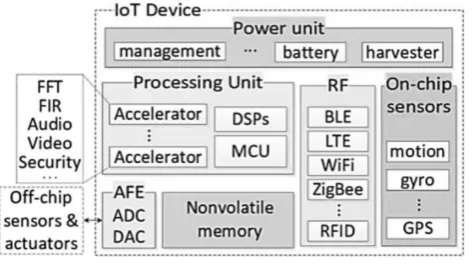
Every application has the processing of the initial and the last step, but in specific applications, storage does not apply, especially when it comes to real-time communi-cation. Fig.1 presented by [7], below shows a general architecture of the Internet of things. The figure shows that IoT entails many components, which include radio trans-ceivers, wireless connectivity RF component, low power multi-radio chips, and other essential components.[8]
Fig. 1.IOT general architecture
Recent advances in technologies have conceded the plan of slender-size low-power and moo-cost devices that can be joined to the Internet, enabling the emerging paradigm of Internet-of-things (IoT). In this invited paper, we discuss and resume the IoT exam-ple with a special center on Life consumption and methodologies for its minimization. In this papery, we have sum up the generalities helter-skelter potency minimization for IoT devices, and we have ventilated several techniques that can be used for such a pur-pose.[9]
3.2 IoT & Healthcare system
dimension of the system. Necessary actions can be taken during semi-major ailment and the health of the patient can be tracked at home as well as by the doctor
According to [11] general system using IOT and raspberry pi tools is primarily fo-cused on determining the health condition of the patient entailing the health parameter, and obtaining perfect outcomes. This system has been helpful for health facilities since the values of the parameters are all in real-time. Via the system, the physician can be calibrated the body temperature, ECG, heart rate parameter of the patient proficiently, also, the Raspberry device can store information momentarily. The heart rate is received in pulses; body temperature in the form Celsius, ECG received in percentage and is shown on a distinct website or health care device.
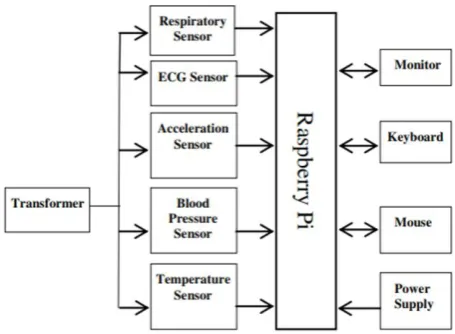
Considering the general architecture design with raspberry pi to monitor patient it comprises sensors connected to the skin of the patient and at the other end connected to the raspberry pi projected based on Fig. 2 below. [10]
Fig. 2. Architectural design diagram comprising raspberry pi
Each sensor value is stored in the server, simultaneously, displaying the very new values. This enables all the stakeholders linked to the patient including the doctor to see the patient’s information data together with the corresponding login data. With the sys-tem above, the doctor can access the history records of the patient and suggest changes in medication and prescription in regular monitoring. The benefit of adopting the Rasp-berry tool in the application is because of its multi-capacity efficiency of low power consumption, as already explained in the introduction part. Furthermore, the system installation at the end part is secure and can also be obtained from a database and as a result, gives valuable information [12][13].
According to Heartbeat and Temp Measuring Sys, [15] they said the shift uses the optical technology to detect the flood of manslaughter through the finger and offers the profit of portability over the cut and dried recording systems. This paper personates these challenges as well as solutions to these problems by proposing a construction which like a Reticulum to be formed between the patient and doctor to endow abstracted supervise of a patient by analyzing the data of the patient. The optical pulse sensory counts the heartbeat per minute and the constitution sensory appraises the temperature from the body and both the uniform data are sent to a receiving issue utilizing wireless technology where the data is expanded in a phone for further progress and subject care. The optical pulse sensor reckons the heartbeat per temperature sensory moderation the moderation from the strength and both the measured data are sent to an embrace death utilizing wireless technology where the data is unfolded in a cell phone for further pro-tuberance and persevering care. LM35 is used as a temperature sensor in this device which appraises the temperature of the thickness and the measured data is fed to the transmitter model. [24]The GSM module requires an SMS to be sent to a mobile shift which may require gainful for SMS to the mobile operator unless the authority takes an initiative to cause the service free of charge which would increase the reliability of the device.
In the up-to-date oversight surrounding, the custom of IoT technologies brings the convenience of physicians and patients, since they are appropriate to changeable in dif-ferent areas (such as real-time supervise, patient complaint management, and healthcare control). The person's sensory network (BSN) technology is one of the core technolo-gies of IoT developments in the healthcare system, where a patient can be monitored worn an assembly of puny sway and lightweight wireless sensory nodes. This system instant the architecture of IoT and workmanship of Smart health monitoring using IoT [16].
According to Ashlesha A. Patil,[17] said a sensor node has attached on the forbearing body to aggregate all the extraordinary from the wireless sensors and sends them to the BSN care swelling. The attached sensors on the patient's body form a wireless body sensor network (WBSN) and they are competent to sense the heart scold, Temperature of the surrounding. The principal advantage of this system in comparison to previous systems is to reduce the energy diminution to hold the network day, swiftness up and prolong the news coverage to increase patient peculiarity of biography.
4
The Proposed Architectural Method
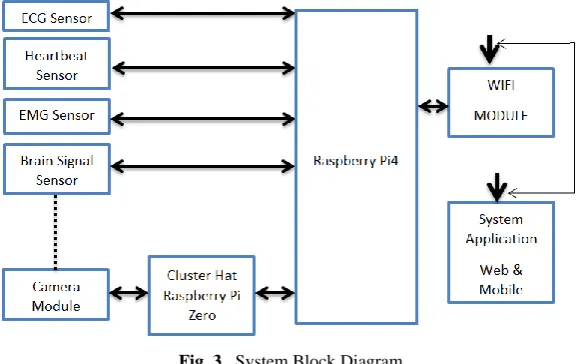
functions in the human body and are part of the hardware part of the system Fig. 3 shows the Block Diagram of the system. The hardware elements are then integrated with the software system which acts as the controller of the hardware and generation of the report” [18][19]. Apart from the sensors, the system will be fitted with microphones and cameras to record any problem during the operation procedure where it will send to the board then to the wireless system via the internet of things system all over the world.
Fig. 3. System Block Diagram
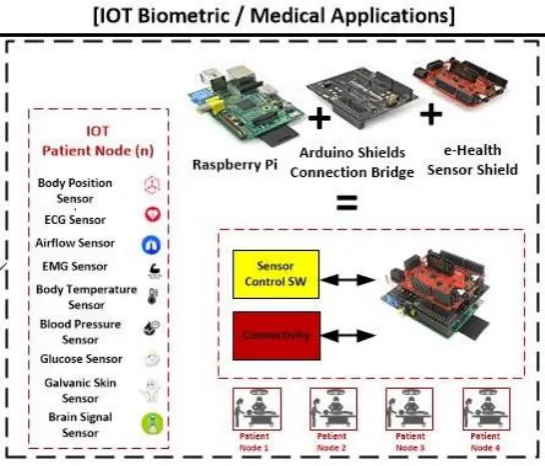
The sensors included in the system include a respiratory sensor, ECG sensor, Blood pressure sensor, heart rate sensor, acceleration sensor, glucose sensors, airflow sensor, brain signal sensor, and body position sensor. “Given that the Raspberry Pi lacks an inbuilt analog to digital converter. The information or data from the sensors is collected with the PIC microcontroller then the digital data is transferred to the Raspberry Pi which has an inbuilt Wi-Fi therefore after processing and displaying the sensor infor-mation and other recorded inforinfor-mation on LCD it as well enables the storage of the data on the cloud via wireless network or Wi-Fi where the online specialist can access the data on their computers and smartphones”.[8] [14]The different components of the pro-posed system and their effectiveness are described below. Fig. 4 below shows the pro-ject Fritzing Circuit Diagram showing sensors included in the system. Fig. 5 shows the representation of the proposed system architecture.
headphones fitted with a wireless microphone to communicate externally where the speech is recognized and sent to the webserver as digital data where is sent to the inter-net of things and received by the online specialist as notifications text or voice message on the monitoring and smart devices”[20]. The headphones are also used to receive the response and guidance from the specialists outside the operating room.
The system is controlled by the administrator where the new patient’s entries, as well as the surgeon or doctor, are made. After getting the information from the sensors and stored in the database the display is done on a separate UI page, which is loaded peri-odically and collects data from the database. The sensor time interval ranges from 5-10 seconds. In case of sudden occurrence, the message is sent to the specialist in real-time. For the projected system, the system and hardware device are connected centrally. Therefore, two servers are used one for system deployment and the other server for a database to store data. All data originating from the operation room is in the digital format to give the advantage of the speed of operation as well as digital processing to be more efficient than an analog signal.[21]
Fig. 5. Proposed System Architecture
4.1 Proposed system hardware module to be used
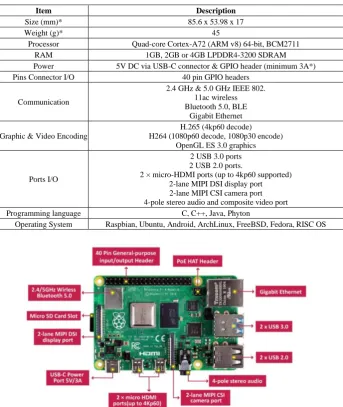
Table 1. Raspberry Pi Model B Specifications
Item Description
Size (mm)* 85.6 x 53.98 x 17
Weight (g)* 45
Processor Quad-core Cortex-A72 (ARM v8) 64-bit, BCM2711
RAM 1GB, 2GB or 4GB LPDDR4-3200 SDRAM
Power 5V DC via USB-C connector & GPIO header (minimum 3A*)
Pins Connector I/O 40 pin GPIO headers
Communication
2.4 GHz & 5.0 GHz IEEE 802. 11ac wireless Bluetooth 5.0, BLE
Gigabit Ethernet
Graphic & Video Encoding
H.265 (4kp60 decode) H264 (1080p60 decode, 1080p30 encode)
OpenGL ES 3.0 graphics
Ports I/O
2 USB 3.0 ports 2 USB 2.0 ports.
2 × micro-HDMI ports (up to 4kp60 supported) 2-lane MIPI DSI display port 2-lane MIPI CSI camera port 4-pole stereo audio and composite video port
Programming language C, C++, Java, Phyton
Operating System Raspbian, Ubuntu, Android, ArchLinux, FreeBSD, Fedora, RISC OS
Fig. 6. Raspberry Pi 4 Computer Model B 4GB
Sensors: Since the system comprises various sensors that are body position sensor, ECG sensor, airflow sensor, EMG sensor, Body temperature sensor, blood pressure sensor, glucose sensor, galvanic skin sensor, brain signal sensor, and heartbeat sensor. Emphasize is done on a heartbeat sensor, which is critical during an operation proce-dure.[18][19].
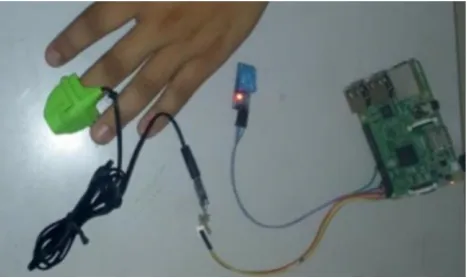
procedure. Hence for the proposed project, it is one of the hardware. It operates by combining simple optical heart rate sensor Fig. 7 shown below; it amplifies the pulse and cancels the noise in the circuitry making it easier and faster to attain reliable pulse readings from fingertip or earlobe. The sensor contains a super bright red LED as well as a light detector. The reason the light is super bright is that it passes via the finger, and it is detected at the other end. The sensor works based on the light modulation principle by the flow of blood through the finger at every pulse. The variations of the detected pulse are converted to an electrical pulse where the signals are amplified and triggered by an amplifier giving an output signal as a blinking light at every heartbeat. This is analog output, which is connected to the controller directly which measures the beats per minute rate.[17] [16]
Fig. 7. heart rate sensor attached to the patient body
The data from the sensor is transferred to the Raspberry pi board and is converted to the digital data, which is then sent to the webserver using the wireless network. To keep the surgeon, update the information is updated into the UI periodically. Simultaneously the digital data is transferred to the GUI Web Application which then transfers the in-formation to the Internet of Things sending alert notifications to the monitoring and smart devices of the specialists outside the operation room. After receiving the alert, the specialist response is transferred through the same infrastructure until it now reaches the surgeon.
4.2 Software description
For this project system, Raspbian, a Debian-based computer operating system, was utilized. Various Raspbian versions exist, including Raspbian Jessie and Raspbian Sketch. For Raspberry pi grounded microprocessor Raspbian is highly optimized. Rasp-bian utilizes PIXEL, and Pi enhanced lightweight X-Window setting as its crucial desk-top.
Raspberry Pi hardware. Moreover, it contains more than 35,000 packages, pre-com-piled software shoved in a pleasant format for informal connection on Raspberry Pi.
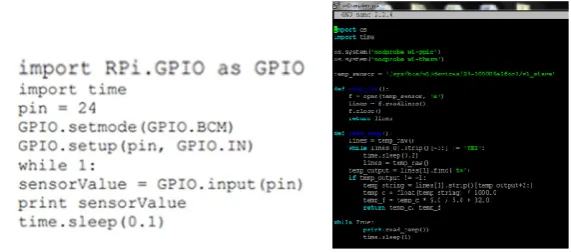
To preinstall, the Raspbian OS 2 GB SD card is required, although a 4 GB SD card or even more than this is extremely suggested for prospect addition of packages com-mended [22]. Fig. 8 below explains the project code used in the Raspbian OS. The sensor data reading code is burned in the microcontroller and interfaced with the Rasp-berry Pi using the I2C bus interface. For further stages, the code is written in Python in the Raspbian OS Nano text editor. The piece of the software code is written to read the value of the sensor in the text editor. A fresh file is built first using the Nano editor with the command $Nano sensor.py in the Raspbian OS terminal window. Then in sensor.py, the code below is written. [14]
Fig. 8. system software in OS & Code used in the Raspbian OS
Then Nano is saved by clicking ‘Ctrl+o’ the saved by clicking ‘return,’ then ‘Ctrl+x.’ And the program can be viewed in the OS.
4.3 Sample system implementation
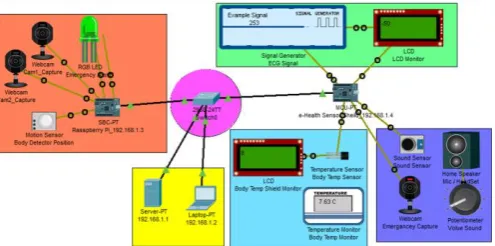
Fig. 9. Simulation of IOT Surgery Operation with Sample Sensor
Step2: Sensor calibrations: In this work, we tried have tested to advance the preci-sion of the measurements through actual-time software calibration, The calibration can be added on appear-up tables that decide aim parameter values can be stored with the Raspberry PI Software in the SD-card or can be transferred to the server.
To begin sensory measure, it needs to measure the actual resistance worth (Ra, Rb, Rc) of the Wheatstone span calibration project. Its be conduct out with an Avometer that is also used to verify the real worth of a reference voltage Vr = 3V. The temperature sensory calibration is utility as a sample on how to moderate the default calibration based on the e-Health kit manufacturer. First, the parameters Aux and Raux are estimated as equation (1), (2), [25]
𝐴𝑢𝑥= 𝑉𝑡 𝑉𝑟+
𝑅𝑏 𝑅𝑎+𝑅𝑏′ (1)
𝑅𝑎𝑢𝑥 = 𝑅𝑐 . 𝐴𝑢𝑥 1−𝐴𝑢𝑥 ′(2)
The estimated Raux is exponentially related to the temperature as follows equation (3):
𝑅𝑎𝑢𝑥(𝑇) = 𝑓 . 𝑝𝑇 ⇒ 𝑇 =
log(𝑅𝑎𝑢𝑥(𝑇) / 𝑓)
log(𝑝) (3)
• f and p: values depend on the measured temperature • Raux : measured resistance
Fig. 10.Blocky Programming - IoT Surgery Operation
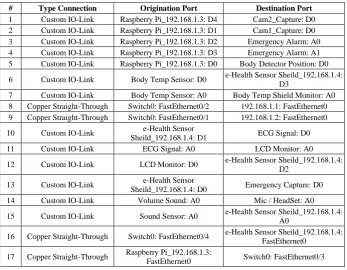
Table 2. System Port Connections
# Type Connection Origination Port Destination Port
1 Custom IO-Link Raspberry Pi_192.168.1.3: D4 Cam2_Capture: D0
2 Custom IO-Link Raspberry Pi_192.168.1.3: D1 Cam1_Capture: D0
3 Custom IO-Link Raspberry Pi_192.168.1.3: D2 Emergency Alarm: A0
4 Custom IO-Link Raspberry Pi_192.168.1.3: D3 Emergency Alarm: A1
5 Custom IO-Link Raspberry Pi_192.168.1.3: D0 Body Detector Position: D0
6 Custom IO-Link Body Temp Sensor: D0 e-Health Sensor Sheild_192.168.1.4:
D3
7 Custom IO-Link Body Temp Sensor: A0 Body Temp Shield Monitor: A0
8 Copper Straight-Through Switch0: FastEthernet0/2 192.168.1.1: FastEthernet0 9 Copper Straight-Through Switch0: FastEthernet0/1 192.168.1.2: FastEthernet0
10 Custom IO-Link e-Health Sensor
Sheild_192.168.1.4: D1 ECG Signal: D0
11 Custom IO-Link ECG Signal: A0 LCD Monitor: A0
12 Custom IO-Link LCD Monitor: D0 e-Health Sensor Sheild_192.168.1.4:
D2
13 Custom IO-Link e-Health Sensor
Sheild_192.168.1.4: D0 Emergency Capture: D0
14 Custom IO-Link Volume Sound: A0 Mic / HeadSet: A0
15 Custom IO-Link Sound Sensor: A0 e-Health Sensor Sheild_192.168.1.4:
A0
16 Copper Straight-Through Switch0: FastEthernet0/4 e-Health Sensor Sheild_192.168.1.4: FastEthernet0
17 Copper Straight-Through Raspberry Pi_192.168.1.3:
FastEthernet0 Switch0: FastEthernet0/3
5
Procedures of the Project Execution and Analysis Results
the same physical resource: the serial port, and additional cluster hat to connect the camera module as shown in the diagram above in Fig.5. This should be done at the preparation phase before the operation procedures start. All the hardware linkage should be verified first before starting the operation. If the Wi-Fi is okay and the online specialist monitoring device is also connected to the internet. Place the patient heartbeat sensor, and this should be done to all the sensors; additionally, the surgeon should be on his/her headphones fitted with microphone and camera and should be linked to the assist and surgeon. The assistant surgery can send the information of an occurrence to the monitoring devices or the server directly as per the surgeon guidelines. Moreover, the doctor can send the information to the webserver directly. The two do not require a raspberry pi board in this case.
The heartbeat, as well as other physical parameters, will be read and displayed on monitor show Fig. 12 if the parameters are abnormal compared to the regular rates it will also be displayed. This information in real-time will be sent to the server then to the internet of things where the online specialist will follow up the process. For our case, the status of the patient will be viewed on the GUI web application. Fig. 13
Fig. 13. Patient information was sent by mail
6
Conclusion and Future Work
This project is designed or developed as a prototype to observe and report sudden and emergence in the operation room during the surgery using Raspberry Pi and the Internet of Things. The proposed system is designed to ensure the safety of the patient during the surgery. Continuous monitoring of a patient during surgery is essential. The surgeon can send audio and video via the server and IOT while the sensors like heart-beat and temperature sensors, which are interfaced by Raspberry through the microcon-troller, can send the physical parameters in real-time to the online specialist. The digital data in the cloud web server can be accessed by specialists from anywhere around the globe in smartphones and other monitoring devices. Additionally, this intelligence can as well be embedded using LINUX programming language. The interface can be per-fected in the future for other healthcare-based sensors that are not included in this sys-tem.
7
Abbreviations
• ECG Sensor - Electrocardiogram: records the pathway of electrical impulses through the heart muscle.
• EMG Sensor- Electromyography.
• Fritzing - Is an open-source initiative to develop amateur or hobby CAD software for the design of electronics hardware, to support designers to move from experimenting with a prototype to building a more permanent circuit.
• DSI- Display Serial Interface is a specification by the Mobile Industry Processor Interface.
• GPIO- General-purpose input/output is an uncommitted digital signal pin on an in-tegrated circuit.
• LCD- Liquid Crystal Display
• LXDE- Lightweight X11 Desktop Environment • USB- Universal Serial Bus
8
Acknowledgement
Funding: No funding
Competing interests: The authors declare that they have no competing interests in this work.
9
References
[1]Kumar,R., & Rajasekaran, M.P. (2016). An IoT based patient monitoring system using Raspberry Pi. 2016 International Conference on Computing Technologies and Intelligent Data Engineering (ICCTIDE'16). https://doi.org/10.1109/ICCTIDE.2016.7725378
[2]Gupta,M.S., Patchava,V., & Menezes,V. (2015). Healthcare based on IoT using Raspberry Pi.2015 International Conference on Green Computing and Internet of Things (ICGCIoT).
https://doi.org/10.1109/ICGCIoT.2015.7380571
[3]Chauhuri, Abhik (2018). Internet of Things, for Things, and by Things. Boca Raton, Florida: CRC Press. https://doi.org/10.1201/9781315200644
[4]Bakir, A. (2018). Setting Up a Raspberry Pi and Using It as a HomeKit Bridge.Program the Internet of Things with Swift for iOS, 235-266. https://doi.org/10.1007/978-1-4842-3513-3_7
[5]Lendvai et al. (2015), Low-cost audiovisual playback and recording triggered by radio fre-quency identification using Raspberry Pi. PeerJ 3:e877; https://doi.org/10.7717/peerj.877
[6]Fremantle and Scott (2017), A survey of secure middleware for the Internet of Things. PeerJ Comput. Sci. 3:e114; https://doi.org/10.7717/peerj-cs.114
[7]Farzad Samie, Vasileios Tsoutsouras, Lars Bauer, Sotirios Xydis, Dimitrios Soudris, Jörg Henkel (12-14 December 2016). "Computation Offloading Management and Resource Al-location for Low-power IoT Edge Devices". In IEEE World Forum on Internet of Things (WF-IoT), Reston, VA, USA. https://doi.org/10.1109/WF-IoT.2016.7845499
[8]Reza Arkian, Hamid (2017). "MIST: Fog-based Data Analytics Scheme with Cost-Efficient Resource Provisioning for IoT Crowdsensing Applications".Journal of Network and Com-puter Applications.82: 152–165. https://doi.org/10.1016/j.jnca.2017.01.012
[9]Jorg Henkel, Santiago Pagani, Hussam Amrouch, Lars Bauer, and Farzad Samie, 2017. Ul-tra-Low Power and Dependability for IoT Devices. (Invited Paper for IoT Technologies). 978-3-9815370-8-6/17/$31.00 c 2017 IEEE. https://doi.org/10.23919/DATE.2017.7927129
[11]Chandini, Harshitha P, Mangala H D, Sapna C L, Manojkumar S B, 2018. ECG Telemetry System for IoT Using Raspberry Pi. International Journal of Engineering Research & Tech-nology (IJERT). NCESC - 2018 Conference Proceedings. Volume 6, Issue 13. P1-4 [12]Shovic, J. C. (2016). Introduction to IoT. Raspberry Pi IoT Projects, 1-8. https://doi.org/1
0.1007/978-1-4842-1377-3_1
[13]Shovic, J. C. (2016). Computer Security and the IoT. Raspberry Pi IoT Projects, 213-228. DOI:10.1007/978-1-4842-1377-3_7 https://doi.org/10.1007/978-1-4842-1377-3_7
[14]Mohd Abdul Muqeet, Mohammed Umair Quadri,(June 2019). IoT Based Patient Monitoring System Using Raspberry Pi. INTERNATIONAL JOURNAL OF RESEARCH IN ELECTRONICS AND COMPUTER ENGINEERING. IJRECE VOL. 7 ISSUE 2 (APRIL- JUNE 2019)
[15]Alam, Mohammad Wajih & Sultana, Tanin & Alam, Sami. (2016). A Heartbeat and Tem-perature Measuring System for Remote Health Monitoring using Wireless Body Area Net-work. International Journal of Bio-Science and Bio-Technology. 8. 171-190. 10.14257/ ijbsbt.2016.8.1.16. https://doi.org/10.14257/ijbsbt.2016.8.1.16
[16]Ashlesha A. Patil, Dr. S. R. Suralkar, May-June2017. REVIEW ON-IOT BASED SMART HEALTHCARE SYSTEM International Journal of Advanced Research in Engineering and Technology (IJARET) Volume 8, Issue 3, pp. 37–42, Article ID: IJARET_08_03_005. [17]Sangle Sagar D, Deshpande Niranjan R, Vadane Pandurang M,Dighe M. S, April- 2017.
“IoT Based Health-Care System Using Raspberry Pi”. International Research Journal of En-gineering and Technology (IRJET). Volume: 04 Issue: 04
[18]Hosmer, C. (2018). Raspberry Pi as a Sensor.Defending IoT Infrastructures with the Rasp-berry Pi, 73-128. https://doi.org/10.14257/ijbsbt.2016.8.1.16
[19]Hosmer, C. (2018). Operating the Raspberry Pi Sensor.Defending IoT Infrastructures with the Raspberry Pi, 129-150. https://doi.org/10.1007/978-1-4842-3700-7_5
[20]N R,P. (2016). Smart pi cam based Internet of things for motion detection using Raspberry pi.International Journal Of Engineering And Computer Science. https://doi.org/10.18535/ij ecs/v5i5.15
[21]Yattinahalli, S., & Savithramma,R.M. (2018). A Personal Healthcare IoT System model us-ing Raspberry Pi 3. 2018 Second International Conference on Inventive Communication and Computational Technologies (ICICCT).https://doi.org/10.1109/ICICCT.2018.8473184
[22]Dionisio, Rogerio & Malhão, Sérgio & Torres, Pedro. (2020). Development of a Smart Gate-way for a Label Loom Machine using Industrial IoT Technologies. International Journal of Online and Biomedical Engineering (iJOE).. https://doi. org/10.3991/ijoe.v16i04.11853
[23]Abderrahmane, Adda Benattia & Moussa, Mohammed & Abdelhalim, Benachenhou & Mebrouka, Abdelhamid. (2019). Design of a Low-Cost Switching Board Enabling a Recon-figurable Remote Experiment. International Journal of Online and Biomedical Engineering (iJOE).15.32.https://doi.org/10.3991/ijoe.v15i12.10650
[24]Li, Jinfeng & Cao, Shun & Duan, Jia-xin & Gao, Peng-cheng & Hou, Yong. (2015). A Novel Remote Monitoring and Control System Based on GSM for Home Security. International Journal of Online Engineering (iJOE). https://doi.org/10.39 91/ijoe.v11i4.4647
10
Authors
Rafeek Mamdouh Tawfiq, corresponding author, Ph.D. candidate, faculty of Comp and Inf. System, Mansoura Univ. Egypt. Received BSC of (MIS) Management Infor-mation System in 2006 from Shorouk academy, Cairo, Egypt, and MSc in computer graphics and information system, specializing Visualization & 3D-Motion Capture, Sa-dat Academy 2013, Cairo, Egypt. He was worked at Brainwaves SME system analysis and design of simulation and visualization department and 3d graphic designer (2007-2011), his worked supervisor of motion capture department at Arab Gulf Production and NEWTECH media production in (2014, 2017). He is mainly interested in machine learning applications, IoT, Algorithms, 3D Visualizations and Knowledge discovery in Azure. Rafeek works as an assistant lecturer at the British University and Shorouk Academy and other institutes from 2012 to 2017. Rafeek work an assistant lecturer at faculty of filmmaking and performing arts, BADR University, Cairo, Egypt to present. Rafeek has published papers in international journal indexed ISI, Scopus and web of Sciences. https://orcid.org/0000-0002-9661-3551
Hazem El-Bakry (Mansoura, EGYPT 20-9-1970) received B.Sc. degree in Elec-tronics Engineering, and M.Sc. in Electrical Communication Engineering from the Fac-ulty of Engineering, Mansoura University - Egypt, in 1992 and 1995 respectively. Dr. El-Bakry received Ph. D degree from University of Aizu-Japan in 2007. Currently, he is full professor at the Faculty of Computer Science and Information Systems - Mansoura University-Egypt. He is the head of Information Systems Dept. His research interests include neural networks, pattern recognition, image processing, biometrics, cooperative intelligent systems and electronic circuits. In these areas, he has published many papers in major international journals and refereed international conferences. Ac-cording to academic measurements, now the total number of citations for his publica-tions is 3698 and the H-index of his publicapublica-tions is 30. Dr. El-Bakry has the United States Patent No. 20060098887, 2006. Furthermore, he is associate editor for journal of computer science and network security (IJCSNS) and journal of convergence in infor-mation technology (JCIT). In addition, he is a referee for IEEE Transactions on Signal Processing, Journal of Applied Soft Computing, the International Journal of Machine Graphics and Vision, the International Journal of Computer Science and Network Se-curity, Enformatika Journals, WSEAS Journals and many different international con-ferences organized by IEEE. Moreover, he has been awarded the Japanese Computer and Communication prize in April 2006 and the best paper prize in two conferences cited by ACM. He has also been awarded Mansoura university prize for scientific pub-lication in 2010 and 2011. Dr. El-Bakry has been selected in who Asia 2006 and BIC
100 educators in Africa 2008.(Email:
cloud computing smart cities and big data analysis. Dr. Riad has authored and coau-thored many research papers in published journals. He also has supervised many Master and Doctorate studies. Reviewer in several national and international scientific journals. Information about publications, activities and personal blog are available at the Web site: http://www.amriad.com or http://www.amriad.name.eg. (Email: [email protected]).
Nashaat El-Khameesy El-Ghitany, Prof. of Computers & Information System, his worked the Dean Sadat Academy for Management Sciences (SAMs), Cairo, Egypt. Dr. Nashaat graduated BSc in Elec. Eng the Military Technical College, (MTC) Cairo, Egypt. MSc. in computers, Faculty of Eng. Cairo-University 1980. He earned his PhD in Electrical Eng, Ohio State Univ., USA, 1988. He started his academic career in MTC, his worked University Council member, Director of R&D, Dean of college of Port Said, Tanta, and Mansoura branches, SAMs 2000-2007. Dr Nashaat was awarded the Span-ish Royal Academy Award 2011, Best of AMSE Award ( Association for the Advance-ments in Modeling and Simulation for Enterprises), DR Nashaat has over 120 publica-tions in international journals and conferences while also supervised over 100 MSc and PhD dissertation, and he's the author of many text books in areas of informatics, e busi-ness and health informatics. His current research interest includes busibusi-ness intelligence, e-business & e-gov., performance enhancement, and cyber security. he's the Vice-pres-ident of the Int. Association for Advanced Modeling and Simulation for Enterprises (AMSE) (www.amse-modeling.org), Barcelona-Paris. He's also the co-founder of the Egyptian Association for Computers and Information Technology (ESIS-ACT) and the ICI committee (Texas A&M-USA, Esterhazy Academy-Hungary, Open Univ.-Malay-sia, Agri-Media). He also addressed many keynotes in many events locally and inter-nationally. (Email: [email protected])