Development of a motorized rice de-stoning machine
Ojediran, John Olusegun
*, Okonkwo Clinton Emeka, Okunola Abiodun Afolabi,
Alake Adewumi Samuel
(Department of Agricultural and Biosystems Engineering, Landmark University, Omu-Aran, Kwara State, Nigeria)
Abstract: A motorized rice de-stoning machine was locally developed for separating stone pebbles from milled rice. Major component being the reciprocating screen coupled with the blower and the hopper. The stone separation is achieved by vertical oscillation of the reciprocating screen coupled with a suction – like air produced by the blower directly beneath the screen causing rice – mixture to float just above the screen and the stones are sucked up the reciprocating screen then discharged through the stone chute and the clean rice collected in opposite order. The de-stoning machine was designed to be powered by a high speed (2980 r min-1) 0.746 kW electric motor. It was evaluated for its efficiencies in terms of rice separation and de-stoning, the tray loss and impurity level after separation were also evaluated. The highest de-stoning efficiency was recorded between 5 to 7 mm feed gates as 99.75% and the lowest was recorded at a feed gate of 20 mm as 82.5%. The highest rice separation efficiency was recorded at 5 mm feed gate to be 98.89% and the lowest of 93.33% was at 20 mm. The highest values of impurity level and tray loss were recorded at 20 mm as 2.041% and 6.67% respectively, while the lowest values were recorded at 5 mm as 0.028% and 1.11% respectively. The capacity also increased as the feed gate increase. All results showed a high correlation with feed gate.
Keywords: rice, de-stoning, blower, eccentric mechanism, pneumaticblower
Citation: Ojediran, J.O., C.E. Okonkwo, A.A. Okunola, and A.S. Alake. 2018. Development of a motorized rice de-stoning machine. Agricultural Engineering International: CIGR Journal, 20(4): 202–209.
1 Introduction
The production and consumption of rice has been on a significant increase due to its adaptability in various traditional food recipe, bread and alcoholic drinks (Dagninet et al., 2015).
An approximate 5 billion people consume rice globally on a regular basis (FAO, 2011; and Prakash et al., 2014). The rate of rice consumption differs in countries and continents (Cho et al., 2017). Rice which is mainly being cultivated for human consumption, still have over 40% (signifying 2.75 million per year), imported to West Africa (Azoumaet al., 2009). However, well over 90% of globalrice production is from tropical and semi-tropical climate especially in Asia. An estimated 120 million Nigerian depend on rice as a staple food where it is
Received date: 2018-02-26 Accepted date: 2018-06-11
*Corresponding author: Ojediran, J. O. Department of Agricultural and Biosystems Engineering, Landmark University, Omu-Aran, Kwara State, Nigeria. Email: [email protected].
consumed in various forms across localities but most popularly as boiled grains (Gbabo et al., 2015). Similarly, in West Africa, Nigeria is the largest producer of rice with an annual average of 3.2 million tons of paddy rice resulting in about 2 million tons of processed rice. Rice consumption in Nigeria has risen to over 10% per annum causing changes to consumer’s preferences (Ajala and Gana, 2015). Production however is largely done by small-scale farmers operating an average 1 to 2 hectares of land and where yield per hectare is relatively low due to several reasons among which are poor production systems, lack of basic trainings, aging farming population, low level of competition between local and imported rice etc (Onuet al., 2015).
post-harvest wastage, poor processing methods, and inefficiency in milling, poor marketing strategies, polishing and low-quality packaging and low/sub- standard mechanization on rice farms which has led to the over-reliance on manual labour for farm operations (International Rice Research Institute, IRRI, 2010).
Nigeria therefore has huge potential to increase her domestic rice production and marketing with the high hopes of becoming a self-sufficient rice producer as this will equally impact positively on the nation’s economy by affecting all the key players and stakeholders (Paddy farmers and traders, rice millers and processors, transporters, citizens, government and exporters). However, the major challenge in Nigerian rice industry is poor processing which allows contaminants such as stone pebbles, sticks and chaff to be introduced during harvesting and post-harvest handling. For this problem to be solved, the use of durable and sustainable machines must be engaged so as to enhance the quality of rice being produced (Gbabo et al., 2015; Mohammed et al., 2017). Pneumatic method has been used to clean threshed rice paddy by air lifting light, chaffy and dusty materials out of the paddy, with material other than paddy which are of the same weight with the paddy being separated by reciprocating screen (Aderinlewo and Raji, 2014; and Buggenhoutet al., 2013). Reciprocating sieves are known to eliminate materials other than paddy which is the same weight with the paddy, since they have the same aerodynamic characteristics with rice paddy. However, it has been advocated that for Agricultural mechanization to be readily adopted in Nigeria, machines must be indigenously designed, developed and constructed to ensure their adaptability to our soils, crops and the local farmers who are the end-users (Adejuyigbe and Bolaji, 2012). The aim of this research therefore was to carry out the design, construction and performance evaluation of a motorized rice de-stoning machine. When it has been successfully tested in Landmark University rice processing unit, it is hoped to be largely adopted as a sure way to improve rice processing in Nigeria and beyond.
2 Materials and method
2.1 Design of the rice de-stoner
A motorized rice de-stoner was designed taking into
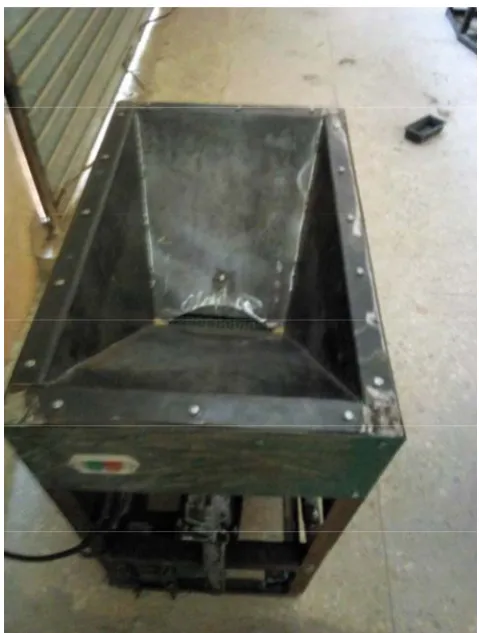
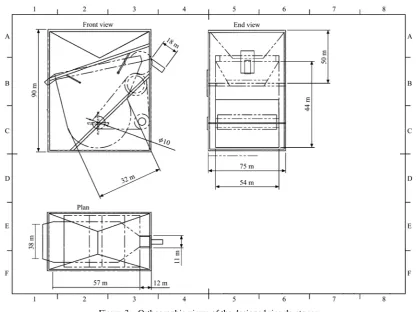
cognizance the pneumatic properties of milled rice (terminal velocity) (Figures 1 and 2). Shape and size, angle of repose were the physical properties of rice taken into consideration while machine properties considered were the configuration of the screen used and the angle of inclination of the screen housing. The reciprocating screen housing the blower was inclined at an angle of 10o in order to aid inward flow of grain across the screen by gravity. The stones were separated by the direction of air blast and the reciprocating screen in the reverse direction to the clean rice grain.
Figure 1 A 3–dimensional view of the motorized rice de-stoner
Figure 3 Orthographic views of the designed rice de-stoner 2.2 Design analysis
The design analysis was carried out with a view to evaluate the necessary design parameters, pneumatic properties, screen configuration, strength of the materials for consideration in the selection of the various rice de-stoner components in order for it to perform efficiently and to avoid failure during the required working life of the machine.
2.3 Determination of the hopper capacity
The hopper used was pyramidal in shape with a semi – circular feed discharge gate which can be regulated to give time for efficient de-stoning of the mass coming into the de-stoning unit.
Volume of the pyramidal section=1 base area height
3× × (1)
where, Base area in m2, Height, m; Volume of the pyramidal section, m3.
The capacity of the hopper was 25 kg. 2.4 Determination of the screen capacity
In order to ascertain the capacity of the machine, the screen capacity is a paramount requirement needed in designing other components of the machine.
V=LBH (2)
where, V is the capacity of the screen in m3; L is the length of the screen in m; B is the breadth of the screen in m; H is the depth of the screen in m.
2.5 Determination of the weight of de-stoning unit
The weight of the de-stoning unit was determined to establish the amount of load being exerted on the eccentric shaft by the de-stoning unit and its content. Hence the weight of the cleaning unit is expressed as;
W=mg (3)
m=ρv (4) where, W is the weight of the de-stoning unit (blower and screen component) and its content, N; m is the mass of the de-stoning unit and its content, kg; g is the acceleration due to gravity, m s-2; ρ is the density of de-stoning unit, kg m-3; v is the volume of the de-stoning unit, m3.
2.6 Power requirement
In selecting power of the motor needed to drive the rice de-stoner, the sum total of the various power needed to drive the pneumatic mechanism(blower) and the reciprocating unit in a pendulum motion was taken into cognizance (Gbaboet al., 2015).
NMDM =NVDV (5)
where, NM is the revolution of the motor, r min-1, which is
1400 r min-1; DM is the diameter of the motor pulley, m;
which is 0.09 m; NV is the revolution of the eccentric
shaft, or the revolution of the blower shaft, r min-1; which is 630 and 1400 r min-1 respectively; DV is the diameter of
the eccentric shaft pulley, or the blower shaft pulley, m; which was 0.2 and 0.09 m respectively.
Power required is expressed as;
P=Tw (6) where, P is the power required which was 746 W; T is the torque, Nm; w is the angular velocity which is taken as 2πN in rad s-1; where N is the revolution of the driven pulley in r min-1.
The power was calculated to be 0.746 kW. 2.7 Determination of twisting moment
T=F×r (7)
where, F is the force transmitted by the prime mover, N;
r is the perpendicular distance, m.
2.8 Determination of the eccentric shaft and the
blower shaft
This was determined to ascertain the eccentric shaft size and the blower shaft size that would withstand the load applied with twisting. It was determined using the Khurmi and Gupta (2007) relationships;
D3
=16(KmM+Te)πbd (8)
and;
2 2
( ) ( )
e m t
T = K M + K T (9)
where, D is the diameter of either the eccentric shaft or the blower shaft, m; Km combined shock and fatigue
factor of bending, 1.5; M is maximum bending moment, Nm; Te is the equivalent twisting moment, Nm; bd is
maximum bending stress, Nm-2; Kt Combined shock and
fatigue factor of torsion, 1.0.
2.9 Determination of the shaft angle of twist
This enabled us to know of the shaft diameter we used for the eccentric mechanism and the blower was safe. It was determined using the formula below; (Gbabo et al., 2015).
4
584M lt
θ Gd
= (10)
where, θ is the angle of twist of the shaft in degrees; Mt is
the twisting moment, Nm; l is the length of the shaft, m;
G is the torsional modulus of elasticity, Nm-2; d is the
shaft diameter of the eccentric mechanism or the blower, m.
2.10 Design of centrifugal blower
The blower must be capable of providing the required air velocity necessary for the separation of the rice-stone mixture. Air velocity was calculated using the continuity equation. The flow rate was 0.8 m3 s-1.
Q=AV (11)
where, A is the area of the blade and V is the actual velocity of air produced from the blower taking consideration of the terminal velocity of rice.
2.11 Determination of amplitude and frequency of
vibration
According to Olugboji and Jiya (2014) for a system of force vibration with a single degree of freedom, the amplitude is given as:
2 2 2 0.5
((1 ( ) ) (2 ( ) )
n n F K Y ω ω ε w w = − + (12)
where, F is the magnitude of excitation, N; K is the stiffness of spring, Nm-1; ε is the coefficient of damping, Nsm-1; ω is the frequency of excitation force, which is
expressed as =2 60
πN
, rad s-1; wn is the natural frequency
of vibration (rad s-1) of the rice de-stoner, which is expressed as;
n k w
m
= (13)
m is the mass of the system, kg; f is the frequency of
vibration (Hz), expressed as;
2
ω f
π
= (14)
2.12 Machine description
The machine comprises of the following components: machine frame, centrifugal blower, hopper, reciprocating screen unit, driving and driven assembly and a discharge outlet.
2.12.1 Machine frame
stabilizes the machine during operation. 2.12.2 Centrifugal blower
The direction of air intake of a centrifugal fan is parallel to its axis of rotation, while its discharge is perpendicular to the axis of rotation. Centrifugal fans was used in producing the require air flow needed for separating the stones from the rice grain.
2.12.3 Hopper
The hopper is trapezoidal in shape. It forms the feeding chute through which the rice – stone mixture is fed, it has a feed gate at the base to regulate the discharge into the de-stoning unit.
2.12.4 Screen casing
The reciprocating screen casing arrangement consists of four reciprocating arms. At the extreme, slightly beneath the reciprocating screen casing is a cam connection (eccentric mechanism) which energizes the reciprocating screen in a pendulum motion. The size of the screen aperture was based on the least equivalent thickness of rice grain sample evaluated.
2.12.5 Driving and driven assembly
A three (3) phase electric motor of 1hp with its pulley and eccentric shaft pulley as well as a blower pulley was used. The electric motor, eccentric shaft and the blower where connected by a V – belt.
2.12.6 Discharge outlets
The machine consists of two discharge outlet openings which contain the de-stoned rice and the stone in the reverse order.
2.13 Operation of machine
The motorized rice de-stoner machine was designed to remove stones from rice. A 0.746 kW electric motor provides power to the reciprocating mechanism alongside the centrifugal blower through an arrangement of pulleys and belt. The reciprocating mechanism oscillates in a pendulum motion with the aid of an eccentric drive. The milled rice - stone mixture discharges from the hopper through the feed gate by gravity where the lighter impurities are blown off via the cushion of air coming from the blower since the milled rice grain terminal velocity is higher than that of the light impurities. The milled rice is collected on the rice outlet while the stone is collected in the stone outlet.
2.14 Performance evaluation of motorized rice
de-stoner
The motorized rice de-stoner comprises of two functional units: the blower unit and the reciprocating screen unit. The blower unit is responsible for the separation of light impurities from the milled rice fed in through the hopper and also in the de-stoning operation while the reciprocating mechanism is responsible for providing the necessary agitation needed for de-stoning operation. The performance of the motorized rice de-stoner was evaluated in order to establish its efficiency, capacity and effectiveness. There were two (2) collection points for the test materials.
2.14.1 Determination of capacity of motorized rice grader
The capacity of the machine was evaluated as the quantity of milled rice the machine was able to de-stone within a recorded time. Two kilograms of the milled rice was introduced into the machine while the time for the de-stoning operation was recorded. It was calculated using Equation (15), Fadele and Aremu (2016)
Q C
T
= (15)
where, C is the capacity of machine in kg s-1; Q is the quantity of milled rice introduced through the hopper in kg; T is the time required for operation in seconds. 2.14.2 Determination of the de-stoning efficiency (DE)
The efficiency of the de-stoner was calculated using the formula as suggested by (Gbabo et al., 2015).
(1 scr)
sm M DE
M
= − (16)
where, DE is the de-stoning efficiency, %; Mscr is the
mass of the stone in the clean rice after separation, g; Msm
is the initial mass of the stone in the mixture, g.
2.14.3 Determination of the rice separation efficiency (RSE)
This is the percentage ratio of the mass of clean rice to the rice in the mixture before separation (Gbaboet al., 2015).
100
cr
rm M RSE
M
= × (17)
where, Mcr is the mass of the clean rice, g; Mrm is the
2.14.4 Impurity level after separation (IML)
This is the percentage ratio of mass of stone in the clean rice to the sum of the mass of clean rice and the mass of stone in the rice (Gbabo et al., 2015).
scr L
cr scr
M IM
M M
=
+ (18)
where, IML is the impurity level after separation, %.
2.14.5 Tray loss (TL)
This is the quantity of rice which was not recovered in the process (Gbabo et al., 2015).
1 cr
rm M TL
M
= − (19)
2.15 Sample preparation
Milled rice sample was collected from Landmark University Teaching and Research Farm. The initial moisture content wet basis was determined using the oven
dry method to be 11%. It was mixed with stones in a ratio of 80% whole rice to 20% stones.
2.16 Experimental design
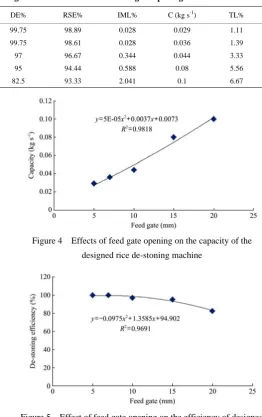
Performance evaluation of the designed motorized rice de-stoning machine was carried out using the complete randomized design with three replicates at each feed gate opening level. Twenty kilograms of milled rice were carefully weighed for each test and the results of mean values are presented in Table 1.
3 Results and discussion
3.1 Performance of the designed rice de-stoning
machine
The motorized rice de-stoning machine was evaluated based on the relationship of the feed regulator at the same moisture content and feed with the various efficiencies (Table 1).
Table 1 Performance of the designed rice de-stoning machine under different feed gate opening levels
S/N TIME (s) FEED (kg) Feed gate (mm) DE% RSE% IML% C (kg s-1) TL%
1 680 20 5 99.75 98.89 0.028 0.029 1.11
2 560 20 7 99.75 98.61 0.028 0.036 1.39
3 450 20 10 97 96.67 0.344 0.044 3.33
4 250 20 15 95 94.44 0.588 0.08 5.56
5 200 20 20 82.5 93.33 2.041 0.1 6.67
3.1.1 Effects of feed gate opening on the capacity of the designed rice de-stoning machine
As shown in Figure 4, variation of the feed gate regulator to the capacity is highly correlated and polynomial. As the feed gate opening on the hopper was increased, it was noticed that the capacity being handled per second was also increasing, because more grain is being released to the de-stoning chamber. The minimum capacity was 0.029 kg s-1 and the maximum been 0.1 kg s-1.
3.1.2 Effect of feed gate opening on the efficiency of designed rice de-stoning machine
The de-stoning efficiency and feed gate opening is highly correlated and polynomial (Figure 5). The de-stoning efficiency was highest (99.75%) at a feed gate range of 5 to 7 mm, while the feed gate of 20 mm gave the lowest efficiency of 82.5%. From the graph it was noticed that as the feed gate increased, the de-stoning efficiency decreases and vice versa. This could be due to the fact that the de-stoning chamber can properly sort by gravity at a specific volume of rice per time.
Figure 4 Effects of feed gate opening on the capacity of the designed rice de-stoning machine
3.1.3 Effect of feed gate opening on the rice separation efficiency
From the graph it was observed that the relationship between the rice separation efficiency to the feed gate is polynomial and highly correlated (Figure 6). As the feed gate was increased, the rice separation efficiency reduced. The lowest efficiency of 93.33% was recorded at a high feed gate opening. This could be because as more rice was released, the clean rice tends to move up with the stone for it to be discharged through the stone outlet; the hopper would be releasing more volumes than that it can handle since it is a gravity sorter.
Figure 6 Effect of feed gate opening on the rice separation efficiency
3.1.4 Effect of feed gate opening on impurity levels after separation
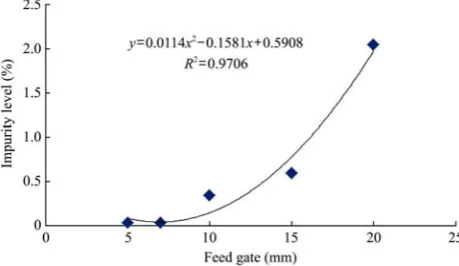
The graphical relationship between the impurity level to the feed gate is highly correlated and polynomial (Figure 7). It is observed that as the feed gate is increased, the impurity level is also increasing and vice versa. This could be because the rice – stone mixture has not been properly sorted out, due to the fact that the de-stoning chamber was fed more than what it can handle per time being a gravity sorter.
Figure 7 Effect of feed gate opening on impurity levels after separation
3.1.5 Effects of feed gate opening on tray loss
It was observed that the relationship between the tray loss and the feed gate is polynomial and highly correlated (Figure 8). As the feed gate is increased the amount of clean rice loss was also increasing. This could be because some of the clean rice tends to move up with the stones, while some rolled over to the ground since the screen is at an angle.
Figure 8 Effect of the feed gate opening on tray loss
4 Conclusion
The following are some specific conclusions made from the work:
1. The de-stoning efficiency decreased with increase in the feed gate opening.
2. The rice separation efficiency decreased with increase in the feed gate opening.
3. The impurity level increased with increase in the feed gate opening.
4. The tray loss also increased with increase in the feed gate opening.
5. Feed gate opening of 5 mm showed the lowest tray loss, impurity level and capacity of 1.11%, 0.028%, 0.029 kg s-1 respectively, but has the highest de-stoning efficiency and rice separation efficiency of 99.75% and 98.89% respectively.
References
Adejuyigbe, S. B., and B. O. Bolaji. 2012. Development and performance evaluation of a rice destoning machine using vibrating sieves.Journal of Natural Sciences, Engineering and Technology, 11(2): 94–105.
Ajala, A. S., and A. Gana. 2015. Analysis of challenges facing rice processing in Nigeria. Journal of Food Processing, 2015 (Article ID893673), 1–6.
Ayanwale, A. B., and C. A. Amusan. 2012. Gender analysis of rice production efficiency in Osun state: implication for the agricultural transformation agenda. In the 13th National Conference of the Nigerian Association of Agricultural Economists, 12-24. Obafemi Awolowo University, Ile–Ife,
Nigeria, 25-27 September.
Azouma, O. Y., M. Porosi, and K. Yamaguchi. 2009. Design of throw-in type rice thresher for small scale farmers. Indian Journal of Science and Technology, 2(9): 10–14.
Bamba, I., A. Diagne, J. Manful, and A. Ajayi. 2010. Historic opportunities for rice growers in Nigeria. Grain de sel, 51: 1–5.
Buggenhout, J., K. Brijs, I. Celus, and J. A. Delcour. 2013. The breakage susceptibility of raw and parboiled rice: A review. Journal of Food Engineering, 117(3): 304–315.
Cho, B., T. Kang, J. Won, S. Kang, H. Lee, and C. Han. 2017. Effects of main shaft velocity on turbidity and quality of white rice in a rice processing system. Journal of Biosystems Engineering, 42(1): 69–74.
Dagninet, A., Y. Negese, and E. Asmamaw. 2015. Development and evaluation of pedal thresher for threshing of rice.American Journal of Mechanics and Applications, 3(4): 27–32.
Fadele, O. K., and A. K. Aremu. 2016. Design, construction and performance evaluation of a Moringa oleifera seed shelling machine. Engineering in Agriculture, Environment and Food,
9(3): 250–256.
FAO. 2011. Food and Agriculture Organization Statistical Data Base, Rome. Available at: http.fao.org/. Accessed 7 January 2013.
Gbabo, A., B. Ndagi, A. M. Kuku, and L. Abdullahi. 2015. Development and testing of a rice de-stoning machine. International Journal of Engineering Research and Science and Technology, 4(3): 135–141.
International Rice Research Institute (IRRI). 2010. World Rice Statistics. Available at: http://beta.irri.org/solutions/index.php. Accessed 6 December 2017.
Khurmi, R. S., and J. K. Gupta. 2007. A Textbook on Machine Design. Ram Nagar, New Delhi:Eurasia publishing house (PVC) Ltd.
Mohammed, G. Y., F. Adesina, K. K. Kamil, and O. C. Ucheoma. 2017. Performance evaluation and modification of an existing rice destoner. International Journal of Engineering Technologies, 3(3): 169–175.
Olugboji, T. O., and F. Jiya. 2014. Design and fabrication of rice de-stoning machine. Food Science and Technology, 2(1): 1–5. Onu, D. O., K. C. Obike, F. E. Ebe, and B. O. Okpara. 2015.
Empirical assessment of the trend in rice production and imports in Nigeria (1980–2013). International Research Journal of Agricultural Science and Soil Science, 5(6): 150–158.