Application of Wireless Sensor Network Technology in
Security Control of Intelligent Buildings
https://doi.org/10.3991/ijoe.v14i05.8652
Jin Wang, Hua Shao!!"
Yancheng Institute of Technology, Yancheng, China
Abstract—When a wireless sensor network is used to perform real-time se-curity monitoring inside a building, there are drawbacks like multi-path signal fading and difficulty in spectrum sensing. In light of these problems, this paper proposes an improved signal spectrum sensing algorithm based on support vec-tor machine (SVM), which inhibits the impacts brought by the low signal-noise-ratio (SNR) environment in the transmission process of wireless sensor signals through the embedded cyclostationary characteristic parameters. Based on this, considering the low efficiency and poor fault tolerance of multi-task monitoring and scheduling inside the building, this paper also proposes a multi-task coordi-nation and scheduling algorithm based on physical information integration, which achieves multi-task scheduling and execution through intelligent break-down and prioritization of general tasks. The simulation test shows that, com-pared with the artificial neural network (ANN) algorithm and the maximum-minimum eigenvalue (MME) algorithm, the proposed algorithm has much bet-ter spectrum sensing effect under low SNR, takes less computation time, and achieves higher accuracy in large-scale multi-task coordination and scheduling. The research conclusions can provide new ideas for the application of wireless sensor network in intelligent building security monitoring.
Keywords—wireless sensor network; intelligent building; spectrum sensing; multi-task coordination; security monitoring
1
Introduction
In recent years, fire, flood, gas explosion and indoor environmental pollution have frequently occurred in all kinds of buildings. Therefore, it is of great significance to establishing and improving real-time monitoring systems for buildings to realize unat-tended and intelligent building security control [1-3].
and remote control, but it also has deficiencies like electromagnetic interference, indistinguishable environmental noise, and inability of sensors to be embedded in buildings [11-13].
When a wireless sensor network is used to perform monitoring inside a building, there are drawbacks like multi-path signal fading and difficulty in spectrum sensing [14-16]. To address these problems, researchers proposed signal classification and energy detection algorithms such as the maximum-minimum eigenvalue method, artificial neural network algorithm and SVM method, but these methods all have shortcomings like poor detection effect, low sensing accuracy [17-18]; regarding the low WSN-based multi-task monitoring and scheduling efficiency and poor fault toler-ance, etc., researchers proposed minimum time algorithm, genetic algorithm and min-imum execution time/earliest finish time algorithm, etc. [19-21], but as the multi-task coordination inside buildings is a problem integrating data and computational task, the above methods can easily result in local node overload, low search efficiency, and low task assignment success rate in the calculation process [22-25].
In light of the above problems, this paper proposes an improved signal spectrum sensing algorithm based on SVM, which inhibits the impacts brought by the low SNR environment in the transmission process of wireless sensor signals through the em-bedded cyclostationary characteristic parameters. Based on this, considering the low efficiency and poor fault tolerance of multi-task monitoring and scheduling inside the building, this paper also proposes a multi-task coordination and scheduling algorithm based on physical information integration, which achieves multi-task scheduling and execution through intelligent breakdown and prioritization of general tasks. The re-search conclusions can provide new ideas for the application of wireless sensor net-work in intelligent building security monitoring.
2
Design of the intelligent building WSN system
Perception environment attributes Buildingphysical environment
Control environment properties
Sensor common
node Information center User terminal
Actuator node
Sensor computing node
The design of the intelligent building WSN system is shown in Fig.1. It is mainly composed of sensor computing nodes, internal physical environment of the building, an information centre and a user terminal. The WSN monitors the internal environ-ment of the building in real time and feeds back the attributes of the environenviron-ment through common nodes to the information centre. The processing commands of the information centre are transmitted back to the internal environment of the building through the actuator node.
3
WSN-based indoor spectrum sensing algorithm
3.1 Indoor spectrum sensing model
Take one building for an example. Suppose that there are W primary users and M secondary users in the building network set, the network system can be expressed as follows:
( )
( )
( )
( ) ( )
0 1 1:
:
W ww
H y t
n t
H y t
s t n t
=
!
=
"
#
=
+
"
$
%
(1)H0/H1 indicates that the system has a/no main user; T is the overall sampling time;
and sw(t) is zero mean signal, whose autocorrelation function and cyclic spectrum are:
( )
0( )
(
)
0 0
1
T, exp 2
d
a
R
R t
atj t
T
!
=
$
!
#
"
(2)( )
(
) (
)
1
1
N,
2
,
2
n n
n
S f
Y t f a Y t f a
NT
!
=
=
#
+
"
!
(3)
a is the cyclic frequency; and Y (tn, f) is the Fourier transform. The identification
of the signal spectrum mainly takes the maximum spectral correlation coefficient Mc,
the spectral average energy E, and the spectral function Ms when a=1/T0 as input
vectors. The expression is as follows:
( )
( )
(
) (
)
( )
1 22
2
max
a a y a C yC f
S f
S f a
S f a
M
C f
!
=
#
+
"
$
%
&
'
(
=
%)
(4)( )
0 1 aS a T
M
S f
=
=
(5)The spectrum sensing input vector is X= {E Mc Ms}. It is used as the training
site are used as actual detection samples for spectrum sensing at different wireless sensor nodes. The decision function for different spectrum sensing is expressed as follows:
( )
(
(
)
)
1
sgn
l i i i,
ii
f x
a y K x x b
=
!
"
=
#
+
$
%
'
&
(6)3.2 Simulation and verification
The algorithm proposed in this paper was compared with the MME algorithm and the ANN algorithm to verify its spectrum sensing performance inside the building. The simulation software was Matlab 2012b, and 3 kinds of modulated signals AM (single frequency sine wave), BPSK and MSK were set, of which the latter two are of random signal sequences. Different SNRs were set for calculation.
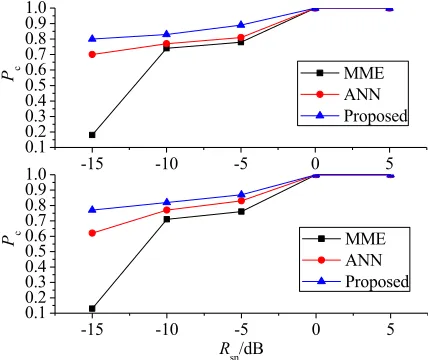
Table 1 shows the spectrum sensing accuracy of the MME algorithm, the ANN al-gorithm, and the proposed algorithm with respect to the three kinds of modulated signals at a SNR of -12dB and 0dB. From the table, it can be seen that when the SNR decreased, the spectrum sensing accuracy of the MME algorithm and the ANN algo-rithm decreased significantly, while the proposed algoalgo-rithm achieved better sensing accuracy at both SNRs. When the SNR was -12dB, the accuracy of the proposed algorithm was higher than those of the MME algorithm and the ANN algorithm by 70.7% and 22.7%.
Table 1. Spectrum sensing accuracy of the three algorithms at a SNR of -12dB and 0dB
Modulation type
Pc(Rsn=-12dB) Pc(Rsn=0dB)
MME ANN Proposed MME ANN Proposed
AM 17.9 70.2 81.5 84.6 87.3 91.1
BPSK 11.8 64.6 77.8 79.0 83.7 86.8
MSK 8.7 56.7 79.4 76.8 82.9 89.4
Fig. 2. Detection accuracy of the 3 algorithms at different SNRs with respect to AM (the upper one) and BPSK (the lower one) modulated signals
4
WSN-based indoor multi-monitoring-task scheduling
optimization
4.1 Multi-monitoring-task scheduling algorithm
Fig.3 shows the structure of the indoor multi-monitoring-task scheduling in an in-telligent building. The structure mainly addresses the task allocation and task schedul-ing. For a specific task, the system decomposes it into multiple subtasks by calculat-ing the correlation constraint relationships and computational complexity, etc., and assigns the subtasks to different computing nodes one by one. The task scheduler performs big data analysis to determine in what sequence these subtasks will be exe-cuted.
Task set
Task distributor
Task scheduler
Calculate node N
Calculate node 2
Calculate node 1
Fig. 3. Multi-monitoring-task scheduling structure
-15 -10 -5 0 5
0.1 0.2 0.3 0.4 0.5 0.6 0.7 0.8 0.9 1.0
-15 -10 -5 0 5
0.1 0.2 0.3 0.4 0.5 0.6 0.7 0.8 0.9 1.0
Pc
P c MME
ANN Proposed
Rsn/dB
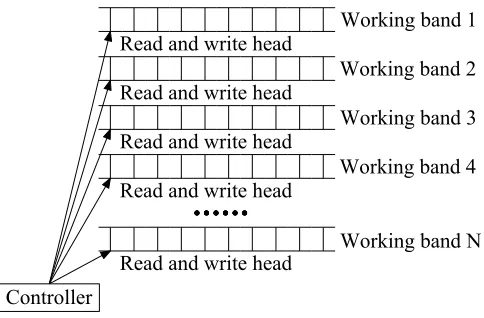
This paper carries out intelligent distribution of the multi-task WSN monitoring based on the multi-band Turing machine model. Let there be a total of N working bands, the relational system be M, the initial state of the Turing machine be q0, the
input task be w, and the time when M accepts w be t (w). The Turing machine server exists inside each monitoring node in the whole wireless sensor system. Based on the complexity of the monitoring task, the server divides it into multiple subtasks super-imposed. The Turing machine server achieves optimal breakdown and allocation of the monitoring task according to the complexity of the task and sorts the sub-tasks according to the calculated degree of difficulty. If a node cannot complete the task after computing for a period of time, it will break down and match the sub-task for a second time until the overall task is completed.
Controller
Read and write head Working band 1
Read and write head Working band 2
Read and write head Working band 3
Read and write head Working band 4
Read and write head Working band N
Fig. 4. Multi-belt Turing machine model
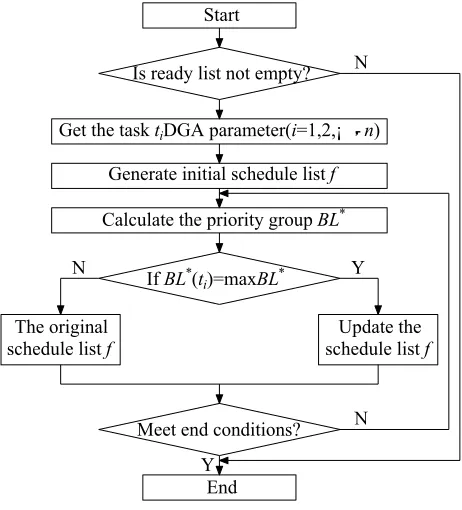
According to the above analysis, a WSN-based indoor dynamic multi-monitoring-task scheduling algorithm is established, as shown in Fig.5. The proposed scheduling algorithm targets the shortest overall multi-task execution time and the highest task execution efficiency. Prior to multi-task scheduling, the first step is to query the di-rected acyclic graph parameters of related tasks, randomly generate a schedule list, and calculate the priority of different tasks according to Equation (7).
( )
( )
max
( )( )
,
( )
j i
i j
i
i t succ t j
p c
C t t
w t
BL t
BL t
M
!M
"
#
$
%
=
+
+
$
%
&
'
(7)
Mp and Mc are the median values of unit calculation and link transmission
Start
Get the task tiDGA parameter(i=1,2,¡ -n)
Generate initial schedule list f
Calculate the priority group BL*
If BL*(t
i)=maxBL* Is ready list not empty?
The original
schedule list f schedule list Update thef
Meet end conditions?
End Y
Y N
N N
Fig. 5. WSN-based indoor dynamic multi-monitoring-task scheduling algorithm
4.2 Test results and analysis
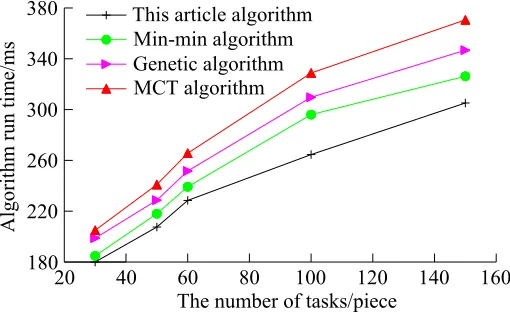
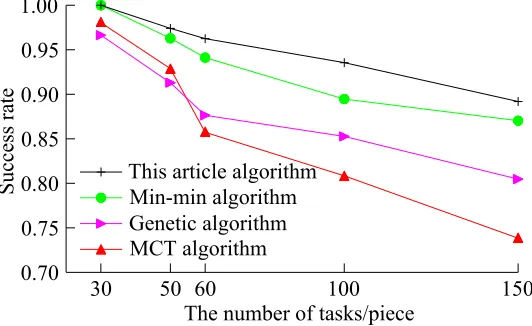
The simulation software was Matlab 2012b. 20 common sensor nodes were ar-ranged inside a building, and 30-150 tasks were generated randomly. Fig.6 shows the overall task scheduling time of the MM algorithm, the genetic algorithm, the MCT algorithm and the proposed algorithm with different numbers of tasks. As can be seen from the figure, when the number of tasks increased, the scheduling time of all the algorithms tended to increase. When the number of tasks reached 100, the task sched-uling time of the proposed algorithm is 265ms, much lower than those of the MM algorithm (299ms), genetic algorithm(308ms) and MCT algorithm(330ms). Compared with the other three algorithms, the proposed algorithm is improved in terms of node load balancing, resource allocation, and prevention of premature convergence.
20 40 60 80 100 120 140 160 180
220 260 300 340 380
The number of tasks/piece
Algori
thm run
tim
e/
ms
This article algorithm Min-min algorithm Genetic algorithm MCT algorithm
Fig. 6. Computation time of different algorithms
150 0
400
The number of tasks/piece
Mission completed ti
me/
ms This article algorithmMin-min algorithm Genetic algorithm MCT algorithm 350
300 250 200 150 100 50
100 60
50 30
Fig. 7. Time taken by the 4 algorithms to complete different number of tasks
The number of tasks/piece
Suc
ces
s ra
te
150
100
60
50
30
0.70
0.75
0.80
0.85
0.90
0.95
1.00
This article algorithm
Min-min algorithm
Genetic algorithm
MCT algorithm
Fig. 8. Relation curve between number of tasks and task scheduling success rate
5
Conclusions
When a wireless sensor network is used to perform real-time security monitoring inside a building, there are drawbacks like multi-path signal fading and difficulty in spectrum sensing. In light of these problems, this paper proposes an improved signal spectrum sensing algorithm based on support vector machine (SVM), which inhibits the impacts brought by the low signal-noise-ratio (SNR) environment in the transmis-sion process of wireless sensor signals through the embedded cyclostationary charac-teristic parameters. Based on this, considering the low efficiency and poor fault toler-ance of multi-task monitoring and scheduling inside the building, this paper also pro-poses a multi-task coordination and scheduling algorithm based on physical infor-mation integration. Through simulation test, this paper proves the feasibility of this algorithm. The conclusions are as follows:
1.The WSN-based indoor spectrum sensing algorithm proposed can still have a high spectrum reconfiguration ability when the SNR is low, and when the SNR is re-duced to -15dB, the spectrum sensing accuracy rate can still be over 75%.
6
Acknowledgement
(1) Jiangsu Province Industry, Universities, Research Institutions Forward-Looking Joint Research Projects. Research on Passive Energy Saving Technology for the En-closure Products of Assembled Residential Buildings in Jiangsu Coastal Area (No.BY2016065-50);
(2) Ministry of Housing and Urban Rural Development of Science and Technology of Projects in People's Republic of China. Research on Integration Technology of Energy Saving Renovation of Existing Residential Buildings in Jiangsu Coastal Area. (No.2014-K1-050).
7
References
[1]Cannistraro, G., Cannistraro, M., Cannistraro, A., Galvagno A. (2016). Analysis of air pol-lution in the urban center of four cities Sicilian, International Journal of Heat and Technol-ogy, 34(S2), S219-S225. https://doi.org/10.18280/ijht.34Sp0205
[2]Wang, W., Wang, N., Jafer, E., Hayes, M., O'Flynn, B., O'Mathuna, C. (2010). Autono-mous wireless sensor network based Building Energy and Environment Monitoring system design. International Conference on Environmental Science and Information Application Technology, 3, 367-372, IEEE. https://doi.org/10.1109/ESIAT.2010.5568311
[3]Gattuso, D., Greco, A., Marino, C., Nucara, A., Pietrafesa, M., Scopelliti, F. (2016). Sus-tainable mobility: environmental and economic analysis of a cable railway, powered by photovoltaic system, International Journal of Heat and Technology, 34(1), 7-14.
https://doi.org/10.18280/ijht.340102
[4]Ou, J., Li, H. (2003). Wireless sensor information fusion for structural health monitoring. Proceedings of SPIE - The International Society for Optical Engineering, 5099, 356-362.
https://doi.org/10.1117/12.487067
[5]Qiu, W.M., Guo, D.W., Zhang, C.Y., Xu, Y.X., Wang, G. (2015). A smart grid client-side testing platform for monitoring, Mathematical Modelling of Engineering Problems, 2(3), 17-20. https://doi.org/10.18280/mmep.020305
[6]Zerbes, M.V., !itoianu, C.I. (2015). Improving food radioactivity monitoring process in the laboratory of the nuclear radiation hygiene from sibiu public health department, Aca-demic Journal of Manufacturing Engineering, 13(2), 84-89.
[7]Boubrima, A., Matigot, F., Bechkit, W., Rivano, H., Ruas, A. (2015). Optimal deployment of wireless sensor networks for air pollution monitoring. 1-7. https://doi.org/10.1109/IC CCN.2015.7288443
[8]Wang, S.C., Yan, K.Q., Ho, C.L., Wang, S.S. (2014). The optimal generalized byzantine agreement in cluster-based wireless sensor networks. Computer Standards & Interfaces, 36(5), 821-830. https://doi.org/10.1016/j.csi.2014.01.005
[9]Wang, S. S., Wang, S. C., Yan, K. Q. (2014). Reaching trusted byzantine agreement in a cluster-based wireless sensor network. Wireless Personal Communications, 78(2), 1079-1094. https://doi.org/10.1007/s11277-014-1802-3
[11]Li, H.M., Liu, H.H. (2017). The optimizated study on preparation process of nano tire pressure sensor used in auto, Academic Journal of Manufacturing Engineering, 15(1), 97-104.
[12]Tang, R.X., Zhang Z.J., Liu Y.L., Wang Z.P. (2017). Spatial information is exploited to ad-just hand movement when hitting moving target, NeuroQuantology, 15(3), 7-11. [13]Mathúna, C. Ó., O’Donnell, T., Martinez-Catala, R. V., Rohan, J., O’Flynn, B. (2008).
En-ergy scavenging for long-term deployable wireless sensor networks. Talanta, 75(3), 613..
https://doi.org/10.1016/j.talanta.2007.12.021
[14]Chatterjea, S., Nieberg, T., Meratnia, N., & Havinga, P. (2008). A distributed and self-organizing scheduling algorithm for energy-efficient data aggregation in wireless sensor networks. Acm Transactions on Sensor Networks, 4(4), 1-41. https://doi.org/10.1145/138 7663.1387666
[15]Toumpis, S., Tassiulas, L. (2006). Optimal deployment of large wireless sensor networks. IEEE Transactions on Information Theory, 52(7), 2935-2953. https://doi.org/10.1109/ TIT.2006.876256
[16]Pacheco-Paramo, D., Pla, V., Martinez-Bauset, J. (2009). Cognitive radio networks. Ve-hicular Technology Magazine IEEE, 4(4), 76-84. https://doi.org/10.1002/9780470742 020.ch6
[17]Gomes, R. D., Adissi, M. O., Lima-Filho, A. C., Spohn, M. A., Belo, F. A. (2013). On the impact of local processing for motor monitoring systems in industrial environments using wireless sensor networks. International Journal of Distributed Sensor Networks, (2013-7-16), 2013(1), 276-277. https://doi.org/10.1155/2013/471917
[18]Abdaoui, A., El-Fouly, T.M. (2014). Tossim and distributed binary consensus algorithm in wireless sensor networks. Journal of Network & Computer Applications, 41, 451-458.
https://doi.org/10.1016/j.jnca.2014.01.010
[19]Tian, J., Gao, M., Ge, G. (2016). Wireless sensor network node optimal coverage based on improved genetic algorithm and binary ant colony algorithm. Eurasip Journal on Wireless Communications & Networking, (1), 104. https://doi.org/10.1186/s13638-016-0605-5
[20]Sun, K., Ning, P., Wang, C. (2006). Tinysersync: secure and resilient time synchronization in wireless sensor networks. IEEE Journal on Selected Areas in Communications, 24(2), 395-408. https://doi.org/10.1007/978-0-387-46276-9_15
[21]Stelte, B. (2012). Unidirectional traffic flow to protect wireless sensor networks against byzantine attacks. Communications in Computer & Information Science, 314, 503-518.
https://doi.org/10.1007/978-3-642-35755-8_36
[22]Fan, Y.M., Qin, B.T. (2010). Genetic algorithm for multiple sink node optimal deployment in large scale wireless sensor networks. Transducer & Microsystem Technologies, 29(6), 32-35.
[23]Banimelhem, O., Mowafi, M., Aljoby, W. (2013). Genetic algorithm based node deploy-ment in hybrid wireless sensor networks. Communications & Network, 5(4), 273-279.
https://doi.org/10.4236/cn.2013.54034
[24]Sarangi, S., Kar, S. (2011). Genetic algorithm based mobility aware clustering for energy efficient routing in wireless sensor networks, 354(1), 1-6. https://doi.org/10.1109/ICON. 2011.6168497
8
Authors
Jin Wang: (1978.09.09).Associate professor of Yancheng Institute of Technology. Dean of the Department of Architecture. His research direction is architectural intelli-gence and green building.
Hua Shao: (1991.07.21). Hua Shao is a joint master at Yancheng Institute of Technology and China University of Mining and Technology. Her research direction is landscape planning and design. Her interest is in landscape design and architecture intelligentization.