
www.biogeosciences.net/6/1927/2009/
© Author(s) 2009. This work is distributed under the Creative Commons Attribution 3.0 License.
Biogeosciences
Testing the relationship between the solar radiation dose and
surface DMS concentrations using in situ data
C. J. Miles, T. G. Bell, and T. M. Lenton
Laboratory for Global Marine and Atmospheric Chemistry (LGMAC), School of Environmental Sciences, University of East Anglia, Norwich, NR4 7TJ, UK
Received: 28 January 2009 – Published in Biogeosciences Discuss.: 13 March 2009 Revised: 7 August 2009 – Accepted: 31 August 2009 – Published: 28 September 2009
Abstract. The proposed strong positive relationship be-tween dimethylsulphide (DMS) concentration and the so-lar radiation dose (SRD) received into the surface ocean is tested using data from the Atlantic Meridional Transect (AMT) programme. In situ, daily data sampled concurrently with DMS concentrations is used for the component vari-ables of the SRD (mixed layer depth, MLD, surface inso-lation,I0, and a light attenuation coefficient,k) to calculate SRDinsitu. This is the first time in situ data for all of the components, including k, has been used to test the SRD-DMS relationship over large spatial scales. We find a sig-nificant correlation (ρ=0.55n=65 p<0.01) but the slope of this relationship (0.006 nM/W m−2) is less than previously found at the global (0.019 nM/W m−2) and regional scales (Blanes Bay, Mediterranean, 0.028 nM/W m−2; Sargasso Sea 0.017 nM/W m−2). The correlation is improved (ρ=0.74 n=65 p<0.01) by replacing the in situ data with an esti-matedI0(which assumes a constant 50% removal of the top of atmosphere value; 0.5×TOA), a MLD climatology and a fixed value forkfollowing previous work. Equally strong, but non-linear relationships are also found between DMS and both in situ MLD (ρ=0.61n=65p<0.01) and the estimated I0(ρ=0.73n=65p<0.01) alone. Using a satellite-retrieved, cloud-adjusted surface UVA irradiance to calculate a UV ra-diation dose (UVRD) with a climatological MLD also pro-vides an equivalent correlation (ρ=0.67 n=54 p<0.01) to DMS. With this data, MLD appears the dominant control upon DMS concentrations and remains a useful shorthand to prediction without fully resolving the biological processes involved. However, the implied relationship between the in-cident solar/ultraviolet radiation (modulated by MLD), and sea surface DMS concentrations, is critical for closing a cli-mate feedback loop.
Correspondence to: C. J. Miles ([email protected])
1 Introduction
Dimethylsulphide (DMS) is a climatically important bio-genic sulphur compound present in surface ocean waters at sufficient concentrations to sustain a significant flux to the remote marine atmosphere (Bates et al., 1992). There, sul-phate aerosols derived from the oxidation of DMS are a ma-jor source of cloud condensation nuclei (CCN), promoting cloud formation and increasing cloud albedo (Andreae and Crutzen, 1997; Ayers et al., 1991; Ayers and Gillett, 2000; Berresheim et al., 1993; Sciare et al., 2001). The resulting impact at the surface is expected to be a reduction in solar in-solation and a net cooling. The CLAW hypothesis proposes a feedback loop whereby phytoplankton producing DMS alter their environment by modulating incoming solar radiation, engendering a change in surface ocean conditions whilst si-multaneously increasing cloud albedo, with global climatic consequences (Charlson et al., 1987). A prerequisite for the closure of any feedback loop is that environmental variables affected by cloud albedo (e.g. insolation, temperature) can in turn influence seawater DMS concentrations. However, the controls on seawater DMS concentrations, hereafter [DMS], and its associated biological processes are complex and are yet to be fully resolved (Sim´o, 2001).
Aranami and Tsunogai (2004) investigated the MLD-based relationship using regional data and suggested that much of the variance in DMS concentrations could be explained by a simpler relationship with MLD alone based on a dilution ef-fect. Belviso et al. (2004a) compared the five aforementioned algorithms utilising a global database of surface seawater [DMS] (http://saga.pmel.noaa.gov/dms/) and found that dif-ferent algorithms are more skilful predictors of DMS concen-trations in different regions. Bell et al. (2006) analysed data collected as part of the Atlantic Meridional Transect (AMT) programme to test these predictive algorithms and found that a refined version of the Aranami and Tsunogai (2004) algo-rithm ([DMS]α40/MLD) was the best fit for the data.
Vallina and Sim´o (2007) have demonstrated a strong pos-itive relationship between sea surface [DMS] and the solar radiation dose (SRD) received into the upper mixed layer of the ocean. This is identified at two fixed locations and at the global level utilising monthly averaged data. A fur-ther strong positive relationship has been reported between the SRD, atmospheric DMS oxidation and satellite derived CCN over large areas of the global ocean (Vallina et al., 2007). The global SRD methodology combines a climatolog-ical mixed layer depth (MLD), the estimated solar radiation incident at the surface (Io) derived from a top of atmosphere
value (0.5×TOA) and the attenuation of total solar radiation within the water column (k) represented by a constant fixed value (0.06 m−1). The SRD is essentially a measure of the average light level experienced by the cells confined within the mixed layer in Wm−2. This positive relationship poten-tially closes a negative feedback loop between incident solar radiation and marine emissions of DMS, sulphate aerosols, CCN, cloud albedo and climate as postulated by the CLAW hypothesis.
Central to the relationship between the SRD and seawa-ter [DMS] is the proposed inseawa-teraction between incident sur-face radiation and MLD. The depth of the mixed layer is ex-pected to have a substantial influence on [DMS] (Sim´o and Pedros-Alio, 1999). Stratified waters, although sustaining a lower overall phytoplankton biomass, are characterised by a species assemblage composed of more prolific dimethyl-sulphoniopropionate (DMSP) producers (Sim´o and Pedros-Alio, 1999). DMSP is the dominant biological precursor to DMS as DMSP cleavage by lyase enzymes is a significant DMS production pathway (Steinke et al., 1998, 2002). In ad-dition, a shallow mixed layer results in elevated exposure to UV irradiance, which inhibits heterotrophic bacterioplankton production as a result of DNA damage caused by UV-B radi-ation (Slezak et al., 2001; Toole et al., 2006). Reduced bacte-rioplankton production leads to reduced DMS consumption rates (Toole et al., 2006). The combination of these factors has been shown to increase [DMS] when surface waters are highly stratified (Sim´o and Pedros-Alio, 1999).
Laboratory studies of the diatom Thalassiosira pseudo-nana and the prymnesiophyte Emiliania huxleyi have shown that elevated DMS production occurs in response to high
UV irradiance with the largest effect under exposure to UV-A wavelengths (320–400 nm) (Sunda et al., 2002). Oxida-tive stressors (including UV) generate harmful free radicals in the cell, while DMSP, DMS and subsequent DMS oxi-dation products have been shown to readily scavenge hy-droxyl radicals and other reactive oxygen species, reliev-ing oxidative stress (Sunda et al., 2002).This suggests an antioxidant function for the DMS(P) cycle, linking it with UV-induced oxidative stress in marine phytoplankton (Sunda et al., 2002). DMS can also be removed from the water column by photo-oxidation to dimethyl sulfoxide (DMSO) following exposure to UV-B radiation (Brimblecombe and Shooter, 1986), whilst (Kniveton et al., 2003) have demon-strated that extreme changes in UV can cause a reduction in atmospheric DMS on a daily timescale, most likely at-tributable to photodestruction in the atmosphere. Thus the same shallow MLD and high insolation levels and durations associated with peak summer [DMS] are seemingly ideal for high photochemical loss rates. The photo-oxidation of DMS does not typically dominate as a loss term because it is dependent upon the presence of chromophoric dissolved organic matter (CDOM) which is at lowest concentrations in the summer (Siegel and Michaels, 1996). Summer is when the MLD is shallowest and UV irradiance levels are highest and these factors combined (SRD) may help explain the DMS “summer paradox” whereby peak [DMS] occur in the summer despite phytoplankton production, biomass and chlorophyll levels reaching maxima earlier in the year (Toole et al., 2003).
Considering the current state of knowledge, we decided to test the reported relationship between SRD and seawa-ter [DMS] (Vallina and Sim´o, 2007). Belviso and Cani-aux (2009) also tested the strength of the SRD-DMS rela-tionship in the North-East Atlantic (using data from the Pro-gramme Ocean Multidisciplinaire Meso-Echelle (POMME) experiment). From their data, they conclude that SRD and DMS do not demonstrate a strong correlation (with SRD accounting for only 19%–24% of the variance associated with monthly surface DMS concentrations). However, their [DMS] data is not normally distributed and the result from their Spearman’s Rank correlation analysis may be more ap-propriate, suggesting a stronger correlation ofρ=0.74. The authors then conducted a sensitivity analysis using different versions of the SRD equation and suggest that the DMS-SRD relationship is heavily influenced by the choice of fixed irra-diance attenuation coefficient (k).
climatological/estimated inputs (SRDclim) using the same methodology and data sources as the global study of Val-lina and Sim´o (2007). The regional studies of ValVal-lina and Sim´o (2007) and Belviso and Caniaux (2009) are from the coastal northwest Mediterranean (Blanes Bay 41◦3 N, 2◦48 E), Sargasso Sea (32◦10 N, 64◦30 W) and northeast At-lantic (16◦W–22◦W, 38◦N–45◦N) respectively. Analysing in situ data from different locations is vital to advance un-derstanding of the reported global relationship that has been demonstrated with in situ data in these regions. The equa-torial/oligotrophic regions covered by our analysis are espe-cially critical as it is here that the decoupling of [DMS] from measures of biomass/chlorophyll (summer paradox) are ob-served.
Our results broadly support those presented previously (Vallina and Sim´o, 2007; Belviso and Caniaux, 2009), but also elaborate upon the importance ofkand MLD in the SRD equation. We also attempt to directly address UV radiation, adapting the SRD methodology to calculate an ultraviolet ra-diation dose (UVRD) that restricts the total surface irradiance to a narrower spectral band relevant to UVA (380 nm). Fi-nally, a comparison is made to the work of Bell et al. (2006) who previously found the best fit to the AMT DMS data to be a simple relationship with MLD alone (40/MLD) (see Meth-ods Sect. 2 for details).
2 Methods
The SRD combines the depth of the mixed layer (MLD), the incident solar radiation at the surface (I0) and its attenuation within the water column (k) (Vallina and Sim´o, 2007): SRD= I0
k·MLD·
1−e−k·MLD
(1) Throughout their global study, Vallina and Sim´o (2007) use a fixed value ofk representative of the attenuation of total solar radiation by clear ocean water (0.06 m−1) and estimate I0on the assumption that a constant 50% of the solar radia-tion incident at the top of the atmosphere reaches the surface (0.5×TOA). MLD is taken from a 2◦×2◦resolution global climatology (de Boyer Mont´egut et al., 2004). The mixed layer is characterised by almost vertically uniform salinity, temperature, and density profiles. The MLD is defined as the point at which a departure from this uniform state can be detected based upon an arbitrary choice of criteria such as temperature, salinity or density (de Boyer Mont´egut et al., 2004). The criterion used to define the climatological MLD is a temperature change of 0.1◦C from a near surface value
of 5 m (as used by Vallina and Sim´o, 2007).
In this study we use daily in situ data for the components of the SRD equation (I0, MLD,k) and surface [DMS] sam-pled concurrently during the AMT programme. The AMT program undertakes research cruises between the UK and the Falkland Islands transecting a range of ecosystems but focus-ing upon the oligotrophic mid-ocean gyres of the North and
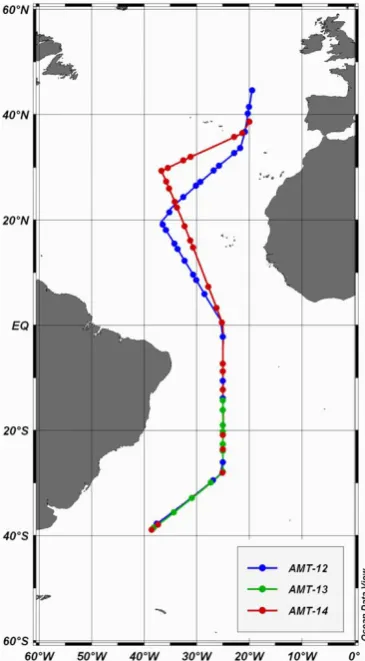
South Atlantic. This study uses data collected during north-ern hemisphere spring (cruises AMT-12 in May–June 2003; and AMT-14 in April–June 2004) and autumn (AMT-13 in September–October 2003) (Fig. 1.) (see Bell et al., 2006, for more detail). To calculate SRDinsituit is necessary to not only have a [DMS] measurement at a sampling point but also con-current data for the components of the SRD (MLD,I0 and k). Within the AMT dataset, this meant that only 65 DMS data points could be used with concurrent data. Although it would be possible to calculate SRD using climatological data (SRDclim) for more of AMT data points, the analysis was restricted to the same dataset to enable a fair compari-son. The same reasoning was applied to the UVRD analy-sis which used all available UV data in conjunction with the DMS data used for the SRD analysis.
For incident solar radiation (I0), a daily average (24 h lead-ing up to the point of sampllead-ing) of the continuous shipboard measurements of total solar radiation was used. Measure-ments in Wm−2 were made using Kipp & Zonen SP Lite 0339-900 TIR Pyranometers (range 300–3000 nm) that were positioned high up on the ship’s foremast approximately 22 m a.s.l. The average of two sensors was used and the same instrumentation used on all cruises. The in situ MLD is de-fined using the same criteria as the V&S07 MLD climatol-ogy, a temperature departure of 0.1◦C from a reference depth of 5 m to avoid the effect of diurnal heating (Bell et al., 2006). The temperature profiles used to calculate the MLD were sampled concurrently with [DMS] along the cruise track at pre-dawn (03:00 LT) each day. The attenuation coefficient (k)used for the SRDinsitu was calculated using the sampled 1% light level depth (Ze) defined as the depth (m) to which
1% of the light incident at the surface penetrated on the pre-vious day’s mid-morning (11:00 LT) cast (k=ln(0.01)/Ze).
We also calculated an ultraviolet radiation dose (UVRD, Eq. 2) based on the SRD equation (Eq. 1) but using a satel-lite surface UV product from NASA’s Total Ozone Mapping Spectrometer (TOMS) in place of in situ total solar irradi-ance (Io). This was in the form of the noon irradiance for
the specific DMS sampling date at the surface of the ocean in mW m−2nm−1at 380 nm (UVA) and at a 1◦×1◦degree grid box resolution. This product incorporates the column ozone amount and cloud conditions, taking into account sun-earth distance, solar zenith angle, total ozone amount, tropospheric aerosol optical depth and cloud transmission (Herman and Celarier, 1997) and is available from the TOMS project at http://toms.gsfc.nasa.gov/. This product does not account for daylength and as such it should be noted that the methodol-ogy differs from the SRD which uses a daily average value. A constant attenuation coefficient appropriate for the attenu-ation of UV under oligotrophic conditions (k=0.10 m−1) was applied (Tedetti and Sempere, 2006) as no appropriate in situ measurements were available.
UVRD= UV380 nm k·MLD ·
1−e−k·MLD
Fig. 1. Location of the AMT cruise tracks (lines) and sampling stations (markers) from which data was available to calculate the SRD (AMT-12, blue; AMT-13, green; AMT-14, red). Plot produced using Ocean Data View (http://odv.awi.de/en/home/).
These results are also compared to a simpler relationship be-tween MLD and [DMS] (Eq. 3) previously found to be the best fit to this data by Bell et al. (2006)
DMSα 40
MLD (3)
3 Results
3.1 SRD
When utilising the SRD methodology in conjunction with the in situ AMT data for all of the SRD variables (k, I0, MLD) (SRDinsitu) we find a strong and significant correlation (ρ=0.55n=65p<0.01) between SRD and [DMS]. The slope of this relationship (0.006 nM/W m−2) is less than that found by Vallina and Sim´o (2007) at the global (0.019 nM/W m−2) and regional levels (Blanes Bay 0.028 nM/W m−2; Sargasso Sea 0.017 nM/W m−2). As these relationships use monthly averaged values, they are intended to be appropriate for the longer term climatological mean situation (Fig. 2). Vallina
and Sim´o (2007) demonstrate that the SRD is connected to the seasonal DMS cycle at the global level (10◦×20◦ grid
boxes, ρ=0.47 n=545 p<0.01) and at two fixed locations using monthly averaged data (Blanes Bay ρ=0.75 n=15 p<0.01; Sargasso Sea: ρ=0.89n=33p<0.01). In contrast the AMT data exhibits significant spatial coverage but rep-resents less seasonal variation, covering only a few months of the seasonal cycle (in Northern Hemisphere spring and autumn). As such, a complete comparison between the two data sets is not possible. However, it is interesting that a strong and significant correlation still exists between SRD and [DMS] when addressing variability on a shorter (daily) timescale in this in situ data series.
The correlation fit to the AMT [DMS] is improved (ρ=0.74 n=65 p<0.01) when the in situ data is replaced with climatological inputs to the SRD calculation (SRDclim) following the methodology used in the global analysis of Vallina and Sim´o (2007). The slope of this relationship (0.010 nM/W m−2) is also closer to the global relationship reported by Vallina and Sim´o (2007) (Fig. 2). An initial motivation of this research was to attempt to improve upon the handling by Vallina and Sim´o (2007) of these climato-logical variables,I0(0.5×TOA), MLD (climatology) andk (fixed). A comparison of the AMT in situ data with clima-tological data does yield statistically significant correlations. The climatological and in situ MLD compare reasonably well (ρ=0.55, n=65, p<0.01) although the climatological MLD significantly underestimates the range of MLD and exhibits a shallow bias when compared with the observed, in situ MLD data from AMT (in situ: range 7–144 m, mean 38 m; climatology: range 6–56 m, mean 20 m). The in situ and climatologicalI0values compare more favourably (ρ=0.78, n=65, p<0.01). The climatologicalI0also underestimates the range of solar radiation incident at the surface when com-pared to the in situ data (in situ: range 78.2–323.4 Wm−2, mean 226.1 Wm−2; climatology: range = 98.9–241.9 Wm−2, mean 210.1 Wm−2). This underestimated range can be ex-plained because the estimatedI0uses a 0.5×TOA value that does not account for varying cloud cover. In this shorter, high resolution dataset, variable cloud cover is expected to play an important role especially given the AMT cruise track crossing the equator and the inter-tropical convergence zone (ITCZ). The fixed value ofk(0.06 m−1) utilised by Vallina and Sim´o (2007) falls within the range of in situ k values from the AMT dataset (0.03–0.11 m−1, mean=0.05 m−1).
Similar strength correlations to that observed between [DMS] and SRD are also observed between [DMS] and MLD (in situ MLD: ρ=0.61n=65 p<0.01, climatological MLD:ρ=0.70n=65p<0.01) and climatologicalI0(ρ=0.74 n=65p<0.01). To investigate the SRD further we examined the components of the equation to try and determine their re-spective influences upon the observed correlations between the SRD and [DMS] (Table 1).
Fig. 2. [DMS] (nM) versus SRD (W m−2) calculated using: (a) in situ data (SRDinsitu, squares); and (b) climatological data (SRDclim, triangles), for MLD,kandI0. On both plots, solid line is linear best fit regression of the data, (a) SRDinsitu: DMS=0.755+0.006.SRD, (b) SRDclim: DMS=0.084+0.010.SRD). Dashed lines a–c are the relationships between [DMS] and SRD reported by Vallina and Sim´o (2007) (a=V&S07 Blanes Bay, DMS=0.138+0.028.SRD; b=V&S07 Global, DMS=0.492+0.019.SRD; c=V&S07 Sargasso Sea, DMS=0.51+0.017.SRD).
uniformly increases the correlation with [DMS] (Table 1). This could partly explain the difference in the correlation to [DMS] between SRDinsitu and SRDclim. The correlation to [DMS] is almost always increased when the in situI0is re-placed with the estimatedI0(0.5×TOA). Fixing the MLD significantly decreases the correlation in conjunction with in situI0but a fixed MLD in combination with an estimatedI0 (0.5×TOA) returns a high correlation (Table 1). The SRD permutations offer some improvement upon the simpler rela-tionships between [DMS] and MLD (40/MLD) (MLD clima-tological:ρ=0.70n=65p<0.01, MLD in situ:ρ=0.61n=65 p<0.01). Using anI0 derived from a TOA value that does not account for cloud (ρ=0.73n=65p<0.01) also performs as well as using the optimum SRD formulation (SRDclim).
3.2 UVRD
Results from the literature (Toole and Siegel, 2004; Toole et al., 2006; Sunda et al., 2002) led us to investigate the SRD equation from the perspective of surface UV irradi-ance (UVRD, Eq. 3), utilising a cloud-adjusted satellite-retrieved surface UVA irradiance (no direct measurements of UV were available from the AMT) within the SRD method-ology (see Methods for details). A fixed value for k was adopted as no direct measurements were available from the AMT with an appropriate value for these oligotrophic condi-tions (k=0.10 m−1) selected from the literature (Tedetti and Sempere, 2006). The best results were achieved when us-ing UVA (380 nm) in this study and this is consistent with previous work. Toole and Siegel (2004) attribute observed patterns of DMS cycling in the oligotrophic Sargasso Sea to a stress forced mechanism associated with UVA irradiance, while Sunda et al. (2002) noted elevated [DMS] with expo-sure to UVA wavelengths under laboratory conditions.
[image:5.595.140.454.62.194.2]The UVRD calculated using a climatological MLD is well correlated to [DMS] from AMT (ρ=0.67 n=54 p<0.01) (Fig. 3) and is a better fit to the [DMS] data than the
Table 1. Spearman’s rank correlation coefficients (ρ) between [DMS] and the outcome of the 3 equations on test (SRD, Eq. 1; UVRD, Eq. 2; 40/MLD, Eq. 3) with various combinations of the available climatological/in situ data as input variables (I0/UV380 nm, MLD andk). Bold coefficients indicate that an ap-propriate fixed value ofkis used (0.06 m−1forI0, 0.10 m−1for UVA) (see methods for further details). Plain text indicates that the in situ value forkis used. The simpler DMSα40/MLD coefficients (italics) does not utilise a k value. All coefficients significant at
p<0.01 unless marked with * (in which case, result is not signifi-cant atp<0.05). For correlations involving UVAn=54, otherwise
n=65).
I0 I0 I0 UVA 40/MLD
In situ Clima- Fixed (satellite) tology
MLD In situ 0.55 0.55 0.48 n/a
0.61
0.62 0.61 0.61 0.55
MLD Climatology 0.53 0.58 0.42 n/a
0.70
0.62 0.74 0.71 0.67
MLD Fixed 0.46 0.71 n/a n/a
n/a
0.47 0.73 n/a 0.26*
SRDinsituwith either variable, in situkvalues (ρ=0.56n=66 p<0.01) or fixedkvalues (ρ=0.63n=66p<0.01). However, the UVRD does not improve upon the correlation between [DMS] and the SRDclim(ρ=0.74n=66p<0.01) although it does use a more appropriate surface irradiance (i.e. cloud adjusted) component. Once again the correlation between UVRD and [DMS] is very similar to the strength of the corre-lations found between the simpler recorre-lationships with [DMS] and MLD alone (40/MLD) or the estimatedI0derived from the TOA value (0.5×TOA).
4 Discussion
[image:5.595.312.545.415.509.2]Fig. 3. [DMS] (nM) versus UV radiation dose (UVRD, mW m−2nm−1) calculated using a climatological MLD, a con-stantk(0.10 m−1) and satellite-derived UVA (380 nm) at the sur-face (ρ=0.67n=54p<0.01) (see methods for further details).
the concurrently sampled, high resolution [DMS] data. This application is beyond the remit originally proposed. The strength of this correlation is reduced relative to the global and fixed location studies of Vallina and Sim´o (2007) and the slope of the relationship between SRD and DMS is less. Notably, the correlation fit is improved when in situ data is replaced with estimated/climatological values as inputs to the SRD (SRDclim), the same approach used to derive the global SRD relationship of Vallina and Sim´o (2007). This also brings the slope into better agreement with the slopes identified by Vallina and Sim´o (2007), although variability in slope can be expected given the varying temporal and spa-tial nature of the cruise track sampling points and the resolu-tion/time period of the data. These results are in agreement with the strength of Spearman’s Rank correlation (ρ=0.74 n=232p<0.01) reported between the SRD and [DMS] from the North East Atlantic over a seasonal cycle by Belviso and Caniaux (2009).
A change from a variable, in situ light attenuation coeffi-cient (k) to a fixed value significantly increased the strength of correlation with [DMS] across the range of SRD equa-tion permutaequa-tions. Fixingkeffectively removes it from the equation in terms of a correlation fit to the data. As Belviso and Caniaux (2009) demonstrate, the value ofk can have a substantial impact on the value of SRD. Our data suggests that allowingkto vary significantly reduces the strength of correlation between SRD and [DMS] and implies that the inclusion of a variablek within the SRD equation reduces its effectiveness at predicting surface [DMS]. This was the likely cause of much of the difference between SRDinsituand SRDclim and their strength of correlation with [DMS]. The switch from an in situI0to anI0derived from a top of the atmosphere value (0.5×TOA) appears to account for the re-mainder of the difference in the strength of correlation of [DMS] with SRDinsitu and SRDclim. Similar strength cor-relations with [DMS] were also found for climatologicalI0 and climatological MLD (40/MLD).
It is important to remember that MLD andI0are not com-pletely independent variables and that the two are likely to be coupled over the seasonal cycle with high insolation lev-els in the summer coinciding with shallow mixed layers (de Boyer Mont´egut et al., 2004). The advantage of the SRD methodology is that it combines these two interrelated vari-ables, incorporating a physical mechanism to explain why the seasonal coherence of shallow MLD and high insolation combine to produce high DMS concentrations. The problem is that it becomes difficult to isolate the causal effect of inso-lation beyond a reinso-lationship with MLD driven by seasonality inI0(i.e. the effect of variableI0or SRD given a constant MLD). This is especially apparent when using a non-cloud adjusted, estimatedI0in place of in situI0data.
The main difference between the two measures of surface irradiance is that the in situI0represents the variability intro-duced by cloud cover whereas the TOA derived, estimatedI0 does not (beyond the assumption that 50% of TOA irradi-ance is removed). The in situ, daily averageI0values must represent more faithfully the surface irradiance that is con-current with the daily sampled [DMS] but the TOA derived I0 is more successful at providing a correlation fit both in combination with the SRD method and when used in isola-tion. The estimated, TOA-derivedI0may be representing the longer-term mean state of the system rather than the snapshot of variability provided by the in situ AMT cruise transect data. Within this high resolution in situ dataset MLD andI0 are less likely to be directly coupled and this could explain why the climatological/estimated data is more successful at resolving the observed DMS concentrations. The estimated I0 could also represent seasonality in an unknown variable or combination of variables that combine with shallow sum-mer MLD to produce high [DMS]. Finally, it could repre-sent a smoothed (inverse) version of MLD itself with [DMS] modulated by a dilution effect independent of high resolution changes in insolation. In conjunction with smoothed monthly data the inclusion of an estimatedI0within the SRD equa-tion may act as a proxy for the seasonality inherent within the DMS cycle, combining latitude and date (seasonality) within one variable. The estimatedI0 could then represent the background potential for exposure to incident surface ra-diation whilst variations in MLD control the dose.
(Sim´o and Pedros-Alio, 1999). This is hinted at in the rela-tionship between [DMS] and UV found in this study.
Prior to the Great Oxidation 2.4 billion years ago, life on Earth evolved without the protection of a stratospheric ozone layer and under much higher UV levels than today (Garcia-Pichel, 1998). This evolutionary history may still be reflected in efficient strategies and physiological mechanisms in mod-ern organisms and ecosystems to prevent UV-induced dam-age and reduce photo-oxidative stress (H¨ader et al., 2003). This may be relevant in the context of DMS(P) production by marine phytoplankton (Sunda et al., 2002). Addressing UVA directly via the substitution of a cloud adjusted satel-lite retrieval of surface UVA irradiance (UVRD) did not sig-nificantly improve or worsen the correlation to [DMS] rel-ative to the SRDclim, estimatedI0or 40/MLD relationship. The UVRD equation did improve upon the correlation be-tween [DMS] and SRDinsitu but most importantly yields a strong significant correlation in conjunction with a cloud ad-justed measure of surface irradiance in a wavelength previ-ously linked to DMS dynamics. This supports the results of Toole and Siegel (2004), who identified a significant correla-tion between [DMS] and in situ UV within the mixed layer at a fixed location (Hydrostation S) in the Sargasso Sea over the seasonal cycle. It is important to note that as with SRD the strength of correlation between [DMS] and UVRD was likely to be influenced by fixing the value ofk. In the fu-ture, utilising direct in situ measurements of UVA and UVB coupled with their attenuation (k) within the water column should improve our understanding of UVRD and DMS dy-namics.
Within the AMT data, there is little difference between the most highly correlated variation of the SRD equation (SRDclim), the UVRD and the simpler relationships based on in situ MLD (40/MLD) or estimatedI0alone. The notion that MLD could be important in modulating DMS concentra-tions was introduced by Sim´o and Pedros-Alio (1999) who commented that it was useful shorthand to prediction until the mechanisms controlling DMS concentrations could be resolved. It is questionable from this AMT data whether the inclusion of the variablesI0/UV andkvia the SRD metho-dology improves the correlation enough to illuminate cau-sation over this resolution. Recent work by Derevianko et al. (2009), uses the recently-updated global database of sur-face seawater [DMS] (http://saga.pmel.noaa.gov/dms/) to ex-amine the SRD relationship and comes to similar conclu-sions.
5 Conclusions
A challenge of Earth system science is to decouple the com-plex inter-relationships and feedbacks between the biosphere and climate. Vallina and Sim´o (2007) have demonstrated that a positive relationship may exist between the SRD and surface [DMS] over the seasonal DMS cycle using monthly
averaged data. This is a necessary condition for the opera-tion of a negative feedback (Charlson et al., 1987). The SRD methodology asserts that the interrelated seasonal cycles of MLD and surface insolation combine to produce high [DMS] when MLD are shallowest and summer insolation strongest. The SRD method is successful at combining these two rela-tionships into one and provides a plausible bio-physical ex-planation for the strong correlations observed over the sea-sonal DMS cycle. The SRD methodology is troubled by the use of an estimatedI0that does not realistically account for cloud cover, especially at this temporal resolution. This has implications for the CLAW hypothesis and the closure of any feedback loop which depends of the modulation of insola-tion by varying cloud albedo. The UVRD proposed here goes some way to addressing this issue producing a good correlation whilst utilising a cloud adjusted, surface irradi-ance product at a wavelength (UVA) with an implicated role in DMS(P) dynamics. Whether the SRD (or UVRD) illumi-nates causation beyond a simpler relationship with MLD or TOA-derivedI0 (i.e. a variable representing seasonality) at this resolution is questionable, at least within this AMT data. The MLD remains a useful shorthand to prediction without fully resolving the biological processes involved. However, it makes it harder to close the CLAW feedback loop. The suggested relationship between incident solar/ultraviolet ra-diation and sea surface DMS concentrations (modulated by MLD) makes it easier to close that feedback loop.
Acknowledgements. We thank Sergio Vallina for his help and advice on the SRD calculation and for supplying the climatological data. We thank Dominic Kniveton and Jay Harman for their help with the acquisition and compilation of the UV data. This work was supported by a Dean of Students Scholarship at the School of Environmental Sciences, University of East Anglia (Miles) and by the UK Natural Environment Research Council (NERC) as part of SOLAS Project Integration (Bell; NE/E001696/1) and the “Feedbacks QUEST” project (Lenton; NE/F001657/1). We thank the 2 anonymous reviewers and Rafel Sim´o for their considered and constructive comments.
Edited by: L. Bopp
References
Anderson, T. R., Spall, S. A., Yool, A., Cipollini, P., Challenor, P. G., and Fasham, M. J. R.: Global fields of sea surface dimethyl-sulfide predicted from chlorophyll, nutrients and light, J. Marine Syst., 30, 1–20, 2001.
Andreae, M. O. and Crutzen, P. J.: Atmospheric aerosols: Bio-geochemical sources and role in atmospheric chemistry, Science, 276, 1052–1058, 1997.
Aumont, O., Belviso, S., and Monfray, P.: Dimethylsulfoniopro-pionate (DMSP) and dimethylsulfide (DMS) sea surface distri-butions simulated from a global three-dimensional ocean car-bon cycle model, J. Geophys. Res.-Oceans, 107(C4), 3029, doi:10.1029/1999JC000111, 2002.
Ayers, G. P., Ivey, J. P., and Gillett, R. W.: Coherence between sea-sonal cycles of dimthyl sulphide, methansulphonate and sulphate in marine air, Nature, 349, 404–406, 1991.
Ayers, G. P. and Gillett, R. W.: DMS and its oxidation products in the remote marine atmosphere: implications for climate and atmospheric chemistry, J. Sea Res., 43, 275–286, 2000. Bates, T. S., Lamb, B. K., Guenther, A., Dignon, J., and Stoiber, R.
E.: Sulphur emissions to the atmosphere from natural sources, J. Atmos. Chem., 14, 315–337, 1992.
Bell, T. G., Malin, G., McKee, C. M., and Liss, P. S.: A comparison of dimethylsulphide (DMS) data from the Atlantic Meridional Transect (AMT) programme with proposed algorithms for global surface DMS concentrations, Deep-Sea Res. Pt. II, 53, 1720– 1735, 2006.
Belviso, S., Bopp, L., Moulin, C., Orr, J. C., Anderson, T. R., Aumont, O., Chu, S., Elliott, S., Maltrud, M. E., and Sim´o, R.: Comparison of global climatological maps of sea sur-face dimethyl sulfide, Global Biogeochem. Cy., 18, GB3013, doi:10.1029/2003GB002193, 2004a.
Belviso, S., Moulin, C., Bopp, L., and Stefels, J.: Assessment of a global climatology of oceanic dimethylsulfide (DMS) concen-trations based on SeaWiFS imagery (1998–2001), Can. J. Fish. Aquat. Sci., 61(5), 804–816, 2004b.
Belviso, S. and Caniaux, G.: A new assessment in North Atlantic waters of the relationship between DMS concentration and the upper mixed layer solar radiation dose, Global Biogeochem. Cy., 23, GB1014, doi:10.1029/2008GB003382, 2009.
Berresheim, H., Eisele, F. L., Tanner, D. J., McInnes, L. M., Ram-seybell, D. C., and Covert, D. S.: Atmospheric sulpur chemistry and cloud condensation nuclei (CCN) concentrations over the Northeastern pacific coast, J. Geophys. Res.-Atmos., 98, 12701– 12711, 1993.
Brimblecombe, P. and Shooter, D.: Photooxidation of dimethyl sul-phide in aqueous solution, Mar. Chem., 19, 343–353, 1986. Charlson, R. J., Lovelock, J. E., Andreae, M. O., and Warren, S. G.:
Oceanic phytoplankton, atmospheric sulphur, cloud albedo and climate, Nature, 326, 655–661, 1987.
De Boyer Mont´egut, C. D., Madec, G., Fischer, A. S., Lazar, A., and Iudicone, D.: Mixed layer depth over the global ocean: An ex-amination of profile data and a profile-based climatology, J. Geo-phys. Res.-Oceans, 109, C12003, doi:10.1029/2004JC002378, 2004.
Derevianko, G. J., Deutsch, C., and Hall, A.: On the relationship between ocean DMS and solar radiation, Geophys. Res. Lett, 36, L17606, doi:10.1029/2009GL039412, 2009.
Garcia-Pichel, F.: Solar ultraviolet and the evolutionary history of cyanobacteria, Origins Life Evol. B., 28, 321–347, 1998. H¨ader, D. P., Kumar, H. D., Smith, R. C., and Worrest, R. C.:
Aquatic ecosystems: effects of solar ultraviolet radiation and in-teractions with other climatic change factors, Photochem. Photo-bio. Sci., 2, 39–50, 2003.
Herman, J. R. and Celarier, E. A.: Earth surface reflectivity cli-matology at 340–380 nm from TOMS data, J. Geophys. Res.-Atmos., 102, 28003–28011, 1997.
Kniveton, D. R., Todd, M. C., Sciare, J., and Mihalopoulos, N.: Variability of atmospheric dimethylsulphide over the southern Indian Ocean due to changes in ultraviolet radiation, Global Bio-geochem. Cy., 17(4), 1096, doi:10.1029/2003GB002033, 2003. Sciare, J., Baboukas, E., and Mihalopoulos, N.: Short-term
variabil-ity of atmospheric DMS and its oxidation products at Amsterdam Island during summer time, J. Atmos. Chem., 39, 281–302, 2001. Siegel, D. A. and Michaels, A. F.: Quantification of non-algal light attenuation in the Sargasso Sea: Implications for biogeochem-istry and remote sensing, Deep-Sea Res. Pt. II, 43, 321–345, 1996.
Sim´o, R. and Pedros-Alio, C.: Role of vertical mixing in controlling the oceanic production of dimethyl sulphide, Nature, 402, 396– 399, 1999.
Sim´o, R.: Production of atmospheric sulfur by oceanic plankton: biogeochemical, ecological and evolutionary links, Trends Ecol. Evol., 16, 287–294, 2001.
Sim´o, R. and Dachs, J.: Global ocean emission of dimethylsulfide predicted from biogeophysical data, Global Biogeochem. Cy., 16(4), 1018, doi:10.1029/2001GB001829, 2002.
Slezak, D., Brugger, A., and Herndl, G. J.: Impact of solar radia-tion on the biological removal of dimethylsulfoniopropionate and dimethylsulfide in marine surface waters, Aquat. Microb. Ecol., 25, 87–97, 2001.
Steinke, M., Wolfe, G. V., and Kirst, G. O.: Partial characterisa-tion of dimethylsulfoniopropionate (DMSP) lyase isozymes in 6 strains of Emiliania huxleyi, Mar. Ecol.-Prog. Ser., 175, 215– 225, 1998.
Steinke, M., Malin, G., Gibb, S. W., and Burkill, P. H.: Vertical and temporal variability of DMSP lyase activity in a coccolithophorid bloom in the northern North Sea, Deep-Sea Res. Pt. II, 49, 3001– 3016, 2002.
Sunda, W., Kieber, D. J., Kiene, R. P., and Huntsman, S.: An an-tioxidant function for DMSP and DMS in marine algae, Nature, 418, 317–320, 2002.
Tedetti, M. and Sempere, R.: Penetration of ultraviolet radiation in the marine environment. A review, Photochem. Photobiol., 82, 389–397, 2006.
Toole, D. A., Kieber, D. J., Kiene, R. P., Siegel, D. A., and Nel-son, N. B.: Photolysis and the dimethylsulfide (DMS) summer paradox in the Sargasso Sea, Limnol. Oceanogr., 48, 1088–1100, 2003.
Toole, D. A. and Siegel, D. A.: Light-driven cycling of dimethylsul-fide (DMS) in the Sargasso Sea: Closing the loop, Geopys. Res. Lett., 31, L09308, doi:10.1029/2004GL019581, 2004.
Toole, D. A., Slezak, D., Kiene, R. P., Kieber, D. J., and Siegel, D. A.: Effects of solar radiation on dimethylsulfide cycling in the western Atlantic Ocean, Deep-Sea Res. Pt.-I, 53, 136–153, 2006.
Vallina, S. M. and Sim´o, R.: Strong relationship between DMS and the solar radiation dose over the global surface ocean, Science, 315, 506–508, 2007.
![Fig. 2. [DMS] (nM) versus SRD (W m−2) calculated using: (a) in situ data (SRDinsitu, squares); and (b) climatological data (SRDclim,triangles), for MLD, k and I0](https://thumb-us.123doks.com/thumbv2/123dok_us/8182347.255287/5.595.312.545.415.509/versus-calculated-using-srdinsitu-squares-climatological-srdclim-triangles.webp)
![Fig. 3.[DMS] (nM) versus UV radiation dose (UVRD,face (stantmW m−2 nm−1) calculated using a climatological MLD, a con- k (0.10 m−1) and satellite-derived UVA (380 nm) at the sur-ρ=0.67 n=54 p<0.01) (see methods for further details).](https://thumb-us.123doks.com/thumbv2/123dok_us/8182347.255287/6.595.89.244.60.203/radiation-stantmw-calculated-climatological-satellite-derived-methods-details.webp)
