Module 2
Circular Functions and Trigonometry
What this module is about
This module is about determining the coordinates of angles in standard position in a unit circle; the six circular functions and finding the six circular functions of special angles; As you go over the discussion, examples and exercises, you will understand what circular functions are all about. Anytime you feel you are at a loss, do not hesitate to go back to the discussion and examples.
What you are expected to learn
This module is designed for you to:
1. determine the coordinates of the terminal side of an angle in standard position in a unit circle
1.1 when one coordinate is given (apply the Pythagorean Theorem and the properties of special right triangles)
1.2 when the angle is of the form:
180ºn ± 30º 180ºn ± 60º
180ºn ± 45º 90ºn 2. define the six circular functions
sine cosine tangent
cotangent secant cosecant 3. find the six circular functions of angles with special values
How much do you know
1. The x-coordinate of an angle in the along the unit circle is
4 3
. If the terminal side of
the angle is located in the fourth quadrant, what is its y-coordinate?
a. 4 1
b. 4
7
c. -4
7 d.
-4 1
2. An angle measuring 30o is in standard position along the unit circle. What are its coordinates?
a.
2 3 , 2 1
b.
2
3 , 2 1
c.
2 1 , 2
3
d.
2 1 , 2
3
3. What are the coordinates of the point of intersection of the terminal side of a 420o angle and the unit circle?
a.
2 1 , 2
3
b.
2 3 , 2 1
c.
2 2 , 2
2
d.
2
3 , 2 1
4. What is the y-coordinate of a 225o angle along the unit circle?
a. 2 1
b.
-2 3
c. -2
2 d. -1
5. It is the relationship between the arc length and the x-coordinate.
a. Circular function b. Sine function
c. Cosine function d. Tangent function
6. What is cos 120o
a.
2 1
b. 2 1
c.
2 3
d.
What you will do
Lesson 1
Coordinates of Points on the Unit Circle
In the previous module you have learned about the measures of arcs on a unit circle. Now, let us find the coordinates of the point where the terminal side of an angle in standard position lies.
Consider a circle whose center is at (0,0). The circle of radius one with center at origin is called the unit circle. Every point on the unit circle satisfies the equation x2 + y2 = 1.
It intersects at the points:
A: ( 1,0 )
B: ( 0, 1 ) C: ( -1, 0 ) D: ( 0, -1 )
You can determine whether a point is on the unit circle if the equation x2 + y2 = 1 is satisfied.
Examples:
Determine whether each point lie on the unit circle.
a. ( 13 12
, 13
5
) c. (
3 1
, 2 1
)
b.
2 2 , 2
2
d. (
2 1
,
2 3
)
Solution:
a. (
13 12
,
13 5
) implies that x =
13 12
and y =
13 5
Substitute the values of x and y in x2 + y2 = 1 X
Y
C
D B
(
13 12
)2 + (
13 5
)2 = 1
169 144
+
169 25
= 1
169 169
= 1 True
The point (
13 12
,
13 5
) is on the unit circle.
b.
2 2 , 2
2
implies that x = -2
2
and y = 2
2
Substitute the values of x and y in x2 + y2 = 1
(-2 2
)2 + (
2 2
)2 = 1
4 2
+
4 2
= 1
4 4
= 1 True
The point
2 2 , 2
2
lie on the unit circle.
c. (
3 1
,
2 1
)
(
3 1
,
2 1
) implies that x =
3 1
, and y =
2 1
Substitute the values of x and y in x2 + y2 = 1
(
3 1
)2 + (
2 1
)2 = 1
9 1
+
4 1
36 9 4
= 1
36 13
= 1 False
The point (
3 1
,
2 1
) is not on the unit circle.
d. (
2 1
,
2 3
)
(
2 1
,
2 3
) implies that x =
2 1
and y =
2 3
Substitute the values of x and y inx2 + y2 = 1
(
2 1
)2 + (
2 3
)2 = 1
4 1
+
4 3
= 1
4 4
= 1 True
The point (
2 1
,
2 3
) is on the unit circle.
Knowing this equation, the other coordinate of a point of intersection of the unit circle and the terminal side of an angle in standard position can be obtained when one of its coordinates is given.
Example 1:
If the x-coordinate of an angle in standard position is
2 1
, what is the
y-coordinate?
Solution:
1 y 2
1 2
2
Substitute the given x-coordinate
1 y 4
1 2
4 1 2
1 2
4 1 -1
y2 Addition property of equality
4 3 y2
4 3 4
1 4 4 1
1
4 3
y
2 3
y 4 2
y = ± 2
3 .
Example 2:
The y-coordinate of an angle in standard position is
7 1
. If the terminal side
of the angle lies between 90o and 180o, what is its x-coordinate?
Solution:
Use the equation of the unit circle x2 + y2 = 1. Substitute the given y-coordinate to find the x-y-coordinate.
1 7 1 x
2
2
Substitute the given y-coordinate
1 49
1
x2
49 1 7
1 2
49 1 1
x2 Addition Property of Equality
49 48 x2
49 48 49
1 49 49
1
1
A B C
D E F
49 48
x Take the square root of both sides
49 3 16
x
7 3 4 x
7 3 4
x , since 90o < <180o which means that the terminal side of the angle lies in the second quadrant where the x-coordinate is negative.
Try this out
A. Let B be a point on the first quadrant of the unit circle. The x-coordinate of the point of intersection of the unit circle and the terminal side at B is
2 1
.
1. Name the angle in standard position.
2. What special kind of triangle is formed out of points O, B, and F?
3. How will you find the y-coordinate of B?
4. Find the y-coordinate of AOB.
5. What is the sign of the y-coordinate of B?
6. What then are the coordinates of B?
7. What are the coordinates of point C which is a reflection of point B in the second quadrant?
8. If D is a reflection of C in the third quadrant, what are the coordinates of the terminal point of AOD?
O O
Y
X
(
9. If E is a reflection of B in the fourth quadrant, what are the coordinates of the terminal point of AOE?
10. In what quadrant is the abscissa or x-coordinate of the terminal point of an angle positive? Negative?
11. What about the y-coordinate or ordinate? In what quadrant is it positive? Negative?
B. Determine whether each of the following points lie on the unit circle.
1. ( 5 3
, 5 4
)
2. ( 0.8, -0.6 )
3. (
3 2 2 ,
3 1
)
4. ( 2 , -1 )
5. (
17 8
, 17
15
)
C. One of the coordinates of the point of intersection of the unit circle and the terminal side of an angle in standard position is given. Find the other coordinate.
1. x = -2 1
2. y = 5 2
3. y =
10 1
4. x =
3 1
5. x =
2 2
6. y = 2 1
, 0 < < 90
7. y =
7 1
, 90 < < 180
8. x =
3 2
,180 < < 270
9. y = 5 1
, 270 < < 360
10. x =
7 5
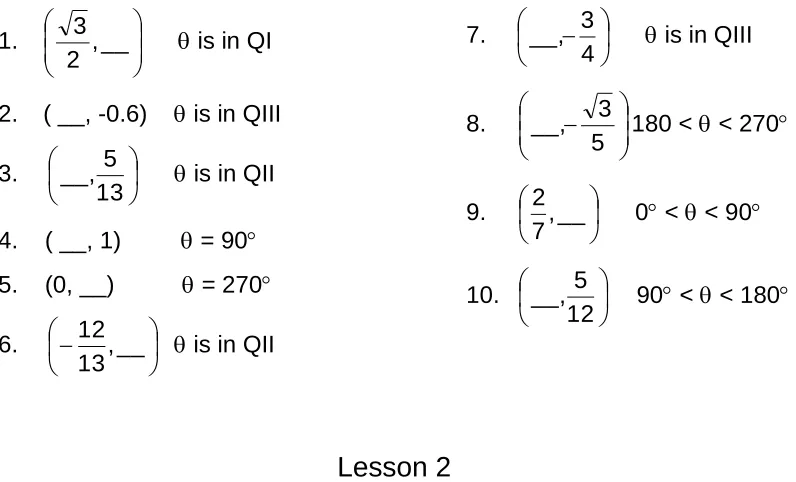
D. Find the missing coordinate of the point of intersection of the unit circle and the terminal ray of an angle in standard position.
1.
__ , 2
3
is in QI
2. ( __, -0.6) is in QIII
3.
13 5
__, is in QII 4. ( __, 1) = 90 5. (0, __) = 270
6.
,__ 13 12
is in QII
7.
4 3
__, is in QIII
8.
5
3
__, 180 < < 270
9.
__ , 7 2
0 < < 90
10.
12 5
__, 90 < < 180
Lesson 2
The Coordinates of Points on the Unit Circle in the form 180
on ± A
In geometry, you have learned that angles whose measures are 30o, 45o, and 60o are called special angles. Now, let these special angles be amount of rotations on the unit circle as you can see in the figures below. Angle measures 30, 45 and 60 are also the arclengths
6
, 4
and 3
[image:9.612.127.525.112.353.2]respectively
Figure 1 Figure 2 Figure 3
What do you think are the coordinates of each of the terminal points? 1
30o
1 45o
1 60o
Y Y
Y
X X X
6
4
[image:9.612.96.501.460.641.2]Consider figure 1. Let P(x, y) be the terminal point of the angle. Drop a perpendicular from P to the x-axis and call the point of intersection M. Notice that triangle OPM is a 30o-60o-90o triangle.
Since P is in QI, then x =
2 3
. Thus, P ( 6
)has coordinates
2 1 , 2
3 .
Consider this time figure 2. Let P(x, y) be the terminal point of the angle. Drop a perpendicular from P to the x-axis and call the point of intersection M. Notice that triangle OPM is a 45o-45o-90o triangle and that a 45o angle in standard position has its terminal side in the first quadrant.
P(x, y)
1 y
Figure 2
P(x,y)
y O x M
Figure 1
1 30o
Recall that in a 30o-60o-90o triangle, the length of the leg opposite the 30o angle is
2 1
the
length of the hypotenuse. Hence, y =
2 1
.
The x-coordinate of P can be obtained using the equation of the unit circle x2 + y2 = 1.
By substitution,
x2 + 1
2 1 2
x2 =
4 3
x2 + 1 4 1
x =
4 3
x2 = 1 -
4 1
x =
2 3
45o
O x M
Recall that in a 45o-45o-90o, the lengths of the two legs are equal. Thus, in Figure 2, x = y.
The coordinates of P can be obtained using the equation of the unit circle, x2 + y2 = 1 where x = y.
x2 + x2 = 1
2x2 = 1
2 1
x
2 1
2
x
2 2
2
1 2
2
or
x
X
Y Y
But P is in quadrant I. Hence,
2 2
x and
2 2
y .
P ( 4
) has coordinates
2 2 , 2
2
.
Now, consider figure 3. Let P(x, y) be the terminal point of the angle. Drop a perpendicular from P to the x-axis and call the point of intersection M. Notice that POM is a right triangle where POM = 60o.
4 1 1
2
y
4 3
y
4 3
y
2 3
y
Since P is in the first quadrant y =
2 3
.
Hence, P( 3
)has coordinates
2 3 , 2 1
. P(x,y)
1
y
Figure 3 60o O x M
To determine the coordinates of P, use the same relation as in Figure 1 since OPM = 30o. Knowing that the side opposite 30o is
2 1
the
length of the hypotenuse, then in figure 3, x = 2 1
.
To find y, use the equation of the unit circle, x2 + y2 = 1. Thus,
1 2
1 2
2
y
41
y
2
1
XThe coordinates of the terminal points of special angles on a unit circle can now be used to determine the coordinates of points of intersection of angles in the form 180on ± A where A is a special angle. This can be done by determining the location of the terminal point of the given angle and the reference angle, A.
Example:
1. Determine the coordinates of the point of intersection of the terminal side of a 135o angle on the unit circle.
Solution:
The terminal point of 135o or
4 3
is located in the second quadrant. Its reference
angle can be determined using the form 180on – A.
135 = 180o(1) – A 135o = 180o – A A = 180o – 135o A = 45o
4 3
or 135o is a reflection of 4
or 45o in QII.
Thus, the terminal point P of 135o has coordinates
2 2 , 2
2
.
2. Determine the coordinates of the point of intersection of the terminal side of a 210o angle on the unit circle.
Solution:
The terminal point of 210o or
6 7
is located in QIII. Its reference angle can be
determined using the form 180on + A.
180o(1) + A = 210o 180o + A = 210o A = 210o – 180o A = 30o
Notice that 210o is a reflection of 30o in the third quadrant. Hence, its coordinates can be obtained using the coordinates of 30o but following the signs of the ordered pairs in the third quadrant.
P(x,y) 135O
P(x,y) X
Y
Y
Hence, the terminal point P of 210o or
6 7
has coordinates
2 1 , 2
3
.
3. Determine the coordinates of the point of intersection of the terminal side of a 660o angle on the unit circle.
Solution:
The terminal side of 660o or
3 11
is in the fourth quadrant. It can be written in the
form 180on - A.
180o(4) – A = 660o – A = 660o – 720o
-A = -60o A = 60o
4. Determine the coordinates of the point of intersection of the terminal side of a -750o angle on the unit circle.
Solution:
The direction of rotation of -750o or 6 25
is clockwise starting from (1, 0). Its terminal side is located in the fourth quadrant and be expressed in the form 180on ± A where A is a special angle.
P(x, y)
Thus, the reference angle of -750o is 30o. The coordinates of the terminal point can be obtained from the coordinates of the points of intersection of the terminal side of 30o and the unit circle.
P(x, y)
Observe that 660o is a reflection of 60o on the fourth quadrant. Hence, the coordinates of the terminal point can be obtained from the coordinates of 60o but following the signs of coordinates in the fourth quadrant.
Then, P(
3 11
) has coordinates
2
3 , 2 1
.
180o(-4) – A = -750o -720o – A = -750o -A = -750 + 720o -A = -30o
A = 30o
X
Y
X
Therefore, the coordinates of the point of intersection of the terminal side of -750o
or
6 25
and the unit circle are
2 1 , 2
3
.
Observe from the examples that the coordinates of the point of intersection of the unit circle and the terminal side of an angle in standard position are as follows:
1. If an angle is of the form 180n 30, the coordinates are
2 1 , 2
3
.
2. If an angle is of the form 180n 60, the coordinates are
2 3 , 2 1
.
3. If an angle is of the form 180n 45, the coordinates are
2 2 , 2
2
.
The signs of the coordinates depend upon the position of the terminal side of the angle.
Try this out
Find the reference angle for each of the following angles on a unit circle and determine the coordinates of its terminal point.
1. 120o 2. 150o 3. 225o 4. 240o 5. 300o
6. 315o 7. 330o 8. 480o 9. 510o 10. 585o
11. 765o 12. -120o 13. -135o 14. -150o 15. -210o
16. -225o 17. -300o 18. -480o 19. -600o 20. -1020o
Lesson 3
The Sine and Cosine Functions
In the previous lesson, you have learned that each terminal point P of special angles on the unit circle corresponds to coordinates of a point (x, y) that satisfies the equation of the unit circle x2 + y2 = 1. These coordinates of points have special names. The relation between the angle and the y-coordinate is called the sine function while the relation between the angle and the x-coordinate is called the cosine function.
P(x, y) = (cos θ, sin θ)
Hence, for each value of θ in the unit circle, the x-coordinate of the terminal point is the cosine of θ and the y-coordinate is the sine of θ.
In symbols, x = cos θ and y = sin θ
Examples:
1. Evaluate sin 0o and cos 0o.
Solution:
2. Evaluate sin 90o and cos 90o. ( Note: 90o = 2
)
Solution:
Note that the sine and cosine functions of angles which are integral multiples of 90o can be easily evaluated.
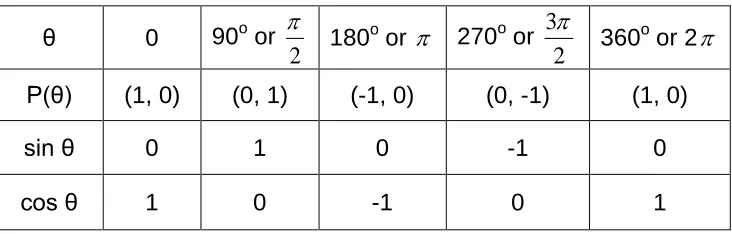
The table below shows the sine and cosine functions of the integral multiples of 90o for 0o ≤ θ ≤ 360o.
θ
P(1, 0)
When θ = 0o
is set in standard position, it intersects the unit circle at the point (1, 0). By definition, sin θ = y and cos θ = x.
Hence, in P(1,0) where x = 1 and y = 0 sin 0o = 0 and cos 0o = 1.
90o
(0, 1) θ = 90o is set in standard position on the unit circle
as shown in the figure. Its terminal side intersects the unit circle at the point (0, 1). By definition, sin θ = y and cos θ = x.
Hence, sin 90o = 1 and cos 90o = 0 or sin
2
= 1and cos 2
= 0. X
Y
Y X
θ 0 90o or 2
180o or 270o or
2 3
360o or 2
P(θ) (1, 0) (0, 1) (-1, 0) (0, -1) (1, 0)
sin θ 0 1 0 -1 0
cos θ 1 0 -1 0 1
To evaluate angles that are not multiples of 90o, use the concept of reference angles as in the previous lesson.
3. Evaluate sin 30o and cos 30o. (Note: 30o = 6
)
Solution:
Similarly, angles of multiples of 30o or 6
can be found in the other quadrants: 150o
or
6 5
in QII, 210o or
6 7
in QIII and 330o or
6 11
in QIV. 1
30o
P
23,21θ = 30o
is set in standard position, as in the figure at the left, the terminal side of the angle
intersects the unit circle at the point P
23,
21 . By definition,sin 30o =
2 1
and cos 30o =
2 3
or
sin 6
= 2 1
and cos 6
= 2
3 Y
[image:16.612.129.495.68.185.2] [image:16.612.59.553.280.603.2]4. Evaluate sin -60o and cos -60o. ( Note: 60o = 3
Solution:
1
5. Evaluate sin 570o and cos 570o. (Note: 570o = 6 19
)
Solution:
570o
P
23,21
Try this out
P
21, 23
-60oIf θ = -60o
or -3
is in standard position as in the
figure, its terminal side intersects the unit circle at the
point
21,
23 .Hence, by definition,
sin -60o = 2 1
and cos -60o = -2
3 or
sin -3
= 2 1
and cos -60o = -2
3 .
The figure at the left shows 570o in standard position. Its reference angle is 30o and the terminal side intersects the
unit circle at the point
23,
21 .Hence, by the definition of sine and cosine functions,
sin 570o = -2 1
and cos 570o = -2
3 or
sin 6 19
=
-2 1
and cos 6 19
=
-2 3
. Y
X
Y
A. The unit circle below is divided into 8 congruent arcs. Complete the table.
A
B. Evaluate the following:
1. sin 60o 2. cos 120o 3. cos 135o 4. sin 150o 5. cos 270o
6. sin 420o 7. sin -45o 8. cos -90o 9. sin -180o 10. cos -330o
C. Identify the quadrant/quadrants where the angle is/are located:
1. sin θ > 0 2. cos θ < 0 3. cos θ > 0 4. sin θ < 0
5. sin θ > 0 and cos θ < 0 6. sin θ > 0 and cos θ > 0 7. sin θ < 0 and cos θ > 0 8. sin θ < 0 and cos θ < 0
Lesson 4
Terminal Point
Degree Measure
Coordinates Sin θ Cos θ
A B C D E F G H B
C D
E
F G
H Y
The Other Circular Functions
In Lesson 3, you learned about two circular functions of an angle θ, sine and cosine. Aside from these two functions, there are four other circular functions of an angle θ in standard position. These are the tangent function, cotangent function, secant function and cosecant function.
The Tangent Function
The third basic function is the tangent function (abbreviated as tan). This function is defined in terms of sine and cosine functions.
Since y = sin θ and x = cos θ, then tan θ = θ cos
θ sin
or
x y
, where cos θ ≠ 0.
The Cotangent Function
The cotangent function (abbreviated as cot) is defined as the set of all ordered pairs
y x ,
θ where y ≠ 0, θ is an angle in standard position and x and y are the first and second
coordinates of the point of intersection of the terminal side of θ with the unit circle, respectively.
Since x = cos θ and y = sin θ, then cot θ = θ sin
θ cos
or y x
, where sin θ ≠ 0.
The Secant Function
The secant function(abbreviated as sec) is defined as the set of all ordered pairs
x 1 ,
θ where x ≠ 0, θ is an angle in standard position and x = cos θ.
Since x = cos θ, then sec θ = θ cos
1 or
x
1
, where cos θ ≠ 0.
The Cosecant Function 1
θ
The tangent function is defined as the set of all
ordered pairs
x y ,
θ where x ≠ 0, θ is an angle in
standard position and y and x are the second and first coordinates of the point of intersection of the terminal side of θ with the unit circle, respectively.
P(x, y)
Y
The cosecant function (abbreviated as csc)is defined as the set of all ordered pairs
y 1 ,
θ where y ≠ 0, θ is an angle in standard position and y = sin θ.
Since y = sin θ, then csc θ =
θ sin
1
or y
1
, where sin θ ≠ 0.
Did you notice that tangent and cotangent functions are reciprocal functions? The same is true for secant and cosecant functions.
The value of the tangent, cotangent, secant and cosecant of special angles can be obtained using their x and y coordinates.
Examples:
1.Evaluate tan 30o, cot 30o, sec 30o and csc 30o. (Note: 30o = 6
)
Solution:
P(30o) =
2 1 , 2
3
. Hence, cos 30o =
2 3
and sin 30o =
2 1
.
Therefore, by definition of tangent, cotangent, secant and cosecant,
tan 30o =
3 3 3 3 3 1 3 2 2 1
2 3 2 1
cot 30o = 3
2 3 2 1 2 2
3
2 1 2 3
sec 30o =
3 3 2 3 3 3 2 3 2 1
2 3
1
csc 30o = 2
1 2 1 2 1
2 1
1
2.Determine tan 45o, cot 45o, sec 45o and csc 45o. (Note: 45o = 4
)
Solution:
If P(45o) =
2 2 , 2
2
. Hence, cos 45o =
2 2
and sin 45o =
2 2
.
tan 45o =
2 2 2
2
= 1
2 2
2 2 2 2 2
2
cot 45o =
2 2 2
2
= 1
2 2
2 2 2 2 2
2
sec 45o =
2 2
2 2 2 2 2 2 2 2 1
2 2
1
csc 45o =
2 2
2 2 2 2 2 2 2 2 1
2 2
1
Notice that the tan 45o and cot 45o are equal and that sec 45o and csc 45o are also equal. It is because the right triangle formed by a 45o-45o-90o is an isosceles right triangle.
3. Find tan 60o, cot 60o, sec 60o and csc 60o. (Note: 60o = 3
)
If P(60o) =
2 3 , 2 1
. Hence, cos 60o =
2 1
and sin 60o =
2 3
.
Therefore, by the definition of tangent, cotangent, secant and cosecant,
tan 60o = 3
2 3 2 1 2 2
3
2 1 2 3
cot 60o =
3 3 3 3 3 1 3 2 2 1
2 3 2 1
sec 60o = 2
1 2 1 2 1
2 1
1
csc 60o =
3 3 2 3 3 3 2 3 2 1
2 3
1
Observe that tan 60o = cot 30o and sec 60o = csc 30o. Why is it so? It is because 30o and 60o are complementary angles. Hence, their functions are also complementary.
4. Evaluate tan 0o, cot 0o, sec 0o, and csc 0o.
Solution:
P(0o) = (1, 0). Hence cos 0o = 1 and sin 0o = 0.
Therefore, by definition,
tan 0o = 0 1 0
cot 0o = undefined 0
1
sec 0o = 1 1 1
csc 0o = undefined 0
1
Division by zero is not defined. Hence, cot 0o and csc 0o are not defined.
5. Evaluate tan 90o. (Note 90o = 2
)
Solution:
If P(90o) = (0, 1). Hence, cos 90o = 0 and sin 90o = 1.
Therefore, by definition,
tan 90o = undefined 0
1
cot 90o = 0 1 0
sec 90o = undefined 0
1
csc 90o = 0 1 0
Division by zero is not defined. Therefore, tan 90o and sec 90o are not defined.
The Circular Functions of other Angles
The circular functions of angles which are not multiples of the quadrantal angles and special angles can be obtained using a scientific calculator or a table of trigonometric functions. In this module, the use of a scientific calculator is encouraged for you to make use of the technology. Caution is given that before you use a scientific calculator, that is, you have to familiarize yourself with the model of the scientific calculator you are going to use. This module will not prescribe a particular scientific calculator.
Use a scientific calculator to evaluate the following
1. sin 15o 2. cos 34o15’
3. cot 100o 4. tan 125o40’
5. sec 20o05’ 6. csc 320o
Answers:
1. sin 15o = 0.258819 2. cos 34o15’ = 0.826590 3. cot 100o = -0.176327
4. tan 125o40’ = -1.393357 5. sec 20o05’= 1.064743 6. csc 320o = -1.555724
Note that the symbol ‘ means minutes. Thus, 34o15’ means 34 degrees 15 minutes.
Answers in the examples are given up to six decimal places.
Try this out
A. Find the six circular functions of the following angles using the definition of the functions.
1. 120o 2. 135o 3. 150o 4. 180o 5. 210o
6. 225o 7. 240o 8. 270o 9. 300o 10. 330o
B. Find the value of the following using a scientific calculator or a trigonometric table.
1. sin 23o 2. cos 34o 3. tan 16o 4. cot 43o 5. sec 95o
6. csc 102o 7. tan 44o23’ 8. cos 48o16’ 9. sin 55o20’ 10. cot 29o29’
11. sec 120o30’ 12. cot 87o50’ 13. cos 95o15’ 14. tan 112o47’ 15. csc 50o10’
16. cos 37o25’ 17. sin 200o52’ 18. cot 312o45’ 19. tan 300o35’ 20. sec 320o28’
C. Identify the quadrant/quadrants where the angle is located given the following conditions:
1. tan θ > 0 2. cot θ < 0
3. tan θ > 0 and sin θ < 0
Let’s Summarize
1. If OA (1, 0) is the initial side of an angle on the unit circle and P is any point on the unit circle then, OP is the terminal side of AOP and the coordinates of point P satisfy the equation of the unit circle, x2 + y2 = 1.
2. The coordinates of an angle in the form 180n 30 are
2 1 , 2
3
.
3. The coordinates of an angle in the form 180n 60 are
2 3 , 2 1
.
4. The coordinates of an angle in the form 180n 45 are
2 2 , 2
2
.
5. Sine function is the relation between an angle and the y-coordinate while cosine function is the relation between an angle and the x-coordinate.
6. Tangent function is the ratio of y to x while cotangent function is the ratio of x to y, where x and y are the coordinates of the point of intersection of the terminal side of an angle in standard position and the unit circle.
7. Secant function is the reciprocal of the cosine function while cosecant function is the reciprocal of the sine function.
What have you learned
1. The ycoordinate of an angle in the along the unit circle is
-5 4
. If the terminal side of
the angle is located in the third quadrant, what is its x-coordinate?
a. 5 3 b. 5 1
c. -5 1
d. -5 3
2. An angle measuring 60o is in standard position along the unit circle. What are its coordinates? a. 2 3 , 2 1
b.
2 3 , 2 1
c.
2 1 , 2 3
d.
2 1 , 2 3
3. What are the coordinates of the point of intersection of the terminal side of a 600o angle and the unit circle?
a.
2 1 , 2 3
b.
2 3 , 2 1
c.
2 2 , 2 2
d.
2 3 , 2 1
4. What is the x-coordinate of a 540o angle along the unit circle?
a. 2 1
b.
-2 3
c.
-2
2 d. -1
5. It is the reciprocal of the cosine function.
a. Tangent function b. Sine Function
c. Cosecant function d. Secant function
6. What is sec 240o a. 2
b.
3 3
2 c. -2
Answer Key
How much do you know
1. c 2. c
3. b 4. c
5. c 6. b
7. a 8. d
9. a 10. a
Try this out Lesson 1
A. 1. BOA
2. Right triangle
3. Pythagorean Theorem 4.
2 3
5. positive
6.
2 3 , 2 1
7.
2 3 , 2 1
8.
2 3 , 2 1
9.
2 3 , 2 1
10. Pos: QI & QIV; Neg: QII & QIII 11. Pos: QI & QII; Neg: QIII & QIV
B. 1. Lies on the unit circle 2. Lies on the unit circle
3. Does not lie on the unit circle 4. Does not lie on the unit circle 5. Lies on the unit circle
C 1. y =
2 3
2. x =
5 21
3. x =
10 11 3
4. y =
3 2 2
5. y =
2 2
6. x =
2 3
7. x =
7 3 4
8. y =
3 7
9. x =
5 6 2
10. y =
7 6 2
D. 1.
2 1
2. -0.8 3.
13 12
4. 0 5. -1
Lesson 2
1. 60o
2 3 , 2 1
2. 30o
2 1 , 2 3
3. 45o
2 2 -, 2 2
4. 60o
2 3 -, 2 1
5. 60o
2 3 -, 2 1
6. 45o
2 2 -, 2 2
7. 30o
2 1 -, 2 3
8. 60o
2 3 , 2 1
9. 30o
2 1 , 2 3
10. 45o
2 2 -, 2 2
11. 45o
2 2 , 2 2
12. 60o
2 3 -, 2 1
13. 45o
2 2 -, 2 2
14. 30o
2 1 -, 2 3
15. 30o
2 1 , 2 3
16. 45o
2 2 , 2 2
17. 60o
2 3 , 2 1
18. 60o
2 3 -, 2 1
19. 60o
2 3 , 2 1
20. 60o
2 3 , 2 1 Lesson 3 A Terminal Point Degree Measure (θ) Coordinates of Points
Sin θ Cos θ
A 0o
1,0 0 1B 45o
2 2 , 2 2 2 2 2 2
C 90o (0, 1) 1 0
D 135o
2 2 , 2 2 2 2 -2 2
E 180o (-1, 0) 0 -1
F 225o
2 2 -, 2 2 -2 2 -2 2
G 270o (0, -1) -1 0
H 315o
Lesson 4 A.
Angle Coordinates sin θ cos θ tanθ cot θ sec θ csc θ
1. 120o
2 3 2 1, 2 3 2 1
3
3 3
-2 233
2. 135o
2 2 2
2,
22
-2
2 -1 -1 2 2
3. 150o
21
2 3,
2 1
- 23
3 3
3 -233 2
4. 180o (-1, 0) 0 -1 undefined 0 -1 undefined
5. 210o
2 1 2
3,-
-2 1
- 23 3
3 3
-3 3
2 -2
6. 225o
2 2 2
2,
- - 22
-2
2 1 1 2 - 2
7. 240o
2 3 2
1,-
-2 3 2 1 3 3
3 -2
-3 3 2
8. 270o (0, -1) -1 0 undefined 0 undefined -1
9. 300o
2 3 2
1,-
-2 3 2 1 -3 -3
3 2
-3 3 2
10. 330o
2 1 2
3,-
-2 1
2
3
-3
3 - 3
3 3
2 -2
B. 1. 0.390731 2. 0.829038 3. 0.286745 4. 1.072369 5. -11.47371
6. 1.022341 7. 0.978703 8. 0.665665 9. 0.822475 10. 1.768694 11. -1.979294 12. 0.037834 13. -0.091502 14. -2.380844 15. 1.302234 16. 0.794238 17. -0.356194 18. -0.924390 19. -1.692031 20. 1.296589
C. 1. I, III 2. II, IV 3. III 4. IV 5. I 6. III
What have you learned 1. d
2. a 3. b 4. d 5. d
6. c 7. c 8. a 9. b B. 1.
2 3 6. 2 3 2. 2 1
7.
2 2 3. 2 2
8. 0
4.
2 1
9. 0
5. 0 10.
2 3