Biogeosciences, 11, 1613–1626, 2014 www.biogeosciences.net/11/1613/2014/ doi:10.5194/bg-11-1613-2014
© Author(s) 2014. CC Attribution 3.0 License.
Biogeosciences
Open Access
Effects of elevated CO
2
in the early life stages of summer flounder,
Paralichthys dentatus, and potential consequences of ocean
acidification
R. C. Chambers1, A. C. Candelmo1, E. A. Habeck1, M. E. Poach1, D. Wieczorek1, K. R. Cooper2, C. E. Greenfield2, and B. A. Phelan1
1Howard Marine Sciences Laboratory, Northeast Fisheries Science Center, NOAA Fisheries Service, 74 Magruder Rd., Highlands, NJ 07732-4054, USA
2Department of Biochemistry & Microbiology, Rutgers, The State University of New Jersey, 76 Lipman Dr. – Room 218, New Brunswick, NJ 08901-8525, USA
Correspondence to: R. C. Chambers ([email protected])
Received: 11 April 2013 – Published in Biogeosciences Discuss.: 23 August 2013 Revised: 6 February 2014 – Accepted: 10 February 2014 – Published: 26 March 2014
Abstract. The limited available evidence about effects on marine fishes of high CO2 and associated acidification of oceans suggests that effects will differ across species, be sub-tle, and may interact with other stressors. This report is on the responses of an array of early life history features of summer flounder (Paralichthys dentatus), an ecologically and eco-nomically important flatfish of the inshore and nearshore wa-ters of the Mid-Atlantic Bight (USA), to experimental ma-nipulation of CO2levels. Relative survival of summer floun-der embryos in local ambient conditions (775 µatmpCO2, 7.8 pH) was reduced to 48 % when maintained at intermedi-ate experimental conditions (1808 µatmpCO2, 7.5 pH), and to 16 % when maintained at the most elevated CO2treatment (4714 ppmpCO2, 7.1 pH). This pattern of reduced survival of embryos at high-CO2levels at constant temperature was consistent among offspring of three females used as experi-mental subjects. No reduction in survival with CO2was ob-served for larvae during the first four weeks of larval life (experiment ended at 28 d post-hatching (dph) when larvae were initiating metamorphosis). Estimates of sizes, shapes, and developmental status of larvae based on images of live larvae showed larvae were initially longer and faster grow-ing when reared at intermediate- and high-CO2levels. This pattern of longer larvae – but with less energy reserves at hatching – was expressed through the first half of the larval period (14 dph). Larvae from the highest-CO2conditions ini-tiated metamorphosis at earlier ages and smaller sizes than
1614 R. C. Chambers et al.: Effects of elevated CO2in the early life stages of summer flounder
1 Introduction
Ocean acidification (OA) results from the absorption of at-mospheric CO2by ocean water. OA is projected to increase for at least the next several centuries, and is likely to have per-vasive effects at individual, population, and ecosystem levels (Doney et al., 2009; Fabry et al., 2008). Various scenarios from models of climate change predict the levels of CO2 to more than double from current conditions by the end of this century. These models are typically configured for open-ocean biogeochemistry where current CO2 concentrations are approximately 390 ppmpCO2. Model scenarios predict CO2 to increase to over 750 ppm by 2100 and to increase over fivefold by 2300 (Caldeira and Wickett, 2003; IPCC, 2007; Feely et al., 2009; Meinshausen et al., 2011). Along with the predicted increases in atmospheric and oceanic CO2 over these time periods, surface ocean water pH is expected to decrease by 0.25 to up to 0.7 units. The current and pre-dicted levels of CO2and acidity of seawater for nearshore, estuarine, and higher-latitude habitats are expected to be even greater and substantially more variable than those for the open ocean (Gruber et al., 2012; Duarte et al., 2013; John-son et al., 2013). Importantly, these inshore temperate to bo-real regions of higher and more variable CO2levels are also where a large fraction of the commercially extractable living marine resources reside.
Research on OA effects in marine fishes is in its infancy, with the large majority of publications having appeared in the last five years. This small but growing body of studies on the OA effects in marine fishes is impressive in the di-versity of study species, their resident ecosystems, and the broad array of response variables evaluated. Reports to date include those on tropical reef fishes (Munday et al., 2009b), a pantropical rachycentrid (Bignami et al., 2013), a temper-ate sciaenid (Checkley et al., 2009), an estuarine atherinop-sid (Baumann et al., 2012), a gadid from the NE Pacific shelf (Hurst et al., 2013), and a clupeid (Franke and Clemmeson, 2011) and gadid (Frommel et al., 2012, 2013) from the low-salinity Baltic Sea. The responses evaluated for evidence of CO2effects include activity of sperm (Frommel et al., 2010) and the survival (Baumann et al., 2012), growth (Hurst et al., 2013), condition (Franke and Clemmesen, 2011), tissue and organ development (Frommel et al., 2012), otolith morphom-etry (Checkley et al., 2009; Bignami et al., 2013), olfactory capabilities (Dixson et al., 2010), sidedness (Domenici et al., 2011), homing ability (Munday et al., 2009a), and predator avoidance (Ferrari et al., 2011) of larvae and young juveniles. If any general pattern can be drawn from published stud-ies, it is that the effects of OA in marine fishes can be ex-pected to (i) vary among species, life stages, and individuals; (ii) be more pronounced in the youngest life stages which have not yet achieved homeostasis with respect to internal acid–base balances; (iii) be subtle yet potentially chronic; and (iv) possibly interact with other stressors. These expec-tations will be challenging to test. They will demand a
care-fully planned, strategic approach in order to efficiently create a basis from which predictive generalizations can be drawn.
Few studies have addressed OA effects in marine fishes of direct economic importance. Exceptions include stud-ies on Baltic cod, Gadus morhua (Frommel et al., 2010, 2012, 2013); Baltic herring, Clupea harengus (Franke and Clemmesen, 2011); and walleye pollock, Theragra
chalcogramma (Hurst et al., 2013). None has evaluated and
reported effects of OA in fishes from the western North At-lantic. Without such information, our ability to predict re-sponses of fishes and other living marine resources to a changing climate in general and elevated levels of CO2 in particular is severely impaired.
This study is part of a larger research effort funded by the US National Oceanic and Atmospheric Administration’s (NOAA) Ocean Acidification Program and is the first of sev-eral studies at our laboratory designed to begin filling this in-formation gap. These studies use fish species that are of eco-nomic and ecological importance to the mid-Atlantic region of the USA. The objective of this study was to identify and quantify the effects of elevated levels of CO2on the early life stages (ELS) of summer flounder, Paralichthys dentatus, an ecologically and commercially important paralichthyid flat-fish common to inshore waters of this region.
For this study, the ELS encompass the embryonic stage (fertilization to hatching) and most of the larval stage (from hatching until notochord flexion, which is concurrent with the initiation of metamorphosis into the juvenile morphol-ogy). The ELS have been shown to be more susceptible to toxic substances and stressors in general than juveniles and adults (Woltering, 1984). They are likely to be the life stages least capable of regulating internal acid–base balances, and therefore most likely to be at risk to the effects of increased acidity associated with elevated-CO2concentrations in their environment. Importantly, the vast majority of mortality in marine fish populations occurs during these ELS, this is when year-class strength is determined, and these stages are often key to population connectedness.
General approach
R. C. Chambers et al.: Effects of elevated CO2in the early life stages of summer flounder 1615
that may act as a costressor and potentially interact with CO2 in its effects on the test organism. The ranges of treatments are again broad (e.g., Candelmo et al., unpublished data). Step-three experiments are also two-way factorial designs (CO2×costressor) but with the range of treatments restricted to those slightly above and below the treatment combinations that elicited the steepest gradient in the response variable(s) in step-two designs. Results from this experimental progres-sion should identify potential responses due to treatment(s), estimates of their magnitudes, and define the functional form of the relationships between responses and CO2, with and without costressors. The ELS responses measured on the test species in these experiments are intended to cover a wide ar-ray of lethal and sublethal impacts. This protocol should also provide guidance regarding the technical merit of candidate responses being considered in other OA studies.
2 Methods
2.1 Species studied
Summer flounder is an ecologically and economically im-portant member of the mid-Atlantic marine and estuarine ecosystem. Adults inhabit continental shelf waters through-out the year, with many ingressing to bays during the warmer months (April through September). Summer flounder be-come piscivorous as young-of-the-year juveniles and are im-portant predators in this ecosystem thereafter.
Summer flounder spawns buoyant eggs in continental shelf water in the autumn, with peak spawning occurring from September to December (Packer et al., 1999). Spawning oc-curs as autumn water temperatures are decreasing (between 22 to 14◦C), and embryos and larvae inhabit water of 22 to 8◦C or colder depending on spawning time and latitude. Em-bryos hatch within 2 to 7 days and larvae settle between 5 and 15 weeks post-hatching, again depending on spawning time and latitude (Able and Kaiser, 1994; Packer et al., 1999). The pelagic waters occupied by summer flounder ELS are spa-tially and seasonally variable, especially in the autumn, but they are less variable than nearby estuarine habitats with re-spect to high-frequency temporal changes in CO2levels. 2.2 CO2experiment implementation
Controlled levels of CO2were supplied to the summer floun-der ELS by a large-scale, flow-through experimental system designed for multivariable OA experiments. The system con-sists of a pretreatment stage wherein the source seawater (Sandy Hook Bay, New Jersey) is filtered to 0.35 µm and sterilized with ultraviolet radiation. During this experiment the mean (±SD)pCO2(µatm) and pH of ambient seawater supplied to our lab were 1671±197 and 7.40±0.03, respec-tively. For the experiment, the local ambient seawaterpCO2 was reduced by stripping CO2from air (Twin Tower model CAS2-11) and then diffusing that air into the filtered and
ster-ilized seawater. The experimental levels for pCO2 and pH were set by regulated addition of CO2gas to the treated sea-water. The CO2levels used in this study – low (“ambient”), intermediate, and high – were set using a two-stage regu-lator with a bubble counter (Milwaukee Instruments MA957 CO2regulator) on a CO2cylinder (Airgas, bone-dry high pu-rity). The regulated gas was diffused into system water to in-creasepCO2(lower pH) to the preselected levels using three 30 L CO2 gas–seawater exchange columns. These columns were 10 cm-diameter, 3.5 m-high cylinders (PVC pipe). The columns used counter-current gas exchange wherein the sys-tem water enters at the top of each of the three columns and exits at the bottom, while CO2enters each column at the bot-tom and exits at the top, flowing counter to the water cur-rent. Water was supplied from these CO2 column at a rate of 66 mL per minute to each of nine flow-through ELS rear-ing containers which were placed in a constant-temperature water bath.
Each pH treatment level was measured at multiple fre-quencies and by several methods. Daily pH measurements were made via the spectrophotometric method (Dickson et al., 2007) (Cary 300 BIO UV Visible Spectrophotometer). Four pH measurements were made per day via benchtop electrode (Hanna HI113 pH meter, Orion HI1043 electrode). Continuous pH measurements were logged by inline Du-rafet pH sensors (DuDu-rafet II, Honeywell UDA analyzer). Wa-ter chemistry and treatment validation were based on waWa-ter drawn from the outflows of each CO2–seawater exchange column. Comparison of the water chemistry from samples taken from the base of these exchange columns with sam-ples of water from the fish-rearing containers showed no dif-ference between the two. Dissolved inorganic carbon (DIC) samples were taken daily in order to determinepCO2 lev-els. Samples were measured on an UIC CM5230 coulometer following methods of Dickson et al. (2007). Measurements for DIC, pH, salinity, and temperature were used to calculate
pCO2, bicarbonate (HCO−3), carbonate (CO 2−
3 ), alkalinity, and the saturation state of aragonite and calcite. These calcu-lations were done using the seacarb library in R (Lavigne and Gattuso, 2011). The experiment-wide mean (±SD) pCO2 (µatm) and pH for the three treatment levels (low, interme-diate, and high) were 775±42 and 7.81±0.02; 1808±362 and 7.47±0.10; and 4714±557 and 7.06±0.07, respec-tively. Observed and derived water chemistry parameter esti-mates are provided in Supplement Table S1.
2.3 Husbandry and experimental protocols
1616 R. C. Chambers et al.: Effects of elevated CO2in the early life stages of summer flounder
Bay with salinity of 20 to 26 (practical salinity units, PSU) and pH of 7.46 to 7.63, and maintained in captivity for 3 to 18 months before spawning. Adults were fed thawed frozen forage fishes three to seven days per week, depending on season, and held in a seasonal light and temperature regime that was manipulated to simulate approaching autumn and therefore spawning conditions. Males ripened spontaneously and females were induced to hydrate oocytes by daily IM in-jections of luteinizing-hormone-releasing hormone analog at 2 mg per kg wet weight until the size of the ovary indicated that egg maturation was imminent (Berlinsky et al., 1997).
Upon ripening, eggs were stripped from each of three fe-males into dry 6 L plastic pans. Each female’s eggs were then mixed with milt pooled from three to five different males. Gametes were flooded with ultraviolet-sterilized, 0.5 µm fil-tered seawater (salinity elevated to 34 PSU by sea salts) to activate the sperm and initiate fertilization. Embryos were gently aerated in 2 L separatory funnels for 2 h until the first water change, and unfertilized eggs and dead embryos were separated from live embryos by buoyancy. Live embryos from each spawned female (hereafter “sibgroups”) were di-vided into two subsets, with one subset counted into 3 groups of 100 embryos. Each 100-count group was transferred to a mesh basket which was floated in 16 L containers that were plumbed to receive one of three concentrations of CO2 -infused seawater in the experimental system. Incubation bas-kets in this embryo subexperiment were monitored daily for dead embryos and hatched larvae. Subsets of hatched lar-vae per basket (i.e., nine CO2×sibgroup combinations) were anesthetized (tricaine methanesulfonate) and photographed live in lateral perspective at 25×magnification with a Zeiss Axiocam HRc color digital camera mounted on a Wild M8 dissecting microscope for later image analyses (n=10), pre-served for histopathology (n=35), or preserved as archived samples for other assays.
The other subset of embryos from each sibgroup was maintained until hatching in 34 PSU seawater in static, aer-ated incubators with twice-daily water change and decant-ing of dead embryos. At one day post-peak-hatch (dph), nine groups of 500 larvae were used to stock the larval subex-periment (3 CO2 levels×3 replicates). Larvae for this ex-periment were drawn from a pool of parental sources (2 fe-males, 7 males), and assigned to one of nine 16 L polycarbon-ate plastic larval-rearing containers wrapped in black tarp. These containers were plumbed for flow-through with water volume and residence time of 12 L and 3 h, respectively, and were the same containers that housed the baskets of embryos. For the first three weeks of the larval subexperiment, lar-vae were fed rotifers (Brachionus plicatilis) enriched with
Nannochloropsis (Rotigrow) and at densities (0.5 to 20
ro-tifers per mL) and frequencies (one or two times per day) that increased with larval size. Advanced larvae (∼21 dph) were also fed second instar Artemia enriched with DHA (Selco) at densities (0.5 to 5 nauplii per mL) and frequencies (one or two times per day) that increased with larval size.
Lar-vae were monitored daily and dead larLar-vae were removed un-til termination of the experiment at 28 dph. Tanks were si-phoned weekly to remove accumulated debris. All embryos and larvae were maintained at 19.5◦C and under a 12 : 12 light : dark photoperiod regime throughout the study.
Subsets of larvae per treatment replicate were sampled weekly through 28 dph. One set of larvae (n=10 per repli-cate) was anesthetized, photographed live in lateral perspec-tive at 6, 12, or 25×magnification as described above for hatchlings, and preserved as archived samples. An additional set of larvae (n=25 to 35 per replicate) was collected and preserved for histological analysis of tissues and organs. 2.4 Response variables
It was assumed that the proximate cause of effects in ELS responses was due to CO2 levels disrupting the acid–base equilibria at the cellular level, and that this disruption was likely to be variously expressed at higher levels of biolog-ical organization within the individual (e.g., physiologbiolog-ical, anatomical, behavioral, and life history responses). To some degree, these different types of response variables are inter-related and represent different manifestations of the underly-ing effects of elevated CO2. The response variables were ex-pected to have different sensitivities to CO2and to respond on different timescales but all have the potential to be corre-lated with individual fitness through their direct relationship with the condition, capability, and likelihood of survival of these individuals during the ELS.
The primary response variables in the embryo subexper-iment were survival to hatching, and the size and shape of hatchlings. Response variables in the larval subexperiment were survival, size, shape, developmental markers, and key tissues and organs of feeding larval during the major portion of the larval period.
2.4.1 Survival
The numbers of embryos surviving to hatching were based on daily inspection of the embryos in the CO2-exposure in-cubation baskets. Hatch-frequency data were summed and converted to proportions of the start group of 100 per incuba-tion basket that survived to hatching. Survival of larvae was based on the numbers initially allocated to each container (N=500) and the numbers remaining at termination of the experiment at 28 dph after discounting for those sampled dur-ing the experiment (approximately 40 to 50 per week). The resulting tally of live larvae and sampled (but censored) lar-vae was converted to proportions surviving.
2.4.2 Size and shape of larvae
R. C. Chambers et al.: Effects of elevated CO2in the early life stages of summer flounder 1617
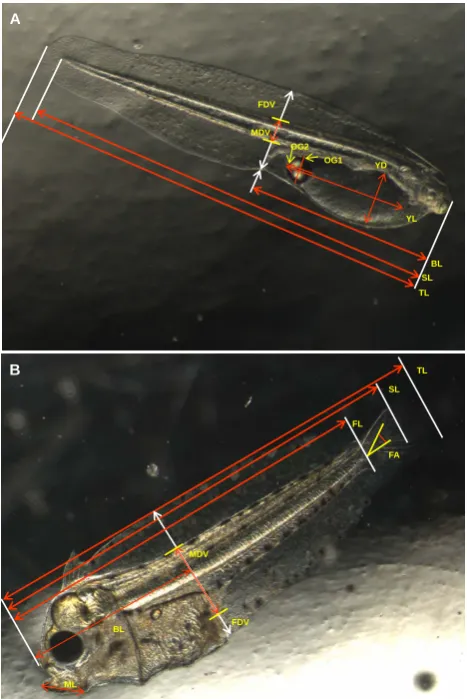
age and development of the larvae. The measurements in-cluded lengths (total, standard, precaudal, flexion, mandible, and yolk), depths (total body, muscle mass at vent, and yolk), oil globule diameter (average of two orthogonal diameters), and a developmental indicator (flexion angle). Eight vari-ables were used for samples taken of 0 and 28 dph larvae (Fig. 1). Three of eight variables (yolk length, yolk depth, and oil globule diameter) were unique to 0 dph larvae and two of eight (flexion length, flexion angle) were unique to age 28 dph larvae. Five variables were shared among larvae of all ages: total length, standard length, precaudal body length, total body depth at vent (including finfold or fin integument), and muscle mass depth at vent. Mandible length was included in the set of measures of larvae of all ages except 0 dph larvae. Morphometric data were ex-tracted from images using UTHSCSA Image Tool software (http://compdent.uthscsa.edu/dig/itdesc.html).
2.4.3 Histopathology
Common ELS toxicities in fishes include cranio-facial and skeletal deformities, reduced growth, and cardiac disruption (Barron et al., 2003). Evidence of these and other possi-ble CO2 effects was examined by clearing and staining and by histopathological analysis of tissues and organs. The ef-fects on cranio-facial and skeletal elements were assessed by alcian-blue staining of cartilage. The staining protocol en-tailed larvae being transferred to 70 % ethanol for 24 h to dehydrate the tissue, rinsed three times with 0.1 % Tween 20, and placed in a 2 µm syringe with filtered 0.1 % alcian-blue, 8GX (Sigma-Aldrich) stain overnight. Larvae were next placed into acidified ethanol to clear excess staining and then transferred to increasing concentrations of glycerol (20, 50, 80, and 100 %) with each step held for 15 min dura-tion. The larvae were retained in 100 % glycerol to preserve the stain for photography and measurements. Each larva was inspected and measured with a SZ PT Olympus stereo mi-croscope. Cranio-facial measurements taken were mandible length (tip of the dentary bone to the quadrate bone and to the end of the preopercular bone), lower jaw (tip of the dentary bone to the posterior end of the quadrate), upper jaw (max-illa), and snout length (tip of the premaxilary bone to the an-terior cranium), where the nomenclature follows Wagemans and Vanderwalle (2001). Total length and cranio-facial struc-tures (mandible, lower jaw, maxilla, and snout length) were measured at 1.1×and 2.4×magnification, respectively. Ab-normal cartilaginous structures or staining characteristics were noted. The slide preparation resulted in five to six fishes from each replicate CO2group at each weekly sample as the basis for the cranio-facial analysis.
The effects of CO2 level on soft tissue and organs were assessed by standard histopathological methods. The larvae were removed from their CO2-exposure containers and im-mediately fixed in 10 % buffered formalin. Following fixa-tion the larvae were processed through a standard
dehydra-Chambers et al., Figure 1
SL TL OG1
OG2
YD
YL FDV
MDV
BL
BL
SL TL
ML
FDV MDV
FA FL
A
[image:5.595.311.545.63.413.2]B
Fig. 1. Morphological variables used to describe size, shape, and
development of summer flounder larvae in CO2effects experiment.
Data were extracted from images of anesthetized live larvae in lat-eral perspective. The variables measured varied with larval age. (A) Yolk-sac larva at 0 dph. (B) Advanced larva (28 dph) undergoing tochord flexion. Abbreviations: total length (TL), standard (or no-tochord) length (SL), flexion length (FL), precaudal body length (BL), total body depth at vent (including finfold or fin integument) (FDV), muscle mass depth at vent (MDV), yolk length (YL), yolk depth (YD), oil globule diameters (OG1, 2), mandible length (ML), flexion angle (FA).
1618 R. C. Chambers et al.: Effects of elevated CO2in the early life stages of summer flounder
knowledge of the CO2-treatment group (only the collection date and the assigned accession numbers were used for book-keeping). A second trained pathologist, also blind to treat-ment group identities of samples, was used to confirm tissue and organ abnormalities. The CO2-treatment key was not re-vealed to evaluators until after the slides had been scored for histological effects. The histopathological preparation anal-yses resulted in three to four fishes from each replicate CO2 group at each weekly sample as the basis for summation of histological analyses of CO2effects on tissues and organs. 2.5 Statistical analyses
All statistical testing addressed the null hypothesis of no ef-fect of CO2 levels on the response variables. The statisti-cal tests applied to these data were predicated on the as-sumption of independence of observations. In order to meet this assumption, either only one datum was analyzed per group from a shared container (e.g., analysis of the treat-ment×replicate means, medians, or summary statistics such as survival) or the interdependence of response variables was explicitly accounted for by applying multivariate statistical methods (e.g., multivariate analysis of variance, ANOVA).
For the embryo subexperiment, the three containers per treatment level available were used for the separate sibgroups and treated these sibgroups as replicates in the test of the null hypotheses. Space limitations precluded also replicating within females, but from prior experience with this species it was expected that the interfemale differences in egg batch quality and embryo survival would be large. Hence, pooling embryos across sibgroups and using the pool as the source of replicates would be ill advised as it would inflate the er-ror variance and prevent any interpretation of that variance. The trade-off is that the intentional confounding of sibgroups and replicates results in the error variance for the test statistic including any among-sibgroup variance. Given the expected interfemale differences in egg batch quality, this trade-off was deemed acceptable. Moreover, such confounding paral-lels the action of replicating over time or blocking over space when the study logistics force a design in which replicates are initiated at different times or locations. There as here, confounding of replicates with an extraneous factor (time, space, or another system attribute) results in a conservative test of the effect of the treatment (e.g., CO2level) because the response variance associated with the extraneous factor is captured by the error term of the test statistic, making it less likely that the null hypothesis is rejected. Conversely, if the null hypothesis is rejected, it can be concluded that the treatment has a robust effect on the responses analyzed. Replicates for the larval subexperiment were drawn from a pooled set of hatchings. The critical value for statistical sig-nificance was set atp=0.05. Analyses were conducted with SYSTAT 11 (SYSTAT Software, 2004) software package.
2.5.1 Survival data
Before analysis, proportions of embryos surviving to hatch-ing were converted to the relative survival proportions for each replicate (= sibgroup) in order to standardize any inter-female differences in survival of their embryos. These em-bryo relative survival proportions, as well as the proportion of larvae surviving to the end of the experiment, were trans-formed via arcsine square root to normalize variances and then analyzed as one-way ANOVAs with CO2 level as the treatment.
2.5.2 Size and shape data
All analyses of size and shape (morphometric) data were conducted on mean values per replicate within CO2levels. The statistical analysis of morphometric data was a three-step process. First, due to the lack of independence and expected covariance of variables describing size, shape, and develop-mental status of the same individual, these data were reduced by principal component (PC) analysis. Second, the result-ing PC scores of individual fishes were reduced to replicate means. Third, the replicate mean PC scores were analyzed as an ANOVA or MANOVA depending on whether one or more PC axes were significant, respectively. Follow-up univari-ate tests for specific CO2-treatment level contrasts, graphi-cal display, and interpretation in the context of the original variables were conducted using ANOVAs.
2.5.3 Histopathology data
The data on H&E-stained responses of cartilage and skele-tal elements (i.e., toskele-tal length and cranio-facial features) were handled similar to the image-based size and shape data (above). Those data were subjected to a PC analysis to re-duce dimensionality of correlated variables and then submit-ted to one-way (M)ANOVA to test for no effect of CO2. The histopathological responses of tissue and organ responses are reported in a qualitative manor for each CO2-level group and age.
3 Results
3.1 CO2effects on survival
R. C. Chambers et al.: Effects of elevated CO2in the early life stages of summer flounder 1619
1.0
0.5
0.0 low (775)
intermediate (1,808)
high (4,714)
Survival to hatching
Chambers et al., Figure 2
CO
2level (pCO
2, uatm)
← sibgroup 2, 3
← sibgroup 1
pH 7.8 7.5 7.1 C02level
[image:7.595.54.280.62.293.2]low intermediate high
Fig. 2. Proportion of fertilized eggs of summer flounder surviving
to hatching at different levels of CO2in rearing water (inset: asso-ciated pH values). Embryos were obtained from three females each crossed with milt pooled from three to five males. Mean (±SE) rela-tive survival is plotted where survival data for each female sibgroup were first scaled to sibgroup survival at ambient (low) CO2(i.e.,
rel-ative survival at low CO2=1.0 for all sibgroups). Absolute survival
at ambient conditions for each sibgroup is denoted by arrows.
among sibgroups from different females in survival at low CO2(range of survival to hatch 0.29 to 0.70, Fig. 2, arrows). Once interfemale differences were accounted for by com-puting relative survival, the decrease due to CO2level was highly significant (F2,6=31.0,p=0.001,R2=0.91). This pattern of reduction in survival was consistent across all three replicates (sibgroups), which justifies retaining sibgroup in-tegrity during the embryonic subexperiment. Survival to hatching also decreased significantly between the low- and intermediate-CO2 levels (two-group contrast, F1,4=70.5,
p=0.001,R2=0.95).
Survival of larvae to the termination of the experiment (28 dph) ranged from 0.64 to 0.91. There was no effect of CO2levels on larval survival (Table S2).
3.2 Size, shape, and development of larvae
3.2.1 Variance structure of larval morphological variables
The expectation that the morphological variables within in-dividuals at each sample age were interdependent and cor-related was confirmed by PC analysis. The analysis was run on each weekly sample and provided one or more signifi-cant independent linear combinations (PC) from the original variables. The PC scores captured well the variance
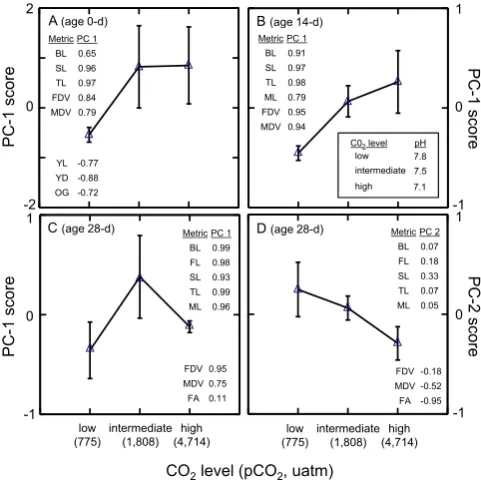
struc-ture of the original data and offered insights into how larval size, shape, and developmental status changed as a function of age and CO2level. For 0 and 14 dph larvae, only one PC (PC10 dand PC114 d)was significant, and it accounted for 69 and 85 % of the original among-individual variance, respec-tively. For 28 dph larvae, two PCs (PC128 d, PC228 d)were significant (Fig. 3), and they accounted for 78 and 17 % of the variance, respectively (sum of 94 %).
For larvae at each of the three sample ages shown here (0, 14, and 28 dph), larval size appears to be the best character-ization of PC1 (PC loadings onto PC1 and PC2 for 28 dph larvae are shown in Fig. 3; values of loadings onto PC1 for 0, 14, and 28 dph are in Fig. 4, inset, and Table S2). Larval lengths (total, standard, and body lengths for all ages, but also including flexion lengths for older larvae) were consis-tently major contributors to PC1. Measures of body depth of the larvae, especially at older ages, and mandible length also contributed positively to PC1. The consistently large load-ings of measures of fish lengths and body depths (all with same positive sign) support a general depiction of isometric growth independent of absolute size; i.e., larger (smaller) lar-vae are proportionately larger (smaller) in all of these mea-sures taken at all ages. For 0 dph larvae, an inverse relation-ship existed between larval size and energy reserves at hatch-ing. The measures of energy available to the larvae (yolk length and depth, and oil globule diameter) contributed neg-atively to PC1 (Fig. 4a and Table S2). For advanced larvae (28 dph) the developmental events in late larval ontogeny contributed most to PC2. Specifically, the extent of flexion – quantified by flexion angle (Fig. 1) – along with a sec-ondary contribution by the depth of body musculature load most heavily on PC2 (Fig. 3). These developmental events near the terminus of the larval period – increased degree of flexion and a deepening of the body – reflect imminent meta-morphosis.
1620 R. C. Chambers et al.: Effects of elevated CO2in the early life stages of summer flounder
PCA Axis 1
-1 0 1
PCA
Axis
2
-1 1
0
FA
MDV FDV
ML FL SL
BL/TL
[image:8.595.56.280.61.282.2]Chambers et al., Figure 3
Fig. 3. Contribution (loadings) of morphological variables
mea-sured on late-stage summer flounder larvae (28 dph) to significant principal component (PC) axes. PC axis 1 accounted for 77 % of overall variance and is dominated by measures of fish size (primar-ily length but also body depth measurements). PC axis 2 accounted for an additional 17 % of the remaining variance and largely reflects developmental stage (degree of flexion) with additional contribu-tions by depth of body muscle mass. See Fig. 1 for abbreviacontribu-tions and Table S2 for summary statistics.
This pattern of smaller larval sizes (lengths, depths, mandible size) at low-CO2 conditions compared to larvae from intermediate- and high-CO2 environments continued through the mid-larval period samples at 7 and 14 dph (data from 14 dph larvae shown in Fig. 4b). By 21 dph (not shown in Figures) the size ranking of larvae from CO2environments began to shift, with larval sizes comparable among all CO2 environments but with a trend towards smaller sizes at the high-CO2environment. By 28 dph (the last trimester of the larval period at the 19.5◦C rearing temperature), the larvae at the intermediate-CO2environment were the largest sizes while larvae from the low and high-CO2environments were smaller and comparable in size (Figs. 4c and 5b). Despite a rough size equivalency between larvae from low and high-CO2environments, these larvae were at significantly differ-ent developmdiffer-ental stages (Fig. 4d). Larvae from the low-CO2 environment were the least advanced of all groups in terms of notochord flexion, those from the intermediate-CO2 envi-ronment were intermediate in their development, and larvae from the highest-CO2 environment were the most develop-mentally advanced at the termination of the experiment. In-dicators that metamorphosis was imminent in the larvae from the high-CO2environment were the greater degree of noto-chord flexion (Fig. 5c), deepening bodies, and prevalence of eye asymmetry.
-2 2
0
PC-1 score
-1 1
0
PC-1 score
-1 1
0
PC-1 score
-1 1
0
PC-2 score
A (age 0-d) B (age 14-d)
C (age 28-d) D (age 28-d)
Chambers et al., Figure 4
Metric PC 1 BL 0.99 FL 0.98 SL 0.93 TL 0.99 ML 0.96
FDV 0.95 MDV 0.75 FA 0.11
Metric PC 2 BL 0.07 FL 0.18 SL 0.33 TL 0.07 ML 0.05
FDV -0.18 MDV -0.52 FA -0.95 Metric PC 1
BL 0.91 SL 0.97 TL 0.98 ML 0.79 FDV 0.95 MDV 0.94 Metric PC 1
BL 0.65 SL 0.96 TL 0.97 FDV 0.84 MDV 0.79
YL -0.77 YD -0.88 OG -0.72
pH 7.8 7.5 7.1 C02level
low intermediate high
low (775)
intermediate (1,808)
high (4,714)
CO2level (pCO2, uatm) low
(775) intermediate (1,808) (4,714)high
Fig. 4. Responses in size, shape, and development of summer
floun-der larvae by age at different levels of CO2in rearing water (in-set: associated pH values). Responses are summarized by principal component (PC) scores. Only significant PC axes are shown. (A) 0 dph, PC 1. (B) 14 dph, PC 1. (C) 28 dph, PC 1. (D) 28 dph, PC 2. The PC loadings on each original measurement (metric) are shown at each age within panels. Data plotted are means±SE. See Fig. 1 for abbreviations and Table S2 for summary statistics.
3.3 CO2effects on histopathology features
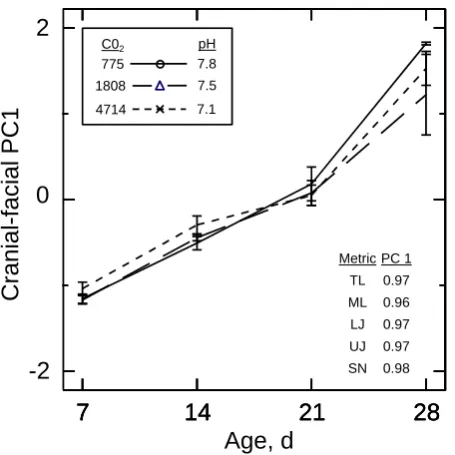
The alcian-blue staining allowed quantification of skeletal el-ements, including the lengths of the total body, mandible, lower jaw, maxilla, and snout of larvae ≥7 dph (younger larvae could not be reliably prepared for histological ex-amination). Total length and all four cranio-facial measure-ments were interrelated, contributing in similar magnitude to the single significant PC (Fig. 6, Table S3). The ontoge-netic trajectory of each of the original measures and PC1 scores mirrored that of the changes in the size variables based on external morphometric measurements presented above. Specifically, larvae from the high-CO2level tended to have larger cranio-facial features up through the mid-larval pe-riod. By age 21 dph and continuing through 28 dph, the larvae from the low-CO2level had the largest cranio-facial features. In addition, larvae from the high-CO2environment showed occasional deformations such as delayed formation of the mandible.
[image:8.595.307.548.63.305.2]R. C. Chambers et al.: Effects of elevated CO2in the early life stages of summer flounder 1621 Chambers, R.C. Figure 5
15 25 35
Flexion angle, degrees
C (age 28-d)
0.8
0.4 1.2
T
o
tal length, mm
A(age 0-d)
1.6
Y
o
lk length,
mm
0 1 2 3 4
TL YL
0 14 28
AGE
2 4 6 8 10 12
T
o
tal length, mm
B
pH 7.8 7.5 7.1 C02
775 1808 4714
low (775)
intermediate (1,808)
high (4,714)
CO2level (pCO2, uatm)
low (775)
intermediate (1,808)
high (4,714)
[image:9.595.74.525.65.220.2]CO2level (pCO2, uatm)
Fig. 5. Responses of summer flounder larvae to different levels of CO2in rearing water (inset: CO2levels (µatm) and associated pH values).
(A) Total length (TL) and yolk length (YL) of larvae at hatching (0 dph). (B) Total length versus age of larvae. (C) Notochord angle of
advanced larvae (28 dph) as an indicator of larval developmental stage. Flexion angle (see Fig. 1b) increases from zero as metamorphosis is approached. Data plotted are means±SE.
Chambers et al., Figure 6
Metric PC 1 TL 0.97
ML 0.96 LJ 0.97
UJ 0.97 SN 0.98
7
14
21
28
7
14
21
28
Age, d
7
14
21
28
Cranial-facial PC1
-2
0
2
pH 7.8
7.5
7.1 C02
775 1808
4714
Fig. 6. Responses in cranio-facial features of summer flounder
lar-vae by age at different levels of CO2in rearing water (inset: CO2
levels (µatm) and associated pH values). Responses are as summa-rized by the first principal component (PC) scores. The PC load-ings on each original cranio-facial measurement (metric) are shown within panel. Plotted data are means±SE. See Sect. 2.4.3 for de-scription of measurements and abbreviations, and Table S3 for sum-mary statistics.
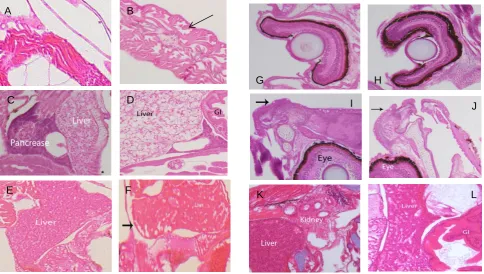
environments were similar in appearance; however larvae from the intermediate-CO2 environment tended to express minor liver sinusoid dilation. Larvae from the high-CO2 en-vironment expressed additional abnormalities including mi-nor focal hyperplasia on the epithelium and separation of the trunk muscle bundles (Fig. 7). In addition, extensive dilation
of the liver sinusoids and central veins was evident, which re-sulted in the liver appearing condensed and being organized into rows or patches.
4 Discussion
4.1 Experimental protocol and CO2levels
Our experiments revealed the embryos and larvae of summer flounder to be sensitive to elevated-CO2 levels and that the effects on survival, size, and development occurred even at the intermediate-CO2levels used here. Two points on our ex-perimental protocol warrant emphasis and help to place these results in context.
[image:9.595.55.283.297.525.2]1622 R. C. Chambers et al.: Effects of elevated CO2in the early life stages of summer flounder
Chambers et al., Figure 7
A B
C D
E F
G H
I J
K L
Chambers et al., Figure 7
A B
C D
E F
G H
I J
K L
Fig. 7. Photomicrographs of H&E-stained tissue sections taken from 21 dph (A–F) and 28 dph (G–L) summer flounder larvae.
Photomicro-graphs on left (A, C, E, G, I, K) are from ambient (low)-CO2level; those on right (B, D, F, H, J, L) are from the high-CO2level. (A, B)
Skeletal muscle. (C, D) Liver (lipid or glycogen vacuolation) and pancreas. (E, F) Liver (eosinophilic hepatocytes and chord-like structure).
(G, H) Eye showing cornea, lens, iris, and retina. (I, J) Epidermis. (K, L) Kidney (renal tubules) and liver. Notes: (B) arrow shows disruption
of skeletal muscle fibers within the bundles. (C–F) Livers of some 21 dph larvae had a vacuolated appearance (C, D) and others had a more distinct chord-like architecture (E, F), but in both types the liver architecture in the high-CO2group was disrupted and more apparent as dilated sinusoids (F, arrow) and focal hepatocyte necrosis. (G, H) No significant differences among groups were observed in the eye. (I,
J) Epidermal hyperplasia was evident with a marked increase in goblet cells (arrows). (K, L) Livers from the 28 dph high-CO2group (L)
showed dilated sinusoids and focal necrosis when compared to the low-CO2group (K).
Second, the CO2 levels that we used met our criteria for a step-one experiment as described above (see General ap-proach). The intent of such an experiment is to screen species and response variables for their sensitivity to future and ex-treme CO2 levels. Although high-resolution CO2 data for inshore habitats are unfortunately quite sparse for most re-gions worldwide – and the Mid-Atlantic Bight is no excep-tion – there is recent evidence and there are suggesexcep-tions from historic surveys (e.g., MARMAP 1978–1987) that temper-ate and higher-latitude inshore regions, including the Mid-Atlantic Bight, are likely to have higher and more variable CO2levels than those predicted for open-ocean environments (Duarte et al., 2013; Wang et al., 2013). The Mid-Atlantic Bight as a whole is a net sink for atmospheric CO2, with the annual cycle of heating and cooling combined with high winds during the period of undersaturation (winter) account-ing for a significant portion of the uptake of CO2 (DeGrand-pre et al., 2002). The marine shelf habitat of the Mid-Atlantic Bight has substantial spatial (nearshore–offshore) and sea-sonal variation in CO2 levels, with nearshore habitats in
summer-autumn exhibiting mean bottom-waterpCO2values as high as 722 µatm (D. Wieczorek, unpublished data, 2008– 2010). Some summer flounder spawn at this time and their ELS occupy these habitats. Hence, the low-CO2level used in experiments here are tailored to the study species. As ar-gued by McElhany and Busch (2013), such local conditions provide a more realistic benchmark in OA experiments than open-ocean averages.
[image:10.595.57.542.65.339.2]R. C. Chambers et al.: Effects of elevated CO2in the early life stages of summer flounder 1623
extreme conditions. Importantly, many of the effects reported here were exhibited even at the intermediate-CO2level.
4.2 CO2effects on embryo survival
A strong effect of CO2was evident in the survival to hatch-ing of summer flounder embryos. This pattern of reduction in relative survival by half with a 2.5 times increase in CO2 levels (0.35 pH unit reduction) in the environment, and a fur-ther reduction by more than half again with anofur-ther 2.5 times increase above the intermediate-CO2levels (a further 0.4 pH unit reduction), was consistent among three sets of embryos from different parents. A reduction in the number of viable hatching larvae by even 50 % as found for the intermediate-CO2environment (1808 µatm, pH 7.5) is unlikely to be sus-tainable as this reduction would be chronic unless summer flounder can responds via acclimation, nongenetic transgen-erational effects, or natural selection to the CO2levels pre-dicted for late this century and through the next one.
A positive covariance between maternal CO2environment and the performance of offspring has been reported for trop-ical reef fishes (Donelson et al., 2012; Miller et al., 2012). It is noteworthy that we saw significant responses of offspring to elevated-CO2environment even though their parents were maintained in local ambient seawater with a pH of 7.46 to 7.63 prior to spawning. All of the prespawned adult fishes were maintained at local ambient conditions, so we could not evaluate the effects on offspring of adult conditioning to varying CO2environments. Although we did not attempt to estimate heritability of resistance to elevated-CO2 environ-ments, and thus the potential for selective response was not assessed, the protocol here of retaining family integrity for the embryo subexperiment does allow a glimpse at the likeli-hood of the potential for a selective response. The finding that these separate sibgroups responded nearly identically in their proportional reduction of embryo survival with increasing CO2 environments is consistent with a limited potential to respond via natural selection to future elevated-CO2 environ-ments. Further study is needed to rigorously evaluate the role of parents in providing advantages to their offspring via ma-ternal conditioning to elevated-CO2environments or through heritable variation in tolerance to these environments.
The degree of reduction in embryo survival at elevated-CO2environments found here has not been reported by most other authors whose combined work is on a diverse set of marine fishes. Munday et al. (2009b) found the survival to hatch of orange clownfish (Amphiprion percula) from the Great Barrier Reef, Australia, to be nonresponsive topCO2 levels up to 1030 ppm. Franke and Clemmesen (2012) found no significant effect of elevatedpCO2(460 to 4635 ppm) on survival to hatch of Atlantic herring from parents collected in the western Baltic Sea. Frommel et al. (2013) found that survival of embryos of Atlantic cod from parents collected in the Bornholm Basin of the western Baltic Sea was not altered atpCO2levels up to 4000 ppm. Hurst et al. (2013)
report no effect on embryo survival of walleye pollock, com-mon in the temperate eastern North Pacific, atpCO2levels up to 1933 ppm. In contrast, Baumann et al. (2012) reported a 74 % reduction in survival of embryos and young larvae of inland silverside, Menidia beryllina, native to estuaries of the US Atlantic coast, when maintained at higherpCO2 lev-els (1100 ppm) compared to those held at lowerpCO2levels (410 ppm). All of these studies varied in the number of par-ents used, the time lapse between egg fertilization and the initiation of the CO2treatments, and in how and when sur-vival was scored. For example, the CO2exposures of inland silverside by Baumann et al. (2012) began at approximately 24 h post-fertilization, and survival was scored at approxi-mately 1 week post-hatching.
The different protocols used among previous studies may preclude a fair cross-study comparison; however, the over-all lack of effect of elevated-CO2 environments on embryo survival (with the conditional exception of inland silverside by Baumann et al. (2012)) is in contrast to the findings here. The habitats occupied by a species, particularly its ELS, may play a role in their sensitivities to elevated-CO2 environ-ments. Why embryos of two species whose ELS are found in estuarine (inland silverside) or inner shelf (summer floun-der) habitats, both with relatively high ambient-CO2levels, exhibit sensitivity to experimentally elevated-CO2 levels is counter to expectations and requires further attention.
4.3 CO2effects on larval size, condition, and development
A consistent trend in the effects of elevated-CO2 environ-ments on larval summer flounder ontogenetic trajectories was evident – one that is ecologically important and could neg-atively affect recruitment. Larvae from elevated-CO2 envi-ronments were larger at hatching but had less energy re-serves (smaller yolk and oil globule) than larvae from low-CO2 conditions. Such a trade-off between size and energy reserves of larvae at hatching from contrasting environments (e.g., two or more thermal regimes or maternal sources) has been exhibited in other marine fishes (Chambers et al., 1989). Here the trade-off means that larvae from environments with higher CO2would be larger but likely have less time to suc-cessfully initiate feeding.
1624 R. C. Chambers et al.: Effects of elevated CO2in the early life stages of summer flounder
with summer flounder. Using another measure of condition, Franke and Clemmesen (2011) report that larvae of Atlantic herring from high-CO2environments were of lower condi-tion (i.e., lower RNA-to-DNA ratios) than their counterparts from lower-CO2environments.
Summer flounder larvae from low-CO2 environments in experiments reported here were smaller than those from high-CO2environments until at least the mid-larval period. An inverse relationship between CO2levels in the environ-ment and the duration of the larval period was also evi-dent. Specifically, the growth trajectories and developmental stages at the termination of this experiment (28 dph) show evidence that larvae at low-CO2 levels can be expected to be larger and older at the completion of metamorphosis than those from the high-CO2levels and quite likely larger than those from the intermediate-CO2level.
Few other OA studies have considered a multivariate char-acterization of larval size, shape, and development with which to compare results from this study, and none has considered flatfish – a taxon whose ontogeny conforms ex-ceedingly well to scoring of developmental progression dur-ing the larval period. An intrigudur-ing study by Munday et al. (2011) provides a highly multivariate characterization of possible CO2responses in the early life history of spiny dam-selfish (Acanthochromis polyacanthus). Fishes were experi-mentally exposed to a range ofpCO2levels (450 to 850 ppm) beginning on hatch day. They evaluated 29 skeletal elements from cleared-and-stained specimens. Three of 29 elements differed significantly (one-way ANOVA) among CO2 lev-els, but none was monotonically related to CO2level and no skeletal element varied significantly among CO2levels after the authors applied a Bonferroni correction to the ANOVA test critical value in order to accommodate multiple tests on their data set. Munday et al. (2011) evaluated other responses (survival, fish length and mass, and otolith morphometry) and found none to vary with CO2 level. This lack of sen-sitivity to CO2challenges may be related to the life history of the spiny damselfish, which lacks a true larval period and hatches as a young juvenile.
An altered ontogenetic trajectory in response to an elevated-CO2environment as found in this study may be of considerable ecological importance in summer flounder. Be-cause this species primarily spawns in autumn (September to December), its larvae experience rapidly declining water temperatures. Depending on the timing of spawning, the au-tumn sea temperatures, and the intrinsic ontogenetic rate, lar-vae from a single summer flounder annual cohort may meta-morphose, ingress, and settle into estuaries before winter, af-ter winaf-ter, or both (R. C. Chambers, unpublished data). Im-portantly, larvae are incapable of metamorphosing at the cool winter water temperatures of this region (December through March), so acceleration of developmental timing as a con-sequence of elevated-CO2levels would amplify any conse-quences – or benefits – of ingressing in the autumn versus spring.
4.4 CO2effects on tissues and organs
The number and severity of malformations in tissues and organs of summer flounder larvae increased with levels of CO2in the environment. The majority of these differences were seen in older larvae, especially in the 21 and 28 dph samples which showed significant differences between the highest and lowest-CO2 environments. The fewer observed abnormalities in younger larvae (e.g., 7 dph) may be due to their small size (3.4 to 3.7 mm TL) and difficulties in prepar-ing and accurately measurprepar-ing these larvae. A trend towards reduction in frequency of abnormalities with age may re-flect mortalities of severely impaired larvae before the sam-ple date. Selective and age-dependent mortality in the lar-val period, possibly as an increasing fraction of the surviv-ing older larvae exhibit homeostatic capabilities that accom-modate high-CO2levels as found in Atlantic cod (Frommel et al., 2012), may account for some of the reduction in fre-quency of developmental anomalies seen here for larvae at advanced ages.
Although the extent of cranio-facial abnormalities less-ened in older larvae, the trend towards reduced sizes of cranio-facial features in high-CO2environments was evident in larvae at the most advanced sample date (28 dph). Indeed, the lengths of all cranio-facial measures in advanced-age lar-vae tended to be smaller for fishes from the high- versus low-CO2environments. Part of these differences among lar-vae from different CO2groups may reflect the different (ac-celerated) developmental stage of the high-CO2 group and the remodeling of the fish cranium that occurs at metamor-phosis. The extent, location, and proximate cause of high-CO2-induced abnormalities of the cranio-facial areas of ma-rine fish species is largely unknown and has not been previ-ously evaluated in summer flounder. Like all flatfish, sum-mer flounder larvae undergo metamorphosis during which the head is remodeled and, in this species, as the right eye of the larva migrates to the left side of the face (Schreiber and Specker, 2000). While this morphology has an evolutionary benefit (Schreiber, 2006), the massive change of cranio-facial structures likely renders the remodeling process as highly sensitive to environmental stressors. The metamorphosis of flatfish is influenced proximally by thyroid hormone (TH), which also controls the tolerance of the fishes to changes in salinity (Schreiber, 2006). The influence of elevated-CO2 levels and increased acidity of seawater on the production of TH in flatfish and the responsiveness of the target tissues to TH warrant further investigation.
5 Conclusions and prospective
R. C. Chambers et al.: Effects of elevated CO2in the early life stages of summer flounder 1625
multivariate approach. Negative effects of a high-CO2 envi-ronment were also evident in larval tissues and cranio-facial features and, like the CO2effects expressed in the external phenotypic measures, changed with age and development. Importantly, the observed CO2-induced variations – even those at the intermediate, next-century CO2values used here – have predictable negative consequences on recruitment of this ecologically and economically important species.
A growing understanding of OA effects on marine fishes is taking shape in the research community. This understand-ing acknowledges the challenges in drawunderstand-ing generalizations when confronted with OA studies on diverse taxa that use variable experimental protocols and employ different types and ways of measuring biological responses. A research strategy that may produce rapid progress on OA research was offered above (General approach), and the first step of that strategy was used in this study.
Three additional criteria for broadening an OA research strategy warrant consideration.
1. Select experimental subjects with life histories, ecolo-gies, and habitat affinities that are representative of broader species groups. Given the infancy of OA re-search on marine fishes, the OA community is limited by the small number and biases of taxa studied to date. The species chosen for past studies have likely been of convenience and familiarity rather than ones that could provide stronger inferences.
2. Identify best practices, refine methods where needed, and document all protocols. Due to the international and multijurisdictional interest in OA, the research community has recurring opportunities for workshops, symposia, and best-practices guidelines (e.g., Riebe-sell et al., 2010).
3. Provide OA project metadata to the OA research communities. Interstudy comparisons and retrospec-tive studies are only as good as the data and metadata available for such analyses. To that end, multiple agen-cies – including NOAA’s Ocean Acidification Program – are developing metadata standards. Input to these standards as well as critiques and usages of them are needed in order to maximize their utility for the largest fraction of the OA research community, resource man-agers, and the concerned public.
Supplementary material related to this article is available online at http://www.biogeosciences.net/11/ 1613/2014/bg-11-1613-2014-supplement.pdf.
Acknowledgements. The contributions to field, laboratory, pro-cessing, and support elements of this study by Kathryn Clark, Allison Crawford, Dawn Davis, Kristin Habeck, James Lang, Katie Lynch, Karan Mirchandani, Keith Noonan, Katherine Peluso, Pete Plantamura, Jennifer Samson, Demond Timmons, and the New Jersey Department of Environmental Protection are greatly appre-ciated. Thanks to Alex Schreiber and an anonymous referee whose comments substantially improved the manuscript. Financial and logistical support was provided by NOAA’s Ocean Acidification Program, NOAA’s Northeast Fisheries Science Center, Rutgers University, and the Cooperative Institute for the North Atlantic Region (CINAR).
Edited by: H.-O. Pörtner
References
Able, K. A. and Kaiser, S. C.: Synthesis of summer flounder habitat parameters, NOAA Coastal Ocean Prog., Decision Analysis Ser. 1. NOAA Coastal Ocean Office, Silver Spring, MD, 68 pp., 1994. Barron, M. G., Carls, M. G., Heintz, R., and Rice, S. D.: Evaluation of fish early life stage toxicity models of chronic embryonic ex-posures to complex polycyclic aromatic hydrocarbon mixtures, Toxicol. Sci., 78, 60–67, 2003.
Baumann, H., Talmage, S. C., and Gobler, C. J.: Reduced early life growth and survival in a fish as a direct response to elevated car-bon dioxide, Nat. Clim. Change, 2, 38–41, 2012.
Berlinsky, D. L., King V. W., Hodson, R. G., and Sullivan, C. V.: Hormone induced spawning of summer flounder (Paralichthys dentatus), J. World Aquacul. Soc., 28, 79–86, 1997.
Bignami, S., Enochs, I. C., Manzello, D. P., Spaunagle, S., and Cowen, R. K.: Ocean acidification alters the otoliths of a pantrop-ical fish species with implications for sensory function, P. Natl. Acad. Sci., 110, 7377–7370, 2013.
Caldeira, K. and Wickett, M. E.: Anthropogenic carbon and ocean pH, Nature, 425, 365–365, 2003.
Chambers, R. C., Leggett, W. C., and Brown, J. A.: Egg size, female effects, and the correlations between early life history traits of capelin (Mallotus villosus): an appraisal at the individual level, Fish. Bullet. US, 87, 515–523, 1989.
Checkley, D. M., Dickson, A. G., Takahashi, M., Radich, J. A. Eisenkolb, N., and Asch, R.: Elevated CO2 enhances otolith
growth in young fish, Science, 324, 1683–1683, 2009.
DeGrandpre, M. D., Olbu, G. J., Beatty, C. M, and Hammar, T. R.: Air-sea CO2fluxes on the US Middle Atlantic Bight, Deep-Sea
Res. Pt. II, 49, 4355–4367, 2002.
Dickson, A. G., Sabine, C. L., and Christian, J. R.: Guide to best practices for ocean CO2measurements, PICES Special
Publica-tion, 3, 191–193, 2007.
Dixson, D. L., Munday, P. L., and Jones, G. P.: Ocean acidification disrupts the innate ability of fish to detect predator olfactory cues, Ecol. Lett., 13, 68–75, 2010.
1626 R. C. Chambers et al.: Effects of elevated CO2in the early life stages of summer flounder
Doney, S. C., Fabry, V. J. Feely, R. A., and Kleypas, J. A.: Ocean acidification: the other CO2problem, Annu. Rev. Mar. Sci., 1,
169–92, 2009.
Duarte, C. M., Hendriks, I. E., Moore, T. S., Olsen, Y. S., Steck-bauer, A., Ramajo, L., Carstensen, J., Trotter, J. A., and McCul-loch, M.: Is ocean acidification an open-ocean syndrome? Under-standing anthropogenic impacts on seawater pH, Estuar. Coast., 36, 221–236, doi:10.1007/s12237-013-9594-3, 2013.
Fabry, V. J., Seibel, B. A., Feely, R. A., and Orr, J. C.: Impacts of ocean acidification on marine fauna and ecosystem processes, ICES J. Mar. Sci., 65, 414–432, 2008.
Feely, R. A., Doney, S. C., and Cooley, S. R.: Ocean acidifica-tion: Present conditions and future changes in a high-CO2world,
Oceanography, 22, 36–47, 2009.
Ferrari, M. C. O., McCormick, M. I., Munday, P. L., Meekan, M., Dixson, D. L., Lonnstedt, O., and Chivers, D.: Putting prey and predator into the CO2equation: qualitative and quantitative
ef-fects of ocean acidification on predator-prey interactions, Ecol. Lett., 14, 1143–1148, 2011.
Franke, A. and Clemmesen, C.: Effect of ocean acidification on early life stages of Atlantic herring (Clupea harengus L.), Bio-geosciences, 8, 3697–3707, doi:10.5194/bg-8-3697-2011, 2011. Frommel, A. Y., Stiebens, V., Clemmesen, C., and Havenhand, J.: Effect of ocean acidification on marine fish sperm (Baltic cod: Gadus morhua), Biogeosciences, 7, 3915–3919, doi:10.5194/bg-7-3915-2010, 2010.
Frommel, A. Y., Maneja, R., Lowe, D., Malzahn, A. M., Geffen, A. J., Folkvord, A., Piatkowski, U., Reusch, T. B. H., and Clemme-sen, C.: Severe tissue damage in Atlantic cod larvae under in-creasing ocean acidification, Nat. Clim. Change, 2, 42–46, 2012. Frommel, A., Schubert, A., Piatkowski, U., and Clemmesen, C.: Egg and early larval stages of Baltic cod, Gadus morhua, are ro-bust to high levels of ocean acidification, Mar. Biol., 160, 1825– 1834, doi:10.1007/s00227-011-1876-3, 2013.
Gruber, N., Hauri, C., Lachkar, Z., Loher, D., Frolicher, T. L., and Plattner, G.-K.: Rapid progression of ocean acidification in the California Current System, Science, 337, 220–223, 2012. Hurst, T. P., Fernandez, E. R., and Mathis, J. T.: Effects of ocean
acidification on hatch size and larval growth of walleye pol-lock (Theragra chalcogramma), ICES J. Mar. Sci., 70, 812–822, doi:10.1093/icesjms/fst053, 2013.
IPCC: Climate Change. 2007: The physical science basis. Contri-bution of working group I to the fourth assessment report of the intergovernmental panel on climate change, CUP, Cambridge, 2007.
Johnson, Z. I., Wheeler, B. J., Blinebry, S. K., Carlson, C. M., Ward, C. S., and Hunt, D. E.: Dramatic variability of the carbonate system at a temperate coastal ocean site (Beaufort, North Carolina, USA) is regulated by physical and biogeochem-ical processes on multiple timescales, PLoS ONE, 8, e85117, doi:10.1371/journal.pone.0085117, 2013.
Lavigne, H. and Gattuso, J.-P.: Seacarb: seawater carbonate chem-istry with R, R package version 2.4., available at: http://CRAN. R-project.org/package=seacarb, 2011.
McElhany, P. and Busch, D. S.: AppropriatepCO2treatments in ocean acidification experiments, Mar. Biol., 160, 1807–1812, 2013.
Meinshausen, M., Smith, S. J., Calvin, K., Daniel, J. S., Kainuma, M. L. T., Lamarque, J.-F., Matsumoto, K. Montzka, S. A., Raper, S. C. B., Riahi, K., Thomson, A., Velders, G. J. M., and van Vu-uren, D. P. P.: The RCP greenhouse gas concentrations and their extensions from 1765 to 2300, Climatic Change, 109, 213–241, 2011.
Miller, G. M., Watson, S.-A., Donelson, J. M., McCormick, M. I., and Munday, P. L.: Parental environment mediates impacts of increased carbon dioxide on a coral reef fish, Nat. Clim. Change, 2, 856–861, 2012.
Miller, T. J., Crowder, L. B., Rice, J. A., and Marschall, E. A.: Lar-val size and recruitment mechanisms in fishes: Towards a con-ceptual framework, Can. J. Fish. Aquat. Sci., 45, 1657–1670, 1988.
Munday, P. L., Dixson, D. L., Donelson, J. M., Jones, G. P., Pratch-ett, M. S., Devitsina, G. V., and Doving, K. B.: Ocean acidifi-cation impairs olfactory discrimination and homing ability of a marine fish, P. Natl. Acad. Sci., 106, 1848–1852, 2009a. Munday, P. L., Donelson, J. M., Dixson, D. L., and Endo, G. G. K.:
Effects of ocean acidification on the early life history of a tropical marine fish, P. Roy. Soc. B, 276, 3275–3283, 2009b.
Munday, P. L., Gagliano, M., Donelson, J. M., Dixson, D. L., and Thorrold, S. R.: Ocean acidification does not affect the early life history development of a tropical marine fish, Mar. Ecol.-Prog. Ser., 423, 211–221, 2011.
Packer, D. B., Griesbach, S. J., Berrien, P. L., Zetlin, C. A., Johnson, D. L., and Morse, W. W.: Essential fish habitat source document: Summer flounder, Paralichthys dentatus, life history and habitat characteristics, Tech. Mem. NMFS-NE-151 Northeast Fisheries Science Center, Woods Hole, MA, 88 pp., 1999.
Riebesell, U., Fabry, V. J., Hansson, L., and Gattuso, J.-P.: Guide to best practices for ocean acidification research and data reporting, European Commission, doi:10.2777/58454, 2010.
Schreiber, A. M.: Asymmetric craniofacial remodeling and lateral-ized behavior in larval flatfish, J. Exp. Biol., 209, 610–621, 2006. Schreiber, A. M. and Specker, J. L.: Metamorphosis in the sum-mer flounder, Paralichthys dentatus: Thyroidal status influences gill mitochondria-rich cells, Gen. Comp. Endocr., 117, 238–250, 2000.
SYSTAT Software: SYSTAT 11 Statistics, Richmond, California, 1792 pp., 2004.
Wagemans, F. and Vanderwalle, P.: Development of the bony skull in common sole: brief survey of morpho-functional as-pects of ossification sequence, J. Fish Biol., 59, 1350–1369, doi:10.1111/j.1095-8649.2001.tb00197.x, 2001.
Wang, Z. A., Wanninkhof, R., Cai, W.-J., Byrne, R. H., Hu, X., Peng, T.-H., and Huang, W.-J.: The marine inorganic carbon sys-tem along the Gulf of Mexico and Atlantic coasts of the United States: Insights from a transregional coastal carbon study, Lim-nol. Oceanogr., 58, 325–342, 2013.