R E S E A R C H
Open Access
Inducing tunable single-mode operation of
Fabry-Perot semiconductor laser coupled
with very-short cavity with selective optical
feedback
Mohammed S. Al-Ghamdi
1, Ahmed Bakry
1and Moustafa Ahmed
1,2*Abstract
We report on achieving tuned single mode operation of a multimode semiconductor laser by coupling it to a very-short external cavity with selective feedback. We show that the induced uniform feedback light from the very-very-short external cavity can induce single-mode oscillation over a broad range of optical feedback. Then by applying selective external to the optimum settings of the single-mode oscillation, we predict tuning of the single-mode output over a wavelength range of ~ 20 nm by detuning the peak wavelength of optical feedback from the central wavelength of the modal gain. The study is based on modeling of the dynamics of multimode semiconductor laser subject to selective optical feedback. The model takes into account mechanisms of both self- and cross-modal gain suppression, and the study is concerned with the very-short external cavity that corresponds to stable continuous-wave (CW) operation.
Keywords:Multimode laser, Optical feedback, Optical gain, Semiconductor laser
Introduction
Subjecting semiconductor laser to external optical feed-back induces variety of changes in the laser output, ran-ging between linewidth narrowing to coherence collapse, and from stable CW operation or period-1 oscillations with low noise to chaotic dynamics with noisiest levels
[1–15]. An experimental study of the so-called‘regimes
of feedback’ and the associated characteristic dynamics of semiconductor lasers was undertaken by Tkach and Chaprylyvy [15]. The distance between the laser facet and the external reflector plays a significant role in de-termining the nature of the response of semiconductor lasers to optical feedback as pointed out in [9, 13, 16]. When the external cavity formed between the laser front facet and external reflector is long enough, the laser out-put is mainly chaotic and could exhibit low-frequency fluctuations [17]. As the length decreases, the laser
exhibits chaos cycles with the increase of the feedback strength. In this case the route-to-chaos may include period-one oscillations, period doubling, or sub-harmonics oscillations depending on the period of the round-trip in the external cavity relative to the period of relaxation oscillation of the laser [9, 12, 18, 19]. As the external cavity gets shorter, the number of chaos cycles decreases and the feedback range of the chaos cycle becomes narrower [20]. In the limit of the very short cavity, the chaos cycles may disappear and the laser operation becomes more stable [20]. This limit is also advantageous to enhance the modulation bandwidth and speed of the laser due to the induced photon-photon-resonance effect between the modulating field and the external-cavity oscillating modes [21].
On the other hand, although semiconductor laser with the Fabry-Perot cavity type is preferential in cost-effective optical systems, its emission spectral width can be quite broad (~ 1 THz). Therefore this type of semi-conductor laser supports oscillations of a large number of coupled longitudinal modes. In principle, when the laser design is optimized in the transverse direction,
© The Author(s). 2019Open AccessThis article is distributed under the terms of the Creative Commons Attribution 4.0 International License (http://creativecommons.org/licenses/by/4.0/), which permits unrestricted use, distribution, and reproduction in any medium, provided you give appropriate credit to the original author(s) and the source, provide a link to the Creative Commons license, and indicate if changes were made.
* Correspondence:[email protected]
1Department of Physics, Faculty of Science, King Abdulaziz University, 80203,
Jeddah 21589, Saudi Arabia
2Department of Physics, Faculty of Science, Minia University, Egypt, Minia
single mode oscillation could be possible. This single-mode oscillation was observed in AlGaAs lasers when the injection current is well-above the threshold level [22]. In lasers made from the quaternary compound InGaAsP, the gain is rather shallow and spectrally asym-metric, which supports oscillation of several modes on the long-wavelength side of the central mode [23–26]. It was observed in experiments that these modes exhibit hopping, which was attributed to the large value of the linewidth enhancement factor that violates the asymmet-ric gain suppression (AGS) and competition among these long-wavelength modes [27]. It was shown that this multimode hopping can be released and the laser supports single-mode oscillation by subjecting the laser to very strong optical feedback and avoiding the chaotic state [28, 29]. They pointed out that the range of feed-back that corresponds to single-mode oscillation shifts to weaker values with shortening the external cavity [28]. It is then motivating to investigate the possibility of achieving stable single-mode oscillation under the pre-dicted stable operation of semiconductor laser coupled with a very-short external cavity. Introducing selective feedback to lock or tune the predicted single-mode oscil-lation could add to the advantages of this coupled laser as a promising device in wavelength-division multiplex-ing transmission systems [30], and optical pumpmultiplex-ing [31]. The selective feedback can be achieved using diffraction gratings [32] or tunable wavelength selective grating structures, such as grating waveguide structures [33] and resonant grating mirrors [34].
In this paper, we investigate the modal behavior of multimode semiconductor laser subject to optical feed-back from a very-closed reflector, aiming at allocating the range of feedback strength that induces stable single-mode oscillation. We also examine the possibility of achieving tunable single mode oscillation by using spectrally selective optical feedback. First, we used a spectrally uniform optical feedback from a very short external optical feedback to convert the multimode os-cillation of the laser into single-mode osos-cillation over a wide range of optical feedback. Then we apply the selective external reflectivity to the optimum settings of stable single-mode oscillation to tune this single mode output. The single-mode output is tuned by detuning the mode wavelength with respect with the peaked wavelength of the external reflectivity. The study is based on numerical integration of time-delay rate equa-tions of multimode semiconductor laser under selective optical feedback. The feedback is included as time delay of the laser modes due to multiple round trips in the external cavity. The model takes into account both mechanisms of self- and cross-modal suppressions of modal gain, with the latter effect including the spectral symmetric and asymmetric gain suppressions. Because
AGS is strong in this case of long-wavelength laser, we compare the obtained results with those obtained using homogeneous gain broadening (HGB) to differentiate between the influence of optical feedback and AGS. The results show that the feedback from the very-closed reflector converts the multimode oscillation into single-mode oscillation over a wide range of feedback covering the weak feedback regime. The spectrally selective feed-back is predicted to tune this single mode oscillation over a wavelength range as wide as 20 nm.
Simulation model
In semiconductor lasers, coupling among the longitu-dinal oscillating modes is introduced through the optical gainGp, which includes two terms
Gp ¼GL pð Þ−GNL pð Þ ð1Þ
The first term GL(p) represents linear gain, which is
proportional to the injected carrier number N and has parabolic spectral broadening [26].
GL pð Þ¼
aξ
V N−Ng−bV λp−λpeak
2
h i
p¼0;1;2; :…
ð2Þ
where a is the tangent gain coefficient, Ngis the
trans-parency level of the carrier number, and b is the spectrum width. V is the volume of the active region whose length isLDand refractive index isnD.λpeakis the
wavelength at the peak of the spectrum. The central modep= 0 is assumed to lie at this peak,λ0=λpeak. The
wavelength of the other modes isλp=λ0+pΔλwhereΔλ
is the mode wavelength separation. The second term
GNL(p)is a nonlinear terms and describes suppression of
the gain of an arbitrary mode p due to the increase in the intensity of the mode itself and the intensities of the other oscillating modes [26,35],
GNL pð Þ¼BSpþ X
q≠p
Dp qð ÞþHp qð Þ
Sq ð3Þ
whereBis the coefficient of self-mode gain suppression, andSpandSqare the photon number of modespandq,
respectively. The second cross-modal gain term controls the spectral broadening of the modal gain. For arbitrary modep, the termDp(q)Sqis called SGS and is
character-ized by the coefficient Dp(q), which is spectrally
symmet-ric around the central mode
Dp qð Þ¼
4 3
B
2πcτin=λ2p
λp−λq
2þ
1 ð4Þ
where c is the speed of light in free space and τin is the
sides of the mode. The last term Hp(q)Sq is called AGS
and is characterized by the coefficientHp(q), which is
spec-trally asymmetric around the modep,
Hp qð Þ¼83π aξ
V 2
N−N
αλ2
p
λq−λp ð
5Þ
where N is the time-averaged value ofN. This equation then indicates thatHp(q)is positive and gain suppression
becomes higher for modes on the longer wavelength side (λq >λp) of the mode, whereas it is negative and gain
suppression becomes lower for modes on the shorter wavelength side (λq <λp). Hp(q) is then enhanced not
only for larger values of α but also for larger values of the gain spectrum width b [27]. For lower values of α and/or b, the gain spectrum is almost homogeneous. Both experiment and theory reported on inhomogen-eous, or specifically asymmetric broadening of modal gain in long-wavelength semiconductor lasers [23–26] because of the large values of the linewidth enhance-ment factorα[36].
The operation characteristics of the oscillating modes of semiconductor laser subject to optical feedback are obtained by numerical integration of the following time-delay rate equations of the injected carrier numberN(t), modal photon numberSp(t)and phaseθp(t):
dN dt ¼
1
eI tð Þ− X
p
APSp−N
τs ð
6Þ
dSp
dt ¼ Gp−Gth0þ c
nDLD lnUpðt−τÞ
Sp
þ aξN=V
4 λp−λpeak
δλ
2
þ1
ð7Þ
dθp dt ¼
1 2
εaξ
2V N−N
− c
nDLDϕb
ð8Þ
where Gth0 is the threshold gain of the solitary laser
(without feedback) andδλ is the full width at half max-imum (FWHM) of the spontaneous emission spectrum. The optical feedback is included in terms of the time-delay function U(t-τ), which is a function of the power reflectivities Rf and Rex of the front facet mirror and
external reflector, respectively, as
Upðt−τÞ ¼ jUpje−jϕp
¼1−1−Rf
Rf X
m¼1
ffiffiffiffiffiffiffiffiffiffiffiffiffiffi RfηRex
p m
e−jmωτ
ffiffiffiffiffiffiffiffiffiffiffiffiffiffiffiffiffiffiffi Spðt−mτÞ
SpðtÞ s
ejθpðt−mτÞ ejθpðtÞ
ð9Þ
This function considers optical feedback as a time delay of laser mode radiation due to multiple round trips in the external cavity. The period of each round trip is
τ= 2nexLex/c, where nex and Lex are the refractive index
and length of the external cavity, respectively. The rate eqs. (5)–(8) represent generalization of the Lang-Kobayashi model [11] to the case of multimode laser with multiple round-trip feedback.
The fourth-order Runge-Kutta algorithm is applied to integrate rate eqs. (6)–(8) using a time step as shirt as
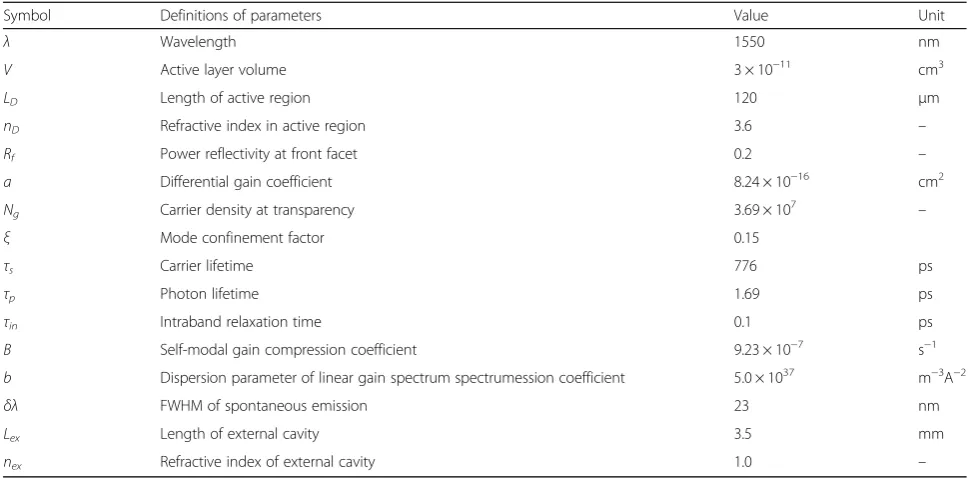
Δt= 0.5 ps. Fifteen modes (p=−7➔+ 7) are considered in the calculations. The parameters of a quaternary 1550-nm InGaAsP laser coupled with a very-short exter-nal cavity used in calculations are listed in Table 1. The injection current is set at 49 mA, which is five times the threshold current. The length of the external cavity is as short as 3.5 mm, which corresponds to round trip propa-gation delay time of τ= 16.67 ps in the feedback cavity. These parameters in the single-mode version are pre-dicted to support intensity modulation up to frequencies as high as 55 GHz [21]. The SMSR of the multimode oscillation is evaluated as the ratio of the average value of the power of the dominant mode to that of the stron-gest side mode. We decide the laser oscillation to be in the single mode operation when SMSR = 100 or 20 dB.
Results
First, we gain inside into the modal oscillations and the dominating multimode operation in the solitary laser. Figure1a plots a typical output multimode spectrum of the InGaAsP laser with the Fabry-Perot structure. The gain spectrum is plotted on right-side axis. In this case the side mode suppression ratio is as small as SMSR =
S+ 1/S+ 2= 1.4, which is much smaller than the
single-mode oscillation of SMSR = 100. As the figure indicates, the spectrum is asymmetric around the most dominant mode p= + 1 as a result of AGS in eq. (5). This metric output spectrum is manifestation of the asym-metric gain profile shown in the same figure, and was observed in experiment [28]. AGS works to induce in-stantaneous mode hopping in the transient region among some modes (p= 0, + 1 and + 2) on the longer-wavelength side of central mode whose total gain can exceed the linear gain of the central mode [26].
In order to clarify the influence of the AGS on the laser output, we plot in Fig.1b the corresponding output spectrum for the case of HGB. In this case, the coeffi-cients of cross-modal gain suppression become
Dp qð Þ¼B & Hp qð Þ¼0
That is the gain becomes
Gp ¼Ap−BX p
Sp¼Ap−BS
where S=∑pSp is the total photon number. Therefore,
the linear gain and the oscillating modes are homogeneously suppressed. Although the figure indicates improvement of the SMSR under HGB to 14.8, this value is still smaller than 100, and the laser oscillates in multimode. In this case, the central mode, p= 0, maintains the highest
intensity as it has the highest gain as shown in the sym-metric gain profile of Fig.1b.
The influence of optical feedback from the very close reflector on the modal oscillation of the investigated laser is depicted in Fig.2. The figure plots SMSR versus the external reflectivity ΓRex (measure of the coupled
light to the primary laser cavity) normalized by the power reflectivityRfat the front facet. It is worth noting
that the laser operates in CW over the relevant range of
ΓRex/Rf, which is a typical advantage of using the very
short external cavity in avoiding the noisiest state of
Fig. 1Output spectra of the laser and modal gainGpfor both cases of (a) ASG and (b) HGB, whenI= 49 mA
Fig. 2SMSR of the semiconductor laser as function of the external power reflectivity for both cases of asymmetric gain and HGB Table 1Typical values of InGaAsP multimode laser coupled with very-short external cavity used in the calculations
Symbol Definitions of parameters Value Unit
λ Wavelength 1550 nm
V Active layer volume 3 × 10⁻¹¹ cm3
LD Length of active region 120 μm
nD Refractive index in active region 3.6 –
Rf Power reflectivity at front facet 0.2 –
a Differential gain coefficient 8.24 × 10⁻¹⁶ cm2
Ng Carrier density at transparency 3.69 × 10⁷ –
ξ Mode confinement factor 0.15
τs Carrier lifetime 776 ps
τp Photon lifetime 1.69 ps
τin Intraband relaxation time 0.1 ps
B Self-modal gain compression coefficient 9.23 × 10⁻⁷ s−1
b Dispersion parameter of linear gain spectrum spectrumession coefficient 5.0 × 1037 m−3A−2
δλ FWHM of spontaneous emission 23 nm
Lex Length of external cavity 3.5 mm
chaos [20]. The figure shows that except for the narrow ranges ofΓRex/Rf< 0.002 and 0.032≤ΓRex/Rf≤0.037, and
the laser oscillates predominantly in single mode with SMSR > 100, which is another advantage of using the very short external cavity to achieve the single-mode oscillation. The figure plots also the SMSR values when considering HGB, showing almost similar behavior to that under asymmetric gain with the variation of the feedback strength. That is, the influence of optical feed-back on the modal oscillation in this case of very-short external cavity is independent of the spectral distribution of the optical gain. This result is confirmed by reporting that the predominantly oscillating mode jumps among the oscillating modes in the range of −2≤p≤+ 2 for both cases of asymmetric gain and HGB. This conclusion agrees with the reports by Ahmed and Yamada [28[and Ahmed [29] that the mode competition phenomenon in-duces motion of the lasing mode to the long- or short-wavelength in the case of short external cavity.
In Fig. 3a – c, we characterize the mode oscillations at the three specific points a, b and c, respectively of Fig. 2 (ΓRex/Rf= 0.035, 0.05, and 0.5) by plotting the
corresponding output spectra. In Fig. 3a, the laser output is mainly contained in the two modes p= 0 and + 1 with the SMSR being improved to SMSR =S+
1/S+ 2= 2.86. In Figs. 3b, the laser oscillates
predomin-antly in the long-wavelength side mode p= + 1, where SMSR jumps to the large value of SMSR = 788. That is, the influence of AGS is still active to enhance the gain of mode p= + 1 over the gain of the central mode p= 0. In Fig. 3c of ΓRex/Rf= 0.5, the laser still
maintains single mode oscillation but in the central mode p= 0 with large of value of SMSR = 612. This means that in this case, the feedback works against ASG and retrieves the gain mode p= 0 at the expense of the gain of mode p= + 1.
In the previous calculations, the external optical feed-back was assumed similar for all oscillating modes, which corresponds to a plane external mirror with flat power
reflectivity over the spectrum of the modal gain. From now on, we will consider narrow-band wavelength-selective optical feedback produced by an external Bragg grating with the following Lorentzian distribution [37].
Rex pð Þ¼Rpeak η
Δλ2 g Δλ2
gþ λpeak−λp
2
" #2
ð10Þ
whereRex(p)is the power reflectivity of mode pof
wave-length λp. Δλg is the grating bandwidth, λpeak and Rpeak
are the peaked wavelength and power reflectivity, re-spectively, and ηis the diffraction efficiency of the grat-ing. We use this form of the modal external reflectivity in eq. (9) of the time-delay feedback function Up(t-τ)
and detune the peak wavelength λpeak to fit with the
wavelength of one of oscillating modes. We fix the power reflectivityRpeakto correspond to one of the
feed-back levelsΓRex/Rfthat reveal single-mode oscillations as
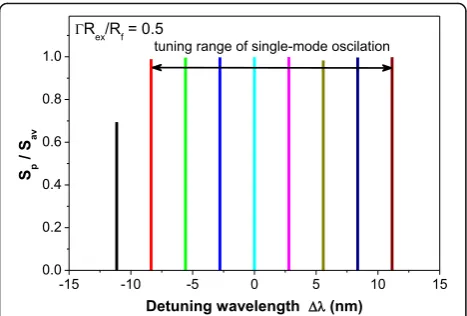
indicated in Fig.3. Figure4 depicts a bar plot of the in-tensity of the oscillating mode p as a function of the detuning wavelength (λp–λpeak) of the investigated laser
coupled with a cavity with selective feedback. The figure corresponds to ΓRex/Rf ~ 0.05 which corresponds to
os-cillation in modep= + 1, as shown in Fig.2b. The figure shows that not only oscillation in single mode is achieved but also selective wavelength of this oscillation is obtained. The wavelength-tuning range is as wide as 19.7 nm, which corresponds to span of the oscillating modes between p=−3 to p= + 4. This range could be more or less depending on the level of optical feedback in either regimes of intermediate or strong feedback.
Conclusions
We presented the improvement of modal oscillation of longitudinal multimode semiconductor laser into oscilla-tion in single mode by means of optical feedback from a very short external cavity. The study was based a time-delay rate equations of multimode semiconductor laser
including the symmetric and asymmetric suppressions of modal gain. The obtained results showed that the optical feedback releases AGS and increases the gain of one of the oscillating mode close to the central mode, which induces single mode oscillation. In addition, by using selective optical feedback and detuning the peaked wave-length of feedback relative to the central wavewave-length of gain, the predominant mode can be tuned over a wide wavelength range of more or less than 20 nm.
Acknowledgements
This work is funded by the Deanship of Scientific Research (DSR), King Abdulaziz University, Jeddah, under grant no. (RG-9-130-38). The authors, therefore, acknowledge with thanks DSR technical and financial support.
Authors’contributions
All authors contribute to the modeling, simulation, discussion and preparation of the manuscript. All authors read and approved the final manuscript.
Funding
This work is funded by the Deanship of Scientific Research (DSR), King Abdulaziz University, Jeddah, under grant no. (RG-9-130-38).
Availability of data and materials Please contact authors for data requests.
Competing interests
The authors declare that they have no competing interests.
Received: 17 June 2019 Accepted: 16 September 2019
References
1. Lenstra, D., Verbeek, B.H., den Boef, A.J.: Coherence collapse in single-mode semiconductor lasers due to optical feedback. IEEE J. Quantum Electron. QE-21, 674–679 (1985)
2. Schunk, N., Petermann, K.: Numerical analysis of the feedback regimes for a single-mode semiconductor laser with external feedback. IEEE J. Quantum Electron.24, 1242–1247 (1988)
3. Tromborg, B., Mork, J.: Stability analysis and the route to chaos for laser diodes with optical feedback. IEEE Photon. Technol. Lett.2, 549–552 (1990) 4. Mork, J., Tromborg, N., Mork, J.: Chaos in semiconductor lasers with
optical feedback: theory and experiment. IEEE J. Quantum Electron.28, 93–108 (1992)
5. Abdulrhmann, S., Ahmed, M., Okamoto, T., Ishimori, W., Yamada, M.: An improved analysis of semiconductor laser dynamics under strong optical feedback. IEEE J. of Sel. Top. Quantum Electron.9, 1265–1274 (2003) 6. Ahmed, M., Yamada, M.: Field fluctuations and spectral lineshape in
semiconductor lasers subjected to optical feedback. J. Appl. Phys.95, 7573– 7583 (2004)
7. Mork, J., Mark, J., Tromborg, B.: Route to chaos and competition between relaxation oscillations for a semiconductor laser with optical feedback. Phys. Rev. Lett.65, 1999–2002 (1990)
8. Mork, J.: Nonlinear Dynamics and Stochastic Behaviour of Semiconductor LasersPhD thesis, Rep. S48,Technical University of Denmark(1989) 9. Schunk, N., Petermann, K.: Stability analysis for laser diodes with short
external cavities. IEEE Photon. Technol. Lett.1, 49–51 (1989) 10. Helms, J., Petermann, K.: A simple analytic expression for the stable
operation range of laser diodes with optical feedback. IEEE J. Quant. Electron.26, 833–836 (1990)
11. Lang, R., Kobayashi, K.: External optical feedback effects on semicobductor laser properties. IEEE J. Quantum Electron.QE 16, 347–355 (1980) 12. Tager, A.A., Petermann, K.: High frequency oscillations and self-mode locking
in short external cavity laser diodes. IEEE J. Quant. Electron.30, 1553–1561 (1994)
13. Ryan, A.T., Agrawal, G.P., Gray, G.R., Gage, E.C.: Optical-feedback-induced chaos and its control in multimode semiconductor lasers. IEEE J. Quant. Electron.30, 668–678 (1994)
14. Petermann, K.: External optical feedback phenomena in semiconductor lasers. IEEE J. Quant. Electron.1, 480–489 (1995)
15. Tkach, E.W., Chraplyvy, A.R.: Regimes of feedback effects in 1.5-mm distributed feedback lasers. IEEE J. Lightwave Technol.LT-4, 1655–1961 (1986) 16. Lenstra, D.: Statistical theory of the multistable external-feedback laser. Opt.
Commun.81, 209–214 (1991)
17. Tromborg, B., Osmundsen, J.H., Olesen, H.: Stability analysis for a semiconductor laser in an external cavity. IEEE J. Quant. Electron.20, 1023–1032 (1984)
18. Kao, Y.H., Wang, N.M., Chen, H.M.: Mode description of routes to chaos in external-cavity coupled semiconductor lasers. IEEE J. Quantum Electron.30, 1732–1739 (1994)
19. Ahmed, M., Yamada, M., Abdulrhmann, S.: Numerical modeling of the route-to-chaos of semiconductor lasers under optical feedback and its dependence on the external-cavity length. Intl. J. Numer. Model.22, 434–445 (2009)
20. Jones, R.J., Spencer, P.S., Lawrence, J., Kane, D.M.: Influence of external cavity length on the coherence collapse regime in laser diodes subject to optical feedback. IEE Proc. Optoelectron.148, 7–12 (2001)
21. Ahmed, M., Bakry, A., Altuwirqi, R., Alghamdi, M., Koyama, F.: Enhancing modulation bandwidth of semiconductor lasers beyond 50 GHz by strong optical feedback for use in mm-wave radio over fiber links. Jpn. J. Appl. Phys. Rap. Comm.53, 124103 (2013)
22. Liu, P., Ogawa, K.: Statistical measurements as a way to study mode partition in injection lasers. J. Lightwave Technol.LT-2, 44–48 (1984) 23. Ogita, S., Lowery, A.J., Tucker, R.S.: Influence of asymmetric nonlinear gain
on the transient of longitudinal modes in long wavelength Fabry–Perot laser diodes. IEEE J. Quantum Electron.33, 198–210 (1997)
24. Ogasawara, N., Ito, R.: Longitudinal mode competition and asymmetric gain saturation in semiconductor injection lasers: I. experiment. Jpn. J. Appl. Phys. 27, 607–614 (1988)
25. Ogasawara, N., Ito, R.: Longitudinal mode competition and asymmetric gain saturation in semiconductor injection lasers: II. Theory. Jpn. J. Appl. Phys.27, 615–626 (1989)
26. Ahmed, M., Yamada, M.: Influence of instantaneous mode-competition on the dynamics of semiconductor lasers. IEEE J. Quantum Electron.38, 682–693 (2002)
27. Yamada, M., Ishimori, W., Sakaguchi, H., Ahmed, M.: Time dependent measurement of the mode competitl0n phenomena among longitudinal modes in long-wavelength lasers,′IEEE J. Quantum Electron.39, 1548–1554 (2003)
28. Ahmed, M., Yamada, M.: Inducing single-mode oscillation in Fabry-Perot InGaAsP lasers by applying external optical feedback. IET Optoelectron.4, 133–141 (2010)
29. Ahmed, M.: Longitudinal-mode competition in semiconductor lasers under external optical feedback: regime of short cavity. Opt. Laser Technol.41, 53–63 (2009)
30. Green, P.E.: Fibre Optic Networks. Prentice Hall, Englewood Cliffs, NJ (1993) 31. Wiemann, C., Hollberg, L.: Using diode lasers for atomic physics. Rev. Sci.
Instrum.62, 1–20 (1990)
32. Lohman, A., Syms, R.R.A.: External cavity laser with a vertically etched silicon blazed grating. IEEE Photonic. Techn. L.15, 120–122 (2003)
33. Rosenblatt, D., Sharon, A., Friesem, A.A.: Resonant grating waveguide structures. IEEE J. Quantum Elect.33, 2038–2205 (1997)
34. Block, S., Gamet, E., Pigeon, F.: Semiconductor laser with external resonant grating mirror. IEEE J. Quantum Elect.41, 1049–1053 (2005)
35. Yamada, M.: Theoretical analysis of nonlinear optical phenomena taking into account the beating vibration of the electron density in semiconductor lasers. J. Appl. Phys.66, 81–89 (1989)
36. Osinski, M., Buus, J.: Linewidth broadening factor in semiconductor lasers—an overview. IEEE J. Quantum Electron.QE-23, 9–29 (1987) 37. Hernandez, G.: Fabry–Perot Interferometers. Cambridge University Press,
Cambridge (1986)
Publisher’s Note