MURDOCH RESEARCH REPOSITORY
This is the author’s final version of the work, as accepted for publication following peer review but without the publisher’s layout or pagination.
The definitive version is available at
http://dx.doi.org/10.1016/j.rser.2007.12.001
Ally, J. and Pryor, T. (2009) Accelerating hydrogen
implementation by mass production of a hydrogen bus chassis.
Renewable and Sustainable Energy Reviews, 13 (3).
pp. 616-624.
Title:
Accelerating hydrogen implementation by mass production of a hydrogen bus chassis
Authors:
Jamie Allya and Trevor Pryorb
a
Corresponding author
Research Institute for Sustainable Energy Murdoch University
Perth, Western Australia
Australia Tel: +61 (0) 404 662 294
b
Research Institute for Sustainable Energy Murdoch University
Perth, Western Australia Australia
Tel: +61 (0) 8 9360 6286
Abstract
Much of the hydrogen vehicle research to date has been conducted and demonstrated in
wealthy nations, with very few exceptions. However, developing economies are largely
dependent on public transportation, and struggle with air pollution and energy security
concerns. The developing regions are in great need of alternative transportation
solutions, and although many alternatives are being explored, hydrogen-fueled vehicles
are emerging as one of the only technologies that can meet the demands for lower
greenhouse gas emissions, lower emissions of air pollutants, and reduced dependence on
imported energy. Most conventional buses in developing regions are built from an
imported ‘buggy-chassis’, which is a functional bus chassis with an engine and other
body and cabin, and install other auxiliary systems. The existing infrastructure of the bus
buggy-chassis market can be used to leverage hydrogen technology for mass production.
This solution allows developing nations to import a state-of-the-art vehicle, with the
possibility for significant local content in the final delivered product, while maintaining
the flexibility for innovative technological developments and promoting hydrogen
research within the developing economies. Indeed, a modular series-hybrid drivetrain
can be made adaptable to a range of primary power sources such as an internal
combustion engine or fuel cell engine. The modular approach provides an opportunity to
reduce cost while still providing flexibility for innovation, and allows customers to tailor
performance to suit their topographical and operational needs.
Keywords: Transportation, hydrogen, fuel cell, hydrogen combustion, alternative energy.
1 Introduction
The interest in hydrogen bus projects has increased substantially over recent years, with
significant investment from both the public and private sectors. A market survey by Fuel
Cell Today reported a reduction in the number of new buses on the road in 2006, but
anticipated increases in 2007 and 2008 due to several new initiatives announced during
2006 [1]. Several alternative fuel pathways are being explored through demonstration
and pilot-scale projects around the world, with hydrogen fueled transportation emerging
as one of the only alternatives that can address the three core concerns of reduced
greenhouse gas emissions, reduced emissions that contribute to air toxicity in cities, and
1.1 The growing global transport task
Population and economic growth have increased the transport task in many cities around
the globe. In the United States alone, the public transportation ridership has been
growing at more than double the US population increase since 1995 [2]. While many of
the wealthier nations of the world continue to grow at a steady pace, the growth in some
developing nations has been staggering. Historical trends have shown that economic
expansion has always been coupled with increasing transport energy demand, and more
than 62% of the increase in global primary energy demand between 2000 and 2030 is
expected to occur in developing nations [3]. It is these developing economies that can
best benefit from the broad implementation of efficient and innovative modes of mass
transportation before a broad dependence on energy-intensive private automobiles takes
hold. The majority of the population in developing nations is already quite efficient, with
a heavy reliance on public transportation or non-motorised transport such as walking and
cycling, as shown in Figure 1. However, if current trends continue the number of cars
worldwide is expected to double by 2030, with the most significant growth in the
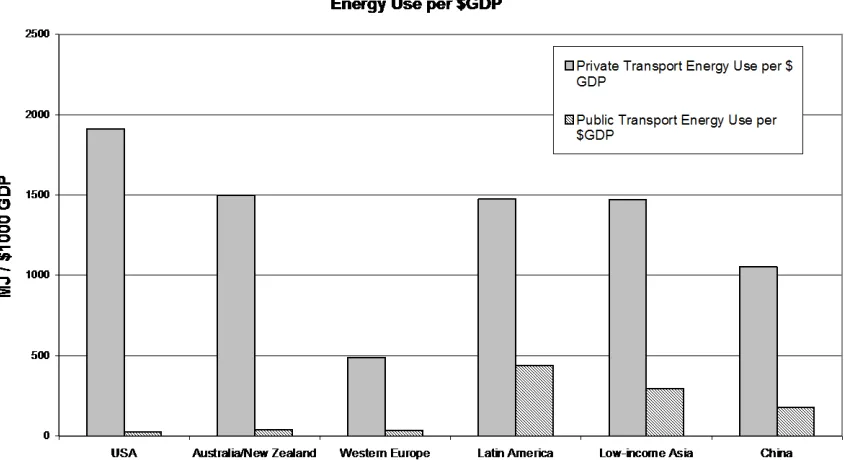
developing regions [4]. Many of these regions already exhibit a very high use of energy
for private transportation relative to their Gross Domestic Product (GDP), with
low-income Asian and Chinese cities surpassing Western European cities in car passenger
kilometres per $1000GDP, as illustrated in Figure 2 [5]. This apparent contradiction can
be attributed to the wealthy minority using personal vehicles while the majority of the
population commutes by more efficient means. If business continues ‘as usual’ the
International Energy Agency (IEA) predicts China and India will need to import 90% of
their oil requirements in 2030 [3], and the United States Energy Information Association
fossil-fuel based automobile dependence that has been established in OECD nations then
the long-term prospects for future environmental and energy security concerns are dire.
1.2 The importance of energy efficiency in transport
One way to reduce the energy required for transport is to optimise efficiency, thereby
reducing the fuel consumed per passenger-kilometre and reducing all emissions
proportionally. The Life Cycle Assessment (LCA) of bus transportation has shown that
fuel economy is a key parameter governing the emissions profile and primary energy
demand over the entire lifecycle of the vehicle [7]. Figure 3 shows the relative efficiency
for various modes of transportation, based on data collected from the Public Transport
Authority in Perth, Australia [8], the Sustainable Transport Energy Programme (STEP)
fuel cell (FC) EcoBus trial [9], and industry expectations for a next-generation FC vehicle
[10-14]. Rail is the most efficient mode of transportation, and a system using electrified
rails creates no tailpipe emissions [15]. If a rail system could be supported by renewable
power generation then the rails would effectively be a zero emission solution. However
the construction of new rail lines requires time and land, cutting rail corridors through the
most popular parts of a city and displacing residents and businesses at significant cost.
1.3 The role of hydrogen
An effective transportation network is a necessity in any modern, vibrant society, and can
be shaped through careful strategic planning. Singapore is an example of a nation that
has successfully limited the number of automobiles while simultaneously improving
public access to efficient transportation, by providing a reliable network of buses, taxis,
The global transportation sector is faced with the dual objectives of reducing transport
energy consumption per capita in the industrialized regions without reducing living
standards, while implementing innovative technology in developing regions that will
allow living standards to increase without a dependence on oil-fueled transport [17]. The
early transition to a domestic source of transport fuel can avert future geo-political
struggles over depleting fossil resources. The IEA has reported that substantial
implementation of alternative transport fuels may be required by 2030, and that hydrogen
is one of the only alternatives that can enhance energy security while still providing
significant CO2 reductions [18].
1.4 The application of hydrogen buses to the global passenger
transport challenge
With personal vehicles becoming an expensive and inefficient option, and long lead times
required to build new rail networks, buses emerge as the only mode of transportation that
meets the immediate need for improved transport efficiency. Further, when accounting
for health effects and damages due to air pollution, a zero-emission hydrogen bus
achieves significant reductions in societal lifecycle costs [19], as well as a reduction in
lifecycle greenhouse gas emissions [20]. The United Nations Environment Programme
(UNEP) Global Environment Facility (GEF) administers a project intended to fund
demonstration FC bus projects in Sao Paolo, Mexico City, Beijing, Shanghai, Cairo, and
New Delhi [21]. These are some of the largest public transportation markets in the world
where buses provide a large share of the public transport task. The GEF provides a good
framework for international collaboration on such an important project, however the
similar trials in North America and Europe. The Brazilian and Chinese GEF programs
are underway, while the Egyptian, Mexican and Indian programs have been cancelled.
All three cancelled programs cited a combination of unanticipated technological,
economic, and bureaucratic issues, complicating the implementation of fuel cell bus
technology [22]. During the same general time period very successful trials of hydrogen
buses have been completed in Europe, North America, and Australia [23-27]. A unique
opportunity now exists to take the learning from successful demonstrations of hydrogen
buses in wealthy nations and leverage that knowledge to push through some of the
challenges preventing hydrogen bus implementation in developing regions [28]. Such a
strategy can have a positive-feedback effect on the growth of hydrogen bus fleets around
the globe by increasing production volumes, thus capturing the benefits of economies of
scale, which in turn provokes further research and cost reduction. Innovation and cost
reduction allows further expansion of hydrogen bus fleets in wealthy nations and
developing countries alike. For the next few years, hydrogen bus projects will likely be
relatively small in numbers, and scattered around the globe. The benefits of mass
production can be accelerated by the establishment of a global standard for hydrogen bus
manufacturing and a modular design allowing the flexibility to incorporate new
innovations within the framework of the standardised bus chassis.
1.5 Hydrogen bus design and the opportunity for market
expansion
The market for hydrogen buses is relatively small, which requires bus manufacturers to
control prototyping costs by minimising the extent of modifications to the bus chassis and
hybrid-specific components within the architecture of a conventional complete bus. On
the Gillig fuel cell bus operated by the Santa Clara Valley Transport Authority [29] the
fuel cell modules are located in the cavity that would normally be occupied by the diesel
fuel tank, while on the Mercedes Benz Fuel Cell Citaro operated by the HyFLEET:CUTE
program [24] the fuel cell modules and other auxiliary systems are placed on the roof
increasing the overall height dimension of the vehicle. On the Van Hool fuel cell buses
operated by AC Transit [30] the fuel cell module is located in the rear engine bay where
the diesel engine would normally be placed. Systems integration company ISE
Corporation [31] has developed several hybrid buses by integrating the drivetrain,
hydrogen storage systems, and hybrid modules within a wide range of existing vehicle
platforms.
In all cases the vehicle is delivered complete to the customer with the hydrogen engine
fully integrated. As will be explained in the sections that follow, this arrangement differs
from the contractual framework of bus procurements in a large segment of the
international diesel bus market – many nations import the chassis and engine, and
contract local companies to add value to the bus by building the body and auxiliaries
upon the imported components. By delivering complete hydrogen buses, suppliers have
effectively precluded these nations from adding value in the hydrogen bus supply chain.
Hydrogen bus components have now reached a level of maturity which would allow
conformance to the existing bus procurement procedures in this market segment, thus
encouraging the uptake of hydrogen buses in these regions and substantially increasing
2 The Bus Chassis Market
In the cities of developing nations, mass transport is the only available means for the
majority of the population (besides non-motorized modes), with the main transportation
mode being public and private buses [32].
Many of the buses currently used in developing economies, as well as in wealthy nations
such as Australia, share a common method of bus construction – a buggy-chassis is
imported, complete with engine, suspension, steering, brakes, and other bus system
auxiliaries. The buggy-chassis is essentially a fully functional driving bus chassis. Local
companies cut the chassis and extend it to full bus length, build up the body and interior
upon the extended chassis, and install body and roof-mounted systems such as heating,
ventilation and air conditioning systems, or compressed natural gas (CNG) cylinders [8,
33].
The buggy-chassis’ are manufactured in different locations around the world, and
conform to standard dimensions and interfaces. Body manufacturers can easily adapt
their designs to suit a buggy-chassis from any of the major manufacturers. A large
fraction of the global market for new buses is based on the buggy-chassis manufacturing
concept, as this strategy provides access to modern drivetrain design from European and
North American companies, with local industry adding value to the final product in the
The market for buggy-chassis’ is strong, and is steadily growing. DaimlerChrysler, one
of the world’s largest manufacturers of buggy-chassis’ and complete buses, sold the same
number of buses in 2006 as were recorded in 2005. However, they reported an increase
in chassis sales to 24,300 units in 2006, from 24,000 units in 2005, and declining sales of
complete buses, from 12,200 in 2005 to 11,900 in 2006 [34].
3 Current Status of Hydrogen Bus Technology
One of the largest, most public, and most successful demonstrations of FC bus
technology was the Clean Urban Transport for Europe (CUTE) and its partner projects,
the Ecological City Transport System (ECTOS) in Iceland, and STEP in Australia. These
programs put 33 buses on the road in 11 different cities for two years. Many of the buses
have continued operation beyond the two-year mark under extension through the
HyFLEET:CUTE program, which also trials Hydrogen Internal Combustion Engines
(H2ICE) in addition to the FC buses that were originally procured as part of the CUTE,
ECTOS and STEP trials [24]. In the United States, recent hydrogen bus trials in
California have also put the technologies to work in regular public service with results
reported by the National Renewable Energy Laboratory (NREL) [26, 27].
Future generations of hydrogen buses will use hybrid architecture to improve energy
efficiency and capture the benefits of regenerative braking. A hybrid powertrain also
improves the lifetime of the primary power source on board the vehicle by allowing a FC
or H2ICE to spend more time running in the best efficiency regions of the operating
parameters in evaluating different hybrid concepts [35], with a parallel-hybrid placing
more of the load directly on the primary source while a series-hybrid buffers the primary
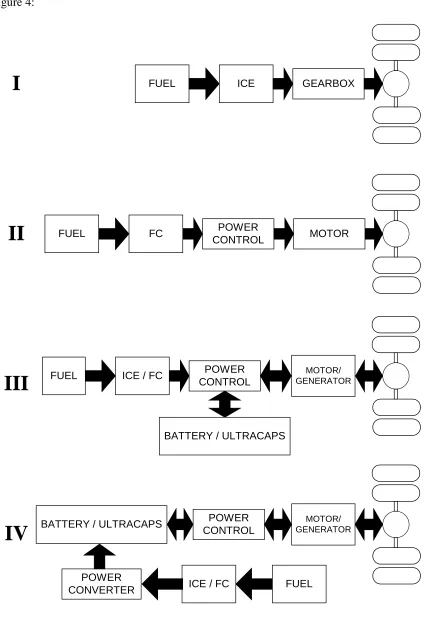
source from transient power demands. The schematics in Figure 4 illustrate some
simplified conventional and hybrid powertrain configurations. Shifting the operating
profile away from the drastic power variations required to meet a typical automotive
drive cycle, and towards a steady-state profile, is highly desirable. A conventional
automotive drivetrain experiences frequent transients, with pressure and power
fluctuations due to the rapidly changing load. The dynamics of transient operation have a
detrimental effect on the lifetime of any machinery, particularly fuel cells, due to the
more vigorous load cycling. In the case of a series-hybrid drivetrain the battery pack, or
ultracapacitors, absorb the transient demands of the drive cycle, while the expensive FC
or H2ICE power source runs mainly at steady-state.
3.1 FC vs H
2ICE
The decision to invest in FC or H2ICE as the primary power source on board a bus is
subject to ongoing debate and will be heavily influenced by future technological
developments. There are a few fundamental facts that can be used now to guide future
research.
The emissions from an H2ICE are only water and Oxides of Nitrogen (NOx); a vast
improvement over conventional diesel and CNG technologies. A reduction to very low
emissions and power output. Another option is exhaust gas after-treatment such as
Exhaust Gas Recirculation (EGR) or use of a three-way catalyst (TWC) [36].
The thermal efficiency of an H2ICE is approximately 25%, while a FC of equivalent
power achieves 50% efficiency [4]. As discussed in Section 1, the efficiency of the
vehicle is of paramount importance as fuel consumption dominates the lifecycle
emissions profile [37].
According to bus operators, CNG buses are not as powerful and do not perform as well as
a diesel bus of equivalent power rating [38]. This loss in power density will be
exacerbated for an H2ICE due to the low volumetric energy density of hydrogen and the
corresponding displacement of air in the intake mixture. For purposes of comparison, a
stoichiometric mixture of hydrogen and air consists of 30% hydrogen by volume, while a
stoichiometric mixture of fully-vaporised gasoline and air consists of approximately 2%
gasoline by volume [36].
One of the key arguments supporting H2ICE over FC technology is the economical
advantage. The use of conventional engine technologies reduces the development cost
and design iterations required to produce an H2ICE powerplant. In essence, internal
combustion engines are a well-understood technology and do not require any special
materials, whereas FC stacks and support systems are very much in their infancy and
require special materials such as platinum group metals. In addition, FC engines require
is a possibility that H2ICE may be able to run hydrogen of reduced purity therefore
stripping cost out of the fuel production process. However, many sites that are testing
H2ICE have been using hydrogen of 99.999% purity anyway. The National Renewable
Energy Laboratory (NREL) recently reported on a trial of FC and H2ICE buses at
SunLine Transit Agency in California, and found that the energy efficiency of the FC bus
was 71% higher than that of the H2ICE bus [26]. The bus purchase costs at SunLine
were $3.1 million USD for the FC bus, and $1 to $2 million USD for the H2ICE bus,
while a conventional CNG bus costs $375,000 USD. The cost to acquire H2ICE
technology is significantly lower than FC technology, yet still much higher than
conventional technology. When taking the purchase cost of the vehicle and the cost of
hydrogen fuel into account, neither FC nor H2ICE will be cost-competitive with
conventional diesel or CNG technologies in the near-term, thus it may be premature to
base investment decisions between FC and H2ICE solely on the economic merits.
3.2 Technical improvements in FC buses
The current FC buses on the road in Perth as part of the STEP trial have achieved an
energy efficiency slightly worse than the diesels, and better than the CNG buses [9].
These buses are designed to demonstrate reliability rather than efficiency, and as such a
number of design tradeoffs have been made to improve reliability and reduce cost at the
expense of energy efficiency. For example, the STEP FC bus is not a hybrid, uses a
standard ZF transmission, and consumes hydrogen when the bus is idle to keep the bus
auxiliary systems running and to keep a minimum load on the fuel cells [39]. The CUTE
electric drivetrain and fuel cell system [23]. As noted in Section 1.2, it is widely
accepted that the technology now exists to build reliable FC vehicles with energy
efficiency more than 2 times greater than conventional vehicles. SunLine in California
have already demonstrated an FC bus energy efficiency 2.5 times higher than their CNG
bus fleet [26].
4 Barriers against mass production of hydrogen buses
Previous hydrogen demonstration projects have overcome a number of significant
barriers, and their contribution to a future hydrogen economy cannot be overstated.
However, many challenges remain in the technical, economic, and public perception
domains, in addition to the necessity of an adequate hydrogen fuel infrastructure. The
bus industry is an excellent platform to push through many of the barriers currently
preventing large-scale introduction of hydrogen as a transport fuel. Buses are relatively
flexible in construction and can accommodate diverse powertrain components, they have
central refueling and maintenance facilities, are operated by limited numbers of drivers,
have high daily utilisation, and bring high public visibility.
4.1 Economic barriers
The main barrier preventing mass production is cost, which will remain an uncertainty
until an initiative is taken to break into large volume production. The cost of a FC bus is
currently estimated to be between $2 to $3 million US dollars [26]. The US Department
of Energy (DOE) provides regular reports on the state of the technology and the progress
The high cost of FC drivetrains can be attributed to a number of components, but
particularly the FC stack itself. Ballard Power Systems, the world leading fuel cell
manufacturer, has reported that they are on track to meet the DOE ‘cost per kilowatt’ fuel
cell target for 2010, which is based on a production volume of 500,000 units per year
[41]. The International Organization of Motor Vehicle Manufacturers (OICA) reported
337,573 buses and coaches produced globally in 2005. The entire global bus market is
not large enough to achieve the DOE definition of mass production, however the DOE
targets are based on sales of 80 kW automotive fuel cells mainly for car applications. As
a point of reference, the buses of the STEP project use 300kW fuel cells. One possible
scenario is for FC buses to lead FC cars in production volume for several years into the
future, thus bringing incremental reduction in cost from economies of scale, along with
new innovations in design and an expansion of the crucially important hydrogen
infrastructure.
A necessary step towards mass production is an upfront investment in nonrecurring costs
to develop a system suitable for larger volumes. Hydrogen cars have not yet been able to
make this transition, however the demand for hydrogen buses has increased significantly,
as noted in Section 1. A hydrogen bus buggy-chassis is one uniform product that can
4.2 Reduction in curb weight
Hydrogen buses have historically been much heavier than their diesel and CNG
counterparts. The curb weight of the STEP EcoBuses is 30% greater than the
conventional diesel buses on the road in Perth, and 21% greater than the CNG buses [37].
The FC and H2ICE buses demonstrated at SunLine Transit Agency weighed 21% and 8%
more than a conventional CNG bus, respectively [26]. There are many opportunities for
weight reduction through optimisation of materials and component design, as well as
improvements in overall engine layout. The overall weight of any vehicle must be
minimised to achieve optimum fuel economy, and the curb weight of a heavy-duty
vehicle such as a bus has implications on the maximum load that can be safely carried
due to maximum axle ratings.
Weight reduction is another area where designs should be optimised before beginning
mass production, however progress toward optimisation will be very limited until a
large-volume market is identified to underwrite the engineering costs. Again, an initial
investment in nonrecurring costs must be undertaken before the benefits of large volume
production can begin to unfold.
4.3 Dissemination of knowledge and understanding
Hydrogen bus projects cannot be successfully implemented without public support for the
use of hydrogen as a transport fuel, and a sense of safety regarding hydrogen vehicles.
Bus companies, drivers, and maintenance personnel, must also be comfortable and
supportive of new initiatives in hydrogen-based transport. Previous and currently
in many cities. Surveys conducted during the STEP trial in Perth recorded a significant
increase in support for large-scale hydrogen bus implementation after the hydrogen buses
had arrived, and positive associations with the word ‘hydrogen’ [42]. Locations that have
not hosted hydrogen vehicles before will require similar efforts to educate and measure
public comfort levels with the use of hydrogen, to accumulate local expertise in hydrogen
vehicle operation and hydrogen handling, and to educate the general public and key
decision-makers in the benefits of hydrogen as a transport fuel.
5 Leveraging the infrastructure of the Chassis Export
Market
The bus buggy-chassis industry is well suited to provide a method of overcoming the
barriers preventing mass production of hydrogen buses. A truly global market that sells
to the developing nations, with established channels for product imports and
dissemination of knowledge and training, provide the necessary infrastructure to rapidly
rollout mass-produced hydrogen buses.
5.1 Chassis layout
A series-hybrid drivetrain can be adapted to a bus buggy-chassis without making
significant modifications to the existing structural design. Electrical and pneumatic
interfaces to systems installed by the body manufacturer can be left as standard, with a
new module dedicated to the auxiliaries such as air compression, power steering, heating,
and air conditioning. A functioning hybrid bus chassis can be supplied to the
Components such as the electric motors, battery packs, ultracapacitors, FC modules, or
H2ICE powerplants, can be installed in the buggy-chassis along with auxiliary systems,
resulting in a fully functional driving chassis, similar to today’s conventional diesel and
CNG buggy-chassis’. The body manufacturer can install hydrogen storage cylinders,
and possibly additional radiators, on the roof. The pre-determined chassis dimensions
and standard body interfaces provide the constraints for the sizing of a modular system.
Based on the topography of an individual city, the electrical power storage and primary
power source can be sized to suit the terrain. A city with mountainous terrain may
require a large primary power source with a small battery module to maintain high power
during hill-climbing and high average speed operation. Alternatively, a city with low
average speed and frequent start/stop operation, and long periods of idle, could achieve
better energy efficiency with a small primary power source and a large battery or
ultra-capacitor bank.
5.2 Aluminium body manufacturing
An added benefit of the chassis-export market is that the bodies are often manufactured
from aluminium extrusions. An aluminium body effects a reduction in the overall vehicle
mass in comparison to a steel frame, with associated benefits in energy efficiency. The
flexibility of the bolted aluminium construction is an additional advantage, as it can be
modified to accommodate design changes due to technological innovations. In
comparison, a steel space-frame constrains the drivetrain design to pre-determined
cavities for the engine and other equipment. The lower yield strength of aluminium in
the roof. Hydrogen bus designers can reference the precedent set by the CNG bus
industry, where the bolted aluminium body has sufficient strength to bear the load of
roof-mounted CNG fuel storage cylinders [43].
5.3 Expanding the world of hydrogen research
Many cities around the world have proven that operators and maintainers can be trained
to work with alternative fuels such as natural gas and propane in a short timeframe, and
hydrogen should be no different in its implementation. The uptake of hydrogen
technology can be accelerated through widespread training and dissemination of
information to engineers and mechanics in transition economies. Such a move would
reduce the concentration of intellectual property in the wealthy nations and mobilize the
efforts of capable scientists and engineers in the developing regions, spreading the overall
knowledge and helping to resolve technological barriers with innovative new solutions.
Indeed, the accumulation of knowledge and understanding in regions that have not been
exposed to hydrogen technology can have a positive feedback effect that resonates
throughout a society. Hydrogen infrastructures will be established, renewable energy
sources will be explored, and the general population will become more aware of the
importance of energy efficiency. The large-scale implementation of FC buses comes at a
high price and may only have a marginal effect on a society’s energy and emissions
profile, but as has been noted in the field of Consequential Life Cycle Assessment, it
must be realised that marginal changes to a subsystem can contribute to radical system
change [44].
6 Conclusions and Future Research
The design of a hydrogen-fueled buggy-chassis brings the industry much closer to the
critical cost reductions required for large-scale implementation of efficient, zero-emission
transport, with the particular anticipation of providing hydrogen buses to developing
cities that rely heavily on bus transportation.
In the broader sense, a hydrogen bus network can lead to wider implementation of
hydrogen technology, the dissemination of knowledge and expertise around the world,
and a better opportunity for global research and development into innovative new
solutions.
A modular approach to the buggy-chassis with a series-hybrid drivetrain provides the
flexibility to explore many power sources, energy storage options, and control
algorithms, while reducing cost through mass production of the common components
required to power the auxiliaries on board every bus. This requires the exploration of
many technology options that are currently being researched around the world, including:
• A modular series-hybrid architecture;
• Sizing of modular primary power sources and energy storage modules to suit
topography and operation profile;
• Interchangeable fuel cell or ICE, with supporting auxiliary packages;
• Interchangeable battery bank, ultra-capacitors, or other energy storage medium;
• Standard interfaces between the modules;
• Standard engine controller minimizing the cost of software development while
providing the flexibility to attempt new control algorithms;
• Standard auxiliaries package, with flexibility to size the system for global
climates, ie. powerful air conditioning capability in hot climates or powerful
heating capability in cold climates;
• Standard suite of training modules and workshop requirements.
Acknowledgements
The authors would like to acknowledge the support of the Government of Western
Australia, Department for Planning and Infrastructure, and the Public Transport
Authority, as well as the valuable contributions of Brendan Davis, Colin Cockroft, Glen
Head, and Brian Jennings.
References
1. Crawley, G. and K.-A. Adamson, Fuel Cell Today Market Survey: Buses. 2006, Fuel Cell Today.
2. Miller, V. and M. Williams, Americans Take More than 10 billion trips on public transportation for the first time in almost fifty years, in American Public
Transportation Association. 2007: Washington, D.C.
3. International Energy Agency, 30 key energy trends in the IEA & worldwide. 2005. 4. Van Mierlo, J., G. Maggetto, and P. Lataire, Which energy source for road
transport in the future? A comparison of battery, hybrid and fuel cell vehicles. Energy Conversion and Management, 2006. 47: p. 2748-2760.
5. Kenworthy, J.R. Transport Energy Use and Greenhouse Gases in Urban Passenger Transport Systems: A Study of 84 Global Cities. in International Sustainability Conference. 2003. Perth, Western Australia.
6. Energy Information Association (EIA), International Energy Outlook 2006. 2006, US Department of Energy: Washington, DC.
8. Woolerson, T., Bus Fleet Manager, Public Transport Authority. 2007: Perth. 9. Cockroft, C., First Year Operating Summary 2004/2005. 2005, Research Institute
for Sustainable Energy, Murdoch University: Perth, Western Australia. 10. Ahluwalia, R., et al., Fuel economy of hydrogen fuel cell vehicles. Journal of
Power Sources, 2004. 130: p. 192-201.
11. Colella, W.G., M.Z. Jacobson, and D.M. Golden, Switching to a U.S. hydrogen fuel cell vehicle fleet: The resultant change in emissions, energy use, and greenhouse gases. Journal of Power Sources, 2005. 150: p. 150-181.
12. General Motors, et al., GM Well-to-Wheel Energy Use and Greenhouse Gas Emissions of Advanced Fuel/Vehicle Systems - North American Analysis. 2001, General Motors: Argonne, USA.
13. General Motors, et al., GM Well-to-Wheel Analysis of Energy Use and
Greenhouse Gas Emissions of Advanced Fuel/Vehicle Systems. 2002, General Motors: Ottobrun, Germany.
14. Schäfer, A., J.B. Heywood, and M.A. Weiss, Future fuel cell and internal
combustion engine automobile technologies: A 25 year life cycle and fleet impact assessment. Energy, 2006. 31: p. 2064-2087.
15. Poudenx, P. and W. Merida, Energy demand and greenhouse gas emissions from urban passenger transportation versus availability of renewable energy: The example of the Canadian Lower Fraser Valley. Energy, 2007. 32: p. 1-9. 16. Library of Congress, A Country Study: Singapore, Federal Research Division,
United States Library of Congress.
17. Hennicke, P. and M. Fischedick, Towards sustainable energy systems: The related role of hydrogen. Energy Policy, 2006. 34: p. 1260-1270.
18. Gielen, D. and F. Unander, Alternative Fuels: An Energy Technology
Perspective. 2005, Office of Energy Technology and R&D, International Energy Agency: Paris.
19. Ogden, J.M., R.H. Williams, and E.D. Larson, Societal lifecycle costs of cars with alternative fuels/engines. Energy Policy, 2004. 32: p. 7-27.
20. Mason, J.E., World energy analysis: H2 now or later? Energy Policy, 2007. 35: p. 1315-1329.
21. Global Environment Facility, Fuel Cell Bus and Distributed Power Generation Market Prospects and Invervention Strategy Options. 2000, United Nations Environment Program.
22. United Nations Development Programme, UNDP-GEF Fuel-Cell Bus Programme: Update. 2006, Global Environment Facility (GEF).
23. EvoBus GmBH, Detailed Summary of Achievements. 2006, Clean Urban Transport for Europe (CUTE).
24. HyFLEET:CUTE. 2007 [cited; Available from: www.global-hydrogen-bus-platform.com.
25. Sustainable Transport Energy Programme. 2007 [cited; Available from:
www.dpi.wa.gov.au/ecobus.
27. Chandler, K. and L. Eudy, Santa Clara Valley Transportation Authority and San Mateo County Transit District—Fuel Cell Transit Buses: Evaluation Results. 2006, National Renewable Energy Laboratory: Battelle.
28. Chen, F., et al., Investigation of challenges to the utilization of fuel cell buses in the EU vs transition economies. Renewable & Sustainable Energy Reviews, 2007.
11: p. 357-364.
29. VTA Zero Emission Bus Demonstration Program. 2007 [cited; Available from:
http://www.vta.org/projects/ZEBs.html.
30. AC Transit HyRoad Program. 2007 [cited; Available from:
http://www.actransit.org/environment/hyroad_main.wu.
31. ISE Corporation. 2007 [cited; Available from: http://www.isecorp.com. 32. Figueroa, M.J., O.R. Davidson, and G.A. Mackenzie, Matching Transport and
Environment Agenda in Developing Countries. 2007, UNEP Collaborating Centre on Energy and Environment, Riso National Laboratory: Denmark.
33. Wilson, J.C., Senior Manager, DaimlerChrysler Australia/Pacific Pty Ltd. 2007: Melbourne.
34. DaimlerChrysler Australia/Pacific Pty Ltd. DaimlerChrysler's 2006 bus sales reach prior year's high level. 2007 [cited; Available from:
www.daimlerchrysler.com.au/dc_australia/.
35. Wang, J., Y. Chen, and Q. Chen, A fuel cell city bus with three drivetrain configurations. Journal of Power Sources, 2006. 159(2): p. 1205-1213. 36. White, C.M., R.R. Steeper, and A.E. Lutz, The hydrogen-fueled internal
combustion engine: a technical review. International Journal of Hydrogen Energy, 2006. 31: p. 1292-1305.
37. Ally, J. and T. Pryor. Life Cycle Assessment of the Diesel, Natural Gas, and Hydrogen Bus Transportation Systems in Western Australia. in Alternative Transport Energies Conference. 2006. Perth.
38. Operations Staff, Path Transit Morley Depot. 2006: Perth.
39. Haraldsson, K., A. Folkesson, and P. Alvfors, Fuel cell buses in the Stockholm CUTE project - First experiences from a climate perspective. Journal of Power Sources, 2005. 145: p. 620-631.
40. DOE Hydrogen Program, 2006 Annual Progress Report. 2006, U.S. Department of Energy.
41. Ballard Power Systems Inc. Ballard Fact Sheet. 2006 [cited; Available from:
http://www.ballard.com/resources.
42. Garrity, L. Complexities Influencing the Introduction of Sustainable Transport Technologies. in Alternative Transport Energies Conference. 2006. Perth, Australia.
43. Grenda, G., Executive Chairman, Grenda Corporation. 2006.
Figure Captions
Figure 1: Comparison of transportation modes in various regions, generated from data
published in [5].
Figure 2: Comparison of transport energy use per $GDP for selected wealthy and
developing regions, generated from data published in [5].
Figure 3: Energy efficiency of different modes of passenger transportation in Perth,
Australia, and comparison with current and future hydrogen fuel cell bus technology.
Figure 4: Simplified schematic of powertrain configurations: I) Conventional
direct-drive powertrain powered by a diesel, CNG or H2 internal combustion engine (ICE); II)
Direct-drive fuel cell (FC) powertrain with an electric motor driving the wheels; III)
Parallel-hybrid configuration powered by electricity from either an FC or an ICE coupled
to a generator. A battery pack or ultracapacitor bank provides energy storage and assists
the primary power source; IV) Series-hybrid configuration powered by electricity from
either an FC or an ICE coupled to a generator. The primary power source charges a
Figures
Figure 3:
Transport Energy Efficiency
0.000 0.500 1.000 1.500 2.000 2.500 3.000 3.500
Automobile Diesel Bus CNG Bus Motorcycle Train EcoBus Future H2 Bus
Transport Mode
M
J/
p
Figure 4:
ICE GEARBOX
FUEL
FC POWER
CONTROL
FUEL MOTOR
I
II
ICE / FC POWER CONTROL
FUEL BATTERY / ULTRACAPS
POWER CONVERTER
IV
MOTOR/ GENERATOR
ICE / FC POWER
CONTROL
FUEL GENERATORMOTOR/
BATTERY / ULTRACAPS