A first-principles density functional study of chlorophenol adsorption
on Cu
2O
„
110
…
: CuO
Mohammednoor Altarawneh,1Marian W. Radny,2,a兲Phillip V. Smith,2John C. Mackie,1 Eric M. Kennedy,1Bogdan Z. Dlugogorski,1Aloysius Soon,3and Catherine Stampfl3 1
School of Engineering, Process Safety and Environment Protection Group, The University of Newcastle, Callaghan, New South Wales 2308, Australia
2
School of Mathematical and Physical Sciences, The University of Newcastle, Callaghan, New South Wales 2308, Australia
3School of Physics, The University of Sydney, Sydney, New South Wales 2006, Australia
共Received 5 December 2008; accepted 24 February 2009; published online 12 May 2009兲
First-principles density functional theory and a periodic-slab model have been employed to explore
the adsorption of a two-chlorophenol molecule on a Cu2O共110兲 surface containing surface Cu–O
bonds, namely, the Cu2O共110兲: CuO surface. The two-chlorophenol molecule is found to interact
very weakly with the Cu2O共110兲: CuO surface, forming several vertical and flat orientations. These
weakly bound states tend to result from interaction between the phenolic hydrogen and an oxygen surface atom. The formation of a two-chlorophenoxy moiety and an isolated hydrogen on the
Cu2O共110兲: CuO surface from a vacuum two-chlorophenol molecule is determined to have an
endothermicity of 8.2 kcal/mol共0.37 eV兲. The energy required to form a two-chlorophenoxy radical in the gas phase is also found to be much smaller when assisted by the Cu2O共110兲: CuO surface than
direct breaking of the hydroxyl bond of a free two-chlorophenol molecule. The calculated binding
energy of a two-chlorophenoxy radical adsorbed directly onto the Cu2O共110兲: CuO surface is
⫺12.5 kcal/mol 共0.54 eV兲. The Cu2O共110兲: CuO and Cu共100兲surfaces are found to have similar
energy barriers for forming a surface-bound two-chlorophenoxy moiety from the adsorption of a
two-chlorophenol molecule. ©2009 American Institute of Physics.关DOI:10.1063/1.3123534兴
I. INTRODUCTION
Polychlorinated dibenzo-p-dioxins and dibenzofurans
共PCDD/Fs兲 are a class of organic pollutants formed invari-ably as unwanted products in all thermal systems where chlorine is present.1,2 PCDD/Fs are formed through a series of complex reactions in the gas phase, as well as through catalyzed reactions. It is believed that 70% of the yield of PCDD/Fs arises from reactions assisted by metal species. One of the major experimentally predicted routes for their formation involves catalytically assisted coupling of precur-sors, especially chlorinated phenols, in the temperature re-gion of 200– 400 ° C.3It is known that in the actual combus-tion environment, copper-based compounds are always present in the fuel feed and hence subsequently in the formed ash. It is also well documented in the literature that copper species, in particular copper oxides, are the most efficient surfaces in catalyzing the formation of PCDD/F compounds from chlorinated phenols.3–5However, the exact mechanism and the intermediate steps, especially the nature of the inter-actions of chlorophenols with copper oxide surfaces, are not well understood.
The formation of a 2-chlorophenoxy moiety following the breaking of the hydroxyl group in a 2-chlorophenol mol-ecule on the CuO surface, constitutes a central step in a
detailed kinetic model that describes the formation of
PCDD/Fs from the adsorption of 2-chlorophenol on CuO.4,5
This assumption is supported by the detection of an oxygen-centered 2-chlorophenoxy moiety on the CuO surface upon adsorption of 2-chlorophenol using an electron paramagnetic resonance technique.6,7The adsorbed 2-chlorophenoxy
moi-ety is then transformed into a chlorophenolate 共the anion
form of 2-chlorophenoxy兲 via an electron transfer from the
copper oxide surface.6,7 The chemisorption of a
2-chlorophenol molecule on the CuO surface was shown to be accompanied by CuO reduction into Cu and mainly Cu2O.6
Two mechanisms have been proposed for the formation
of PCDD/Fs.6,7 The Langmuir–Hinshelwood mechanism,
which involves coupling of two adsorbed chlorophenolate moieties forming PCDFs, and the Eley–Rideal mechanism where the adsorbed chlorophenolate reacts with a gaseous chlorophenol molecule to produce PCDDs. Central to obtain-ing a better understandobtain-ing of these mechanisms is the need to survey all possible interaction modes between chlorophenols
and copper oxide surfaces. In a recent study,8 we have
ad-dressed reactions between a 2,4,5-trichlorophenol molecule and an isolated CuO dimer, with an emphasis on the path-ways which produce the 2,4,5-trichlorophenoxy radical through the abstraction of the hydroxyl H by the isolated CuO dimer. The process was found to be highly exothermic and facile. While our simplified model using an isolated CuO dimer accounts satisfactorily for the main experimental
fea-a兲Author to whom correspondence should be addressed. Electronic mail: [email protected]. FAX:共⫹61 2兲4921 6907. Tel.:共⫹61 2兲 4921 5447.
tures for the interaction between chlorophenols and CuO sur-faces, a better representation is needed to describe an ex-tended copper oxide surface.
Interaction between an oxygen molecule and a clean
copper surface has been studied experimentally9–11 and
theoretically.12–16These studies indicate that oxygen
interac-tion with copper surfaces forms a thin layer of Cu2O that
grows in a layer-by-layer fashion. This highlights the impor-tance of studying clean Cu2O surfaces and the reactions that
occur upon them.
Soon et al.16 investigated the relative stability of the three low-index Cu2O surfaces, namely, 共111兲, 共110兲, and
共100兲, in addition to different surface terminations of these three surfaces, using the so-called “ab initio atomistic ther-modynamics” approach.17,18 Their principal aim was to
de-termine the most stable Cu2O surfaces for a wide range of
temperature, pressure, and oxygen concentration to simulate the conditions appropriate to catalytic processes. For condi-tions under which PCDD/Fs are formed, two surfaces are
found to be more stable than other surfaces: the
Cu2O共110兲: CuO surface in which the outermost layer
con-tains both O and Cu atoms 共surface Cu–O bonds兲 and
Cu2O共111兲– CuCuS which has a vacant Cu position. In this
study, we investigate the interaction between a
2-chlorophenol molecule and the Cu2O共110兲: CuO periodic surface. The results are compared with those derived from our recent work on the adsorption of a 2-chlorophenol mol-ecule on clean copper surfaces19,20 in order to explore sys-tematically the effect of various copper species in assisting the formation of PCDD/Fs.
II. COMPUTATIONAL METHODS
The Vienna ab initio simulation package 共VASP兲 共Ref.
21兲 has been used for all of the geometry optimization and
total energy calculations reported in this paper. Spin-polarized calculations have been performed using the
gener-alized gradient approximation 共GGA兲 of Perdew and Wang
共PW91兲 共Ref. 22兲 for exchange and correlation. The ionic
cores are represented by projector augmented wave 共PAW兲
potentials.
The calculations were performed for a slab comprising a
共2⫻2兲surface unit cell and up to six atomic layers共see Sec.
III A 2兲. A vacuum thickness of at least 10 Å was used to
separate each slab from its neighboring images along the z
direction共normal to the surface兲. Generally, the two top-most layers of our slab and the molecule were allowed to fully relax, while the remaining layers were kept fixed. Integra-tions over the first Brillouin zone were performed using the four specialk-points in the irreducible symmetry element of the surface Brillouin zone proposed for a rectangular cell by
Cunningham.23 Tests performed using a 16 special k-point
set only changed the total energies by a few meV. For each geometry optimization, the total energy was converged to an accuracy of 1.0⫻10−5 eV, and the forces on each ion to an
accuracy of 0.01 eV Å−1. Any dipole effects along the
z-direction have been compensated by introducing a dipole
vector with the same value in the opposite direction. Binding energies have been calculated using the geometries
opti-mized with a 350 eV energy cutoff. Using a 500 eV energy cutoff for one of the structures was found to change the binding energy by only 6.0%. These binding energies were calculated as the difference between the total energy of the optimized chemisorbed structure, and the total energy of the noninteracting molecule and substrate in the same supercell. Reaction barriers for two key reactions have been deter-mined by constructing energy paths consisting of eight inter-mediate images between the initial and final states using the nudged elastic band 共NEB兲 method24,25 as implemented in
the VASPcode. The eight intermediate images were allowed
to relax varying the same atoms as for the optimization of the initial and the final states until a minimum energy path was formed for which all of the perpendicular forces to this path are negligibly small.
III. RESULTS AND DISCUSSION
A. Bulk Cu2O, Cu2O„110…: CuO surface and 2-chlorophenol molecule
1. BulkCu2O
We first validated the adopted methodology by calculat-ing the lattice constant of bulk Cu2O. As can be seen from
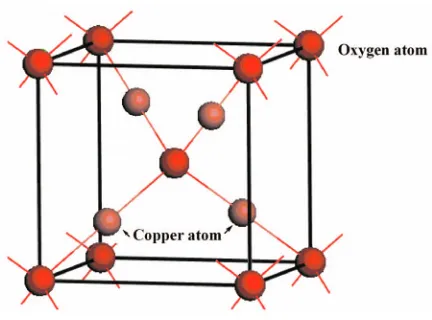
Fig. 1, each oxygen atom in bulk Cu2O is coordinated by
four copper atoms共forming a tetrahedron兲, and each oxygen layer is sandwiched between two copper layers. The lattice constant was determined by plotting the variation in the energy with the volume of the unit cell of bulk Cu2O shown
in Fig.1. The lattice constant fitting was performed using a
TABLE I. Calculated geometrical parameters for bulk Cu2O.
Method
Lattice constant
共Å兲
Cu–O
共Å兲
Cu–Cu
共Å兲
This work共GGA-PAW兲 4.31 1.87 3.05
GGA-PAWa 4.31 1.87 3.05
HFb 4.28 1.85 3.03
GGA-U.S.a 4.32 ¯ ¯
GGA-PBEc 4.34 1.88 3.07
Expt.d 4.27 1.85 3.01
aReference27. bReference28. cReference29. dReferences30and31.
8⫻8⫻8 Monkhorst–Pack grid.26The calculated lattice
con-stant was 4.31 Å. In Table I, we compare our calculated
geometry for bulk Cu2O with other experimental and
theo-retical values. Our results are seen to agree exactly with
those obtained by Jianget al.27 using the same method and
are also in good agreement with both experiment and other theoretical calculations.
2.Cu2O„110…: CuO surface
A共2⫻2兲 supercell of the Cu2O共110兲: CuO surface was
constructed from the 共1⫻1兲 unit cell presented by Soon
et al.16 Our optimized substrate structure is displayed in
Fig. 2, and our geometrical parameters compared with the
results of Soonet al.16 in TableII. We observe that the two sets of data agree quite well. We have also found that the geometrical parameters in TableIIchange by less than 0.005 Å when allowing three layers to relax instead of two or when using a six-layer slab and allowing the four top-most layers to relax.
3. 2-chlorophenol molecule
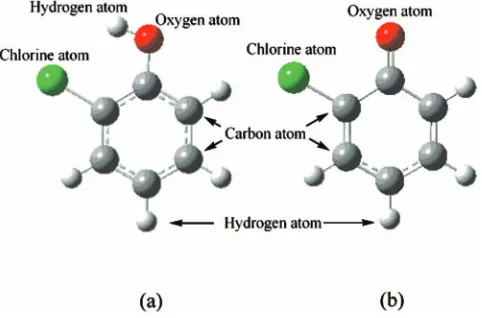
In a previous study,20using various theoretical methods, we obtained the ground state structure of the 2-chlorophenol molecule and its derivative radical, the 2-chlorophenoxy radical, which forms after the loss of the H atom from the hydroxyl group. The structures that we determined for the 2-chlorophenol molecule and 2-chlorophenoxy radical are shown in Fig.3. In all structural optimizations, thecisform of the 2-chlorophenol molecule has been employed as it is
slightly more stable than its trans counterpart. The
corre-sponding structural parameters are presented in Table 1 in Ref. 20.
B. Adsorption of 2-chlorophenol on the Cu2O„110…: CuO surface
1. Molecular adsorption
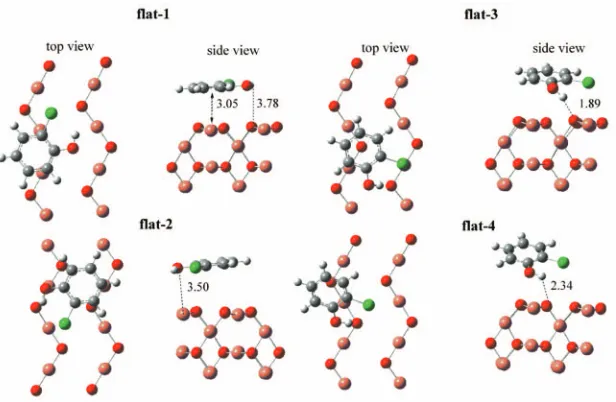
Several flat and vertical configurations have been
con-sidered for the 2-chlorophenol molecule on the
Cu2O共110兲: CuO surface. The optimized flat and vertical
structures are shown in Figs. 4and5, respectively. Binding energies are given in Table III.
As can be seen from the bond distances shown in Figs.4
and5, and the calculated binding energies in TableIII, chlo-rophenol is very weakly bound to the Cu2O共110兲: CuO
sur-face. These results are very similar to those reported for the interaction of a chlorophenol molecule with clean copper surfaces.19,20Most of the structures in Figs.4and5are char-acterized by the formation of a weak bond between the hy-drogen in the hydroxyl group of the 2-chlorophenol molecule and a surface oxygen共Osurf兲. Also, these structures exhibit to
a large extent the geometry of a free chlorophenol molecule. Since all of these molecular structures are very weakly FIG. 2. 共Color兲Top and side views of the 2⫻2 unit supercell of the Cu2O共110兲: CuO surface. Dimensions
are in angstrom.
TABLE II. Bondlengths in the Cu2O共110兲: CuO surface. Atom labels are
given in Fig.2.
This work
共Å兲
Soonet al.a
共Å兲
Osurf– Cusurf 1.82 1.84
Osurf– CuIN1 1.83 1.84
Cusurf– CuIN2 2.84 2.78
Cusurf– Cusurf 3.06 3.05
aReference16.
bonded to the surface, it is reasonable to assume that their adsorption from the vacuum onto the surface occurs without any energy barrier.
2. Dissociative structures
a. Formation of 2-chlorophenoxy moiety Dissociation of
the hydrogen atom from the hydroxyl 共OH兲 group of the
2-chlorophenol molecule results in the formation of a
2-chlorophenoxy moiety on the Cu2O共110兲: CuO surface.
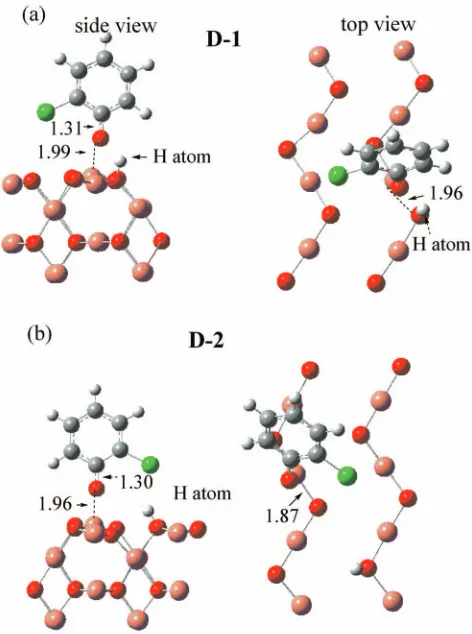
Two possible resultant structures are shown in Fig. 6. In
structure D-1, both the 2-chlorophenoxy radical and the dis-sociated H are adsorbed on the same surface Cu–O bond,
with the H atom attached to an Osurf atom and the
2-chlorophenoxy moiety bonded to a Cusurf atom. The
C–O bondlength in the adsorbed 2-chlorophenoxy moiety is
1.31 Å, intermediate between its length in the free
2-chlorophenol molecule 共1.38 Å兲 and the free
2-chlorophenoxy radical 共1.25 Å兲. The Osurf– Cusurf
bondlength has increased by 0.14 Å from its equilibrium distance in the substrate 共1.82 Å兲, and the Cusurf atom has
moved upward by 0.3 Å. Formation of D-1 from the vacuum
2-chlorophenol is endothermic by 8.2 kcal/mol 共0.36 eV兲.
Transfer of the H atom in D-1 onto the Osurf of a different
Cu–O surface bond produces the structure 共D-2兲 shown in
Fig.6共b兲. This structure is less stable than the structure D-1 by 4.0 kcal/mol共0.17 eV兲.
To estimate the reaction barrier for the formation of D-1 by means of the NEB method, we took the initial image to be the weakly bound vertical-1 structure shown in Fig.5and the final image to be the structure D-1. Since all of the vertical FIG. 4. 共Color兲 Optimized structures for flat adsorption of a 2-chlorophenol molecule on the Cu2O共110兲: CuO
sur-face. Reported distances are in ang-strom. Only the first atomic layer is shown in the top views.
FIG. 5. 共Color兲 Optimized structures for vertical ad-sorption of a 2-chlorophenol molecule on the Cu2O共110兲: CuO surface. Reported distances are in
molecular structures bond to the surface in the same way and have similar stabilities, the vertical-1 structure can be taken as being representative of all the vertical structures for cal-culating the reaction barrier for the formation of the D-1 structure. To find the minimum energy path we created eight intermediate images by linearly interpolating between the initial and the final images and then optimized these images within the NEB method. The energy was found to change smoothly from that of the weakly bound initial state to the
final product 共adsorbed 2-chlorophenoxy+ H兲 without
pass-ing through a reaction barrier. We can thus conclude that the amount of energy required to form the D-1 structure from an isolated 2-chlorophenol molecule above the Cu2O共110兲: CuO
surface is 8.2 kcal/mol共0.36 eV兲. This value is 11.1 kcal/mol
共0.48 eV兲lower than the value used by Khachatryanet al.4in their recent kinetic model for the formation of PCDD/Fs over a CuO surface.
Desorption of the 2-chlorophenoxy moiety into the vacuum from structures D-1 and D-2 was found to be
endothermic by 8.5 kcal/mol 共0.37 eV兲 and 12.5 kcal/mol
共0.54 eV兲, respectively. These results 共together with the above barrierless formation energy of 8.2 kcal/mol for D-1兲 indicate that the energy requirement for the formation of a gaseous 2-chlorophenoxy radical when assisted by the Cu2O共110兲: CuO surface is much less than the 83.0 kcal/mol
共3.6 eV兲 required to break the hydroxyl bond in the gas
phase.8
It is interesting to note that the formation of a 2-chlorophenoxy moiety is more thermodynamically pre-ferred on the clean Cu共100兲 surface 共⫺2.8 kcal/mol兲 共Ref.
20兲 than on the Cu2O共110兲: CuO surface 共+8.2 kcal/mol兲. However, kinetic parameters are also important in determin-ing which surface is more efficient in formdetermin-ing the 2-chlorophenoxy moiety. Thus, we have also calculated the reaction barrier for the Cu共100兲surface. The calculated reac-tion pathway is plotted in Fig. 7. This figure describes the movement of the phenolic H from the O atom of the 2-chlorophenol molecule to its preferred hollow site on the Cu共100兲surface. The initial state is a weakly bound state in which the 2-chlorophenol molecule is oriented vertically with the hydroxyl group pointing downward. The calculated reaction barrier is determined to lie 13.6 kcal/mol共0.59 eV兲 above the weakly bound 2-chlorophenol state on the Cu共100兲 surface or 11.5 kcal/mol共0.50 eV兲above the 2-chlorophenol molecule in the vacuum. A comparison of the energetics of the Cu共100兲 and Cu2O共110兲: CuO surfaces associated with
forming the 2-chlorophenoxy moiety is shown in Fig.8. As
stated above, the energy required for the Cu2O共110兲: CuO
surface is 8.2 kcal/mol共0.36 eV兲, compared with 11.5 kcal/ mol共0.50 eV兲for the Cu共100兲surface. We can thus conclude that these two surfaces require fairly similar energies in fa-cilitating the formation of a 2-chlorophenoxy moiety.
In the conditions encountered in a real combustion envi-ronment, the 2-chlorophenoxy radical can be formed in the TABLE III. Binding energies for the flat and vertical structures shown in
Figs.4 and 5. A negative value indicates that the adsorption process is exothermic.共1.0 eV= 23.06 kcal/mol兲.
Structure
Binding energy
共kcal/mol兲 Structure
Binding energy
共kcal/mol兲
Flat-1 ⫺2.0 Vertical-2 ⫺2.0
Flat-2 ⫺2.4 Vertical-3 ⫺2.0
Flat-3 ⫺3.4 Vertical-4 +0.5
Flat-4 ⫺1.5 Vertical-5 ⫺1.5
Vertical-1 ⫺2.2
FIG. 6. 共Color兲 Chemisorption of a 2-chlorophenoxy radical on the Cu2O共110兲: CuO surface in the optimized structures共a兲D-1 and共b兲D-2. Distances are in angstrom. Only the first atomic layer is shown in the top views.
gas phase via highly exothermic reactions with the O/H radi-cal pool. In addition, the 2-chlorophenoxy radiradi-cal is a stable persistent radical that can build up to an appreciable amount in the combustion reaction environment due to its very slow reaction with molecular oxygen.32As a result, we have also investigated the adsorption of an isolated 2-chlorophenoxy radical directly onto the Cu2O共110兲: CuO surface. By means
of the NEB method, the reaction pathway for this adsorption process has been followed from a 2-chlorophenoxy radical in the vacuum to an adsorbed 2-chlorophenoxy moiety. We found that the adsorption process does not encounter a bar-rier and the adsorbed 2-chlorophenoxy has an energy of
⫺12.5 kcal/mol 共⫺0.54 eV兲 with respect to the vacuum
2-chlorophenoxy radical. The optimized geometry of the ad-sorbed 2-chlorophenoxy moiety on the Cu2O共110兲: CuO
sur-face is very similar to that reported for the 2-chlorophenoxy moiety in the structure D-2关see Fig.6共b兲兴. It is interesting to note that the 2-chlorophenoxy moiety is more strongly bound to the clean copper surfaces, having binding energies of ⫺40.6 kcal/mol共⫺1.76 eV兲and⫺32.6 kcal/mol共⫺1.41 eV兲 for the Cu共100兲 共Ref. 19兲 and Cu共111兲 共Ref. 20兲 surfaces, respectively.
Due to the relatively small energy of 12.5 kcal/mol
共0.54 eV兲required to desorb a 2-chlorophenoxy moiety from the Cu2O共110兲: CuO surface, an equilibrium state compris-ing both chemisorbed and gaseous 2-chlorophenoxy radicals is most likely to dominate the adsorption process.
b. Formation of phenyl moiety Formation of a phenyl moiety through dissociation and the separate adsorption of a chlorine atom and a hydroxyl group on the Cu共100兲 共Ref.20兲
and Cu共111兲 共Ref. 19兲 surfaces was shown to provide the most stable structures resulting from the interaction of a 2-chlorophenol molecule. We thus now turn to investigate the formation of a phenyl moiety on the Cu2O共110兲: CuO
surface. In this section, we only consider energetics and ge-ometries for the structures and not reaction barriers, as the considered structures are not precursors for the formation of PCDD/Fs.
Lomnicki and Dellinger33 have investigated the
forma-tion of PCDD/Fs from the pyrolysis of 2-chlorophenol over a supported copper oxide catalyst in the temperature range of
200– 500 ° C. Despite the absence of oxygen, Lomnicki and
Dellinger33found that 95% of the 2-chlorophenol molecules
were consumed into CO and CO2, and only about 0.5% were
converted to PCDD/Fs. Due to the highly reducing condi-tions, the oxygen was assumed to have originated from the copper oxide surface. To model direct interaction between phenolic carbon atom and a surface oxygen atom, we have placed the dissociated hydroxyl group of a chlorophenol
molecule above a Cusurf atom, and the unpaired C atom of
the remaining 2-chlorophenol moiety above an Osurf atom.
The resulting optimized structure is shown in Fig. 9. The
C–O bond is 1.41 Å which is close to the C–O distance in both the free 2-chlorophenol molecule and 2-chlorophenoxy radicals chemisorbed on the clean copper surfaces共1.37 Å兲. The formation of this chemisorbed structure is found to be unlikely, however, as it requires 39.1 kcal/mol 共1.70 eV兲of energy. Moving the OH group onto another copper surface atom also makes little difference to this energy value.
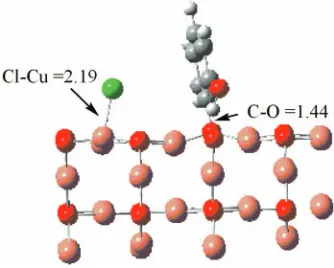
Finally, we explore dechlorination of a 2-chlorophenol molecule through chlorine abstraction by the surface, and the formation of a surface-bound OH-phenyl moiety. The
result-ing optimized geometry is shown in Fig. 10. The adsorbed
chlorine forms an ionic Cu–Cl bond with length of 2.19 Å, and the OH-phenyl moiety is attached to an Osurfatom via its
1 2 3 4 5
-4 -2 0 2 4 6 8 10 12
14 Relative energy
(kcal/mol)
Adsorbed 2-chlorophenoxy + surface-H
Adsorbed 2-chlorophenoxy + surface-H
TS
(-2.2) (-2.1) (-2.8)
(11.5)
(8.2)
Physisorbed state Gaseous 2-chlorophenol
+ clean surface
(0.0)
Physisorbed state
FIG. 8. Relative energies for the formation of a 2-chlorophenoxy moiety. The dotted and solid lines de-note reaction paths for the Cu2O共110兲: CuO and
Cu共100兲surfaces, respectively.
radical C site. The formation of this structure from a com-pletely isolated 2-chlorophenol molecule requires 4.7 kcal/ mol 共0.20 eV兲. By contrast, the formation of similar disso-ciative structures on the clean copper surfaces was found to take place with considerable exothermicity.19,20
IV. SUMMARY AND CONCLUSIONS
We have investigated the interaction between a
2-chlorophenol molecule and the Cu2O共110兲: CuO surface,
which according to Soon et al.16 is one of the two most
stable Cu2O surfaces under pressure and temperature
condi-tions corresponding to the formation of PCDD/Fs in combus-tion systems. The 2-chlorophenol molecule is found to adopt several different flat and vertical orientations in which it is bound to the Cu2O共110兲: CuO surface via a weak interaction
between the phenolic H and a substrate surface oxygen atom. The formation of a 2-chlorophenoxy moiety, which re-sults from the fission of the phenolic O–H bond on the Cu2O共110兲: CuO surface, is found to be endothermic by 8.2
kcal/mol 共0.37 eV兲, whereas it was exothermic by 2.8 kcal/
mol 共0.12 eV兲 on the Cu共100兲 surface. Reaction pathway
calculations have shown that the energy required for O–H bond fission and the formation of a surface 2-chlorophenoxy moiety on the Cu2O共110兲: CuO surface is the same as the
reaction energy共i.e., it is a barrierless reaction兲, while there is a net barrier of 11.5 kcal/mol 共0.50 eV兲 on the Cu共100兲 surface. Reaction on these two surfaces, however, is more energetically favorable than the uncatalyzed process in the gas phase.
The adsorption of a 2-chlorophenoxy radical from the
vacuum onto the Cu2O共110兲: CuO surface was found to
occur without a barrier and to yield a binding energy of
⫺12.5 kcal/mol, significantly less than the corresponding
values reported for the clean copper surfaces 共⫺40.6 kcal/ mol共⫺1.76 eV兲and⫺32.6 kcal/mol共⫺1.41 eV兲for Cu共100兲
and Cu共111兲, respectively兲. Since the desorption barrier for a 2-chlorophenoxy moiety on the Cu2O共110兲: CuO surface is
relatively small, it is likely that an equilibrium state forms
between surface-bound 2-chlorophenoxy moieties and
2-chlorophenoxy radicals in the gas phase.
ACKNOWLEDGMENTS
This research has been supported by a grant from the Australian Research Council. The authors also acknowledge access to the computational facilities of the Australian
Part-nership of Advanced Computing共APAC兲.
1N. W. Tame, E. M. Kennedy, and B. Z. Dlugogorski,Prog. Energy
Com-bust. Sci. 33, 384共2007兲.
2B. R. Stanmore,Combust. Flame 136, 398共2004兲.
3K. Tuppurainen and J. Ruuskanen,Chemosphere 38, 1825共1999兲. 4L. Khachatryan, S. Lomnicki, and B. Dellinger,Chemosphere 68, 1741
共2007兲.
5S. Lomnicki, L. Khachatryan, and B. Dellinger, Organohalogen Compd.
66, 1023共2004兲.
6S. L. Alderman, G. R. Farquar, E. D. Poliakoff, and B. Dellinger,
Envi-ron. Sci. Technol. 39, 7396共2005兲.
7S. L. Alderman and B. Dellinger,J. Phys. Chem. A 109, 7725共2005兲. 8Q. Sun, M. Altarawneh, B. Z. Dlugogorski, E. M. Kennedy, and J. C.
Mackie,Environ. Sci. Technol. 41, 5708共2007兲.
9G. W. Zhou and J. C. Yang,J. Mater. Res. 20, 1684共2005兲. 10J. C. Yang, D. Evan, and L. Tropia,Appl. Phys. Lett. 81, 241共2002兲. 11M. Lampimaki, K. Lahtonen, M. Hirsimaki, and M. Valden,J. Chem.
Phys. 126, 034703共2007兲.
12Y. Xu and M. Mavrikakis,Surf. Sci. 494, 131共2001兲. 13Y. Xu and M. Mavrikakis,Surf. Sci. 538, 219共2003兲.
14M. Alatalo, S. Jaatinen, P. Salo, and K. Laasonen, Phys. Rev. B 70,
245417共2004兲.
15A. Soon, M. Todorova, B. Delley, and C. Stampfl,Phys. Rev. B 73,
165424共2006兲.
16A. Soon, M. Todorova, B. Delley, and C. Stampfl,Phys. Rev. B 75,
125420共2007兲.
17C. Stampfl,Catal. Today 105, 17共2005兲.
18J. Rogal, K. Reuter, and M. Scheffler,Phys. Rev. B 69, 075421共2004兲. 19M. Altarawneh, M. W. Radny, P. V. Smith, E. M. Kennedy, J. C. Mackie,
and B. Z. Dlugogorski,Appl. Surf. Sci. 254, 4218共2008兲.
20M. Altarawneh, M. Radny, P. Smith, E. M. Kennedy, J. C. Mackie, and
B. Z. Dlugogorski, Surf. Sci. 602, 1554共2008兲.
21G. Kresse and J. Furthmüller,Phys. Rev. B 54, 11169共1996兲. 22J. P. Perdew, J. A. Chevary, S. H. Vosko, K. A. Jackson, M. R. Pederson,
D. J. Singh, and C. Fiolhais,Phys. Rev. B 46, 6671共1992兲.
23S. L. Cunningham,Phys. Rev. B 10, 4988共1974兲. 24G. Mills and H. Jónsson,Phys. Rev. Lett. 72, 1124共1994兲.
25G. Mills, H. Jonsson, and G. K. Schenter,Surf. Sci. 324, 305共1995兲. 26H. J. Monkhorst and J. D. Pack,Phys. Rev. B 13, 5188共1976兲. 27Y. Jiang, J. B. Adams, and D. Sun,J. Phys. Chem. B 108, 12851共2004兲. 28E. Ruiz, S. Alvarez, P. Alemany, and R. A. Evarestov,Phys. Rev. B 56,
7189共1997兲.
29A. Soon, T. Sohnel, and H. Idriss,Surf. Sci. 579, 131共2005兲. 30A. Werner and H. D. Hochheimer,Phys. Rev. B 25, 5929共1982兲. 31M. M. Beg and S. M. Shapiro,Phys. Rev. B 13, 1728共1976兲. 32B. Dellinger, S. Lomnicki, L. Khachatryan, Z. Maskos, R. W. Hall, J.
Adounkpe, C. McFerrin, and H. Truong,Proc. Combust. Inst. 31, 521
共2007兲.
33S. Lomnicki and B. Dellinger,Proc. Combust. Inst. 29, 2463共2002兲.