Client-based SBM Layer for Predictive Management of Traffic Flows in
Heterogeneous Networks
Fatema Shaikh
Aboubaker Lasebae
Glenford Mapp
Middlesex University, London. UK.
{f.shaikh, a.lasebae, g.mapp}@mdx.ac.uk
Abstract
In a heterogeneous networking environment, the knowledge of the time before a vertical handover (TBVH) for any network is vital in correctly assigning connections to available channels. In this paper, we introduce a predictive mathematical model for calculating the estimated TBVH component from available network parameters and discuss the different scenarios that arise based on a mobile host’s trajectory. We then introduce the concept of an intelligent Stream Bundle Management Layer (SBM) which consists of a set of policies for scheduling and mapping prioritised traffic streams on to available channels based on their priority, device mobility pattern and prevailing channel conditions. The layer is also responsible for the maintenance of connections during vertical handovers to avoid their forced termination.
1. Introduction
In heterogeneous networks, the convergence of diverse access technologies with disparate characteristics results in many complexities at both the client and the network sides, particularly during vertical handovers. Applications running on a mobile host (MH) are offered the choice of transmission on multiple but changing wireless channels exhibiting different QoS. The effective delivery of multimedia traffic across these diverse channels, by minimising forced termination of ongoing connections during handovers while accommodating new connections, is the main responsibility that falls upon both mobile hosts and networks. There is therefore an increasing demand for the development of traffic management strategies for scheduling and managing traffic streams among heterogeneous network channels based on application QoS, device mobility pattern and available network resources.
Rapid developments in mobile positioning technology for indoor and outdoor environments [3,4,11] have enabled researchers to utilise this information along with available network parameters to predict the mobility pattern of MHs with reasonable accuracy. This paper proposes the idea that by having sufficient knowledge of a MH’s position and underlying channel parameters, it is possible to derive an estimate of the time before vertical handover (TBVH). This knowledge of TBVH is then utilised by a proposed intelligent client-based Stream
Bundle Management Layer (SBM) [10] that combines it with the knowledge of conditions of all networks for scheduling and allocating traffic streams to appropriate channels in heterogeneous networks.
The rest of this paper is organised in the following manner. In Section 2, different research directions are discussed and arguments are put forth to justify our client-based approach. A discussion on related work is presented in Section 3. We then introduce a predictive mathematical model that calculates the estimated Time Before Vertical Handover (TBVH) component in Section 4. Section 5 explains the concept of the Stream Bundle Management Layer. Finally, we conclude the paper in Section 6 with a brief discussion on future work.
2. Background
2.1. Adoptation of client-controlled traffic management policies.
Most solutions suggested previously in literature [1,5,9] adopt network-controlled call/traffic management strategies in which the Base Station (BS) maintains information about the different access channels available at a MH and decides on its behalf the channel on which the MH should transmit. While this approach may work for hierarchical homogeneous networks, it gives rise to problems when a MH is simultaneously connected to several different networks as it is difficult to assign control to any single BS. Moreover, in order to make decisions, a BS needs access to a continuous flow of information about different network channels available at the MH, causing increased network overhead. Due to this, the BS may not be able to maintain up-to-date context knowledge, thus hampering its decision-making ability. As different networks in a heterogeneous environment may be provided by different service providers, a successful integration of these networks involves the resolution of a number of technical and administrative issues, making the whole process even more complex.
based on the behavioural pattern of the traffic stream and prevailing networking conditions. In case of an imminent vertical handover, sufficient knowledge of the underlying network infrastructure enables the MH to avoid allocation of traffic streams to channels that might be lost soon. In the literature, several recent studies have discussed the benefits and importance of client-based traffic control and handover mechanisms [3,7,8]. In fact, the IEEE 802.21 working group [7] is actively involved in the creation of a framework that defines a Media Independent Handover Function residing in the lower layers of a MH, which will help mobile devices to roam seamlessly across heterogeneous networks.
2.2. Predictive schemes for mobility prediction.
In the wireless field, resource management has always been a subject of intensive investigation with a number of solutions being proposed. Among such proposed solutions, reactive resource reservation schemes do not claim to possess previous knowledge of networks and merely react to changes in the underlying access channel conditions. For example Chou et al. [13] suggested an adaptive bandwidth allocation scheme that negotiates bandwidth based on the number of incoming and ongoing calls. Proactive schemes on the other hand, possess the ability to reserve resources in advance by predicting a MH’s trajectory, based on the knowledge of network parameters such as topology, coverage and positioning information as in [2].
In this paper we take a different approach and propose a predictive mathematical model for calculating the TBVH component for a MH roaming across heterogeneous networks. While this model makes use of the knowledge of the MH’s location and network conditions as in a proactive policy, by applying this information to a realistic mathematical model, it can actually predict the MH’s behaviour better than the proactive mechanism. Moreover, while both reactive and proactive schemes may achieve a better performance in real-time systems, our predictive model is simple, yet realistic enough to be plugged in to both simulations and real-time systems with ease.
3. Related Work
The authors in [9] proposed a predictive channel reservation (PCR) approach based on real-time position measurement and movement extrapolation. Here, the BS used the current position and orientation of the MH to predict its future path. This BS would subsequently send a channel reservation request to the BS of the next cell to which the MH was heading. While this study succeeded in predicted the next cell for a roaming MH, it was a simple approach that did not consider overlaid cells in hierarchical networks. Moreover call admission was purely network-controlled.
Naghian in [6] presented a proactive solution called the Hybrid Predictive Handover (HPH) method, which attempted to address some of the shortcomings of the
PCR approach. The HPH method utilised mobile positioning information along with signal quality for optimising signalling load due to mobility in third generation networks. It also considered the scenario of MHs roaming in hierarchical networks and suggested assigning devices to macro and micro cells based on their velocity. However, the HPH method did not consider the complexies that stem from the fact that heterogeneous networks consist of a variety of networks offering disparate QoS and coverage, so with different categories of applications such as voice, video and data running on a roaming MH, it is vital to consider how to map these application demands on to the right network without resulting in connection loss.
Another scheme referred to in [2] proposed a proactive mobility prediction technique based on positioning knowledge and road topology that predicted the time a MH had before a horizontal handover. This approach mainly relied on large volumes of data on road maps stored in prediction databases inside every BS. Thus, it is not possible to predict the path of a MH that strays away from the road topology.
4. Predictive mathematical model for
calculation of TBVH component:
In a heterogeneous environment a clear estimate of the time for which a MH will have access to a particular network channel will help to increase the efficiency of channel allocation and resource reservation management strategies, which in turn will help to prevent unnecessary vertical handovers. For example, a MH that is aware that it may loose WLAN coverage in the next minute will avoid allocating an interactive video stream to it. By choosing the next best available network, it avoids the network overhead associated with an upward vertical handover. Similarly, a user’s PDA may pick up the coverage of a WLAN for a short period when the user walks near a hotspot. The awareness that this coverage is only for a short period could help the MH to decide not to perform a downward vertical handover to the WLAN. In this section a predictive mathematical model is presented for calculating TBVH based on the MH’s positioning information, velocity and direction of motion. This work complements the PCR and HPH approaches. The underlying assumptions of our method are that:
Wireless technologies in the heterogeneous network are overlaid efficiently to ensure soft handovers.
techniques are quite acceptable and do not degrade the performance of a network.
4.1. Heterogeneous network topology
This paper proposes a loosely-coupled heterogeneous wireless interworking architecture consisting of networks that exhibit vastly different characteristics in terms of bandwidth, transmission delay, loss rate and coverage (Table 1 [8]).
Table 1. Wireless Networks Specifications WIRELESS
NETWORK BANDWIDTH COVERAGE IEEE 802.11a Upto 54 Mbps 50-300 m GPRS 9.6-144 Kbps Aprox.35 km UMTS Upto 2 Mbps Aprox. 20 km IEEE802.16a Upto 70 Mbps Aprox. 30 km Satellite Upto 144 Kbps Global
The successful deployment of heterogeneous networks involves the seamless integration of these access technologies by minimising the effects of vertical handovers through the creation of well-defined boundaries. It is equally important is to increase the context-awareness of the roaming MH. In order to tackle these issues we propose some topological changes to networks by introducing additional functionality in the BSs existing at network boundaries, called Boundary Base Stations (BBS). A MH approaching a BBS is made aware of the fact that it is close to the network boundary and may have to handoff after a certain period. The main task of a BBS is to inform the MH of its location parameters and other network parameters it may need to calculate the TBVH. The BBS could also keep a record of other networks that may be in its vicinity to which the MH is likely to perform a vertical handover but which it is yet to discover.
4.2. Mathematical derivation of TBVH
In this section we begin by exploring the different scenarios for the TBVH component for upward vertical handovers, based on the MH’s location and direction of movement. For the sake of simplicity, in this paper we only consider the UMTS-WLAN handover combination, although our model is easily applicable to other network combinations as well.
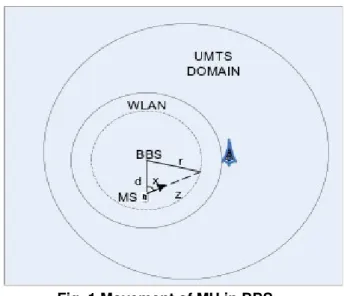
The first scenario to be considered is a MH that is roaming under the coverage of a BBS and is moving towards the boundary with velocity as shown in Fig. 1. Here we consider a circular cell of radius R. The inner dotted concentric circle shown in the above figure represents the handover threshold of radius r which is the distance from the BSS where a MH is expected to perform a handover. Location co-ordinates of the MH
Fig. 1 Movement of MH in BBS
can be extracted as explained in references [3,11]. While x is the angle made by the BBS and direction of movement at the MH, the distance d between the BBS and MH and r can both be derived from the equation where the Received Signal Strength (RSS) is given by [14]:
(1)
where is distance from the transmitter and is the propagation path-loss coefficient. The BBS passes the latest values of the required information to the MH which is responsible for performing the calculations. In order to find the TBVH in this scenario we need to calculate the distance which is the point on the threshold circle where the MH is expected to vertically handover. As
(2)
The value of calculated by solving the quadratic equation is
(3)
Therefore, the estimated TBVH for this scenario is: (4) The parameter values in the above equation can be easily obtained, making it possible to calculate TBVH.
As WLANs may have specific points of exits such as doors in a building, the prediction accuracy of TBVH can be improved if the co-ordinates of these exit points are stored in the BBS and passed on the MH which then calculates the TBVH to the exit point.
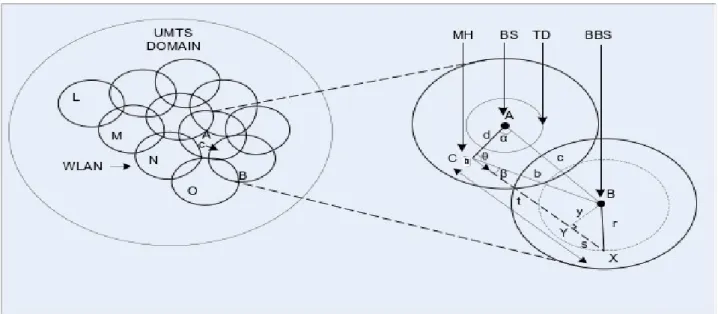
Fig. 2. Outward movement of MH from normal BS to BBS
Figure 2. In this case we adopt the concept of threshold distance TD [9] in the normal BS. This is a distance smaller than the cell’s radius, which describes a smaller concentric circle located within the cell. The idea is that a MH moving inside the TD circle is more likely to change its direction, however on moving out of this circle, it is less likely to undergo a sudden change in its direction, thus enabling a correct prediction of the cell the MH is moving towards.
The goal in this case is to improve the prediction capability of the model by making it able to predict the TBVH of MH while it still moves in the coverage of A. As the MH is too far from the BBS to get a reasonably accurate value of we first need to find this distance and the angle in order to calculate distance From fig.2 we can see that
Therefore,
(5) Depending on which side of line AB point X lies, angle (6) Considering triangle BYC, we have
(7) (8) Therefore, in triangle BYX,
(9) As
,
From (7), (8) and (9) we have
(10) Thus the TBVH component for this scenario is,
(11) This is similar to the equation obtained in (4).
4.3. Different cases that arise for TBVH
Based on the position and direction of movement of the MH in a network, we have two special scenarios in which we may not need to calculate the TBVH. In the first case a MH is attached to a normal BS that is surrounded by BSs, so the need to calculate the TBVH does not arise. In the second case, a MH is under the coverage of a BBS, but instead of moving towards the network boundary, it either moves towards an adjacent BBS or inwards towards a normal BS. Here, unless the MH undergoes a change in direction, we do not need to calculate TBVH. A way of detecting this change in direction is to compare the co-ordinates of two adjacent locations at small intervals.
We now discuss the contribution of the TBVH component in the decision-making process for performing a downward vertical handover. We consider the case of MH that is initially connected to a network with a larger coverage and while roaming in this network, it moves under the coverage of a smaller network i.e. a hotspot. Unlike the situation in an upward vertical handover, the MH here does not have stringent time constraints on performing a vertical handover as there is no danger of loss of existing connections due to the sudden coverage loss of the current network. In fact, it may not be wise to perform a hasty downward vertical handover only due to the availability of resources while the MH lacks enough context knowledge about the new network. A possibility is that the MH could have strayed into this hotspot for a short duration and may move out again before connections are established and attain stability on the new interface, thus causing degradation in QoS of ongoing connections.
based on the MH’s position, velocity, and direction of movement. This will give rise to different scenarios, similar to the situation in upward vertical handovers. While it is possible to predict the TBVH estimate for the hotspot when the MH is in the vicinity of a BBS, we may need to rely on additional statistical data to make any predictions when the MH moves deeper into the hotspot. We are currently working on improving the predictability of the TBVH model for this particular scenario.
In the next section we elaborate how the TBVH information is utilised for the allocation of multimedia traffic streams to different available channels.
5. Stream Bundle Management Layer
One of the most prominent challenges in heterogeneous environments is the ability of a multi-interfaced MH to maintain the provision of the desired QoS of ongoing connections while minimising service disruption due to fluctuating channel conditions during vertical handovers. For example, an ambulance equipped with wireless telementoring equipment and roaming in a heterogeneous network will require the transmission of various kinds of multimedia streams. The MH in a homogeneous network is always connected to a single network, so the task of mapping application QoS requirements on to available network channels is less complex. This is due to the fact that fluctuations in the network QoS parameters fall within known thresholds and the MH possesses predefined strategies to adjust its behaviour to these changes. However, in heterogeneous networks, the presence of multiple channels offering varying levels of QoS introduces a new level of complexity to the process of traffic stream management. In this case the MH must possess knowledge of available resources and conditions for all available channels before bundling traffic streams over them.
The study conducted previously in literature [5] suggests algorithms for call admission control of voice and data streams in UMTS-WLAN environments. However it fails to address the issue of minimising call dropping probability when a MH is temporarily under the coverage of a network. Guenkova-Luy et al. in [15] proposed the development of an end-to-end negotiation protocol (E2ENP) at the session level for negotiating QoS parameters for a roaming MH. This study did not consider the technical challenges faced during negotiation of QoS parameters at the transport level and below it during vertical handovers.
By having sufficient knowledge of the conditions of all the channels and their TBVH component, it is possible to manage channel allocation to active TCP connections with greater efficiency for a roaming MH.
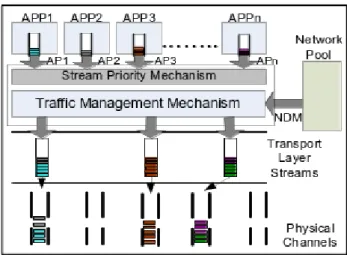
Fig. 3. Stream Bundle Management Layer
In this section, we introduce the concept of the SBM Layer that aims to tackle the issues of traffic management in heterogeneous environments.
The Stream Bundle Management Layer (SBM) is a specialised layer residing in the multi-interfaced heterogeneous network client. It consists of a set of policies for scheduling prioritised traffic streams onto different available channels based on their priority and behavioural patterns, device mobility patterns and prevailing channel conditions. Residing above the Transport Layer in the OSI network model, the SBM layer adopts a fine-grained approach for managing existing connections optimally over available channels to avoid their forced termination during vertical handovers. The decision-making mechanism is based on the feedback received from the lower layers about the available networks and their prevailing channel conditions, i.e. available bandwidth, delays like round-trip time (RTT), TBVH, and velocity of MH. To achieve this, the SBM Layer would rely on models existing at lower layers like IEEE 802.21[7] or PROTON [8]. Figure 3 gives an overview of the graphical design of the SBM Layer that consists of traffic stream management and control policies. These decision-making mechanisms rely on the feedback received from lower layers about prevailing network conditions. The SBM layer updates these values based on the periodic updates it receives normally. In the event of sudden dramatic changes in the parameter values, the layer receives triggers which prompt it to take immediate notice of the changed values. The network context information for each network to which the MH can connect is stored in a two-dimensional matrix called the Network Descriptor Matrix (NDM) that is generated in the Network Pool. Each row of the NDM corresponds to a network interface and the elements of each row describe the latest network parameter values. For example as shown in the figure, the MH has five different interfaces corresponding to different networks, namely, IEEE 802.11, IEEE 802.16a, GPRS, WCDMA and Satellite.
network status (status) with on/off values, available network bandwidth (avbw), received signal strength (RSS), time before vertical handover (TBVH), and round trip time (RTT) respectively.
The four main types of traffic considered in our work are interactive video, one-way streaming video, audio and data. An application’s parameter values (AP) are sent down to the decision making mechanism through the stream priority mechanism where they are assigned a priority, or are sent directly if the priorities are predefined. The Traffic Management sublayer then first runs the algorithms for performing the Resource Availability Check (RAC). This is a comparison of the APs with the available network parameters to ensure the required resource availability conditions are fulfilled. On achieving success, the mechanism maps the traffic stream onto the most appropriate channel. If the application fails the RAC, it is then added to a waiting queue and will be activated only when the required network conditions are fulfilled.
The SBM layer employs a per-flow control mechanism for the management of co-existing TCP and non-TCP traffic streams. The distribution of streams across different interfaces based on their requirements prevents channel overloading and simplifies their management. The SBM Layer can also maintain a list of networks with which a prioritised application stream is compatible. In the event of the unavailability of the assigned channel (CH), the layer checks the next best channel choice for stream allocation.
6. Conclusion and Future Work
The successful deployment of heterogeneous networks requires the resolution of a number of challenges for which a MH needs to constantly monitor channels and adjust its transmission patterns to changing network conditions. In this paper we proposed improving the network context awareness of the MH through the development of a predictive mathematical model for calculating the estimated time before vertical handover (TBVH) based on positioning techniques and MH’s speed and direction. Different cases that could arise based on the MH’s trajectory were discussed. This was followed by an introduction to the Stream Bundle Management Layer for the management of connections over different available channels in a heterogeneous network.
The main issues we plan to investigate in our future work are the effects of co-existence of different TCP
flavours on different available network channels that are being accessed by the same client, and the issue of multiple vertical handovers in a heterogeneous network.
7. References
[1] D. Niyato and E. Hossain, “Call Admission Control for QoS Provisioning in 4G Wireless Networks: Issues and Approaches”, IEEE Network, Sept/Oct 2005, pp. 5-11.
[2] W-S Soh and H.S. Kim, “Dynamic Bandwidth Reservation in Cellular Networks Using Road Topology Based Mobility Predictions”, Proc. IEEE INFOCOM’23, Honkong, March 2004.
[3] C-L Wang, Y-S Chiou and S-C Yeh, “An Indoor Location Scheme Based on Wireless Local Area Networks”, Proc. IEEE CCNC’02, Jan.2005, pp. 602-604.
[4] M. Hellebrandt, R. Mathar, and M. Scheibenbogen, “Estimating Position and Velocity of Mobiles in a Cellular Radio Network”, IEEE Trans. Veh. Techno., Vol. 46. No.1, Feb 97, pp. 65-71.
[5] W. Song, H. Jiang, W. Zhuang and X. Shen, “Resource Management for QoS Support in Cellular/WLAN Interworking”, IEEE Network, Sept/Oct 2005, pp. 12-18.
[6] S. Naghian, “Hybrid Predictive Handover in Mobile Networks”, Proc. IEEE VTC’03, Oct 2003, pp. 1918-1922.
[7] A.Dutta, S.Das, D. Famolari, Y.Ohba, K.Taniuchi, T.Kodama and H.Schulzrinne, “Seamless Handover across Heterogeneous Networks – An IEEE 802.21 Centric Approach”, Proc. IEEE WPMC, Sept 2005.
[8] P.Vidales, L. Patanapongpibul, G. Mapp, A. Hopper, “Experiences with Heterogeneous Wireless Networks, Unveiling the Challenges”, Proc. HET-NET’04, July 2004, pp. WP10/1-WP10/8.
[9] M-H Chiu, M. Bassiouni, “Predictive Schemes for Handoff Prioritization in Cellular Networks Based on Mobile Positioning”, IEEE J. Select Areas Commun., vol. 18, no. 3, Mar. 2000, pp. 510-522.
[10] F. Shaikh, A. Lasebae and G. Mapp, “SBM Layer for Optimum Management of Co-existing Telemedicine Traffic Streams under Varying Channel Conditions in Heterogeneous Networks”, Proc. MIT’05. Aug. 2005.
[11] 3GPP, Technical Specification, Stage 2 Functional Specification for LCS in UTRAN, 25.305, v5.4.0, Sept. 2002, 53p.
[12] C.T. Chou and K. G. Shin, “Analysis of Adaptive Bandwidth Allocation in Wireless Networks with Multilevel Degradable Quality of Service,” IEEE Trans. Mobile Comp., vol. 3, no. 1, Jan-Mar 2004, pp. 5-17.
[13] H.G. Ebersman, O.K. Tonguz, “Handoff ordering using signal prediction priority queuing in personal communication systems,” IEEE Trans. Veh. Techno., Vol. 48. No. 1 1999, pp. 22-35.