Volume 2010, Article ID 597039,13pages doi:10.1155/2010/597039
Research Article
Adaptive Long-Term Coding of LSF Parameters Trajectories for
Large-Delay/Very- to Ultra-Low Bit-Rate Speech Coding
Laurent Girin
Laboratoire Grenoblois des Images, de la Parole, du Signal, et de l’Automatique (GIPSA-lab), ENSE3 961, rue de la Houille Blanche, Domaine Universitaire, 38402 Saint-Martin d’Heres, France
Correspondence should be addressed to Laurent Girin,[email protected]
Received 22 September 2009; Revised 5 March 2010; Accepted 23 March 2010
Academic Editor: Dan Chazan
Copyright © 2010 Laurent Girin. This is an open access article distributed under the Creative Commons Attribution License, which permits unrestricted use, distribution, and reproduction in any medium, provided the original work is properly cited.
This paper presents a model-based method for coding the LSF parameters of LPC speech coders on a “long-term” basis, that is, beyond the usual 20–30 ms frame duration. The objective is to provide efficient LSF quantization for a speech coder with large delay but very- to ultra-low bit-rate (i.e., below 1 kb/s). To do this, speech is first segmented into voiced/unvoiced segments. A Discrete Cosine model of the time trajectory of the LSF vectors is then applied to each segment to capture the LSF interframe correlation over the whole segment. Bi-directional transformation from the model coefficients to a reduced set of LSF vectors enables both efficient “sparse” coding (using here multistage vector quantizers) and the generation of interpolated LSF vectors at the decoder. The proposed method provides up to 50% gain in bit-rate over frame-by-frame quantization while preserving signal quality and competes favorably with 2D-transform coding for the lower range of tested bit rates. Moreover, the implicit time-interpolation nature of the long-term coding process provides this technique a high potential for use in speech synthesis systems.
1. Introduction
The linear predictive coding (LPC) model has known a considerable success in speech processing for forty years [1]. It is now widely used in many speech compression systems [2]. As a result of the underlying well-known “source-filter” representation of the signal, LPC-based coders generally separate the quantization of the LPC filter, supposed to represent the vocal tract evolution, and the quantization of the residual signal, supposed to represent the vocal source signal. In modern speech coders, low rate quantization of the LPC filter coefficients is usually achieved by applying vector quantization (VQ) techniques to the Line Spectral Frequency (LSF) parameters [3, 4], which are an appropriate dual representation of the filter coefficients particularly robust to quantization and interpolation [5].
In speech coders, the LPC analysis and coding process is made on a short-term frame-by-frame basis: LSF parameters (and excitation parameters) are usually extracted, quantized, and transmitted every 20 ms or so, following the speech time-dynamics. Since the evolution of the vocal tract is quite smooth and regular for many speech sequences, high
correlation between successive LPC parameters has been evidenced and can be exploited in speech coders. For example, the difference between LSF vectors is coded in [6]. Both intra-frame and interframe LSF correlations are exploited in the 2D coding scheme of [7]. Alternately, matrix quantization was applied to jointly quantize up to three successive LSF vectors in [8, 9]. More generally, Recursive Coding, with application to LPC/LSF vector quantization, is described in [2] as a general source coding framework where the quantization of one vector depends on the result of the quantization of the previous vector(s).1 Recent theoretical
of the excitation signal, in order to jointly smooth both the residual signal and the frame-to-frame variation of LSF coefficients. This idea has been recently revisited in a different form in [14], by introducing a memory term in the widely used Spectral Distortion measure that is used to control the LSF quantization. This memory term penal-izes “noisy fluctuations” of LSF trajectories, and conduces to “smooth” the quantization process across consecutive frames.
In all those studies, the interframe correlation has been considered “locally”, that is, between only two (or three for matrix quantization) consecutive frames. This is mainly because the telephony target application requires limiting the coding delay. When the constraint on the delay can be relaxed, for example, in half-duplex communication, speech storage, or speech synthesis application, the coding process can be considered on larger signal windows. In that vein, the Temporal Decomposition technique introduced by Atal [15] and studied by several researchers (e.g., [16]) consists of decomposing the trajectory of (LPC) spectral parameters into “target vectors” which are sparsely distributed in time and linked by interpolative functions. This method has not much been applied to speech coding (though see an interesting example in [17]), but it remains a powerful tool for modeling the speech temporal structure. Following another idea, the authors of [18] proposed to compress time-frequency matrices of LSF parameters using a two-dimension (2D) Discrete Cosine Transform (DCT). They provided interesting results for different temporal sizes, from 1 to 10 (10 ms-spaced) LSF vectors. A major point of this method is that it jointly exploits the time and frequency correlation of LSF values. An adaptive version of this scheme was implemented in [19], allowing a varying size from 1 to 20 vectors for voiced speech sections and 1 to 8 vectors for unvoiced speech. Also, the optimal Karunhen-Loeve Transform (KLT) was tested in addition to the 2D-DCT.
More recently, Dusan et al. have proposed in [20, 21] to model the trajectories of ten consecutive LSF parameters by a fourth-order polynomial model. In addition, they implemented a very low bit rate speech coder exploiting this idea. At the same time, we proposed in [22, 23] to model the long-term2 (LT) trajectory of sinusoidal speech
parameters (i.e., phases and amplitudes) with a Discrete Cosine model. In contrast to [20,21], where the length of parameter trajectories and the order of the model were fixed, in [22,23] the long-term frames are continuously voiced (V) or continuously unvoiced (UV) sections of speech. Those sections result from preliminary V/UV segmentation, and they exhibit very variable size and “shape”. For example, such a segment can contain several phonemes or syllables (it can even be a quite long all-voiced sentence in some cases). Therefore, we proposed a fitting algorithm to automatically adjust the complexity (i.e., the order) of the LT model according to the characteristics of the modeled speech segment. As a result, the trajectory size/model order could exhibit quite different (and often larger) combinations than the ten-to-four conversion of [20, 21]. Finally, we carried out in [24] a variable-rate coding of the trajectory of LSF
parameters by adapting our (sinusoidal) adaptive LT model-ing approach of [22,23] to the LPC quantization framework. The V/UV segmentation and the Discrete Cosine model are conserved,3 but the fitting algorithm is significantly
modified to include quantization issues. For instance, the same bi-directional procedure as the one used in [20,21] is used to switch from the LT model coefficients to a reduced set of LSF vectors at the coder, and vice-versa at the decoder. The reduced set of LSF vectors is quantized by multistage vector quantizers, and the corresponding LT model is recalculated at the decoder from the quantized reduced set of LSFs. An extended set of interpolated LSF vectors is finally derived from the “quantized” LT model. The model order is determined by an iterative adjustment of the Spectral Distortion (SD) measure, which is classic in LPC filter quantization, instead of perceptual criteria adapted to the sinusoidal model used in [22,23]. It can be noted that the implicit time-interpolation nature of the long-term decoding process makes this technique a potentially very suitable tech-nique for joint decoding-transformation in speech synthesis systems (in particular, in unit-based concatenative speech synthesis for mobile/autonomous systems). This point is not developed in this paper that focuses on coding, but it is discussed as an important perspective (seeSection 5).
The present paper is clearly built on [24]. Its first objec-tive is to present the adapobjec-tive long-term LSF quantization method in more details. Its second objective is to provide a series of additional material that were not developed in [24]: Some rate/distortion issues related to the adaptive variable-rate aspect of the method are discussed; A new series of rate/distortion curves obtained with a refined LSF analysis step are presented. Furthermore, in addition to the comparison with usual frame-by-frame quantization, those results are compared with the ones obtained with an adaptive version (for fair comparison) of the 2D-based methods of [18,19]. The results show that the trajectories of the LSFs can be coded by the proposed method with much fewer bits than usual frame-by-frame coding techniques using the same type of quantizers. They also show that the proposed method significantly outperforms the 2D-transform methods for the lower tested bit rates. Finally, the results of formal listening test are presented, showing that the proposed method can preserve a fair speech quality with LSF coded at very-to-ultra low bit rates.
This paper is organized as follows. The proposed long-term model is described in Section 2. The com-plete long-term coding of LSF vectors is presented in
Section 3, including the description of the fitting algorithm and the quantization steps. Experiments and results are given in Section 4. Section 5 is a discussion/conclusion section.
2. The Long-Term Model for LSF Trajectories
arbitrary fromn=1 toN. They are obtained froms(n) using a standard LPC analysis procedure applied on successive short-term analysis windows, with a window size and a hop size within the range 10–30 ms (see Section 4.2). For the following, let us denote by N = [n1n2· · ·nK] the vector
containing the sample indexes of the analysis frame centers. Each LSF vector extracted at time instant nK is denoted
ω(I),k = [ω1,k ω2,k· · ·ωI,k]T, for k = 1 to K (T denotes
the transpose operator4). I is the order of the LPC model
[1,5], and we take here the standard valueI=10 for 8-kHz telephone speech. Thus, we actually haveILSF trajectories of
Kvalues to model. For this aim, let us denote byω(I),(K)the I×Kmatrix of general entryωi,k: The LSF trajectories are
theIrowK-vectors, denotedωi,(K)=[ωi,1ωi,2· · ·ωi,K], for
i=1 toI.
Different kinds of models can be used for represent-ing these trajectories. As mentioned in the introduction, a fourth-order polynomial model was used in [20] for representing ten consecutive LSF values. In [23], we used a sum of discrete cosine functions, close to the well-known Discrete Cosine Transform (DCT), to model the trajectories of sinusoidal (amplitude and phase) parameters. We called this model a Discrete Cosine Model (DCM). In [25], we compared the DCM with a mixed cosine-sine model and the polynomial model, still in the sinusoidal framework. Overall, the results were quite close, but the use of the polynomial model possibly led to numerical problems when the size of the modeled trajectory was large. Therefore, and because of the limitation of experimental configurations in
Section 4, we consider only the DCM in the present paper. Note that, more generally, this model is known to be efficient in capturing the variations of a signal (e.g., when directly applied to signal samples as for the DCT, or when applied on log-scaled spectral envelopes, as in [26,27]). Thus, it should be well suited to capture the global shape of LSF trajectories. Formally, the DCM model is defined for each of theILSF trajectories by
ωi(n)=
P
p=0 ci,pcos
pπn
N
for 1≤i≤I. (1)
The model coefficientsci,pare all real.Pis a positive integer
defining the order of the model. Here, it is the same for all LSFs (i.e.,Pi=P), since this leads to significantly simplify the
overall coding scheme presented next. Note that, although the LSF are initially defined frame-wise, the model provides an LSF value for each time indexn. This property is exploited in the proposed quantization process of Section 3.1. It is also expected to be very useful for speech synthesis systems, as it provides a direct and simple way to proceed time interpolation of LSF vectors for time-stretching/compression of speech: interpolated LSF vectors can be calculated using (1) at any arbitrary instant, while the general shape of the trajectory is preserved.
Let us now consider the calculation of thematrix of model coefficientsC, that is, theI×(P+ 1) matrix of general term
ci,p, given thatPis known. We will see inSection 3.2how an
optimalPvalue is estimated for each LSF vector sequence to
be quantized. Let denote byMthe (P+ 1)×Kmodel matrix
that gathers the DCM terms evaluated at the entries ofN:
M= ⎡ ⎢ ⎢ ⎢ ⎢ ⎢ ⎢ ⎢ ⎢ ⎢ ⎢ ⎢ ⎢ ⎢ ⎢ ⎣
1 1 · · · 1
cos πn1 N cos πn2 N
· · · cos
πnK
N
cos
2πn1 N
cos
2πn2 N
· · · cos
2πnK N · · · · · · · · · · · · cos Pπn1 N cos Pπn2 N
· · · cos
PπnK
N ⎤ ⎥ ⎥ ⎥ ⎥ ⎥ ⎥ ⎥ ⎥ ⎥ ⎥ ⎥ ⎥ ⎥ ⎥ ⎦ . (2)
The modeled LSF trajectories are thus given by the lines of
ω(I),(K)=CM. (3)
Cis estimated by minimizing the mean square error (MSE)
CM−ω(I),(K)between the modeled and original LSF data.
Since the modeling process aims at providing data dimension reduction for efficient coding, we assume thatP+ 1< K, and the optimal coefficient matrix is classically given by
C=ω(I),(K)MT
MMT−1. (4)
Finally note that in practice, we used the “regularized” version of (4) proposed in [27]: a diagonal “penalizing” term is added to the inverted matrix in (4) to fix pos-sible ill-conditioning problems. In our study, setting the regularizing factorλof [27] to 0.01 gave very good results (no ill-conditioned matrix over the entire database of
Section 4.2).
3. Coding of LSF Based on the LT Model
In this section, we present the overall algorithm for quantiz-ing every sequence ofKLSF vectors, based on the LT model presented in Section 2. As mentioned in the introduction, the shape of spectral parameter trajectories can vary widely, depending on, for example, the length of the considered section, the phoneme sequence, the speaker, the prosody, or the rank of the LSF. Therefore, the appropriate order
P of the LT model can also vary widely, and it must be estimated: Within the coding context, a trade-offbetween LT model accuracy (for an efficient representation of data) and sparseness (for bit rate limitation) is required. The proposed LT model will be efficiently exploited in low bit rate LSF coding if in practicePis significantly lower thanKwhile the modeled and original LSF trajectories remain close enough.
For simplicity, the overall LSF coding process is presented in several steps. In Section 3.1, the quantization process is described given that the order P is known. Then in
Section 3.2, we present an iterative global algorithm that uses the process ofSection 3.1as an analysis-by-synthesis process to search for the optimal orderP. The quantizer block that is used in the above-mentioned algorithm is presented in
3.1. Long-Term Model and Quantization. Let us first address the problem of quantizing the LSF information, that is, representing it with limited binary resource, given that P
is known. Direct quantization of the DCM coefficients of (3) can be thought of, as in [18, 19]. However, in the present study the DCM is in one dimension,5 as opposed
to the 2D-DCT of [18, 19]. We thus prefer to avoid the quantization of DCM coefficients by applying a one-to-one transformation between the DCM coefficients and a reduced set of LSF vectors, as was done in [20, 21].6
This reduced set of LSF vectors is quantized using vector quantization, which is efficient for exploiting the intra-frame LSF redundancy. At the decoder, the complete “quantized” set of LSF vectors is retrieved from the reduced set, as detailed below. This approach has several advantages. First, it enables the control of correct global trajectories of quantized LSFs by using the reduced set as “breakpoints” for these trajectories. Second, it allows the use of usual techniques for LSF vector quantization. Third, it enables a fair comparison of the proposed method, which mixes LT modeling with VQ, with usual frame-by-frame LSF quantization using the same type of quantizers. Therefore, a quantitative assessment of the gain due to the LT modeling can be derived (seeSection 4.4). Let us now present the one-to-one transformation between the matrixC and the reduced set of LSF vectors. For this, let us first define an arbitrary function f(P,N) that uniquely allocatesP + 1 time positions, denotedJ =
[j1 j2· · ·jP+1], among the N samples of the considered
speech section. Let us also define Q, a new model matrix evaluated at the instants ofJ(henceQis a “reduced” version ofM, sinceP+ 1< K):
Q= ⎡ ⎢ ⎢ ⎢ ⎢ ⎢ ⎢ ⎢ ⎢ ⎢ ⎢ ⎢ ⎢ ⎢ ⎢ ⎢ ⎣
1 1 · · · 1
cos πj1 N cos πj2 N
· · · cos
πjP+1
N
cos
2πj1 N
cos
2πj2 N
· · · cos
2πjP+1 N · · · · · · · · · · · · cos Pπj1 N cos Pπj2 N
· · · cos
PπjP+1
N ⎤ ⎥ ⎥ ⎥ ⎥ ⎥ ⎥ ⎥ ⎥ ⎥ ⎥ ⎥ ⎥ ⎥ ⎥ ⎥ ⎦ . (5)
The reduced set of LSF vectors is the set ofP+ 1 modeled LSF vectors calculated at the instants ofJ, that is, the columns
ω(I),p,p=1 toP+ 1, of the matrix
ω(I),(J)=CQ. (6)
The one-to-one transformation of interest is based on the following general property of MMSE estimation techniques: The matrix C of (4) can be exactly recovered using the reduced set of LSF vectors by
C=ω(I),(J)QT
QQT−1. (7)
Therefore, the quantization strategy is the following. Only the reduced set ofP+ 1 LSF vectors are quantized (instead of the overall set of K original vectors, as would be the
ω(I),(K)
I×K
LT model (orderP) LT model estimation
(orderP)
ω(I),(K)
I×K
(Sampling at original locations)
ω(I),(J)
I×(P+ 1)
ω(I),(J)
I×(P+ 1) (Sampling atJ)
VQ
VQ−1
I×(P+ 1)
ω(I),(J)
P+ 1 codeword indexes
{K,P}
vector index
Figure1: Block diagram of the LT quantization of LSF parameters. The decoder (bottom part of the diagram) is actually included in the encoder, since the algorithm for estimating the order P and the LT model coefficients is an analysis-by-synthesis process (see
Section 3.2).
case in usual coding techniques) using VQ. The indexes of the P + 1 codewords are transmitted. At the decoder, the corresponding quantized vectors are gathered in aI×(P+ 1) matrix denoted ω(I),(J), and the DCM coefficient matrix is
estimated by applying (7) with this quantized reduced set of LSF vectors instead of the unquantized reduced set:
C=ω(I),(J)QT
QQT−1. (8)
Eventually, the “quantized” LSF vectors at the original K
indexesnkare given by applying a variant of (3) using (8):
ω(I),(K)=CM . (9)
Note that the resulting LSF vectors, which are the column of the above matrix, are abusively called the “quantized” LSF vectors, although they are not directly generated by VQ. This is because they are the LSF vectors used at the decoder for signal reconstruction. Note also that (8) implies that the matrixQ, or alternately the vectorJ, is available at the decoder. In this study, theP+ 1 positions are regularly spaced in the considered speech section (with rounding to the nearest integer if necessary). ThusJcan be generated at the decoder and need not be transmitted. Only the sizeKof the sequence and the orderPmust be transmitted in addition to the LSF vector codewords. A quantitative assessment of the corresponding additional bit rate is given inSection 4.4. We will see that it is very small compared to the bit rate gain provided by the LT coding method. The whole process is summarized inFigure 1.
3.2. Iterative Estimation of Model Order. In this subsection, we present the iterative algorithm that is used to estimate the optimal DCM orderPfor each sequence ofK LSF vectors. For this, a performance criterion for the overall process is first defined. This performance criterion is the usual Average Spectral Distortion (ASD) measure, which is a standard in LPC-based speech coding [28]:
ASD= 1 K K
k=1
100
π π
0
log10Pk(ejω)−log10Pk(ejω) 2
dω,
(10)
where Pk(ejω) and Pk(ejω) are the LPC power spectra
respectively, for frame k (remind that K is the size of the quantized LSF vector sequence). In practice, the integral in (10) is calculated using a 512-bins FFT.
For a given quantizer, an ASD target value, denoted ASDmax, is set. Then, starting with P = 1, the complete
process ofSection 3.1is applied. The ASD between the orig-inal and quantized LSF vector sequences is then calculated. If it is below ASDmax, the order is fixed toP, otherwise,Pis
increased by one and the process is repeated. The algorithm is terminated for the first value ofP assuming that ASD is below ASDmax, or otherwise, forP =K−2 since we must
assumeP+ 1< K. All this can be formalized by the following algorithm:
(1) choose a value for ASDmax. SetP=1;
(2) apply the LT coding process ofSection 3.1, that is:
(i) calculateCwith (4), (ii) calculateJ= f(P,N), (iii) calculateω(I),(J)with (6),
(iv) quantizeω(I),(J)to obtainω(I),(J),
(v) calculateω(I),(K)by combining (9) and (8);
(3) calculate ASD betweenω(I),(K)andω(I),(K)with (10);
(4) if ASD>ASDmaxandP < K−2, setP ←P+ 1, and
go to step (2), else (if ASD<ASDmaxorP=K−2),
terminate the algorithm.
3.3. Quantizers. In this subsection, we present the quantizers that are used to quantize the reduced set of LSF vectors in step (2) of the above algorithm. As briefly mentioned in the introduction, vector quantization (VQ) has been generalized for LSF coefficients quantization in modern speech coders [1, 3, 4]. However, for high-quality coding, basic single-stage VQ is generally limited by codebook storage capacity, search complexity and training procedure. Thus different suboptimal but still efficient schemes have been proposed to reduce complexity. For example, split-VQ, which consists of splitting the vectors into several sub-vectors for quantization, has been proposed at 24 bits/frames and offered coding transparency [28].7
In this study, we used multistage VQ (MS-VQ)8 which
consists in cascading several low-resolution VQ blocks [29,
30]: The output of a block is an error vector which is quantized by the next block. The quantized vectors are reconstructed by adding the outputs of the different blocks. Therefore, each additional block increases the quantization accuracy while the global complexity (in terms of codebook generation and search) is highly reduced compared to a single-stage VQ with the same overall bit rate. Also, different quantizers were designed and used for voiced and unvoiced LSF vectors, as in, for example, [31]. This is because we want to benefit from the V/UV signal segmentation to improve the quantization process by better fitting the general trends of voiced or unvoiced LSFs. Detailed information on the structure of the MS-VQ used in this study, their design, and their performances, is given inSection 4.3.
3.4. Rate-Distortion Considerations. Now that the long-term coding method has been presented, it is interesting to derive an expression of the error between the original and quantized LSF matrices. Indeed, we have
ω(I),(K)−ω(I),(K)=CM −ω(I),(K). (11)
Combining (11) with (8), and introducingq(I),(J)=ω(I),(J)−
ω(I),(J), basic algebra manipulation leads to:
ω(I),(K)−ω(I),(K)=ω(I),(K)−ω(I),(K)+q(I),(J)QT
QQT−1M.
(12)
Equation (12) shows that the overall quantization error on LSF vectors can be seen as the sum of the contributions of the LT modeling and the quantization process. Indeed, on the right side of (12), we have the LT modeling error defined as the difference between the modeled and the original LSF vectors sequence. Additionally, q(I),(J) is the
quantization error of the reduced set of LSF vectors. It is “spread” over the K original time indexes by a (P + 1)×K linear transformation built from matrices M and
Q. The modeling and quantization errors are independent. Therefore, the proposed method will be efficient if the bit rate gain resulting from quantizing only the reduced set ofP+ 1 LSF vectors (compared to quantizing the wholeKvectors in frame-by-frame quantization) compensate for the loss due to the modeling.
In the proposed LT LSF coding method, the bit ratebfor a given section of speech is given byb=((P+ 1)×r)/(K×h), whereris the resolution of the quantizer (in bits/vector) and
his the hop size of the LSF analysis window (h=20 ms). Since the LT coding scheme is an intrinsic variable-rate technique, we also define anaverage bit rate, which results from encoding a large number of LSF vector sequences:
b=
M
m=1(Pm+ 1)
M
m=1Km ×r
h, (13)
where m indexes each sequence of LSF vectors of the considered database,M being the number of sequences. In the LT coding process, increasing the quantizer resolution does not necessarily increase the bit rate, as opposed to usual coding methods, since it may lead to decrease the number of LT model coefficients (for the same overall ASD target). Therefore, an optimal LT coding configuration is expected to result from a trade-offbetween quantizer resolution and LT modeling accuracy. InSection 4.4, we provide extensive distortion-rate results by testing the method on a large speech database, and varying both the resolution of the quantizer and the ASD target value.
4. Experiments
in the experiments is presented in Section 4.2. Section 4.3
presents the design of the MS-VQ quantizers used in the LT coding algorithm. Finally, in Section 4.4, the results of the LSF long-term coding process are presented.
4.1. 2D-Transform Coding Reference Methods. As briefly mentioned in the introduction, the basic principle of the 2D-transform coding methods consists in applying either a 2D-DCT or a Karhunen-Loeve Transform (KLT) on the
I ×K LSF matrices. In contrast to the present study, the resulting transform coefficients are directly quantized using scalar quantization (after being normalized though). Bit allocation tables, transform coefficients mean and variance, and optimal (non-uniform) scalar quantizers are determined during a training phase applied on a training corpus of data (seeSection 4.2): Bit allocation among the set of transformed coefficients is determined from their variance [32] and the quantizers are designed using the LBG algorithm [33] (see [18,19] for details). This is done for each considered tempo-ral sizeK, and for a large range of bit rates (seeSection 4.4).
4.2. Database. We used American English sentences from the TIMIT database [34]. The signals were resampled at 8 kHz and low- and high-pass filtered at the 300–3400 Hz telephone band. The LSF vectors were calculated every 20 ms using the autocorrelation method, with a 30 ms Hann window (hence a 33% overlap),9high-frequency pre-emphasis with the filter H(z) = 1−0.9375z−1, and 10 Hz-bandwidth expansion.
The voiced/unvoiced segmentation was based on the TIMIT label files which contain the phoneme labels and boundaries (given as sample indexes) for each sentence. A LSF vector was classified as voiced if at least 25% of the analysis frame was part of a voiced phoneme region. Otherwise, it was classified as an unvoiced LSF vector.
Eight sentences of each of 176 speakers (half male and half female) from the eight different dialect regions of the TIMIT database were used for building the training corpus. This represents about 47 mn of voiced speech and 16 mn of unvoiced speech. This resulted in 141,058 voiced vectors from 9,744 sections, and 45,220 unvoiced LSF vectors from 9,271 sections. This corpus was used to design the MS-VQ quantizers used in the proposed LT coding technique (see
Section 4.3). It was also used to design the bit allocation tables and associated optimal scalar quantizers for the 2D-transform coefficients of the reference methods.10
In parallel, eight other sentences from 84 other speakers (also 50% male, 50% female, and from the eight dialect regions) were used for the test corpus. It contains 67,826 voiced vectors from 4,573 sections (about 23 mn of speech), and 22,242 unvoiced vectors from 4,351 sections (about 8 mn of speech). This test corpus was used to test the LT coding method, and compare it with frame-by-frame VQ and the 2D-transform methods.
The histogram of the temporal sizeKof the LSF (voiced and unvoiced) sequences for both training and test corpus are given on Figure 2. Note that the average size of an unvoiced sequence (about 5 vectors≈100 ms) is significantly smaller than the average size of a voiced sequence (about 15 vectors≈300 ms). Since there are almost as many voiced and
0 100 200 300 400 500 600 700
N
u
mb
er
of
o
ccur
renc
es
10 20 30 40 50 60 70 80 90 100 Size of LSF sequences
Voiced speech sections
(a)
0 200 400 600 800 1000 1200 1400 1600
N
u
mb
er
of
o
ccur
renc
es
5 10 15 20 25
Size of LSF sequences Unvoiced speech sections
(b)
Figure 2: Histograms of the size of the speech sections of the training (black) and test (white) corpus, for the voiced (a) and unvoiced (b) sections.
unvoiced sections, the average number of voiced or unvoiced sections per second is about 2.5.
to test a wide set of configurations, for both voiced and unvoiced speech.
The design of the quantizers was made by applying the LBG algorithm [33] on the (voiced or unvoiced) training corpus described inSection 4.1, using the perceptual weighted Euclidian distance between LSF vectors proposed in [28]. The two/three-stage quantizers are obtained as follows. The LBG algorithm is first used to design the first codebook block. Then, the difference between each LSF vector of the training corpus and its associated codeword is calculated. The overall resulting set of vectors is used as a new training corpus for the design of the next block, again with the LBG algorithm. The decoding of a quantized LSF vector is made by adding the outputs of the different blocks. For resolutions ranging from 20 to 24, two-stage quantizers were designed, with a balanced bit allocation between stages, that is, 10-10, 11-11, and 12-12. For resolutions within the range 26–36, a third stage was added with 2 to 12 bits. This is because computational considerations limit the resolution of each block to 12 bits. Note that the ms structure does not guarantee that the quantized LSF vector is correctly conditioned (i.e., in some cases, LSF pairs can be too close to each other or even permuted). Therefore, a regularization procedure was added to ensure correct sorting and a minimal distance of 50 Hz between LSFs.
4.4. Results. In this subsection, we present the results obtained by the proposed method for LT coding of LSF vectors. We first briefly present a typical example of a sen-tence. We then give a complete quantitative assessment of the method over the entire test database, in terms of distortion-rate. Comparative results obtained with classic frame-by-frame quantization and the 2D-transform coding techniques are provided. Finally, we give perceptual evaluation of the proposed method.
4.4.1. A Typical Example of a TIMIT Sentence. We first illustrate the behavior of the algorithm of Section 3.2 on a given sentence of the corpus. The sentence is “Elderly people are often excluded” pronounced by a female speaker. It contains five voiced sections and four unvoiced sections (see
Figure 3). In this experiment, the target ASDmax was 2.1 dB
for the voiced sections, and 1.9 dB for the unvoiced sections. For the voiced sections, settingr =20, 22 and 24 bits/vector respectively, leads to a bit rate of 557.0, 515.2 and 531.6 bits/s respectively, for an actual ASD of 1.99, 2.01 and 1.98 dB respectively. The corresponding total number of model coefficients is 44, 37 and 35 respectively, to be compared with the total number of voiced LSF vectors which is 79. This illustrates the fact that, as mentioned in Section 3.4, for the LT coding method, the bit rate does not necessarily decrease as the resolution increases, since the number of model coefficients also varies. In this case,r=22 bits/s seems to be the best choice. Note that in comparison, the frame-by-frame quantization provides 2.02 dB of ASD at 700 bits/s. For the unvoiced sections, the best results are obtained withr=
20 bits/vector: we obtain 1.82 dB of ASD at 620.7 bits/s (the frame-by-frame VQ provides 1.81 dB at 700 bits/s).
Speec
h
sig
nal
2000 4000 6000 8000 10000 12000 14000 16000 Time (sample index)
V1 V2 V3 V4 V5
U1 U2 U3 U4
(a)
0.5 1 1.5 2 2.5
LSF
p
ar
amet
ers
(r
ad/s)
10 20 30 40 50 60 70 80 90 100 Time (frame index)
(b)
Figure 3: Sentence “Elderly people are often excluded” from the TIMIT database, pronounced by a female speaker. (a) The speech signal; thenth voiced/unvoiced section is denoted V/Un; the total number of voiced (resp., unvoiced) LSF vectors is 79 (resp., 29). The vertical lines define the V/U boundaries given by the TIMIT label files. (b) LSF trajectories; solid line: original LSF vectors; dotted line: LT-coded LSF vectors with ASDmax=2.1 dB for the voiced sections (r=22 bits/vectors) and ASDmax=1.9 dB for the unvoiced sections (r=20 bits/vectors) (see the text). The vertical lines define the V/U boundaries between analysis frames, that is, the limits between LT-coded sections (the analysis frame is 30 ms long with a 20 ms hop size).
We can see onFigure 3the corresponding original and LT-coded LSF trajectories. This figure illustrates the ability of the LT model of LSF trajectories to globally fit the original trajectories, even if the model coefficients are calculated from the quantized reduced set of LSF vectors.
4.4.2. Average Distortion-Rate Results. In this subsection, we generalize the results of the previous subsection by (i) varying the ASD target and the MS-VQ resolutionrwithin a large set of values, (ii) applying the LT coding algorithm on all sections of the test database, and averaging the bit rate (13) and the ASD (10) across either all 4,573 voiced sections or all 4,351 unvoiced sections of the test database, and (iii) comparing the results with the ones obtained with the 2D-transform coding methods and the frame-by-frame VQ.
20 22
14
16
18
20 26
28
28
30 32
34 36 24
30 1
1.2 1.4 1.6 1.8 2 2.2 2.4
ASD
(dB)
400 500 600 Long-term coding
Frame-by-frame quantization
700 800 900 1000 1100 12001300 1400 Average bit-rate (bits/s)
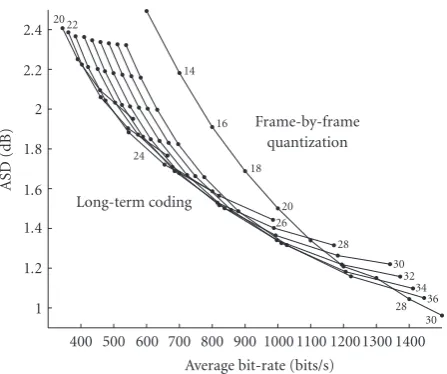
Figure4: Average spectral distortion (ASD) as a function of the average bit rate, calculated on the whole voiced test database, and for both the LSF LT coding and frame-by-frame LSF quantization. The plotted numbers are the resolutions (in bits/vector). For each resolution, the different points of each LT-coding curve cover the range of the ASD target.
36 bits/vector. The ASD target was being varied from 2.6 dB to a minimum value with a 0.2 dB step. The minimum value is 1.0 dB for r =36, 34, 32 and 30 bits/vector, and then it is increased by 0.2 dB each time the resolution is decreased by 2 bits/vector (it is thus 1.2 dB for r = 28 bits/vector, 1.4 dB for r = 26 bits/vector, and so on). In parallel, the distortion-rate values were also calculated for usual frame-by-frame quantization using the same quantizers than in the LT coding process, and using the same test corpus. In this case, the resolution range was extended to lower values for a better comparison. For the 2D-transform coding methods, the temporal size was varied from 1 to 20 for voiced LSFs, and from 1 to 10 for unvoiced LSFs. This choice was made after the histograms ofFigure 2and after considerations on computational limitations.11 It is coherent with the values
considered in [19]. We calculated the corresponding ASD for the complete test corpus, and for seven values of the optimal scalar quantizers resolution: 0.75, 1, 1.25, 1.5, 1.75, 2.0 and 2.25 bits/parameter. This corresponds to 375, 500, 625, 750, 875, 1,000 and 1,125 bits/s, respectively, (since the hop size is 20 ms). We also calculated for each of these resolutions a weighted average value of the spectral distortion (ASD), the weights being the bins of the histogram of
Figure 2 (for the test corpus) normalized by the total size of the corpus. This enables one to take into account the distribution of the temporal size of the LSF sequences in the rate-distortion relationship, for a fair comparison with the proposed LT coding technique. This way, we assume that both the proposed method and 2D-transform coding methods work with the same “adaptive” temporal-block configuration.
The results are presented in Figures4and5for the voiced sections, and in Figures6and7for the unvoiced sections. Let us begin the analysis of the results with the voiced sections.
Figure 4displays the results of the LT coding technique in terms of ASD as a function of the bit rate. Each one of the curves on the left of the figure corresponds to a fixed MS-VQ resolution (which value is plotted), the ASD target being varied. It can be seen that the different resolutions provide an array of intertwined curves, each one following the classic general rate-distortion relationship: an increase of the ASD goes with a decrease of the bit rate. These curves are generally situated on the left of the curve corresponding to the frame-by-frame quantization, which is also plotted. They thus generally correspond to smaller bit rates. Moreover, the gain in bit rate for approximately the same ASD can be very large, depending on the considered region and the resolution (see more details below). In a general manner, the way the curves are intertwined involves that increasing the resolution of the MS-VQ quantizer makes the bit rate increase for the left upper region of the curves, but it is no more the case in the right lower region, after the “crossing” of the curves. This illustrates the specific trade-offthat must be tuned between quantization accuracy and modeling accuracy, as mentioned inSection 3.4. The ASD target value has a strong influence on this trade-off. For a given ASD level, the lower bit rate is obtained with the leftmost point, which depends on the resolution. The set of optimal points for the different ASD values, that is, the left-down envelope of the curves, can be extracted and it forms what will be referred to as theoptimal LT coding curve.
For easier comparison, we report this optimal curve on Figure 5, and we also plot on this figure the results obtained with the 2D-DCT and KLT transform coding methods (and also again the frame-by-frame quantization curve). The curves of the 2D-DCT transform coding are given for the temporal size 2, 5, 10 and 20, and also for the “adaptive” curve (i.e., the values averaged according to the distribution of the temporal size) which is the main reference in this variable-rate study. We can see that for the 2D-DCT transform coding, the longer is the temporal size, the lower is the ASD. The average curve is between the curves corresponding toK=5 andK=10. For clarity, the KLT transform coding curve is only given for the adaptive configuration. This curve is about 0.05 to 0.1 dB below the adaptive 2D-DCT curve, which corresponds to about 2-3 bits/vector savings, depending on the bit rate (this is consistent with the optimal character of the KLT and with the results reported in [19]).
1 1.2 1.4 1.6 1.8 2 2.2 2.4 2.6 2.8 3
ASD
(dB)
400 600 Optimal long-term quantization
2D-DCT transform coding
Adaptive 2D-DCT transform coding
Adaptive KLT transform coding
Frame-by-frame quantization
800 1000 1200 1400 Average bit-rate (bits/s)
Figure5: Average spectral distortion (ASD) as a function of the average bit rate, calculated on the whole voiced test database, and for LSF optimal LT coding (continuous line, black points, on the left); Frame-by-frame LSF quantization (continuous line, black points, on the right); 2D-DCT transform coding (dashed lines, grey circles) for, from top to bottom,K=2, 5, 10, and 20; adaptive 2D-DCT transform coding (continuous line, grey circles); and adaptive 2D-KLT transform coding (continuous line, grey diamonds).
20 2224
26 28
12
30 32 3436
20
22 24 1
1.2 1.4 1.6 1.8 2
ASD
(dB)
400 500 600 Long-term
coding
Frame-by-frame quantization
700 800 900 1000 1100 1200 1300 Average bit-rate (bits/s)
Figure6: Same asFigure 4, but for the unvoiced test database.
technique clearly outperforms both 2D-transform methods. For example, at 2.0 dB of ASD, the bit rates of the LT, KLT, and 2D-DCT coding methods are about 489, 587, and 611 bits/s respectively. Therefore, the bit rate gain provided by the LT coding technique over the KLT and 2D-DCT techniques is about 98 bits/s (i.e., 16.7%) and 122 bits/s (i.e., 20%) respectively. Note that for such ASD value, the frame-by-frame VQ requires about 770 bits/s. Therefore, compared to this method, the relative gain in bit rate of the LT coding is about 36.5%. Moreover, since the slope of the LT coding curve is smaller than the slope of the other curves, the relative gain in bit rate (or in ASD) provided by the LT
coding significantly increases as we go towards lower bit rates. For instance, at 2.4 dB, we have about 346 bits/s for the LT coding, 456 bits/s for the KLT, 476 bits/s for the 2D-DCT, and 630 bits/s for the frame-by-frame quantization. The relative bit rate gains are respectively 24.1% (110 out of 456), 27.3% (130 out of 476), and 45.1% (284 out of 630).
In terms of ASD, we have for example 1.76 dB, 1.90 dB, and 1.96 dB respectively for the LT coding, the KLT, and the 2D-DCT at 625 bits/s. This represents a relative gain of 7.4% and 10.2% for the LT coding over the two 2D-transform coding techniques. At 375 bits/s this gain reaches respectively 15.8% and 18.1% (2.30 dB for the LT coding, 2.73 dB for the KLT, and 2.81 dB for the 2D-DCT).
For unvoiced sections, the general trends of the LT quantization technique discussed in the voiced case can be retrieved inFigure 6. However, at a given bit rate, the ASD obtained in this case is generally slightly lower than in the voiced case, especially for the frame-by-frame quantization. This is because unvoiced LSF vectors are easier to quantize than voiced LSF vectors, as pointed out in [31]. Also, the LT coding curves are more “spread” than for the voiced sections of speech. As a result, the bit rates gains compared to the frame-by-frame quantization are positive only below, say, 900 bits/s, and they are generally lower than in the voiced case, although they remain significant for the lower bit rates. This can be seen more easily onFigure 7, where the optimal LT curve is reported for unvoiced sections. For example, at 2.0 dB the LT quantization bit rate is about 464 bits/s, while the frame-by-frame quantizer bit rate is about 618 bits/s (thus the relative gain is 24.9%). Compared to the 2D-transform techniques, the LT coding technique is also less efficient than in the voiced case. The “crossing point” between LT coding and 2D-transform coding is here at about{700–720 bits/s, 1.6 dB}. On the right of this point, the 2D-transform techniques clearly provide better results than the proposed LT coding technique. In contrast, below 700 bits/s, the LT coding provides better performances, even if the gains are lower than in the voiced case. An idea of the maximum gain of LT coding over 2D-transform coding is given at 1.8 dB: the LT coding bit rate is 561 bits/s, although it is 592 bits/s for the KLT, and 613 bits/s for the 2D-DCT (the corresponding relative gains are 5.2% and 8.5%, resp.).
Let us close this subsection with a calculation of the approximate bit rate which is necessary to encode the{K,P}
pair (see Section 3.1). It is a classical result that any finite alphabet α can be encoded with a code of average length
L, withL < H(α) + 1, where H(α) is the entropy of the alphabet [1]. We estimated the entropy of the set of{K,P}
1 1.2 1.4 1.6 1.8 2 2.2
ASD
(dB)
Optimal long-term quantization
2D-DCT transform coding Adaptive 2D-DCT
transform coding Adaptive KLT transform coding
Frame-by-frame quantization
Average bit-rate (bits/s)
300 400 500 600 700 800 900 1000 1100 1200 1300
Figure7: Same asFigure 5, but for the unvoiced test database. The results of the 2D-DCT transform coding (dashed lines, grey circles) are plotted for, from top to bottom,K=2, 5, and 10.
quantization. Besides, the 2D-transform coding methods require the transmission of the size K of each section. Following the same idea, the entropy for the set ofKvalues was found to be 5.1 bits for the voiced sections, and 3.4 bits for the unvoiced section. Therefore, the corresponding coding rates are 5.1×2.5 = 12.75 bits/s and 3.4×2.5 =
8.5 bits/s respectively. The difference between encoding K
and the pair{K,P}is less than 5 bits/s in any case. This shows that (i) the values of K andP are significantly correlated, and (ii) because of this correlation, the additional cost for encodingPin addition toKis very small compared to the bit rate difference between the proposed method and the 2D-transform methods within the bit rate range of interest.
4.4.3. Listening Tests. To confirm the efficiency of the long-term coding of LSF parameters from a subjective point of view, signals with quantized LSFs were generated by filtering the original signals with the filterF(z)= A(z)/A(z), where
A(z) is the LPC analysis filter derived from the quantized LSF vector, andA(z) is the original (unquantized) LPC filter (this implies that the residual signal is not modified). The sequence of A(z) filters was generated with both the LT method and 2D-DCT transform coding. Ten sentences of TIMIT were selected for a formal listening test (5 by a male speaker and 5 by a female speaker, from different dialect regions). For each of them, the following conditions were verified for both voiced and unvoiced sections: (i) the bit rate was lower than 600 bits/s; (ii) the ASD was between 1.8 dB and 2.2 dB; (iii) the ASD absolute difference between LT-coding and 2D-DCT coding was less than 0.02 dB; and (iv) the LT coding bit rate was at least 20% (resp., 7.5%) lower than the 2D-DCT coding bit rate for the voiced (resp., unvoiced) sections. Twelve subjects with normal hearing listened to the 10 pairs of sentences coded with the two methods and presented in random order, using a high-quality PC soundcard and Sennheiser HD280 Headphones, in a quiet environment. They were asked to make a forced
choice (i.e., perform an A-B test), based on the perceived best quality.
The overall preference score across sentences and subjects is 52.5% for the long-term coding versus 47.5% for the 2D-DCT transform coding. Therefore, the difference between the two overall scores does not seem to be significant. Considering the scores sentence by sentence reveals that, for two sentences, the LT coding is significantly preferred (83.3% versus 16.7%, and 66.6% versus 33.3%). For one other sentence, the 2D-DCT coding method is significantly preferred (75% versus 25%). In those cases, both LT coded signal and 2D-DCT coded signal exhibit audible (although rather small) artifacts. For the seven other sentences, the scores vary between 41.7%–58.3% to the inverse 58.3%– 41.7%, thus indicating that for these sentences, the two methods provide very close signals. In this case, and for both methods, the quality of the signals, although not transparent, is quite fairly good for such low rates (below 600 bits/s): the overall sounding quality is preserved, and there is no significant artifact.
These observations are confirmed by extended informal listening tests on many other signals of the test database: It has been observed that the quality of the signals obtained by the LT coding technique (and also by the 2D-DCT transform coding) at rates as low as 300−500 bits/s varies a lot. Some coded sentences are characterized by quite annoying artifacts, whereas some others exhibit surprisingly good quality. Moreover, in many cases, the strength of the artifacts does not seem to be directly correlated with the ASD value. This seems to indicate that the quality of very-to-ultra low bit rate LSF quantization may largely depend on the signal itself (e.g., speaker and phonetic content). The influence of such factors is beyond the scope of this paper, but it should be considered more carefully in future works.
4.4.4. A Few Computational Considerations. The complete LT LSF coding and decoding process is done in approximately half real-time using MATLAB on a PC with a processor at 2.3 GHz (i.e., 0.5 s is necessary to process 1 s of speech).12
Experiments were conducted with the “raw” exhaustive search of optimal orderPin the algorithm ofSection 3.2. A refined (e.g., dichotomous) search procedure would decrease the computational cost and time by a factor of about 4 to 5. Therefore, an optimized C implementation would run within several ranges of order below real-time. Note that the decoding time is only a small fraction (typically 1/10 to 1/20) of the coding time since decoding consists in applying only (8) and (9) only once, using the reduced set of decoded LSF vectors and decoded{K,P}pair.
5. Summary and Perspectives
its optimal order. As a result, the method generally provides a very large gain in bit rate (up to 45%) compared to short term (frame-by-frame) quantization, at an equivalent coding quality. Also, for the lower range of tested bit rates (i.e., below 600–700 bits/s), the method compares favorably with transform coding techniques that also exploit the interframe correlation of LSFs across many frames. This has been demonstrated by extensive distortion/rate benchmark and listening tests. The bit rate gain is up to about 7.5% for unvoiced speech, and it is up to about 25% for voiced speech, depending on coding accuracy. Of course, at the considered low bit rates, the ASD is significantly above the 1.0 dB bound which is correlated with transparency quality. However, the proposed method provides a new bound of attainable performances for LSF quantization at very- to ultra-low bit rates. It can also be used as a first stage in a refined LSF coding scheme at higher rates: the difference between original and LT-coded LSF can be coded by other techniques after that the long-term interframe correlation has been removed.
It must be mentioned here that although efficient, the MS-VQs used in this study are not the best quantizers available. For instance, we have not used fully optimized (i.e., using treillis search as in [30]) MS-VQ, but basic (i.e., sequential search) MS-VQ. Also, more sophisticated frame-wise methods have been proposed to obtain transparent LSF quantization at rates lower than the ones required for MS-VQ, but at the cost of increased complexity [35,
36]. Refined versions of split-VQ are also good candidates for improved performances. We restricted ourselves with a relatively simple VQ technique because the goal of the present study was primarily to show the interest of the long-term approach. Therefore, it is very likely that the performances of the proposed LT coding algorithm can be significantly improved by using high-performance (but more complex) quantizers,13since the reduced set of LSF vectors
may be quantized with lower ASD/resolution compared to the MS-VQ. In contrast, it seems very difficult to improve the performances of the reference 2D-transform methods, since we used optimal (non-uniform) quantizers to encode the corresponding 2D coefficients.
As mentioned before, the analysis settings have been shown to noticeably influence the performance of the proposed method. As pointed out in [13], “it is desirable for the formant filter parameters to evolve slowly, since their [short-term] fluctuations may be accentuated under quantization, creating audible distortions at update instants”. Hence it may be desirable to carefully configure the analysis, or to pre-process the LSF with a smoothing method (such as [13,14] or a different one) before long-term quantization, to obtain trajectories freed from undesirable local fluctuations partly due to analysis (seeFigure 3). This is likely to enable the proposed fitting algorithm to significantly lower the LT model order and hence lower the bit rate, without impair-ing signal quality. A deeper investigation of this point is needed.
Beyond those potential improvements, future work may focus on the elaboration of several complete speech coders functioning at very- to ultra-low bit rates and exploiting the
long-term approach. This requires an appropriate adaptation of the proposed algorithm to the coding of the excitation (residual signal). For example, ultra-low bit rate coding with acceptable quality may be attainable with the long-term coding of basic excitation parameters such as funda-mental frequency, voicing frequency (i.e., the frequency that “separates” the voiced region and the unvoiced region for mixed V/UV sounds), and corresponding gains. Also, we intend to test the proposed long-term approach within the framework of (unit-based concatenative) speech synthesis. As mentioned inSection 2, the long-term model that is used here to exploit the predictability of LSF trajectories can also be directly used for time interpolation of those trajectories (a property that is not assumed by 2D-transform coding; see Endnote 5). In other words, the proposed method offers an efficient framework for direct combination of decoding and time interpolation, as required for speech transformation in (e.g., TTS) synthesis systems. It can be used to interpolate LSF (and also source parameters) “natural” trajectories, to be compared in future works with more or less complex existing interpolation schemes. Note that the proposed method is particularly suitable for unit-based synthesis, since it is naturally frame length- and bitrate-adaptive. Therefore, an appropriate mapping between speech units and long-term frames can be defined.14As suggested by [13], the interaction
between filter parameters and source parameters should be carefully examined within this long-term coding and interpolating framework.
Endnotes
1. The differential VQ and other schemes such as pre-dictive VQ and finite-state VQ can be seen as spe-cial cases of recursive VQ [2, 10], depending on the configuration.
2. In the following, the term “long-term” refers to con-sidering long sections of speech, including several to many short-term frames of about 20 ms. Hence, it has a different meaning than in the “long-term (pitch) predictor” of speech coders.
3. The V/UV segmentation is compliant with the expecta-tion of somewhat “coherent” LSF trajectories on a given long-term section. Indeed, it is well known that these parameters have a different general behavior for voiced or unvoiced sounds (see, e.g., [31]).
4. In the following, all vectors of consecutive values in time are row vectors, while vectors of simultaneous values taken at a given time instant are column vectors. Matrices are organized accordingly.
coefficients of (1). Hence, the coefficients of C are time model coefficients. In contrast, 2D-transform coefficients jointly concentrate both time and frequency information from data (and those 2D models cannot be directly interpolated in one dimension).
6. For the fixed-size 10-to-4 conversion of LSF into poly-nomial coefficients. Let us remind that in the present study, theK-to-Pconversion is of variable dimension.
7. “Coding transparency” means that speech signals syn-thesized with the quantized and unquantized LSFs are perceptually undistinguishable.
8. The methods [6–14] exploiting interframe LSF correla-tion are not pertinent in the present study. Indeed, the LSF vectors of the reduced set are sparsely distributed in the considered section of speech, and their correlation is likely to be poor.
9. The analysis settings have been shown to slightly influ-ence the performance of the proposed method, since they can provide successive LSF vectors with slightly different degrees of correlation. The present settings are different from the ones used in [24], and they provided slightly better results. They were partly suggested by [37]. Also, this suggests that the proposed method is likely to significantly benefit from a pre-processing of the LSF with “short-term” smoothing methods, such as [13,14] (seeSection 5).
10. Note that for the 2D-DCT the coefficients are fixed whereas they depend on the data for the KLT; thus, for each tested temporal size, the KLT coefficients are also determined from the training data.
11. We must ensure (i) a sufficient number of (voiced or unvoiced) sections of a given size to compute the corresponding bit allocation tables and optimal scalar quantizers (and transform coefficients for the KLT), and (ii) a reasonable calculation time for experiments on such extended corpus. Note that for the 2D-transform coding methods, voiced (resp., unvoiced) sequences larger than 20 (resp., 10) vectors are split into sub-sequences.
12. In comparison, the adaptive (variable-size) 2D-transform coding methods require only approximately 1/10th of real-time, hence 1/5th of the proposed method resource. This is mainly because they do not require inverse matrix calculation but only direct matrix products.
13. The proposed method is very flexible in the sense that it can be directly applied with any type of frame-wise quantizer.
14. In the present study we used V/UV segmentation (and adapted coding), but other segmentation, more adapted to concatenative synthesis, can be considered (e.g., “CV” or “VCV”). Alternately, all voiced or all unvoiced (subsets of) units could be considered in synthesis system using the proposed method.
References
[1] J. D. Markel and A. H. Gray Jr.,Linear Prediction of Speech, Springer, New York, NY, USA, 1976.
[2] R. M. Gray and A. Gersho, Vector Quantization and Signal Compression, Kluwer Academic Publishers, Boston, Mass, USA, 1992.
[3] J. Pan and T. R. Fischer, “Vector quantization of speech line spectrum pair parameters and reflection coefficients,”IEEE Transactions on Speech and Audio Processing, vol. 6, no. 2, pp. 106–115, 1998.
[4] P. Hedelin, “Single stage spectral quantization at 20 bits,” in Proceedings of the IEEE International Conference on Acoustics, Speech and Signal Processing (ICASSP ’94), pp. 525–528, Adelaide, Australia, 1994.
[5] N. Sugamura and F. Itakura, “Speech analysis and synthesis method developed at ACL in NTT—from LPC to LSP,”Speech Communication, vol. 5, no. 2, pp. 199–215, 1986.
[6] M. Yong, G. Davidson, and A. Gersho, “Encoding of LPC spectral parameters using switched-adaptive interframe vector prediction,” inProceedings of the IEEE International Conference on Acoustics, Speech and Signal Processing (ICASSP ’88), pp. 402–405, New York, NY, USA, 1988.
[7] F.-R. Jean and H.-C. Wang, “Transparent quantization of speech LSP parameters based on KLT and 2-D-prediction,” IEEE Transactions on Speech and Audio Processing, vol. 4, no. 1, pp. 60–66, 1996.
[8] C. Tsao and R. M. Gray, “Matrix quantizer design for LPC speech using the generalized Lloyd algorithm,” IEEE Transactions on Acoustics, Speech, and Signal Processing, vol. 33, no. 3, pp. 537–545, 1985.
[9] C. S. Xydeas and C. Papanastasiou, “Split matrix quantization of LPC parameters,”IEEE Transactions on Speech and Audio Processing, vol. 7, no. 2, pp. 113–125, 1999.
[10] J. Samuelsson and P. Hedelin, “Recursive coding of spectrum parameters,”IEEE Transactions on Speech and Audio Process-ing, vol. 9, no. 5, pp. 492–502, 2001.
[11] A. D. Subramaniam, W. R. Gardner, and B. D. Rao, “Low-complexity source coding using Gaussian mixture models, lat-tice vector quantization, and recursive coding with application to speech spectrum quantization,”IEEE Transactions on Audio, Speech and Language Processing, vol. 14, no. 2, pp. 524–532, 2006.
[12] S. Subasingha, M. N. Murthi, and S. V. Andersen, “Gaussian mixture kalman predictive coding of line spectral frequencies,” IEEE Transactions on Audio, Speech and Language Processing, vol. 17, no. 2, pp. 379–391, 2009.
[13] M. R. Zad-Issa and P. Kabal, “Smoothing the evolution of the spectral parameters in linear prediction of speech using target matching,” inProceedings of the IEEE International Conference on Acoustics, Speech and Signal Processing (ICASSP ’97), vol. 3, pp. 1699–1702, Munich, Germany, 1997.
[14] F. Nord´en and T. Eriksson, “Time evolution in LPC spectrum coding,”IEEE Transactions on Speech and Audio Processing, vol. 12, no. 3, pp. 290–301, 2004.
[15] B. S. Atal, “Efficient coding of LPC parameters by tem-poral decomposition,” in Proceedings of the IEEE Interna-tional Conference on Acoustics, Speech and Signal Processing (ICASSP ’83), vol. 1, pp. 81–84, Boston, Mass, USA, 1983. [16] A. M. L. Van Dijk-Kappers and S. M. Marcus, “Temporal
[17] Y.-M. Cheng and D. O’Shaughnessy, “On 450–600 b/s natural sounding speech coding,” IEEE Transactions on Speech and Audio Processing, vol. 1, no. 2, pp. 207–220, 1993.
[18] N. Farvardin and R. Laroia, “Efficient encoding of speech LSP parameters using the discrete cosine transformation,” in Proceedings of the IEEE International Conference on Acoustics, Speech and Signal Processing (ICASSP ’89), vol. 1, pp. 168–171, Glasgow, UK, 1989.
[19] D. J. Mudugamuwa and A. B. Bradley, “Optimal transform for segmented parametric speech coding,” inProceedings of the IEEE International Conference on Acoustics, Speech and Signal Processing (ICASSP ’98), vol. 1, pp. 525–528, Seattle, Wash, USA, 1998.
[20] S. Dusan, J. Flanagan, A. Karve, and M. Balaraman, “Speech coding using trajectory compression and multiple sensors,” in Proceedings of the International Conference on Speech & Language Processing, Jeju, South Korea, 2004.
[21] S. Dusan, J. Flanagan, A. Karve, and M. Balaraman, “Speech compression by polynomial approximation,” IEEE Transac-tions on Audio, Speech and Language Processing, vol. 15, no. 2, pp. 387–395, 2007.
[22] L. Girin, M. Firouzmand, and S. Marchand, “Long-term mod-eling of phase trajectories within the speech sinusoidal model framework,” inProceedings of the International Conference on Speech & Language Processing, Jeju, South Korea, 2004. [23] L. Girin, M. Firouzmand, and S. Marchand, “Perceptual
long-term variable-rate sinusoidal modeling of speech,”IEEE Transactions on Audio, Speech and Language Processing, vol. 15, no. 2, pp. 851–861, 2007.
[24] L. Girin, “Long-term quantization of speech LSF parameters,” inProceedings of the IEEE International Conference on Acous-tics, Speech and Signal Processing (ICASSP ’07), vol. 4, pp. 845– 848, Honolulu, Hawaii, USA, 2007.
[25] L. Girin, M. Firouzmand, and S. Marchand, “Comparing sev-eral models for perceptual long-term modeling of amplitude and phase trajectories of sinusoidal speech,” inProceedings of the 9th European Conference on Speech Communication and Technology (Interspeech ’05), pp. 357–360, Lisboa, Portugal, 2005.
[26] T. Galas and X. Rodet, “An improved cepstral method for deconvolution of source-filter systems with discrete spectra: application to musical sound signals,” inProceedings of the International Computer Music Conference (ICMC ’90), pp. 82– 84, Glasgow, UK, 1990.
[27] O. Capp´e, J. Laroche, and E. Moulines, “Regularized estima-tion of cepstrum envelope from discrete frequency points,” inProceedings of the IEEE Workshop on Applications of Signal Processing to Audio and Acoustics (WASPAA ’95), New Paltz, NY, USA, October 1995.
[28] K. K. Paliwal and B. S. Atal, “Efficient vector quantization of LPC parameters at 24 bits/frame,”IEEE Transactions on Speech and Audio Processing, vol. 1, no. 1, pp. 3–14, 1993.
[29] N. Phamdo, N. Favardin, and T. Moriya, “Combined source-channel coding of LSP parameters using multi-stage vector quantization,” in Proceedings of the IEEE Work-shop on Speech Coding for Telecommunications, pp. 36–38, 1991.
[30] W. P. LeBlanc, B. Bhattacharya, S. A. Mahmoud, and V. Cuperman, “Efficient search and design procedures for robust multi-stage VQ of LPC parameters for 4 kb/s speech coding,” IEEE Transactions on Speech and Audio Processing, vol. 1, no. 4, pp. 373–385, 1993.
[31] R. Hagen, E. Paksoy, and A. Gersho, “Voicing-specific LPC quantization for variable-rate speech coding,”IEEE Transac-tions on Speech and Audio Processing, vol. 7, no. 5, pp. 485–494, 1999.
[32] N. S. Jayant and P. Noll, Digital Coding of Waveforms: Principles and Applications to Speech and Video, Prentice-Hall, Englewood Cliffs, NJ, USA, 1984.
[33] Y. Linde, A. Buzo, and R. M. Gray, “An algorithm for vector quantizer design,” IEEE Transactions on Communications Systems, vol. 28, no. 1, pp. 84–95, 1980.
[34] J. S. Garofolot, L. F. Lamel, W. M. Fisher, et al., TIMIT Acoustic-Phonetic Continuous Speech Corpus, Linguistic Data Consortium, Philadelphia, Pa, USA, 1993.
[35] M. A. Ferrer-Ballester and A. R. Figueiras-Vidal, “Efficient adaptive vector quantization of LPC parameters,”IEEE Trans-actions on Speech and Audio Processing, vol. 3, no. 4, pp. 314– 317, 1995.
[36] A. D. Subramaniam and B. D. Rao, “PDF optimized paramet-ric vector quantization of speech line spectral frequencies,” IEEE Transactions on Speech and Audio Processing, vol. 11, no. 2, pp. 130–142, 2003.