www.dx.doi.org/10.21113/iir.v8i1.384 _____________________________
Abstract
The focus of this study is to identify the barriers to develop and introduce innovations in the public sector of Kosovo. This paper is compiled based on the mixed methodology approach and findings are compared and contrasted with the current condition of knowledge. The findings clearly indicate that a risk-averse culture still continues in Kosovo’s public sector. In addition to this, lack of human and financial resources adds another important barrier towards public sector innovation. Moreover, staff resistance is also considered an important barrier to public sector innovation in Kosovo. Therefore, it is recommended for public sector managers to integrate the new concepts of the open innovation and networked governance to reduce these barriers. These concepts demand engaging all employees as well as external parties in critical innovation processes which in evasion will lead to the adoption of an innovative culture in the public sector of Kosovo. This study contributes to further research, regarding the adoption of the culture of innovation in the public sector of developing countries. Finally, this research enriches and widens the current knowledge in the public sector innovation with a focus on the barriers to public sector innovation processes in developing countries.
MSc. Ri
nor
K
UR
TES
HI
A Systematic Review of the Internal and
External Barriers to Public Sector
Innovation in Kosovo
Key Words: Public sector innovation; barriers to innovation processes; innovation; Kosovo;
1. Introduction
1.1. Introduction to public sector innovation
Innovation in the public sector domain has gained great interest from both professionals and scholars (Hartley, 2005; Moore, 2005; Albury, 2005). Financial challenges and growing service needs in the public sector are some of the reasons that have fostered the need to study innovation in the public sector domain (Townsend, 2013; Kallio, 2013; Bason, 2013). The importance of innovation lies upon the change in the overall efficiency, effectiveness and responsiveness of governments and public service organizations.
Financial challenges and growing service needs in the public sector have increased the need for public managers to find new alternatives for achieving their work goals, which in default has led to study innovation in the public sector domain (Townsend, 2013; Kallio, 2013; Bason, 2013).
In the modern era, economic growth is uncertain therefore public services must be produced with fewer resources but retain quality, whereby public stakeholders face challenges in developing, producing and diffusing innovation (Albury, 2005; Hartley, 2005). The literature is limited in the scope of public sector innovation, in particular among transitional economies (Batalli, 2011).
In this paper, the factors that impede innovation in the public sector of Kosovo are thoroughly researched and discussed.
1.2. Research inquiry and research objectives
Innovation is crucial in today’s environment. It is of great importance to organizations that continuously compete and to economies at large (Kallio et al., 2013). In addition, innovations not only increases the capabilities of private organizations to remain competitive in the global market, nevertheless, they are of prime importance to today’s public sector excessively (Goyal and Pitt, 2007; Blahus, 2012; Bason et al., 2013).
_____________________________
study, however, the focus is on the barriers that impede innovation practices in the public sector of Kosovo.
The research objectives for analyzing the query are:
O1. Discover and review the main internal and external barriers of innovation in the public sector of Kosovo;
O2. Compare and contrast the barriers to innovation practices in the public sector of Kosovo, with the existing literature.
2. Literature Review
Discovering and reviewing the barriers to public sector innovation is of paramount importance in the evolution of public sector innovation. By identifying the barriers that impede innovation, public sector manager may develop strategies to mitigate them. According to the literature, the main barriers to public sector innovation are: The existence of a risk averse culture, a perceived need for establishing or maintaining stability, unsupportive bureaucratic processes and a deficit of incentives (Mulgan and Albury, 2003; Steen, 2009).
2.1. Risk Averse
The private and public sector are undergoing significant reforms and thus they are obliged to adapt in a continuous way to the transformations that are happening. For achieving successful adoption of reforms, organizations have to become learning organizations, which in default requires mitigating the fear from the new among the organizational staff. However, this is easily achievable in the private sector, but individuals who work in the public sector are more risk averse because of the impact that the adoption of a culture of innovation would potentially have on their career (Pfeifer, 2011; Barrados and Mayne, 2003). In addition to that, public sector employees feel that they are underpaid in compare to their contribution and due to that they hesitate to provide further contributions to their organization (Buurman et al., 2012).
prevailing in the public sector due to the reason that public sector managers and staff feel secure, while managers and staff that feel threatened and face the fear of unemployment are more predominant to take risks. Another factor that causes a risk adverse culture is the managers’ lack of trust towards their employees, because a certain level of trust in subordinates means tolerance of occasional mistakes; trust is a prerequisite to risk taking actions in the organizational level (Parsons, 2006). Furthermore, formalized personnel constraints that provide employee protection from being fired, add another source to the risk adverse culture (Chen and Bozeman, 2012).
Overcoming the risk adverse culture in the public sector is only achievable by learning how to manage risk and being prepared to admit failure and be innovative towards overcoming those failures. Some solutions towards this shift are:
- Leadership from top management, which demonstrates the value of learning;
- A free flow of information in a non-hierarchal way;
- Rewarding inquiry and learning, especially from mistakes; - Political support for a learning public service;
- An accountability system, which supports learning (Barrados and Mayne, 2003).
The difficult question is how to achieve this shift. Joyce (2007) states that even in organizations where innovation is actively promoted, it takes time for them to overcome a risk adverse culture and shift to a learning organization.
2.2. Maintaining Stability
_____________________________
maintaining stability will diminish the importance of innovation in the public sector (Sorenson and Torfing, 2011). Anthony Down (1967) conceives the high degree of stability in the public bureaucracies as a perennial problem because it prevents a dynamic adaptation of the public sector to societal changes and new conditions for public governance.
2.3. Deficit of Incentives
Incentives are important to encourage employees to be innovative and from the organizational perspective, both the private and public sector want their employees to be innovative. Nevertheless, the public sector usually cannot provide significant monetary incentives whereas the private sector offers financial incentives and special bonuses to its employees for bringing up innovative ideas. Few incentives are identified by researchers from a public sector viewpoint that encourage employees to be innovative (Rosenblat, 2011; Mulgan, 2007; Albury, 2005; Borins, 2001).
Except monetary incentives, Borins (2001) brings light into the issue of why employees in the public sector deter to be innovative. He makes a comparison where individuals with innovative ideas in the private sector become partners or owners of their innovations, but in the public sector, innovations become the property of the government. Adding to this, fixed salaries, modest bonuses, etc., discourage public sector employees to take on innovation. However, there are incentives such as promotions and the respect of peers and bosses, which help in becoming more innovative (Rosenblatt, 2011). This viewpoint is also proven by Sauermann and Cohen (2008). Adding to this, certain people are service-oriented, they behave consistently with the public interest, this is called ‘public service motivation’, it is considered a factor of motivation for public sector employees (Perry and Hondeghem, 2008; Brewer et al., 2000).
2.4. Bureaucratic Processes
Overcoming this obstacle requires serious commitment to reforming the gears of innovation in the public sector, through: policy development, legislation, budget requirements and performance reporting (Steen, 2009). Adding to this, the number of goals that a new initiative has to accomplish poses barriers towards innovation, for instance: If a new idea is proposed, it should accomplish certain goals, such as: equality, universal access, protection of citizens, rights and respect for the rule of law, etc. Many rules and bureaucracies in default are barriers towards innovations (Mulgan, 2007). The discussion above serves as a basis for formulating strategies to overcome barriers to public sector innovation processes in Kosovo.
3. Methodology
Based on the topic under research, a mixed methodology would provide important insights to the topic under investigation. Mixed methodology is a convergence of quantitative and qualitative methods (Driscoll et al., 2007). Quantitative methods are viewed as descriptive, because correlations between variables alone cannot drive to uncover the causes that generate the actual event that is being observed. Researchers have described quantitative methods as unsatisfactory and problematic. In contracts to the quantitative approach, qualitative methods are more capable of describing a phenomenon, in identifying interaction between complex mechanisms (Volkoff et al., 2007). However, findings through the use of qualitative methods may be unique to few people included in the research study; the results are easily influenced by the researcher’s personal biases (Johnson and Onwuegbuzie, 2004). As a result, mixed methodology brings together the strengths of both quantitative and qualitative approaches, by generating more complete data and deeper understanding of the phenomenon, although it is time-consuming and costly (Johnson and Onwuegbuzie, 2004).
_____________________________
balance between the methods and to achieve a more comprehensive view of the findings.
Table 1: Participation of public institutions, according to activities
Activities Distribution
General government activities or finance 15.40%
Education 15.40%
Social services 25%
Health 5.80%
Other 34.60%
[Refusal] 3.80%
TOTAL 100%
Source: Author’s calculations based on data extracted from the distribution of questionnaires
The targeted personnel are public sector managers who are actively involved in decision-making. The managerial level affects all aspects of innovation in the public sector (Sarros et al., 2008). For deriving to concise and definite conclusions, both research methods, the quantitative and qualitative instruments are targeted to the managerial level employees for data collection. The questionnaires are delivered to the middle-level public sector managers (head of department), or in smaller organizations where such functions do not exist, supervisor or project managers are the target group, and interviews with senior managers or general managers responsible for strategic-decision-making are conducted.
For the collection of data, two methods were used, for the quantitative data collection the Inn barometer 2010 was employed which is developed by the Gallup Organization and the same questionnaire was used to derive questions for the qualitative data collection. Data gathered were analyzed through SPSS while qualitative data was analyzed through a thematic analysis.
4. Research Findings
impeding innovation (31% of respondents indicated that lack of financial resources is a high importance barrier to innovation development). Regulatory requirements seem not to have a high impact on innovation (60% of respondents indicated that regulatory requirements have low importance in impeding innovation). Lack of management support is considered a barrier towards developing innovation (19% of respondents said that lack of management support is considered a high importance factor on impeding innovation, while 37% of respondents said it was with medium importance). Concerning staff resistance (52% of respondents see it as an important barrier of innovation).
Figure 1: Importance of various barriers to develop and introduce innovations
Source: Author’s calculations based on data extracted from the distribution of questionnaires
Regarding the qualitative data analysis, interviewees have specified almost the same barriers that impede innovation as found through the quantitative data analysis. For instance, interviewee P2 states: “Lack of human resources and budgetary issues are the main barriers which are causing lack of innovation in our institution”, this view is supported from interviewee P3, who states: “Lack of financial resources are the main barrier to developing and introducing innovations in our institution.” However, interviewee P1 makes a distinction from the above statements and says: “The psychological factor, the background and culture of our people is an important barrier towards innovation”,
_____________________________
sector innovation in Kosovo, which is “lack of financial resources.” Another barrier, which is often stated from the interviewees, is “staff resistance”.
Interviewee P8 states: “Our staff is mainly old aged, and they are afraid of technology, therefore they lack the will and motivation to adapt to modern innovations like using personal computers.” In summary, the eight interviewees stated that the lack of human and financial resources are the main barriers of public sector innovation in Kosovo, without excluding the psychological/cultural factor which is considered as an important barrier towards public sector innovation in Kosovo.
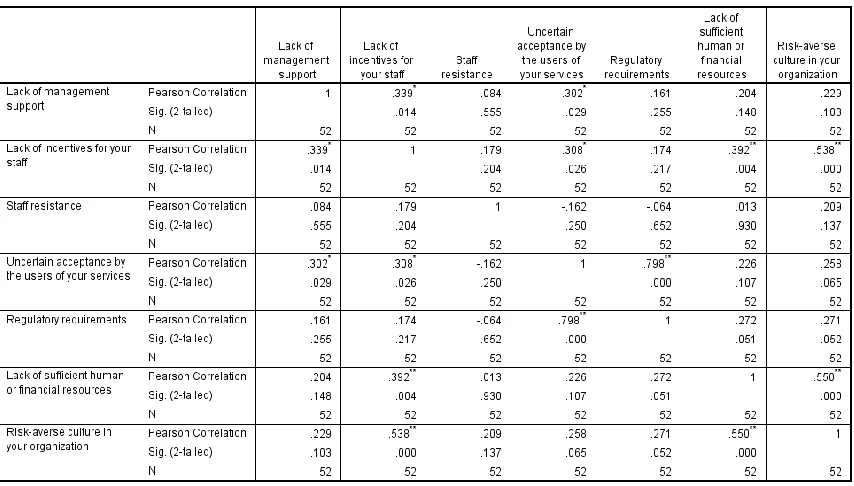
Running correlations between barriers of innovation, the results indicate that lack of sufficient human or financial resources have a strong positive correlation with the lack of incentives from staff. In addition to that, lack of incentives from staff correlates strongly with the risk-averse culture in the organization, which has proven to be the main barrier of public sector innovation in Kosovo (Appendix A).
In sum, the main barriers that cause the lack of development and introduction of innovations in the public sector of Kosovo are:
Risk-averse culture in your organization; Lack of sufficient human or financial resources; Staff resistance.
Since the three barriers above are the most prevalent barriers found, we will only focus on those three and identify the areas where these barriers are mostly spread in Kosovo’s public sector institutions. Based on findings, we can clearly tell that a risk averse culture is mostly spread in organizations which offer social services where a risk averse culture is found to be of medium and high importance, as well as in organizations which main areas of responsibilities include general governmental activities and functions or finance (Appendix B). There are many reasons behind this finding and future research should tackle this issue.
As for the barrier of lack of financial and human resources, it is widely spread across public sector organizations; however it is generally found to be of high importance among organizations providing social services, general governmental activities and education (Appendix C). Interestingly enough, a risk adverse culture and lack of financial and human resources are found in these two specific areas.
provides a base for future researchers who might be interested in identifying the reasons behind staff’s resistance to change and innovation (Appendix D).
5. Discussion and Conclusion
According to data analysis, the most notable barrier to public sector innovation in Kosovo is risk-averse culture. This finding is in perfect relation to the most recent literature. Pfeifer and Christina (2008) state that employees in the public sector are afraid from a culture of innovation because of the impact that the culture of innovation might have on their career. Furthermore, employees chose to work in the public sector mainly for the reason of avoiding risk (Buurman et al., 2012).
Another notable finding is that lack of sufficient human or financial resources played an important role in impeding the development and introduction of innovations in the public sector. These barriers are acknowledged throughout the quantitative and qualitative data analysis. This finding is in line with the literature. Joyce (2007) recognizes the position of financial or human resources as an essential factor to adopting a culture of innovation in the public sector. However, concerning the public sector domain, Murray et al. (2010) states that the public sector often lacks on innovation enablers, in terms of money, people and processes. In addition to that, due to the lack of financial resources, public managers and personnel are forced to be short-term thinkers (Bason, 2010).
_____________________________
take an active role in designing and implementing new public services (Kallio et al., 2013).
6. Conclusion
Regarding the barriers to public sector innovation practices, a strong risk-averse culture is found in Kosovo’s public sector, therefore, public sector manager have to provide trainings continuously to their employees regarding innovation practices in reaching effectiveness and efficiency in their jobs. Moreover, public sector organizations in Kosovo have to broaden their scope of obtaining financial resources and go beyond their current paradigm by becoming entrepreneurial, because findings obviously indicate that public sector institutions in Kosovo lack on financial resources. Furthermore, staff resistance still persists in the public sector of Kosovo. To overcome this barrier, the literature suggests hiring young staff that has cutting-edge knowledge in technology and other modern processes (Fernandez and Rainey, 2006).
List of References
Albury, D., (2005), “Fostering Innovation in Public Services” Public Money and Management, Vol 25, No.1, pg.51-56.
Barrados, M. and Mayne, H., (2003), “Can Public Sector Organizations Learn” OECD Journal on Budgeting, Vol 3, No.3, pg. 87-103.
Bason, C., (2010), “Leading public sector innovation: Co-creating for a better society” Policy Pres.
Bason, CH., (2013), “Design-led innovation in government” Stanford Social Innovation Review, Vol 11, No.2, pg.15-17.
Batalli, M., (2011), “Impact of Public Administration Innovations on Enhancing the Citizens’ Expectations” International Journal of e-Education, e-Business, e-Management and e-Learning, Vol.1, No.2, pg.156-162.
Blahuš, R., (2012), “The Importance of Innovations for Czech Business Companies” Journal of Innovation & Business Best Practices, 2012, pg. 1-11. Borins, S., (2001), “Encouraging innovation in the public sector” Journal of
Intellectual Capital, Vol. 2, No.3, pg. 310-319.
Brewer, G. A., Selden, S. C., Facer, I. I. and Rex, L., (2000), “Individual conceptions of public service motivation” Public administration review,
Buurman, M., Delfgaauw, J., Dur, R. and Bossche, S.V., (2012), “Public Sector Employees: Risk Averse and Altruistic” CESifo Working Paper,
Vol. 3851, pg. 1-30.
Carstensen, H. V., and Bason, C., (2012), “Powering collaborative policy innovation: Can innovation labs help” The Innovation Journal: The Public Sector Innovation Journal, Vol. 17, No. 1, pg. 1-26.
Chen, C.A. and Bozeman, B., (2012), “Organizational Risk Aversion: Comparing The Public and Non-Profit Sectors” Public Management Review, Vol. 14, No. 3, pg. 377-402.
Christian, P., (2008), “Risk aversion and sorting into public sector employment”, German Economic Review, Vol.12, No. 1, pg. 85-99.
Curry, L.A., Nembhard, I.M. and Bradley, E.H., (2009), Qualitative and mixed methods provide unique contributions to outcomes research”
Circulation, Vol. 119, No. 10, pg. 1442-1452.
Driscoll, D.L., Yeboah, A.A., Salib,P. and Rupert, D.J., (2007), “Merging qualitative and quantitative data in mixed methods research: How to and why not” Ecological and Environmental Anthropology, Vol. 3, No. 1, pg. 19-28.
Fernandez, S. and Rainey, H.G., (2006), “Managing Successful Organizational Change in the Public Sector” Public administration review, Vol. 66, No, 2, pg. 168-176.
Gadot, E.V., Shoham, A., Schwabsky, N. and Ruvio, A., (2005), “Public sector innovation for the managerial and the post-managerial era: Promises and realities in a globalizing public administration”
International Public Management Journal, Vol. 8, No. 1, pg. 57-81.
Golembiewski, R. T., & Vigoda, E., (2000), “Organizational innovation and the science/craft of management” Current topics in management, Vol. 5, pg. 263-280.
Goyal, S. and Pitt, M., (2007), “Determining the role of innovation management in facilities management” Facilities, Vol. 25, No. 1/2, pg. 48-60.
Hartley, J., (2005), “Innovation in Governance and Public Services: Past and Present” Public Money and Management, Vol.25, No. 1, pg. 27–34.
Johnson, R.B. and Onwuegbuzie, A.J., (2004), “Mixed Methods Research: A Research Paradigm Whose Time Has Come” American Educational Research Association, Vol. 33, No. 7, pg. 14-26.
_____________________________
http://www.queensu.ca/sps/publications/working_papers/43-Joyce.pdf [Accessed at: 19th of July, 2014].
Kallio, K., Lappalainen, I. and Tammela, K., (2013), “Co-innovation in public services: Planning or experimenting with users” The Innovation Journal: The Public Sector Innovation Journal, Vol. 18, No. 3, pg. 1-16. Moore, M.H., (2005), “Break-through innovations and continuous
improvement: Two different models of innovation processes in the public sector” Public Money & Management, Vol. 25, pg. 43-50.
Mulgan, G. and Albury, D., (2003), “Innovation in the public sector” Strategy Unit, Cabinet Office.
Murray R., Caulier-Grice J., Mulgan J., (2010), The open book of social innovations. NETSA, The Young Foundation.
Parson, W., (2012), “Innovation in the public sector: spare tires and fourth plinths” The Innovation Journal: The Public Sector Innovation Journal, Vol. 11, No. 2, pg. 1-9.
Perry, J. and Hondeghem, A., (2008), Motivation in Public Management: The Call of Public Service. Oxford University Press, Oxford.
Pfeifer, C., (2011), “Risk Aversion and Sorting into Public Sector Employment” German Economic Review, Vol. 12, No. 1, pg. 85–99
Rosenblatt, M., (2011), “The use of innovation awards in the public sector: Individual and organizational perspectives” Innovation: Management, policy and practice, Vol. 13, No. 2, pg. 207-219.
Sarros, J.C., Cooper, B.K. and Santora, J.C., (2008), “Building a Climate for Innovation Through Transformational Leadership and Organizational Culture” Journal of Leadership and Organizational Studies, Vol. 15, No. 2, pg. 145-158.
Sauermann, H. and Cohen, W., (2008), “What makes them tick? Employee motives and firm innovation” Management Science, Vol. 56, No. 2, pg. 2134-2153.
Sorensen, E. and Torfing, J., (2011), “Enhancing Collaborative Innovation in the Public Sector” Administration and Society, Vol. 43, No. 8, pg. 842-868. Steen, V.B., (2009), Measuring innovation in the BC public sector: developing a
performance measurement framework for IGRS'innovation program.
Unpublished MA dissertation.
_____________________________ Appendices
Appendix A
Appendix B