Issues
ISSN: 2146-4138
available at http: www.econjournals.com
International Journal of Economics and Financial Issues, 2016, 6(S2) 164-171.
Special Issue for “State and Municipal Regulation, Investment, Commerce: National and International Aspects of the Business”
Managing Innovational Processes at Cotton Processing
Enterprises in Central Asia Countries
Gulmira Mombekova
1*, Gulzhan Turysbekova
2, Assel Baimbetova
31International Kazakh-Turkish University Named after A. Yassawi, 29 B. Sattarkhanov Avenue, 161200 Turkestan, Republic of
Kazakhstan, 2Euroasian National University Named after L. N. Gumilev, K. Munaitpasov Street 5, 010008 Astana, Republic of
Kazakhstan, 3Euroasian National University Named after L. N. Gumilev, K. Munaitpasov Street 5, 010008 Astana, Republic of
Kazakhstan. *Email: [email protected]
ABSTRACT
Cotton is the most important cash crop in the economy of the Central Asia countries. After the Central Asia countries acquired their independence, decisive steps have been taken to liquidate the dependence on the export of cotton fiber and to increase volumes of cotton processing. At the present time the Central Asia countries have achieved a definite success in the development of cotton processing industry: New plants have been constructed and put into service, and the current production facilities have been modernized. However, productive capacities and technological level of cotton processing enterprises do not make it possible to turn out competitive products with the high added value. The situation in the cotton processing industry of the Central Asia countries emphasizes the urgency to increase the productivity, quality and competitiveness of products of cotton processing by forming a national innovative system of the industry development. The analysis of the positions of the Central Asia countries on the world cotton market and peculiarities of the development of cotton processing industry in the region allowed the author to make the conclusion that mastering and applying innovational technologies are a necessary condition for ensuring competitive advantages for cotton processing enterprises. The conducted research demonstrates that national systems of the Central Asia countries do not fully comply with the needs of the cotton processing industry and at the present time they are at their stages of formation. The author offers the following measures as basic ones in order to increase innovational activity of enterprises of cotton processing industry of Central Asia countries: Increasing expenses for research and development, implementing reforms of innovative systems, modernizing systems of higher education, raising external investments for the development of the sectoral science, and developing and implementing mechanisms to support innovational entrepreneurship.
Keywords: Cotton Cultivation, Textile Industry, Competitiveness, Innovations
JEL Classifications: E22, O13
1. INTRODUCTION
Cotton is the basic raw material of the textile industry. It is of high importance for the economic growth of both developed and developing countries, and contributes to the development of stable and socially responsible economy. Along with human resources of the Central Asia countries, high agro-climate potential creates favorable conditions for cultivating cotton and developing cotton processing industry in these countries.
Agricultural production, and in particular, cotton cultivation has always made up the economic basis for the development of
the Central Asia countries. Contemporary cotton industry of the Central Asia countries is a part of larger international trading of cotton fiber that is still produced in spite of the growing competitiveness on the part of synthetic textile (Rieter. Report about Countries - Central Asia).
Taking into account the mentioned above, the formation of optimized complete cycles from producing high quality raw cotton to producing ready products is an actual problem related to the development of the cotton industry for all Central Asia countries. However, examples seem to indicate that the formed mechanisms and methods of management do not fully comply with the contemporary market requirements. The limitation of capacities, low technological level, and high level of wear and tear of the equipment do not make it possible to reach the export potential of the cotton processing industry of the Central Asia countries.
In order to speed up the development of producing the end-user products, it is necessary not only to modernize the current production capacities and to create new ones, but also to actively implement innovational technologies at cotton processing enterprises. The development of market processes and dynamics of increasing cotton textile production in particular must rest on scientific basis, use and implementation of contemporary equipment and intensive innovational technologies.
The aim of this research is to define basic areas of the innovational development of enterprises of the cotton processing industry in Central Asia countries.
In order to achieve the set goal, we have solved the following tasks: • To consider the positions of the Central Asia countries on the
world market of cotton and cotton processing,
• To reveal peculiarities of the development of the cotton processing industry of the Central Asia countries and, • To define ways of innovational development of cotton
processing industry enterprises.
2. METHODOLOGY
It is possible to characterize the contemporary global economy as economy of knowledge. It is based on technological innovations, development of new products, and processes to increase competitiveness of domestic products on the world market.
Stable development is based on the combination of four types of innovations: Technological, product, marketing, and innovations of business systems (Henriksen et al., 2012).
Technological innovations that integrate various technical resources act as a basic area of increasing the labor effectiveness, providing stable quality of products and energy saving. In order to achieve new breakthroughs, it is necessary to form technological centers that monitor advanced cotton and textile technologies, acceleration of continuous processes, automation of production, improving cooperation within joint researches, etc.
Product innovations aim at researching new fibers, new technologies and processes with the emphasis on the development of functional production that enables producing high quality product with a higher added value.
Marketing of innovations focuses on the market environment, researches of market opportunities, market segmentation and
brand strategy, strategy of price formation and sale, positioning of the product on the domestic and foreign markets to achieve new breakthroughs in the management of the cotton processing enterprise.
Innovations in business systems aim at forming a model of profit. Here innovations act as a key factor of improving the management of research and development (R&D), marketing and other key areas.
The potential of innovational activity growth depends on appropriate management of implementing innovational mechanisms on the level of separate cotton processing enterprises.
The object of this research is the innovative development of the cotton processing industry of the Central Asia countries. The subject of the research includes prospects of the development of technological innovations of cotton processing enterprises that aim at reaching expert potential of the economy of these countries.
The methodological basis of the research includes dialectic principles and methods of abstracting, as well as the comprehensive approach that makes it possible to see the innovational process in the cotton processing industry and to manage it in the interrelation and interdependence. In our work we applied methods of empiric research, system analysis, structural and logical method, etc.
The informational basis of the research includes materials of customs services and services of state statistics of the Central Asia countries, materials of the Eurasian Economic Commission, data bases of the UNO (Commodity Trade Statistics, Industrial Commodity Statistics, Food and Agriculture Organization), materials of the International Monetary Fund, World Bank, World Trade Organization, Organization for Economic Cooperation and Development. The work uses data and publications of specialized editions and analytical reviews as well as results of researches made by marketing and consulting agencies, materials of industrial establishments, professional unions and associations.
3. POSITIONS OF THE CENTRAL ASIA
COUNTRIES ON THE WORLD COTTON
MARKET
In the classical definition Central Asia includes Kazakhstan, Kyrgyzstan, Uzbekistan, Tadzhikistan, and Turkmenistan. Along with other organizations this classification of Central Asia is also used by the UNO Census Bureau, the UN Statistics Division (World Trade Report, 2014).
In Central Asia this is an old tradition to grow cotton. Until now cotton has been grown in all five countries. Till 1991 three countries of the former Soviet Union - Uzbekistan, Tadzhikistan and Turkmenistan - used to be the main regions of the USSR that grew cotton and produced 90% of the yield per year.
The production of cotton continues playing an important role not only as a source of stable currency but also as a basis of the industrial development.
After five countries of Central Asia had become independent between 1991/1992 and 2013/2014, the volume of cotton production decreased by more than 41%. The decrease was especially sharp in Tadzhikistan (61%) and Uzbekistan (41%).
The analysis of the world production of cotton over the latest years demonstrates that Central Asia as a region with the production of about 1.3 million tons (2014/15) has only the share of 5.7% of the world production that is about 22.9 million tons.
Since 1999 the export of cotton has decreased by more than half. Thus, the relative decrease in the export volume was more considerable than the decrease in the production of cotton that was approximately 41% for the period of 1991/1992-2014/2015.
The comparison of volumes of production and export of cotton shows that as a whole the export share of the Central Asia region firstly was increasing since 1991/1992 till 2000/2001, and then it has been continuously decreasing. Consequently, since the beginning of the previous decade more and more cotton for further processing has remained on the territory of the country.
Uzbekistan is the largest producer of cotton and supplier of cotton fiber on the world market in Central Asia. Its share is about 65.7% of the cotton produced in Central Asia. Basic indicators of the cotton industry of the Central Asia countries in the season of 2014/2015 are shown in Table 1.
Uzbekistan does not have any access to a sea. It is located in the center of Central Asia and has strategic meaning in the trade of cotton. Theoretically Uzbekistan gradually liberalized the structure of cotton industry of the Soviet era, separated state and co-operative farms, and de-monopolized the system of purchases. Almost nothing has changed for a simple peasant since the Soviet epoch.
At the present time Uzbekistan ranks sixth among the countries producing cotton, and is one of the largest exporters of cotton in the world. According to the results of the 2014-2015 season, Uzbekistan produced 855 thousand metric tons of cotton and
exported 61.5% of all products. The main buyers of the Uzbek cotton include Bangladesh (39%), China (13%) and Korea (7%).
Turkmenistan ranks second in terms of the volumes of production and processing of cotton among the Central Asia countries. In order to achieve a higher level of self-dependence of the country with food, the government started stimulating wheat production since 1990. However, in spite of relative decline of raw cotton production, Turkmenistan remains a serious producer of cotton in the region. Its share is 23% of the regional production volumes.
In total Tadzhikistan, Kazakhstan and Kyrgyzstan produced only 11.2% from the regional volume.
4. PECULIARITIES OF DEVELOPMENT OF
THE COTTON PROCESSING INDUSTRY IN
THE CENTRAL ASIA COUNTRIES
Demand for and need in cotton fiber that are growing on the world market more and more require timely processing of the cotton grown by applying contemporary technologies and improving works on getting high quality fiber from it.
Under the current conditions, processing of cotton can be seen from the production of cotton yarn (Table 2).
In Kazakhstan, Kyrgyzstan and Tadzhikistan the production of cotton yarn considerably decreased after 1992 - approximately by 90%. The Government of the Republic of Tadzhikistan adopted the “Program of Development of Cotton Industry in the Republic of Tadzhikistan for 2010-2014” and the “Program of Full Processing of Raw Cotton Produced in the Republic of Tadzhikistan for the Period Until 2015.”
However, ambitious plans set in these programs have not been fulfilled. More than that, with the annual decrease in the volumes of the production of raw cotton, the volume of cotton processing in the Republic of Tadzhikistan remains on a low level. About 90% of cotton is exported to countries with the developed opportunities of textile processing.
According to the “Program of Full Processing of Raw Cotton Produced in the Republic of Tadzhikistan for the Period
Table 1: Basic Indicators of the cotton industry of the Central Asia countries in the season of 2014/2015 (International Cotton Advisory Committee)
Countries General area of the cotton plant,
thousand ha
Yield,
kg/ha Inventory at the beginning
Production, thousand metric tons
Export, thousand metric tons
Internal consumption, thousand metric tons
Coefficient of cotton processing, %
Kazakhstan 103 441 45 45 48 11 24.4
Kyrgyzstan 23 822 4 19 20 1 5.3
Tadzhikistan 154 533 30 82 75 9 11.0
Turkmenistan 534 515 39 300 120 152 50.7
Uzbekistan 1.220 701 253 855 526 339 39.6
Total for countries
of Central Asia 2.034 602.4 371 1.301 789 512 39.35
Until 2015,” 45 new textile enterprises had to start their work. Instead, today it is possible to observe a deep crisis at the enterprises that have been working for years, where the equipment turned old long ago and the production stands idle. In 2014 such enterprises as “Faizi 2011,” “Resandai Kurgonteppa,” “Khima-Textil,” “Valizodai Niez,” “Avesto 2010,” “Todzhi Gafurov” and others entirely terminated their business activity.
Cotton processing and production of cotton fabrics are also the most important industries for Kazakhstan, too. At the same time the scale of production is considerably lower than those in Uzbekistan and Turkmenistan. Similar to other Central Asia countries, the basic volume of the produced raw cotton is exported. Basic internal consumers are large textile enterprises such as “Alliance Kazakh Russian Textile” LLP, “Melange” JSC, “Yutex” JSC and “Nimex Textile” LLP.
Uzbekistan and Turkmenistan were particularly successful in the continuous increase in added value of the chain of the textile production that includes all stages of production from raw cotton to ready-made clothes. Even taking into account that both countries still focus on cotton and production of cotton yarn, additional production capacities have been created step by step over the last decade. They have been also created at the further stages of production such as weaving and manufacture of knitted fabric as well as finishing and garment manufactures.
Turkmenistan demonstrated particularly high dynamics of the production of cotton yarn. For the period of 1992-2014 the volumes of production increased almost 6 times.
Before Turkmenistan became independence, it had not individually processed even 3% of the received textile raw material. And only during 15 years of its independence the country has managed to turn from the supplier of raw materials on the world markets into a large producer of textile.
At the present time in accordance with national and state programs the country implements large-scale reforms aiming at the diversification of the national economy and giving it an innovational character. One of the most important tasks of the industry is the progressive increase in volumes of the processed raw cotton. It means the creation of new working places that is a key factor of social policy. By now Turkmenistan has formed a full processing infrastructure that includes highly technological integrated plants on processing cotton focused on export.
The increase in volumes of internal processing of peculiar raw cotton creates favorable conditions for the accelerated development of the textile industry of Turkmenistan. At the present time about 70 large textile enterprises function in the country and provide a place of honor for the textile industry among 3 largest export industries. Proper textile industry is based on contemporary producing complexes with the full cycle from processing cotton to releasing ready products. For example, they include such textile complexes in Erric-Kala, Geok-Tepe, Kipchak, Ashgabad, and Kyzyl-Arvata.
In Uzbekistan the production of cotton yarn was already higher in the 90s. In subsequent years the production of yarn firstly ranged from 100 to 150 thousand tons, and after 2006 it has continuously grown. Thus, now Uzbekistan processes 30% of own-produced cotton.
In order to increase the level of products received as a result of cotton processing on the external market, in April 3, 2007 the Resolution of the Cabinet of Ministers of the Republic of Uzbekistan “On Program of Modernizing and Reconstructing Enterprises of Cotton Industry for 2007-2011” was adopted. As a result of implementing the program measures on modernizing and reconstructing Uzbek enterprises of the cotton industry, the efficiency of the production considerably grew, the quality of products increased, and the supply of high quality fiber that complied with the world standards was adjusted for large enterprises of textile and consumer goods industries of many countries of the world.
Now in Uzbekistan there are above 2.2 thousand enterprises of consumer goods industry. Above 280 of them are parts of the “Uzbekengilsanoat” State Joint Stock Company. The most contemporary technologies are widely implemented in the industry. The range of the released products is annually supplemented by 20 new items (The Perm Chamber of Commerce and Industry).
In order to raise direct foreign investments to organize contemporary highly technological textile production, increase export potential of the industry and create new working places, the Government of Uzbekistan adopted the program on modernizing and diversifying the textile production for 2015-2019. It is planned to implement 77 investment projects for a total amount of $918 million under the program on modernizing and diversifying the production. In includes the creation of vertically integrated textile complexes in various regions of the country.
5. INNOVATIVE DEVELOPMENT OF THE
COTTON PROCESSING INDUSTRY OF THE
CENTRAL ASIA COUNTRIES
Mastering and applying innovational technologies are a necessary condition to provide competitive advantages for cotton processing enterprises of the Central Asia countries.
Since the very beginning of the independence the governments of the Central Asia countries have been taking efforts on developing the textile industry on the basis of achievements of the contemporary science and technology.
Table 2: Production of cotton yarn in Central Asia, thousand ton (ICIS, Annual Conference Report, 2015)
Countries 1992 1996 2001 2006 2011 2014
Kazakhstan 41 4 1 6 3 4
Kyrgyzstan 22 6 1 2 1 1
Tadzhikistan 24 12 14 10 5 9
Turkmenistan 21 26 54 80 103 128
Uzbekistan 183 105 181 144 200 219
According to the Report of UNO on issues related to education, science and culture published in 2015, Central Asia countries is gradually transferring from administrative and command to the market economy. Instead of the fact that as a result of the boom related to selling primary products over the last decade the volumes of both export and import considerably increased, these countries remain vulnerable under conditions of perturbations in the economy due to their dependence on the export of raw materials, limited number of business partners, and weak potential of the processing industry (UNESCO Science Report: Towards 2030).
In all these countries except Uzbekistan for the period of 2009-2013 the number of national research institutes decreased twice. Consequently, the scientific institutions that had been created during the Soviet period outmoded as a result of the development of new technologies and changes of national priorities. As a part of infrastructure that contributed to modernization, Kazakhstan and Turkmenistan construct technological parks and unite existing organizations for the establishment of scientific centers. National strategies of development reinforced in all these countries except Kyrgyzstan by stable economic growth contribute to the creation of new highly technological productions, joint use of resources, and focus of economy on export markets.
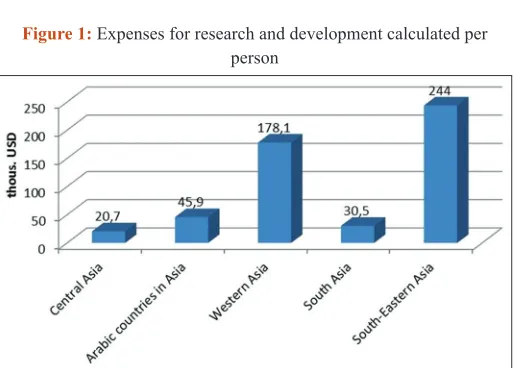
Sustainably low level of investments in R&D prevents from achieving ambitious goals in the area of innovational development of the cotton processing industry. According to this indicator, the Central Asia countries considerably lag behind other Asian countries (Figure 1).
At the same time it is necessary to specify the increase in expenses for R&D in the Central Asia countries during the period of 2007-2013 as a positive tendency (Table 3).
Over the last decade the correlation of gross expenditure on R&D/ gross domestic product of this region has ranged on the level of 0.2-0.3%.
In 2013 Uzbekistan violated this tendency and increased the intensity of R&D up to 0.41%. At the present time the consumer goods industry of Uzbekistan goes through a qualitatively new leap in its development. Traditional and old technologies are replaced by new ones that allow to achieve higher capacity by less labor expenditures and to increase the standards of the quality of products of cotton processing. At the present time innovational developments in the industry are made by the Uzbek Research Institute of Native Fibers and Tashkent Institute of Textile and Light Industry. Uzbekistan involves new mechanisms of promoting research and technology with heightened attention to the development of innovational economy. One of them includes republic fairs of innovative ideas, technologies, and projects conducted on an annual basis.
After the global economic crisis, Kazakhstan initiated a large-scale industrial development and innovational program in order to increase its total capacity and to decrease its dependence on import.
At the present time Kazakhstan is the only country where enterprises and establishments of private non-commercial sectors make an incredible contribution to R&D. However, the total indicator of the researches and developments intensity in Kazakhstan was rather low - only 0.17 in 2013. Nevertheless, the expenditures both for research and technological services in this country have considerably increased. It witnesses about the growing demand for the R&D products. This tendency also reflects the preference of enterprises to purchase technological solutions used in the imported machinery and equipment. The government confirmed the strategy of modernizing enterprises by transferring technologies and development of business qualities. Herewith, the development of financing projects, including by establishing joint enterprises, is emphasized.
It is necessary to note that in spite of the current potential, the national innovational systems of the Central Asia countries undergo the stage of their formation.
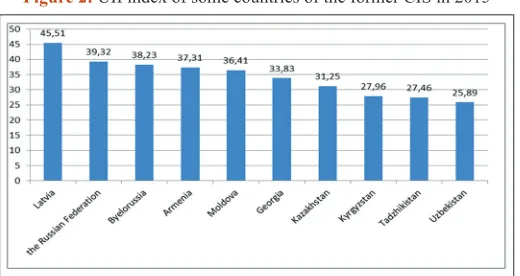
The places held in the Global Innovations Index (UII) (Тhe Global Innovation Index, 2015) prove that the Central Asia countries are inferior not only to other Asian countries but also countries of the former CIS (Figure 2).
At the present time the Central Asia countries lag behind other Eastern Europe states in terms of the higher education coverage. At the same time more serious disruption is observed in the co-operation of higher educational establishments with employers.
The countries of the Central Asia lag behind other countries of the world even more according to the KI knowledge index of the World Bank of knowledge estimation.
Figure 1: Expenses for research and development calculated per person
Table 3: Expenses for R&D of the Central Asia countries during 2007-2013
Indicator 2007 2009 2011 2013
GERD (PPP in billion USD) 0.8 1.1 1 1.4 Share in the world GERD (%) 0.1 0.1 0.1 0.1
GERD in % from GDP 0.2 0.24 0.2 0.23
GERD calculated per person (PPP
in USD) 13.4 16.9 15.7 20.7
GERD calculated per one
researcher (PPP in thousand USD) 38.2 427 39.2 41.5
Four of five Central Asia countries (excluding Turkmenistan) participated in the rating of 145 countries with the knowledge index calculated in 2012.
Tadzhikistan, Uzbekistan, and Kyrgyzstan took places 106, 105 and 95, respectively, and descended in the rating as compared to 2000 when they held places 102, 101 and 82. At the same time Kazakhstan holds place 73 (in comparison with place 78 in 2000). In comparison with 2000, the position of Kazakhstan changed little, but it demonstrated more positive results than other Central Asia countries. The problem is even more obvious if we separately consider only the innovations index. According to it, the positions of the majority of the Central Asia countries decreased in comparison with 2000.
Thus, the shown indicators allow to make the conclusion that the national systems of Central Asia countries do not fully comply with the needs of the cotton processing industry and economy of the countries as a whole, and are now being formed. The national systems of higher education are characterized by a low level of its accessibility, old-fashioned mechanisms of management and quality provision as well as the structure of financing that does not comply with the needs of the cotton processing industry.
6. PROBLEMS AND PRIORITY AREAS
OF INNOVATIVE DEVELOPMENT OF
COTTON PROCESSING ENTERPRISES OF
THE CENTRAL ASIA COUNTRIES
Currently cotton processing enterprises of Central Asia have a lot of problems that do not allow them to occupy the adequate level of competitiveness and provide economic efficiency in the long-term.
It is necessary to note that in the majority of Central Asia countries the technological level of production of cotton fiber and textile products is still rather low. It negatively affects the level of the produced cotton fiber and as a whole the competitiveness of the textile products of the Central Asia countries on the external market.
For example, in Uzbekistan approximately 75-80% of cotton processing plants are characterized by using the
old-fashioned technology of processing raw cotton. As a result, the production rate of cotton fiber and losses from wastes at cotton gin plants of the republic are considerably worse than those in the countries that use modern ginnery equipment. For example, in the developed countries the production rate of cotton fiber is not <39%, and in Uzbekistan this figure hardly reaches 32%.
In order to ensure competitiveness of products on the external market, enterprises of cotton processing of the Central Asia countries must improve the quality and expand the range of the manufactured products in compliance with the requirements of the fashion, increase the level of workforce productivity in the industry, decrease the cost of production, and create technical fabrics of new generation. Cotton processing enterprises must enhance the concept of innovations and actively use innovational mechanisms in production processes, marketing, finances, management, and de-verifying development.
The conducted researches allow to make the conclusion about the lack of a comprehensive approach to the organization of innovative processes in cotton processing industry of the Central Asia countries. In its turn it is revealed in the disunity of interests and functioning of various elements of the innovational cycle: From developments to production (International Conference Fostering Inclusive and Sustainable Industrial Development in Middle Income Countries in Europe and Central Asia through Innovation and Technological Learning: Needs, Potentials and best Practices).
In order to transfer the cotton processing industry to the innovational way of development under the conditions of rapidly changing world economy, the Central Asia countries must be based on their strengths and drastically overcome such negatives as:
• Low level of investments in science.
• Unsatisfactory frame conditions, from bad access to financing and heavy expenses for the protection of intellectual property rights to weak standardization and inefficient use of state funds. This is the most massive disadvantage when proper cotton processing enterprises search for investments and opportunity to conduct researches in other parts of the world.
• Weak state support of innovational entrepreneurship. • Deficit of skilled human resources.
• Insufficiency of venture funds for financial support of innovational entrepreneurship and separate innovational projects.
• Weak integration of education (universities), science (research and innovational centers, technoparks, spin-off companies, science cities, etc.) and production (industrial laboratories, pilot and test systems of management, cross-industrial associations, special economic zones, etc.).
It is possible to single out the following high priority measures aiming at the increase in the innovational activity of enterprises of cotton processing industry of the Central Asia countries: 1. In the period of financial restrictions the Central Asia countries
must go on investing in education, science, technologies, innovations, and ICN.
• Expenses for R&D must provide competitiveness of products of the cotton processing on the world market and enhance budgetary incomes from the export of products with high added value.
2. It must be done simultaneously with reforms in order to achieve the greatest correlation between the price and quality of the products of cotton processing. National research and innovational systems must be better connected with each other for improving their productivity.
3. Systems of education must be modernized on every level. At the present time systems of higher education in the Central Asia countries to various extents lag behind in playing their role of the mover of innovational approaches to higher education and generator of new ideas that is required for stimulating the growth of contemporary economy based on the knowledge. The most important factor of providing universal understanding of large-scale results of reforms of national systems of the higher education is the development and acceptance of comprehensive strategy of development and modernization of the area of higher education of the Central Asia countries.
4. It is necessary to strive for raising large external investments for the industrial science.
• It is necessary to enhance the cooperation between the areas of the science and the world of business. It is necessary to eliminate the existing obstacles and correctly emphasize such cooperation. It is necessary to provide system interrelation and participation of the interested parties by developing state and private partnership. 5. Various barriers for the innovational entrepreneurship must
be eliminated.
The world practice shows that 50% of innovations are created by small companies (Asia 2050: Realizing the Asian Century, 2011). The basic advantages of small and medium-sized enterprises include flexibility, proactivity, dynamism and mobility in taking managerial decisions, high level of opportunities in the provision of diversification of goods in compliance with the demand, and accelerated reaction to the changes in economic circumstances. All of them are confirmed by the practice of economic activity of all countries with the market economy.
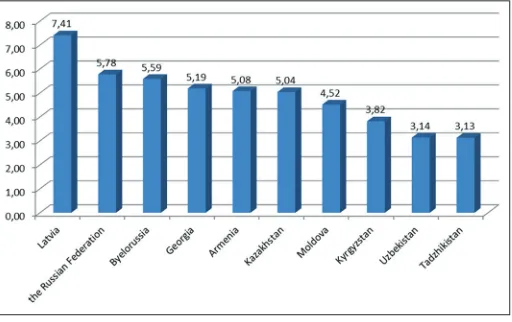
State support for innovational entrepreneurship can be expressed in improving access to financing, especially for small and medium-sized enterprises that implement “ideas to the market,” simplifying access to intellectual property rights, more reasonable regulation of target indicators, and establishing compliant standards and strategic use of state budgetary assignations (Figure 3).
7. CONCLUSION
The cotton processing industry is strategic for the economy of the majority of the Central Asia countries. That’s why the formation of highly technological production making it possible to manufacture competitive products with higher added value becomes the critical task for independent states.
The offered measures allow to activate the innovational activity of enterprises, increase intellectual and educational potential of the republics, set the mechanism of supporting innovative activity, and get a result in the form of large-scale investment projects in the cotton processing industry of the region.
REFERENCES
Asia 2050: Realizing the Asian Century. (2011), Asian Development Bank. Available from: http://www.unido.org/fileadmin/user_media/ UNIDO_Worldwide/Asia_and_Pacific_Programme/Documents/ AsianDevelopmentBankreport_asia-2050.pdf.
Henriksen, K., Bjerre, M., Almasi, A.M., Damgaard-Grann, E. (2012), Green Business Model Innovation Conceptualization Report. Nordic Innovation, Oslo. Available from: http://www.nordicinnovation. org/Global/_Publications/Reports/2012/2012_16%20Green%20 Business%20Model%20Innovation_Conceptualization%20 report_web.pdf.
ICIS, Annual Conference Report. (2015), Intelligent and Responsible Production from Raw Material to Final Consumer. The Mission of the Global Textile Industry. Available from: http://www.itmf.org/wb/ media/conference/PreviousConferences/2015.pdf.
International Conference Fostering inclusive and Sustainable Industrial Development in Middle Income Countries (MICs) in Europe and Central Asia through Innovation and Technological Learning: Needs, Potentials and Best Practices. Organized by the United Nations Industrial Development Organization (UNIDO) the Ministry of Foreign Affairs (MOFA) of the Republic of Belarus and the United Nations Development Programme (UNDP), 23-24 April 2015 Minsk, Belarus. Available from: http://www. unido.org/fileadmin/user_upload/20OCT_MICs_conference_ report_1_.pdf.
International Cotton Advisory Committee. Cotton this Month. From the Secretariat of the ICAC. Available from: https://www.icac.org/ cotton_info/publications/updates/2016/English/ectm1_16.pdf. Rieter. Report About Countries - Central Asia. Available from: http://
www.rieter.com.
The Perm Chamber of Commerce and Industry. (n.d.), Specificity of Conducting Entrepreneurship Activity in Uzbekistan. Review of Uzbek Goods and Services Markets that are Actual for Small and Medium-Sized Business of the Kama Region. Available from: http://www.permtpp.ru/upload/iblock/17f/spetsifika-vedeniya-v-uzbekistane-predprinimatelskoy-deyatelnosti.pdf.
The World Bank’s, Knowledge Economy Index, (KEI). (2012), Rankings. Available from: http://www.siteresources.worldbank.org/
INTUNIKAM/Resources/2012.pdf.
UNESCO Science Report: Towards 2030. Executive Summary. UNESCO. (2015). Available from: http://www.unesdoc.unesco.org/ images/0023/002354/235407r.pdf.
UNIDO, Inclusive and Sustainable Industrial Development in Europe and Central Asia. (2015), UNIDO. Available from: http://www.unido.org/
fileadmin/media/images/worldwide/UNIDO_in_EUR_CA_Region.pdf. World Trade Report. (2014), Trade and Development: Recent Trends and
the Role of the WTO. Available from: https://www.wto.org/english/ res_e/booksp_e/world_trade_report14_e.pdf.