Volume 6, Issue 4, 2019, pp. 67-79 Available online at www.jallr.com ISSN: 2376-760X
* Correspondence: Mina Reaisi, Email: m.110raesi yahoo.com, ORCID: 0000-0001-8221-0682 © 2019 Journal of Applied Linguistics and Language Research
Identifying Code-Switching Cases and Exploring Their
Inter-sentential and Intra-sentential Patterns in
Persian-English Bilingual Classrooms
Mina Raeisi*
Lecturer, Department of English, Isfahan (Khorasgan) Branch, Islamic Azad University, Isfahan, Iran
Massome Raeisi
MA in Translation Studies, Department of English, Shahreza Branch, Islamic Azad University, Shahreza, Isfahan, Iran
Abstract
This qualitative study aimed to (1) identify code-switching (CS) cases, (2) analyze the frequency of their occurrences, and (3) explore the patterns of inter-sentential and intra-sentential code-switching in an Iranian EFL classroom. To this end, an EFL class at Islamic Azad University, whose students were supposed to study English language teaching course in one semester, were selected based on purposive sampling; both included 30 male and female sophomore students whose age range was between 21 to 38. The data were collected using observation and the tape-recorded transcripts. Results showed that code-switching mostly occurred in 5 categories and 3 subcategories while shifting to give explanation in cultural issues, shifting to avoid misunderstanding, and shifting for elaborating grammatical matters, were 32, 20, and 16 cases respectively. Additionally, inter-sentential code-switching patters were seen more than intra-sentential patterns. This study proved fruitful in determining the proper usage of code-switching among Iranian EFL students. Findings of this study can be useful for EFL students as well as teachers to enhance the efficiency and productivity of the class to be aware of the most frequent cases of switching to stop incorrect and adventitious usage of code-switching strategies.
Key words: code-switching, Iranian EFLclassroom, learning ability
INTRODUCTION
speakers rather than interference and from other perspectives it may be viewed as interference." (p. 4).
As cited by Hoffmann (2014), according to Richard and Schmidit (2010) and Woolard (2010), switching between English and another language in every discourse by a bilingual speaker or writer is called code-switching. This process can happen while speaking and producing statements (oral and written discourse).
Based on Abrams (2008) and Kuiper (2011), the phenomenon of code-switching is normally happening unconsciously that might occur frequently in day-to-day conversations. Another source in which code-switching normally happens is media including weblogs, novels, newspapers, songs, movies. The first three ones are those factors occurring in literature mostly. According to Merriam Webster Dictionary code-switching is defined as “the switching from the linguistic system of one language or dialect to that of another”.
According to Grosjean (1982), code-switching has been regarded by many people as a grammarless mixture of two languages (p. 147). Based on Mattsson and Burenhult (1999), sometimes code-switching can take several functions. Maybe the teacher in the class perform it unconsciously, it means that the teacher is not always aware of the functions and outcomes of the code-switching process. Therefore, in some cases it may be regarded as an automatic and unconscious behavior. Nevertheless, either conscious or not, it necessarily serves some basic functions which may be beneficial in language learning environments. These functions are listed as topic switch, affective functions, and repetitive functions (p. 61).
According to Merritt (1992), in order to have a general idea about these, it will be appropriate to give a brief explanation about each function. Even if some researchers believe that code-switching has received criticism, there are other researchers considering it as a valuable communication resource (p. 118). Based on Adendorff (1993), in most classrooms, code-switching seems most often motivated by cognitive and classroom management factors (p. 149). Usually, it serves a need to focus or regain pupils' attention, or a need to clarify, enhance or reinforce lesson material. Determinants of code-switching in the classroom are only partially dictated by formal language policy. Even if an official policy exists, teachers make individual moment-to-moment decisions about language choice that are mostly dictated by the need to communicate effectively.
Till now, different researchers have analyzed code-switching from different aspects like grammatical, sociolinguistic, and interactional ones. From a grammatical perspective, based on his analysis of the grammatical aspects, Poplack (1980) proposed three types of CS which categorized into intra-sentential, tag-switching, and inter-sentential patterns. As the name shows, the first one means the occurrence of code-switching case in a separate sentence, the second one characterized by a switch outside the sentence or the clause level which shifts from one language variety to another, and the third one characterized by its occurrence within the sentence in a phrase or word.
Research questions of this study are as the followings:
RQ 2. From among inter-sentential or intra-sentential CS patterns, which dominates among Iranian EFL students?
REVIEW OF THE LITERATURE
A survey has been conducted by Olúmúyìwá (2013) in Africa which is a multilingual society with residents whose job is to shift from one language to another repeatedly to communicate and live in this state. The author analyzed the use of code-switching and code mixing on Olúse ́gun Mímíkò’s political billboards during election period. The study found the substantial use of code-switching and code mixing in Olúse ́gun Mímíkò’s political billboards from among other communicative intents. The paper showed that none of his political billboards is anti-opposition; rather, they were used to eulogize him. Another study carried out by Rose and Dulm (2011) entitled examined code-switching in classrooms in Africa. The data comprising audio recordings of classroom interactions based on Myers-Scotton’s (1993a) Markedness Model who believed there are four types of code-switching, namely marked, unmarked, sequential unmarked, and exploratory code-switching. Within each of these types of code-switching, a number of specific functions of code-switching in the classrooms observed were identified, such as expansion, clarification, and identity marking. The conclusion of this research demonstrated that the Markedness Model offers a useful framework to examine types of code-switching, and that code-switching has a specific functional role to play within multicultural and multilingual classrooms.
Kamaruzaman Jusoff and Badrul Hisham (2009) carried out a research regarding code-switching and examined four issues including learners’ perceptions of teachers’ code-switching, the relationship between teachers’ code-switching and learners’ affective support, the relationship between teachers’ code-switching and learners’ learning success, and the future use of code-switching in students’ learning. The study found that learners perceived code-switching as a positive strategy which was due to its various functions. There were significant relationships between teachers’ code-switching and learners’ affective support and teachers’ code-switching and learners’ learning success. At last, the study concluded that teachers’ code-switching is an effective teaching strategy when dealing with low English proficient learners.
Based on their ethnographic observation of classroom interaction in three primary schools in Kenya, Merritt et al. (1992) argued that code-switching provides an additional resource for meeting classroom needs (p. 118). Poplack (cited in Grosjean, 1982, p. 148) argued that code-switching is a verbal skill requiring a large degree of competence in more than one language, rather than a defect arising from insufficient knowledge of one or the other.
The objectives of the present research are to know the most frequent cases of code-switching among Iranian EFL students and also explore inter-sentential or intra-sentential CS patterns, and their frequency among Iranian EFL students.
METHOD
Participants: The participants of this research were 30 male and female sophomore students, whose age range was between 21 to 38, majoring English translation studying at Islamic Azad University of Isfahan (Khorasgan). The selected participants in the present research were sophomore EFL students.
Research material: Normally, teachers introduce methodologies of teaching by Larsen Freeman as the base to teach different principles of teaching to the students in the first two hours, but in the second two hours, where the treatment has done accordingly, was in a way that the teacher asked them to select atopic from intermediate or advanced English books and give a lecture as their practical exam. In fact, the given topic for giving lecture was optional (they could freely select teaching grammar, vocabulary, pronunciation, proverbs, or other parts of language teaching) their classmates were supposed to consider the lecturer as their teacher and behave as if this is a real English class).
Data collection procedure: The data on the frequency of lecturers' code-switching behavior while teaching English to an EFL classrooms were gleaned using both classroom observations and tape-recorder. It is worthwhile to mention that the teacher did not interrupt the lecturer, and act as if she was one of the students, in a way that occasionally she asked them some questions as a dumb student. Each lecturer was given time for almost an hour to present what s/he has made ready; the rest of the time was managed by the professor. In order to make sure of the reliability of the research, the regulated principles of sampling methods were applied in data collection, i.e. they were selected based on purposive sampling method to cover the expected community, who were sophomore EFL students in the present research. The observations included students' expressions, their speech, body language, physical surroundings and exact conversation. In order to prevent Hathorn effect, the teacher decided to let the students know about the tape-recording in the last session and said the voices stayed confidential and would be removed after conducting the research, the transcripts were written anonymously like student 1, student 2. Students in the classroom had similar backgrounds and cultures, just one of them in class B was from an Arab family (born in Iraq, but her parents left there from the time that their daughter was two years old. As she had gone to Iranian schools, her background was like her classmates). The students themselves were Persian dominant and had an average English vocabulary. They were from varying socioeconomic levels, ranging from low to upper middle-class.
RESULTS
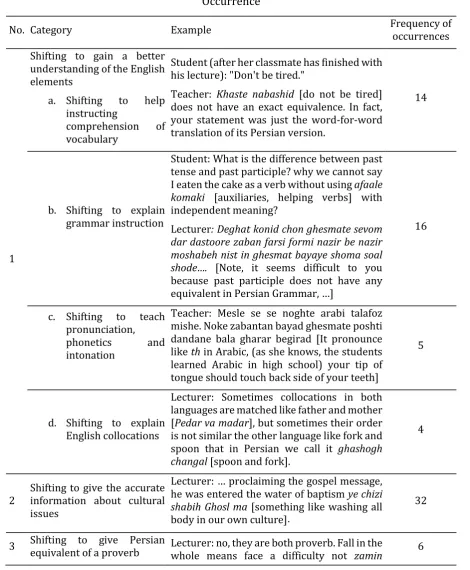
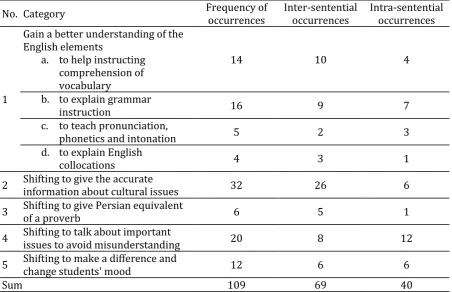
The research questions have already cleared the focus of the study. Therefore, after analyzing the transcript of the tape-recorded files, the following results were identified. Frequency of code-switching occurrence during lecturers’ teachings and the main categories of the code-switched examples, which were tabulated in the following tables together with example, were given. Besides, inter-sentential and intra-sentential patterns of the code-switched cases were explored.
Table 1. Categories of Identified code-switching, their Example and the Frequencies of Occurrence
No. Category Example Frequency of occurrences
1
Shifting to gain a better understanding of the English elements
a. Shifting to help instructing
comprehension of vocabulary
Student (after her classmate has finished with his lecture): "Don't be tired."
Teacher: Khaste nabashid [do not be tired] does not have an exact equivalence. In fact, your statement was just the word-for-word translation of its Persian version.
14
b. Shifting to explain grammar instruction
Student: What is the difference between past tense and past participle? why we cannot say I eaten the cake as a verb without using afaale
komaki [auxiliaries, helping verbs] with
independent meaning?
Lecturer: Deghat konid chon ghesmate sevom dar dastoore zaban farsi formi nazir be nazir moshabeh nist in ghesmat bayaye shoma soal
shode…. [Note, it seems difficult to you
because past participle does not have any
equivalent in Persian Grammar, …]
16
c. Shifting to teach pronunciation, phonetics and intonation
Teacher: Mesle se se noghte arabi talafoz mishe. Noke zabantan bayad ghesmate poshti dandane bala gharar begirad [It pronounce like th in Arabic, (as she knows, the students learned Arabic in high school) your tip of tongue should touch back side of your teeth]
5
d. Shifting to explain English collocations
Lecturer: Sometimes collocations in both languages are matched like father and mother
[Pedar va madar], but sometimes their order
is not similar the other language like fork and spoon that in Persian we call it ghashogh
changal [spoon and fork].
4
2 Shifting to give the accurate information about cultural issues
Lecturer: … proclaiming the gospel message,
he was entered the water of baptism ye chizi
shabih Ghosl ma [something like washing all
body in our own culture] .
32
3 Shifting to give Persian equivalent of a proverb Lecturer: no, they are both proverb. Fall in the
khordan and put the nail on the head means provide true explanation and do the right thing not to sare khodesh zadan [to tap on his head]
4
Shifting to talk about important issues to avoid misunderstanding
Therefore, first clean it, then wash it, after that cut the green parts of its body, and then wash it again without using any other chemical materials. deghat konid aval tamiz
konod, baad beshueed, [note that first you
should clean it, after that wash it].
20
5 Shifting to make a difference and change students' mood
Lecturer (in the middle of his speech with a laughing intonation): Havasedoon hast [are you with me or are you listening to what I am saying].
12
Sum 109
As it is considerable in Table 1, the first three most frequent cases of code-switching were shifting to give explanation in cultural issues, shifting to avoid misunderstanding, and shifting for elaborating grammatical matters which were 32, 20, and 16 respectively.
Table 2. The Frequency of Inter-Sentential and Intra-Sentential code-switching Cases
No. Category Frequency of occurrences Inter-sentential occurrences Intra-sentential occurrences
1
Gain a better understanding of the English elements
a. to help instructing comprehension of vocabulary
14 10 4
b. to explain grammar
instruction 16 9 7 c. to teach pronunciation,
phonetics and intonation 5 2 3 d. to explain English
collocations 4 3 1
2 Shifting to give the accurate information about cultural issues 32 26 6
3 Shifting to give Persian equivalent of a proverb 6 5 1
4 Shifting to talk about important issues to avoid misunderstanding 20 8 12
5 Shifting to make a difference and change students' mood 12 6 6
Sum 109 69 40
important issues to avoid misunderstanding, their frequencies were 32 and 20 respectively. As tag-switching did not occur in the class at all, it was not added to the table. The data which are based on direct class observations is classified into five categories. Each category is supported with real classroom observations in that regard.
1. Instructors' code-switching was a strategy to help students gain a better understanding of the English elements such as vocabulary, grammar, pronunciation, collocation and equivalence. Each of these subcategories are elaborated in the following:
1.a. code-switching for better comprehension of vocabulary: Definitely different teachers have used different strategies to teach vocabulary items; therefore, shifting to the mother tongue of EFL or ESL students, here Persian, was also observed. In the following example, the Persian meaning of an ironic and misleading phrase "quite a bit" was given in Persian. Normally, code-switching for lexical and grammatical clarification and giving the correct answer to the students who are puzzled and do not have any background information about that issue is natural. Therefore, none of the examples in this part were unexpected. Example 1
Lecturer: His mother knows quite a bit of information about healthy food. This is why they do not get sick as much.
Student: They do not or they do?
Student: to know quite a bit of information means she ziad midoone.
On the contrary of your interpretation of this sentence. It is the synonym of quite a lot. The same shifting was also observed too. The teacher switched to Persian to correct the wrong form of the sentence made by one of her students.
Example 2
Student (after her classmate has finished with his lecture): "Don't be tired."
Lecturer: In American classroom environment, it is not so common to say something to the teacher after the class to show you are worrying for his/her tiresome or even to show you wanted to say something to him/her; therefore, khaste nabashid [do not be tied] does not have an exact equivalence. In fact, your statement was just the word-for-word translation of its Persian version.
Example 3
Lecturer (while explaining past participle grammar): We use ghesmate sevome fe’l [past participle] forms in passives, conditional type 3, or present and past perfect. […]
The grammar was explained to the class […]
Student: What is the difference between past tense and past participle? why we cannot say I eaten the cake as a verb without using afaale komaki [auxiliaries, helping verbs] with independent meaning?
Lecturer: Deghat konid chon ghesmate sevom dar dastoore zaban farsi formi nazir be nazir moshabeh nist in ghesmat bayaye shoma soal shode…. [Note, it seems difficult to you because past participle does not have any equivalent in Persian Grammar, …]
1.c. Shifting while teaching pronunciation, phonetics and intonation: teaching pronunciation and the way of articulating sounds in mother tongue seems challenging. When it came to some new sounds same as "th" in "then" or "birthday", Persian language is needed because they should learn it precisely.
Example 4
Lecturer (while teaching how to pronounce th): for articulating such words like teeth or birthday, your tip of tongue should touch back side of your teeth.
Students: What [with bewildered eyes]?
Lecturer: Mesle se se noghte arabi talafoz mishe. Noke zabantan bayad ghesmate poshti dandane bala gharar begirad [It pronounce like th in Arabic, (as she knows, the students learned Arabic in high school and have an enriched background) your tip of tongue should touch back side of your teeth]
1.d. code-switching to talk about English collocations: Shifting was observed as a tool for explaining the function of collocations to help them understand precisely the difference between verb usage in two languages. For example, while explaining the reason why the phrase "find a friend" is incorrect in English, the teacher had to shift to Persian.
Example 5.
Lecturer: In English, make is normally used in collocation for something positive, for example make friend or make money while in Persian we say doost peyda kardan na sakhtan or pool dar avardan (not sakhtan).
Within the more tangible Persian collocations like fork and spoon: Example 6.
Lecturer: Sometimes collocations in both languages are matched like father and mother [Pedar va madar], but sometimes their order is not similar the other language like fork and spoon that in Persian we call it ghashogh changal [spoon and fork].
issues. Although the instructor tried to help him find better English equivalence, he repeatedly had to switch it to Persian. In some cases, there felt a need to shift to Persian to elaborate on that more.
While talking about Christian’s religious ceremonies, he talked about baptism Example 7
Lecturer: … proclaiming the gospel message, he was entered the water of baptism ye chizi shabih Ghosl ma [something like washing all body in our own culture] .
While giving lecture about different customs and cultures of different people from around the world, when it comes to architypes including different meaning of colors, numbers, signs, and symbols in every culture, the rest of the students misunderstood and could not get the point which were among the unexpected results. Finally, the lecturer had to switch to Persian and elaborate the differences in condition that they expect hearing the similarity.
Example 8
Lecturer (in reading a short Indian story): While she was wiping her tears with her white sleeve, saw a huge number of populations coming toward her.
Student: sorry, are you sure it was a funeral. Why she saw a big group of people in white clothes?
Lecturer: Tebghe rosoom farhange ma …. [according to our customs …]
While giving lecture about funeral ceremonies in India, he talked about wearing white clothes in condition that his classmates expected them to wear clothes in black color. The teacher switched to Persian to explain the culture and customs of Indian people. The same situation happened about the meaning of numbers, symbols, animals, and sign languages too. Its unexpectedness matter was because of the general issues that almost all of the students expected to see the same rule which is quite common around him/her, but in a simple story they understand that it can be vice versa as it is a conventional issue.
Shifting to give the Persian equivalence of a proverb. After giving explanation in English and it was found out that precise meaning will not be achieved in English classrooms, the teacher had to provide the situation of code-switching, or for teaching accents in English, using Persian language and Isfahani accent to depict different accents in different communities; adding that in the U.S also, there are different accents in different states. Example 9
Lecturer: when he had fallen in the whole he had to put his nail on the head Students: It means when he fell in the ground, s/he tap on his head
Lecturer: no, they are both proverbs. Fall in the whole means face a difficulty not zamin khordan and put the nail on the head means provide true explanation and do the right thing not to sare khodesh zadan [to tap on his head]
settings or something which is vitally important to note. In the example, one of the students, for her lecture, wanted to teach her classmates how to hive a summary practically. In the following example, she gave the recipe of cleaning and removing the toxic materials of delicious, but dangerous type of fish.
Example 10
Lecturer: for the next session I want you to do what I said in order and provide me with your oral report step by step.
Lecturer: Puffer Fish is extraordinarily delicious however it includes toxic materials inside its body. Therefore, first clean it, then wash it, after that cut the green parts of its body, and then wash it again without using any other chemical materials. deghat konid aval tamiz konod, baad beshurid, [note that first you should clean it, after that wash it].
4. Shifting to make a difference and change students' mood. Some cases were observed when the lecturers sought to change students' mood by shifting to their mother tongue. Some of the lecturers shifted to Persian to attract students’ attention especially when they seemed sleepy or not listening to what they were saying.
Example 11
Lecturer (in the middle of his speech with a laughing intonation): Havasedoon hast [are you with me or are you listening to what I am saying].
His target was just to change the monotonous mood of the class because of the tough material selected to teach. Therefore, he said so with heavy Isfahani’s accent, to refresh the class. This short Persian phrase caused the students to listen precisely to his lecture. 5. Some special situations comprise the next category of shifting. Two of these are
just listed here:
a. Shifting when one student felt bad due to a big problem.
b. code-switching because of one student's becoming emotional and starting to cry.
Example 12
Lecturer: Masih, now it is your turn to repeat what I am saying loudly Student: Emmm, no, and burst to tear
Lecturer (shocked): Chi shode [what is happened]?
Another student: Dirooz madaresh fout karde [yesterday, his mother died] DISCUSSION
depicts, the language planners in Ministry of Education of Zimbabwe were suggested to reconsider the rules and let teachers code-switch at the classrooms, specially while teaching cultural issues. In this study, focusing on Postmethod pedagogy was also recommended for the ease of ESL teachers. The results of both studies in terms of positive feedback of the students, based on the observations, is in line with the results of the research conducted by Brice and Roseberry-McKibbin (2001), Ferguson (2003), Clegg and Afitska (2011), and Moduopela (2013).
Results of a recent study conducted by Adriosh and Razi (2019) in terms of having a positive attitude toward code-switching in bilingual classroom for EFL students was in line with the results of the present study. Additionally, in this English-Arabic context, which was conducted in Lybia, the functions used for the code-switching were labeled as socialization, repetition, recapitulation and clarification. The used method of this new research was based on exploratory ethnographic approach, which deals with the exploration of professors of the university, to exploit their first language to help the students understand the second language using different functions like pedagogical and functional ones. On the contrary of the nature of both conducted research in which both teachers and students used code-switching strategies at the class for clarification function, some researchers like Bahous et al. (2014) encountered those EFL professors who were not aware of the positive sides of exploiting first language to learn the second language better.
Similarly, results of a research carried out by Hamid (2016) who focused on code– switching in conversation among Indonesian eighth-grade students of SMAN 1 Tombolo Pao, Gowa Regency in terms of the identified functions of the code-switched cases were in line with the results of the present study. The similar functions of code-switching between Iranian EFL students and Indonesian secondary students were for expressing unpleasant feelings, creating humor, and clarifying reiteration of a message.
As code-switching phenomenon occurs in both oral and written discourse, it can be analyzed based on inter-sentential, intra-sentential, and tag switching categories. Therefore, results of a study done by Yusuf et al. (2017) in terms of using inter-sentential code-switching in comparison with the other two categories was in-line with the results of the present research. In fact, the focus of their investigation was on analyzing code-switching types in a novel Indonesian and English and Antologi Rasa (literally translated as ‘The Anthology of Taste’) by Ika Natassa. Inter-sentential, intra-sentential, and tag switching cases of this research were 62.3%, 20.9%, and 12.4% respectively. According to the author, using more code-switching cases in literary work attracts more reader and added that this is important for the significance of the literary works.
CONCLUSION
exploring the suitable forms of code-switching (inter-sentential and intra-sentential). They further reveal that code-switching can be an acceptable and effective strategy for the authors while writing literary texts like novels. The presentation of the examples is also very helpful for the beginners. The findings can, in fact, be exploited by such extended groups as university professors, secondary school teachers, and play-writers. They can help them improve their learning/teaching quality in a right, accurate and effective mode. A final word is that based on the findings of this research, through finding the best methods of using code-switching strategies at EFL and ESL classrooms, teachers used code-switching in the classroom were better able to convey their knowledge of subject matter to the students than teachers selected English-only policy.
SUGGESTIONS FOR FURTHER RESEARCH
As interdisciplinary fields of study are gaining momentum these days, it is suggested to combine psychological factors to analyze code-switching patterns in different settings like classrooms, social media, and characters of the novels to examine if there is any significant relationship between code-switching and that special person’s self-confidence or comparing the patterns of CS among genders to see if it is common among one gender and consequently examining the relationship between code-switching, gender, and self-confidence. Additionally, in the field of teacher education and teacher self-efficacy, it is possible to analyze the relationship between teacher self-efficacy and using code-switching patterns in bilingual classrooms.
REFERENCES
Abrams, M.H. (2008). A glossary of literary terms. (9th ed.), Harcourt Brace College: Fort
Worth, TX.
Adendorff, R. (1993). code-switching amongst Zulu-speaking teachers and their pupils: its functions and implications for teacher education. Retrieved from the world wide web on June 30, 2019 http://www.tandfonline.com.dbgw.lis.curtin.edu.au/doi/abs/ 10.1080/09500789309541356
Adriosh, M., & Razı, Ö. (2019). Teacher’s code-switching in EFL Undergraduate Classrooms in Libya: Functions and Perceptions. SAGE Open. https://doi.org/10.1177/2158244019846214..
Bahous, R. N., Nabhani, M. B., & Bacha, N. N. (2014). Code-switching in higher education in a multilingual environment: A Lebanese exploratory study. Language Awareness, 23, 353-368.
Baker, C. (2006). Foundations of bilingual education and bilingualism. Tonawanda, NY: Library of Congress Cataloging in Publication Data. Retrieved from the World Wide Web on January 1, 2014: http://www.bl.uk/
Brice, A. & Roseberry-McKibbin, C. (2008). Choice of languages in instruction. Teaching Exceptional Children, 33(4), 10-16.
Clegg, J. & Afitska, O. (2011). Teaching and learning in two languages in African classrooms. Comparative Education, 47(1), 61-77.
Ferguson, G. (2003). Classroom code-switching in post-colonial contexts: Functions, attitudes and policies. AILA Review, 16, 38-51.
Hamid, S. M. (2016). code-switching between the teachers and the students of the conversation. Exposure Journal. 5(2), 174-195.
Grosjean, F. (1982). Life with two languages: An introduction to bilingualism. Cambridge: Harvard University Press.
Hoffmann, C. (2014). An introduction to bilingualism. Routledge: New York, NY.
Kuiper, K. (2011). Poetry and drama: Literary terms andconcepts. Britannica: New York, NY.
Kamaruzaman, J. & Badrul Hisham, A. (2009). Teachers’ code-switching in classroom instructions for low English proficient learners. Journal of English Language Teaching, 2(2), 49-55.
Mareva, R. (2016). Teachers‟ code-switching in English as a Second Language (ESL) instruction: Perceptions of selected secondary school learners in Zimbabwe. IRA-International Journal of Management & Social Sciences, 4(1). doi:http://dx.doi.org/10.21013/jmss.v4.n1.p11.
Mattsson, A. & Burenhult-Mattsson, N. (1999). code-switching in Second Language Teaching of French. Working Papers, 47, 59-72.
Merritt, M., Cleghom, A., Abagi, J. O. & Bunyi, G. (1992). Socialising multilingualism: determinants of code-switching in Kenyan primary classrooms. Journal of Multilingual and Multicultural Development, 13(1/2), 103-121.
Moduopela, O.R. (2013). code-switching as a teaching strategy: Implications for English Language teaching and learning in a multilingual society. IOSR Journal of Humanities and Social Sciences, 14(2), 92-94.
Myers-Scotton, C. (1993). Social motivations for code-switching. Evidence from Africa. Oxford: Clarendon Press.
Numan, D. and Carter, D. (2001). Teaching English to Speakers of Other Languages. Cambridge: Cambridge University Press.
Olúmúyìwá, T. (2013). The use of code-switching /code mixing on Olúse ́gun Mímíkò’s political billboards, Oǹdó State, South-West Nigeria. Journal of Studies in Literature and Language. 6(1), 26-34.
Poplack, S. (1980). Sometimes I’ll start a sentence in Spanish y termmino en Espanol: Toward a typology of the CS. Linguistics 18, 581-618.
Poplack, Sh. (2000). Sometimes I'll start a sentence in English y termino en Espaiiol. The Bilingualism Reader. Routledge. London.
Richards, J.C. & Schmidt, R.W. (2010). Longman dictionary of language teaching and applied linguistics. (4th ed.). Pearson Education: Harlow, UK.
Rose, S., Dulm, O. V. (2011). Functions of code-switching in multilingual classrooms. Journal of Language Learning, 2(2), 1-13.
Skiba, R. (1997). code-switching as a countenance of language interference. The Internet TESL Journal. 3(10), 26-34.
Woolard, K.A. (2010). Codeswitching: A companion to linguistic anthropology. Blackwell: Oxford, UK.