This is anearly accessversion of
Starr, William B.2020. A preference semantics for imperatives.Semantics and
Pragmatics 13(6). https://doi.org/10.3765/sp.13.6.
This version will be replaced with the final typeset version in due course. Note that page numbers will change, so cite with caution.
A preference semantics for imperatives
*William B. Starr
Cornell University
[email protected] http://williamstarr.net
Abstract Imperative sentences like Dance! do not seem to represent the world. Recent modal analyses challenge this idea, but its intuitive and historical appeal remain strong. This paper presents three new chal-lenges for a non-representational analysis, showing that the obstacles facing it are even steeper than previously appreciated. I will argue that the only way for the non-representationalist to meet these three chal-lenges is to adopt a dynamic semantics. Such a dynamic semantics is proposed here: imperatives introduce preferences between alternatives. This characterization of meaning focuses on what function a sentence serves in discourse, rather than what that sentence refers to (e.g., a state of the world). By representing the meaning of imperatives, connectives and declaratives in a common dynamic format, the challenges posed for non-representationalism are met.
Keywords:Imperatives, Dynamic Semantics, Modality, Expressivism
1 Introduction
It seems like a platitude that imperative sentences like Dance! do not represent the world. Surely they instead direct the addressee to make the
early
access
world a certain way. The historical and intuitive appeal of this idea remains strong, but it has been challenged by recent work on imperatives. Sec-tion2presents three new challenges for this appealing idea: imperatives interact with connectives and contextual information, and bear conse-quence and consistency relations in ways that are hard to capture on a non-representational semantics. Section 2.1 is the highlight of this dis-cussion, where I argue that no static (non-dynamic) non-representational semantics can capture the way imperatives, declaratives and sentential connectives interact — modulo another constraint motivated there. New data is presented there which shows that English and other languages al-low imperatives to embed under disjunction and conjunction while clearly maintaining their standard meaning. I will then sketch a dynamic account in §3whose basic ideas are as follows:
Basic Analysis
i. Imperatives introduce preferences between alternatives
ii. Declaratives provide information
iii. Conjunction sequences the effects of its conjuncts
iv. Disjunctions create competing ‘substates’ for each disjunct where that disjunct has had its standard effect
Components (i) and (iv) are the key innovations here. (iv) in particular addresses major limitations in the way previous non-representationalists like Portner 2004, 2012 and Charlow 2014 have analyzed disjunction. Section4provides a specific formalization of these ideas in a propositional logic. Even this very basic implementation suffices to meet the challenges for non-representationalism from §2.
It is important to be clear at the outset about what exactly a non-representational semantics for imperatives is. Some might take a non-representational semantics to mean that the semantic-value of an impera-tive is not a proposition in Stalnaker’s (1976) sense: a set of worlds. On examination, this is a rather naive construal ofnon-representational. The key idea to be captured here is that the discourse function of an imperative is not to represent the world. In principle, a set of worlds could be used to model that discourse function: worlds included in the set could capture ways the worldshould be.1
early
access
A more sophisticated definition of non-representationalism focuses on discourse function, rather than semantic type:
Non-Representational Semantics JφKis non-representational just in case the primary discourse function of JφK is not to rule out ways the world could be.
Two exemplars of this approach are Portner 2004 and Charlow 2014. According to Portner 2004, J!φKis a property of the addressee, namely the property of the addressee making it the case thatφ. It serves to update their To-Do List, constraining what actions the addressee may rationally take, rather than what the world is like.2Charlow’s (2014) theory can be
understood as takingJ!φK to be a property of plans, namely the property of requiring that the addressee act so as to makeφ true. Plans are formal constructs that encode the agents’ policies for what to do across a range of possible circumstances.3 This way of thinking about non-representational
accounts also extends to von Fintel & Iatridou 2017 which holds that imperatives do notsemantically encode any directive meaning likePortner 2004, but unlikePortner 2004that imperatives do not always function in discourse to update the To-Do List.
By contrast, the modal analyses ofAloni 2007andKaufmann 2012take
J!φKto be a modal proposition whose primary discourse effect is to say what the world is like. Indirectly, this results in accommodating a change to the modal’s contextual parameters, ensuring that the modal proposition denoted by!φis true. Similarly,Condoravdi & Lauer 2012analyzesJ!φKas
pragmatically infer discourse function from semantic type. But the proposal to follow about non-representationalism is neutral with respect toPortner’s (2004) proposal. 2 Formally, a property is a function from individuals and worlds to truth values. A To-Do
List is a function from individuals to sets of properties, namely the set of properties that individual is to make true (Portner 2004).
early
access
a proposition about the speaker’s preferences which cannot fail to be true if!φis felicitously uttered. Its discourse function is to represent how the speaker’s preferences are in the actual world.
On the analysis I will propose below,!φdirectly changes thepreferences
mutually assumed in a discourse. As will become clear, this operation on preferences has radically different formal properties than the way declaratives change the information mutually assumed in a discourse. Imperatives are motivational, and plausible abstract models of motivational mental states have very different features from those for representational states. This paper focuses on non-representational analyses, but §5 will briefly discuss representational ones. I will also explain there how the semantics of imperatives underdetermines the force of imperative speech acts.
2 Three challenges
Beginning with truth-tables and ending with operations on sets of worlds like intersection and union, the story of connective meanings focuses on representational language. If one takes the semantic value of !A to be non-representational, it raises the question of whether these familiar stories can be adapted to a non-representational end. At first glance, it doesn’t look to be a problem for non-representational analyses like Charlow 2014 andPortner 2004. There is no obvious barrier to treating
!A∧!Bas intersecting properties (Portner 2004) or sets of plans (Charlow 2014). However, things get more interesting with disjunctions and hybrid conjunctions like▷A∧!B, where▷is a declarative operator. Section 2.1 argues that there are natural language sentences corresponding to these forms (§2.1.1), and that it is not possible to explain how the declarative and imperative components of these sentences have their distinct discourse effects without embracing some form of dynamic semantics (§2.1.2). This is the first challenge, which prefigures two related challenges.
2.1 Challenge 1: imperatives under connectives
early
access
linguists.4 With imperatives, previous work has focused on combinations,
like (1–4), that receive conditional interpretations.
(1) Fly to Harare and I’ll meet you there.
(2) Piss off a Texan and you’ll be sorry.
(3) Make tortillas and you’ll need flour.
(4) Move to Portland or you’ll never relive the 90s.
These enigmas deserve attention and are the focus of an extensive liter-ature (e.g., Lascarides & Asher 2003,Russell 2007,Kaufmann 2012,von Fintel & Iatridou 2017), includingStarr 2017which analyzes it within the semantics proposed in §4. But they are not ideal evidence of impera-tive mood scoping under connecimpera-tives. It is controversial in this literature whether the conditional readings really arise from the standard meaning of the connectives and imperative mood. Section 2.1.1will provide more conclusive data, and §2.1.2will make clear the challenge this data poses for non-representational static theories.
2.1.1 The data
We’ve just arrived home in Santa Fe after years away. We need some good New Mexican food. I propose a plan:5
(5) I’ll make the chile and you make the tortillas!
(6)
a. { #So
#But } don’t make tortillas
b. { #So
#But } I won’t make the chile
Both (6a) and (6b) are infelicitous as follow-ups to (5), showing that the speaker commits themselves to both the directive and informative con-juncts. As observed byStarr 2017, this property is not shared with other
4No: it’s a conceptual confusion (Frege 1923: 2-3) and empirically unmotivated (Dummett 1973: Ch.10).Yes: for all moods and connectives (Searle 1969: 13), or maybe just some (Asher 2007,Krifka 2014). Related work demonstrates an interaction between mood and quantification (Krifka 2001), embedding verbs (Crniˇc & Trinh 2009) and evidentials (Bittner 2008,Murray 2010a).
early
access
conjunctions of imperatives and declaratives, where the first conjunct can be contradicted. Suppose you are deciding whether to make corn or flour tortillas, and are contemplating whether to also make beans.
(7) a. Make flour tortillas and Mom will complain.
b. { So
#But } don’t make flour tortillas.
(8) a. Make beans and you’ll need epazote.
b. { #So
But }don’t make beans (they’ll take too long)
The negative connotation of the second conjunct in (7a) not only makes contradicting the first felicitous, it makes it manifest enough to license
so. (8a), by contrast, can just serve to remind you what’s needed to make beans — needing epazote may have neither positive nor negative value for the proposal of making beans. This neutral interpretation of the directive conjunct allows contradiction, although it is more felicitous with the contrast markerbut. Conjunctions like (7a) and (8a) are set aside here.
There may still be doubt about the second conjunct of (5) being a true imperative, since it has an obligatory subject. Note that (5) doesn’t change meaning upon reversal.
(9) a. Make the tortillas and I’ll make the chile!
b. { #So
#But } don’t make tortillas.
This equivalence, and the true imperative nature of the first conjunct of (9), suggests that the second conjunct of (5) is a true imperative. Further, this reversibility demonstrates that the and in (9) must be true conjunction, not a potentially special interpretation ofand as in examples like (7) and (8). Further, switching to a negative imperative in the second conjunct eliminates the troubling obligatory subject.6
(10) I’m going home and don’t (you) try to stop me!
Even stronger evidence is available from languages that explicitly mark sentences for imperative mood. Consider the Plains Algonquian language Cheyenne which marks sentences for mood using verbal suffixes, much as English marks tense with verbal suffixes. Cheyenne moods include
early
access
declarative, interrogative and imperative — declarative being the unmarked member of the mood paradigm (Murray 2016).7 A conjunction with a
declarative and an imperative is felicitous in a context like the following. We often perform a song and dance together. Sometimes, I sing and you dance. Other times you sing and I dance. We are planning for a performance, and I decide that I want to sing. I can communicate this by:
(11) Ná-to'se-néméne naa ho'sóe-o'o! (Murray 2016)
1-going.to-sing and dance-del.imp.2sg ‘I am going to sing and (you) dance (then)!’
Indeed, once one looks to languages that explicitly mark mood, a simple conjunction of imperatives also suggests an analysis where and scopes under mood. Cheyenne (13) clearly contains two imperative morphemes (in bold) under the conjunction naa.8
(12) Everybody dance and somebody sing!
(13) Némene-o'o naa ho'sóe-o'o! (Murray 2016)
sing-del.imp.2sg and dance-del.imp.2sg ‘Sing (later) and dance (later)!’
The flexibility to combine imperatives with declaratives is not limited to conjunction. Similar examples exist withbecause,so andunless.
(14) Donate blood because vampires will starve otherwise.
(15) a. Donate some blood so a vampire can eat peacefully tonight. b. I’ll make the chile so make the tortillas!
(16) Leave a donation unless you cannot afford it.
Disjunction is slightly more nuanced, but there too imperatives embed.9
Suppose we’re at a used book sale to stock our joint library. We’ve each
7 Cheyenne contains two imperative forms: immediate and delayed. Only the delayed can occur in (11). The immediate cannot generally be conjoined without a prefixno'-, meaningalso, on the second verb (Murray 2016).
early
access
found three books, but we only have enough cash for five books. One of us has to put a book back. I suggest:
(17) a. Me: Put backWaverly or I’ll put backNaked Lunch. I don’t care which.
(Me: I’ll put backNaked Lunchor you put back Waverly. I don’t care which.)
b. You: I’m fine with either too.
Unlike (4) and (18a), this disjunction does not have a negative conditional meaning. This is clear from its reversibility and from the fact that these others cannot be followed with either indicator of a free-choice reading:I don’t care whichandI’m fine with either too.
(18) a. Me: You put back Waverly or I’ll burn your signed edition of
Vineland! (#I don’t care which.) b. You: #I’m fine with either too.
It is tempting to assume that conditional imperatives have an embedded imperative consequent.
(19) If Chris tries to leave, close the door!
But perhaps an imperative operator is taking scope over the entire condi-tional, meaning Make it the case that if Chris tries to leave, you close the door! The wide-scope analysis is problematic given examples like:
(20) If Chris tries to leave, I’ll distract him and you close the door!
How could a wide-scope analysis prevent the bizarre prediction that the imperative being conditionalized is the whole consequent:I distract him and you close the door? Since the wide-scope analysis has largely been motivated by despair at a narrow-scope analysis, I hope even the most staunch defenders of a wide-scope analysis will admit that a narrow-scope analysis would be worth seeing.10
While imperatives clearly embed under connectives, it is important to grant that there are limitations on when such combinations will yield a coherent discourse move. The embedding facts show that a compositional semantic theory is needed to explain how these structures are interpretable at all. But it is equally important to stress, asAsher(2007: 212) does, that
early
access
a theory of discourse coherence is needed to explain why certain syntactic combinations are pragmatically incoherent. I will focus on the semantic challenge here: to interpret these constructions without positing ambigu-ous connectives and without blurring the differences between imperatives and declaratives. But it must be kept in mind that this is only a partial explanation which will need to be integrated with a theory of discourse coherence (Asher & Lascarides 2003,Kehler 2004,Beaver et al. 2017).
2.1.2 The challenge: why dynamic semantics is necessary
Given the data above, it is clear that imperatives and declaratives em-bed in conjunctions and disjunctions. This fact interacts with a non-representational analysis of imperatives in a very surprising way. When another plausible constraint is assumed, it entails that one cannot adopt astatic non-representational analysis of imperatives. This section details the argument for this surprising claim.
On a static analysis, a sentence’s semantics does not directly encode its discourse function. It simply encodes a content like a proposition or a property, and pragmatic discourse rules determine how that content affects discourse context.Portner 2004,2007, 2012andCharlow 2014are exemplars of the static, non-representational analysis. For concreteness, I’ll focus on the Portner 2004 analysis, but what I’ll say applies equally well toCharlow 2014. ForPortner 2004,2007,2012, an imperative denotes a property (a function from worlds and individuals to truth-values), and that’s all the semantics says. The semantics is supplemented with:
Pragmatic Update Principles (Portner 2004)
1. If a matrix clause denoting a set of worlds has been felicitously uttered, update the Common Ground with that set of worlds.
2. If a matrix clause denoting a property has been felicitously uttered, update the addressee’s To-Do List with that property.
early
access
isnot part of an imperative’s compositional semantics. The plausibility of a static account goes hand-in-hand with:
The Static Thesis
A sentence’s update effect is not recursively computed from the update effect of its parts, and the sentence’s syntactic structure.
This thesis is the only principled grounds on which a static analysis could be preferred to a dynamic one where a sentence’s compositional meaning is identified with its update effect.11 After all, if this thesis is wrong then
update effects have the characteristic features of a semantic effect.
Consider now a hybrid sentence like ▷A∧!B. One does not want to actually combine the contents by intersection, since that will impede each conjunct having a distinct discourse function, as required by non-representationalism. One way forward is to take conjunctions to denote pairs of contents, one for each conjunct. So ▷A∧!B will denote ⟨a, B⟩, where ais the proposition denoted by▷Aand the property denoted by!B
isB. One way to proceed is to posit an additional pragmatic principle:
3. If a matrix clause denoting a pair has been felicitously uttered, update the Common Ground with any sets of worlds in the pair, and update the To-Do List with any properties in the pair.
It is interesting to consider this principle with respect to theStatic Thesis. 3 does not technically violate the Static Thesis because the cumulative pragmatic theory of 1-3 is not strictly speaking recursive: 3 does not explicitly refer to 1 and 2. However, it effectively simulates a theory which says that the update effect of a conjunction is determined by the update effects of its conjuncts. What limitations does this non-recursive pragmatic theory have, which a recursive semantic theory would not?
The first limitation of 3 is that it assumes the conjuncts are themselves simple content types. For this reason it does not capture a simple embed-ding like (!A∧!B) ∧ ▷C. This would generate a content like ⟨⟨A, B⟩, c⟩ to which 3 does not correctly apply. One could try to engineer around this difficulty by flattening the hierarchical structure of conjunctions, instead treating them as n-tuples of contents, e.g., (!A∧!B) ∧ ▷C would denote
early
access
⟨A, B, c⟩. This would even allow one to compress 1-3 into a single update rule, if one lifts the types of imperatives to unit sequences of properties and declaratives to unit sequences of sets of worlds:
0. If a matrix clause denoting⟨x1, . . . , xn⟩has been felicitously uttered,
update the Common Ground with any sets of worlds fromx1, . . . , xn
and update the To-Do List with any properties fromx1, . . . , xn.
But this strategy is short-sighted. It assumes that conjunction is the only way of forming complex content types.
As shown above, imperatives also embed under disjunction. How can the strategy above be applied to !A∧ (!B∨!C)? A new kind of complex content will be needed to capture disjunctions, perhaps a set of contents (Portner 2012), so!B∨!C will denote {B, C} — temporarily set aside the question of how to update with this content. So for!A∧ (!B∨!C), one gets the content⟨A,{B, C}⟩. The problem encountered with complex conjunc-tions, and allegedly solved by moving ton-tuples, re-arises. But this angle on the problem makes it much clearer that a static theory cannot solve it and why. One cannot modify 0 to read:
0.1. If a matrix clause denoting⟨x1, . . . , xn⟩has been felicitously uttered,
then, where1≤i≤n, update the Common Ground with xi ifxiis a
set of worlds, update the To-Do List withxiifxiis a property and
update withxiin the appropriate way ifxi is a set of contents.
The last part is doomed to failure, even abstracting from the question of how to correctly model the update effect of disjunctions. As long as disjunction and conjunction have different update effects, the last part will not work. A set of contents could itself contain complex contents, so there are indefinitely many different procedures for updating that this last clause will need to invoke. To fill it out, the clause will have to say something like: if a member of this content set is ann-tuple, reapply 0.1 to it, if the member is itself a content set, reapply this clause to it. In other words, the theory must recursively compute update effects of a complex sentence on the basis of the update effects of its parts.
early
access
complex sentences on the basis of the update effects of its parts and its syntactic structure. The best explanation of this phenomenon is a dy-namic semantics which assigns these dydy-namic effects as the semantic values of the sentences in question. The challenge here is a barrier not only to recent theories like Portner 2004 and Charlow 2014, but to the many older non-representational ones.12Section4will propose a particular
way of composing updates that draws on the rich tradition of analyzing imperatives in dynamic logic.13 Those accounts, however, prohibit
mix-ing imperative and declarative sentences (see §3.5). My positive account shows how to interpret imperatives, declaratives and various connectives as updates on the same kind of context.
2.1.3 Dynamics of disjunction and conditional imperatives
I will now return to the issue set aside above: how disjunctions should update context.Portner 2012makes a surprising proposal: disjunctions denote a set containing the content of each disjunct, and one simply updates context with each component of this set. So one would update a context with!A∨!B, which denotes {A, B}, by updating the To-Do List of that context with each of these properties.Portner 2012adds the crucial assumption that the disjuncts are always exclusive, so this update leads to a conflicted To-Do List: the addressee cannot satisfy both properties. The addressee must then choose which property to jettison. Yet,Portner 2012 does not examine disjunctions where the exclusivity is absent.
Consider a parent assigning chores to their child who utters:14
(21) Take out the trash or wash the dishes, or do both!
12 E.g.,Hofstadter & McKinsey 1939,Castañeda 1960,Lemmon 1965,Rescher 1966,Sosa 1967,McGinn 1977,Huntley 1984,Boisvert & Ludwig 2006,Vranas 2008.
13 E.g., Meyer 1987,Segerberg 1989, 1990,van der Meyden 1996,van Eijck 2000,van Benthem & Liu 2007,Yamada 2008,Barker 2012.
14 Kai von Fintel notes that even (21) could be rendered exclusive via the process of recursive exhaustification discussed in recent work on scalar implicatures (Chierchia et al. 2012). The first two disjuncts would be interpreted with an implicitonly. It is enough for my argument to note that if the parent instead saysTake out the trash or wash the dishesand the child does both, the child has not violated the command. This presents a dilemma. If equipped with recursive exhaustification, thePortner 2012
early
access
If the Portner 2012 analysis is directly applied to this case it wrongly predicts that (21) requires the child to both take out the trash and wash the dishes.15 Further, if it is extended to hybrid disjunctions and pure
declarative disjunctions, it predicts that the declarative components update the Common Ground. These implausible predictions highlight how difficult it is for a non-representationalist to treat disjunction.16 The basic idea
I will pursue in §4 is that disjunctions create two versions of the input context, one where each disjunct has had its update effect. It is useful to see how thePortner 2004model could use the same idea, and say why I will pursue a different model in §4.
Portner 2004 models a context as a pair consisting of a Common Ground C (a set of propositions) and a To-Do List T (a function from individuals to sets of properties). One can instead treat contexts as a set of such pairs: {⟨C1, T1⟩, . . . ,⟨Cn, Tn⟩} — call each pair a subcontext.
A dynamic semantics could then be specified as follows. Declaratives and imperatives operate on each Ci and Ti, respectively. Conjunction
encodes sequential updates with each conjunct. Disjunction creates a subcontext for each disjunct.▷A∨ ▷Bwould take a context like{⟨C1, T1⟩}
and return{⟨C1∩a, T1⟩,⟨C1∩b, T1⟩}. It is an important to offer an intuitive
interpretation of what subcontexts are. I will do this in §3.3.2.
My positive account will drop To-Do Lists in favor of preference rela-tions for modeling the dynamics of imperatives. I have two reasons for this change. First, To-Do Lists make it difficult to model conditional im-peratives like (19) and (20). As Charlow 2010details, there is no content one can plausibly add to a To-Do List to correctly model the effect a con-ditional imperative has on the permissions and requirements at play in discourse.Charlow 2010addresses this by complicating the structure of To-Do Lists: they become functions from sets of worlds to old To-Do Lists:
{⟨p1, T1⟩, . . . ,⟨pn, Tn⟩}. Intuitively, for each⟨pi, Ti⟩the agent is supposed to
make all the properties inTi true if they are inw ∈pi. A conditional
im-perative only updates a Tiwhen it is associated with a pi which entails the
antecedent of the conditional. There are a number of issues for this model,
15Portner 2004,2007,2012proposes that addressees are required to choose those actions which make as many of their To-Do List items true as possible.
16Charlow(2014: §5.1) has little choice but to define disjunction in terms of conjunction and negation:⟨S,Λ⟩ ⊧φ∨ψ ⇐⇒ ⟨S,Λ⟩ ⊧ ¬(¬φ∧ ¬ψ), whereΛis a plan (or hyper plan:
early
access
but it cannot capture hybrid consequents as in (20).17My second reason
will come from the second challenge for non-representationalism, which suggests that the primary effect of imperatives is to order alternatives in the Common Ground rather than update a separate To-Do List.
2.2 Challenge 2: felicity and contextual information
The second challenge, broadly construed, is that imperatives appear to be sensitive to information or otherwise behave like information-providing discourse. Consider first the felicity of imperatives in contexts where they promote an alternative that is inconsistent with the mutual information.18
(22) a. # Unicorns have never existed, and never will. Bring me a unicorn! b. # The door is open. Open the door!
These cases indicate that the felicity of imperatives depends on the mutual information that precedes their utterance. Theories likePortner 2004and Charlow 2014do not have an immediate explanation of this.Portner(2004, 2007, 2012) does construct an ordering of worlds compatible with the Common Ground from the To-Do List.19 This ordering is used to formulate
a constraint on which actions rational conversationalists are expected to take: those actions make true the worlds that are best according to the ordering.20 While the imperatives in (22) do not change this ordering, that
does not violate the constraint. Furthermore, the ordering is a secondary and indirect effect of imperatives. ForPortner 2004, the discourse function of imperatives is primarily to update the To-Do List and the imperatives in (22) fulfill that function flawlessly. Similarly for Charlow 2014, the imperatives in (22) denote a property of plans, and rule out plans that lack that property. Because these accounts separate To-Do Lists, or plans, and information they do not immediately capture data like (22). Further data helps highlight the takeaway point from this observation.
17 This same issue arises with the non-To-Do-List approach inCharlow 2014: §5.5. 18 Examples like (22a) and (22b) have been discussed byKaufmann 2012: §4.2.3 in the
context of a representational, modal analysis. 19 Whereαis an agent andw, w′∈ ⋂CG:w<
αw′iffwinstantiates a strict subset of the
properties thatw′instantiates fromα’s To-Do List.
20 For any agentα,α’s actions are deemed rational and cooperative to the extent that those actions, in any worldw ∈ ⋂CG, tend to make it more likely that there is no
w′∈ ⋂CGsuch thatw<
early
access
Suppose you need to do one more chore to earn your allowance and Dad gives you a choice:
(23) Take out the trash or wash the dishes!
Taking out the trash is easier, so you head for the trashcan. To your sur-prise, it’s empty. Your brother, who’s a real parent pleaser, took it out last night. It’s clear that you had better get ready to wash some dishes. This means that gaining information can change what’s required by an impera-tive: initially you were required to do either one of the chores, but after more information comes in you’re required to wash the dishes. The chal-lenge for non-representationalists is capture this information-sensitivity without assuming imperatives’ function is to provide information.
The takeaway point from information sensitivity is not that it is im-possible for analyses likePortner 2004andCharlow 2014to explain it.21
Both accounts, at some point, appeal to an ordering of worlds from the Common Ground. I think this is a promising idea, but my analysis will not treat it as an add-on to the analysis of imperatives. Instead, I will propose that tracking the dynamics of this ordering is the core component of a semantic theory of imperatives. It meets the first challenge and explains data like (22) and (23) without further stipulations about how the Common Ground and an ordering interact. The explanation of (22), provided at the end of §3.2, relies only on the way imperatives update a preference ordering and independently justified assumptions about what rational preferences look like. The explanation of (23) will be outlined at the end of §3.3.2, and discussed more generally in §4.2 where it will be shown that!T
is a consequence of !T∨!D,▷¬D.
There is yet more to the felicity conditions of imperatives. For example, issuing contrary imperatives like (24) and (25) is infelicitous.22 Suppose
you’re a Marine and your sergeant is giving you instructions to work off your demerits. Neither (24) nor (25) would be felicitous sequences for the sergeant to utter, at least without a change of mind or change of orders.
(24) a. Marine, clean that latrine! b. #Don’t clean that latrine!
early
access
(25) a. Marine, if you’ve never been on latrine duty, clean that latrine! b. #If you’ve never been on latrine duty, don’t clean that latrine!
While the infelicity of these particular examples is clear, indifference im-peratives, discussed byDavies 1986: 59–60 andvon Fintel & Iatridou 2017: §2, challenge the generality of these felicity conditions.23
(27) Go left! Go right! I don’t care. (von Fintel & Iatridou 2017: §2)
But setting aside howgeneral these felicity conditions are, the question stands how to explain the infelicity of (24). Representational theories have a ready explanation. The function of an imperative is to represent ways the world can be, but these pairs, taken in conjunction, rule out any way the world could be. For a non-representationalist like Portner 2004, the function of an imperative is to augment the addressee’s To-Do List. This alone does not explain why updates with contrary imperatives like (24) are dysfunctional. Portner 2004 does add that the To-Do List is used to generate an ordering, which constrains which actions the addressee may rationally choose. Because of the way this ordering is constructed, a To-Do List updated with both (24a) and (24b) will generate an empty ordering and therefore fail to constrain the addressee’s actions.24 However, an empty
To-Do List also has that feature and is not supposed to be dysfunctional — it’s the way many conversations start. (25) compounds this issue. Even if one could explain (24) by appealing to the empty ordering it generates, that
23 I suspect this is a more general discourse phenomena found across sentence types. A detective and two officers are trying to apprehend a suspect. The suspect flees, knocks the officers over and gets away. The officers are arguing about which way he went. The detective can then felicitously say:
(26) He went left. He went right. I don’t care, split up and find him!
Context and intonation play a crucial role in these discourses (Davies 1986: 59–60;
Aikhenvald 2010: §3.1). These cues could be used in a theory where a disjunction-like discourse relation Alternation (Asher & Lascarides 2003) is inferred between sentences. This would explain whyand, which is incompatible with Alternation, cannot be inserted between the sentences in (27) and (26).von Fintel & Iatridou 2017: §2 highlight that the same indifference interpretation is not possible in modal variants of (27).Starr(2017) argues that modal and imperative sentences encode different eventualities and that this explains why the two clause types interact differently with discourse relations. This suggests a similar explanation of why Alternation is not available for sequences of deontic modals but is available for imperatives.
early
access
explanation will not work for (25b). On any plausible account of how (25) affects that ordering, it will not change the relative rank of worlds where the antecedent is false. In a context where there is a positive ordering of worlds in which the antecedent is false, (25) will not even lead to an empty ordering.
Charlow 2014stresses the difficulty of explaining (24) and (25) within thePortner 2004framework, though does not pose the specific challenge described above. As Charlow 2014: §5.6.1 also highlights, the general difficulty is one that has been articulated and discussed extensively in the philosophical literature on imperatives and expressivism. Charlow 2014: §5.3 offers a detailed explanation of (24) and (25). That explana-tion proceeds by showing that no planning state can, on pain of leading to a metalanguage contradiction, satisfy contrary imperatives.25 On the
account I will offer in §4, there are preference states that satisfy (‘support’) contrary imperatives. But those imperatives are inconsistent because the only strict preferences that support them are irrational in a practical sense: no decision maker could simultaneously satisfy them.26 Separating these
two analyses is a subtle matter left for further work.
2.3 Challenge 3: imperatives, consequence and connectives
The third challenge builds on an old one: Ross’s Paradoxconcerning im-peratives and disjunction (Ross 1941). I will argue that this paradox is best met semantically if one is a non-representationalist. But together with the first challenge from §2.1, non-representationalist accounts fail to meet a further challenge: treating disjunction uniformly when occurring be-tween imperatives and declaratives. A uniform treatment is independently attractive and required to capture the hybrid disjunctions discussed in §2.1.1.
If what (28a) commands is required, is what (28b) commands required?
(28) a. Post the letter!
b. Post the letter or burn the letter!
25Charlow’s (2014: §5.3) derivation neglects the absurd planning state∅ that satisfies every sentence. This may be a problem for this strategy.
early
access
“No”, says Ross(1941: 38). (28b) provides permission to burn the letter, which is incompatible with being required to post the letter: if you are required to post the letter, you can’t burn it. This isRoss’s Paradox(Ross 1941). It would seem that this highlights a stark contrast between disjunc-tions of imperatives and disjuncdisjunc-tions of declaratives. If what (29a) says is true, then what (29b) says is true — even if saying it sounds odd (Grice 1978).
(29) a. You posted the letter.
b. You posted the letter or you burnt the letter.
However, the fact that asserting (29b) after (29a) sounds odd, and the fact that there is a plausible pragmatic explanation of this, leaves openHare’s (1967) reply: the inference in (28) is pragmatically odd, but semantically valid nonetheless. I will argue that this pragmatic reply fails if one is a non-representationalist, and that a semantic account is needed instead.
Consider first how the pragmatic explanation is supposed to work for declaratives. AssertingA∨Bimplicates thatAis not known, because the latter is logically stronger and hence more informative. This Quantity implicature generates a clash when an assertion of A is followed by an assertion ofA∨B: the first represents the speaker as knowing Awhile the latter implicates that they do not know A. Evidence for this pragmatic analysis comes from the fact that the ignorance implication is cancelable.
(30) The prize is in the garden or the prize is in the attic. I know where it is because I hid it, but I won’t tell you. (Grice 1978: 45)
For a non-representationalist to adopt this reply, they must fill in crucial details omitted inHare 1967: what exactly does (28b) implicate, how does that implicature arise and why should disjunction introduction actually be valid in the first place? The second question arises since Quantity demands the speaker be as informative as possible, but the non-representationalist holds that imperatives are not in the business of providing information. Indeed, until the first question is answered, one cannot even construct an example like (30) to test the hypothesis that an implicature is involved.
It would be questionable to posit a completely different set of Maxims for imperative discourse, so the task is to find a generalization of Quantity that applies to non-representational discourse. A natural idea is this:
early
access
Specificity for declaratives amounts to representing the world as accurately as possible. For imperatives, it seems natural to say that they should direct the addressee’s actions as accurately as possible. While truth provides a measure of declarative accuracy, the challenge is to say what imperative accuracy is. What an imperative commands is correct just in case it is
required. So it seems that requirement and permission are the most natural measure of imperative accuracy. But if this is right, then no semantics for imperatives and disjunction should validate disjunction introduction.
When I introduced (28), I carefully phrased it in terms of what (28a) and (28b)require. (28a) clearly requires the addressee to post the letter, while (28b) does not. So if good imperative inference preserves requirement (and permission), then disjunction introduction should be invalid. Of course, if one thinks about imperatives in terms of whether or not they are
satisfied, the validity is more plausible. If what (28a) commands is satisfied, then what (28b) commands is satisfied. But satisfaction conditions for imperatives are not correctness or accuracy conditions. They don’t say when an imperative is correct/accurate, in the way that truth-conditions say when a declarative is correct/accurate. For this reason, it is difficult to see how to fit them into a uniform understanding of what semantic values are or what Quantity is. This makes the pragmatic strategy self-undermining: the most natural way of working it out is to invoke pragmatic principles which entail that disjunction introduction is invalid for imperatives. Indeed, the considerations of the previous paragraph provide an independent argument for this: being required, and not being satisified, should play the role for imperatives that truth plays for declaratives.27 One is left with the
conclusion that disjunction introduction is simply invalid for imperatives. To summarize, in order for a non-representationalist to adopt a Gricean account of Ross’s Paradox, they must generalize maxims like Quantity. But at least on the most natural way of doing that, one is led to a semantics for imperatives that does not validate disjunction introduction anyway. In fact, just trying to find a concept for imperatives that is parallel to truth for declaratives leads one to that conclusion. This challenge seems to be implicit in the non-representationalist literature on imperatives, where there are many semantic accounts of Ross’s Paradox and no modern pragmatic ones. I will now turn my attention to those accounts.
Non-representationalist accounts likeVranas 2008,Portner 2012and Barker 2012solve the local problem of Ross’s Paradox, but generate a new
early
access
problem: disjunction between declaratives is treated entirely differently from when it occurs between imperatives. For example,Portner 2012takes imperative disjunctions to denote a set of exclusive properties, has the To-Do List updated with both contents and then posits a pragmatic revision via the clash between the two properties. But that is not a plausible account of how disjunctions of declaratives work. Section 3.5 applies a parallel criticism to dynamic logic analyses likeBarker 2012. The general problem here is this: imperatives and declaratives are treated as fundamentally different semantic types, and the ‘disjunction’ operation for imperatives bears little resemblance to that for declaratives. The next section outlines an analysis that meets this challenge, along with those from §§2.1 and2.2.
3 The basic analysis
On the semantics I will propose, imperatives do not denote (refer to) a content. Instead, their meaning is identified with the characteristic way in which they change language users’ mental states. Those mental states, of course, will be modeled in terms of their contents. So meanings will be functions from one content to another. I show that using the tools of dynamic semantics28 one can assign meanings of this kind to all
sentence-types and connectives in a way that meets the challenges from §2. The three sentence-types (declarative, interrogative, imperative) are semanti-cally distinguished by the different ways they modify our mental states. Declaratives provide information and interrogatives introduce questions (alternative propositions).29 My proposal is that imperatives promote alternatives.30 In particular, Dance Frank! ranks Frank’s dancing over
Frank’s not-dancing. I understand this ordering of alternatives in terms of a (binary) preference relation over a set of live alternative propositions:
{⟨p1, p2⟩, . . . ,⟨pn, pm⟩}, meaning p1 is preferable top2, and so on for the
other alternatives. It is not essential to this analysis that alternatives be
28 For similar formulations of dynamic semantics seeVeltman 1996,Groenendijk et al. 1996,Murray 2010b,2014,Bittner 2011.
29Stalnaker 1978analyzed the pragmatic function of declaratives as updating information.
Hamblin 1958analyzed interrogatives in terms of introducing alternative propositions, which is compatible with the refinement that the alternatives form partitions ( Groe-nendijk & Stokhof 1982). I will set aside interrogatives here, but seeMurray & Starr
(to-appear) andMurray(2014) for an extension of this analysis to interrogatives. 30 SeeMurray 2010b: Ch.8 for a similar semantics of sentential mood, andStarr 2010:
early
access
modeled as sets of worlds, and some may prefer to model them as prop-erties of the addressee (Portner 2004), events or actions (Barker 2012). All that matters is that the primary effect of !A is to rank an A alter-native over a ¬Aone. This makes its compositional semantics dynamic: it transforms one preference relation{⟨p1, p2⟩, . . . ,⟨pn, pm⟩}into another {⟨p1, p2⟩, . . . ,⟨pn, pm⟩,⟨a, a⟩}.
I will begin in §3.1 by laying out this analysis in more detail, saying what body of preferences is updated by an imperative, and how declarative update can be understood in the same model. This will be enough to meet the challenge from §2.2 concerning information and felicity conditions. Section3.3 will show how to model conjunction, disjunction and condi-tionals in this dynamic framework, and how it addresses the challenge from §2.1. Section 3.4 then turns to Ross’s paradox and the challenges from §2.3. Throughout §3, my presentation will be semi-formal and rely heavily on diagrams. §4 provides the full formal analysis.
3.1 Simple imperatives and declaratives
Starting in familiar territory, consider Stalnaker’s (1978) model of as-sertion. The context setc models the information conversationalists are mutually assuming for the purposes of their exchange — orpresupposing. Formally, c is a set of worlds — those compatible with the presupposi-tions. Successful assertions augment this background by making more information presupposed (Stalnaker 1978). In terms of content,c comes to be restricted to a smaller set of worlds. Consider an example where there are just two basic facts of interestA(Alice ran) and B(Bob ran). Just four worlds are needed to cover every possibility; one for each Boolean combination. Fig.1depicts the process of presupposing no informationc0
and then coming to presuppose the information carried by an assertion ofA(lower-case signifies falsity). WhileStalnaker 1978took this process to be pragmatic, the kind of data discussed in §2.1and that analyzed in Murray & Starr to-appearshows that it is better modeled as the semantic contribution of declarative mood because it compositionally interacts with connectives. This can be done in an update semantics (Veltman 1996) by having the meaning of a declarative sentence be a function from one context set to another, written [▷A].
early
access
aB ab
AB Ab
[▷A]
-→
AB Ab
c0 c1
{wAB, wAb, waB, wab} {wAB, wAb}
Figure 1 Declarative Update a laStalnaker 1978
the context set. Explaining how imperatives are used to influence action requires understanding how rational agents decide what to do. Work in decision theory, artificial intelligence and philosophy suggests understand-ing this process in terms of preferences: agents form preferences between alternatives and choose alternatives on this basis (Ramsey 1931,Savage 1954,Newell 1992, Hansson & Grüne-Yanoff 2011). What are alternatives? What does it mean to say that I find dancing preferable to not dancing? It at least entails that I will prefer the news that I’m dancing to the news that I’m not dancing. I will go further andidentify preferences with a relational propositional attitude: it ranks one alternative proposition over another (Jeffrey 1990: §5.7).31 Formally, a preference relationr is a set of pairs
of propositions. FollowingStalnaker’s (1978) lead, I do not think speech acts directly affect agents’ private commitments — that concerns utterance force and is a throughly pragmatic process. They effect only the agents’ mutual attitudes. Imperatives, therefore, update what the agents are mu-tually preferring for the purposes of the exchange. For!A, this is modeled by adding a new pair of propositions⟨a, a⟩to the existing preferences, as depicted in Fig.2.32
31 Sometimes, preference relations relate worlds instead, e.g.,van Benthem & Liu(2007). I use sets of worlds instead for a number of reasons, some of which requiring getting deep into the technicalities of the implementation. But the short version is this: it allows one to track information and preferences with one formal object by including a preference for the context set over the empty set. This is especially useful for conditional imperatives which express a preference over a restricted set of worlds.
early
access
aB ab
AB Ab
[!A]
-→
aB ab
AB Ab
r0 r1
{ ⟨{wAB, wAb, waB, wab},∅⟩ } { ⟨{wAB, wAb},{waB, wab}⟩, ⟨{wAB, wAb, waB, wab},∅⟩ }
Figure 2 Imperative Update, Warm Colors as Preferred Alternative
In this case, the background preferencesr0are not substantive: they
don’t promote any alternative over another live alternative. They only prefer the world being any way to it being no way. Since imperative update amounts to unioning in a new preference, this non-substantive preference persists inr1. The preferences in play are only assumed to cover what the
agents’ regard aslive possibilities. That is essential for imperatives to be action-guiding, and also allows one to model declarative update using a preference relation, rather than separately keeping track of c. One can think of the context setcr of a preference relation r as the union of any
alternatives related by r. A declarative update ▷B to r1 intersects each
alternative with theB-worlds, thereby eliminating¬B-worlds from each of the alternatives inr1. The basic semantics can be summarized as follows,
and is fully formalized in §4.1.33
Imperative Update!A Union the input preference relation with{⟨a, a⟩}, whereais the set of worlds fromcr in whichAis true, anda=cr−a.
Declarative Update▷A Intersect each alternative in the input preference relation witha.
To meet the challenge from §2.2about information and felicity conditions, one must say more about what rational preferences are.
33 On this basic semantics, formalized in Definition4below, the successive preferences imposed by imperatives are not combined such that!(A∧B)will be a consequence of
early
access
3.2 Preference, choice and rational imperative utterances
I proposed to model imperatives using preferences because preferences relate to choice. Spelling out this connection more explicitly is crucial to understanding the proposal and explaining the challenges from §2.2. The preferences at play with imperatives arestrict preferences, meaning that when⟨a, a⟩ ∈r,a is strictly preferred toa. Intuitively, this means that the agents would always chooseaover a. There are many competing ways of formally specifying what the best choices are given a strict preference or-dering. For my purposes, the most sensible one to use is a ‘non-dominance principle’ (Hansson & Grüne-Yanoff 2011: §3.2):
Choice ais agood choiceinr just in caseais better than something and is not worse than anything (See Definition11 in §4.2)
• Notation: ch(r)is the set of good choices inr.
Given this way of thinking about choice, it becomes clear that certain preference structures are irrational in a specific sense. Preferences serve to motivate choice, just as the role of beliefs is to represent the world. Preference relations which are cyclic, like{⟨a, b⟩,⟨b, a⟩}, are dysfunctional because they fail to motivate any choice: there is no alternative that can be rationally chosen according to them. More formally:ch({⟨a, b⟩,⟨b, a⟩}) = ∅. So rational preferences are ones for whichch(r) ≠ ∅. What other features should rational preferences have?
The function of a preference is to motivate a choice. So preferences which leave open no choices are defective. Further, a choice which settles on an inconsistent alternative or jointly inconsistent alternatives is also a failure: you can’t do the impossible, so you can’t bring about inconsistent alternatives or the absurd alternative∅. If your preferences tell you to do
aand do b, butaandbare inconsistent (a∩b= ∅), then your preferences are motivationally defective. The following definition captures this and an additional important feature:
Rational Preferences Rational preferences are those that motivate choos-ing some actionable alternatives in all of the foreseen circumstances, i.e.,∀r′⊆r∶ch(r′) ≠ ∅,∅ ∉ch(r′)and ⋂ch(r′) ≠ ∅.
early
access
a technical trick. An agent with such preferences will end up with cyclic preferences if they subsequently rule out the possibility ofc, despite this being a foreseen possibility. That is just as irrational as having cyclic preferences in first place. There is a further technical question: what formal properties must a preference relation have to berational? This is discussed in §4.2, but needn’t detain us here. The two properties relevant to explaining the data from §2.2have already been identified:
1. r isacyclicif and only if there is not a seriesa1, a2, . . . , an such that ⟨a′1, a′2⟩, . . . ,⟨a′n, a′′1⟩ ∈r, wherea1′ ⊆a1, a′2⊆a2, . . . , a′n ⊆an, a′′1 ⊆a
′
1.
2. r does not promoteabsurdityif and only if ∄a∶ ⟨∅, a⟩ ∈r.
With this in place it is time to turn back to language: which imperative utterancesare rational?
The answer is simple: rational imperative utterances are just those that lead to rational preference relations. The utterance of two contrary imperatives!Aand!¬A, in state r0, leads to an irrational preference
rela-tion. Even though ch(r0[!A][!¬A]) = {{wAB, wAb, waB, wab}},r0[!A][!¬A]is
aB ab
AB Ab
r0[!A][!¬A]
Figure 3 Contrary Imperatives Lead to Cyclic Preferences
early
access
Contrary imperatives do not just lead to irrational preference states in some contexts. They lead to them in all contexts. Indeed, that is how preferential inconsistency is defined:
Preferential Inconsistency
φ and ψ are preferentially inconsistent just in case there is no r
such thatr[φ][ψ]is rational. (See Definition14)
But some sentences can lead to irrational preference relations, and thereby be infelicitous utterances, without beinginconsistent. That is what we find with (22a), where the infelicity stems from the contextual information.
(22) a. # Unicorns don’t exist. Bring me a unicorn!
LetU:unicorns exist andB:you bring me a unicorn. There are no worlds which both lack unicorns and you manage to bring me a unicorn. So wuB
will not be a live possibility in the background preference relationr20a. (22a) amounts to the update r20a[▷¬U][!B]. The declarative eliminates both
ub
UB Ub
[▷¬U]
-→
ub [-→
!B] ubFigure 4 r20a[▷¬U][!B]
U-worlds and thereby the onlyB-world. The preference introduced by!Bis absurd: it promotes∅over the¬B-worlds. This means thatr20a[▷¬U][!B] is irrational, and hence an infelicitous state for the conversation to be in.
Another important piece of data was:
(22) b. # The door is open. Open the door!
early
access
door is open, there are no live worlds whereyouhave brought that about at the right time. Alternatively, one could point out that the second sentence will have no effect on the preference relation: it will attempts to add⟨cr,∅⟩,
but that preference is already there. Then the imperative fails to achieve its characteristic conversational function: to promote an alternative.34Further
research is needed to decide between these explanations.
There was more to the challenge from §2.2: recall the infelicity of contrary conditional imperatives, and the way that disjoined imperatives, requirement and information gain interacted. Meeting these challenges, along with the embedding of mood under connectives from §2.1, requires specifying a semantics for conjunction, disjunction and conditionals.
3.3 Connectives
3.3.1 Conjunction
As is standard in dynamic semantics, conjunction will be treated as sequen-tial update. When occurring between imperative operators, this sequences the whole imperative update. When occurring under an imperative
opera-aB ab
AB Ab
aB ab
AB Ab
r0[!A∧!B] r0[!(A∧B)]
Figure 5 Conjoined Imperatives and Imperative Conjunctions
tor, conjunction sequences the construction of the set of worlds which is used to form the preference. This difference illustrates the compositional dynamics, but does not get at a significant difference in meaning. As dis-cussed in §3.4, on a plausible definition imperative consequence!(A∧B)
and!A∧!Bwill end up equivalent. Here, I wish to focus on the semantics for the connectives and how they capture embedded mood.
early
access
Conjunctions like (10) are nicely captured as sequential update.
(10) I’m going home and don’t (you) try to stop me!
Where G is I’m going home and S is You try to stop me, (10) has the form▷G∧!¬S. As Figure6 depicts, ▷G∧!¬Sfirst provides information
gS gs
GS Gs
[▷G]
-→
GS Gs
[!¬S]
-→
GS Gs
Figure 6 r[▷G∧!¬S] = (r[▷G])[!¬S]
and then promotes the remaining ¬S-worlds. Both the imperative and declarative constituents are allowed to have their distinctive effects. This effect was difficult to secure on a static analysis where connectives operate on contents and update effects are pragmatic. But as I argued in §2.1.2, the best case for the dynamic analysis comes not just from this success. It is a simultaneous and parallel success with disjunction.
3.3.2 Disjunction
Some work in dynamic semantics has treated disjunction as the union of parallel updates:r[φ∨ψ] =r[φ] ∪r[ψ]. But recall that imperatives update by union. So this semantics for disjunction would incorrectly predict that
r[!A∨!B] = r[!A][!B] = r[!A∧!B]. I propose to address this problem by having sentences updatepreference statesinstead of preference relations:
Preference States A preference state R is a set of preference relations
r1, . . . , rn, each of which is competing for control over the agents’
actions and beliefs.
early
access
InR1, there is only one preferential and informational perspective, while
in R2 there are two. I interpret this as the agent, or agents, in R2 being undecided between two preferential/informational perspectives (r1 and
r2), while there is no such indecision inR1. It is helpful to contrast being
undecided with being uncertain.
Being uncertain whether the information in r1holds or the information
in r2 holds is actuallya special case of being undecided between r1 and
r2. You cannot decide, because you don’t know which is true, and your
decision hinges on the truth. This corresponds to the kind of preference state induced by ▷A∨ ▷¬B.35 But to interpret R
2 = {r1, r2} generally as
uncertainty requires a dubious move. Suppose r1 and r2 involve only
different preferences. Then the uncertainty must be cast at a meta-level in terms of the agent being uncertain what their preferences are, or uncertain what preferences the context contains. While such states are possible, they are not an adequate way to model imperative disjunctions. In many cases, it is not natural for the addressee to follow upWash apples or peel bananas! with Okay, but which one do I have to do? Indeed, readingWash apples or peel bananas! as expressing uncertainty between two preferences would seem to undermine the presupposed authority of the speaker in many contexts. By contrast, ifWash apples or peel bananas! expresses an undecided preference state, one can immediately explain the fact that it allows the addressee to choose which preference relation to act on.
The utility of modeling disjunction in terms of indecision between perspectives is particularly useful for capturing the dynamic interac-tion between informainterac-tion and preferences. Consider a disjuncinterac-tion like
(▷A∧!B) ∨ (▷C∧!D). On this analysis here, this disjunction bundles to-gether the information thatA with a preference forB. This predicts that if an agent accepts this disjunction, and then the agent learns thatA is false, then they can automatically dismiss the preference forB(see §4.2):
(31) a. Either I’ll cut apples and you peel bananas, or I’ll wash cherries and you peel dragon fruit.
b. There aren’t any apples.
c. Okay, I’ll wash cherries and you peel dragon fruit.
early
access
The idea that agent’s learn and make decisions by maintaining multiple competing perspectives on the world has been widely developed in artificial intelligence (Minsky 1985, Franklin 1995: Ch.9), epistemology and the philosophy of mind (Rayo 2013, Egan 2008,Elga & Rayo 2015).36
With this general framing of the proposal in place, it is appropriate to work through a concrete example. Updating a state likeR0= {r0}with
a disjunction will spawn two preference relations, one for each disjunct:
R0[!A∨!B] =R0[!A]∪R0[!B], depicted in Fig.7. A preferencestateis rational
aB ab
AB Ab
[!A∨!B]
-→
aB abAB Ab
aB ab
AB Ab
R0 R0[!A] ∪R0[!B]
= =
³¹¹¹¹¹¹¹¹¹¹¹¹¹¹¹¹¹¹¹¹¹¹¹¹¹¹¹¹¹¹¹¹¹¹¹¹¹¹¹¹¹¹¹¹¹¹¹¹¹¹¹¹¹·¹¹¹¹¹¹¹¹¹¹¹¹¹¹¹¹¹¹¹¹¹¹¹¹¹¹¹¹¹¹¹¹¹¹¹¹¹¹¹¹¹¹¹¹¹¹¹¹¹¹¹¹¹µ {⟨{wAB, wAb,
³¹¹¹¹¹¹¹¹¹¹¹¹¹¹¹¹¹¹¹¹¹¹¹¹¹¹¹¹¹¹¹¹¹¹¹¹¹¹¹¹¹¹¹¹¹¹¹¹¹¹¹¹¹¹¹¹¹¹¹¹¹¹¹¹¹¹¹¹¹¹¹¹¹¹¹¹¹¹¹¹¹¹¹¹¹¹¹¹¹¹¹¹¹¹¹¹¹¹¹¹¹¹¹¹¹¹¹¹¹¹¹¹¹¹¹¹¹¹¹¹¹¹¹¹¹¹¹¹¹¹¹¹¹¹¹¹¹¹¹¹¹¹¹¹¹¹¹¹¹¹¹¹¹¹¹¹¹¹¹¹¹¹¹¹¹¹¹¹¹¹¹¹¹¹¹¹¹¹¹¹¹¹¹¹¹¹¹¹¹¹¹¹¹¹¹¹·¹¹¹¹¹¹¹¹¹¹¹¹¹¹¹¹¹¹¹¹¹¹¹¹¹¹¹¹¹¹¹¹¹¹¹¹¹¹¹¹¹¹¹¹¹¹¹¹¹¹¹¹¹¹¹¹¹¹¹¹¹¹¹¹¹¹¹¹¹¹¹¹¹¹¹¹¹¹¹¹¹¹¹¹¹¹¹¹¹¹¹¹¹¹¹¹¹¹¹¹¹¹¹¹¹¹¹¹¹¹¹¹¹¹¹¹¹¹¹¹¹¹¹¹¹¹¹¹¹¹¹¹¹¹¹¹¹¹¹¹¹¹¹¹¹¹¹¹¹¹¹¹¹¹¹¹¹¹¹¹¹¹¹¹¹¹¹¹¹¹¹¹¹¹¹¹¹¹¹¹¹¹¹¹¹¹¹¹¹¹¹¹¹¹¹¹µ { ⟨{wAB, wAb, waB, wab},∅⟩, { ⟨{wAB, wAb, waB, wab},∅⟩,
waB, wab},∅⟩}
´¹¹¹¹¹¹¹¹¹¹¹¹¹¹¹¹¹¹¹¹¹¹¹¹¹¹¹¹¹¹¹¹¹¹¹¹¹¹¹¹¹¹¹¹¹¹¹¹¹¹¹¹¹¸¹¹¹¹¹¹¹¹¹¹¹¹¹¹¹¹¹¹¹¹¹¹¹¹¹¹¹¹¹¹¹¹¹¹¹¹¹¹¹¹¹¹¹¹¹¹¹¹¹¹¹¹¹¶ ´¹¹¹¹¹¹¹¹¹¹¹¹¹¹¹¹¹¹¹¹¹¹¹¹¹¹¹¹¹¹¹¹¹¹¹¹¹¹¹¹¹¹¹¹¹¹¹¹¹¹¹¹¹¹¹¹¹¹¹¹¹¹¹¹¹¹¹¹¹¹¹¹¹¹¹¹¹¹¹¹¹¹¹¹¹¹¹¹¹¹¹¹¹¹¹¹¹¹¹¹¹¹¹¹¹¹¹¹¹¹¹¹¹¹¹¹¹¹¹¹¹¹¹¹¹¹¹¹¹¹¹¹¹¹¹¹¹¹¹¹¹¹¹¹¹¹¹¹¹¹¹¹¹¹¹¹¹¹¹¹¹¹¹¹¹¹¹¹¹¹¹¹¹¹¹¹¹¹¹¹¹¹¹¹¹¹¹¹¹¹¹¹¹¹¹¹¸¹¹¹¹¹¹¹¹¹¹¹¹¹¹¹¹¹¹¹¹¹¹¹¹¹¹¹¹¹¹¹¹¹¹¹¹¹¹¹¹¹¹¹¹¹¹¹¹¹¹¹¹¹¹¹¹¹¹¹¹¹¹¹¹¹¹¹¹¹¹¹¹¹¹¹¹¹¹¹¹¹¹¹¹¹¹¹¹¹¹¹¹¹¹¹¹¹¹¹¹¹¹¹¹¹¹¹¹¹¹¹¹¹¹¹¹¹¹¹¹¹¹¹¹¹¹¹¹¹¹¹¹¹¹¹¹¹¹¹¹¹¹¹¹¹¹¹¹¹¹¹¹¹¹¹¹¹¹¹¹¹¹¹¹¹¹¹¹¹¹¹¹¹¹¹¹¹¹¹¹¹¹¹¹¹¹¹¹¹¹¹¹¹¹¹¹¶⟨{wAB, wAb},{waB, wab}⟩ }, ⟨{wAB, waB},{wAb, wab} ⟩} Figure 7 Updating with!A∨!B
just in case each of its preference relations is rational, in the sense defined above. This means that the rationality of a preference state is only lo-cally enforced, and competing preference relations may disagree on which alternatives are good choices. This is reasonable given that !A∨!¬Ais a perfectly felicitous sentence to utter. Conjoined imperatives union prefer-ences together into a single preference relation. But disjoined imperatives segregate them in separate preference relations and hence do not require that they be rationally coherent with each other.
Preference states also capture the way in which disjunctions of impera-tives areinformation sensitive. Recall example (23)Take out the trash or wash the dishes. The child accepts!T∨!W, then learns the information that
¬T, and concludes!W. Figure8help illustrates why this conclusion follows
early
access
naturally from the model of rationality and preference states detailed here.
tW tw
TW Tw
tW tw
TW Tw
tW tw tW tw
R0[!T ∨ !W] R0[!T ∨!W]+ information that¬T
Figure 8 Updating with!T∨!Wthen information that ¬T
The information that ¬T renders the preference relation for the !T
disjunction irrational: it says the best choice is the empty set. No rational agent can stay undecided between an irrational preference relation and a rational one, so the agent moves to the state corresponding toR0[!W]. It
bears mention that the full formal semantics for▷Tin Definition5 (§4.1) will make this kind of reasoning automatic: ▷T will not just eliminate
¬T-worlds, it will eliminate each pair that ends up with an absurd left element (e.g.,⟨∅, q⟩), and eliminate a preference relation entirely if all of its pairs are eliminated. This predicts the validity of inferring!Bfrom ▷A∨!B
and▷¬A.
The full power of preference states is on display with the hybrid dis-junction from §2.1.
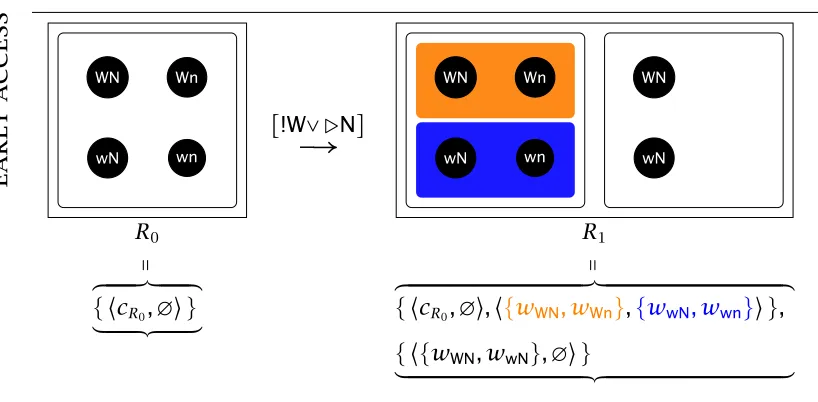
(17a) Put back Waverly or I’ll put backNaked Lunch, I don’t care which.
This analysis captures the fact that (17a) neither commands that you put back Waverly, nor asserts that I will put back Naked Lunch. But it also captures the fact that this utterance is not inert: it puts into competition a perspective where you are motivated to put backWaverly with one where I will put back Naked Lunch, as depicted in Figure 9. The analysis of disjunctive update in terms of preference states requires redefining all of the other sentence types for preference states. But the changes are not drastic. Declaratives and imperatives will distribute the effects they previously had to eachri∈R. Conjunction can still be treated as sequential
early
access
wN wn
WN Wn
[!W∨▷N]
-→
wN wnWN Wn
wN WN
R0 R1
= =
³¹¹¹¹¹¹¹¹¹¹¹¹¹¹¹¹¹¹¹¹¹¹¹·¹¹¹¹¹¹¹¹¹¹¹¹¹¹¹¹¹¹¹¹¹¹¹µ { ⟨cR0,∅⟩ } ´¹¹¹¹¹¹¹¹¹¹¹¹¹¹¹¹¹¹¹¹¹¹¹¸¹¹¹¹¹¹¹¹¹¹¹¹¹¹¹¹¹¹¹¹¹¹¹¶
³¹¹¹¹¹¹¹¹¹¹¹¹¹¹¹¹¹¹¹¹¹¹¹¹¹¹¹¹¹¹¹¹¹¹¹¹¹¹¹¹¹¹¹¹¹¹¹¹¹¹¹¹¹¹¹¹¹¹¹¹¹¹¹¹¹¹¹¹¹¹¹¹¹¹¹¹¹¹¹¹¹¹¹¹¹¹¹¹¹¹¹¹¹¹¹¹¹¹¹¹¹¹¹¹¹¹¹¹¹¹¹¹¹¹¹¹¹¹¹¹¹¹¹¹¹¹¹¹¹¹¹¹¹¹·¹¹¹¹¹¹¹¹¹¹¹¹¹¹¹¹¹¹¹¹¹¹¹¹¹¹¹¹¹¹¹¹¹¹¹¹¹¹¹¹¹¹¹¹¹¹¹¹¹¹¹¹¹¹¹¹¹¹¹¹¹¹¹¹¹¹¹¹¹¹¹¹¹¹¹¹¹¹¹¹¹¹¹¹¹¹¹¹¹¹¹¹¹¹¹¹¹¹¹¹¹¹¹¹¹¹¹¹¹¹¹¹¹¹¹¹¹¹¹¹¹¹¹¹¹¹¹¹¹¹¹¹¹¹¹µ { ⟨cR0,∅⟩,⟨{wWN, wWn},{wwN, wwn}⟩ }, { ⟨{wWN, wwN},∅⟩ }
´¹¹¹¹¹¹¹¹¹¹¹¹¹¹¹¹¹¹¹¹¹¹¹¹¹¹¹¹¹¹¹¹¹¹¹¹¹¹¹¹¹¹¹¹¹¹¹¹¹¹¹¹¹¹¹¹¹¹¹¹¹¹¹¹¹¹¹¹¹¹¹¹¹¹¹¹¹¹¹¹¹¹¹¹¹¹¹¹¹¹¹¹¹¹¹¹¹¹¹¹¹¹¹¹¹¹¹¹¹¹¹¹¹¹¹¹¹¹¹¹¹¹¹¹¹¹¹¹¹¹¹¹¹¹¸¹¹¹¹¹¹¹¹¹¹¹¹¹¹¹¹¹¹¹¹¹¹¹¹¹¹¹¹¹¹¹¹¹¹¹¹¹¹¹¹¹¹¹¹¹¹¹¹¹¹¹¹¹¹¹¹¹¹¹¹¹¹¹¹¹¹¹¹¹¹¹¹¹¹¹¹¹¹¹¹¹¹¹¹¹¹¹¹¹¹¹¹¹¹¹¹¹¹¹¹¹¹¹¹¹¹¹¹¹¹¹¹¹¹¹¹¹¹¹¹¹¹¹¹¹¹¹¹¹¹¹¹¹¹¹¶ Figure 9 Updating with!W∨ ▷N
3.3.3 Conditionals
To analyze conditionals, I will draw on recent dynamic strict conditional analyses (Veltman 2005, Gillies 2004, 2010, Starr 2014b). These analy-ses have two key features that make them useful here. First, they relate antecedent and consequent in terms of their updates rather than propo-sitions, making it possible to have a general account that applies to both declarative and imperative consequents. Second, they do not assume that all conditionals have a wide-scope modal operator, making it possible to distinguish imperative operators from modals and treat hybrid impera-tive/declarative consequents without further assumptions. The various proposals in this family have a common element:37
Dynamic Strict Conditional
(ifφ)ψtests that updating withψ, after updatingcwithφ, provides no more information.
• If the test is passed, then the update returnsc.
• Otherwise it returns a failed information state:∅.
early
access
This guarantees that all of the φ-worlds in c are ψ-worlds. I will adapt this idea to the setting of preference states, whereψ could be declarative, imperative or a hybrid of the two.
The basic idea will be that when every preference relation in a state passes the test, then an augmented state will be returned. For declaratives, this augmented state will simply include a preference forφ∧ψ-worlds over
∅, alongside the preference forcR over∅. For imperatives, this augmented
state will include a preference for theφ∧ψ-worlds over theφ∧ ¬ψ-worlds.
Dynamic Strict Conditional Generalized
(ifφ)ψtests, for ever
![Figure 6→declarative constituents are allowed to have their distinctive effects. This ¬and then promotes the remaining[▷ ∧¬] = ([▷])[¬] !→rGSrG!SS-worlds](https://thumb-us.123doks.com/thumbv2/123dok_us/297240.2026370/29.612.103.507.163.332/figure-declarative-constituents-allowed-distinctive-eects-promotes-remaining.webp)