14
Avoiding the Second Year Slump: A
Transition Framework for Students
Progressing Through University
Janine E. McBurnie, Malcolm Campbell, and Jan M. West
Corresponding author:
Faculty of Science and Technology, Deakin University, Burwood VIC 3125, Australia
Keywords: engagement; intervention; second year; sophomore slump; transition International Journal of Innovation in Science and Mathematics Education, 20(2), 14-24, 2012.
Abstract
The ‘Sophomore Slump’ is a lack of engagement that can be experienced by students entering their second year at university. It has been a recognized phenomenon in American universities for many years but has gone largely unrecognized within Australian universities. In 2009 a program called ‘Welcome to Second Year’ was introduced at a metropolitan Australian university for science students returning as second years or articulating straight into second year. The one day program took place during the week before trimester 1 classes commenced. The aim of the program was to re-engage students both socially with their peers, and academically with their course, and also to introduce them to professionals in their field. This paper provides a description of the program as well as student evaluation of the program over the three years it has now been run.
Introduction
Most second year undergraduate students are familiar with university life, and have taken part in some form of orientation at the beginning of their first year. However, traditional orientation programs may not be enough, as some students experience a lack of engagement with university during their second year. The ‘Sophomore Slump’ is a lack of engagement that can be experienced by students entering their second year at university. It has been a recognized phenomenon in American universities for many years but has been largely ignored within most Australian universities.
In 2009 a program called ‘Welcome to Second Year’ was introduced for Science students entering second year at Deakin University, a metropolitan university in Melbourne, Australia. The program took place on a day within Orientation week.
The ‘Welcome to Second Year’ program provides a short (half day), targeted intervention that (re)engages students socially with their peers and academically with their course and also to introduce them to professionals in their field. Evaluation of the program was carried out to assess whether the ‘Welcome to Second Year’ program assists those students who participate to become (re)engaged with the university, their peers and their course.
15
Background
First year transition
Internationally, much work has been done to improve the first year experience of undergraduate students. The range of backgrounds of students entering tertiary institutions means that the expectations vary widely (Maunder, Gingham, & Rogers, 2010) and thus many programs have been developed to assist students in making the step, for some a ‘leap’ to university life. These programs can enhance students’ engagement with educational practices at their institution (Vinson, Nixon, Walsh, Walker, Mitchell & Zaitseva, 2011), and in turn, would be expected to improve retention rates. As well as improving the student educational experience, the financial implications on non-completions on institutions is significant (Yorke, 2000; Maunder et al., 2010). While student retention has been a recognized issue in higher education for many decades (Tinto, 2006/2007) it remains an issue that tertiary institutions must constantly monitor and address.
Quinlivan (2010) carried out a longitudinal study of undergraduate psychology students and the predictors of academic performance at RMIT University, a large metropolitan university in Melbourne, Australia. In regard to supporting students, Quinlivan (2010) found that students in different year levels did in fact have different needs, at different times, but also reinforced the need for further analysis of second year support and transition programs that are targeted particularly to second year needs. Quinlivan (2010, p.143) stated that ‘the second year has idiosyncratic stressors that increase the potency of the relationship between psychological maladjustment and grade point average and increase the importance of previously established academic skills’.
Being aware of the factors that influence academic performance is vital if we are to develop programs to assist students with targeted interventions when they are needed. With growing numbers of students entering tertiary institutions, it is essential that higher education institutions provide the support to students at appropriate times within their study pathway. Data published by the U.S. National Center for Education Statistics showed that, only 35% of full-time university students in the United States completed their degree within four years, and 25% never finish their degree (Knapp, Kelly-Reid, Whitmore, & Miller, 2007). Jones and Taylor (1991) reported that in the United Kingdom, students who failed to complete their degree earned less and experienced longer durations of unemployment when compared to their peers who had graduated.
16
Second year transition
Previous studies have shown that second year students can sometimes face difficulties returning to study. In the United States this is referred to as ‘sophomore slump’. Sophomores are second year college students, and the ‘slump’ refers to a loss of engagement with college or university life (Gump, 2007). Many students fail to make the transition into second year (Hunter, Tobolowsky, Gardner, Evenbeck, Pattengale, Schaller, & Schriner, 2010) due to a range of pressures. Students feel stress due to academic pressures and personal development issues, which includes forming desirable relationships (Bennett, 2003; Gump, 2007). However, second year is very important as it can be the year during which students make decisions, such as choosing a major stream of study, that have a large impact on their future careers direction (Tobolowsky, 2008). When Freedman (1956) first used the phrase ‘Sophomore slump’, he described it as being a time of inertia and confusion for students. In many North American universities, targeted second year programs and initiatives have been developed to address the ‘slump’. Trinity College in Texas found that amongst their international students the highest attrition occurred between first and second year. Their student support programs had been focused on first and fourth year students, and so developed targeted second year programs in an attempt to improve retention rates at second year. This program focused on the social aspects of university life (Burke, 2007). At Ohio State University they have developed programs for (second years living both on and off campus including social and professional networking opportunities, a sophomore seminar series and a leadership program. Analysis of their programs found that in the long term, it is institutional commitment that had the largest impact on program success and student involvement (Gahagan & Hunter 2006).
Problem identification
While transition programs can help students to feel confident academically, transition is also recognized as an essential part of students’ social and personal journeys (Yorke & Thomas, 2003; Longden, 2006; Vinson et al., 2010). Nelson and Kift (2005) argue that successful transition must involve institutional practices that are embedded in a way that assists students in a timely manner. In 2005 the importance of first year transition into university was recognized by the formulation of Australian Government policy that included a commitment to first year students as a core area of strategic planning (DEST 2006).
The first author of this paper has been involved in the development and implementation of first year orientation and transition programs for over 15 years. As the teacher and coordinator of a large first year core unit during this period of time the success and importance of first year transition has been evident. Working closely with the students during their first year, the author has developed a strong relationship with the students and it became evident through conversations early in their second year experience that many of the students felt lost, and in need of a focus to help them ground themselves and become engaged in the second year of their course. The following comment from a student commencing second year in 2008 illustrates these observations:
I thought you would always be there for us. I know you have to teach the new first years, but who is going to look after us now? How come you aren’t there for us anymore?
17
mark (WAM) of 179 full time students in their first and second year was carried out, and fifty-four percent of students showed a decrease in their WAM from first year to completion of second year. In addition, we compared the WAM of these cohorts between trimester 1 and trimester 2 of their second year and 64% of students had a lower WAM in their second trimester.
To investigate evidence of a slump further we analysed the marks of a cohort of second year students from the unit SLE221 (Anatomy and Physiology) as an indicator of a slump in academic performance from first to second year. These students were completing their degree fulltime and had commenced their degree at Deakin in 2009. We examined a number of students who received final grades of Distinction (D) n= 10; Credit (C) n = 12; Pass (P) n= 11; and Fail (N) n= 4 for this unit. The lower the grade, the higher the percentage of students who experienced a slump at second year; 30% of students who received a Distinction had a lower average mark than for first year, 33% who received a credit, 54.5% who received a Pass and 75% who failed the unit. Interestingly for many of these students the most noticeable decline in marks occurred in trimester 2 in their second year. Several of these students had reduced the number of units per trimester they were undertaking but still could not maintain their average.
Content of the ‘Welcome to Second Year’ program
Inspired by a second year transition program implemented at Griffith University (Australia) to re-introduce second year biomedical students to essential academic concepts and theories (Harrison, 2007), in 2009 a short (one day) intervention program was designed to (re)engage students entering second year Environmental Science courses at Deakin University to assist the students to make the transition to second year. Whilst the majority of students attending the program had been first year undergraduate students at Deakin University in the previous year, the other cohort attending consisted of students articulating straight into second year. The articulating students had received credit for studies completed at other institutions. Therefore, these students were not re-engaging, but engaging for the first time with Deakin University. This program provided both articulating and returning students with a chance to meet with their peers and academic staff before the first week of classes.
The transition program has now been expanded to include a ‘Welcome to Second Year’ program for students completing their Bachelor of Science, Bachelor of Biological Science, and Bachelor of Biomedical Science.
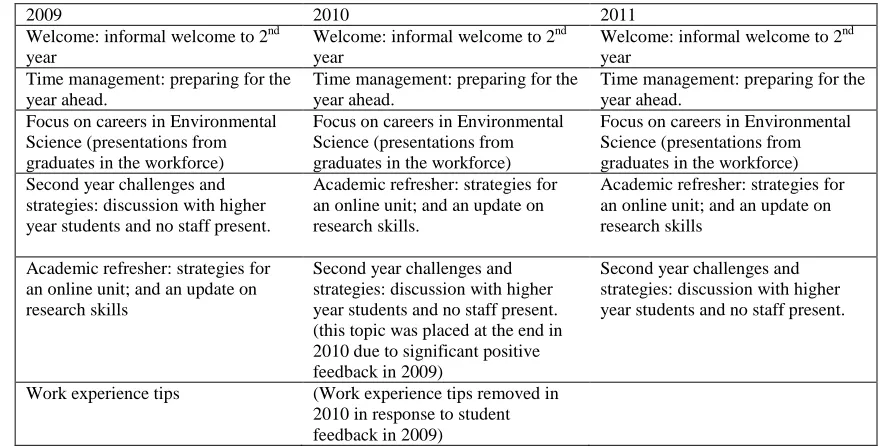
The welcome back program ran for the first time in orientation week (the week before trimester 1 classes) in 2009. All students entering second year, including those articulating directly into second year, were invited to attend a (re)orientation day. As well as providing an opportunity for an academic refresher, it gave the students the opportunity to re-establish social links, and to feel re-connected with the campus and the staff. While a structure was in place for the day (Table 1), it was left somewhat flexible to allow students time to explore issues that were important to them. This provided an opportunity for students to ask about any particular issues of concern to them.
18
and strategies: This session consisted of a briefing session from several science students from the previous year (current 3rd years who had just completed 2nd year). During this session staff left the room so that students could talk openly and freely; (d) academic refresher: an introduction to the second year units that students had in the past found most challenging (eg. research methods, biochemistry and wholly online units). The staff involved in these units talked to the students about the best way to approach the units and strategies for success; and (e) work experience tips. In the field of science it has proved beneficial for students to undertake work experience during their degrees, so this session targeted areas where they might consider volunteering, or opportunities for summer placements to complete their professional practice placement (part of a core unit in the science courses at Deakin).
The one day program addressed some of the issues that all students will face during second year. It provided them with pathways that they can follow if they feel they need support with both academic and personal issues. Student feedback was obtained via a short written survey that students completed at the end of the program. All students were asked to complete the survey and it was collected and collated by someone not involved in the program delivery. The survey included Likert scale questions as well as open ended questions. Student feedback was very positive as illustrated by the following student comments:
Fantastic idea. I feel more ‘on the ball’ about what is to go on in second year Informative – good way to start back without being ‘thrown into the deep end’
In 2010, the program was reduced to half a day (in response to 2009 participant evaluations). Whilst the 2009 evaluations were positive students felt that an entire day was not warranted. Feedback indicated that the students felt that the information of most use to them could be covered in half a day and by having shorter breaks between sessions could be compressed into a shorter time frame.
The 2010 program differed from 2009 by removing the session on ‘work experience and volunteering’ but making sure these were themes incorporated into the other sessions. The program began with a welcome to the students from the staff member who had worked the most closely with the students in first year (the author). This formed the start of a hand over process to the second year academic staff. Vinson et al., (2011) highlight the importance of student-centered staff being part of transition programs. This was also taken into account when choosing the appropriate staff to participate. During the welcome, any administrative changes (such as timetables) that the students needed to be aware of were explained, and students had the opportunity to raise any concerns or queries that they had at that time. Time management was a strong feature of this session as students were seeking advice on the best way to manage their busy lives – balancing study and work.
19
involved and his positive encouragement and enthusiasm about the class helped students to approach the class with more realistic expectations.
The third session introduced professionals in the science field. One of the aims of the Welcome to second year program is to ensure that students start to see where they are heading professionally. This session involved past Science students talking about their career journey. They gave students honest feedback on what they believed they did right or wrong, and provided a link to the profession and a willingness to provide further information or guidance to students if requested.
During the final session, students who had completed second year in the preceding year were invited to talk with the students. No staff stayed in the room for this session so that both the 3rd year and second year students could speak freely. Following this session, students were invited to attend an informal lunch with all staff from the Faculty. The 2011 program followed the same structure as that used in 2010.
Table 1. Structure of the ‘Welcome to Second Year’ program from 2009-2001.
2009 2010 2011
Welcome: informal welcome to 2nd year
Welcome: informal welcome to 2nd year
Welcome: informal welcome to 2nd year
Time management: preparing for the year ahead.
Time management: preparing for the year ahead.
Time management: preparing for the year ahead.
Focus on careers in Environmental Science (presentations from graduates in the workforce)
Focus on careers in Environmental Science (presentations from graduates in the workforce)
Focus on careers in Environmental Science (presentations from graduates in the workforce) Second year challenges and
strategies: discussion with higher year students and no staff present.
Academic refresher: strategies for an online unit; and an update on research skills.
Academic refresher: strategies for an online unit; and an update on research skills
Academic refresher: strategies for an online unit; and an update on research skills
Second year challenges and strategies: discussion with higher year students and no staff present. (this topic was placed at the end in 2010 due to significant positive feedback in 2009)
Second year challenges and strategies: discussion with higher year students and no staff present.
Work experience tips (Work experience tips removed in 2010 in response to student feedback in 2009)
Over a three year period the students taking part in ‘Welcome to Second Year’ were invited to evaluate the program by completing a survey that consisted of Likert scale questions as well as open ended questions. A survey was handed out to all the students participating in the program once all sessions were completed. The surveys were completed by the students and collected at the end of the final session. The results presented herein are the responses from the students completing their degree in Environmental Science. While the program has subsequently been offered to students undertaking other degrees within the faculty, this is the only degree that has offered the program for 3 consecutive years. All students were asked to evaluate the program and the following numbers of evaluations were received: 2009 (37); 2010 (30) and 2011 (36). All students participating in the program completed the evaluation.
20
the students in determining the professional direction they wish to pursue within the field of environmental science?
Analysis of the feedback was both quantitative and qualitative in nature.
Survey design
The 2009 program was a whole day program and these results will be presented first, followed by analysis of the evaluations of the 2010 and 2011 half day programs.
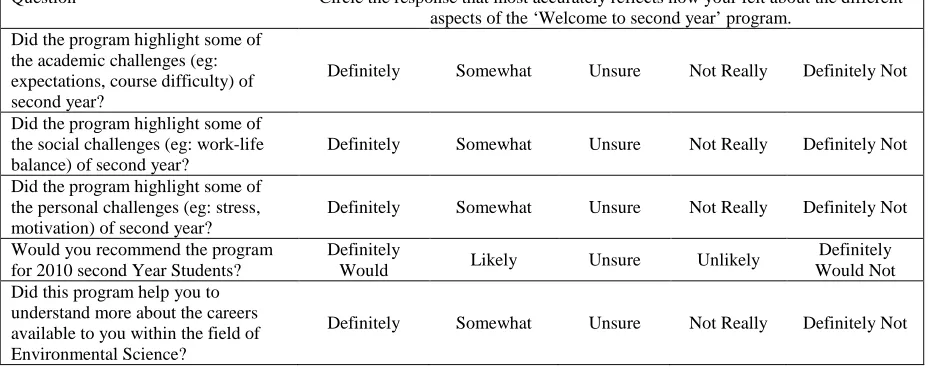
Over the three years (2009-2011) the students were asked to evaluate the program using the same questions. Table 2 shows the Likert scale questions that students were asked when evaluating the program. Students were also given the opportunity to respond to five open ended questions about the program.
The open ended questions asked were:
1. Name two things that you will now do differently this trimester due to having attended the welcome to second year program
2. What session(s) did you find most useful in the program? 3. What session(s) did you find least useful in the program?
4. What other session(s) do you think could be added to the program? 5. Do you have any other comments about the program?
Table 2. Questions students were asked to evaluate the 2009-2011 ‘Welcome to Second Year’
program.
Results
Respondents were very positive about the program. A majority of students stated that it gave them the opportunity to re-engage with their peers, and provided them with valuable information that helped them to plan and prepare for second year. It also prompted many to reflect on their future direction within the field of Environmental Science.
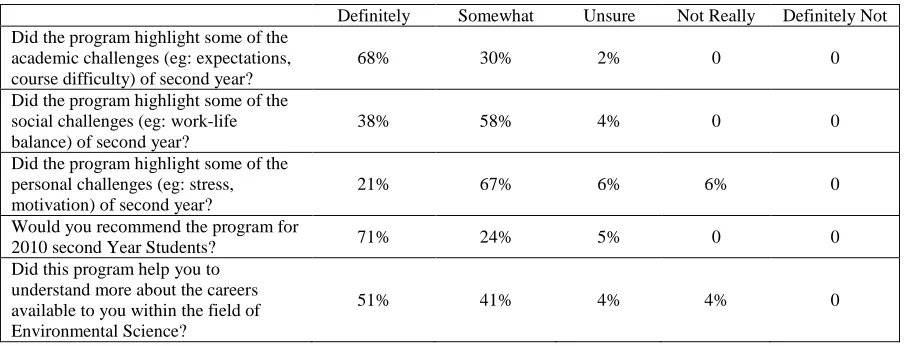
Tables 3 and 4 provide a summary of the responses to the survey questions asked within the program evaluation. Responses indicate a majority of positive responses to all aspects of the program.
Question Circle the response that most accurately reflects how your felt about the different aspects of the ‘Welcome to second year’ program.
Did the program highlight some of the academic challenges (eg: expectations, course difficulty) of second year?
Definitely Somewhat Unsure Not Really Definitely Not
Did the program highlight some of the social challenges (eg: work-life balance) of second year?
Definitely Somewhat Unsure Not Really Definitely Not
Did the program highlight some of the personal challenges (eg: stress, motivation) of second year?
Definitely Somewhat Unsure Not Really Definitely Not
Would you recommend the program for 2010 second Year Students?
Definitely
Would Likely Unsure Unlikely
Definitely Would Not Did this program help you to
understand more about the careers available to you within the field of Environmental Science?
21
Due to the restructuring of the program in 2010 the data from 2009 has been presented separately, and the data from 2010 and 2011 has been combined as during these two years the programs followed the same format.
Table 3. Student responses to the 2009 ‘Welcome to Second Year’ program survey (N=37).
Definitely Somewhat Unsure Not Really Definitely Not Did the program highlight some of the
academic challenges (eg: expectations, course difficulty) of second year?
89% 11% 0 0 0
Did the program highlight some of the social challenges (eg: work-life balance) of second year?
35% 62% 3% 0 0
Did the program highlight some of the personal challenges (eg: stress, motivation) of second year?
46% 46% 3% 5% 0
Would you recommend the program for
2010 second Year Students? 78% 16% 6% 0 0
Did this program help you to understand more about the careers available to you within the field of Environmental Science?
67% 27% 6% 0 0
Table 4. Student responses to the 2010 & 2011 ‘Welcome to Second Year’ program survey (N=66).
Definitely Somewhat Unsure Not Really Definitely Not Did the program highlight some of the
academic challenges (eg: expectations, course difficulty) of second year?
68% 30% 2% 0 0
Did the program highlight some of the social challenges (eg: work-life balance) of second year?
38% 58% 4% 0 0
Did the program highlight some of the personal challenges (eg: stress, motivation) of second year?
21% 67% 6% 6% 0
Would you recommend the program for
2010 second Year Students? 71% 24% 5% 0 0
Did this program help you to understand more about the careers available to you within the field of Environmental Science?
51% 41% 4% 4% 0
The students’ responses to the ‘Welcome to Second Year’ program were positive in all three years. The only area that evaluated very slightly in the negative over the three years was whether or not the program highlighted some of the personal challenges that the students may face, however these figures were small percentages (<6%) overall. All other aspects of the program received positive evaluations from the students.
Tables 3 and 4 show that the students believed that the program either ‘definitely’ or ‘somewhat’ highlighted the academic challenges they would be facing in second year. The five open ended questions reinforced these findings.
22
I need to plan my time better and stay on top of my work.(2009) Allocate specific time for online subject (2010)
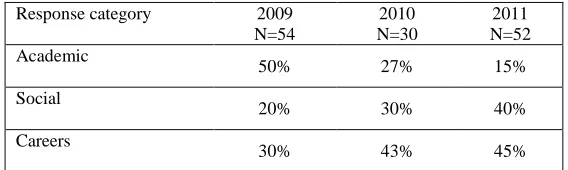
Table 5 provides a summary of the responses to the open ended question, ‘What session(s) did you find the most useful?’ The responses have been grouped into three categories: academic, social and careers. The academic category included all responses related to the academic refresher session, and other comments that where about course content. The social category included the talk with current students who had completed second year the year before. Other responses included in this category related to the social nature of the day, and the opportunity to re-connect with their peers and academic staff. The final category, careers combined responses related to presentations around careers in environmental science, including work experience ideas and presentations from past graduates.
Table 5. Summary of responses to the question ‘What session(s) did your find the most useful’. As students could provide multiple responses, a percentage of total responses has been provided.
Response category 2009
N=54
2010 N=30
2011 N=52 Academic
50% 27% 15%
Social
20% 30% 40%
Careers
30% 43% 45%
During 2010 and 2011 responses to the other four open ended questions didn’t show any trends in responses and overall indicated that the students didn’t believe that changes needed to be made to the program. The only negative response to the program was in 2009, when the program ran for one full day. Some students indicated that the full day program was too long and half a day would have been more appropriate.
Open ended questions
When asked what sessions that students found most useful the area that received the majority of positive feedback over the three years was future careers and employment opportunities. It appears that at the beginning of second year, the students are certainly thinking about their professional identity and the program for some highlighted career options they had not previously considered, and for others reinforced that they were on the right path.
Gave me a better idea of what is out there rather than freaking out that I will never find a job (2009) Great speakers – highly interesting, really got me thinking about different pathways (2011)
23
students and whilst all had a decline in marks in their second year 9 of the 13 students had a major decline in trimester 2 of their second year. Once again a reduction in the number of units undertaken per trimester had not abated the decline in marks with several students failing to complete units in trimester 2 of their second year which may indicate the students are less engaged with university life.
The importance to the second years of future careers was further reinforced by the students’ responses to the question ‘What other session(s) do you think could be added to the program?’ While the majority of students did not respond to this question, most of the responses centered around work experience and careers.
Some more information about potential careers (2010)
The session which involved careers could have been more in depth (2009)
The final question gave students the opportunity to comment in general about the program. Overall the comments were very supportive of the program and the students used the opportunity to thank the organisers for helping them to feel more ‘ready’.
Informative – good way to start back without being thrown into the deep end (2009)
Thank you for organising this welcome back. It has definitely made this second year transition a little less scary (2010)
Good to hear the opinion of people that have actually done what we’re about to. Nice to know what we’re up for (2011)
Discussion and conclusions
The ‘Welcome to Second Year’ program has been a useful, targeted intervention to assist Environmental Science students to (re) engage with university life. A major limitation of the evaluation of the program so far is that an assessment of whether or not the lessons learned during the program have stayed with the students who participated throughout their second year, and also beyond second year. Future evaluation will involve tracking the academic progress of those students who participated in the program, and comparing their grade point average change with those who did not participate in the program. Also asking students what their goals and/or expectations are for second year? In addition to compare out results nationally and internationally the second year students will be invited to participate in the Sophomore Experience Survey developed by Prof Laurie Schreiner from Azusa Pacific University, California.
An enhancement of the program that will take place in 2011 will involve making contact with the 2012 participants at regular intervals throughout the year. It is hoped that this will determine whether or not the content addressed within the program did assist the students both academically and socially throughout second year. It will also give students the opportunity to feedback on areas – academic and social – that they may need assistance with during second year.
24
References
Burke, C., (2007) Combating the sophomore slump and declining retention rates: An experiential academic program for second year international students. Capstone Collection. Paper 790.
DEST (2006). Learning and teaching performance fund, future directions: Discussion paper. In Nelson K., Kift S., Humphreys J., and Harper W. (2006) A blueprint for enhanced transition: taking an holistic approach to managing student transition into a large university. In: 9th First Year in Higher Education Conference 2006, Brisbane. Retrieved December 6, 2011, fro don’t understand this reference. Are you referencing DEST (2006) or the Nelson et al., 2006 FYHE paper? Freedman, M.B. (1956). The passage through college. Journal of Social Issues, 12(4), 12-28.
Gahagan, .J, Hunter, M.S. (2006). The second-year experience: Turning attention to the academy's middle children, About Campus, 11(3), 17-22.
Gump, S. (2007). Classroom research in a general education course: Exploring implications through an investigation of the Sophomore Slump, The Journal of General Education, 56(2), 105-125.
Harrison, G. (2007). Aussie Attrition: The down under experience of sophomore slump in the health sciences. Retrieved October 10, 2011, fro Hunter M., Tobolowsky B., Gardner J., Evenbeck S., Pattengale J., Schaller, M., & Schriner L. (2010). Helping
Sophomores Succeed: Understanding and Improving the Second-Year Experiences. San Francisco: John Wiley and Sons.
Jone, S. J., & Taylor, J. (1991). Non-completion of a degree course and its effect on the subsequent experience on non-completers in the labour market. Studies in Higher Education, 16, 73-81
Knapp, L.G., Kelly-Reid, J. E., Whitmore, R.W., & Miller, E. (2007). Enrollment in postsecondary institutions, fall 2005; graduation rates, 1999 and 2002 cohorts: and financial statistics, fiscal year 2005 (Publication No. NCES 2007-154). Washington, DC: National Center for Education Statistics, U.S. Department of Education.
Longden, B. (2006). An institutional response to changing student expectations and their impact on retention rates, Journal of Higher Education Policy and Management,28(2), 173-87.
Maunder, R.E., Gingham, J., & Rogers, J. (2010). Transition in higher education: Exploring the experiences of first and second year psychology undergraduate students. The Psychology of Education Review,34(1), 50-54.
McKenzi,e K., &Schweitzer, R. (2001). Who succeeds at university? Factors predicting academic performance in first year Australian university students. Higher Education Research & Development, 20(1): 21-33. Morisano, D., Hirsh, J. B., Peterson, J. B., Pihl, R. O., & Shore, B. M. (2010). Setting, elaborating, and
reflecting on personal goals improves academic performance. Journal of Applied Psychology , 95(2), 255-264.
Nelson, K., & Kift, S. (2005). Beyond curriculum reform: embedding the transition experience. In A. Brew & C. Asmar (Eds.), Proceedings HERDSA2005 (pp. 225-235), Sydney, Australia.
Quinlivan, T. (2010). Investigating the transition process across the undergraduate degree: implementing a peer mentoring program to address the second year slump, PhD Thesis, School of Health Sciences, RMIT University, Australia.
Tobolowsky, B.F. (2008) Sophomores in transition: The forgotten year. New Directions in Higher Education, 144, 59-67.
Tinto, V. (2006/2007). Research and practice of student retention: What next? Journal of College Student Retention, 8(1), 1-19.
Vinson, D., Nixon, S., Walsh, B., Walker, C., Mitchell, E., & Zaitseva, E. (2011). Investigating the relationship between student engagement and transition. Active Learning in Higher Education, 11(2), 131-143.
Yorke, M. (2000). Smoothing the transition into higher education: What can be learned from student non-completion? Journal of Institutional Research,9(1), 35-47.
Yorke, M. and Thomas, L. (2003). Improving the retention of students from lower socio-economic groups.