Managing Mathematics with CALMAT
This article was first published in the CTI Mathematics quarterly newsletter Maths&Stats Volume 9, Number 3, August 1998.
Dexter J Booth
School of Computing and Mathematics, University of Huddersfield, UK
The art of good teaching is the art of being organised; lectures ready, clearly delivered with tutorial and homework support. Homework is given out, handed in, marked and handed back on a weekly basis - at regular times and over regular intervals. Learning is work and the student has to develop the habit of regular application if he or she is to succeed. Knowledge acquisition is not an osmotic process; it requires steady graft and continual reflection. If it were otherwise it would not be worthwhile.
But if the student does not participate, no amount of organisation on behalf of the teacher is going to be of worth. The corner stone of a student's participation rests on their willingness to work alone; a willingness that can be stimulated by regular homework followed by regular feedback. Take that away and pretty soon the wall will be breached - the odd lecture is missed - no sanction. Then the odd tutorial - still no sanction. Then large scale absenteeism And then the sanction - failure - but too late. Admittedly not all students follow this pattern but too many do and here is the point at issue; with a large group of first year students how can the habit of regular effort be instilled? How can the teacher ensure that no-one is 'slipping the net'? Clearly weekly homeworks are out of the question with 100+ students and this is where automated systems come into their own.
This paper describes the operation and consequences of a pilot study to use a computer to deliver tutorial activities and continual assessments to a large group of first year undergraduate
engineering students1.
The software
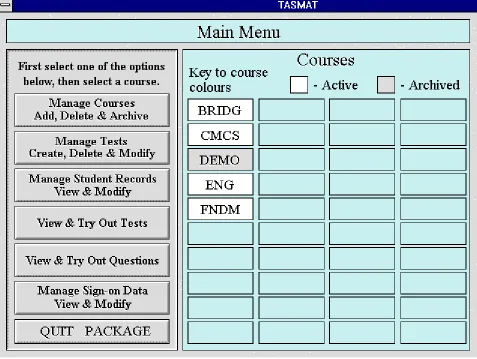
The software is called CALMAT and is accompanied by a sister suite called TASMAT. It was developed by and is available from Dr Jean Cook in the Department of Mathematics at Glasgow Caledonian University.
CALMAT is a software suite that contains expository material, tutorial activities, some measure of assessment and a comprehensive management information system that ensures that the teacher can maintain course control with a close awareness of student effort. The expository material ranges from GCSE mathematics through to A-level mathematics (Scottish University Year 1) and covers all the topics that one would expect to be familiar to a competent junior
mathematician.
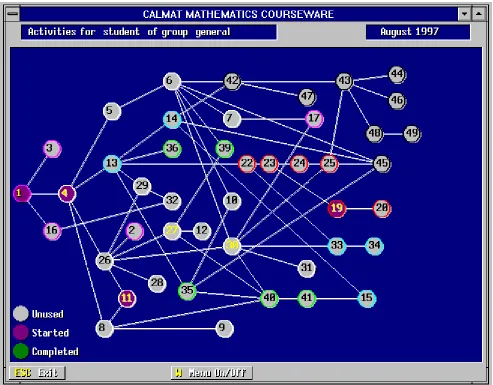
Figure 1. Module map
The name of the game is to complete modules one at a time in the order prescribed by the
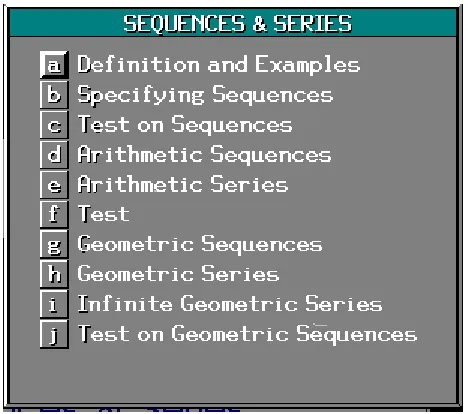
Figure 2. Typical subsection list
To complete each subsection the student has to answer correctly a number of tutorial type questions in sequence. If the student enters an incorrect answer then the student has to start the sequence again. This greatly concentrates the mind. When a subsection has been completed the subsection label turns green otherwise it turns pink to indicate that it has been started but not completed. Return is possible to any part completed subsection at any future time. When all the subsections have been completed satisfactorily the module marker on the module map turns green and the student is credited with having completed that module. Some modules have specific assessments included and the scores for these are recorded separately.
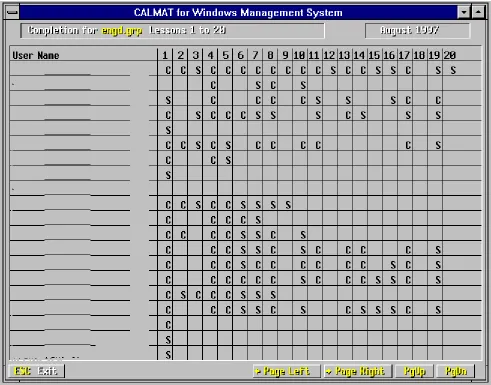
Figure 3. Completion for a group
Figure 3 displays those modules started (S), completed (C) or not done (blank) by each student for a particular tutorial group of students (the names of the students have been blanked out to comply with the Data Protection Act). The performance of any particular student can also be viewed.
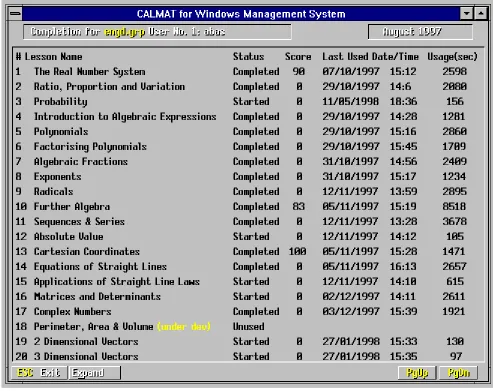
Figure 4. Completion for a student
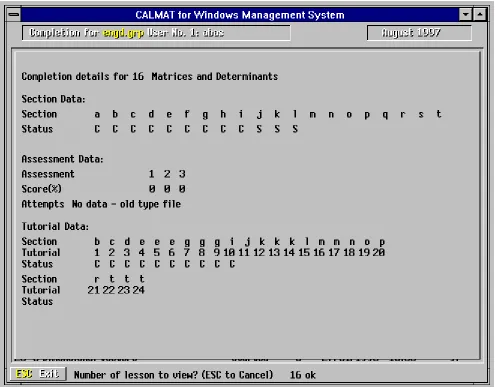
Here, in Figure 5, we see that this student has a little more effort to expend to complete this module. If it were felt that this student was falling behind or was experiencing some difficulties then it is a simple matter to email the student. I found that widespread use of email was very effective in encouraging and maintaining student participation though there were one or two exceptions to this rule. If a student did not respond to email then it was time to contact the course tutor for further action. Fortunately, this was a rare occurrence but when encountered was
Figure 5. Details of a particular module for a particular student
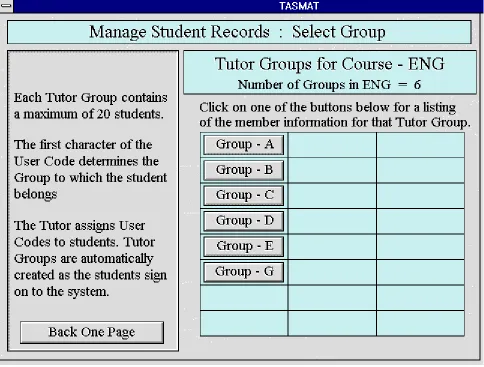
Figure 7. TASMAT tutorial groups
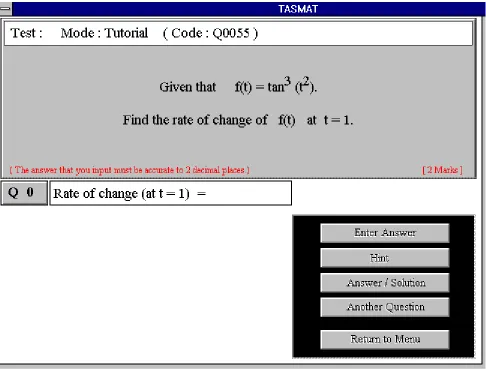
Figure 8. A sample question
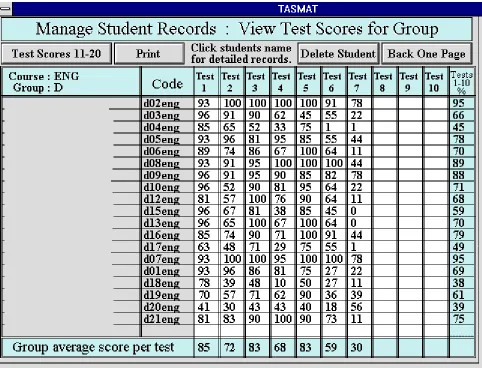
Figure 9. Student group scores
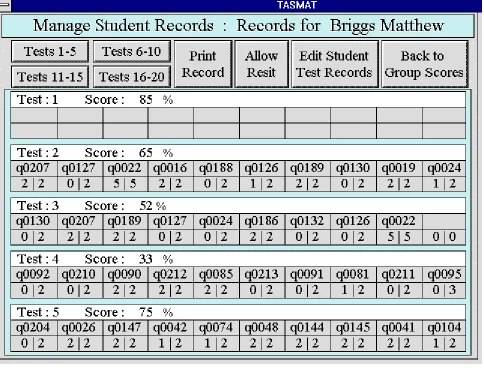
Figure 10. Student test scores
The first test has blanks for each question. This is because the system failed to record the marks across the network when it was first put to serious use. Despite the frustrations that this caused it was possible to note each student's mark and then, as tutor, enter the marks onto the record. This raises another important point. As far as is possible test the technology because this is where the system is at its most vulnerable and there is nothing more likely to put a student off than trying to use a system that keeps falling over.
The course
The course on which I have been running the pilot installation is a two semester course of service mathematics to 120 first year engineering students from a variety of disciplines. The
course itself is delivered by two one hour lectures each week followed up by a one hour tutorial. In addition to this the students are expected to spend upwards of three hours per week in 'directed unsupervised activity' (DUA) - a euphemism for homework.
In the past the tutorials have been paper based and very poorly attended. As far as the directed unsupervised activity is concerned, because this could never be monitored it was probably never done. In effect, a significant number of the students were not putting in a consistent effort during the year and leaving their learning of the course material to a cramming session in preparation for the examinations. With some students this approach pays off to the extent that they do not fail the examination. With an increasing proportion of the students, however, this style of learning has disastrous consequences.
The course structure
The 1997-1998 delivery of the course was re-structured to take account of the software. Each lecture was delineated against one of the CALMAT modules and the appropriate course notes duplicated (each module comes with a complete set of course notes). Each tutorial was likewise delineated against one of the CALMAT modules and was taken in a computer laboratory. Certain other modules (13 in all) were designated as starred modules and the students were expected to work through these in their own time. This latter formed the directed unsupervised activity. Every three weeks the students sat a TASMAT test during their appropriate tutorial. This structure is clearly laid out in the Module Handbook that is issued to the students at the beginning of the academic year as is shown in Figure 11:
Lecture Schedule for Semester 1
Date Topic of the week CALMAT Programs
Tutorial Program
DUA Programs
2/10/97 Real numbers and algebraic
expressions 1, 4 1 4*
9/10/97 Polynomials and their factorization 5, 6 5 6
Week beginning
13/10/97 Test 1 6
16/10/97 Algebraic functions and exponents 7, 8 6 7*, 8*
23/10/97 Further algebra, sequences & series 10, 11 11 10*
30/10/97 Co-ordinates and the straight line 13, 14 13 14
Week beginning
21/11/97 Test 2 14
13/11/97 Matrices and linear equations 16, 29 16 29*
20/11/97 Quadratic equations 30, 31 30 31
Week beginning
24/11/97 Test 3 31
27/11/97 Complex numbers and two
dimensional vectors 17, 19 31 17*, 19*
4/12/97 Three dimensional vectors and
triangles 20, 23 20 23*
11/12/97 Trigonometry 24, 25 24 25
Week beginning
15/12/97 Test 4 25
18/12/97 Introduction to probability Notes 25 Notes
Figure 11. Course structure
Assessment
The course is assessed by course assessment (40%) and final examination (60%). The in-course assessment is built up by collecting points. The seven TASMAT tests contribute a
maximum of 40 points but, of course, no-one is going to achieve all 40 that way. As a spur to the students to undergo their directed unsupervised activity and so develop their own self-assessment each completed 'starred' module will gain them an extra point. These extra points they can then add to their test points to accumulate to a maximum of 40 points. A number of students took this aspect very seriously to finish the year with a 100% contribution from their in-course
assessment. Needless to say, these very students gained the highest marks in the final examination.
Operation of the course
Apart from one or two minor technical hitches in the early weeks (they did not seem to be minor at the time!) the students have responded to this form of course delivery with remarkable
CFN105 Mathematics 1 Final Questionnaire Week 9 Semester 2
Yes No Average Score
Score 5 4 3 2 1 Score Rating
01 Have you enjoyed the course? 16% 35% 40% 8% 2% 3.6 71%
02 Do you approve of the use of
CALMAT? 21% 30% 37% 11% 2% 3.8 75%
03 Do you approve of the use of
TASMAT? 27% 32% 24% 10% 8% 3.7 75%
04 Has it helped you organise your
study? 8% 32% 35% 19% 6% 3.3 66%
05 Has it helped you control your
learning? 13% 37% 35% 10% 5% 3.3 67%
06 Do you feel that you have learned more than if you had paper-based tutorials?
20% 23% 30% 13% 15% 3.7 74%
07 Do you like the points system for the
self-assessed modules? 30% 46% 16% 3% 5% 3.5 70%
08 Did you find the lectures useful? 10% 27% 38% 17% 8% 3.4 69%
09 Did you find the handouts useful? 22% 33% 37% 8% 0% 3.8 75%
10 Do you feel confident about a more
traditional course next year? 15% 21% 39% 13% 13% 3.7 73%
11 Do you perceive your degree course
favourably? 7% 32% 54% 5% 2% 3.5 70%
Overall satisfaction rating (1-5) 3.6 71%
(Standard Deviation) 0.2
If you like the use of CAL is it because: (10% did not like)
1 I can study in my own time 84%
2 Helps me to organise myself 25%
4 Forces a response to questions 46%
5 It is easier than using a text book 46%
6 I can see an attainable target 40%
7 Did you use the learning diary?
Often Occasionally Never
5% 44% 51%
Figure 12. Questionnaire analysis
Results
A detailed quantitative analysis of the results of this year's experience would be of little worth as it would be trying to compare two different cohorts of students operating under two different systems; the assessments last year were paper based and fewer in number and the directed unsupervised activity was not monitored. Instead, suffice it to say that the overall success rate was significantly better than hitherto and convinced me that this system was worthwhile. There are just a few caveats:
It is essential that the tutor maintains a regular watching brief on every student's activity. Email is an invaluable means of maintaining a personal contact with any student who appears to be having difficulties.
Ensure that the assessments are only taken when the tutor is present - it is possible to lock a particular student out of the assessment mode of any test.
Give the students plenty of opportunities to practice paper based problems so as to develop their examination techniques. Being tested by the computer is quite different from the traditional form of testing.
There is a need to consider later effects - will the students demonstrate that they are better prepared for their second year courses than would have been expected from past experiences? I wait to see.
Conclusions
of learning to learn has begun. All that is required of the learner to succeed is the desire to do so and the willingness to react to the immediate feedback on progress that only an automated system can deliver.
Seated before the computer the learner is challenged to make something happen, to act or pursue, rather than merely react or absorb2.
Furthermore, the course becomes so wrapped up inside the technology that the only way for the student to progress is via the technology which acts as an ever vigilant recorder of the student's efforts; not only can the teacher maintain a continual record of a particular student's efforts but, and equally importantly, the student can as well. However, and this fact cannot be stressed too much, the enveloping of a course of study within a computer ethos can only be made effective if an over-arching management information system is part of the deal.
References
1. Booth, Dexter J. Incorporating Mathematics Into CAL, Alt-N, 21, April 1998.
http://www.warwick.ac.uk/alt-E/alt-N/current/calmat.html (can only be accessed by ALT members).
2. Rudenstein, Neil L. The Internet and Education: A Close Fit
http://www.mcb.co.uk/services/conferen/jan98/vuj/background_paper.htm
Supplier contact details:
The CALMAT Team Department of Mathematics Glasgow Caledonian University Cowcaddens Road
West Yorkshire Glasgow G4 0BA United Kingdom [email protected]
http://www.maths.gcal.ac.uk/calmat/
Dexter J Booth
School of Computing and Mathematics University of Huddersfield