17
STUDENTS’ READING PRACTICES AND ENVIRONMENTS
Aiza Johari
Academy of Language Studies, Universiti Teknologi Mara, Sarawak
email: [email protected]
Amelia Alfred Tom
Academy of Language Studies, Universiti Teknologi Mara, Sarawak
email: [email protected]
Affidah Morni
Academy of Language Studies, Universiti Teknologi Mara. Sarawak
email: [email protected]
Siti Huzaimah Sahari
Academy of Language Studies, Universiti Teknologi Mara, Sarawak
email: [email protected]
Abstract: The challenges of reading are indeed apparent in most teaching and learning processes in ESL classrooms. As a result, this study is conducted to resolve the issues of students who seem to find reading to be unbearable. Many of them have limited ability to read well and hence, possess insufficient reading habits to become competent readers, particularly out-of-school context. Besides, poor home literacy environments also contribute to their shortcomings in reading. The main objectives of this study are to identify the students’ reasons for reading as well as to find out their home reading environments (reading backgrounds and habits; reading attitudes and motivation; reading exposure and supports). To identify these, questionnaires were distributed to 120 secondary school students (Form 4: 16 years old) from one of the urban schools in Sarawak, Malaysia. The findings indicate that the students read to gain information and knowledge though many chose reading as a hobby as their last choice in explaining their motives of reading. Besides, they preferred non-academic reading materials, mainly lighter forms reading materials such as comics, story books and magazines. Though the students acknowledged the importance of reading in their daily lives, their average reading habits, attitude, motivation, exposure and support within the home domain had suggested otherwise. They mainly read for instrumental purposes while reading for pleasure seemed not to be given priority. Besides, the respondents acknowledge that their parents and themselves did not read much at home. As an implication, it is vital for students to improve their reading perceptions, abilities and practices to achieve personal, societal and national progress. On a final note, parents’ early and continuous efforts to be involved in their children’s literacy events in an out-of-school context are believed to be vital to inculcate positive reading environments, habits and culture.
Keywords: secondary, reading environments, reading habits
LINGKUNGAN DAN PRAKTIK MEMBACA SISWA
18
menemukan kesulitan dalam keterampilan membaca. Banyak dari mereka memiliki kemampuan terbatas untuk membaca dengan baik dan karenanya kurang memiliki kebiasaan membaca untuk menjadi pembaca yang kompeten, khususnya konteks di luar sekolah. Selain itu, lingkungan rumah yang kurang memiliki literasi juga berkontribusi terhadap kekurangan mereka dalam membaca. Tujuan utama dari penelitian ini adalah untuk mengidentifikasi alasan siswa membaca serta untuk mengetahui lingkungan membaca di rumah mereka (latar belakang dan kebiasaan membaca, sikap dan motivasi membaca, paparan dan dukungan membaca). Untuk mengidentifikasi hal tersebut, kuesioner dibagikan kepada 120 siswa sekolah menengah (dari 4: 16 tahun) dari salah satu sekolah di perkotaan di Sarawak, Malaysia. Temuan menunjukkan bahwa siswa membaca untuk mendapatkan informasi dan pengetahuan meskipun banyak yang memilih hobi membaca sebagai pilihan terakhir mereka dalam menjelaskan motif mereka membaca. Selain itu, mereka lebih suka bahan bacaan non-akademis, terutama bahan bacaan ringan seperti komik, buku, buku cerita dan majalah. Meskipun siswa mengakui pentingnya membaca dalam kehidupan sehari-hari mereka, rata-rata kebiasaan membaca, sikap, motivasi, paparan dan dukungan mereka dalam domain rumah telah menyatakan sebaliknya. Mereka membaca terutama untuk tujuan penting dan membaca untuk kesenangan tampaknya tidak diprioritaskan. Selain itu, responden mengakui bahwa orang tua mereka dan diri mereka sendiri tidak membaca banyak di rumah. Sebagai implikasinya, sangat penting bagi siswa untuk meningkatkan persepsi, kemampuan dan praktek membaca mereka untuk mencapai kemajuan pribadi, bermasyarakat dan bernegara. Pada catatan akhir, upaya awal dan berkesinambungan dari orang tua untuk terlibat dalam kegiatan keaksaraan anak-anak mereka dalam konteks luar sekolah diyakini penting untuk menanamkan lingkungan membaca yang positif, menjadi kebiasaan dan budaya.
Katakunci: lanjutan, lingkungan membaca, kebiasaan membaca
Reading is supposed to be an enjoyable and rewarding experience. According to Gee (1999), “Good readers read as the pull of a book is irresistible”. Yet, many ESL students do not in fact choose to read, even though reading is currently recognized as a significant source of input for second language acquisition (Dupuy, Tse and Cook, 1996; Kim and Krashen, 1997; Gove and Cvelich, 2010; Mielke, 2011). In fact, Krashen (2004) affirmed that not everyone reads and those who do are the ones who are often not reading as effectively as they could be.
To add, children who read very little usually have poor reading skills as reading is a struggle for them and they avoid it whenever possible (Reading is Fundamen-tal, 2007). In a wider perspective, the
19 lack of time for their children, lack of interest in their children’s education, or lack of knowledge about how to support their children’s academic success.
Why do we read?
As we are surrounded by written texts daily, reading skills are seen as valuable throughout our life. In terms of academic literacy, the skills are the keys to many successes. When people read extensively in the language, reading comprehension, writing style, vocabulary, spelling and grammatical developments tend to im-prove, particularly in response to our new demands and changes in jobs (Krashen, 2004). Therefore, the English syllabus in Malaysia has placed reading at the centre of English learning skills.
Examining the main purpose of reading, reading to gain knowledge is seen as one of the main reasons why people read. Reading for that purpose is what Harmer (2004) describes as reading for utilitarian or instrumental purpose. Addi-tionally, another motive of reading is to gain pleasure, where Hedge (2006) ack-nowledges that once a reader finds pleasure in reading, the ‘love’ towards reading will also be increasing. As a result, the ‘love’ of reading has propelled many learners to successful acquisition of reading skills.
The enrichment of acquiring know-ledge and the abilities to read well would also in turn, enable an individual to present him or herself more confidently (Dicker, 2004). Hence, a competent reader is assumed to gain higher degree of confi-dence as he or she will be able to tackle a wider range of reading texts and gain an abundance of knowledge thus, able to disseminate lots of information and know-ledge.
Looking at a wider context of the society, Wallace (2006) further stresses that reading is perceived as a means of commu-nication in a highly literate society. It is relevant in the context of a social process where reading does not only contribute to
an individual’s well-being, self-develop-ment and progress but also the nation as a whole. At present, the importance of reading habits and attitudes is gaining more of its importance among working people of the world, in which Comper (1999) emphasized:
Whatever else you bring to the twenty-first century workplace, however great your technical skills and however attractive your attitude and however deep your commitment to excellence, the bottom line is that to be successful, you need to acquire a high level of information literacy.
Developing Reading Environments Cook (1980), Morrow (1985) and Gove and Cvelich (2010) suggest that literacy awareness begins at home before the children go to school. For most children, the most important contexts are home and family. As Harmer (2004) adds, the attitudes of parents and other siblings will be crucial because their approval and encouragement in reading will affect students’ motivation and interests to read. In the same way, Reading Is Fundamental (2007) also indicated that children who see their parents reading daily; both for function and for pleasure will more likely become avid readers themselves and if they see parents visiting libraries and checking out books, giving and receiving books as gifts, and borrowing and loaning books to friends, they will know their parents place high value on reading.
Notably, the development of literacy in children is qualitatively and quantitatively affected by adults, who live and interact regularly with children (Snow et al., 2005). The researchers established a wide variety of factors which affect these interactions: parent’s beliefs and attitudes about reading and literacy, the children’s motivation for reading, the opportunities to read that parents provide to children and parents’ own reading and literacy ability levels.
20 individual interest towards reading. She continued to state that “this interest will affect the pattern of behaviour related to reading that is continually practised by the individual”. As children begin reading in the context of home and family, in many ways, they are following the example of their family members.
Examining the relationship between parents and children’s reading backgrounds and habits, the parental factors such as the reading materials, parental reading beha-viours, the frequency of reading to the child and parental beliefs will contribute to their children’s more positive reading habits and outcomes (Greaney and Hegarty, 1987). Subsequently, Mullis et al. (2004) suggested that the earlier the parents become involved in their children’s literacy practices; the more profound will be the results and more longer-lasting the effects. This in turn, will also develop students’ more positive attitudes towards school and homework habits (Hedge, 2006). This view has indicated that the role of the teacher should be that of supplementing the parents and should not be the only party who is completely involved in the children’s literacy development.
Children’s reading attitudes and motivation are among the aspects that children develop within the family where parents’ love, support and approval are crucial in motivating their children to learn how to read during these early years. Reading attitude is referred to as a state of mind, accompanied by feelings and emo-tions, which makes reading more or less feasible (Smith, 1990). Conversely, Gan (2002) described reading motivation as the energizing force that actually causes reading to occur when a favourable attitude (from the students or parents) towards reading exists. It is evident that parental involvement with reading activities at home has a significant positive influence not only on reading achievement, language comprehension and expressive language skills (Gest et al., 2004) but also on
students’ interest and motivation in reading, attitudes towards reading and attentiveness in the classroom (Rowe, 1991).
To add, children’s reading exposure and support will aid learning domain where positive reading values within such domain are clearly expressed by parents to their children (Lynch, 2007). Parents’ visible effort and transparent intention to maxi-mize reading exposure and support will often encourage children who are normally perceptive to accept such values in a positive way. Commenting on access to books, De Temple (2001) states that the print-rich domain is an environmental factor strongly related to children’s literacy development. For that reason, ‘Inter-national Reading Association’ (2005) has revealed that homes with many books (more than 100) had higher reading achievement than homes with fewer than 10 children’s books. Thus, parents and guardians need to be aware of the significant contribution they can make to their children’s learning by providing a stimulating environment around language, reading and writing as well as supporting a home literacy agenda, both during the early years as well as the primary and secondary years of schooling (Clark, 2007). This paper explores two objectives: to identify students’ reasons for reading and to iden-tify students’ reading environments (reading backgrounds and habits; reading attitudes and motivation; reading exposure and supports).
METHOD
21 Ong’s Reading Habits and Interests Questionnaire (2005). The data derived from the questionnaires was analysed using Statistical Package for the Social Sciences (Version 17) where descriptive and inferen-tial statistics were utilized.
FINDINGS AND DISCUSSION Demographic Data
The research finding indicates that 60% of the respondents were girls and they outnumbered the boys by a percentage of
20%. This reflects an overall pattern in the population of the study. As for ethnicity, by far, the largest group of respondents was Chinese (67%), followed by the Malay (21%). The minorities were the Bidayuhs, Indians, Ibans and Melanaus. Generally, it is observed that this particular school is mostly populated by Chinese compared to other races. The location of the school is believed to be situated in a catchment area that is heavily populated by Chinese.
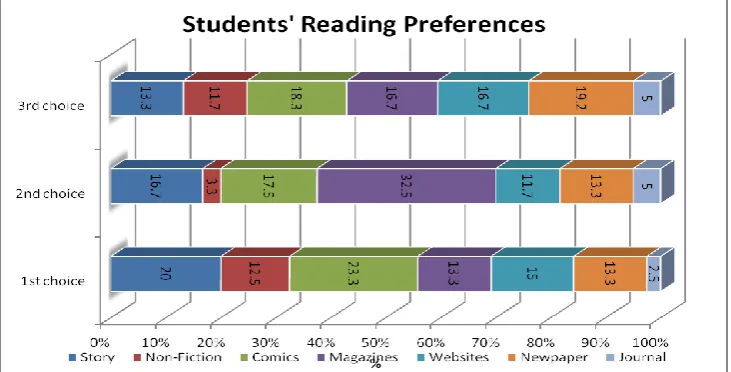
Figure 1: Respondents’ preferences ranking for reading materials
In the questionnaire, the respondents were asked to rank from their first to the seventh choice of preferred reading materials but the above stacked bar graph indicates only the top three rankings of their preferred reading materials.
Figure 1 indicates that many students favoured reading non-academic reading materials compared to academic materials. Among the non-academic materials, they preferred lighter forms of printed texts such as comics (23.3%) and storybooks (20%). These represent the highest and the second highest percentages for first choice. Besides, magazines which are also another form of light reading materials illustrate 32.5%, making them the highest second choice.
The result of comics as the highest first rank is expected as most teenagers are
known to love reading comics. As described by Murray (2006): “A comic is an endlessly fascinating art form”. As comics are eye-catching and easier to read, ‘struggling’ readers can interpret the non-linear information without difficulty, thus ranking comics the highest among the seven choices. In a survey by Malaysian National Library (2006), comic reading was revealed to be common among readers between 10 to 24 years old.
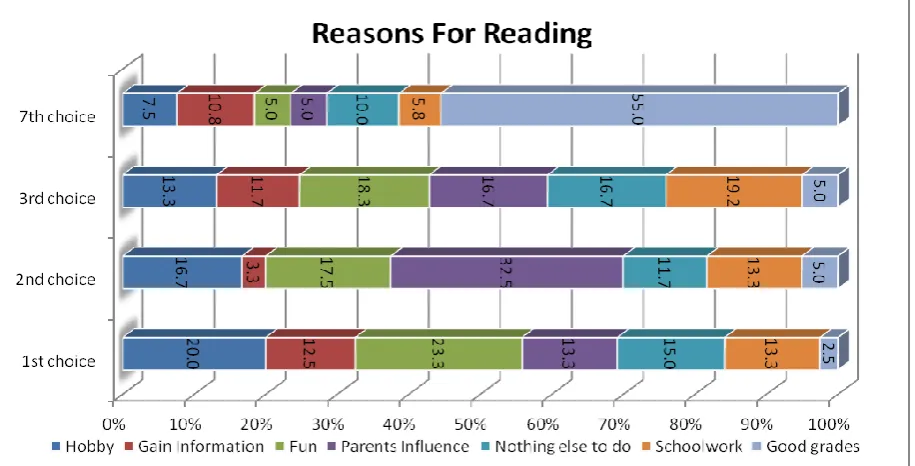
In the questionnaire, the respondents were asked to rank from their first to the seventh choice of preferred reading materials but the above stacked bar graph indicates only the top three and the last rankings of their reasons for reading.
22 percentage for first ranking) as well as 20% and 21.7% for the second and the third rankings. This is encouraging to note that many respondents want to educate themselves by reading. On average, the respondents to a certain extent were also aware of the importance of reading. Reading enables them to do their schoolwork (10%) and to obtain good
grades (15%). In a similar line, such purposes are relevant in their daily lives as students who are required to read in school as parts of lessons or to prepare for exams. These findings confirm the observation by Harmer (2004) that reading for utilitarian or instrumental purpose is viewed as the main reason on why people actually read.
Figure 2: Students’ preferences ranking for reasons for reading
Nonetheless, it is quite discouraging to note that quite a number of respondents ranked “reading as a hobby” seventh. The finding indicates that reading is not perceived as sufficiently attractive by the respondents to be conducted as a hobby. This is probably due to the existence of other ‘fun’ or ‘interesting’ activities.
Respondents’ Reading Environments at Home: Backgrounds and Habits
In the following tables, the respondents’ reading backgrounds and habits, attitudes and motivation, and exposure and support are examined. Subsequently, the findings are analysed as descriptive data (frequen-cies).
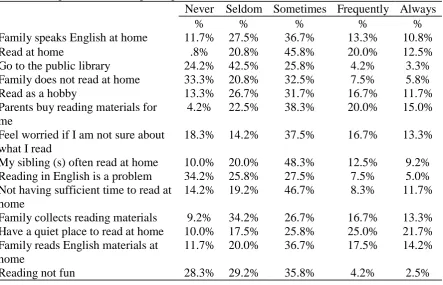
Table 1 gives general description of the respondents’ reading backgrounds and habits. Most of the respondents opted
‘sometimes’ as their favorable options and on average, this indicates that they have neutral reading backgrounds and habits. Another reason for opting ‘sometimes’ was probably due to the respondents who did not have firm answers to the respective statements or were still undecided whether they have positive reading backgrounds and habits.
23 at home (‘sometimes’: 46.7%). Obviously, the children could not practise healthy reading habits if their parents do not practise similar habits themselves. As affirmed by Fauziah (2002): “You can’t catch it from someone who hasn’t got it”.
As for contradicting the statement that ‘Reading is not fun’ (57.8% for ‘never’ and ‘seldom’), the idea of fun reading is possibly due to the availability of a variety of reading materials sold in the market as well as the ones downloaded from the internet. In contrast, the amount of time spent at the library is not impressive with 24.2% of the respondents choosing ‘never’ and 42.5% with ‘seldom’. This means that the students rarely spent their free time at
the library. They might have some amount of reading materials at home and they may not have a pressing need to go to the public library. Noting the options ‘always’ with 13.3% and ‘frequently’ with 16.6% for ‘family collects reading materials’, the results are rather discouraging as most respondents generally did not have big collections of reading materials at home because their families are not avid collectors of printed materials. To sum, the overall results disclose the reasons why many respondents were average readers whereby they had average reading habits, average quality reading time at home and were infrequent users of the libraries.
Respondents’ Reading Backgrounds and Habits
Table 1: Respondents’ reading backgrounds and habits
Never Seldom Sometimes Frequently Always
% % % % %
Family speaks English at home 11.7% 27.5% 36.7% 13.3% 10.8%
Read at home .8% 20.8% 45.8% 20.0% 12.5%
Go to the public library 24.2% 42.5% 25.8% 4.2% 3.3% Family does not read at home 33.3% 20.8% 32.5% 7.5% 5.8%
Read as a hobby 13.3% 26.7% 31.7% 16.7% 11.7%
Parents buy reading materials for me
4.2% 22.5% 38.3% 20.0% 15.0%
Feel worried if I am not sure about what I read
18.3% 14.2% 37.5% 16.7% 13.3%
My sibling (s) often read at home 10.0% 20.0% 48.3% 12.5% 9.2% Reading in English is a problem 34.2% 25.8% 27.5% 7.5% 5.0% Not having sufficient time to read at
home
14.2% 19.2% 46.7% 8.3% 11.7%
Family collects reading materials 9.2% 34.2% 26.7% 16.7% 13.3% Have a quiet place to read at home 10.0% 17.5% 25.8% 25.0% 21.7% Family reads English materials at
home
11.7% 20.0% 36.7% 17.5% 14.2%
Reading not fun 28.3% 29.2% 35.8% 4.2% 2.5%
It is evident from Table 2 that 44.2% of the respondents agreed that “Reading is not a waste of time” while 58.3% found that ‘Reading is fun’. On the other hand, 56.7% of the respondents strongly dis-agreed to the statement ‘Learning how to read properly and effectively is not
24 motivation which if nurtured, could be developed into good reading habits. Notably, these results supported the findings illustrated by Thadphoothon (2006) where her respondents were not only aware of the significance of reading to improve their academic achievement, but also the importance of correct their reading skills to improve their quality of life.
Other outstanding indicators from the table above shows that most respondents (47.5%) strongly disagreed that ‘Reading is not really important’ while 32.8% were ‘undecided’ and 31.9% ‘agreed’ to the statement: ‘They learn to read more at school than at home’. In addition, 48.3% of the respondents also revealed that they
were not sure whether ‘They always make time for reading at home’. These suggested that they acknowledged the significance of reading but more reading were done at school compared to at home because many did not have sufficient reading time at home. This result is parallel to the study conducted by Kaur and Thiyagarajah (1999), where many of the students were found to read very little at home (except for some who read the daily newspapers) and seemed perturbed when asked about their reading interests, giving the typical reasons of the lack of time and access to reading materials to explain the lack of time used for reading.
Respondents’ Reading Environments at Home: Attitude and Motivation
Table 2: Respondents’ reading attitudes and motivation
Subsequently, only 35.8% ‘agreed’ and 27.5% ‘strongly agreed’ that ‘their family motivates them to read’. This phenomenon suggests that more than half of the respon-dents were from families who gave
rela-tively average motivation towards reading, hence may influence students to actually obtain some positive reading attitude. Strongly
Disagree
Disagree Undecided Agree Strongly Agree
% % % % %
I want to learn how to become a better and more effective reader
0 5.8 15.8 41.7 36.7
Learning how to read properly and effectively is not important
56.7 29.2 5.0 6.7 2.5
Enjoy reading English materials 2.5 6.7 30.8 38.3 21.7 Reading is not really important 47.5 40.0 8.3 3.3 .8 I always make time for reading 3.3 15.8 48.3 28.3 4.2 I am good at reading in English 5.0 16.7 33.3 34.2 10.8 It’s a pain to read in English 38.3 30.0 20.8 8.3 2.5 Learn to read more at school
than at home
5.9 17.6 32.8 31.9 11.8
Reading is fun 5.0 9.2 27.5 40.0 18.3
Reading in English is too difficult
32.5 30.8 28.3 6.7 1.7
I enjoy the challenge of reading and doing reading activities
2.5 12.5 34.2 37.5 13.3
25 Students’ Reading Environments at
Home: Exposure and Support
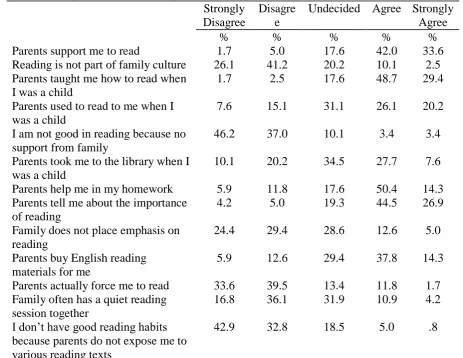
Table 3 shows that a majority of the respondents seemed to agree that ‘their parents support them to read’ (42.0% for agree and 33.6% for strongly agree). This is heartening to note as most parents were able to give either physical or moral supports for their children by providing relatively good reading facilities at home and stressing the significance of reading in
their studies and life. Nonetheless, it would be encouraging if the respondents’ family provide more time for quiet reading session together as more than half (52.9%) disagreed and strongly disagreed to the statement: “Family often has a quiet reading session together”. This activity is believed to nurture good reading habit and provide parents with the opportunities to bond with their children.
Table 3: Respondents’ reading exposure and support Strongly Disagree
Disagre e
Undecided Agree Strongly Agree
% % % % %
Parents support me to read 1.7 5.0 17.6 42.0 33.6 Reading is not part of family culture 26.1 41.2 20.2 10.1 2.5 Parents taught me how to read when
I was a child
1.7 2.5 17.6 48.7 29.4
Parents used to read to me when I was a child
7.6 15.1 31.1 26.1 20.2
I am not good in reading because no support from family
46.2 37.0 10.1 3.4 3.4
Parents took me to the library when I was a child
10.1 20.2 34.5 27.7 7.6
Parents help me in my homework 5.9 11.8 17.6 50.4 14.3 Parents tell me about the importance
of reading
4.2 5.0 19.3 44.5 26.9
Family does not place emphasis on reading
24.4 29.4 28.6 12.6 5.0
Parents buy English reading materials for me
5.9 12.6 29.4 37.8 14.3
Parents actually force me to read 33.6 39.5 13.4 11.8 1.7 Family often has a quiet reading
session together
16.8 36.1 31.9 10.9 4.2
I don’t have good reading habits because parents do not expose me to various reading texts
42.9 32.8 18.5 5.0 .8
Subsequently, it is interesting to note the responses for the statement: ‘They are not good in reading because their families do not provide reading support at home’ where most respondents strongly disagreed and disagreed. The result suggests that most of the students did not completely blame their parents in explaining their shortcomings and limitations in reading. To
26 It must also be mentioned at this point that, many of the respondents’ parents had moderately intervened in their children’s early reading, in terms of exposure and support: ‘My parents help me in my homework if I face problems’ with 50.4%; ‘My parents taught me how to read when I was small’ with 48.7%; ‘Parents tell me about the importance of reading’ with 44.5% and those who strongly disagreed that ‘I do not have good reading habits because my parents do not expose me to various reading texts’ with 42.9%. These outcomes are promising because some parents did provide some means of support in terms of encouragement, reading resources, reading exposure and opportu-nities, in order to cultivate constructive reading interests, habits and interest. The importance of providing sufficient reading exposure and support by parents was validated as early as 1957 by Hartley, Frank and who state that parents who disregard their children’s reading will miss the golden opportunities to gain ultimate pleasure and enlightenment that reading offers.
CONCLUSION
In general, the findings suggest that many students were aware of the significance of reading but some did not have sufficient time to read at home. They were inclined to learn how to read properly in schools compared to at home. In terms of reading preferences, many students were found to prefer light reading materials such as comics, story books and magazines,
followed by other reading resources. In affirming their motives to read, the students responded that mainly, they read to gain information and knowledge though many ranked reading as a hobby as their last choice. They also reported that parents were not to be blamed for their lacking in reading at home. In brief, based on the results of frequency distributions in relation to home reading environments (reading backgrounds and habits; attitudes and motivation; exposure and support), it can be assumed that a large number of the students came from families of average readers. Many students and their family members did not spend much time reading at home where they claimed insufficient time hindered them from reading more frequently. In addition, most students alleged that they had only a fair amount of reading collections at home which indi-cated that their families were not avid collectors of printed texts. Nonetheless, despite the students’ tendencies who read more in school compared to at home, it is heartening to observe that some parents were relatively concerned with their child-ren’s early literacy and academic back-grounds by teaching them to read as well as aiding them in their school works.
On a final note, it is recommended that parents should read avidly, so that their children will read more frequently at home. Parents who are able to provide stimulating reading environments can encourage their children to read, both for pleasure and academic purposes and thus attaining the benefits that reading can offer.
REFERENCES
Clark, C. (2007) Why is it important to involve parents in their children’s literacy development.
NationalLiteracyTrust. Retrieved: August, 23, 2007 from http:// www. nationalliteracytrust. org. uk.
Comper, F. A. (1999, June 14). Information literacy: Key to success in the 21St
century, Rank of Montreal CEO advises University of Toronto graduates. Canada L%wswire.
Retrieved March 11, 2006, from http:// proquest.umi.com.
27 De Temple, J. (2001) Parents and children
reading books together. In Dickinson, D. & Tabors, P. (Eds.), Beginning literacy with language, pp. 31-51 Baltimore: Brooks
Dicker, C. (2004) Habits of reading. In Reading connections. Sasbadi-MELTA ELT Series. Petaling Jaya: Sasbadi. Dupuy, B., Tse, L. & Cook, T. (1996)
Bringing books into the classroom: first steps in turning college-level ESL students into readers. TESOL Journal, 5, pp.10-15.
Farstrup, A. E. & Samuels, S. J. (2002) What research has to say about reading instruction. USA:
International Reading Association. Fauziah, H. (2002) Developing competent
readers. In Developing Reading Skills. Petaling Jaya: Sasbadi Melta Series. Gan, S. E. (2002) Reading habits of
English optionists of Maktab Perguruan Teknik. Kuala Lumpur. Retrieved: October, 7, 2006 from http://mptkl.tripod.com/rnd/gan_02.ht ml.
Gee, R. W. (1999) Encouraging ESL students to read. TESOL Journal, 8, pp. 3-7.
Gest, S. D., Freeman, N. R., Domitrovich, C. E. & Welsh, J. A. (2004) Shared book reading and children’s
comprehensive skills: the moderating role of parental discipline practices. Early Childhood Research Quarterly, 19, pp. 319-336.
Gove, A. & Cvelich, P. (2010) Early reading: Igniting education for all. a report by the early grade learning community of practice. Retrieved on March,12,2012 from
http://www.uis.unesco.org/Education/
Documents/early-reading-report_gove_cvelich.pdf Greaney, V. & Hegarty, M. (1987).
Correlates of leisure-time reading. Journal of Research in Reading, 10, pp. 3-27.
Harmer, J. (2004) The practice of English language teaching. Harlow: Longman. Hartley, R E., Frank, L., & Goldenson, R.
M. (1957). The complete book of children's play. New York: Crowell. Hedge, T. (2006) Teaching and learning
the language classrooms. Oxford: Oxford University Press.
International Reading Association (2005) Individual, home and community factors. Retrieved: April, 22, 2007 from http:// www. reading. org. Kaur, S. & Thiyagarajah, R. (1999) The
English reading habits of ESL students in University Science Malaysia in the 6th Inter Literary and Education Research Network Conferences on Learning. Penang.
Kim, H. & Krashen, S. (1997) Why don’t language acquirers take advantage of the power of reading? TESOL Journal, 6, pp. 26-29.
Krashen, S. (2004) The power of reading. Englewood: Libraries Unlimited. Lynch, J. (2007) Learning about literary:
social factors and reading acquisition on Canadian language and literary research network. Retrieved: July, 27, 2007 from http:// literary encyclopedia. Ca/pdfs/ learning-about. Literary. Malaysian National Library (2006)
Reading survey. Retrieved: July, 14, 2007 from http:// i.baca.pmm.my/ kajian/ kajian 2_en.asp.
Mielke, A.R. (2011) Comprehension support for English language learners using the read naturally
strategy.Retrieved: May, 20,2012 from http://www.readnaturally.com/pdf/com prehension-support-for-ELLs.pdf Morrow, C.M. (1985) Developing young
voluntary readers: the home-the child-the school. Reading Research and Instruction, 25, pp.1-8.
28 Murray, C. (2006) Reading comics.
Retrieved: August, 8, 2007 from http://www. Dundee.ac.uk/ Eng/ Swig/ READING%20comics.pdf.
Ong, I.(2005) A study of the reading habits and interests of urban working
professionals, executives and
managers in Malaysian Management Review. Retrieved: September, 17, 2007 from http://
mgu.min.edu.my/mmr /0206/ 020608. Html.
Pustaka (2006) Eastern times in education campaign. October, 16, Kuching: PSPN Sarawak Print.
Reading Is Fundamental (2007) Children who can read, but don’t. Retrieved: April, 7, 2007 from http://
www.rif.org/parents/ articles / children who don’t read. mspx.
Reading Is Fundamental (2007) Creating a reading environment at home.
Retrieved: April, 7, 2007 from http:// www.rif.org / parents/ articles/ creating. mspx.
Rowe, K. (1991) The influence of reading activity at home on students’ attitudes toward reading, classroom
attentiveness and reading achievement: and application of structural equation modeling. British Journal of Education Psychology, 61, pp.19-35.
Samsiah, M. (2007) Reading attitudes among the students of two selected schools in Kota Bharu, Kelantan. Retrieved: August, 21, 2007 from http://ktbc.kelantan.gov.my/kertaskajia n/ drsam.doc.
Smith, M.C. (1990) A longitudinal investigation of reading attitude development from childhood to
adulthood. The Journal of Educational Research, 83(4), pp. 215-219
Snow, C. E., Burns, S.M. & Griffin, P. (2005) Preventing reading difficulties in young children. Washington: National Academy Press. Thadphoothon, J. (2006) Selected
psychological and behavioural determinants of EFL students’ achievement: perspectives and analyses. Retrieved: October, 12, 2006, from http:// www. geocities. com/ janphaact/ effects.html. Wallace, C. (2006) Reading. Oxford:
Oxford University Press. Yamashita, J. (April, 2004) Reading