Effect of coconut oil pulling on
plaque-induced gingivitis: A prospective
clinical study
Siddhi Chalke
1, Sameer A. Zope
2, Girish Suragimath
2, Siddhartha A. Varma
2,
Keshava Abbayya
2, Vishwajeet Kale
21Department of Periodontology, School of Dental Sciences, Krishna Institute of Medical Sciences Deemed University, Karad, Satara, Maharashtra, India, 2Department of Periodontology, Krishna Institute of Medical Sciences Deemed University, Karad, Satara, Maharashtra, India
Abstract
Background: Plant-derived ayurvedic medicines have been used since ancient times to treat various health ailments including periodontal diseases. Previously, many herbal oral rinses have shown promising results in controlling bleeding and reducing inflammation of periodontium. Hence, the aim of this clinical study was to assess the effect of an ancient oil pulling method using coconut oil in controlling plaque-induced gingivitis. Materials and Methods: A total of 75 age-matched (19–21 years) subjects with plaque-induced gingivitis were selected for the study. All the enrolled subjects were advised to perform oil pulling with 5 ml of edible coconut oil every morning for 5 min on empty stomach and before tooth brushing. The clinical parameters such as plaque and gingival index scores were assessed periodically at baseline, 15th day, and 30th day. The collected
data were analyzed using student paired t-test with SPSS software version 19. Result: No untoward side effects were observed following coconut oil pulling among all the study participants during the study period. A gradual statistical significant decrease in pre- and post-treatment scores of plaque and gingival index was noticed from baseline to 15th and 30th day (P < 0.0001). Conclusion: Coconut oil pulling used as an adjunctive oral hygiene aid
is effective in decreasing plaque formation and subsequent plaque-induced gingivitis. Key words: Coconut oil, oil pulling, plaque control, plaque-induced gingivitis
Address for correspondence:
Dr. Sameer A Zope, Department of Periodontology, School of Dental Sciences, Krishna Institute of Medical Sciences Deemed University, Karad, Satara - 415110, Maharashtra, India. Phone: +91-919890669053. Tel: 02164-241959. Fax: 02164-241854. E-mail: [email protected]
Received: 25-10-2017 Revised: 18-11-2017 Accepted: 27-11-2017
INTRODUCTION
G
ingivitis is a common and the mildest form of the periodontal disease usually caused by inadequate oral hygiene. It is characterized by inflammation, bleeding, and swelling of the gums. The main etiology of gingivitis is an accumulation of plaque on the surface of teeth and gums.In a global scenario, gingivitis begins in early childhood aged 3–11 years, and the prevalence rises to 70–90% at puberty.[1] Oral hygiene
maintenance very important for all individual and it includes mechanical tooth cleaning with the additional adjunctive use of chemical/ herbal agent for reducing the plaque formation. Various chemical plaque control agents like mouthwash have their own disadvantages like brown staining of teeth and oral appliances, increased formation of tartar, temporary alteration of taste, oral dryness, and burning sensation of oral mucosa. Alcohol-containing
mouthwash may result in dry mouth and worsening of halitosis.[2,3]
Oil pulling has been used extensively as a traditional Indian folk remedy since many years for strengthening teeth, gingiva, dryness of throat, and cracked lips. It is mentioned in Ayurveda text Charaka Samhita (Sutrasthana 5, 78–80) where it is called Kavala, Gandoosha/Kavala Graha, and it is claimed to cure about 30 systemic diseases ranging from a migraine to diabetes and asthma. Dr. F. Karach
RESEARCH AR
familiarized the concept of oil pulling in 1990s in Russia. Recent studies on oil pulling therapy using sunflower and sesame oil were found to decrease plaque-induced gingivitis. The most wonderful part of oil pulling is that it can be performed using any oil easily at home such as sunflower or sesame oil.[4-6]
There is an only one pilot study available emphasizing the benefit of coconut oil pulling therapy as a preventive adjunct in the maintenance of oral hygiene. Coconut oil is edible and consumed as a part of the staple diet. It is unique because it contains many medium-chain fatty acids (MCFAs) that have proven anti-inflammatory and antimicrobial effects. Oil pulling is powerful detoxifying ayurvedic technique which can be used as preventive as well as curative procedure and it is also feasible to carry out in day-to-day life. Hence, the present study was conducted to assess the effect of coconut oil pulling on plaque formation and plaque-related gingivitis.
MATERIALS AND METHODS
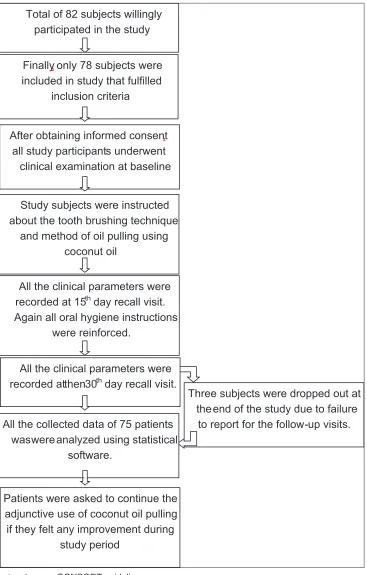
This was a prospective open-label clinical study, conducted at the Department of Periodontology [Figure 1]. This study was carried out after due approval of the Ethical Committee of Krishna Institute of Medical Sciences Deemed University (vide letter no: KIMSDU/IEC/03/2015). This study was conducted during June 2016 to September 2016 period in accordance with the Declaration of Helsinki (1975)
Patient Selection
The sample size for the current study (n = 75) was determined according to power analysis. Additional number of subjects was enrolled in the study considering possible future dropouts. A total of 82 patients willingly participated in the study, but only 78 subjects in the age range of 19–21 years were considered for the study. Subjects with at least 20 permanent teeth and suffering from plaque-induced mild-to-moderate gingivitis were included in the study. Informed consent was obtained from all the study participants before commencement of the study. Subjects with a history of periodontal treatment, anti-inflammatory drugs, and antibiotics usage within the past 3 months and subjects allergic to coconut oil were excluded from the study.
Clinical and Periodontal Examination
All the subjects enrolled into the study were subjected to clinical examination. The clinical assessment was carried out by a single calibrated examiner under the guidance of senior periodontist. Most widely used indices in clinical trials for therapeutic agents, i.e., gingival index by Loe and Silness.[7]
and plaque index by Sillness and Loe.[8] were used for clinical
assessment in the current study.
Baseline Index Scoring
Gingival index
Gingival index by Loe and Silness[7] is used to assess the
severity of gingivitis.
Gingival index score for the entire mouth was determined by dividing the total score by the number of surfaces examined. The final scoring criteria were as follows - Mild gingivitis: 0.1–1, moderate gingivitis: 1.1–2, and severe gingivitis: 2.1–3
Plaque index
Plaque index by Silness and Loe[8] was used to assess the
plaque accumulation. Plaque index score for the entire mouth was determined by dividing the total score by the number of surfaces examined.
The final scoring criteria were as follows - Excellent: 0, good: 0.1–0.9, fair: 1.0–1.9, and poor: 2.0–3.0
Procedure to Practice Oil Pulling
Participants were instructed to use one tablespoon (5 ml) of edible coconut oil (Patanjali’s Tejas edible coconut oil, Haridwar, India) for mouth swishing on empty stomach in the morning before brushing. With mouth close and chin up, they were asked to swish oil in the mouth for 5 min. They were asked to swish till the initially viscous oil becomes thin and milky white.[9] Afterward, they were asked to spit out
the swished oil and rinse their mouth thoroughly with warm water. Subjects were instructed to perform the procedure once daily in the morning for 30 consecutive days.
Scheduled Recall
All the study subjects were recalled at the interval of 15th day
and 30th day for a reassessment of clinical parameters and
reinforcement of oral hygiene instructions.
Statistical Analysis
All data were expressed as mean. The data collected were statistically analyzed using the Statistical Package for the Social Sciences (SPSS Software Version 19, Armonk, New York; IBM. Corporation, USA). The pre- and post-values of the plaque and gingival index scores were compared using student paired t-test. In the current study, P < 0.01 was considered as the level of significance.
RESULTS
Three subjects were dropped out at the end of the study due to failure
to report for the follow-up visits. Total of 82 subjects willingly
participated in the study
Finally,only 78 subjects were
included in study that fulfilled inclusion criteria
All the clinical parameters were
recorded at 15thday recall visit.
Again all oral hygiene instructions were reinforced.
After obtaining informed consent,
all study participants underwent clinical examination at baseline
Study subjects were instructed about the tooth brushing technique
and method of oil pulling using coconut oil
All the clinical parameters were
recorded at then30thday recall visit.
All the collected data of 75 patients was were analyzed using statistical
software.
Patients were asked to continue the adjunctive use of coconut oil pulling if they felt any improvement during
study period
Figure 1: Study protocol as per CONSORT guidelines
patient dropped out of the study as they did not report for follow-up visits so, at the end of the study, data of only 75 patients were collected and considered for analysis. Plaque and gingival indices of all the subjects were recorded at baseline, 15, and 30 days. The changes in clinical parameters were recorded and compared. None of the study participants reported with any observable
adverse reactions on hard and soft tissues during the study. The mean gingival index for all study subjects was 1.08 at baseline. Subsequently, mean gingival index reduced to 1.00 at 15th day and 0.91 at 30th day, respectively [Table 1].
The average plaque index for all study subjects was 1.59 at baseline. Plaque index gradually decreased to 1.489 on the 15th day and 1.39 on 30th day, respectively [Table 3]. When
compared to baseline, the observed difference in plaque index score at 15th day was 0.11, while at the 30th day, it was
0.20 [Table 4].
The difference in means of both plaque and gingival index scores recorded at baseline, 15th day, and 30th day was
statistically significant (P < 0.0001) [Tables 2 and 4].
DISCUSSION
Oral health and general health are interrelated, and hence, it is very important to maintain oral health.[10] Gingivitis is an
inflammatory process which causes irritation, redness, and swelling of gingiva. Supragingival plaque control measures are considered most effective to prevent gingivitis and its further progression to periodontitis by maintaining dental health. Chemomechanical procedures reduce the incidence of plaque accumulation, thus reducing the incidence of plaque-related diseases.[11] Our study was aimed at evaluating the
effectiveness of coconut oil pulling in reducing plaque and plaque-induced gingivitis when used as an adjunct to regular oral hygiene practice.
In the present study, unlike common side effects associated with cationic chemical mouthwashes, there were no alterations in taste or any noticeable staining reported following use of coconut oil for oil pulling. It also resulted in significant decrease in the plaque index and gingival index scores. These results are in agreement with a study conducted by Peedikayil and associates.[12]
The exact mechanism of the action of coconut oil pulling therapy is not clear. The beneficial results in controlling plaque formation and plaque-induced gingivitis can be attributed to medicinal properties of coconut oil.
Coconut oil is one of the most commonly used oil in soap industry as it has a high saponification value. It was also proposed that the alkalis in the saliva can react with the coconut oil leading to saponification and formation of soap like substance which results in reduced adhesion of plaque.[6]
Antibacterial, Antifungal, and Antiviral Activity
Oral microorganisms are known to produce many MCFAs and long-chain fatty acids as end-products of their metabolism. There is a potential for these fatty acids to contribute to ecological and biological interactions among the oral bacteria residing in the biofilm.
The fatty acid-secreting pathogens are present in both dental caries and periodontitis. Fatty acid production could contribute to a natural “nutrient reservoir” in oral biofilms, resulting in mutualistic relationships with other oral bacteria. Free fatty acids (FFAs) present in coconut oil result in competitive inhibition of oral organisms by competing with fatty acids produced by pathogens.[13]
Medium chain monoglycerides, especially monolaurin found in coconut oil, are effective in destroying a wide variety of lipid-coated Gram-positive and Gram-negative microorganisms by disrupting their lipid membrane and inhibit enzymes involved in energy production and nutrient transfer, leading to the death of the bacteria. Coconut oil has been found to be as effective as chlorhexidine in the reduction of Streptococcus mutans and Lactobacillus count.[14-16] Thus, it may play an important role
in the prevention of dental caries.
In a recent study, coconut oil has demonstrated significant antifungal activity which is comparable with ketoconazole against various strains of Candida spp.[17] Coconut oil is
very effective against a variety of viruses that are lipid coated such as visna virus, influenza virus, cytomegalovirus, Epstein–Barr virus, leukemia virus, pneumonia virus, and hepatitis virus. In the case of viruses, the virucidal activity of monolaurin is attributed to solubilizing the phospholipids and lipids in the envelope leading to the disintegration of the viral particles and interference with virus maturation.[18]
Antinociceptive, Anti-inflammatory, Antioxidant, and Anti-ulcer Activity
Antinociceptive virgin coconut oil (VCO) probably inhibits the proliferative phase of chronic inflammation. During
Table 2: Comparison of gingival index scores between baseline, 15th, and 30th day
Period Mean
difference 95% confidence interval Paired t value Two-tailedPvalue
Baseline to day 15 0.08 0.07 0.09 15.67 <0.0001*
Baseline to day 30 0.17 0.16 0.19 20.98 <0.0001*
*: Statistically significant (P≤0.001)
Table 1: Means of gingival index score at various intervals
Follow-up
Intervals (Mean n=75) Standard deviation error of meanStandard
Baseline 1.08 0.50 0.06
inflammatory process, phagocytic cells release lysosomal enzymes which damage the surrounding cells. The anti-inflammatory activity of VCO may be due to stabilization of the lysosomal membrane and/or its inhibitory effect on inflammatory cell activity. VCO inhibits the release and/or synthesis of these inflammatory mediators such as prostaglandins, bradykinin, and histamine responsible for pain and edema formation.[19] In a recent study, anti-inflammatory
effect of coconut oil has been demonstrated. Authors reported a significant reduction in gingival inflammation which was attributed to aforementioned anti-inflammatory mechanism, decreased accumulation of plaque, and the emollient effect of coconut oil.[12]
VCO exerts antiulcer activity which could be attributed to their FFAs content. Some of the FFAs have been reported to possess antioxidant effects (i.e., palmitic acid and myristic acid) and anti-inflammatory activities (i.e., linoleic acid, oleic acid, and lauric acid). The antiulcer activity of the oils could be associated with their anti-inflammatory and antioxidant activities and the FFA composition. This activity may contribute to the reduction in gingival bleeding and healing time of ulcerative lesions of the oral cavity.[20-22]
Although coconut oil pulling has resulted in a significant reduction in plaque and gingival index scores, it cannot be considered as a substitute for tooth brushing but can definitely be a effective adjunctive oral hygiene aid. The most unpleasant part of this procedure is that it has to be performed early in the morning, on an empty stomach. The most amazing part of oil pulling is that it can be performed using edible coconut oil easily available at most of the Indian homes.This cost effective therapy if practiced right at home, will be a huge repository of benefits.
Limitations
Limitations of the present study were short-term follow-up of study subjects and lack of supportive microbiological data to substantiate clinical findings.
Future Prospective
More clinical studies with larger samples and microbiological investigations are required to substantiate the beneficial use of coconut oil as an effective oral hygiene aid in maintaining and improving oral health.
CONCLUSION
Within the limits of the present study, it was concluded that coconut oil pulling resulted in significant reduction in plaque formation and plaque-induced gingivitis. Hence, coconut oil pulling can be used as safe, cost-effective, and easily available oral hygiene adjunct to routine tooth brushing.
REFERENCES
1. Stephen JM. Gingivitis. Medscape Web site. Available from: http://www.emedicine.medscape. com/article/763801-overview#a6. [Last updated on 03 Aug 2016; Last accessed on 2017 Feb 7].
2. Parashar A. Mouthwashes and their use in different oral conditions. Sch J Dent Sci 2015;2:186-91.
3. Jones CG. Chlorhexidine: Is it still the gold standard? Periodontol 2000 1997;15:55-62.
4. Asokan S, Emmadi P, Chamundeswari R. Effect of oil pulling on plaque induced gingivitis: A randomized, controlled, triple-blind study. Indian J Dent Res 2009;20:47-51. 5. Singh A, Purohit B. Tooth brushing, oil pulling and
tissue regeneration: A review of holistic approaches to oral health. J Ayurveda Integr Med 2011;2:64-8.
6. Shanbhag VK. Oil pulling for maintaining oral hygiene-A review. J Tradit Complement Med 2017;7:106-9. 7. Loe H, Silness J. Periodontal disease in pregnancy. I.
Prevalence and severity. Acta Odontol Scand 1963;21:533-51.
8. Silness J, Loe H. Periodontal disease in pregnancy. Ii. Correlation between oral hygiene and periodontal
Table 4: Comparison of plaque index scores between baseline, 15th, and 30th day
Period Mean
difference 95% confidence intervalLower Upper tPaired value Two-tailedPvalue
Baseline to day 15 0.11 0.08 0.13 9.15 <0.0001*
Baseline to day 30 0.20 0.17 0.23 14.23 <0.0001*
*: Statistically significant (P≤0.001)
Table 3: Means of plaque index score at various intervals
Follow-up
Intervals (Mean n=75) Standard deviation error of meanStandard
Baseline 1.59 0.74 0.09
15‑day follow‑up 1.48 0.72 0.08
condtion. Acta Odontol Scand 1964;22:121-35.
9. Asokan S. Oil pulling therapy. Indian J Dent Res 2008;19:169.
10. Satakshi R, Palmer CA. Oral health and nutition as gatekeepers to overall health: We are all in this together. Eur J Dent 2015;4:99-105.
11. Ciancio S, Slot DE, Van Dyke T, Al Bayaty F, Aswapati NW, Joshi V, et al. Group A. Consensus paper. Plaque control-home remedies practiced in developing countries. J Int Acad Periodontol 2015;17:17-20. 12. Peedikayil FC, Sreenivasan P, Narayanan A. Effect of
coconut oil in plaque related gingivitis-A preliminary report. Niger Med J 2015;56:143-7.
13. Huang CB, Alimova Y, Myers TM, Ebersole JL. Short- and medium-chain fatty acids exhibit antimicrobial activity for oral microorganisms. Arch Oral Biol 2011;56:650-4.
14. Peedikayil FC, Remy V, John S, Chandru TP, Sreenivasan P, Bijapur GA, et al. Comparison of antibacterial efficacy of coconut oil and chlorhexidine on Streptococcus mutans: An in vivo study. J Int Soc Prev Community Dent 2016;6:447-52.
15. Singla N, Acharya S, Martena S, Singla R. Effect of oil gum massage therapy on common pathogenic oral microorganisms - A randomized controlled trial. J Indian Soc Periodontol 2014;18:441-6.
16. Thaweboon S, Nakaparksin J, Thaweboon B. Effect of oil-pulling on oral microorganisms in biofilm models. Asia J Public Health 2011;2:62-6.
17. Shino B, Peedikayil FC, Jaiprakash SR, Ahmed
Bijapur G, Kottayi S, Jose D, et al. Comparison of antimicrobial activity of chlorhexidine, coconut oil, probiotics, and ketoconazole on Candida albicans isolated in children with early childhood caries: An in vitro study. Scientifica (Cairo) 2016;2016:7061587. 18. Arora R, Chawla R, Marwah R, Arora P, Sharma RK,
Kaushik V, et al. Potential of complementary and alternative medicine in preventive management of novel H1N1 flu (Swine flu) pandemic: Thwarting potential disasters in the bud. Evid Based Complement Alternat Med 2011;2011:586506.
19. Intahphuak S, Khonsung P, Panthong A. Anti-inflammatory, analgesic, and antipyretic activities of virgin coconut oil. Pharm Biol 2010;48:151-7.
20. Selverajah M, Zakaria ZA, Long K, Ahmad Z, Yaacob A, Somchit MN. Anti-ulcerogenic activity of virgin coconut oil contribute to the stomach health of humankind. Tang [Humanitas Medicine] 2016;6:11.1-7.
21. Skulason S, Holbrook WP, Thormar H, Gunnarsson GB, Kristmundsdottir T. A study of the clinical activity of a gel combining monocaprin and doxycycline: A novel treatment for herpes labialis. J Oral Pathol Med 2012;41:61-7.
22. Lakshmi T, Rajendran R, Krishnan V. Perspectives of oil pulling therapy in dental practice. Dent Hypotheses 2013;4:131-4.