Comparative infrared spectra analysis
of one territory soil humic acids by
IR-EXPERT computer system
Yu. M. Deryabina
1, T. A. Kornakova
1, N. L. Bazhina
2, V. D. Tikhova
3 1N.N. Vorozhtsov Novosibirsk Institute of Organic Chemistry SB RAS, Novosibirsk, Russia, 2Department of Biology, Novosibirsk Institute of Soil Science and Agrochemistry of SB RAS, Russia, 3Department of Chemistry, N.N. Vorozhtsov Novosibirsk Institute of Organic Chemistry SB RAS, Novosibirsk, RussiaAbstract
Background and Objective: Humic acids (HAs) extracted from different soils of the Western Tuva have been studied using infrared-EXPERT information-analytical computer system and database. Methods: A total of 10 samples of HA were extracted from the humic horizon of some modern soils of the Western Tuva according to standard methods. Results: The most similar spectral analogs, their structures, and structural fragments of the HA have been identified and compared with those, which had been investigated earlier. Conclusion: Analysis of the obtained 10-node fragments showed that all HAs contain a linear, weakly branched, conjugated chains of double C-C-bonds. HA of mountain chestnut soils, with high probability, contains fragments of aromatic amines and amides.
Key words: Humic acids, information-analytical system, infrared-spectra, natural organic compounds
Address for correspondence:
Yu. M. Deryabina, N.N. Vorozhtsov Novosibirsk Institute of Organic Chemistry SB RAS, 9 Lavrentieva Avenue, Novosibirsk, Russia. E-mail: [email protected]
Received: 04-07-2017
Revised: 29-07-2017
Accepted: 18-08-2017
INTRODUCTION
H
umic acids (HAs) are a complex mixture of high molecular natural organic compounds extracted from soils, peat, coal, and sapropel with alkaline solutions. The variety of structures of these substances is primarily connected with their origin, zonal, and territorial identity of the raw material. The formula of the structures of HA that is described at different times are of hypothetical, conjectural character, so their use should be limited to the extent of such formulas or experimental data to explain how they are useful for different tasks.[1,2] Structures of HAand FA known from the literature are logically divided into two groups: Block diagrams and structural formulas.[3,4]
The aim of this work is to identify the most probable structural fragments of HA of the soil of one territory on the basis of their infrared (IR) spectra analysis with the use of information and analytical system IR-EXPERT, which is a combination of a large database (DB) (more than 50,000 records of “the IR spectrum-structure-structural fragments and related information”) and software modules allowing
to solve a variety of spectral and structural tasks (search for spectral and structural analogs, determining spectral manifestations of structural fragment, the creation of model spectra to determine the degree of differences and similarities of spectral curves, etc.).[5]
Currently, the IR spectra are described in almost all works concerning the chemical structure of HA.[6,7] However, they
are merely illustrative, and in the most studies, the use of IR spectroscopy is limited by the traditional approach based on the use of correlation tables reflecting the relationship of the presence of characteristic groups and the absorption bands in certain parts of the spectrum.[7,8]
The system IR-expert was used in the previous works for the analysis of complex mixtures of extractive substances of peat in Tomsk region,[9] HA of Siberian soils and peat,[9] as
well as for the comparative analysis of HA of paleosoils of Khakassia.[10]
ORIGINAL
AR
METHODS
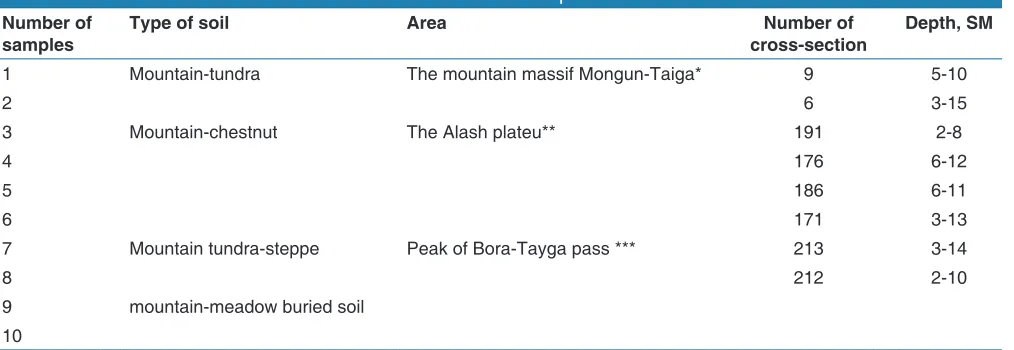
A total of 10 samples of HA [Table 1] were extracted from the humic horizon of some modern soils of the Western Tuva according to standard methods.[11]
A detailed description of these plots is given in the paper.[12]
IR spectra of the samples were registered in a tablet with KBr (1:150) in the frequency range 4000-400 cm-1 by a vector 22 spectrometer with OPUS software 3.0.
The procedure of using IR EXPERT to analyze the IR spectra of HA was previously described in the study by Tikhova et al.[10]
RESULTS
The following procedures were performed to identify the most probable structural fragments of HA:
1. A search for the most similar spectral analogs was performed for each spectrum of HA. A comparison of full spectral curves (the Euclidean metric) gives better results than the method of descriptor describing.[9] As
a result, search result (SR) consisting of 10 organic compounds available in the DB of the IR EXPERT was received for each of the 10 samples of HA. It was found that 3 compounds (No.reg=29041, 1529, 17291) with different degrees of similarity (from 0.2401 to 0.4018) are presented in all ten SRs [Table 2].
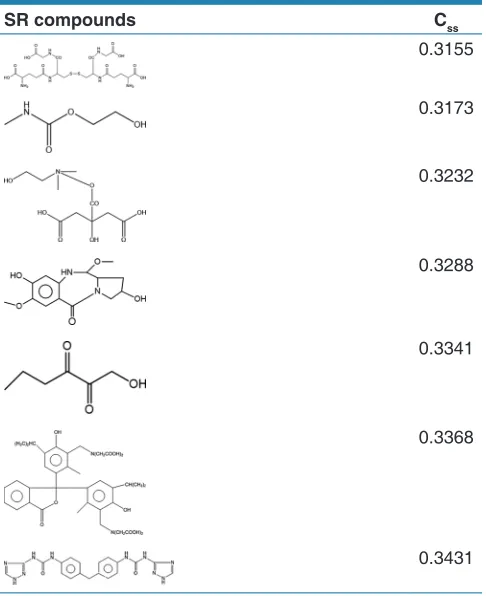
Figure 1 shows a comparison of the IR spectra of sample 4 and spectrum of compounds from the DB (No.reg=29041) with the best degree of overlap with the query spectrum (the coefficient of spectral similarity equal 0.2647) due to the Euclidean metric and occupies first place in the results of a spectral search. Table 3 shows the other seven spectral analogs from SR for the HA (No. 4) that were not detected in all 10 samples of our study and were not included in Table 2.
Table 1: Details of HA sample extraction Number of
samples Type of soil Area cross-sectionNumber of Depth, SM
1 Mountain‑tundra The mountain massif Mongun‑Taiga* 9 5‑10
2 6 3‑15
3 Mountain‑chestnut The Alash plateu** 191 2‑8
4 176 6‑12
5 186 6‑11
6 171 3‑13
7 Mountain tundra‑steppe Peak of Bora‑Tayga pass *** 213 3‑14
8 212 2‑10
9 mountain‑meadow buried soil
10
*The massif Mongun‑Taiga occupies the outside part of South‑Western Tuva, which is orographic node at the junction of the mountain systems of the Altai, West Sayan, and West Tanu‑Ola, **Alash plateau is a part of the South‑Sayan mountain meadow‑taiga‑steppe locally basin‑steppe region of the Southern Altai‑Tuva‑Khangai basin‑mountain province of the steppe zone, ***Pass Bora‑Tayga is located in the South‑Eastern part of the Alash plateau
Table 2: Common compounds with the degree of similarity Compound and its
registered number in DB
Degree of similarity (Css)
Number of the sample in Table 1
1 2 3 4 5 6 7 8 9 10
No.рег=29041 0.2899 0.3056 0.3649 0.2647 0.3227 0.3046 0.2776 0.3019 0.2995 0.3346
No.reg=1529 0.2890 0.2598 0.3513 0.2686 0.3306 0.3105 0.2662 0.2606 0.3261 0.3080
The comparison of the received SRs with the results presented earlier in the study by Tikhova et al.[9,10] show
that compounds from DB - tetraenamide (No.reg=29041) and 1-acetamidopropan-2-yl acetate (No.reg=1529) are also included in SR for a number of HA of soils, paleosols, and peats.
2. All compounds of 10 received SRs were subjected to decomposition into its constituent structural fragments (from 3 to 10 nodes) followed by analyses of 10-node fragments with the factor of non-randomness of the appearance in SR does not exceed 0.9.
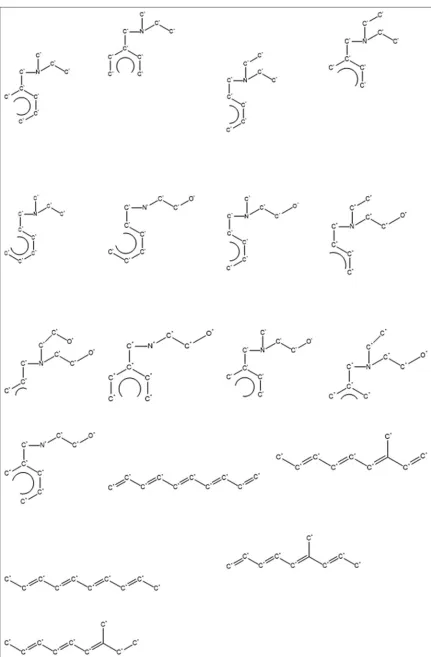
Figure 2 shows 10-node fragments for the sample 4 with the value of the non-randomness of their occurrence in structures of SR more than 0, 9.
It was found that 13 of the 18 pieces contain part of the aromatic ring and can be combined in the generalized fragment I and the remaining 5 pieces in the generalized fragment II with the conjugated chain of double bonds (Figure 3). Analyses of structural fragments for another HA were conducted similarly.
Spectra of compounds from the DB quite significantly different from the spectra of HA, but almost all these compounds have functional groups inherent to HA and defining their functions, namely, carboxyl, carbonyl, phenolic, hydroxyl, methyl, and amide I и II.
CONCLUSION
It was found that there are 3 identical compounds with different degrees of similarity (from 0.2401 to 0.4018) in all SRs obtained for HA of the soil of one area.
The number of 10-node fragments with the factor of non-randomness of the occurrence in SR does not exceed 0.9, varies from 5 for sample 7 to 281 (Table 4) for sample 9. Analysis of the obtained 10-node fragments showed that all HAs contain a linear, weakly branched, conjugated chains of double C-C-bonds. HA of mountain chestnut soils, with
high probability, contains fragments of aromatic amines and amides. There is pyrimidine-pyrazinoic skeleton in two samples, which was previously discovered in HA of peat and tundra soils.[9]
Thus, it is possible to solve a variety of spectral and structural tasks that would significantly complement the picture of the HA structure on the basis of the analysis of its infrared spectra with the use of modern information analytical system IR-EXPERT.
ACKNOWLEDGMENTS
The work was carried out with the financial support of the Russian Foundation for basic research (Contract
Figure 1: The spectrum of the studied sample of the humic acids No. 4 (solid line), the spectrum of the most similar spectral
analog (fill), and its structure
Table 3: Structures of other SR compounds for HA No. 4
SR compounds Css
0.3155
0.3173
0.3232
0.3288
0.3341
0.3368
0.3431
No. 15-44-00090) and the government of the Khanty-Mansiysk Autonomous Okrug-Yugra (Contract No. 07.0246-10-YuSU-173).
REFERENCES
1. Sartakov MP. X-Ray diffraction characteristic of humic acids of alluvial soils in ob-irtysh floodplain, formed in various moisture conditions. Res J Pharm Biol Chem Sci 2015;6:230-4.
2. Sartakov MP, Komissarov ID, Shundrin LA. The peat humic acids electronic paramagnetism research for ob-irtysh flood plains. Res J Pharm Biol Chem Sci 2015;6:1685-92.
3. Orlov DS. Humic acids of soils and general theory of humification. Functions of Natural Organic Matter in Changing Environment. Мoscow: House of MSU; 1990. p. 325.
4. Komissarov ID. Humic Preparations, Scientific Works of Tyumen Agricultural Institute. Tyumen: 1971. p. 266. 5. Derendyaev BG, Piottukh-Peletskii VN, Chmutina KS,
Zhbankov RG, Korolevich MV. The “IR EXPERT” Information System for Solving Spectal and Structural Problems. J Appl Spectrosc 2003;70:615-627.
6. Natalya C, Mikhail S, Tatiana K. Alteration in Elemental and Functional Composition of Heated Peat Humic Acids. MATEC Web of Conferences 2016;85:01004. 7. Bellamy L. Infrared Spectra of Complex Molecules.
Moscow, IL: Springer Netherlands; 1963.
8. Nikulicheva ON, Fadeeva VP, Piottukh-Peletskii VN, Pokrovsky LM, Bogdanova TF, Yudina NV. The study of extractive substances of peat using IR and gas chromato-mass spectrometry. J Appl Chem 2005;78:1388.
9. Tikhova VD, Bogdanova TF, Fadeeva VP, Piottukh-Peletskii VN. Study of the fragment composition of humic acids of different origin using IR-EXPERT software. J Anal Chem 2013;68:86.
10. Tikhova VD, Bogdanova TF, Dergachyova MI, Fadeeva VP, Kallass EV. A comparative analysis of the humic acids of paleosols of the republic of khakassiausing the computer program IR-EXPERT. Theor and Appl Ecol 2015;1:24.
11. Orlov DS, Frishina LA. Practicum of the Humus Chemistry. Мoscow: Miscellaneous Publication; 1981. p. 272.
12. Bazhina NL, Ondar EE, Ochur KO, Dergachova MI. Elemental Composition of Humic Acids of Soils of the Western Tuva, Vestnik. Bull Org Geochem U 2013:10:159.
Source of Support: Nil. Conflict of Interest: None declared. Table 4: The number of 10‑node fragments in the studied samples
Number of sample 1 2 3 4 5 6 7 8 9 10
Number of 10‑node fragments 16 17 51 18 51 62 5 131 281 131
Figure 3: Generalized structural fragments for the sample 4.
(a) I, (b) II