Volume 2, Issue 4, 2015, pp. 168-178 Available online at www.jallr.ir ISSN: 2376-760X
Correspondence: Hadi Rahimpour, Email: [email protected] © 2015 Journal of Applied Linguistics and Language Research
The Difference between Rural and Urban EFL Learners' Achievement
through Different Types of Task
Hadi Rahimpour
M.A in TEFL, Tarbiat Modares University, Tehran, Iran
Gholam Reza Kiani
Associate professor, Tarbiat Modares University, Tehran, Iran
Abstract
Task-Based Language Teaching (TBLT) has recently been addressed in a good proportion of research in the scope of applied linguistics. Consequently tasks are widely used in most English teaching course books. With regard to increasing interest of learning English which has, nowadays, been expanded to even rural areas, the question of compatibility of different types of task with rural areas arises. Thus, the present study is aimed at comparing language learners’ achievement (performance) in Real-world task and Pedagogical task in rural and urban areas. Participants are 80 female English language learners at elementary level aged from 15 to 25. Half of the participants are selected from an urban area, and another half are from a rural area. To measure participants’ language achievement (performance) through each task type, two different Real-world Task Test and Pedagogical Task Test were given to the students at the end of the term. To analyze the data, two T-Tests were run. The results showed that urban participants had a better performance in real-world task compared to rural participants, but both rural and urban groups did not differ in their performance in pedagogical task. The findings of this study, on the one hand, are in line with some theories and models in the related literature, and on the other hand, can appeal not only to English language teachers working in different urban and rural institutes or schools but also appear to be of high importance for English language teaching material developers.
Keywords: real-world task, pedagogical task, urban, rural, language achievement
INTRODUCTION
life of the classroom. Although, TBLT in such a sense shares some of its principles with communicative language teaching, the truth of the matter is that TBLT surpassed its contemporary rival through remedying the areas in which CLT seemed problematic. It, thus, can be deemed that an active employment of real-life language activities is at the core of TBLT.
Another feature essential to the essence of the Task is its focus on process rather than goal. Breen (1987) sees Task Based Teaching more process based. It is the characteristic of the Task that Prabhu (1987) did not mention, since he emphasized on arriving at an outcome, as most advocates of TBLT did, but the dichotomy of goal-oriented or process based tasks versus goal-driven or product-based tasks was made.
Long (1985) adds another aspect to Task and states that task should involve the things we usually do in our daily life: “a piece of work undertaken for oneself o r for others, freely or for some reward”. In this definition, examples of tasks include painting a fence, dressing a child, filling out a form, buying a pair of shoes, making an airline reservation, borrowing a library book, taking a driving test, typing a letter, weighing a patient, sorting letters, taking a hotel reservation, writing a check, finding a street destination and helping someone across a road. It is generally assumed that task has four principles, that is to say, the meaningfulness, problem solving, process/product-based and a real-world activity. Skehan (1998) views the four principles as the main features of any Task.
Significance of this study can be viewed from three different angles. First, due to considerable importance of socio-cultural aspect of learning, including foreign/second language learning, a body of research has been conducted to clarify the relationship between socio-cultural background of learners and their language learning (e.g. Aljaafreh & Lantolf, 1994; Ohta, 2001; Roebuck, 2000), but research undertaken to investigate the socio-cultural side of this relationship through the angle of the dichotomy of learners' rural/ urban living area is very scarce, if any. Second, cognitive considerations have always been at the core of task-related studies. Based on different theories and models about complexity of task or cognitive analysis of task (Skehan, 1992; Candlin, 1987), a lot of studies have been done to determine the effect of tasks with different cognitive loads on different issues such as personality type, education system, level of proficiency, and gender, but very few works can be found to study the effect of task types, which are different in terms of cognitive load like Real-world and Pedagogical tasks on rural and urban English language learners in rural and urban areas.
Real-word & Pedagogical Tasks
Different authorities in the field of TBLT proposed definitions for Real-world and Pedagogical tasks. Nunan (2004) proposes four types for task: 1.Real-world or Target task, 2.Pedagogical task, 3.Rehearsal task, 4.Activation task. Based on his ideas, the distinction between Real-world and Pedagogical task is that Pedagogical task gives a non-linguistic outcome to activate learning something done in the outside world through language, while Real-world task’s outcome is non-linguistic and is the sort of thing done in the outside world.
What can be inferred about the issue at hand is that basically, the rationale behind this dichotomy is a matter of form and meaning. Pedagogical tasks focus on form, while in real-world tasks, meaning takes priority. But, recently the issue has been better clarified. Willis and Willis (2007) portrayed the borders of these two types of task more clearly and put forth three levels to compare two different sides of this dichotomy:
First, there was the level of meaning in which learners produce meanings which will be useful in the real world. Second was the level of discourse in which learners realize discourse acts which reflect the real world- the things we had highlighted above, such as agreeing and disagreeing, guessing at meanings and making inferences. Finally, at the level of activity, they engage in a communicative activity which reflects very directly the way language is used outside the classroom-they tell stories, get involved in arguments, explain how to do things, and so on. (Willis & Willis, 2007, p.136)
The kind of task which meets all of these three levels is called real-world task, but Pedagogical (here termed artificial) task shares the first two levels with real-world task. In two examples above, both in writing mail as a real-world task and in comparing emails as a pedagogical task, real life meaning is produced and received. In writing an e -mail, it is dealt with the same discourse acts such as: explaining, describing, agreeing, disagreeing and etc that we are doing when comparing E-mails with each other. Therefore, in both tasks, one is concerned with real-world discourse acts. In writing an e-mail, a usual real-world activity is done, while about comparing e-mails it is rarely done in our real life, so it is not a real-world activity. Therefore, when it comes to reflecting discourse acts into real world acting, one can see real-world task is distinguished from pedagogical task.
RESEARCH QUESTIONS AND HYPOTHESES The following research questions guided this study.
Is there any significant difference between Iranian rural and urban English language learners in their language achievement in real-world tasks?
Based on the aforementioned research questions, the following hypotheses were formulated.
There is no significant difference between Iranian rural and urban English language learners in their language achievement in real-world tasks.
There is no significant difference between Iranian rural and urban English language learners in their language achievement in pedagogical tasks.
METHOD Participants
The sample consisted of 80 English learners at elementary level from Zabansara English Language Institute in Gorgan as an urban area and Pars English Language Institute in Sorkhankalate (one of the villages around Gorgan) as a rural area of living. Learners were chosen with the same rate of proficiency on the basis of their last term final exam score (a criterion of beyond score of 70 in their exams).
Instruments
The following instruments were used by the researcher.
Homogeneity Test
The two institutes employ a standard test for evaluating their learners’ English achievements. This test consisted of vocabulary, grammar, listening and writing.
Pedagogical Task Test
The first part of the book Interchange 1 embeds a number of pedagogical tasks that were used by the researchers in the development of a test to measure participants’ language achievement. This pedagogical-task test, being adopted from the book Tests (Interchange1 Test) and tasks, had items adding up to 0-to-100 score range.
Real-world Task Test
In addition to the pedagogical tasks, the first part of the book interchange 1 embeds a number of Real-world tasks that like the pedagogical tasks were used by the researchers in the development of another test to measure participants’ language achievement. This Real-world task test, being adopted from the book Tests and tasks had items adding up to a 0-to-100 score range.
Procedure
into two classes. They started studying the first 8 units of Interchange 1 which has some real-world and Pedagogical tasks. Out of these tasks, 12 real-world tasks and 12 pedagogical ones were highlighted and the teachers were trained to teach the tasks appropriately as instructed in Task-Based Language Teaching Method. So, both groups were taught under the same instruction and were exposed to the same pedagogical and real-world task-based materials.
The tasks were attempted to be chosen from all language skills of speaking, listening, writing and reading and also the sub-skills of vocabulary, grammar and pronunciation. The term will take 18 sessions of 90 minutes. At the end of the term, both groups were given Real-world Task Test and Pedagogical Task Test to evaluate their language achievement through each type of task. Each test was scored out of 100. The scores of these two 100-score tests were added to find their performance in task generally, in an aggregate of 200 scores for the two intended tasks.
Data analysis
A T-Test was run between rural participants’ scores and urban participants’ scores in real-world task test to find out whether they differ in terms of their language achievement through real-world tasks. Another T-Test was run in the same situation but between rural and urban participants’ scores in pedagogical task test to see whether there is any difference between them in their language achievement through pedagogical tasks.
RESULTS
Normality Test
Before going through the statistical procedures named above, it was needed to get assured of normality of the data, i.e., the data should be under the assumptions of normal distribution. To measure normality of the data, one Sample Kolmogorov-Smirnov was used for each group.
The results of this application as revealed in table 1 manifest that P values are greater than 0.05 level of significance, thus, indicating the normality of distribution across the samples. The level of significance is 0.05 which is indicative of 5 chances in 100 of being wrong and 95 chances in 100 of being right. It means that if there are fewer than 5 chances in 100, applied linguists believe that the null hypothesis is rejected. (p≤ 0.05) (Hatch & Lazaraton)
Table 1. One-Sample Kolmogorov-Simirnov Test for Rural Group
R-P R-R R-T R-A
N 40 40 40 40
Negative -.181 -.165 -.146 -.115 Kolmogorov-Smirnov Z 1.145 1.041 .925 1.093 Asymp. Sig. (2-tailed) .145 .228 .359 .183 R-P = Pedagogical Task Test for Rural Group
R-R = Real-World Task Test for Rural Group
This table shows that p-values for all dependent variables are above 0.05 (p ≥ 0.05). It means that the data of Rural group is normal. For example, the variable R-R (Rural Real-world Task Test) is 0.22 in One-Sample Kolmogorov-Smirnov Test which is higher than 0.05. Therefore, the value of this variable is normal and so are the other variables. The data in this group benefits from normal distribution (p ≥ 0.05).
Table 2. One-Sample Kolmogorov-Simirnov Test for Urban Group
U-P U-R U-T U-A
N 40 40 40 40
Normal Parametersa Mean 72.0750 72.8000 1.4590E2 84.6750 Std. Deviation 1.36896E1 1.75341E1 2.87908E1 2.71863E1
Most Extreme Differences
Absolute .133 .167 .144 .100
Positive .072 .078 .081 .100
Negative -.133 -.167 -.144 -.083 Kolmogorov-Smirnov Z .841 1.057 .910 .634
Asymp. Sig. (2-tailed) .479 .214 .380 .817 U-P = Pedagogical Task Test for Urban Group
U-R = Real-World Task Test for Urban Group
Investigation of Hypothesis One
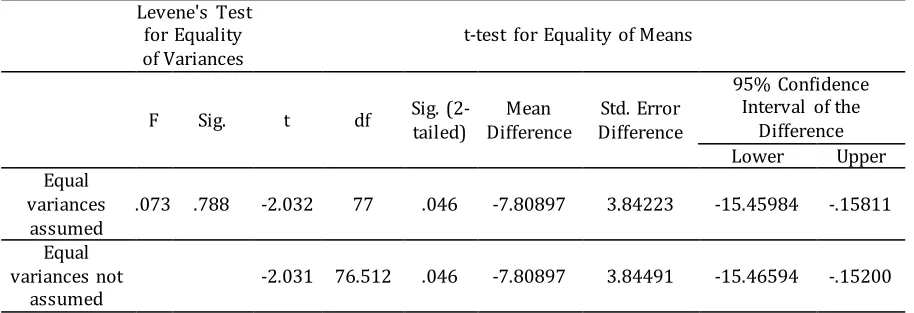
Regarding the first hypothesis claiming for no significant difference between Iranian rural and urban English language learners in their language achievement of the Real-World Tasks, another Independent T-Test was run.
Table 3. Independent T-Test for R and U Groups in Language Achievement through R Task
Levene's Test for Equality of Variances
t-test for Equality of Means
F Sig. t df Sig. (2-tailed) Difference Mean Difference Std. Error
95% Confidence Interval of the
Difference Lower Upper Equal
variances assumed
.073 .788 -2.032 77 .046 -7.80897 3.84223 -15.45984 -.15811
Equal variances not
assumed -2.031 76.512 .046 -7.80897 3.84491 -15.46594 -.15200
through Real-World Task (p-value ≤ 0.05). Urban Group had a better Language Achievement in Real-World Tasks than Rural Group did.
Investigation of Hypothesis two
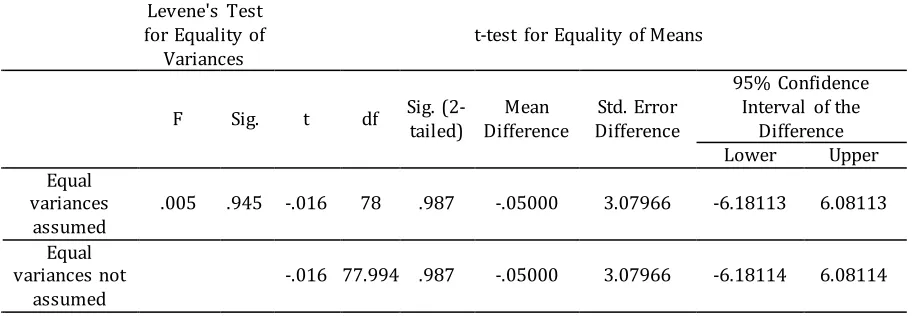
Null hypothesis 2: There is no significant difference between Iranian rural and urban English language learners in their language achievement through Pedagogical Tasks. According to the table 4, the Levene’s Test (t (78)= -0.016, p= .987) is not significant (p ≥ 0.05). So the t-value calculated with variance estimate is appropriate, i.e., the outcomes of employing the Independent Sample T-Test indicates that the difference is not significant because p-value is higher than 0.05. As shown in Table 4, there is no significant difference between the means of Rural Group (72.05), and Urban Group (72.10) in Pedagogical Task Test.
Table 4. Independent T-Test for R and U Groups in Language Achievement through P Task
DISCUSSION Real-world task
The results show that urban group outperformed rural group in their language achievement through real-world task. It means that the urban group had a better performance on real-world task compared to rural group. This finding can be discussed from cognitive and socio-cultural views.
Cognitively speaking, complexity of task is an important predictor of task performance. The study findings support Skehan’s model for task complexity. Skehan (1992) presents a three-way distinction for the analysis of tasks. In this scheme, familiarity of task is taken into account in three levels:
familiarity of topic and its predictability familiarity of discourse genre
familiarity of task Levene's Test for Equality of
Variances
t-test for Equality of Means
F Sig. t df Sig. (2-tailed) Difference Mean Difference Std. Error
95% Confidence Interval of the
Difference Lower Upper Equal
variances assumed
.005 .945 -.016 78 .987 -.05000 3.07966 -6.18113 6.08113
Equal variances not
assumed
Later, Skehan argues that “familiarity of discourse genre is the extent to which differentiated organized background knowledge is available.” (Skehan, 1998, p:100). Based on this model, it can be inferred that the more organized background knowledge a learner has in doing a task, the easier the task will be, and therefore the learner is more likely to perform better in that task. According to Willis and Willis (2007), real-world tasks mostly include: electronic communication like sending e-mail and everyday English like reading newspaper, making reservations for hotels and filling in an application form and etc. There is no question that all of these real world activities are usually done in an urban environment more than in a rural one. So it can be logically expected that urban English learners have much more organized background knowledge or discourse genre familiarity with real-world task and can learn English better through real-world task than rural English learners. With reference to these, the study is in line with Skehan’s
familiarity of discourse genre.
Moreover, the results can well reflect the notions of Scaffolding and Task depe ndency. These have been discussed by Nunan (2003) when offering seven principles for implementing task-based teaching, among which are Scaffolding and Task dependency. Scaffolding implies that the learners should not be exposed to the language and the material which have not been familiarized earlier explicitly or implicitly. Task dependency presents that the task should be built upon the ones which have been done before. Regarding the concepts of Scaffolding and Task Dependency defined above, rural participants are expected not to be as successful as urban participants in real-world task, because rural participants have been exposed to real-world activities such as sending email less than urban participants, and it is a logical expectation that for urban gr oup, real-world tasks are built upon the activities done before which is not the case about rural group. It is found in the results of this study. Therefore, this finding is in consistency with the concepts of Scaffolding and Task Dependency.
Apart from the cognitive perspectives, the present findings can be discussed from socio -cultural aspects too. Regarding this, it can be said that the results are in line with The Zone of Proximal Development (ZPD). According to the concept of ZPD, the learner can learn better when s/he is benefiting from someone’s help or social activities. As a matter of fact, ZPD implies that learning can be reinforced when a novice is helped by an expert or culturally and socially shaped artifacts. However, Lantolf and Thorne (2003) rejects the idea that ZPD happens necessarily in a novice and expert situation and believes that just working jointly and being able to co-construct the context is enough for fostering learning, and existence of an expert can not necessarily be an obligatory part of learning from ZPD point of view. With regard to what has been said about ZPD, in this study participants’ doing tasks, in particular real-world tasks is exactly the learner’s involvement in social activities and using artifacts, and also getting someone’s help. For example, when the participant is working with his partner to write an email, on the one hand he gets his partner’s help, and on the other hand he benefits from a culturally shaped artifact which is email. Therefore, ZPD is true in doing real-world tasks. The discussion is that rural participants cannot make use of the artifacts in real-world tasks as well as urban learners do, because they were not familiar with those artifacts in their daily life, likewise they could not interact with each other in doing real-world tasks. Therefore, the study findings support ZPD, because the materials used in real-world tasks can be considered to be culturally and socially shaped artifacts for urban participants but not for rural participants because these artifacts have been defined neither culturally nor socially for them.
The last concept argued in Socio-cultural Theory (SCT) is the concept of Internalization
Pedagogical task
The results showed that there is no significant difference between two groups in their language performances on pedagogical task. This finding shows that rural language learners and urban language learners do not differ in their performance in pedagogical task. Pedagogical tasks are planned to trigger language learners to be involved in language learning through some cognitive processes such as listing, or dering, and matching (Willis and Willis, 2006). As both groups have been taught in the same educational system, it can be concluded that they have been exposed nearly to the same number of cognitive processes as the ones named above. Besides, Skehan (1998) presents Familiarity of Task as one of the parts of Cognitive Complexity. It implies that “unfamiliarity of task type could make a task less predictable and less susceptible to previously developed communication strategies.” Regarding the same educational background, both groups have been exposed to the cognitive types of pedagogical task to the same amount. Consequently, they must perform alike in the pedagogical task which benefits from these cognitive processes. The study then supports Skehan’s Familia rity of Tasks taking cognitive processes into account.
CONCLUSION
The intention of this study was to find the suitability of task types in two rural and urban areas. The results, therefore, can appeal not only to English language teachers working in different urban and rural institutes or schools but also appear to be of importance for English language teaching material developers.
Regarding the former, English language teachers can bear in mind that in urban areas, a tendency toward real-world tasks is present in learners, so they can put more emphasis on this task type. Furthermore, English language teachers in rural areas can benefit from the results of this study too, they should devote their attention to the point that real-world tasks may pose some difficulties for rural English learners, particularly the ones dealing with email, application form, making reservations at hotels or airports, because they have rarely been subject to do them in their everyday life, in other words these tasks seem unfamiliar to them.
REFERENCES
Aljaafreh, A., & Lantolf, J. P. (1994). Introducing sociocultural theory. In Lantolf, J. (ed.) 2000. Sociocultural theory and second language learning. Oxford: Oxford University Press.
Breen, M. (1987). Learner Contribution to Task Design. In Nunan, D. (2004). Task-based language teaching. Cambridge: Cambridge University Press.
Candlin, C. (1987). Towards task-based language learning. In Skehan, P. (1998). A Cognitive Approach to Language Learning. Oxford University Press.
Lantolf, J. P., & Thorne, S. L. (2003). Sociocultural Theory and Second Language Learning.
Retrieved April 12, 2011 from rua.ua.es/dspace/bitstream/10045/5992/1. Long, M. (1985). A role for instruction in second language acquisition. Retrieved March
6, 2011 from www.finchpark.com/afe/l.htm
Nunan, D. (2004). Task-based language teaching. Cambridge: Cambridge University Press. Ohta, A. (2001). In . Lantolf (ed.) 2000. Sociocultural theory and second language learning.
Oxford: Oxford University Press.
Prabhu, N. S. (1987). Second Language Pedagogy. Oxford University Press.
Roebuck, R. (2000). Subjects Speak Out. In J.P. Lantolf. (2005). Epistemology, Politics and Ethics in Sociocultural Theory. MLJ, 89:3 466-488. Retrieved March 10, 2011 from
http://onlinelibrary.wiley.com/advanced/search/results.
Skehan, P. (1992). Strategies in second language acquisition. In Skehan, P. (1998). A Cognitive Approach to Language Learning. Oxford University Press.