Volume - 4, Issue - 2, March - April - 2018, Page No. 01 - 06
Corresponding Author: T.kavimani, Page No. 01 - 06
Pag
e1
ISSN: 2455 - 1597
Candy Industry Effluent characterization and Treatment performance: A Case Study
T.kavimani, M.E, Assistant Professor, Department of Civil Engineering, Government college of Engineering, Thanjavur,
Tamil Nadu, India.
E-mail: [email protected]
Abstract
Rapid growth of population demands the increase of food production. Technological development results in increasing of
food industries and also many new varieties of food being introduced. The range of food industries start from a “Corner
Bakery” to the industries which export the food products after processing. The problem facing with regard to food
industries is the pollution caused by its discharge. The food industries uses enormous amount of water in its processing.
The wastewaters from food industries are mainly characterized by high organic load. Different advanced treatment
techniques have been employed to reduce the organic load. But, still in most of the industries the treatment system fails
due to many reasons such as fluctuating organic loading, fluctuating hydraulic body, improper and inadequate design of
unit operations etc.
Normally candy industry is facing acute problem in treating all wastes (liquid and solid) produced during their process.
Most of the existing treatment units perform very poor and the efficiency of treatment reduced to minimum. The samples
collected from the various unit operations outlet were analysed. Due to high organic loading rate, higher hydraulic
loading rate, poor maintenance of VFA / ALK ratio and very high COD and BOD in the effluent. Hence an UASBR
model had been framed and the wastewater collected from the industry was treated by adjusting the secondary parameters
and (pH, HRT etc.)
Keywords: BOD, COD, Hydraulic retention time (HRT), Organic loading rate (OLR) UASBR, VFA / ALK ratio
1. Introduction
Food industries are the industries, which produce the food products mostly from natural raw materials. In the early
periods the food industries are mainly based on the Agro only. Many varieties of food were evolved over a long period
starting from the Bakery to the Beverages. The development of the food industries is based upon the needs of the people.
Many techniques been employed in various food industries manufacturing process. Due to the increase in population the
production of food has been increased which results in the expansion of many number of industries. The advancement of
science and technology change the life style of the people and it includes the food what they are taking. As a result of it
many varieties of food being introduced, many chemicals, toxic in nature to the food added. Now the biggest problem due
to the food industry is the disposal of wastewater generated by the food industries not meeting the standards. Food
industries comprises of industries like Baking, Pastry, Candy, Confectionary, Chocolate, meat processing, Dairy
industries and beverages.
India is the world's second largest producer of food next to China, and has the potential of being the biggest with the food
and agricultural sector. The total food production in India is likely to double in the next ten years and there is an
© IJERGS, All Rights Reserved.
Pag
e2
Pag
e2
Pag
e2
Pag
e2
Pag
e2
Pag
e2
Pag
e2
Pag
e2
Pag
e2
Pag
e2
Pag
e2
Pag
e2
Pag
e2
Pag
e2
Pag
e2
Pag
e2
Pag
e2
Pag
e2
Pag
e2
Pag
e2
Pag
e2
Canning, Dairy and Food Processing. Health food and its supplements is another rapidly rising segment of this industry,
which is gaining vast popularity amongst the health conscious. India is one of the world’s major food producers but
accounts for less than 1.5 per cent of international food trade. This indicates vast scope for both investors and exporters.
The Indian food industries sales turnover is Rs 140,000 crore annually as at the start of year 2000. The industry has the
highest number of plants approved by the US Food and Drug Administration (FDA) outside the USA.
India's food processing sector covers fruit and vegetables; meat and poultry; milk and milk products, alcoholic beverages,
fisheries, plantation, grain processing and other consumer product groups like confectionery, chocolates and cocoa
products, Soya-based products, mineral water, high protein foods etc. We cover an exhaustive database of an array of
suppliers, manufacturers, exporters and importers widely dealing in sectors like the -Food Industry, Dairy processing,
Indian beverage industry etc. We also cover sectors like dairy plants, canning, bottling plants, packaging industries,
process machinery etc.
The most promising sub-sectors includes -Soft-drink bottling, Confectionery manufacture, Fishing, aquaculture,
Grain-milling and grain-based products, Meat and poultry processing, Alcoholic beverages, Milk processing, Tomato paste, Fast
food, Ready-to-eat breakfast cereals, Food additives, flavors etc.
Using the raw materials like sugar, syrup, milk, colouring materials, nuts, spice, etc., the candies are manufactured. Many
varieties of candies are manufactured with different taste.
The types of candy industries are classified on the basis of the products manufactured from the industries. The various
candy industries like: Shenzhen Rungu Food Co., Ltd. Manufacture Gummy candies, candies, biscuits, cookies and
chocolates, Chuanghui Food Co., Ltd. [Manufacture] Confectionery and candies, including lollipop, fruit candy, chewing
gum, chocolate, jelly bean, toy candy, and light up lollipop, Yake (China) Co., Ltd. [Manufacture] Fruit candies, chewing
gums, gummy candies, jellies, biscuits and chocolate, Quanzhou Ligao Confectionery Co., Ltd. [Manufacture] Lollipops,
jelly pops, lollipop toys and novelty candy, Guangzhou Treasure Flavour Food Co., Ltd. [Manufacture] Healthy sweeties,
sweetmeats, dried snacks, Guangdong Zhenmei Foods Group Co., Ltd. Manufacture Pork bar, beef bar, pork floss,
candies, gums, jelly and other snacks, Chaozhou Zhancui Foodstuff Co., Ltd. [Manufacture] Preserved fruits, candies,
toy candies, and arts and crafts candies, Webb Business Promotions Inc. Guangzhou Office [Manufacture] Liquid mints,
breath mints, hard mints Guangzhou Baiyun Laili Food Industry Company [Manufacture] Biscuits, mooncakes, noodles,
candies and mineral water, Wally International Trading Company Trading Company Confectioneries, chewing gums,
biscuits, and drinks, Jiangmen City Nanfang Foods Manufacture Co., Ltd. [Manufacture] Hard fruit candy, milk
chocolate, compressed tablets, sugar free mints, lollipops and marshmallows, Kangyi Foods and Drink Co., Ltd.
[Manufacture] All kinds of candies like (From Presentation all candies), Shantou Maohuat Enterprises Co., Ltd.
[Manufacture] Confectionery, cakes, biscuits and succades, WEBB CANDY INC Manufacture Liquid mints, breath
mints, Candies Boavistense Manufacture Candies, caramelos, lollipops, bubble gum, Candy Floss Crazy Manufacture
Custom packaged tubs of candy, candy, Tequila & Mexican Candy Agent Tequila, candy, aloe vera, Milk Candy India
We can supply sugar boiled confectionery in various flavour, Ball Gums 4 Pcs Pack India 4 pcs ball gum pack. Further
packed in acetate box or cardboard, Candy And Sweet Manufacturing Plant India Complete plant to manufacture Candy
© IJERGS, All Rights Reserved.
Pag
e3
Pag
e3
Pag
e3
Pag
e3
Pag
e3
Pag
e3
Pag
e3
Pag
e3
Pag
e3
Pag
e3
Pag
e3
Pag
e3
Pag
e3
Pag
e3
Pag
e3
Pag
e3
Pag
e3
Pag
e3
Pag
e3
Pag
e3
Pag
e3
2. Materials and Methods
2.1 General
A candy industry is located at Chengalpet Taluk, Kancheepuram Dist. They are manufacturers of sugar confectionery
products of 12,000 tonnes per year.
The raw materials used for manufacturing of these toffees are Sugar, Liquid Glucose, Approved Food colors, Approved
flavours, Food acids (Citric acid, Fumaric acid, Malic acid, Lactic acid), Oils and Fats (Hydrogenated coconut oil, Cream,
Ghee, Condensed Milk), Emulsifiers (Edible gum, Soya lecithin, Malto dextrin) and Salts (Edible common salt, Sodium
Bicarbonate).
The waste generated from this industries are characterised by high organic load, acidic in nature, high TDS, solid waste
like pancakes rich in volatile solids, heavy metals like pancakes rich in volatile solids, heavy metals like Cu, Ni, Pb, Zn
etc., The heavy metals are below the permissible limit. The emissions resulting from fuel consumption used to generate
steam from boilers and in some facilities from the ovens heated by fuel combustion. The violating parameters would be :
particulate matters (PM10), sulfur oxides, nitrogen oxides and carbon monoxide. The problem is only the high organic
load. Hence the revamping of the failed treatment units has been required. This high organic load is due to introduction of
new variety of candies in the manufacturing process and also the increased quantity of the candies manufacturing.
2.2 Candy Manufacturing Process
The main materials are sweets and sugar, and spice and coloring are added to such materials. Raw materials are
compounded, steamed, and kneaded completely, and then water contents of them evaporated by decompression. Such
resolved and compounded hot materials are moved on to round iron plates cooled indirectly and semi-solidified by
cooling. And these materials are transferred into kneading devices and made sticks, and sent to molding machines, formed
in given shapes, and finally commercialized.
A schematic flow diagram of manufacturing process of candies is shown in fig I.
Starch syrup
Sugar
Spice
Coloring
Material compounding
Steam Water
Steaming Dehydrating by decompress
Indirect
cooling Kneading Water
Cooling tower
Effluent
molding Packaging
© IJERGS, All Rights Reserved.
Pag
e4
Pag
e4
Pag
e4
Pag
e4
Pag
e4
Pag
e4
Pag
e4
Pag
e4
Pag
e4
Pag
e4
Pag
e4
Pag
e4
Pag
e4
Pag
e4
Pag
e4
Pag
e4
Pag
e4
Pag
e4
Pag
e4
Pag
e4
Pag
e4
2.3 Characteristics Of Effluents From Candy Industries
The combined wastewater mainly comprises of wash waters of floors, vessels, scowling processes, open most of the
candy unit and generate trade effluent within the range of 150 m3/day. The characteristic of raw candy industry
wastewater is presented in Table .1.
Table 1: General Characteristics of Waste Water From Candy Industries
Characteristics Range
pH 5.8 – 6.9
BOD (mg/l) 1000 – 1200
COD (mg/l) 12000 – 15000
TDS (mg/l) 1000 – 1100
TSS (mg / l) 650 – 1000
Chlorides (mg/l) 1000 – 1200
Sulphates (mg/l) 950 – 1250
Oil & grease (mg/l) 20-30
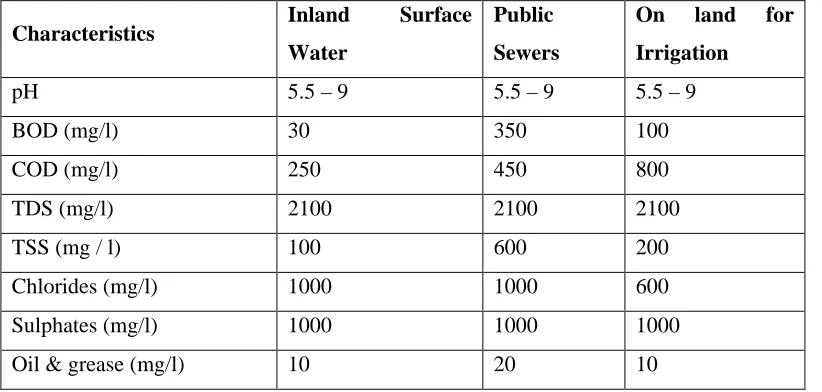
2.4 Disposal Standards For Candy Industries
The disposal standards for the candy industries is presented in Table 2
Table 2: - Tolerance Limits of Trade Effluents
Characteristics Inland Surface
Water
Public
Sewers
On land for
Irrigation
pH 5.5 – 9 5.5 – 9 5.5 – 9
BOD (mg/l) 30 350 100
COD (mg/l) 250 450 800
TDS (mg/l) 2100 2100 2100
TSS (mg / l) 100 600 200
Chlorides (mg/l) 1000 1000 600
Sulphates (mg/l) 1000 1000 1000
Oil & grease (mg/l) 10 20 10
2.5 Treatment Methods of Candy Industry
The treatment units employed in the candy industry varies from industry to industry to the effluent characteristics. The
conventional unit operations involved in the candy industry are as follows.
1. V-notch
2. Collection sump
3.Diffused Air Floatation (DAF)
4. Equalization tank
© IJERGS, All Rights Reserved.
Pag
e5
Pag
e5
Pag
e5
Pag
e5
Pag
e5
Pag
e5
Pag
e5
Pag
e5
Pag
e5
Pag
e5
Pag
e5
Pag
e5
Pag
e5
Pag
e5
Pag
e5
Pag
e5
Pag
e5
Pag
e5
Pag
e5
Pag
e5
Pag
e5
6. Upflow Anaerobic Sludge Blanker Reactor (UASBR)
7. Fixed Film Anaerobic Reactor (FFAR)
8. Aeration tank
9. Clarifiers
10. Dual Medium Filters (DMF)
1. V Notch
The V notch, sharp crested weir is one of the most precise waste discharge measuring devices, suitable for a wide
range of open channel flows.
2. Collection sump
The effluents from hostels candy industry is collected in collection tank. To remove stones, plastics and other
solid wastes a grid removal screen is provided where the solid waste removal is done manually and daily.
Effluents from the sources mentioned above are collected in a collection tank (capacity 350m3).
3. Diffused Air Floatation (DAF)
It removes the high oil and grease, TSS by the addition of alum. It helps in reducing for surface leading rate. The
solid waste generated from this units are the pancakes which is used as fuel for the boilers on the industry.
4. Equalisation tank
If the equalisation tank is serving an aerobic system then the contents of the tank should be kept aerobic. It should
be well mixed and kept free of floating or settled sludge or solids. The capacity of equalization tank 208 m3.
5. Buffer tank
In this tank, the wastewater pH is neutralized mostly candy industry wastewater in acidity nature, chemical
substance like NaOH are added to neutralize the wastewater.
6. Aeration tank
From the collection tank, effluent is pumped to the aeration tank (350 m3), mechanical aerator (15 HP) is used in
aeration tank to dissolve atmospheric oxygen into the effluent. A retention time of 24-32 hours is given for the
aeration and the microbes to act on the wastewater.
7. Clarifiers
In a sedimentation tank, also called settling tank or clarifier, the operation involved is either to detain unfloculated
water containing heavier and suspended impurities and there because them to settle out of suspension.
8. Dual Medium Filters (DMF)
This is the final treatment unit involved to remove the BOD, TSS and also some toxic chemicals by using the
activated carbons
Conclusion
Industrial polluted water is very harmful for every living organism and environment. Treatment plant controls the
germination of effects and disease on this industrial area and no effects in local people. The effluent treatment plant is
delivering treated effluent quality well within the norms as laid by pollution control board. This process is healthy for
© IJERGS, All Rights Reserved.
Pag
e6
Pag
e6
Pag
e6
Pag
e6
Pag
e6
Pag
e6
Pag
e6
Pag
e6
Pag
e6
Pag
e6
Pag
e6
Pag
e6
Pag
e6
Pag
e6
Pag
e6
Pag
e6
Pag
e6
Pag
e6
Pag
e6
Pag
e6
Pag
e6
clogging process in pipelines. There are skimming tank is a good removal for oil, grease, fat and other floating impurities
and implement the effluent quality from this process. pH is low after anaerobic treatment because three process are
involve for treatment in anaerobic contact filter there are- Hydrolysis, Acidification and Gasification.
Reference
1. Ajit P.Annachhatre and Prasanna L.Amatya (1997), “UASB Treatment of Tapioca Starch wastewater”, Journal of
Environmental Engg, 126:1149.
2. Annachhatre, A.P and Amornkaew, A. (2001), “Up flow Anaerobic Sludge Blanket Treatment of Starch Wastewater
Containing Cyanide”, Water Environment Research, 73:622-632.
3. Ansari IA and Jogi MM (2003), “Sludge granulation in lab scale UASB reactor based on starch effluent”. 117-119
[5 Ref].
4. APHA (1992), Standard method for the examination of water and wastewater – APHA,Newyork, USA.
5. Behling. E, A. Diaz, G. Colina, M. Herrera, E. Gutierrez, E. Chacin, N. Fernandez and C. F. Forster (1997),
“Domestic wastewater treatment using a UASB reactor”, Bioresource Technology 61:239-245.
6. Chakraborty, S., M. K. Purkait, (2003), "Nanofiltration of textile plant effluent for color removal and reduction in
COD." Separation and Purification Technology 31(2): 141-151.
7. Chen, K.-C and J.-Y. Wu, (2003), "Decolorization of the textile dyes by newly isolated bacterial strains." Journal of
Biotechnology 101(1): 57-68.
8. Fernandez, A. Morão, M. Magrinho, A. Lopes and I. Gonçalves (2003), “Electrochemical degradation of C. I. Acid