This is an open access journal, and articles are distributed under the terms of the Creative Commons Attribution-Non Commercial-ShareAlike 4.0 License, which allows others to remix, tweak, and build upon the work non-commercially, as long as appropriate credit is given and the new creations are licensed under the identical terms.
© 2017 Journal of Advanced Pharmacy Education & Research | Published by SPER Publication 397
Knowledge on Osteoporosis prevention among Bahraini
women: A cross sectional study
Gayathripriya. N
1*, Hala Mohamed Sanad
2, Muyssarabri Hassan Awadhalla
31Asst. Professor, Nursing Department, College of Health Sciences, University of Bahrain, 2Asst.Professor, Nursing Department, College of Health Sciences, University of
Bahrain, 3Head, Nursing Department, College of Health Sciences, University of Bahrain
Corresponding Author:N. GayathriPriya, Nursing Department, College of Health Sciences, University of Bahrain. Email: [email protected]
ABSTRACT
Objectives: To estimate the level of knowledge on osteoporosis among Bahraini women. 2. To determine relationship between the background variables with the level of knowledge. Methods: A cross sectional survey study consisting of 400 Bahraini women were included in the study using convenience sampling technique in a community setting. The data were collected using Osteoporosis Knowledge Assessment Tool (OKT). The SPSS (version 20.0) for windows was used and descriptive and inferential statistics were performed. Results: The majority of the participants’ age was 30-39 years (44.0%). Most of the women 292 (73%) had moderately adequate knowledge on osteoporosis. There was an association found between house hold activity, practice and exercise and calcium intake at p<0.001, Frequency of fast food intake/week and exercise at p<0.001 & educational level and calcium intake at p<0.5. Conclusion: Bahraini women were having moderate level of knowledge on different aspects of osteoporosis knowledge on risk factors, exercise and calcium intake. Improving knowledge to the level of adequate knowledge among this particular ethnic background is essential which demands high financial costs on the government in terms of treatment. Health care professionals should be prepared for teaching role on prevention of osteoporosis.
Keywords: Bahraini women, knowledge, osteoporosis, exercise, calcium intake
Introduction
Osteoporosis is a serious health concern that affects millions of people around the world. It is estimated to affect 200 million women worldwide and causes more than 8.9 million fractures annually [1, 2]. Osteoporosis is a skeletal disease characterized by low bone mass and deterioration of the micro architecture of bone tissue, with a consequent increase in bone fragility and susceptibility to low trauma fractures [3]
. The disease is medically diagnosed as having reduced bone mineral density that is 2.5 standard deviations below the adult peak mean [4] which decreases bone strength and increases the risk of skeletal
fractures, particularly fractures to the hip, spine and wrist, and osteoporosis and osteoporotic fractures significantly reduce the quality of life [5] and increase mortality [6].
In the gulf region, multiple studies have sought to deter-mine the prevalence of the disease as well as its burden on the community. A recent study was conducted in KSA during 2015 and revealed that 34% of females between the ages of 50 and 79 years suffer from osteoporosis [7]. Another study reported that the bone mineral density among Saudi women was lower than that of their American counterparts, possibly due to a higher prevalence of vitamin D deficiency as well as multiple pregnancies [8]
. Females have vitamin D deficiency higher than males as they were protective clothing and avoid sun exposure. Furthermore, due to Islam and its beliefs, Muslim women who wear abaya and hejab are at high risk for vitamin D deficiency than the who do not wear it because, white and lighter clothes are less effective in blocking UV radiation than long and black clothing. Several studies in different populations assessed the knowledge and attitudes toward OP aiming at providing baseline data essential for planning educational interventions [9, 10]
. Thus, there is a need for intensive action at both the international and national levels to develop a coordinated
Access this article online
Website: www.japer.in E-ISSN: 2249-3379
How to cite this article: Gayathripriya. N, Hala Mohamed Sanad, Muyssarabri Hassan Awadhalla. Knowledge on Osteoporosis prevention among Bahraini women: A cross sectional study. J Adv Pharm Edu Res 2017;7(4):397-403.
Source of Support: Nil, Conflict of Interest: None declared.
398 Journal of Advanced Pharmacy Education & Research | Oct-Dec 2017 | Vol 7 | Issue4
strategy to deal with osteoporosis and reduce its burden on society. However, there is also a need for information for action, especially in Bahrain, to adequately plan an osteoporosis prevention and control strategy. Furthermore, no research on the topic has been pursued in the primary health care setting which constitute the first line interaction between the community and the health care system in Bahrain.
Methods
The study approach was a quantitative approach and the design was a cross sectional survey. The study population comprised of Bahraini women who were fulfilling the criteria and accessible in the community settings. The sample size was calculated according to the relevant published article and with 80% power and 5% error and the estimated sample size was 400. The following inclusion criteria applied Female gender, all women with Bahraini nationality, aged from 30 to 80 years and above and able to communicate with Arabic language only.
The Bahraini women aged less than 30 years old, male gender, non-Bahraini women, those who were not willing to participate, who were not able to read and respond to questions, and non-Arabic speakers were excluded from the study. Non probability convenience sampling technique was used to recruit the samples for the study. During the visit to community health centers, the women were assessed for inclusion criteria and they were included in case they were found to be eligible.
Ethical consideration:
The investigation fits into the principles defined in the Declaration of Helsinki (World Medical Association, 2013). A subject information sheet was provided with clear explanation to each study participants and written informed consent was obtained before including them in the study. All enrolled women were asked to complete the self-administered questionnaire given to them after being provided with all the information regarding the research work and they were informed that participation in the study was totally voluntary. Privacy and confidentiality of data were assured all through the research work.
Instruments
The instrument had two parts. Part A comprised the items that were used to collect the socio-demographic factors such as age, educational level, marital status, type of family, monthly family income. And Part B consisted of personal variables such as how many times you eat fast food in a week? How often are you eating homemade food /week? Do you eat calcium supplement? number of children? Do you have family history of osteoporosis? Household activity, practice and exercise? Part C was the Osteoporosis Knowledge Test (OKT, revised 2011). It is a 32 item scale developed by Phyllis Gendler was used as a research tool based on the published article “Knowledge about osteoporosis prevention among women screened by bone
densitometry” [11]
. It has three knowledge subscales: Knowledge on osteoporosis risk factors (16) that measures the risk factors of developing the osteoporosis, Exercise scale (6items) that measures the knowledge on exercise in relation to osteoporosis and Calcium intake scale (10items) which measures the knowledge on calcium intake [11].
The questions under the self-administered OKT related Knowledge on osteoporosis risk factors are of more likely, less likely and don’t know/neutral types. Score interpretation responses in relation to knowledge on exercise were scored as correct, incorrect and don’t know. The don’t know option was included to avoid guessing. The correct responses were coded as 1 and incorrect and don’t know as 0. The knowledge on Calcium intake includes correct, incorrect and don’t know responses. The Arabic translation of the tool was done and it was linguistically accepted.
Validity and Reliability:
Instrument part A & B, consist of socio-demographic and personal factors was given to a panel of six subject experts to establish the content validity. The experts were selected based on their experience and interest in the problem being assessed in this study. I-CVI (Item level content validity index) and S-CVI (scale level content validity index) were calculated. The mean of both I-CVI and S-CVI was 0.97. Therefore, the tool was valid in this study. The pilot study was conducted with 40 women to assess the reliability in the local population being studied. They were not a part of the main study and the calculated internal consistency Cronbach’s alpha value for the Osteoporosis risk factor scale was r = 0.82, Exercise scale. r = 0.89 and Calcium intake scale (r=0.92). The tool in its Arabic version is both reliable and linguistically acceptable.
Data collection procedure:
In the community Health Centers waiting area, where the people used to sit for some time for the consultation, were accessed for data collection. The purpose of this research was explained to all the participants and provided with a subject information sheet. After obtaining the written informed consent, the patients completed the self-reported Arabic version questionnaire of socio demographic variables, personal variables and OKT questionnaire. The average time taken by the participants to fill the data collection form varied from 10-15 minutes. The data was collected from February 2017- June 2017. To summarize, 430 participants were approached to join this study and out of 412 eligible participants, 400 were enrolled in the study.
Statistical Analysis:
Journal of Advanced Pharmacy Education & Research | Oct-Dec 2017 | Vol 7 | Issue4 399
deviation, adequate, moderately adequate & inadequate scores were calculated to report the knowledge level. The association between knowledge scores and demographic factors was analyzed by using one-way ANOVA. The results were summarized by using the tables and presented with narrative descriptions. There were no missing data in the statistical analysis.
Results
The study enrolled 400 Bahraini women participants. The highest frequency of age was found in the age group of 30-39 years (n=176, 44%). Most of them came from the income group between the range of 400-600 Bahraini Dinars (n=207, 51.8%). With respect to education, majority of them fall under the category of undergraduate education (n=159, 39.8%). The marital status of studied women showed that about three quarters (n=302, 75.5%) of them were married, single (n=39, 9.8%) and divorced were (n=32 8.0%). In relation to the type of family, (n=275,68.8%) were living as a nuclear family pattern, and (n=125,31.2%) were living as extended family (Table.1)
Table 1. Demographic distribution of Bahraini Women
Variables Number %
Age
30-39 176 44.0%
40-49 122 30.5%
50-59 79 19.8%
60-69 18 4.5%
70-79 5 1.2%
Education level
No formal education 19 4.8% Primary (1 grade -6 grade) 22 5.5%
Intermediate
(7 grade -9 grade ) 44 11.0% Secondary (10 grade -12
grade) 152 38.0% University
Under graduate
(diploma – bachelors) 159 39.8% Post graduate
(master – Doctorate) 4 1.0%
Marital status
Single 39 9.8%
Married 302 75.5% Divorced 32 8.0%
Widow 27 6.8%
Type of Family
Nuclear family 275 68.8% Extended family 125 31.2% Monthly
family income
Less than 300 BD 83 20.8% Between 400-600 BD 207 51.8% More than 600 BD 110 27.5%
The majority of studied women (n=198, 49.5%) reported that they used to take fast food for more than five times in a week. In a same way, the majority of the participants reported that they used to take homemade food more than 5 times in a week (n=187, 46.8%) and one fourth (n=76, 19.0%) of the participants reported that they used to take home made for one to two times in a week. Three fourth of the participants replied that (n=305, 76.2%) of them were not taking calcium
supplements. One fourth of the participants (n=95, 23.8%) of them agreed that they were taking calcium supplements. In relation to the number of children, majority of them (n=177, 44.2%) responded that they were having 1-3 children in their family and 32.2%, 3.0% of them were having 4-6, 7-9 children respectively in their family. In terms of the family history of osteoporosis, most of them (n=236, 59%) of the studied women responded that they don’t have the family history of osteoporosis and one fourth (n=81, 20.2%) responded as they have the family history of osteoporosis. In the practice of house hold activity and exercise, majority (n=207, 51.8%) of the participants depend only on housemaids and (n=152,38%), (n=40,10%) responded as having housemaid that assists them with house work, do house work without assistance such as cooking & cleaning respectively. The main source of the information regarding osteoporosis among studied woman was mass media (n=198, 49.5%) (Table-2).
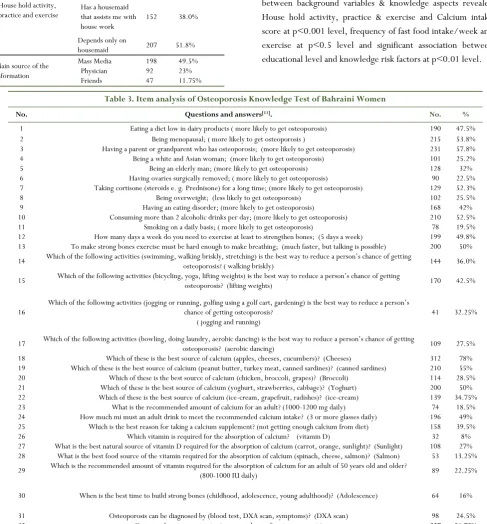
The examined participants correctly indicated the risk factors for osteoporosis, i.e. eating a diet low in dairy products (47.5%), Being menopausal (53.8%), having a parent or grandparent who has osteoporosis (57.8%), and smoking on a daily basis (49.8%). And substantial part of the participants knew that Being a white and Asian woman to develop osteoporosis (25.2%) and they don’t know about link between the absence of ovaries and osteoporosis and scored (22.5%), taking cortisone for long time responded (52.3%). The very less and meager percentage of the participants knew that for the calcium absorption, vitamin D is essential (8%), and 27 % of the women correctly indicated the sunlight as the source of vitamin D. Participants also correctly indicated the best sources of calcium: yoghurt (50%), cheeses (78%), ice cream (34.75%), canned sardines (55%) and unfortunately the participants were unaware of the recommended amount of calcium intake for an adult and gave wrong responses (81%). Most of the respondents were unaware of the reason to take calcium supplement and the correct response was only (39.5%). The largest percentage of the participants (for strong bones exercise must be hard enough to make breathing; much faster) (50%) was in favor of the fact that exercise makes bone strong. Only (49.8%) of the respondent were aware of the fact that exercising 5 times a week enabled formation of strong bones and to prevent the development of osteoporosis. Only 36% of participants knew that brisk walking is the best way to prevent osteoporosis, 32.2% of women indicated running & jogging, 42.5% weightlifting, and 27.5% aerobic dancing. The largest percentage of the examined were unaware of recommended amount of calcium (1000-1200mg) for an adult and calcium dosage that is 18.5%. The above data are presented in (Table-3).
Table 2. Personal variables distribution of Bahraini Women
400 Journal of Advanced Pharmacy Education & Research | Oct-Dec 2017 | Vol 7 | Issue4
How many times you eat fast food in a week?
1-2 91 22.8%
3-4 111 27.8%
More than 5 198 49.5%
How often are you eating homemade food/ week?
1-2 76 19.0%
3-4 137 34.2%
More than 5 187 46.8% Do you take calcium
supplement
Yes 95 23.8%
No 305 76.2%
Number of children
Don’t have children 76 19.0%
1-3 177 44.2%
4-6 129 32.2%
7-9 12 3.0%
More than 9 6 1.5%
Do you have family history of osteoporosis
Yes 81 20.2%
No 236 59.0%
I don’t know 83 20.8%
House hold activity, practice and exercise
Do house work without assistance such as cooking and cleaning
41 10.2%
Has a housemaid that assists me with house work
152 38.0%
Depends only on
housemaid 207 51.8%
Main source of the information
Mass Media Physician Friends
198 92
47
49.5% 23% 11.75%
Readings Others
58 5
14.5% 1.25%
The overall statistical analysis of knowledge score depicted that 73% of the study participants were having moderately adequate knowledge on osteoporosis related aspects. Only 17.5% of them were having inadequate knowledge on osteoporosis and related calcium intake and exercise. The above data are presented in (Table 4).
The analysis of the results showed that the overall mean scores of knowledge on osteoporosis risk factors showed 12.8 with the standard deviation of 4.47. And the exercise revealed the mean scores of 3.55 with the standard deviation of 1.86. Also the calcium intake showed the total mean score of 3.88 with the standard deviation of 1.53 (Table 5.). The analysis of association between background variables & knowledge aspects revealed House hold activity, practice & exercise and Calcium intake score at p<0.001 level, frequency of fast food intake/week and exercise at p<0.5 level and significant association between educational level and knowledge risk factors at p<0.01 level.
Table 3. Item analysis of Osteoporosis Knowledge Test of Bahraini Women
No. Questions and answers[11]. No. %
1 Eating a diet low in dairy products ( more likely to get osteoporosis) 190 47.5% 2 Being menopausal; ( more likely to get osteoporosis ) 215 53.8% 3 Having a parent or grandparent who has osteoporosis; (more likely to get osteoporosis) 231 57.8% 4 Being a white and Asian woman; (more likely to get osteoporosis) 101 25.2% 5 Being an elderly man; (more likely to get osteoporosis) 128 32% 6 Having ovaries surgically removed; ( more likely to get osteoporosis) 90 22.5% 7 Taking cortisone (steroids e. g. Prednisone) for a long time; (more likely to get osteoporosis) 129 52.3%
8 Being overweight; (less likely to get osteoporosis) 102 25.5%
9 Having an eating disorder; (more likely to get osteoporosis) 168 42% 10 Consuming more than 2 alcoholic drinks per day; (more likely to get osteoporosis) 210 52.5% 11 Smoking on a daily basis; ( more likely to get osteoporosis) 78 19.5% 12 How many days a week do you need to exercise at least to strengthen bones; (5 days a week) 199 49.8% 13 To make strong bones exercise must be hard enough to make breathing; (much faster, but talking is possible) 200 50%
14 Which of the following activities (swimming, walking briskly, stretching) is the best way to reduce a person’s chance of getting
osteoporosis? ( walking briskly) 144 36.0%
15 Which of the following activities (bicycling, yoga, lifting weights) is the best way to reduce a person’s chance of getting
osteoporosis? (lifting weights) 170 42.5%
16
Which of the following activities (jogging or running, golfing using a golf cart, gardening) is the best way to reduce a person’s chance of getting osteoporosis?
( jogging and running)
41 32.25%
17 Which of the following activities (bowling, doing laundry, aerobic dancing) is the best way to reduce a person’s chance of getting
osteoporosis? (aerobic dancing) 109 27.5% 18 Which of these is the best source of calcium (apples, cheeses, cucumbers)? (Cheeses) 312 78% 19 Which of these is the best source of calcium (peanut butter, turkey meat, canned sardines)? (canned sardines) 210 55% 20 Which of these is the best source of calcium (chicken, broccoli, grapes)? (Broccoli) 114 28.5% 21 Which of these is the best source of calcium (yoghurt, strawberries, cabbage)? (Yoghurt) 200 50% 22 Which of these is the best source of calcium (ice-cream, grapefruit, radishes)? (ice-cream) 139 34.75% 23 What is the recommended amount of calcium for an adult? (1000-1200 mg daily) 74 18.5% 24 How much mi must an adult drink to meet the recommended calcium intake? (3 or more glasses daily) 196 49% 25 Which is the best reason for taking a calcium supplement? (not getting enough calcium from diet) 158 39.5% 26 Which vitamin is required for the absorption of calcium? (vitamin D) 32 8% 27 What is the best natural source of vitamin D required for the absorption of calcium (carrot, orange, sunlight)? (Sunlight) 108 27% 28 What is the best food source of the vitamin required for the absorption of calcium (spinach, cheese, salmon)? (Salmon) 53 13.25%
29 Which is the recommended amount of vitamin required for the absorption of calcium for an adult of 50 years old and older?
(800-1000 IU daily) 89 22.25%
30 When is the best time to build strong bones (childhood, adolescence, young adulthood)? (Adolescence) 64 16%
Journal of Advanced Pharmacy Education & Research | Oct-Dec 2017 | Vol 7 | Issue4 401 Table 5. The overall mean scores with SD of knowledge on
risk factors, exercise
Components N Minimum Maximum Mean SD Osteoporosis
knowledge on risk factors
400 .00 24.00 12.80 4.47
Exercise 400 .00 7.00 3.55 1.86 Calcium intake 400 .00 8.00 3.88 1.53
Discussion
The purpose of this study was to assess the knowledge of Osteoporosis among Bahraini women and to observe the association between knowledge score and background variables. Overall, this study shows moderate levels of knowledge regarding osteoporosis among Bahraini women and half of the studied participants were aware of the osteoporosis treatment options. This result is in accordance with studies conducted in other countries. A troubling finding was the low level of knowledge regarding the vitamin D which is required for the absorption of calcium. A more reassuring finding was that most women knew that use of glucocorticoids can increase the risk for osteoporosis and this is supported by the study glucocorticoids induced osteoporosis [12]. In our study, the majority of the participants reported mass media including television, radio, newspaper and magazines (49.5%) as their main source of knowledge, while physicians were ranked as the second source of information (23%) Comparable results were obtained as to sources of information about this disease, where media (radio, television) proved to be the dominant source of knowledge indicated by 63.7% of patients[13]
.This was in agreement with what was reported in many studies carried out among Turkish, American, Bruneian, Indian and Singaporean women (mass media was rated as the main source of information in 53%, 55%, 70%, 74% and 76.4% of the studied women respectively)[14-18]. In contrast and interestingly, the American and Canadian studies reported women receiving most of their education/information on osteoporosis from their Health care providers [19]. The existing evidence showed that the majority of the participants are aware of source of calcium supply. Few participants knew about the best way to reduce a person’s chance of getting osteoporosis. It was determined that less percentage of studied women had family history of osteoporosis. And this finding is supported by the study conducted among Americans revealed 19.8% of them, a positive family history was reported and was significantly and
independently associated with osteoporosis [20]
. A troubling finding was the low level of knowledge regarding medications and supplements related to the treatment of osteoporosis. Participants also showed a weak understanding of the role of calcium dosage, role of Vitamin D in calcium absorption, recommended calcium dosage, smoking, ovaries surgically removed, best way to reduce a person’s chance of getting osteoporosis in the prevention of osteoporosis. The osteoporosis related risk factors, exercise and calcium intake osteoporosis have got some effects on the women’s body. And this concept is coincided by Lifestyle factors such as: a dietary intake low in calcium, especially in childhood/early adulthood, smoking, excessive alcohol intake, low bodyweight, lack of resistance/weight bearing exercise and over exercising, resulting in periods of amenorrhea that interfere with the beneficial effects of estrogen on bone metabolism, also pose risks for the development of osteoporosis [21, 22]
. This was comparable to a Turkish study in which it was reported that 80.4%, 67.6%, 60.4%, 53%, and 52.6% of women respectively knew that low calcium and vitamin D in diet, premature menopause, family history of OP, lack of activity and smoking are risk factors for OP [23]. Regarding the association between the total knowledge score for OP and women’s age, it was found that the highest score was among the age group of 60 to 69 years. However, this was statistically insignificant (P =0.33). This was in agreement with the previous study [24]
. Several previous studies found that the mean knowledge of OP was significantly higher among highly educated women [25, 26]
. This was in accordance with the current study. Moreover, the same relation was found between knowledge score and employment status as knowledge was significantly higher among educated women and calcium intake & exercise (p=0.5, p=0.6) respectively. On assessing women’s knowledge regarding bone growth, it was found that very less percentage of the studied women (16 %%) knew the most important time in age for bone building is during adolescent period and this was supported by essentials of the pathogenesis of osteoporosis [27]
. On the other hand, studying the risk factors for OP showed that a low intake of calcium was identified as a risk factor for OP by about three quarters of the studied women (78%) revealed cheese was the best source of calcium, but smoking was identified as a risk factor by minority studied women (19.5%) [28, 29]. Regarding the role of exercise on bone physiology, 49.8%of the participants knew the five days a week need to exercise at least to strength and improves bone health. About 36% of the studied women knew that walking had an essential role in bone health. These figures were much higher than those reported in that most of the women understand that walking has a beneficial effect on bone density similar to that of high impact exercise, in addition to, its obvious cardiovascular benefits [30, 31]
. Hence, on planning health education programs for prevention of OP, the health
Table 4: Overall knowledge on osteoporosis related aspects
Knowledge categories No. %
Inadequate (<50%) 38 9.5 Moderately adequate(51-75%) 292 73
402 Journal of Advanced Pharmacy Education & Research | Oct-Dec 2017 | Vol 7 | Issue4
education messages should emphasize the different risk factors of OP and importance of calcium intake and the regular habit of doing exercise [32-34]
. Limitations
The present study is limited by selecting a convenient sample of women from the community represent a less representative sample which decreases the generalizability of the results. Moreover, exclusion of illiterate females because of using a self-administered questionnaire who an important category of women in the community affects the total knowledge score that was expected to be lower. Duration of data collection period was less.
Conclusion
The current study concluded that the knowledge on osteoporosis among Bahraini women could be considered moderate as related to knowledge on osteoporosis risk factors, exercise and calcium intake. Furthermore, education of the public regarding prevention of OP must be incorporated in the health services provided for schoolchildren, adolescents, and maternity care and extended to post menopausal and elderly care services. It is very important to train health care professionals in utilizing the clinical and community visit as an opportunity to give information about osteoporosis and its prevention. There is a need of the hour to wide spread information related to osteoporosis, specially targeting premenopausal women, to halt the progression of this silent disease.
Conflict of Interests:
The author declares that there is no conflict of interest
Acknowledgments
The researchers wish to thank the student research team Zainab Mohammed, Mariam Khamis, Sanad Abdul Rahman, Mariam Hasan, Jenan Mohammed and Wadeea Ali from Nursing department, College of Health Sciences, University of Bahrain who carried out the data collection for this study.
References
1. Reginster JY, Burlet N. “: A still increasing prevalence” Bone 2006; 38(2 Suppl. 1): S4–9. 2. Watts NB, Bilezikian JP, Camacho PM, Greenspan
SL, Harris ST, Hodgson SF, et al. “AmericanAssociation of Clinical Endocrinologists Medical Guidelines for Clinical Practice for the diagnosis and treatment postmenopausal osteoporosis”. EndocrPract 2010;16 (Suppl. 3):1–37. 3. European Commission, 1998. “Building strong bones for preventing fractures”. Report on Osteoporosis in the European Community. Times Ltd, Germany
4. Kanis JA, Melton LJ, Christiansen C, Johnston CC, KhaltaevN. Perspective: “The diagnosis of osteoporosis”. J Bone Mineral Res 1994; 9:1137e41. 5. Lips P, van Schoor NM. “Quality of life in patients
with osteoporosis”. Osteoporosis Intl 2005; 16:447e55
6. Johnell O, Kanis JA, Oden A, Sernbo I, Redlund- Johnell I, Petterson C, et al. “Mortality after osteoporosis fractures”. OsteoporosInt2004; 15:38 e42.
7. doing enoughe1150.
8. World Health Organization. Regional office for the Eastern establishing regional
9. Ungan M, Tumer M. “Turkish women’s knowledge of osteoporosis”. FamPract 2001; 18:199–203. 10. Juby AG, Davis P. “A prospective evaluation of the
awareness, knowledge, risk factors and currenttreatment of osteoporosis in a cohort of elderly subjects”. OsteoporosInt 2001; 12:617–22 11. Mariola Janiszewska, Ewelina Firlej, Dorota
Zolnierczuk-Kieliszek. “Knowledge about osteoporosis prevention among women screened by bonedensitometry”. Menopause Rev 2016; 15(2): 96-103.
12. Dr Lisa-Ann Fraser , Dr Jonathan D. Adachi. “Glucocorticoid-Induced Osteoporosis: Treatment Update and Review”. Therapeutic Advances in Musculo skeletal Disease;2009 Apr; 1(2): 71–85. 13. Podbielska M, Sokołowski K, Sokołowska M.
Ocenapoziomuwiedzynatematosteoporozyis to Sowanejprofilaktykiwśródkobietpo 50 rokużycia. ZeszNauk WSSP 2013; 17: 88-95.)
14. Saw SM, Hong CY, Lee J, Wong ML, Chan MF, Cheng A, et al. “Awareness and health beliefs ofwomen towards osteoporosis”. Osteoporosis Intl 2003; 14:595–601.
15. Gemalmaz A, Oge A. “Knowledge and awareness about osteoporosis and its related factors among rural Turkish women”. ClinRheumatol 2008; 27:723–8. 16. Geller SE, Derman R. “Knowledge, beliefs, and risk
factors for osteoporosis among African–American and Hispanic women”. J Natl Med Assoc 2001;93(1):13– 21.
17. Liza H, Darat HN, Pande KC. Knowledge about osteoporosis in Bruneian women attending anorthopaedic clinic. Malays Orthop J 2009;3(1):28– 31.
Journal of Advanced Pharmacy Education & Research | Oct-Dec 2017 | Vol 7 | Issue4 403
19. Ribeiro, V., Blakeley, J., Laryea, M., 2000. “Women’s knowledge and practices regarding the prevention and treatment of osteoporosis”. Health Care for Women International 21, 347–353. 20. Julie Robitaille,et.al(2008) “Prevalence, Family
History, and Prevention of Reported Osteoporosis in U.S. Women”. American Journal of Preventive Medicine. Published by Elsevier Inc. Volume 35, Issue 1, Pages 47–54.
21. Hannon C, Kathy Murphy, “A survey of nurses’ and midwives’ knowledge of risks and lifestyle factors associated with osteoporosis” Journal of Orthopedic Nursing,2007,11, 30-37
22. National Osteoporosis Society, 1998. “Osteoporosis: Causes, Prevention and Treatment”. National Osteoporosis Society, Bath.
23. Ungan M, Tu¨ mer M. “Turkish women’s knowledge of osteoporosis”. FamPract 2001; 18:199–203. 24. Riaz M, Abid N, Patel M, Tariq M, Khan MS, Zuberi
L. “Knowledge about osteoporosis among healthy women attending a tertiary care hospital”. J Pak Med Assoc 2008;58(4):190–4.
25. Kutsal YG, Atalay A, Arslan S, Bas_aran A, Cantu¨ rk F, Cindas_ A, et al. “Awareness of osteoporotic patients”. Osteoporos Int2005; 16:128–33. 3. 26. Hong CY, Lee J, Wong ML, Chan MF, Cheng A, et
al. “Awareness and health beliefs of women towards osteoporosis”. Osteoporosis Intl 2003; 14:595–601. 27. Horowitz M, Eastell R, Insogna K, editors. “Essentials
of the pathogenesis of osteoporosis”. London: Current Medicine Group (Springer Healthcare); 2010.
28. Ungan M, Tu¨ mer M. “Turkish women’s knowledge of osteoporosis”. FamPract 2001; 18:199–203. 29. Jalili Z, Nakhaee N, Askari R, Sharifi V. “Knowledge,
attitude and preventive practice of women concerning osteoporosis”. Iran J Public Health 2007;36(2):19– 24.
30. Bonaiuti D, Shea B, Iovine R, Negrini S, Robinson V, Kemper HC, et al. “Exercise for preventing and treating osteoporosis in postmenopausal women”. Cochrane Database Syst Rev 2002(3): CD000333. 31. Yamazaki S, Ichimura S, Iwamoto J, Takeda T,
Toyama Y. “Effect of walking exercise on bonemetabolism in postmenopausal women with osteopenia /osteoporosis”. J Bone Miner Metab2004; 22:500–8.
32. Malak MZ, Toama ZT. “The effect of osteoporosis health education program based on health belief model on knowledge and health beliefs towards osteoporosis among Jordanian female teachers”. EurSci J 2015; 1:385–98.
33. Werner P. “Knowledge about osteoporosis: assessment, correlates and outcomes”. Osteoporosis Intl2005; 16:115–27.