Mieczysław Fryczkowski
a–F, Piotr Bryniarski
c, d, Maciej Szczębara
a–e,
andrzej Paradysz
a, c, e, FThe Impact of 5-Alpha Reductase Inhibitor
vs. Alpha-1 Adrenergic Receptor Antagonists
on Course of Prostate Premalignant Conditions
Urology department in the Medical and dentistry division in Zabrze, Medical University of Silesia in Katowice, Poland
A – research concept and design; B – collection and/or assembly of data; C – data analysis and interpretation; D – writing the article; E – critical revision of the article; F – final approval of article; G – other
Abstract
Background. Prostate intraepithelial neoplasm and atypical small acinar proliferation are considered prostate pre-malignant conditions. Such a diagnosis impacts further follow-up significantly as early detection of prostate cancer is of utmost importance. alpha-1 adrenergic receptor antagonists (i.e. doxazosiunum) and inhibitors of 5-alpha reductase (Finasteride) showed some efficacy in prevention of prostate cancer development.
Objectives. To assess the impact of both abovementioned drugs on prostate premalignant conditions.
Material and Methods. From January 2008 till September 2012, 213 patients with one of the abovementioned pre-malignant condition were retrospectively evaluated. after diagnosis they were assigned to group 1 (n-126)– treated with Finasteride or to group 2 (n-87)-treated with doxazosinum. every 6–7 months rebiopsies were conducted in each patient. Rate of remission and progression was assessed.
Results. In comparison between group 1 and 2 the rate of remission was 35.7% (n-45) vs. 18.4% (n-16) (p = 0.005). In terms of progression, the difference between 1st and 2nd group of patients was 7.1% (n-9) vs. 5.7% (n-5) (p = 0.68).
Conclusions. Remission of prostate premalignant condition is efficacious with Finasteride and not with doxazosinum. However, in terms of progression there were no differences among both drugs (Adv Clin Exp Med 2014, 23, 1, 79–84).
Key words: prostate cancer, prostate intraepithelial neoplasia, atypical small acinar proliferation, chemoprevention.
adv clin exp Med 2014, 23, 1, 79–84 ISSN 1899–5276
ORIGINaL PaPeRS
© copyright by Wroclaw Medical University
detection of prostate intraepithelial neoplasia (PIN) has recently increased along with the num-ber of biopsies conducted in patients with the sus-picion of prostate cancer (Pca). atypical small aci-nar proliferation (aSaP) is slightly less frequently diagnosed. Both kinds of dysplasia will treated in a not very distant perspective as strong invasive precursors of Pca [1].
The occurrence of both pathological prostate states is estimated in first biopsy for 4–16% ac-cording to high grade PIN (HG PIN) and 3–23% according to aSaP. Rebiopsies obtain respectively 23–47% and 25–57% diagnoses of prostate cancer. The probability of such diagnosis rises with the increased concentration of PSa in serum [2]. In
young men, low grade PIN (LG PIN) is most com-monly diagnosed. Such lesions are connected with the progression to Pca in patients with PSa serum concentration over 10 ng/mL. There are only a few long-term observations which clearly confirm the high risk of carcinogenesis in patients with LG PIN [3]. Still, only a few authors show similar per-centage of Pca diagnosis in rebiopsy independent-ly of the initial diagnosis (LG PIN or HG PIN); i.e. Goeman obtained 27% vs. 30% Pca in rebiopsy, respectively [4].
In a pathological sense, PIN has clearly defined morphological repetitive features [2, 5]. aSaP is an advanced atypia, often doubtfully accompanied by the basal cells damage both focally and multi-focally. due to this fact, it is often not defined his-tologically in a biopsy specimen, also because of the high percentage of uniqueness of that diagno-sis. It is rather a diagnostic category of scheduling the prostate’s basal cells with a different grade of probable transformation to Pca [5]. However, at the time of such a diagnosis there are no features of Pca. Therefore, very often immunohistochemi-cal investigations are very helpful in differentiating these two conditions. They reveal uninterrupted basal cells layer of the prostate. It is also speculated that PSa rise is a strong predictor of progression in PIN HG and not in aSaP [6].
The existence of a discrepancy of given mor-phological images and interpretations in different pathological schools certainly might be an expla-nation for such situation [7].
The increasingly young age of patients and consequently long period of carcinogenesis to the clinical figure of Pca make these patients perfect candidates for primary prevention and, above all, chemoprevention [8]. Regardless, prostate pre-malignant conditions (PPc) might be considered markers of the efficacy of the drugs implemented during chemoprevention [2, 9].
It should not be omitted that Pca and PPc might occur in one prostate competitively, next to each other in 6–30% [10].
It is highly possible that these drugs, effica-cious in primary chemoprevention, will be effec-tive also in stabilizing the existing cancer during secondary chemoprevention [11]. Both 5-alpha re-ductase inhibitor (Finasteride) and the antagonists of alpha-1 adrenergic receptor (i.e. doxazosinum) are the most frequently used medicines against symptomatic dysuria in patients with benign pros-tatic hyperplasia. This study aims at a comparative analysis of PPc chemoprevention using the above-mentioned medicines with simultaneous evalua-tion of subjective improvement of lower urinary tract symptoms (LUTS). In addition, the meaning of predictive factors of the risk of Pca development such as prostate volume, total serum PSa (T PSa) and total testosterone (TT) concentration and the influence of chemoprevention on their behavior were defined.
Material and Methods
The study was conducted from January 2008 till September 2012. The analysis covers 213 men in whose histopathological examination after the
transrectal biopsy (TRU cUT) revealed one of the above PPc. Patients with PSa T concentration higher than 4 ng/mL or/and pathology in digital rectal examination were qualified for biopsies.
The first biopsy was usually sextant. during re-biopsy done 6–7 months after the first one, 12 cores were collected. Before each biopsy, the PSa T (electrochemiluminescence method ecLIa) and TT concentration (electrochemiluminescence method ecLIa in elecsys 2010 analyzer) were ana-lyzed as well as the prostate volume (after eval-uating 3 prostate diameters) using the formula width × height × length × 0.52. The dysuria was evaluated in IPSS scale (0–35points) where the standard is located between 0–7 points, with simul-taneous quality of life evaluation (QL) in 6-grade scale with the normal range between 0–2 points. Patients filled out the survey on their own. For PSa T concentration – 4 ng/mL and for TT con-centration – 3.4 ng/mL were considered standard. Measurements were made in the morning (9:00– –10:00 aM). Patients were divided into 2 groups. The first group (n-126) consisted of patients tak-ing Finasteride in 5 mg dose a day, while the sec-ond one (n-87) – doxazosinum (doxar®) in 4 mg dose a day. all mentioned treatments and diagnos-tics were repeated every 6–7 months. Histopatho-logical examination was done by two independent uropathologists. Lack of any of the PPc changes described above was considered a criterion of re-mission. Progression was diagnosed in patients at the moment of morphological Pca confirmation present in prostate’s core biopsy. Statistical soft-ware v. 8 (StatSoft, Tulsa, OK, USa) was used in statistical evaluation. all statistical tests were two-sided with p < 0.05 considered to be statistically significant. The check for normality of the vari-ables’ distribution were done using the Shapiro-Wilk test. For dependent samples without stan-dard parametric distribution Wilcoxon matched pairs was applied. For categorical variables chi Square test was used. In distributions which were different from the standard – the U -Mann-Whit-ney test was used. correlations between variables were evaluated and presented with R Spearman correlation coefficient.
Results
an average TT concentration was 4.3ng/dL (range: 2.9 – 7.6 ng/dL). an average prostate volume was 36.4 cm3 (range: 29.3 – 46.7). The IPSS ranged from 7–22 points, averagely 13 pts. The remis-sion of PPc was diagnosed in 61 patients (28.6%). In the 1st group remission was observed in 44.4% of patients suffering from LG PIN, and in 27.3% suffering from HG PIN and in 0% suffering from aSaP. The 2nd group showed the following re-sults – 19.4%, 23.1%, and 0%, respectively.
In comparison between group 1 and 2 the rate of remission was 35.7% vs. 18.4% with a difference of 17.3% (p = 0.005) (Table 1). Between patients with LG PIN in 1st vs 2nd group, there were al-so statistically significant differences in terms of remission. However, in the case of HG PIN and aSaP there was no statistical significance.
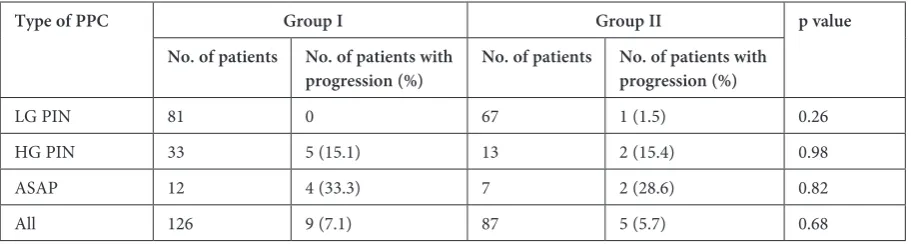
The progression of PPc has been found in 14 patients (6.6%). In the 1st group of patients it was 0% in LG PIN, 15.1% in HG PIN and 33.3% in aSaP. In the 2nd group – 1.5%, 15.4% and 28.6%, respectively. altogether the difference between 1st and 2nd group of patients was 7.1% vs. 5.7% and equaled 1.4% (p = 0.68). a different situation oc-curs in patients with remission. There are no statis-tical differences in progression between the groups and kinds of PPc (Table 2).
In both groups of patients the remission of PPc was accompanied by an increase in TT con-centration which only in group 2 appeared to be statistically significant (p = 0.0157). In U-Mann- -Whitney test, the initial TT concentration in pa-tients with remission was higher in relation to the rest (p = 0.0285). Still, it did not correlate with the increase in PSa T concentration or prostate vol-ume (r = 0.45, p = 0.68; r = 0.48, p = 0.82 respec-tively). The PSa T concentration in patients with remission was insignificantly lower in relation to the patients with progression (p = 0.0685). On the other hand, statistical significance was observed in an analysis of PSa T in group 1 between patients with remission and progression (p = 0.0033).
among 14 patients with progression, in 5 (35.7%) the tumor grade in Gleason score was higher than 7, in 2 patients it equaled 7 (14.3%) and in the rest (50%) it was lower than 7. In group 1, it was on average 6.9 vs. 6.6 in the second group (p = 0.810). In the 1st group of patients with remission, sta-tistically a significant decrease in prostate volume was noticed (12.2%, p = 0.0076). In the 1st group, prostate volume was correlated with the decrease of PSa T concentration (r = 0.74, p = 0.03). In the first group, in patients with progression, the de-crease in prostate volume was noticed (p = 0.0328)
Table 1. The influence of chemoprevention on PPc remission rate
Type of PPC Group I Group II p value
No. of patients No. of patients with
remission (%) No. of patients No. of patients with remission (%)
LG PIN 81 36 (44.4) 67 13 (19.4) 0.001
HG PIN 33 9 (27.3) 13 3 (23.1) 0.77
aSaP 12 0 7 0 Ns
all 126 45 (35.7) 87 16 (18.4) 0.005
PPc- prostate premalignant condition; LG PIN – low grade prostate intraepithelial neoplasia; HG PIN – high grade prostate intraepithelial neoplasia; aSaP – atypical small acinar proliferation.
Table 2. The influence of chemoprevention on PPc progression rate
Type of PPC Group I Group II p value
No. of patients No. of patients with
progression (%) No. of patients No. of patients with progression (%)
LG PIN 81 0 67 1 (1.5) 0.26
HG PIN 33 5 (15.1) 13 2 (15.4) 0.98
aSaP 12 4 (33.3) 7 2 (28.6) 0.82
all 126 9 (7.1) 87 5 (5.7) 0.68
but without a strong correlation with PSa T and TT. In patients with remission, the difference be-tween 1 and 2 group (IPSS scale) after chemother-apy equaled 3.3 pts and was statistically significant (p = 0.0244). Overall, between patients with remis-sion vs. progresremis-sion, the difference equaled 1.2 pts and did not have the features of statistical signifi-cance (p = 0.5). along with the IPSS survey, the QL was evaluated and showed insignificant statistical improvement in patients with remission vs. pro-gression (p = 0.124).
Discussion
currently, we are not using any specific bio-marker or other diagnostic methods that would al-low us to evaluate the risk of Pca development in men with PIN and aSaP. In case of both kinds of prostate dysplasia, the indicators of aneuploidy and angiogenesis are similarly increased. The in-dex of proliferation and apoptosis are also simi-lar [5]. This considerable simisimi-larity to the changes noticed in patients with Pca causes the prostate bi-opsy to be the diagnostically conclusive test [1, 12]. In practice, we often face the problem when the suggested chemotherapy influences the risk of car-cinogenesis. It is quite understandable that not only the kind of chemotherapeutics and its dura-tion, but also the current hormonal status of the patient (i.e. hypogonadism), his lifestyle and di-et influence the result [8, 13]. The lack of clearly established facts as far as this issue is concerned is strange because the scale of this phenomenon is becoming wider and rises with the improve-ment of diagnostics in patients with Pca suspi-cion. In the USa, about 115 thousand patients with HG PIN are recognized – 9% of all biopsies, 3–5% with aSaP and many more have to be add-ed to this number (approximately 12–14% with LG PIN) [14]. according to the opinion shared by majority of the authors, Pca will be diagnosed in 1 per 7 men throughout his life. considering that in most cases, it will be a clinically insignificant cancer, still it remains a significant problem, not only medical but also socio-economic. an active primary chemoprevention seems to be a logical an-swer to this challenge [9].
The aim of this study was to evaluate the in-fluence of the most frequently used drugs during LUTS therapy in patients with high risk of Pca pro-gression. The thesis that allows implementing an-tagonists alpha-1 adrenergic receptor, particular-ly those with quinazolin ring (doxazosinum and Terazosinum) holds that it has an inhibitory ef-fect on Pca cells [15]. Nowadays, it is believed that one of the mechanisms might be an intermediate
influence on the apoptosis of cancers cells. anoth-er postulated mechanism is that these medicines work as angiogenesis inhibitors. In recent years, the PTeN inactivation and Bcl-2 degradation are the most widely described potential mechanisms that justify their effects in chemoprevention [16]. The most possible mechanism of doxazosinum is to induce apoptosis through akt induction [17]. despite a quite broad theoretical basis, clinical studies do not confirm the efficacy of this group of medicines in Pca chemoprevention, both as pri-mary and as secondary ones [18]. Retrospective analysis of over 2,000 patients taking doxazosi-num in arterial hypertension showed a decrease in the percentage of patients suffering from Pca by 40% compared to the control group. Still, Harris’s report is a very sparse exception [16]. In turn, al-most 4,000 patients taking alpha-adrenolytics dur-ing european Randomized Study of Prostate can-cer Screening Trial by Finnish authors, proved no influence of these medicines on the incidence of prostate cancer. The significant part of this case study was an allegation concerning the decrease in percentage of high grade malignant Pca.
In relation to 5-alpha reductase inhibitors, their efficacy in Pca prevention was repeatedly confirmed, and it also refers to PPc [19, 20]. The-oretical basis that allows for the implementation of this group of medicine in primary and second-ary chemoprevention is connected to its influence on the alternative signal transduction pathways in prostate cells for adrenergic receptor [11].
is significantly higher in both groups than in pa-tients with PIN. These observations are consistent with outcomes presented by other authors [6, 14]. Braussi et al. conducted radical prostatectomy in 30 patients with pathologically confirmed diagno-sis of aSaP. In postoperative examination, they obtained in all patients a histological confirmation of Pca [23]. On such a basis, he presents the thesis that the radical treatment of aSaP is not consid-ered as overtreatment. The absence of remission as well as the high percentage of progression in pa-tients with aSaP confirms such a thesis on the ba-sis of our observations.
Shandu et al. claim that the Pca volume and HG PIN correlate with prostate size. Therefore, a small prostate volume is a predictor of invasive Pca. The Pca tumor’s volume is inversely propor-tional to prostate volume, which directly influences PSa T concentration. It could not be confirmed in the case of PIN or aSaP in our study. The authors explain this by saying that 1g Pca causes an increase in PSa T on an average by 0.8 ng/mL, while 1g of non-tumor tissue only by 0.07 ng/mL. (11 times less) [7, 24]. The decrease in prostate volume after chemoprevention should improve the LUTS pa-rameters in patients from group 1 in terms of both remission and progression, but there is no correla-tion between those results (r = 0.44, p = 0.682). The expected IPSS scale improvement occurred in the second group of patients with remission, but also not connected with the decrease in prostate vol-ume. That change has only correlated with the in-crease in TT concentration (r = 0.67, p = 0.0338).
currently, there is no unequivocal evaluation of typical mutual behavior between PSa T con-centration and increase in TT concon-centration in pa-tients with PPc [13]. as far as the opinions on the influence of low TT concentration on the frequen-cy of PPc and Pca are divided, the majority of au-thors believe that they are accompanied by higher malignancy grade. It expresses itself through high-er grade in Gleason score as well as the highhigh-er phigh-er- per-centage of locally advanced forms of Pca [25]. an increase in TT concentration (often also with PSa T concentration) is accompanied by an increase in Pca diagnosis, so its increase in patients with PPc is to be proof of progression [26]. We did not ob-serve such dependence among treated patients. Similarly, the increase in TT concentration was not accompanied by a significant increase in PSa T
concentration. It is possible that an almost 19-month period (on average) of observation is not enough to reveal the discussed dependence, as well as an insufficient number of patients did not allow for an evaluation of statistically strong con-nections between considered factors. Part of these concerns might have been answered by adding and assessing a placebo group [22]. However, in the experimental environment, this is hard to con-duct not only due to ethical concerns. Still, part of the results are understandable and result from e.g. low initial scoring in relation to IPSS [10 pts] and QL [2.6 pts]. The prostate was also, initially, not too big [36 cm3]. There was no increase in prostate volume with the simultaneous lack of the TT and PSaT concentration during the Finasteride thera-py does not exclude progression to Pca. Similarly, there was no increase in prostate volume with a de-crease of PSa T and an inde-crease in TT may indicate remission. That is why the changes did not manage to reveal themselves. The only sure statement re-sulting from our work is the absence of remission in the treated patients with aSaP and a high risk of progression, regardless of the implemented che-motherapeutics. due to the isolated character of the clinical and laboratory changes and the lack of significant correlation between them, it has to be ascertained that rebiopsy every 6–7 months should be an obligatory procedure in PPc. Patients with aSaP should receive special observation and con-trolled supervision.
authors concluded that after Finasteride chemoprevention, the remission of PPc is sig-nificantly more frequent than after doxazosinum chemoprevention, but only in relation to LG PIN it is a statistically significant difference.
after 19 months of chemoprevention, there were no significant differences in the percent-age of progression between compared therapeutic groups.
an increase in TT concentration promotes re-mission in patients treated with doxazosinum.
a decrease in prostate volume with the lack of the TT and PSa T concentration growth during the Finasteride therapy does not exclude progres-sion to Pca. Similarly, a decrease in prostate vol-ume with decrease of PSa T and an increase in TT may indicate remission.
The diagnosis of PPc in first biopsy should al-ways indicate the need for rebiopsy.
References
[1] Park S, Shinohara K, Grossfeld GB, Caroll RH: Prostate cancer detection in men with HG PIN or aSaP. J Urol 2001, 165, 1409–1413.
[3] Allen CA, Chan JY, Epstein JI, Hokore H: Long-term follow-up of men with initial atypical prostate needle biopsy. J Urol 2001, 165, Supl 4 abs 405.
[4] Goeman L, Janian S, Panetta D: Is low grade prostatic intraepithelial neoplasia a risk factor for cancer? Prostate cancer and Prostatic diseases 2003, 6, 305– 310.
[5] Haggeman MJ, Makoska JA, Wojno KJ, Oesterling JE: The relationship between prostatic intraepithelial neopla-sia and prostate cancer. critical issues. J Urol 1997, 158, 12–17.
[6] Zuniga A, Lockword G, Tas A: Prostate specific antigen level is a predictor of cancer among men with HG PIN but not among men with aSaP. J Urol 2008, 179, Supl 4, abs 1239.
[7] Sadhu S, Walker G, Jarmułowicz M, Kaisary A: The investigation using morphometric criteria. The relationship between HG PIN, prostate cancer and serum PSa. BJU Intr 2004, 94, Supl 2a, abs UP 6–15.
[8] Kristal AH, Stanford M, Cohen JE: Vitamin and mineral supplement use is associated with reduced risk of pros-tate cancer. cancer epidemiol Biomarkers Prev 1999, 8, 889–892.
[9] Sakr WA: PIN: a marker for high-risk group and potential target for chemoprevention. eur Urol 1999, 35, 474–478. [10] Fryczkowski M, Szczębara M, Kupilas A: a comparison of tumor progression in patients with simultaneous prostate cancer and prostate premalignant conditions to patients with prostate cancer alone. centr eur J Urol 2009, 63, 20–24. [11] Janianu S, Goeman L, Roskama T: The effect of chemoprevention on PSa and clinical management in patients
with high-grade prostatic intraepithelial neoplasia. eur Urol 1994, 67, Supl 3, abs 259.
[12] Lefkovitz GK,Taneja SS, Brown J: Follow-up internal prostate biopsy 3-years after diagnosis of high-grade tatic intraepithelial neoplasia is associated with high likelihood of prostate cancer independent of change in pros-tate specific antigen levels. J Urol 2002, 168, 1415–1418.
[13] Morgentaler A, Rhoden EI: Prevalence of prostate cancer among hypogonadal men with prostate specific antigen of 4 ng/mL or less. Urology, 2006, 68, 1263–1268.
[14] Moore CK, Karikehalli S, Mauzer T: Prognostic significance of high-grade prostatic intraepithelial neoplasia and atypical small acinar proliferation in the contemporary era. J Urol 2003, 175, 70–72.
[15] Kyprianou N, Bemmintg CM: Suppression of human prostate cancer cell growth by alpha-1 adrenoceptor antago-nists doxazosin and Terazosin via induction of apoptosis. cancer Res 2000, 60, 2606–2610.
[16] Harris AM, Warber BW, Wilson JM: effect of alpha-1 adrenoreceptor antagonist exposure on prostate cancer incidence an observational cohort study. J Urol 2007, 178, 2178–3180.
[17] Weng L, Brown J, Eng C: PTeN induces apoptosis and cell cycle arrest through phosphoinosito-3 kinase/akt – dependent and independent pathways. Hum Mol Genet 2001, 10, 237–242.
[18] Murtola TJ, Tamela TLJ, Maattanen L: Prostate cancer incidence among Finasteride and a-blocker users in Finish Prostate cancer Screening Trial. Brit J cancer 2009, 101, 843–848.
[19] Slem CE, Cole RJ, Skiner EC: The effect of Finasteride on prostate gland peripheral zone histology and prolifera-tion rates in men at high-risk for prostate cancer. J Urol 1997, 157, 228–252.
[20] Thompson IM, Lucia MS, Redman AW: Finasteride decreases risk of prostate intraepithelial neoplasia. J Urol 2007, 178, 107–110.
[21] Clarc IC, Marshal JH: Randomized controlled chemoprevention trials in population at very high risk for prostate cancer (elevated PSa and HG PIN). Urology, 2001, 57, 185–189.
[22] Bono AV, Mazzuccelli R, Ferrari L: Bicalutamide 50 mg monotherapy in patients with isolated high-grade PIN. Findings in repeat biopsies at 6 month. J clin Pathol 2007, 60, 443–446.
[23] Braussi M, Cartagnetti G, Paracjin G: Immediate radical prostatectomy for patients with atypical small acinar proliferation is not an overtreatment. BJU Inter 2004, 94, supl 2, abs UP 9–30.
[24] Gaworow A, Puskhar D, Kosko I, Kirilina M: are the volume of HG PIN and number of biopsies with HG PIN predictive for prostate cancer? eur Urol 2006, 69, Supl 3/2, abs 871.
[25] Aleksander EE, Qion J, Wollan PC: Prostate intraepithelial neoplasia results is elevated serum prostatic specific antigen levels. Urology 1996, 47, 693–698.
[26] Ronnett BM, Carmichael MJ, Carter HM, Epstein JI: does high-grade prostatic intraepithelial neoplasia results in elevated serum prostate specific antigen levels? J Urol 1993, 150, 386–389.
Address for correspondence:
Piotr Bryniarski Tęczowa 15 41-500 chorzów Tel.: 605 611 963
e-mail: [email protected]
conflict of interest: None declared