10
Antidiabetic activity of Areca catechu leaf extracts against streptozotocin
induced diabetic rats
Suvankar Mondal1, Sanjib Bhattacharya2*and Moulisha Biswas1
1. Bengal Institute of Pharmaceutical Sciences, Kalyani, Nadia 741235, West Bengal,
India
2. Bengal School of Technology (A College of Pharmacy), Delhi Road, Sugandha,
Hooghly 712102, West Bengal, India.
*Corresponding author: [email protected]
ABSTRACT
Areca catechu L. (Palmaceae), commonly known as Areca nut in English, is a perennial
tree occurring throughout the Indian subcontinent and used traditionally for several
medicinal purposes. The present study was expected to evaluate anti diabetic activity of
petroleum ether, chloroform and methanol extracts of A. catechu leaf in Wister rats.
Diabetes mellitus was induced in rats by single intraperitoneal injection of
streptozotocin (STZ, 50 mg/kg body weight). After STZ induction, the hyperglycemic
rats were treated with all three extracts orally at the dose 200 mg/kg body weight daily
for 15 days. Glibenclamide (0.5 mg/kg b. w., p.o.) was used as reference drug. The
fasting blood glucose levels were measured on every 5th day during the 15 day
treatment. All the extracts at 200 mg/kg orally significantly (p < 0.001) exhibited anti
diabetic activity in STZ-induced diabetic rats by reducing and normalizing the elevated
fasting blood glucose levels as compared to those of STZ control group. The methanol
extract was most active. The present study concludes that A. catechu leaf confirmed
promising anti diabetic activity in STZ-induced diabetic Wister rats.
Key words: Antidiabetic, Areca catechu, streptozotocin, leaf
INTRODUCTION
Diabetes mellitus is a metabolic disorder characterized by hyperglycemia, glycosurea,
and negative nitrogen balance and it is mainly due to absolute deficiency or diminished
effectiveness of insulin. It is the most prevalent disease in the world affecting 25% of the
population and afflicts 150 million people and is predicted to rise to 300 million by
11
Insulin therapy is the only satisfactory approach in diabetic mellitus, even though it
has several drawbacks like insulin resistance, anorexia, brain atrophy, and fatty liver in
chronic treatment. [2] There are several oral hypoglycemic agents used therapeutically
but certain adverse effects and weak effectiveness of them has led to the search for
more effective agents. Therefore, herbal drugs are gradually gaining popularity in the
treatment of diabetes mellitus. The major qualities of herbal medicine seem to be their
supposed efficacy, low incidence of serious adverse effects and low cost.
Areca catechu L. (Palmaceae), commonly known as areca nut or betel nut in English,
Supari in Bengali is a tall perennial palm occurring in sandy-clay land throughout the
Indian subcontinent and other South East Asian countries. It is commercially cultivated
across different parts of India for its seeds which are consumed as masticatory. Its
seeds have sialogogue properties and used as anthelmintic in veterinary practice. [3]
Previous researchers have reported some pharmacological properties of its seed. [4-6]
However, there are no reports on the experimental pharmacological studies on this
plant’s leaf. The present study was therefore aimed to investigate the possible
antidiabetic effects of A. catechu leaf extracts against streptozotocin (STZ)-induced
diabetic Wister albino rats.
MATERIALS AND METHODS
Plant material: The leaves of Areca catechu L. (Palmaceae) were collected during August- September 2011 from Barrackpore, West Bengal, India. The plant material was
taxonomically identified at the Central National Herbarium, Botanical Survey of India,
Howrah, and West Bengal, India. The voucher specimen [CNH/91/2011/Tech.II/587]
was maintained in our research laboratory for future reference. The leaves from the
plant were collected and the leaves were shade-dried with occasional shifting and then
coarse powder with mechanical grinder and stored in an airtight container for use in
the study.
Drugs and chemicals: Streptozotocin (STZ) from SISCO Research Laboratory, Mumbai, India; Glibenclamide from Hoechst, Mumbai, India. All the other reagents used were of
analytical reagent grade obtained commercially.
Preparation of extract: The powdered plant material (153.4 g) was extracted with petroleum ether (700 ml) for 2 days in a percolator, followed by extraction with the
chloroform (650 ml) similarly for 2 days and again extraction similarly with methanol
12
water bath. The dry extracts (pet. ether, yield: 1.85 % w/w, chloroform, yield: 1.32 %
w/w, methanol, yield: 8.25 % w/w) were kept in a vacuum desiccators until use.
Preliminary phytochemical analysis performed on pet. ether extract (pH 6.0) revealed
the presence of triterpenoids and steroids; chloroform extract (pH 7.0) revealed the
presence of alkaloids and triterpenoids; metahnol extract (pH 6.0) revealed the presence
of alkaloids, steroids, saponins, tannins, glycosides and carbohydrates. [7]
Experimental animals: Adult male Wister albino rats weighing 170-200 g, procured from registered breeders (Rita Ghosh & Co., Kolkata, India) and were housed in a clean
polypropylene cage with not more than four animals per cage and maintained under
standard laboratory conditions (temperature 25 ± 2°C with dark/light cycle 12/12 h).
They were fed with standard pellet diet (Hindustan Lever, Kolkata, India) and water ad
libitum. The animals were acclimatized to laboratory conditions for 10 days prior to
experiment. All experimental procedures described were reviewed and approved by the
Institutional Animal Ethics Committee.
Acute toxicity: The acute oral toxicity of pet ether extract, chloroform extract,
methanol extract of A. catechu in male Swiss albino mice was studied as per reported
method. [8] These extracts were given to four groups (n = 6) of animals at 500, 1000,
1500 and 2000 mg/kg body weight (b.w.) per os (p.o.). The treated animals were kept
under observation for 2 days, for mortality and general behavior. No death was observed
till the end of the study.
Induction of diabetes: Diabetes mellitus was induced in overnight fasted rats by a single intraperitoneal injection of streptozotocin (50 mg/kg body weight). After 3 days,
fasting blood glucose levels were measured and the animals showing blood glucose level
225 mg/dl were used for the present investigation.
Experimental protocol: The rats were divided into six groups (n = 6). Except group I which served as normal non diabetic control all other groups were comprised of diabetic
rats. Group II served as diabetic (STZ) control. Groups III, IV and V, received pet. ether,
chloroform and methanol extracts at the dose of 200 mg/kg b.w., p.o., respectively; and
group V received the reference drug glibenclamide (0.5 mg/kg b.w., p.o.) daily for 15
days. [9] Fasting blood glucose (FBG) level of each rat was measured on 0, 5th, 10th and
13
Body weight: The body weights of rats of each group were measured before and after 14 days of the treatments.
Serum biochemical parameters: The blood was used for the estimation of serum biochemical parameters viz. serum glutamate oxaloacetate transaminase (SGOT), serum
glutamate pyruvate transaminase (SGPT), serum alkaline phosphatase (SALP), total
cholesterol were estimated by using commercially available reagent kits (Span
Diagnostic Ltd., Surat, India). Serum total protein was estimated according to the
reported method. [10]
Statistical Analysis: The experimental data were expressed as mean ± standard error of mean (SEM). Statistical significance was analyzed by one-way analysis of variance
(ANOVA) followed by Dunnett’s post hoc test of significance. P values of < 0.001 were
considered as statistically significant.
RESULTS AND DISCUSSION
The present work was aimed to study the anti diabetic activity of different solvents
extracts from A. catechu leaf in STZ-induced diabetic rats. The results of this study
revealed that pet ether, chloroform and methanol extract at the doses of each 200
mg/kg body weight orally, demonstrated effective anti hyperglycemic activity in STZ
induced diabetic rats; and restored body weight towards normal.
Streptozotocin (STZ) is an antibiotic obtained from Streptomyces achromogenes. STZ
enters the pancreatic cells via a glucose transporter-GLUT2 and causes alkylation of
deoxyribonucleic acid (DNA) leading to pancreatic damage. Its toxicity depends upon the
potent alkylation properties combined with the synergistic action of nitric oxide and
reactive oxygen species that continue to DNA fragmentation. As a result of STZ action,
streptozotocin pancreatic cells are destroyed by necrosis. STZ is not only damaging to
the pancreatic cells but also to hepatocytes, nephrons and cardiomyocytes. [9, 11]
In the present study, hyperglycemia was observed in rats after 3 days of STZ-induction.
Treatment with pet. ether, chloroform and methanol extracts in STZ-induced diabetic
rats, started reducing fasting blood glucose levels after 5 days and made them
completely normoglycemic after 15 days. The antidiabetic effect of pet. ether, chloroform
and methanol extract each at 200 mg/kg dose was found to be comparable to that the
14
However, the methanol extract was found to be most active followed by chloroform and
pet. ether extracts respectively.
Induction of diabetes with STZ had been associated with a characteristic loss of body
weight, which is due to increased muscle wasting and loss of tissue proteins. Diabetic
rats treated with the pet. ether, chloroform and methanol extract showed significant
improvement in body weight as compared to the STZ control animals; hence pet. ether,
chloroform and methanol extract exhibited marked effect in controlling the loss of body
weights of diabetic rats (Table 2). The results of the present study are in agreement with
those of previous workers. [12]
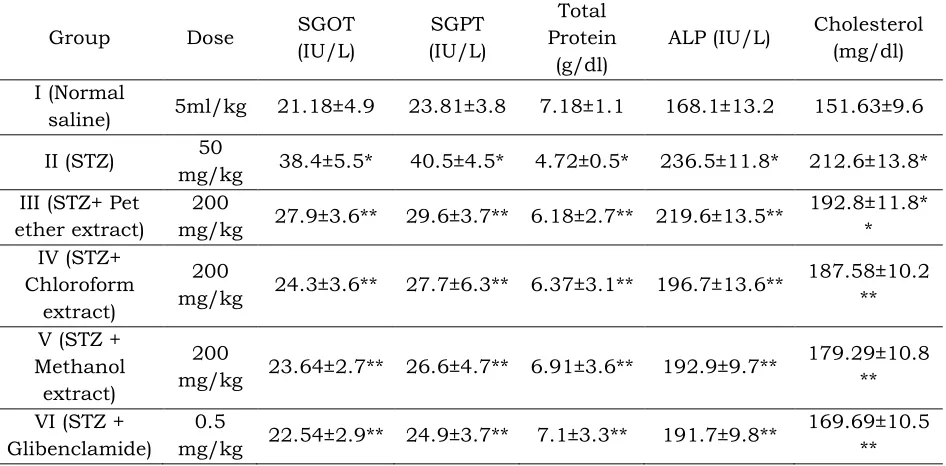
It has been well established that elevated levels of SGOT, SGPT and SALP are indicative
of cellular leakage and loss of functional integrity of the hepatic cell membranes
implying hepatocellular damage. [13] Serum total proteins on the other hand are related
to the function of the hepatic cells revealing the functional status of the hepatic cell.
Elevated serum cholesterol and triglyceride levels in STZ challenged rats indicated
impaired fat metabolism. Altered serum biochemical parameters in STZ-induced rats
were reported elsewhere. [9] The test extracts decreased the elevated serum enzyme
activities, cholesterol contents with elevation of total protein content in the STZ treated
rats which are comparable to the normal control group (Table 3).
Table: 1. Effect of A. catechu leaf extracts on fasting blood glucose levels.
Group Dose Day 0 Day 5 Day 10 Day 15
I (Normal Saline) 5 ml/kg 76.85±2.1 75.32±4.2 74.92±3.6 74.72±2.9
II (STZ) 50
mg/kg 278.54±9.2* 280.95±10.5* 285.73±11.4* 292.72±9.8*
III (STZ + Pet ether extract)
200
mg/kg 261.36±11.9 110.65±7.8** 91.45±1.6** 87.73±1.8**
IV (STZ + Chloroform
extract)
200
mg/kg 265.76±16.5 90.59±4.4** 83.58±3.2** 75.81±2.9**
V (STZ + Methanol extract)
200
mg/kg 271.53±10.3 93.45±3.7** 82.69±1.8** 74.92±2.6**
VI (STZ+ Glibenclamide)
0.5
mg/kg 279.53±13.3 95.45±2.8** 81.69±1.5** 72.91±2.4**
Values are expressed as mean ± SEM (n = 6); *p < 0.001 compared with saline control
15
Table: 2. Effect of A. catechu leaf extracts on body weight, liver weight and kidney weights.
Group Dose
Initial body wt
(g)
Final body wt (g)
I (Normal Saline) 5 ml/kg 179.76±7.8 183.54±5.2
II (STZ) 50 mg/kg 174.68±7.2 149.54±4.5*
III (STZ+ Pet ether extract) 200 mg/kg 165.54±4.2 150.72±2.9**
IV (STZ+ Chloroform extract) 200 mg/kg 169.41±5.2 151.94±1.8**
V (STZ + Methanol extract) 200 mg/kg 176.23±5.5 165.76±3.3**
VI (STZ + Glibenclamide) 0.5 mg/kg 178.53±4.5 169.76±3.6**
Values are expressed as mean ± SEM (n = 6); *p < 0.001 compared with saline control
and **p < 0.001 compared with STZ control group
Table 3: Effect of A. catechu leaf extracts on different serum biochemical parameters
Group Dose SGOT
(IU/L) SGPT (IU/L) Total Protein (g/dl)
ALP (IU/L) Cholesterol
(mg/dl)
I (Normal
saline) 5ml/kg 21.18±4.9 23.81±3.8 7.18±1.1 168.1±13.2 151.63±9.6
II (STZ) 50
mg/kg 38.4±5.5* 40.5±4.5* 4.72±0.5* 236.5±11.8* 212.6±13.8*
III (STZ+ Pet ether extract)
200
mg/kg 27.9±3.6** 29.6±3.7** 6.18±2.7** 219.6±13.5**
192.8±11.8* * IV (STZ+ Chloroform extract) 200
mg/kg 24.3±3.6** 27.7±6.3** 6.37±3.1** 196.7±13.6**
187.58±10.2 **
V (STZ + Methanol
extract)
200
mg/kg 23.64±2.7** 26.6±4.7** 6.91±3.6** 192.9±9.7**
179.29±10.8 **
VI (STZ + Glibenclamide)
0.5
mg/kg 22.54±2.9** 24.9±3.7** 7.1±3.3** 191.7±9.8**
169.69±10.5 **
Values are expressed as mean ± SEM (n = 6); *p < 0.001 compared with saline control
16
Preliminary phytochemical analysis revealed the presence of triterpenoids and steroids
in pet. ether extract; chloroform extract revealed the presence of alkaloids and
triterpenoids; metahnol extract revealed the presence of alkaloids, steroids, saponins,
tannins, glycosides and carbohydrates. The observed antidiabetic activity of all the
extracts may be due to mainly the presence of triterpenoid compounds.
In the present investigation, oral administration of pet ether, chloroform and methanol
extracts on 15 days continuous treatment to STZ-induced diabetic rats demonstrated
prominent reduction and normalization of elevated blood sugar levels i.e. anti
hyperglycemic or antidiabetic effect, comparing to respective control rats. The methanol
extract was most active followed by chloroform and pet. ether extracts. Therefore, it can
be concluded that the extracts of Areca catechu leaf possessed remarkably effective
antidiabetic potential against streptozotocin induced diabetes in Wistar rats. The
findings of the present study is encouraging enough to warrant further studies on this
pant in pursuit of a new oral hypoglycaemic agent.
REFERENCES
1. Vats R.K., Kumar V., Kothari A., Mital A., Ramachandran U. Emerging targets for
diabetes. Curr. Sci. 2000, 88: 241-247.
2. Weidmann P., Boehlen L.M., Courten M. Pathogenesis and treatment of
hypertension associated with diabetes mellitus. American Heart J. 1993; 125:
1498-1513.
3. Kokate C.K., Purohit A.P., Gokhale S.B. Pharmacognosy. 34th ed. Nirali Prakashan:
Pune; 2006.
4. Pithayanukul P., Nithitanakool S., Bavovada R. Hepatoprotective potential of
Extracts from Seeds of Areca catechu and Nutgalls of Quercus infectoria. Molecules
2009; 14: 4987-5000.
5. Shrestha J., Shanbhag T., Shenoy S., Amuthan A., Prabhu K., Sharma S., Banerjee
S., Kafle S. Antiovulatory and abortifacient effects of Areca catechu (betel nut) in
female rats. Indian J. Pharmacol. 2010; 42: 306-11
6. Khan S., Mehmood M.H., Ali A.N., Ahmed F.S., Dar A., Gilani A.H. Studies on
anti-inflammatory and analgesic activities of betel nut in rodents. J. Ethnopharmacol.
2011; 135: 654-61.
7. Kokate C.K. Practical Pharmacognosy. 4th Edition. New Delhi: Vallabh Prakashan;
17
8. Lorke D.A. A new approach to practical acute toxicity testing. Arch. Toxicol. 1983;
54: 275-287.
9. Biswas, M., Kar B., Bhattacharya S., Kumar R.B.S., Ghosh A.K., Haldar P.K.
Antihyperglycemic activity and antioxidant role of Terminalia arjuna leaf in
streptozotocin-induced diabetic rats. Pharm. Biol. 2011; 49: 335-340.
10.Lowry O.H., Rosebrough N.J., Farr A.L., Randall R.I. Protein measurement with the
folin-phenol reagent. J. Biol. Chem. 1951; 193: 265-272.
11.Mythili M.D., Vyas R., Akila G., Gunasekharan S. Effect of streptozotocin on the
ultra structure of rat pancreatic islets. Microscopy Res. Tech. 2004; 63: 274-281.
12.Kumavat U.C., Shimpi S.N., Jagdale S.P. Hypoglycemic activity of Cassia javanica
Linn. in normal and streptozotocin-induced diabetic rats. J. Adv. Pharm. Tech. Res.
2012; 3: 47-51.
13.Biswas M., Karan T.K., Kar B., Bhattacharya S., Ghosh A.K., Kumar R.B.S., Haldar
P.K. Hepatoprotective activity of Terminalia arjuna leaf against paracetamol-induced