Stanislava Kalafutova
1, A–D, F, Bozena Juraskova
2, 3, E, F, Jiri Vlcek
1, E, FThe Impact of Combinations
of Non-Steroidal Anti-Inflammatory Drugs
and Anti-Hypertensive Agents on Blood Pressure*
1 Department of Social and Clinical Pharmacy, Faculty of Pharmacy in Hradec Kralove, Charles Universityin Prague, The Czech Republic
2 Sub-Department of Gerontology, Faculty of Medicine in Hradec Kralove, Charles University in Prague,
The Czech Republic
3 3rd Clinic of Internal Medicine, Metabolism and Gerontology, University Hospital Hradec Kralove,
The Czech Republic
A – research concept and design; B – collection and/or assembly of data; C – data analysis and interpretation;
D – writing the article; E – critical revision of the article; F – final approval of article; G – other
Abstract
Nowadays NSAIDs are the most frequently used groups of drugs, especially because of their availability. Their consumption is high among older people, who are much more sensitive to the side effects, and who are often also taking other drugs which can interact with them. Moreover, the majority of the older population is suffering from hypertension. This could well explain the commonly encountered experience of drug interaction between NSAIDs and antihypertensive drugs, which is very common in clinical practice. The severity of this drug interaction is classified as class C, with a recommendation to monitor therapy. However, even a minor long-term increase in blood pressure can significantly increase the risk of cardiovascular mortality, while mortality rates can possibly be reduced by sufficiently effective treatment of hypertension. Therefore, in clinical practice, this type of interaction should not be overlooked as a major cause of failure of hypertension treatment in older patients, as well in many cases in general. The present article focusses on the mechanism and the degree of influence on the blood pressure of particular types of antihypertensive agents used in combination with NSAID. Not all groups of antihypertensive drugs are affected to the same degree; some are more affected, and others, such as calcium channel blockers, are not affected at all. Similarly, not every NSAID increases blood pressure. Many studies, some of which are analyzed in this article, present evidence of the degree of the influence NSAIDs have on blood pressure (Adv Clin Exp Med 2014, 23, 6, 993–1000).
Key words: antihypertensive drugs, non-steroidal anti-inflammatory drugs, blood pressure, hypertension.
Adv Clin Exp Med 2014, 23, 6, 993–1000 ISSN 1899–5276
REVIEwS
© Copyright by wroclaw Medical University
Hypertension is well known as one of the most common cardiovascular diseases. Approximately 690 m people around the world suffer from hyper-tension. It is one of the major risk factors causing arteriosclerosis, including atherogenic coronary artery disease in the form of ischemic heart dis-ease [1]. Hypertension affects the majority of peo-ple over 65 years of age, occurring in up to 60% of this population [2]. In most cases, it accounts for subsequent organ damage or many other manifes-tations of cardiovascular diseases [2, 3]. Adequate
treatment of hypertension is important especially in older populations, as has been confirmed by the HYVET study [4]. Moreover, older populations often experience pain, both chronic and acute. The use of different analgesics therefore becomes a reg-ular part of their lives. It should therefore be borne in mind that the treatment of hypertension may be significantly influenced by the concomitant use of other therapeutic classes.
The authors of this article focused on clari-fying the mechanisms of the influence on blood
merous group (83%) consisted of interactions with clinical seriousness level C, i.e. with a recommen-dation to monitor therapy. NSAID and antihyper-tensive drug interaction have been ranked in the first place in this group [5].
Pain in the Older Population
As mentioned above, hypertension therapy is of high importance in older patients. A diastolic blood pressure decrease of 5–6 mm Hg can lead to a 67% decrease in the risk of cerebral stroke and a 15% decrease in the risk of coronary heart dis-ease [6]. Sufficient hypertension therapy can lead to a significant decrease in the risk of cardiovascu-lar events in systolic-diastolic hypertension, as well as in isolated systolic hypertension, which is mark-edly more frequent in older patients [7]. Systolic blood pressure can be a more effective mortality predictor than diastolic blood pressure [8]. At the same time, pain in older patients is of serious con-cern, and since the size of this population is in-creasing, the consumption of analgesics has been constantly increasing. Analgesics are among the drugs most widely used on a long-term basis. An-tihypertensive agents and NSAIDs are used at the same time by at least 12–15% of older patients. The use of analgesics in self-medication of joint and back pain has increased from 28.5% to 41.5% in the last 10 years; in systematic target therapy 35.5% of patients were treated for joint pain and 38.5% for back pain [9]. NSAIDs are reported to consti-tute 57.5% of total pain management by pharma-cotherapy, acetaminophen 20.9 % and weak opi-oids 18.5%. Uncontrolled analgesic usage in by older patients significantly decreases their safe-ty [9]. Unprofessionally treated pain leads to se-vere problems or adverse effects (e.g., gastrointes-tinal bleeding; blood pressure elevation; impeded cognitive, renal and hepatic functions; and allergic reactions) [10]. These complications have been re-ported to occur in more than 25% of patients us-ing NSAIDs. Out of those patients, 10% had to be hospitalized due to adverse side effects [9]. Old-er patients are much more sensitive to the side ef-fects of NSAIDs and should therefore be treated with them carefully. They are also likely to be less cautious in their use of opioid substances in pain management, although fear of addiction to opi-oid substances in older age is often completely un-founded [11]. The risk of developing an addiction
The Role of Prostaglandins
in Blood Pressure
Regulation
Prostaglandins (PGs) play a key role in renal hemodynamics in the kidneys, in ion transport and in renal hormone synthesis. They maintain the bal-ance between hypertensive and antihypertensive mechanisms in the organism (Fig. 1). Thrombox-ane A2 (TxA2) and prostaglandin H2 (PGH2) are especially significant in hypertensive action. They have vasoconstrictive effects and decrease kidney blood flow. Prostacyclin (PGI2) and prostaglandin E2 (PGE2) counteract these effects, primarily due to their vasodilating effect, which leads to an elevation in blood flow [13]. PGI2 relaxes vascular smooth muscles and supports sodium secretion by lowering glomerular vascular resistance. PGE2 induces vaso-dilation, but eventually inhibits tubular reabsorption of sodium and chloride ions in the kidneys. It oper-ates as an antagonist of vasopressin (an antidiuretic hormone) in the collecting ducts, increasing water secretion [14–16]. PGs inhibit endothelin 1 synthe-sis, which increases blood pressure by increasing peripheral vascular resistance [17]. Besides these ef-fects, PGs also influence renin release, which conse-quently increases the synthesis of angiotensin II (a strong vasoconstrictor) and aldosterone (a hormone regulating water and sodium reabsorption in kid-neys) [13, 16]. NSAIDs suppress PG synthesis and can lead to a decrease in renin release, thereby caus-ing blood pressure to drop in some individuals [13]. However, in individuals who already have low renin levels (e.g. the elderly), the loss of PGI2- and PGE2- -mediated vasodilation may not be accompanied by any compensatory reduction in renin-mediated vasoconstriction [16].
The Combination
of NSAIDs and
Antihypertensive Agents
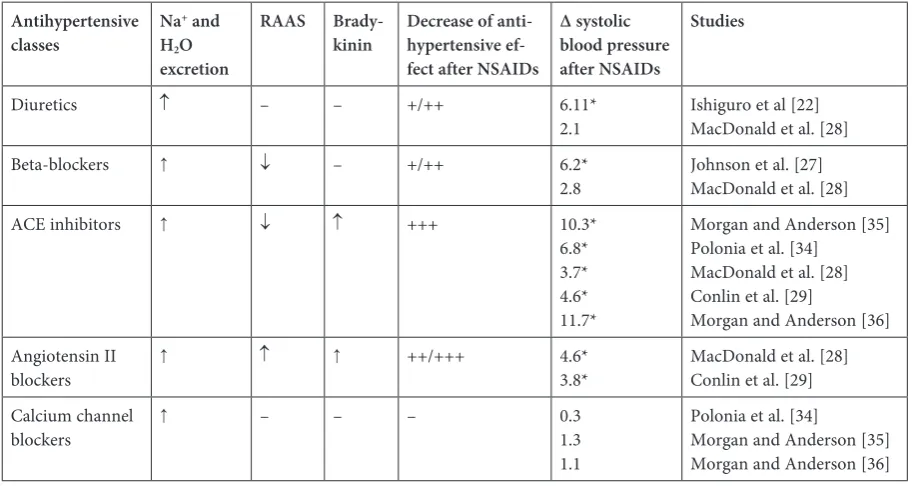
Drug interactions between NSAIDs and an-tihypertensive agents can lead to problems with blood pressure control in patients using both class-es of medication at the same time. Blood prclass-essure can increase by up to approximately 5.0 mm Hg in this group of older people. However, different classes of antihypertensive drugs are not influenced in the same way. The level of interaction between NSAIDs and antihypertensive drugs depends on how big a role PGs play in the mechanism of ac-tion of the antihypertensives [19, 20]. By influenc-ing PG synthesis, NSAIDs can limit their ability to regulate blood pressure. The probable sites and the relevance of action of NSAIDs on the mechanisms of action of the five main antihypertensive drug groups are presented briefly in Table 1.
Diuretics
There are two major classes of diuretics used in the treatment of hypertension: thiazide and loop diuretics. Both classes influence blood pressure by
decreasing extracellular water volume and the to-tal peripheral resistance. PG activity in the kid-neys supports and increases the effects of diuret-ics. NSAIDs decrease the effect of diuretics by inhibiting PG synthesis. As a result, the amount of secreted water and salts is lower [21]. This de-crease in diuretic effect has been proved in many studies investigating the usage of diuretics and NSAIDs [22–24]. The reduction of diuresis was es-pecially evident in older people [21].
Beta-Blockers
The mechanism by which beta-blockers (BBs) lower blood pressure is still not completely under-stood. It has been that some of the following may be involved: a reduction of cardiac output; effects on the central nervous system; inhibition of the renin– angiotensin–aldosterone system (RAAS); a reduc-tion in plasma volume, as well of vasomotor tone and peripheral vascular resistance; improvements in vascular compliance; resetting of the baro-re-ceptors, and other models of action [25]. NSAIDs can interfere with some of these mechanisms (Ta-ble 1) [21, 26]. Propranolol has also been found to stimulate PGI 2 synthesis in patients with essen-tial hypertension, and NSAIDs interfere with this
process in such a way that even the PGI 2 synthe-sis induced by propranolol will not prevent block-age of the BB antihypertensive effect [21]. Accord-ing to a meta-analysis carried out by Johnson et al., NSAIDs block the antihypertensive effect of BBs more significantly than diuretics do[27].
Angiotensin-Converting-
-Enzyme Inhibitors
Angiotensconverting-enzyme (ACE) in-hibitors induce vasodilation and decrease blood pressure by inhibiting angiotensin II and aldo-sterone production. If ACE is blocked by ACE inhibitors, bradykinin is not inactivated, which leads to further vasodilation and blood pressure decrease. Bradykinin enhances the antihyperten-sive effect of ACE inhibitors. It also stimulates the release of PGs, which play a key role in vasodila-tion. Thedecrease in blood pressure stimulated by bradykinin is crucial to the full effect of ACE in-hibitors. NSAIDs block vasodilation by inhibit-ing PGs, thereby significantly lowerinhibit-ing the anti-hypertensive effect of ACE inhibitors. This effect is more pronounced in hypertensive patients with lower renin levels, because the decrease in blood pressure caused by ACE inhibitors is induced pri-marily by influencing bradykinin [21, 26]. Because of this, the effect of ACE inhibitors is to a large extent dependent on PGs synthesis, which is why the influence of ACE inhibitors on blood pressure,
when administered in combination with NSAIDs, is very similar to the effect of angiotensin II block-ers[28, 29].
Angiotensin II Blockers
Angiotensin II blockers decrease blood pres-sure by blocking the receptor for angiotensin II type 1 (AT1). This mechanism leads to increased vasodilation and salt reabsorption [21], and to de-crease of aldosterone production [30]. It is impor-tant to note that there is no blockage of AT2 recep-tors in angiotensin II blockers. This fact probably plays an essential role in blood pressure regula-tion by causing a release of bradykinin and nitrous oxide (NO), which in turn also induces vasodila-tion. PG inhibition can inhibit the functioning of angiotensin II blockers [31], which are affected by NSAIDs at the same high level as ACE inhibitors are [28].
Calcium Channel Blockers
(CCBs)
CCBs, which are used in hypertension thera-py, do not significantly interact with NSAIDs [19]. Their antihypertensive effect is not dependent on the action of PGs [32]. CCBs specifically inhibit Ca2+ ion penetration through L-type
voltage-de-pendent calcium channels into vascular smooth
Diuretics ↑ – – +/++ 6.11*
2.1 Ishiguro et al [22]MacDonald et al. [28]
Beta-blockers ↑ ↓ – +/++ 6.2*
2.8 Johnson et al. [27]MacDonald et al. [28]
ACE inhibitors ↑ ↓ ↑ +++ 10.3*
6.8* 3.7* 4.6* 11.7*
Morgan and Anderson [35] Polonia et al. [34] MacDonald et al. [28] Conlin et al. [29]
Morgan and Anderson [36] Angiotensin II
blockers
↑ ↑ ↑ ++/+++ 4.6*
3.8* MacDonald et al. [28]Conlin et al. [29] Calcium channel
blockers
↑ – – – 0.3
1.3 1.1
Polonia et al. [34]
muscle cells, contractile and conducting myocar-dium cells. After administration, intracellular cal-cium concentrations decrease and the resulting ef-fect is a reduction in myocardial contractility and excitability, which reduces the myocardial meta-bolic demand of oxygen. The antihypertensive ef-fect is achieved through dilatation of arterioles and a consequent reduction in blood pressure [33].
The Influence of NSAIDs
on Blood Pressure Level
NSAIDs can be classified on the basis of their selectivity to cyclooxygenase (COX). Non-selec-tive NSAIDs inhibit both COX 1 and COX 2 iso-enzymes, while selective COX 2 NSAIDs only in-hibit isoenzyme COX 2 [17]. As mentioned above, not all NSAIDs influence blood pressure to an equal extent; they can be divided into one group with a stronger influence on blood pressure and another group with little or no influence. It has been assumed that the pro-hypertensive effect of NSAIDs is associated with sodium and fluid reten-tion [34]. Indomethacin, naproxen and piroxicam increase blood pressure more efficiently in com-parison with sulindac or aspirin [19, 32]. Sulindac has been shown to preserve the synthesis of PGs, which could explain why it has a lesser effect on blood pressure than indomethacin, piroxicam and naproxen, with which it has been compared [6].
In a prospective study, Pavličevič et al. observed 88 patients over 55 years old who were treated with antihypertensive agents. In the control group there were 17 women and 22 men, aged 68.5 ± 6.7 years. The patients were given either a combination of lisinopril/hydrochlorothiazide or amlodipine. In the intervention group, the patients were divided into 4 subgroups: 30% of the patients used lisin-opril/hydrochlorothiazide with ibuprofen; 28.6% used lisinopril/hydrochlorothiazide with piroxi-cam; 22.4% used amlodipine with ibuprofen; and 18.4% used amlodipine with piroxicam. The mean age in the intervention group was 69.8 ± 6.9 years. In the lisinopril/hydrochlorothiazide subgroup with piroxicam, the average systolic blood pres-sure increased by 14.1 mm Hg, and in the lisin-opril/hydrochlorothiazide subgroup with ibupro-fen, the average systolic blood pressure increased by 11.2 mm Hg. These results show that ibuprofen and piroxicam significantly elevated blood pres-sure in the group of patients with lisinopril/hy-drochlorothiazide in comparison with the control group, in which the blood pressure decreased by 0.1 mm Hg. The blood pressure elevation in the amlodipine group was very small (with piroxicam 1.7 mm Hg; with ibuprofen 2.4 mm Hg) compared
to the control group (0.2 mm Hg), and no signifi-cant correlation was confirmed [19].
wilson and Poulter [16] cited three studies in their review comparing the influence of indo-methacin on the ACE inhibitor enalapril and on calcium channel blockers such as nifedipine [34], felodipine [35] and amlodipine [36]. The results of these studies were very similar. In the study list-ed first, by Polonia et al. [34], eighteen random-ized patients were taking enalapril/indomethacin or nifedipine/indomethacin over a period of one week. In the enalapril/indomethacin group, the increase in blood pressure was 6.8 mm Hg, while in the nifedipine/indomethacin group it was only 0.3 mm Hg. In the second study, by Morgan and Anderson [35], 12 patients were randomized into a felodipine group and 15 patients into an enala-pril group. After 4 weeks of 100 mg of indometha-cin, there was a higher blood pressure increase in the enalapril group (10.3 mm Hg; p < 0.01) than in the felodipine group (1.3 mm Hg). The third study, also by Morgan and Anderson [36], in-volved 24 patients on enalapril and 26 patients on amlodipine randomized in the study. The pa-tients in both groups took 100 mg of indometha-cin for two weeks. A significant increase in blood pressure (11.7 mm Hg; p = 0.002) was noted in the enalapril group, whereas no significant increase (1.1 mm Hg) was noted in the amlodipine group. Significant blood pressure elevation was found in all the study groups with enalapril/indometha-cin, compared to all the groups with CCBs/indo-methacin, where blood pressure elevation was on-ly minimal.
The group of selective COX 2 NSAIDs has been compared with the group of non-selec-tive NSAIDs. According to a meta-analysis in 2005 [37], selective inhibitors of COX-2 (coxibs) caused a bit higher blood pressure elevation com-pared to non-selective NSAIDs. In the meta-anal-ysis, rofecoxib with a placebo, rofecoxib with a non-selective NSAID, celecoxib with a placebo, celecoxib with a non-selective NSAID and rofe-coxib with celerofe-coxib were compared. The increase in blood pressure was 5.66 mm Hg, 3.32 mm Hg, 2.60 mm Hg, 0.14 mm Hg and 2.83 mm Hg, re-spectively. This confirms the presumption that various levels of blood pressure elevation is a prop-erty of all NSAIDs.
ing a placebo, and a similar decrease was noted in the group using ibuprofen. Sulindac increased blood pressure by 2.2 mm, and acetylsalicylic ac-id increased it by 0.61 mm Hg. Patients with low-er salt intake sufflow-ered from blood pressure eleva-tion only after indomethacin and naproxen (more than 3.5 mm Hg); piroxicam increased blood pres-sure by only 0.45 mm Hg on average. Other sub-stances, like ibuprofen, placebo, sulindac and ace-tylsalicylic acid, showed an average arterial tension decrease. Pressure changes in the indomethacin group were significantly higher than in the sulin-dac group (p < 0.002), and they also differed from acetylsalicylic acid and placebo (p < 0.05) groups. Naproxen influenced blood pressure distinctly less when the patients’ salt intake was modified (from 6.1 to 3.7 mm Hg), but despite that it still notice-ably differed from ibuprofen, acetylsalicylic acid and sulindac (p ≤ 0.03).
In a meta-analysis by Johnson et al. [27], data from 50 randomized studies with 771 patients were processed. The findings observed in this study mir-ror those of the study outlined in the previous para-graph. The average blood pressure was increased by 5 mm Hg in patients using NSAIDs. Indomethacin and piroxicam led to marked increases; however, only piroxicam increased blood pressure to a sta-tistically significant degree (6.2 mm Hg). Ibupro-fen, tiaprofenic acid, diclofenac, naproxen, flurbi-profen, sulindac and acetylsalicylic acid let to only minor increases in blood pressure. Blood pres-sure elevation appeared in hypertonic patients on-ly. The effect of blood pressure elevation was more significant in normotensive patients using antihy-pertensive medications (hypertonic patients with sufficiently corrected hypertension) in compari-son with hypertensive people without any antihy-pertensive treatment or with healthy normotensive people (5.4 mm Hg vs. 2.5 mm Hg and 1.1 mm Hg, respectively).
study [39]. This double-blind randomized study included 404 patients who used 200 mg/day of ce-lecoxib or 25 mg/day of rofecoxib or 500 mg of naproxen twice a day for 12 weeks. The highest blood pressure increase was recorded in the ro-fecoxib group (3.7 mm Hg), followed by the cele-coxib group (0.3 mm Hg). Naproxen increased the blood pressure by 3.6 mm Hg.
Most of these studies did not directly target geriat-ric patients. However, a project by Johnson et al. [40] focused precisely on this group: 2805 non-institution-alized patients, all over 65 years old, took part. The study observed the use of NSAIDs and subsequent blood pressure values. The frequency of NSAID us-age was divided into groups according to us-age, gen-der, blood pressure and arthritis history. Of the total study population, 26% noted use of NSAIDs. In this group, 12% of the subjects were using NSAIDs and antihypertensive medications concurrently. In pa-tients using NSAIDs, hypertension occurrence was up to 1.4 times more frequent than in those who did not use them. It was found that in almost 29% of the subjects who were taking NSAIDs and antihyperten-sive drugs simultaneously, the hypertension could be attributed to the use of NSAIDs.
The authors concluded that when prescribing NSAIDs, physicians should not forget that their joint use with antihypertensive therapy leads to worsened blood pressure control. Both hyperten-sion occurrence and NSAID use increase with age, and older population are likely to be more predis-posed to blood pressure elevation owing to NSAID use. Potentially, this increase can be very serious because even a relatively slight elevation in blood pressure (less than 5 mm Hg) can contribute to an increase in the occurrence of infarctions or the risk of heart failure [21]. In cases where NSAID admin-istration is necessary, it is highly recommended to choose substances with a lower potential of influ-encing the patient’s blood pressure [6].
References
[1] Grundmann M, Kacířová I: Combination therapy for hypertension. Ambulantná terapia 2007, 5, 106–110.
[2] Cífková R: Hypertension in the elderly. Kap Kardiol 2012, 4, 9–13.
[3] Juszczyk Z: Systolic hypertension in older persons – Controversies and indications for treatment. Adv Clin Exp Med 2006, 15, 521–526.
[4] Beckett NS, Peters R, Fletcher AE, Staessen JA, Liu L, Dumitrascu D, Stoyanovsky V, Antikainen RL, Nikitin Y, Anderson C, Belhani A, Forette F, Rajkumar C, Thijs L, Banya W, Bulpitt CJ, HYVET Study Group: Treatment of hypertension in patients 80 years of age or older. N Engl J Med 2008, 358, 1887–1898.
[6] Johnson AG: NSAIDs and blood pressure. Clinical importance for older patients. Drugs Aging 1998, 12, 17–27.
[7] Frishman WH: Effects of Nonsteroidal Anti-Inflammatory Drug Therapy on Blood pressure and Peripheral Edema. Am J Cardiol 2002, 89, 18–25.
[8] Halawa B: Unresolved problems in hypertension treatment. Adv Clin Exp Med 2001, 10, 115–119.
[9] Vondráčková D: Treatment of pain in elderly patients. Čes Ger Rev 2004, 1, 28–36.
[10] Armstrong EP, Malone DC: The impact of nonsteroidal anti-inflammatory drugs on blood pressure, with an emphasis on newer agents. Clin Ther 2003, 25, 1–18.
[11] Vondráčková D: Treatment of nonmalignant pain in geriatric patients opioids. Čes Ger Rev 2008, 6, 103–108.
[12] Auret K, Schug SA: Underutilisation of opioids in elderly patients with chronic pain: approaches to correcting the problem. Drugs Aging 2005, 22, 641–654.
[13] Nasjletti A: Arthur C. Corcoran Memorial Lecture. The role of eicosanoids in angiotensin-dependent hyperten-sion. Hypertension 1998, 31, 194–200.
[14] Schlondorff D: Renal complications of nonsteroidal anti-inflammatory drugs. Kidney Int 1993, 44, 643–653.
[15] Smith MC, Dunn MJ: The role of prostaglandins in human hypertension. Am J Kidney Dis 1985, 5, 32–39.
[16] Wilson SL, Poulter NR: The effect of steroidal anti-inflammatory drugs and other commonly used non-narcotic analgesics on blood pressure level in adults. J Hypertens 2006, 24, 1457–1469.
[17] Gaziano JM: Nonnarcotic Analgesics and Hypertension. Am J Cardiol 2006, 97, 10–16.
[18] Zadražil J: Nonsteroidal antiinflammatory drugs and the kidney. Vnitř Lék 2006, 52, 7–8.
[19] Pavlicević I, Kuzmanić M, Rumboldt M, Rumboldt Z: Interaction between antihypertensives and NSAIDs in primary care: a controlled trial. Can J Clin Pharmacol 2008, 15, 372–382.
[20] Hersh EV, Pinto A, Moore PA: Adverse drug interactions involving common prescription and over-the-counter analgesic agents. Clin Ther 2007, 29, 2477–2497.
[21] Ruoff GE: The impact of nonsteroidal anti-inflammatory drugs on hypertension: alternative analgesics for patients at risk. Clin Ther 1998, 20, 376–387.
[22] Ishiguro C, Fujita T, Omori T, Fujii Y, Mayama T, Sato T: Assessing the effects of non-steroidal anti-inflam-matory drugs on antihypertensive drug therapy using post-marketing surveillance database. J Epidemiol 2008, 18, 119–124.
[23] Favre L, Glasson P, Riondel A, Vallotton MB: Interaction of diuretics and non-steroidal anti-inflammatory drugs in man. Clin Sci (Lond) 1983, 64, 407–415.
[24] Herchuelz A, Derenne F, Deger F, Juvent M, Van Ganse E, Staroukine M, Verniory A, Boeynaems JM, Douchamps J: Interaction between nonsteroidal anti-inflammatory drugs and loop diuretics: modulation by sodi-um balance. J Pharmacol Exp Ther 1989, 248, 1175–1181.
[25] Mason RP, Giles TD, Sowers JR: Evolving mechanisms of action of beta blockers: focus on nebivolol. J Cardiovasc Pharmacol 2009, 54, 123–128.
[26] Whelton A: Nephrotoxicity of nonsteroidal anti-inflammatory drugs: physiologic foundations and clinical impli-cations. Am J Med 1999, 106, 13–24.
[27] Johnson AG, Nguyen TV, Day RO: Do nonsteroidal anti-inflammatory drugs affect blood pressure? A meta-analysis. Ann Intern Med 1994, 121, 289–300.
[28] MacDonald TM, Richard D, Lheritier K, Krammer G: The effects of lumiracoxib 100 mg once daily vs. ibupro-fen 600 mg three times daily on the blood pressure profiles of hypertensive osteoarthritis patients taking different classes of antihypertensive agents. Int J Clin Pract 2010, 64, 746–755.
[29] Conlin PR, Moore TJ, Swartz SL, Barr E, Gazdick L, Fletcher C, DeLucca P, Demopoulos L: Effect of indo-methacin on blood pressure lowering by captopril and losartan in hypertensive patients. Hypertension 2000, 36, 461–465.
[30] Oral I: Medicaments reducing the effectiveness of antihypertensive drugs. Klin Farmakol Farm 2004, 18, 22–25.
[31] Schmieder RE: Mechanisms for the clinical benefits of angiotensin II receptor blockers. Am J Hypertens 2005, 18, 720–730.
[32] Salort-Llorca C, Mínguez-Serra MP, Silvestre-Donat FJ: Interactions between ibuprofen and antihypertensive drugs: incidence and clinical relevance in dental practice. Med Oral Patol Oral Cir Bucal 2008, 13, 717–721.
[33] Perlík F, Lincová D, Fendrich Z: Substances affecting the cardiovascular and renal systems. In: Basic and Applied Pharmacology. Second, supplemented and revised edition. Eds.: Lincová D, Farghali H, Galén Prague 2007, 2nd ed.,
219–269.
[34] Polónia J, Boaventura I, Gama G, Camões I, Bernardo F, Andrade P, Nunes JP, Brandão F, Cerqueira-Gomes M:
Influence of non-steroidal anti-inflammatory drugs on renal function and 24h ambulatory blood pressure-reduc-ing effects of enalapril and nifedipine gastrointestinal therapeutic system in hypertensive patients. J Hypertens 1995, 13, 925–931.
[35] Morgan T, Anderson A: Interaction of indomethacin with felodipine and enalapril. J Hypertens 1993, 11, 338–339.
[36] Morgan T, Anderson A: The effect of nonsteroidal anti-inflammatory drugs on blood pressure in patients treated with different antihypertensive drugs. J Clin Hypertens (Greenwich) 2003, 5, 53–57.
[37] Aw TJ, Haas SJ, Liew D, Krum H: Meta-analysis of cyclooxygenase-2 inhibitors and their effects on blood pres-sure. Arch Intern Med 2005, 165, 490–496.
Address for correspondence:
Stanislava Kalafutova
Faculty of Pharmacy in Hradec Kralove Department of Social and Clinical Pharmacy Heyrovskeho 1203
500 05 Hradec Kralove The Czech Republic Tel.: +420 495 067 486
E-mail: [email protected]
Conflict of interest: None declared