French, M. 2014. Gaps in the gaze: Informatic practice and the work of public health surveillance.
Martin French
Concordia University, Canada. [email protected]
Abstract
Many works that may be situated within the interdisciplinary field of Surveillance Studies have described dangerous potentialities associated with the pervasive, IT-mediated merger of once discrete data sets. In effect, these works cautioned about the rise of “big data” before it was named as such. Even so, they share an uncomfortable consonance with euphoric claims about the revolutionary transformation portended by big data. Situating both euphoric and critical accounts of the IT-mediated gaze within a larger informatic ethos—a spirit in the Weberian sense of this term, defined above all by its concealment of the labor that makes IT work—this article argues that discourse on the data-driven, information revolution must be supplemented by a more modest discourse empirically rooted in the everyday, pragmatic realities of IT. Where it departs from well-established social scientific analyses of IT, however, is in its development of a novel concept: informatic practice. Informatic practice may be defined as the sum of labor or activity that materializes information, including, for instance, such mundane activities as data entry. To empirically illustrate some complexities associated with informatic practice, this article discusses process challenges associated with the implementation of a large-scale (or “big”), regionally interconnected public health information system in Ontario, Canada. Informed by science and technology studies (STS) and actor-network theory (ANT), it uses documentary evidence and interviews with 38 key informants to describe informatic practice and to illustrate the mutations—the natural change—introduced into the IT-mediated gaze by everyday, material practices. This complicates both critical and euphoric claims about big data.
Introduction
A big-data revolution is under way in health care. Start with the vastly increased supply of information. Over the last decade, pharmaceutical companies have been aggregating years of research and development data into medical databases, while payors and providers have digitized their patient records. Meanwhile, the US federal government and other public stakeholders have been opening their vast stores of health-care knowledge, including data from clinical trials and information on patients covered under public insurance programs. In parallel, recent technical advances have made it easier to collect and analyze information from multiple sources—a major benefit in health care, since data for a single patient may come from various payors, hospitals, laboratories, and physician offices.
(Kayyali et al. 2013: 1).
Talk of a “big data revolution” has become ubiquitous, suggesting the prominence and prevalence of imaginaries associated with this “next big thing” in the decades-old ethos that celebrates the wonders of information technology (IT). As the above quotation illustrates, the big data revolution is supposed to be borne of apparently novel capacities to merge once discrete data sets, thereby creating vast stores of knowledge. Overlooked in such propositions, however, is a long-standing axiom of computer science:
garbage in, garbage out. What this pithy formulation points to, and what discourse on the big data revolution seems to consistently overlook, is the complex socio-technical reality associated with getting data into the multiple data sets that big data analytics are meant to process.
Discourse on the big data revolution is not the only place one discovers a de-emphasis of the complexities, work processes, and material realities that make up databases. Indeed—and surprisingly—the field of Surveillance Studies has developed in ways that share an uncomfortable consonance with euphoric discourse on big data. The powers of the IT-mediated gaze are front and center; meanwhile, far less attention has been paid to its gaps, cracks, and blind spots. Foundational works emphasize the potentialities of “computer matching” (Lyon 1994: 9-11) and the emergence of a “surveillant assemblage” that manifests “the desire to bring systems together, to combine practices and technologies and integrate them into a larger whole” (Haggerty and Ericson 2000: 610). This increasing melding of “different sorts of surveillance” is said to create an “intensification” (Ball and Webster 2003: 2) of the gaze. These generative analyses have been important for helping to motivate and frame Surveillance Studies. Yet, following Smith (2014), I argue in this article that the field is in need of complementary approaches to the study of surveillance, ones that foreground the mundane and messy everyday work of surveillance and which leave open the possibility of acknowledging practice-based mutations in the IT-mediated gaze. Mutations change the gaze, perhaps with intensifying effects, but perhaps also with effects that can occlude and obfuscate the phenomena under scrutiny.
As a way of attending to mutations in the IT-mediated gaze, this article advances the concept of informatic practice. This concept signifies the sum of everyday activity, by assemblages of humans and non-humans, that makes information a material reality in quotidian life—it describes the work of scrawling a pencil across paper, the function of booting up a laptop, the artful composition of characters in a free-text field, the writing of data to discs, the transit of signals through a network, and a great deal of other everyday practices that cause information to manifest. To play on a millennial turn of phrase, informatic practice is what animates the “social life of information” (Brown and Duguid 2000).
In contemporary discourse on IT, the work of informatic practice is routinely overlooked. To help explain why, I posit a generalized ethos—let’s call it the spirit of informationization, or the informatic ethos (cf. Castells 2000)—in which it has become commonplace to disattend to the everyday labor that makes IT work. With reference to health IT, it is possible to speak of the spirit of informationized health—an ihealth ethos (cf. Andrejevic 2007)—which hides the labor of informatic practice that health systems perform. The ihealth ethos is not dissimilar from that ethos famously described by Max Weber (1904/1958) as “the spirit of capitalism,” which hid labor by transforming it at the level of signification from a means into an end in itself. What distinguishes the ihealth ethos, though, is its symbolic assimilation of the work of health professionals, patients, organizations and non-human actors to the utopic province of technology. Health IT, for example, is commonly conceptualized as a labor-saving intervention, a means of rationalizing and simplifying informatic practice. It is supposed to reduce “small-area variation” (Wennberg and Gittelsohn 1973) and render insignificant the undulations of everyday, locally situated work. Yet this conceptualization ignores how health IT—especially “big” health IT—can founder in complex public health and medical care settings. It ignores health IT’s potential to amplify, instead of reduce, complexity (Tsoukas 1997).
process challenges associated with IT-mediated public health surveillance. This presentation draws from semi-structured interviews with 38 key informants working in public health in Ontario, and it makes pragmatic observations for future health IT implementation efforts. Fourth, I conclude by calling for greater attention to informatic practice in Surveillance Studies.
Methods
Data informing this article were gathered as part of a larger study, funded by the Social Sciences and Humanities Research Council of Canada (Grant # 767-2004-2022). The aim of the study was to examine transformations in Ontario’s public health system following the 2003 epidemic of Severe Acute Respiratory Syndrome (SARS). Informed by a Surveillance Studies (Lyon 2007) perspective, and by the sociology of public health surveillance (Mykhalovskiy and Weir 2006; Weir and Mykhalovskiy 2010), the study asked: how does public health surveillance function in Ontario and (how) has it changed post-SARS?
In Canada, public health refers to an institution that is related to, yet organizationally distinct from, primary (general practice) and secondary (hospital-based) medical care. For example, in Ontario this institution is composed of 36 public health units (PHUs), which are dispersed across the province. PHUs provide a range of services, including public health surveillance, which has been defined as “the tracking and forecasting of any health event or health determinant through the continuous collection of high-quality data, the integration, analysis and interpretation of those data into surveillance products (for example reports, advisories, alerts, and warnings), and the dissemination of those surveillance products…” (NAC 2003: 92; see also French 2009).
To focus empirical investigation, a review of relevant literature was undertaken, including an examination of post-SARS policy literature relating to the provincial-level organization of medical care and public health systems (e.g. EPS 2004; SARS Commission 2006). The project underwent ethics review by the Queen’s University IRB (Kingston, Canada). Following completion of the review process, an interview-based inquiry was undertaken. Between December 2005 and January 2008 I conducted 64 semi-structured, key-informant interviews; the case study presented in this article concentrates on a subset of 38 interviews with Ontario public health professionals, including medical officers of health, epidemiologists, managerial staff, and public health nurses. These participants were drawn from a sample frame covering all of Ontario’s PHUs.
Participants were identified by calling each PHU, and through chain-referral sampling. I sought key informants who could describe public health surveillance at local and provincial levels. Participants were ultimately recruited from 19 of Ontario’s 36 different PHUs. Interviews were conducted by phone and lasted an average of 30 minutes. Interviews were transcribed verbatim and transcripts were member-checked.
Informed by ANT (e.g. Law 2004) and grounded theory (e.g. Charmaz 2001), I coded transcripts for emergent themes related to surveillance and health IT. Data were organized into thematic memos, which were then examined for common subthemes. Subthemes highlighted herein relate to (i) work, (ii) coordination (iii) training, and (iv) discretion, all of which highlight challenges associated with informatic practice.
A critique of ihealth: Bringing informatic practice back into view
Health IT is commonly envisioned as a catalyst for revolutionary change. For example, shortly after the World Health Assembly passed the 2005 eHealth resolution, the (then) director of The World Health Organization’s (WHO) eHealth strategy argued that health IT could help “bypass” economic, social and scientific blockages by initiating a movement away from treatment- and hospital-based systems towards prevention- and home-based systems. Interlocking with long-standing neo-liberal notions involving the “offloading” of “duties of monitoring onto the populace” (Andrejevic 2005: 482), this vision rested upon IT-enabled citizens “managing their own health” (Healy 2007: 2). It is in line with the contemporary scholarly interest in exploring how health IT could “transform health care” in “poor and low-income countries” (Dentzer 2010: 229), thereby ostensibly negating the effects of vast inequities in the global distribution of wealth.
In public health, the widespread diffusion of “do-it-yourself information gathering technologies” (Andrejevic 2005: 489) has prompted calls for the development of new organizational forms and competencies that can take advantage of “novel streams of information” (Kahn et al. 2010: 1241) that might arise as citizens use IT to manage—or at least communicate about—their health. Commonly bound up with an anxiety about the “pandemic potential” of health events, such calls often evoke pre-emptive ideals and appeal to the miracle of technology as a way of realizing these ideals (French and Mykhalovskiy 2013).
The broad diffusion of IT can have, no doubt, transformational consequences for the organization of medical care and public health. However, my sense is that this diffusion is accompanied by a style of commentary, which, within the ihealth ethos, has achieved critical mass. Accordingly, my argument is that this style of commentary now needs to be supplemented by a more modest discourse empirically rooted in everyday, pragmatic aspects of IT, and specifically focused on the immense “remainder” (de Certeau 1984/1988: 61) constituted by informatic practice. To illustrate this argument I will use an example from Ontario that shows how ihealth obscures from view the crucial, everyday work that makes health IT function. Then, drawing from STS and ANT, I will insist that this informatic practice be brought back into view. This two-fold analysis will highlight the problematic assumptions of ihealth.
We might think of ihealth as a culturally and discursively constituted ethos, a mix of competing desires and rationales that evince certain “elective affinities”—or “correlations”—between prevailing beliefs and their consequent effects (Weber 1909/1958: 91). Using this classic sociological framing, it is apparent that one prevailing belief in particular—which is prevalent in information societies more generally—is especially problematic. This belief holds electronically mediated information to be immaterial, that is, without materiality (Hayles 1999). As a consequence, the material practices that call information into being are largely ignored.
For this reason, the belief that information is immaterial is incompatible with the study of informatic practice. The concept of informatic practice is based upon the assumption that information has a material basis in the spatio-temporal milieu of everyday life. In addition, the concept assumes that information is only ever manifest in the course of some modality of practice, whether undertaken by humans or non-humans. Before justifying these claims in greater detail, however, let me return to my critique of the ihealth ethos and to the illustration of what is lost when informatic practice is overlooked.
Ontario’s ihealth ethos
Ontario’s health information ecology (which sets the backdrop for the case study that I will subsequently present), is both expansive and profoundly complex. It spans organizations, geography, and professions. Consistent with other tangled IT ecologies, its jungle-like nature has inspired considerable efforts towards tighter integration, streamlining, and interconnectivity (Monteiro 2003). One such effort, a 2004 information management survey undertaken by Ontario’s MOHLTC, mapped health system information flows. It conducted research to identify how information is collected, where it is stored, who has access to it, who makes decisions based on it, and how it moves between databases. On the basis of this research, “a more organized, efficient, and ultimately more sustainable way of managing health information…” was proposed (MOHLTC 2006).
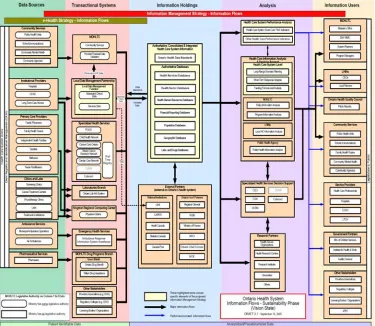
The Ministry’s research illustrates both the struggle that organizations face in their efforts to disentangle and clean up information ecologies and the hopeful (yet problematic) beliefs that underpin this struggle. Below I present two very different diagrammatic representations of health information flows. The first representation, Figure 1, evokes information in its most idealized form—it discloses a desired end product, the goal towards which reforms in information management were directed.
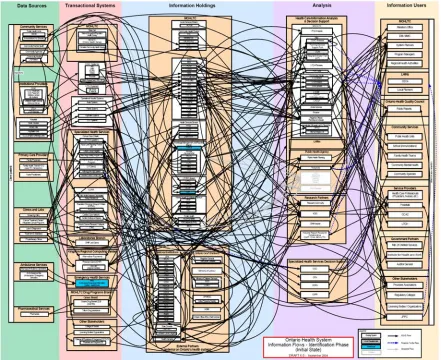
Note the orderly and seemingly rational nature of Figure 1. Note, also, the streamlined arrows indicating desired data trajectories from frontline data sources (on the left) to decision-making information users (on the right). This informatic ideal was born of an engagement with the complex reality of Ontario’s health information ecology, which is represented by Figure 2, below. Illustrating the Ministry’s 2004 audit-findings, Figure 2 suggests a marked contrast between the simplified ideals of the ihealth ethos, and the complex meshwork of information flows and informatic practice that characterizes actual health information ecologies.
Figure 2. Source: (MOHLTC 2004a) © Queen’s Printer for Ontario
The story told by the juxtaposition of Figure 1 and Figure 2 is about the complexity of informatic practice and the attempts of organizations to clean up, contain, and rationalize that complexity. When this complexity is swept from view (Figure 1), so too is the labor that makes information move. However, when the complexity is retained (Figure 2), this work is easier to fathom. Moreover, the ecology depicted in Figure 2, while perhaps appearing inefficient by contrast with Figure 1, may derive value from its complexity. For example, is the ecology idealized by Figure 2, with its multiple redundancies, more resilient than the ecology idealized by Figure 1? Such questions are out of place in the ihealth ethos, which disattends to (the value of) everyday informatic practice.
Informatic practice as a critique of the ihealth ethos
everyday practice. This tradition has diverse disciplinary origins in philosophy and social theory, sociology, and anthropology. Drawing on approaches that investigate how “the contours of material and human agency reciprocally constitute one another” (Pickering 2001: 164), especially research informed by ANT and STS (Latour 2005; Law and Hassard 1999), the concept of informatic practice is meant to grasp the material nature of information as instantiated by human-infrastructural assemblages in everyday practice.
As noted, informatic practice describes the activity that materializes information in everyday contexts. To understand information in this way is to break with prevailing beliefs that immaterialize electronic, IT-mediated information. Practice-based approaches to IT are not novel (Hanseth et al. 2004; Orlikowski 2007), though their application to information itself is still nascent (however see Leonardi 2010). To take a practice-based approach to information itself is to conceptualize it as something that—far from being transcendentally given—must be actively cultivated and nurtured by people, organizations, and their socio-technical actor-networks.
Thus, the common conceptualization of health information in the ihealth ethos, when seen through the lens of informatic practice, is poorly formulated. In order to recuperate the complexity and materiality of health information in this ethos, empirical studies of informatic practice are needed. This work can, of course, build on numerous excellent STS- and ANT-informed examinations of health IT (e.g. Aarts et al. 2010; Adams and Berg 2004; Berg 1997; Coiera 2007; Greenhalgh and Stones 2010; Jensen 2005; MacPhail forthcoming; Moser 2005; Oudshoorn 2011; Oudshoorn and Pinch 2005; Winthereik 2003) and to a lesser extent on research into data quality and management (e.g. Herzog et al. 2007; Redman 1996). However, it must also push beyond the analysis of organizations and technology-in-practice to examine the organization of information-in-practice, its complex materiality and multiplicity. As Moser and Law observe, amidst the widespread and utopian rhetorics promoting health IT, there has been a dearth of attention to the complexity of health information. Consequently, they argue, there is a pressing need to think about its “variable role” (2006: 57).
Moser and Law advance the idea that health information is fluid, open, uncertain, and in process—it “needs to change its shape and re-form itself as it moves around” (2006: 58). Understanding this fluidity requires close attention to informatic practice, to the changing hybridities produced by the (re)combination of information, technology, and users in the context of everyday practice. This means, for example, attending “to the humble tasks of filling out forms” (Bowker and Star 1999: 65), to the mundane, taken-for-granted, and often “invisible” everyday work that makes health IT function (Star and Strauss 1999). It also means attending—in addition to human-human and human-machine interactions—to machine-machine interactions, to protocols, code, and network control (Galloway 2001). And it means attending to the evolution of health information within these metastable interactional relations. By looking at health information in this way, it is possible to glean important divergences between how health IT is supposed to operate and how it actually operates.
ready to hand. As will become apparent in the following discussion, such analysis is necessary if we are to understand, and engage with, the duration and materiality of information, the natural change of information that necessarily mutates the IT-mediated gaze.
Informatic practice as “objectual” practice
The preceding discussion of informatic practice, which argues for an everyday approach to the materialization of information, corresponds to an ontology of information. A complete articulation of this ontology is beyond the scope of the present analysis; however, suffice it to say that this is an ontology that embeds information in practice relations. In other words, it is an ontology that only grants information status as a phenomenon in the world if it is characterized as a form of process or practice, as an object (for lack of a better term) that unfolds in time and space. This militates, at the level of ontology, against suppositions that would hold information apart from the assemblage of actors that produces it, apart, in other words, from the real, material world.
To illuminate the pragmatic implications of this ontology, it will be helpful to draw from Knorr Cetina’s (2001) discussion of “objectual practice.” As she argues, scholarship on practice has largely focused on the specification of rules, habits, and other identifiable schemata that might be said to guide practice. However, there is a need, also, to consider practices that are other than habitual, practices that reflect the kind of continual innovation, as might occur, for example, while trying to learn something in the context of a scientific experiment. Of course there are routines and habits, but there is also non-linearity and serendipity, which transforms both the object of inquiry and the learner/observer/subject.
Thus, objectual practice describes not a Kantian object-in-itself, but rather an object-in-practice. These objects are characteristically complex, open, and unfolding. “They are processes and projections rather than definitive things”—they are “always in the process of being materially defined” and “can never be fully attained” (2001: 181).
Borrowing from Knorr Cetina, I want to assert that information is always in “the process of being materially defined”—taking this ontological proposition seriously means refusing to grant transcendental status to information, refusing, in other words, to conceive of data sets, databases, information holdings, and other aggregations of information as static bases upon which to erect evidentiary claims. Instead of thinking of these informational aggregations as the bedrock of big data, they would be better conceptualized as shifting sands. To illustrate this claim, and to show how informatic practice problematizes ihealth’s prevailing beliefs, I present, below, a case study of a big, IT-mediated public health information system.
Mutations in/under an IT-mediated surveillant gaze
Discourse on IT-mediated public health surveillance is furnished with several ihealth-inspired expressions—an early instance appears in the 1994 epidemiology text, Principles and Practice of Public Health Surveillance. In a chapter entitled “Computerizing Public Health Surveillance Systems,” the authors depict a utopic vision for 21st century epidemiology, lauding the apparent capacity of health IT to thin the “herd of clerks” (Dean et al. 1994: 206). As is evident in such formulations, the hope is that health IT will reduce human labor.
with surveillance infrastructure. In Ontario, where SARS was most prevalent in Canada, the provincial government faced significant pressure to rapidly develop such surveillance infrastructure. During 2005, it spent $25 million to implement the integrated Public Health Information System (iPHIS) province-wide. It was hoped that this infectious disease case management system would also effectively function as a real-time surveillance system. By 2007, however, government officials were reporting problems related to an underestimation of the “complexity of the project”: those responsible for disease surveillance, for instance, “could not rely on iPHIS data because it was inconsistent and incomplete” (AG 2007: 293).
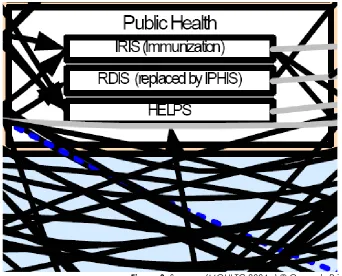
The case of iPHIS exemplifies precisely what’s problematic with ihealth—in hiding the complexity of informatic practice, it fosters health IT that can as easily hinder as help public health professionals. Recall Figure 2, presented above. It depicts a complex information ecology; yet at the level of individuated systems, pristine, white boxes blot out informatic practice. This is easily visible in Figure 3, which magnifies a portion of Figure 2.
Figure 3. Source: (MOHLTC 2004a) © Queen’s Printer for Ontario
Figure 3 corresponds to the public health information ecology. I will now open up and explore informatic practice within a sub-system of this ecology, here designated by the “RDIS (replaced by iPHIS)” box. This exercise will demonstrate that the entanglement of data flows linking the blocks, so nicely displayed in Figure 2, is mirrored by a further level of entanglement that holds together the block itself.
From RDIS to iPHIS
This meant that outbreak notification was hopelessly post-facto. Ontario implemented iPHIS, in part, to try to remedy these limitations.
iPHIS is/in practice
A number of my informants were proponents of iPHIS, feeling that it was a considerable advance over RDIS. Still, much of its potentiality went unrealized because, as I will illustrate, iPHIS was a singular system in name only. Mol (2002/2005) has convincingly argued that the body given us by biomedical practice is “multiple.” Berg and Bowker (1997) develop this idea with respect to the medical record. We might add to this formulation the idea that the database, which houses the record, is also multiple. In practice, at least, iPHIS proved to be a multiplicity of systems, more a loosely coordinated network of access and data-entry patterns than a monolithic or singular piece of health IT.
As we shall see, had the multiplicity of iPHIS been more fully appreciated from the start, it might have been possible to head off some of the process challenges described below. Yet, a caveat is necessary here too: the study of informatic practice does not necessarily yield easy pronouncements about the success or failure of a system. It differs from typical evaluation research (e.g. PHAC 2004; Klaucke 1992; see also Ammenwerth and Shaw 2005) in that it does not confine analysis to the question of whether or not a system met its stated objectives. Instead, the focus on practice sheds light on the circumstances under which systems are judged to succeed or fail. From this perspective, it is comprehensible that, while iPHIS was judged by some users to have been a failure, others saw it as a success. What follows, therefore, is not a description of a failed system per se, but a presentation of some consequences associated with the persistent undervaluation of informatic practice. The focus will be on (i) work, (ii) coordination, (iii) training, and (iv) user discretion. Core pragmatic observations will then be raised before making concluding remarks.
IT takes work
Numerous factors made iPHIS into a multiplicity, including the way its architecture accorded users different access based on their different roles in the system. For instance, nurses would have access to the results of the laboratory diagnosis of their patients while epidemiologists would not. Or again, a nurse working in a sexual health clinic might only have access to the STI module of iPHIS, and not the respiratory infection module. An epidemiologist might have access to both of these modules, but only the reporting end (and not the clinical end). Hence, although the term iPHIS suggests a single database, the database is itself multiple because of the structural differences amongst users plugged into the system. This form of modulated access ostensibly increases the possibility for patient confidentiality; however, it can also make data access difficult (for instance where an epidemiologist might like to examine how clinical variables relate to disease). Such barriers result in local modifications and “informal work-arounds” (Bowker and Star 1999: 54). Indeed, at the PHU level, the demands of iPHIS provoked a wide range of organizational responses.
As noted, it was hoped that, in addition to being an effective case-management tool, iPHIS would enable real-time surveillance. To explain this hope, a program manager I interviewed contrasted iPHIS with the system it replaced (RDIS):
So it’s [iPHIS] good that way, because right now, if I went in, and entered a client, and they had salmonella, I would be able to see, you know, where else salmonella had been detected, and have a better idea. So that’s a good thing. The fact that it’s what we call quote real-time—that’s a very loosely used term because it is supposedly real-time—those issues should be able to be spotted more quickly than they used to be in RDIS, because RDIS was not done in real-time.
The key factor enabling iPHIS to aspire towards this real-time ideal is its attempt to unite data-entry work with frontline service delivery. As imagined by designers, nurses would put information directly into iPHIS as they dealt with their clients on a case-by-case basis. This, in turn, could enable more rapid detection of outbreaks.
A nurse I interviewed described how this labor process would work in the context of an HIV test. I asked what kind of information would be kept in my file if, for example, I had a reactive test. She replied:
I 20: In your file? Meaning your file on iPHIS, or the paper file that we keep?
MF: The paper file. I guess this would be a bit different, right? If you’re managing a case you need to have a bit more comprehensive information?
I 20: Yes, and we do progress notes. For every contact that I make with you, or with your physician, I would collect progress notes. And then […] your demographic information, your treatment info, sexual contacts, symptoms, reason for your testing, your physician information, risk factors… Anything that we enter into iPHIS is on a form, we actually have a form that we use to collect all of the information needed for iPHIS entry, and we don’t collect any more than that, just what’s on our form. And then we enter that exact information into the system, except for the progress notes.
Though this nurse preferred iPHIS to RDIS because it gave her access to information beyond her catchment area (for example, if her client had been previously diagnosed with an STI in another catchment area, thus potentially indicating a need for more intensive behavioral interventions), she noted that it also took more time to use.
Echoing the observation that iPHIS took more time, the program manager quoted above observed: “Well, there is certainly more work to it [iPHIS] than we were ever led to believe. It’s been much more time intense, and resource intense” (I22). Moreover, this led to a tension between the work of case management and data entry:
I 22: […] which comes first? Obviously the case management, because you have to find out who is ill, and how they got ill, and who else might become ill, and try to break that chain of infection, right? So that’s the priority—to break the chain. Sometimes the data inputting has to be put off until the crisis is managed.
IT takes coordination
One consequence of the increased workload associated with iPHIS was that, in some cases, information flow and data quality issues impinged on the work of assembling the epidemiological gaze—that is, some epidemiologists reported that they could not rely on iPHIS to create a provincial epidemiological picture. A manager-epidemiologist gave a succinct diagnosis of the problem:
For a system that’s province-wide, there should be a lot more emphasis put on quality. The bottom line is that a lot of people just don’t realize that if you put garbage in, you’ll get garbage out. So, if you don’t spend a lot of time looking at the quality of the data going in the system, then how can you trust the case counts, or the statistics you generate (I 17)?
Data quality issues arose, in part, because of the differential organization of informatic practice across different PHUs. For example, owing to workload issues, some PHUs relied on frontline staff to enter information into iPHIS, while other PHUs relied on a centralized pool of data-entry clerks. A nurse I interviewed summed this issue up succinctly:
I 46: We’re coming up to release 6 of iPHIS […] and certainly Public Health Division [with the MOHLTC] has created a lot of sub-committees who are looking at different aspects of the iPHIS program, best practices, and so on. I think one of the biggest challenges, in terms of business practice, is that not all health units are doing the same things. They all have different processes that make iPHIS work. So, I think that, sometimes it’s a bit more challenging if you’re working with a health unit that doesn’t do things exactly the same way that you do them.
In addition to highlighting the fact that the system itself changes (iPHIS had already been through five upgrades when I interviewed this informant) the above description points to the different processes that make iPHIS work. It also highlights the potential data quality effect that work-arounds can have.
IT takes training
Increased data-entry workload, and consequent work-arounds, are but two dimensions of labor that reveal the heterogeneity of informatic practice. Another dimension is training. A doctor I interviewed captured a number of points related to this issue:
I 41: […] we have one central office and [a number of] branch offices. In the branch offices, we have staff in charge of some of this reportable disease work, who are part time staff, and who would see individual cases of different reportable diseases quite rarely. And so, it is challenging for them to feel like they are maintaining their competence, to be able to enter data when the incidence is so low. Most computer programs you need to use to maintain your familiarity and feeling of competence with them. And so, it is challenging. We have set up, for some reportable diseases, a system where the actual data entry into iPHIS is done centrally, at our main office, to avoid data entry that is not as standardized as we would like.
Never mind the heterogeneity of informatic practice across PHUs: as these comments illustrate, such heterogeneity exists also within PHUs. A manager from a different PHU gives training a different spin:
look at doing regular training sessions to make sure that people actually know what they’re doing, and that we’re all doing it consistently.
Here, training in the use of a new system is in tension with other organizational factors. High turnover of staff exerts an influence as does the part time nature of some public health jobs and the frequency with which communicable disease occurs in a given area.
This last point about the irregular occurrence of (some) disease is especially pertinent: public health surveillance efforts are frequently beset by unusual, crisis-level pressures, such as when an outbreak is perceived. Informatic practice under such circumstances is far from habitual. Training not only helps to coordinate complex informatic practice across the multiple organizational nodes, specialties, rationalities and goals of public health, but also provides a means of preparing professionals for non-habitual informatic practice in crisis situations. Yet, if training is de-emphasized along with the complexity of informatic practice, the prospects for effectively integrating health IT into extent information ecologies are diminished.
IT takes discretion
To sum up, numerous factors related to informatic practice modified iPHIS locally. These factors, such as different geographic locations, different levels of experience, and different levels of disease occurrence complicate the smooth functioning of big health IT. There are more factors still. Frontline workers have face-to-face relationships with their patients. As such, the public health clinic bridges two sometimes divergent sets of interests. Public health professionals must negotiate the occasional tension between their responsibility to patients, and their responsibility to protect the public. The public health professionals I interviewed understood clearly their responsibility to the public; but, they were also concerned, for example, with patient privacy. It is not unheard of in Canada for police to serve PHUs with production orders for records regarding subjects of criminal investigation. Such factors weigh on public health professionals as they reflect on their surveillance initiatives. In the words of one informant:
I’ve been doing it [surveillance] for thirteen years, with our program, and definitely, we have refined what it is that we collect. That’s a concern, sometimes, with health surveillance. You can be collecting all kinds of data. But do you really need it? I think you have to balance a lot of that stuff off with the right to privacy, our client’s right to privacy. What gets put on computer, and how protected that is […] …with iPHIS and everything else, the area of concern that I have is, how much information is available to other people, and breaching that client’s right to privacy (I 21).
There is a substantial ethico-juridical and policy literature on secondary uses of health information (e.g. CIHR 2002; Lowrance 2002; and Safran et al. 2007). However, this policy-focused literature rarely delves into the space of discretionary practice. It thus misses the sometimes conflicted negotiation, exemplified in the above quotation, which governs individuated moments of informatic practice. How will a client’s information ultimately be used? This question plays into the discretionary decisions that public health professionals make.
Moreover, the informatic practice decisions that public health professionals make interact with automated decisions encoded into software protocols (Aneesh 2009). A striking illustration of this is provided by a doctor I interviewed:
lab reports on somebody, the system is changing the dates. So if a person was diagnosed with HIV, say two years ago, and we receive another lab report, the date of diagnosis changes to the current lab report’s date.
MF: So it’s an automatically updating field?
I 37: Yes, so those kind of bumps are being fixed in the system. But, in the province, we are not able to produce reports on some of the risk factors data right now. It’s difficult. We’re able to get aggregate numbers and basic demographic information out of the system. But some of the information we used to get out of RDIS, we’re not able to get out right now.
IT is supposed to automate and simplify aspects of informatic practice. Yet in this instance IT created new complications. Although the problem was subsequently fixed, this example illustrates the evolution and fluidity of health information, and the recursive nature of informatic practice.
Furthermore, we might invite a semantic play on the subtitle of this section: IT takes discretion. It certainly took the discretion of public health professionals to know how to interpret HIV diagnoses, especially when iPHIS was re-encoding these records. Beyond the discretion of public health professionals, there is a sense in which iPHIS took on a life of its own, acted on its own discretion to update people’s diagnoses. Whether or not we view iPHIS as an “actant” (Latour 1999: 303) in this interaction—a question I shall return to by way of conclusion—the important pragmatic point to observe is that public health professionals and iPHIS work now together, now at odds with each other, and this informatic practice not only complicates the work of public health professionals, but also potentially blurs public health’s surveillant gaze.
Pragmatic observations
Some pragmatic observations can be derived from the above study of informatic practice. First, the implementation of a big, regionally interconnected information system is an ongoing project. Contrary to the bureaucratic demand that implementation proceed according to a finite timeline (MOHLTC 2004b, 2005), it seems more realistic to assume that the work of implementation is never complete. Second, health IT can introduce both intended and unintended changes into work processes. With respect to data-entry and requisite work-arounds, and in light of training-related issues, iPHIS increased the workload of frontline staff. Third, health IT can raise discretionary questions about what information should be collected, when, for what purposes, and who should have access to it—its introduction into health information ecologies may constrain but does not eliminate discretionary labor. Fourth, health IT can work at odds with health professionals, challenging them, for example, with data quality issues, and impacting their ability to plan for and deliver services.
work they actually do on a quotidian basis. To conclude, let me emphasize the implications of the preceding for understandings of the IT-mediated gaze.
Conclusion
In public health and medical care, as in other sectors, we witness a growing desire to amalgamate disparate data sets in order to create a “big data” playfield for knowledge discovery. This desire, as boyd and Crawford astutely observe, rests on an interplay of technology, analysis, and mythology: a “widespread belief that large data sets offer a higher form of intelligence and knowledge that can generate insights that were previously impossible, with the aura of truth, objectivity, and accuracy” (2012: 663). This mythology is clearly at work, for example, in the quotation that opened this article, which emphasizes the potential of big data to revolutionize health care.
Taking a more skeptical stance, critical discourses warn of unintended consequences associated with building big data playfields. A number of important works in the field of Surveillance Studies have exemplified this critical stance, raising questions about the IT-mediated intensification of the gaze and the potential harms that could arise from the amalgamation of once discrete surveillance systems. These seminal texts were critical of big data mythologies before the so-called big data era. Yet their criticisms sometimes also buy into the mythology of big data in a way that is commensurate with the stance adopted by big-data–proponents. Mutations of the gaze are considered—to the extent they are considered at all— largely in terms of their intensifying effects. Far less attention has been accorded to the gaps, cracks, and blind spots that arise as a result of the continual, practice-based mutations in the gaze.
In a sense, then, both proponents and critics of big data have emphasized the power of the IT-mediated gaze. To help explain this coincidence, I suggested a heuristic device, an informatic ethos in which it is commonplace to ignore the actual effort that invests the gaze with power. To critique some of the most prevalent assumptions of the informatic ethos—namely that information is immaterial, and that the labor associated with making information move is insignificant—this article advanced the concept of informatic practice. As an illustration of how this concept might guide empirical research in Surveillance Studies, it focused on the hidden labors of informatic practice in public health settings, showing how the everyday operation of health IT not only complicated the work of public health, but also blurred public health’s surveillant gaze. This illustration indicated that the IT-mediated gaze is perhaps best apprehended as a material, practice-based, and situated phenomenon. Whatever knowledge it produces, in other words, is subtended less by a universal and unchanging evidentiary bedrock of “big data,” and more by the shifting sands of what Susan Oyama has, in another context, described as “in-formation” (2002: 14).
Let me end with a final provocation. To more fully appreciate mutations in the IT-mediated gaze—to better understand its gaps, cracks, and blind spots—studies of informatic practice must attend not simply to the work of humans, but also to the work of non-humans. As this article has shown, the informatic practice of non-human actants can play a key role in the composition of the IT-mediated gaze. Accordingly, studies of informatic practice must forge into conceptual and actual spaces that other paradigms for studying IT have left largely unexplored. This includes theorizing the informatic practice of transacting machines (think of algorithmically determined decisions), the durational characteristics of data, and the materially manifest evolution of information itself. Only by examining informatic practice in all aspects of the “surveillant assemblage” will it be possible to more fully understand the range of mutations that might augment—or blur—the IT-mediated gaze.
Acknowledgements
also funding a post-doctoral fellowship, which enabled me to start new empirical work while also providing time to write up this research (Grant # 756-2010-0741). This article also benefited from anonymous reviewers’ careful engagement, and from the guidance of Mark Andrejevic and Kelly Gates, the editors of this special issue of Surveillance & Society. Finally, this research would not have been possible without the time, effort and insight given me by my amazing study participants—thanks to them most of all.
References
Aarts, J., Callen, J., Coiera, E., and Westbrook, J. 2010. Information technology in health care: socio-technical approaches.
International Journal of Medical Informatics 79(6): 389-390.
Adams, S. and Berg, M. 2004. The nature of the net: constructing reliability of health information on the web. Information Technology & People 17(2): 150-170.
Ammenwerth, E. and Shaw, N. 2005. Bad health informatics can kill—is evaluation the answer. Methods of Information in Medicine 44(1): 1-3.
Andrejevic, M. 2005. The work of watching one another: lateral surveillance, risk, and governance. Surveillance & Society 2(4): 479-497.
Andrejevic, M. 2007. iSpy: surveillance and power in the interactive era. Lawrence: University of Kansas Press. Aneesh, A. 2009. Global labor: algocratic modes of organization. Sociological Theory 27(4): 347-370.
Ball, K. and Webster, F. 2003. The Intensification of Surveillance. In: The Intensification of Surveillance: Crime, Terrorism and Warfare in the Information Age, eds Kirstie Ball and Frank Webster, 1-15. London: Pluto Press.
Berg, M. 1997. Rationalizing medical work: decision support techniques and medical practices. Cambridge, MA: MIT Press. Berg, M. and Bowker, G. 1997. The multiple bodies of the medical record: Toward a sociology of an artifact. The Sociological
Quarterly 38(3): 513-537.
Bowker, G. and Star, S. 1999. Sorting things out: classification and its consequences. Cambridge, MA: MIT Press. boyd, d. and Crawford, K. 2012. Critical questions for Big Data. Information, Communication & Society 15(5): 662-679. Brown, J. and Duguid, P. 2000. The social life of information. Boston: Harvard Business School Press.
Canada, Canadian Institutes of Health Research (CIHR). 2002. Secondary use of personal information in health research: case studies. Ottawa: CIHR.
Canada, Department of Finance (DoF). 2004. The importance of health. Ottawa: DOF. http://www.fin.gc.ca/budget04/pamph/pahea-eng.asp (accessed 22.06.12).
Canada, National Advisory Committee on SARS and Public Health (NAC). 2003. Learning from SARS: renewal of public health in Canada. Ottawa: Health Canada.
Canada, Public Health Agency of Canada (PHAC). 2004. Framework and Tools for Evaluating Health Surveillance Systems. Ottawa: Health Surveillance Coordinating Committee, Population and Public Health Branch, Health Canada.
Castells, M. 2000. The information age: economy, society and culture – volume 1: the rise of the network society, 2nd edition. Oxford: Blackwell.
Charmaz, K. 2001. Qualitative interviewing and grounded theory. In: Handbook of interview research: context & method, eds J. Gubrium and J. Holstein, 675-692. London: Sage.
Coiera, E. 2007. Putting the technical back into socio-technical systems research. International Journal of Medical Informatics
76(S1): 98-103.
Dean, A., Fagan, R., and Panter-Connah, B. 1994. Computerizing public health surveillance systems. In Principles and practice of public health surveillance, eds S. Teutsch and R. Churchill, 200-217. Oxford: Oxford University Press.
Dentzer, S. 2010. E-health’s promise for the developing world. Health Affairs 29(2): 229.
de Certeau, M. 1984/1988. The practice of everyday life, S. Rendall (trans). Berkeley: University of California Press.
French, M. 2009. Woven of war-time fabrics: The globalization of public health surveillance. Surveillance & Society 6(2): 101-115.
French, M. and Mykhalovskiy, E. 2013. Public health intelligence and the detection of potential pandemics. Sociology of Health & Illness 35(2): 174-187.
Galloway, A. 2001. Protocol, or, how control exists after decentralization. Rethinking Marxism 13(3/4): 81-88.
Greenhalgh, T. and Stones, R. 2010. Theorizing big IT programmes in healthcare: strong structuration theory meets actor-network theory. Social Science & Medicine 70(9): 1285-1294.
Haggerty, K., and Ericson, R. 2000. The Surveillant Assemblage. The British Journal of Sociology 51(4): 605-622.
Hanseth, O., Aanestad, M., and Berg, M. 2004. Actor-network theory and information systems: what’s so special? Information Technology & People 17(2): 116-123.
Hayles, N.K. 1999. How we became posthuman: virtual bodies in cybernetics, literature, and informatics. Chicago: University of Chicago Press.
Healy, J. 2007. The WHO eHealth resolution: eHealth for all by 2015? Methods of Information in Medicine 46(1): 2-4. Herzog, T., Scheuren, F., and Winkler, W. 2007. Data quality and record linkage techniques. New York: Springer.
Jensen, C. 2005. An experiment in performative history: electronic patient records as a future-generating device. Social Studies of Science 35(2): 241-267.
Kayyali, B., Knott, D., and van Kuiken, S. 2013. The big-data revolution in US health care: Accelerating value and innovation. New York: McKinsey & Company.
Klaucke, D. 1992. Evaluating public health surveillance systems. In Public Health Surveillance, eds W. Halperin, E. Baker, and R. Monson, 26-41. New York: Van Nostrand Reinhold.
Knorr Cetina, K. 2001. Objectual practice. In The practice turn in contemporary theory, eds T. Schatzki, K. Knorr Cetina, E. von Savigny, 175-188. London: Routledge.
Latour, B. 1999. Pandora’s hope: essays on the reality of science studies. Cambridge: Harvard University Press. Latour, B. 2005. Reassembling the social: an introduction to actor-network theory. Oxford: Oxford University Press. Law, J. 2004. After method: mess in social science research. New York: Routledge.
Law, J. and Hassard, J., eds. 1999. Actor network theory and after. Oxford: Blackwell.
Leonardi, P. 2010. Digital materiality? How artifacts without matter, matter. First Monday 15(6). http://firstmonday.org/htbin/cgiwrap/bin/ojs/index.php/fm/article/view/3036/2567 (accessed 22.06.12).
Lowrance, W. 2002. Learning from experience: privacy and the secondary use of data in health research. London: Nuffield Trust.
Lyon, D. 1994. The Electronic Eye: The Rise of Surveillance Society. Minneapolis, MN: University of Minnesota Press. Lyon, D. 2007. Surveillance studies: an overview. Cambridge: Polity Press.
MacPhail, T. Forthcoming. The Viral Network: A Pathography ofthe H1N1 Influenza Pandemic. Ithaca: Cornell University Press. Mol, A. 2002. The body multiple: ontology in medical practice. Durham: Duke University Press.
Monteiro, E. 2003. Integrating health information systems: a critical appraisal. Methods of Information in Medicine 42(4): 428-432.
Moser, I. and Law, J. 2006. Fluids or flow? Information and qualculation in medical practice. Information Technology & People
19(1): 55-73.
Moser, I. 2005. Information and its uses in medical practice: a critical interrogation of IT plans and visions in health care.
International Journal of Action Research 1(3): 339-73.
Mykhalovskiy, E. and Weir, L. 2006. The Global Public Health Intelligence Network and early warning outbreak detection: a Canadian contribution to global public health. Canadian Journal of Public Health 97(1): 42-44.
Ontario, Office of the Auditor General of Ontario (AG) 2007. Annual report. Toronto: Queen’s Printer.
Ontario, Expert Panel on SARS and Infectious Disease Control (EPS). 2004. For the public’s health: a plan of action. Toronto: MOHLTC.
Ontario, Ministry of Health and Long Term Care (MOHLTC). 2004a. The current and future state of information management, diagrams 1 and 2. Toronto: MOHLTC.
http://www.health.gov.on.ca/transformation/providers/information/current_state.pdf ; http://www.health.gov.on.ca/transformation/providers/information/future_state.pdf (accessed 22.06.12).
Ontario, Ministry of Health and Long Term Care (MOHLTC). 2004b. Operation health protection: an action plan to prevent threats to our health and to promote a healthy Ontario. Toronto: MOHLTC.
Ontario, Ministry of Health and Long Term Care (MOHLTC). 2005. iPHIS implementation handbook: reference guide. Ontario: MOHLTC [on file with author].
Ontario, Ministry of Health and Long Term Care (MOHLTC). 2006. Bringing better local management to health information: Ontario’s first local data management partnerships. Toronto: MOHLTC.
Ontario, SARS Commission. 2006. Spring of fear - volume 2: The SARS Commission final report, Pages 1-873. Toronto: MOHLTC.
Orlikowski, W. 2007. Sociomaterial practices: exploring technology at work. Organization Studies 28(9): 1435-1448. Oudshoorn, N. 2011. Telecare Technologies and the Transformation of Healthcare. New York: Palgrave Macmillan.
Oudshoorn, N. and Pinch, T., eds. 2005. How users matter: the co-construction of users and technology. Cambridge: MIT Press. Oyama, S. 2002. The ontogeny of information: developmental systems and evolution, 2nd edition. Durham: Duke University Press. Pickering, A. 2001. Practice and posthumanism: social theory and a history of agency. In The practice turn in contemporary
theory, eds T. Schatzki, K. Knorr Cetina, E. von Savigny, 163-174. London: Routledge. Redman, T. 1996. Data quality for the information age. Boston: Artech House.
Ruppert, E. 2012. The governmental topologies of database devices. Theory, Culture & Society 29(4/5): 116-136.
Safran, C., Bloomrosen, M., Hammond, E., Labkoff, S., Markel-Fox, S., Tang, P., Detmer, D., and Expert Panel. 2007. Toward a national framework for the secondary use of health data: an American medical informatics association white paper.
American Medical Informatics Association 14(1): 1-9.
Smith, G. 2014. Opening the Black Box: The Work of Watching. Abingdon, Oxon: Routledge.
Star, S. and Strauss, A. 1999. Layers of silence, arenas of voice: the ecology of visible and invisible work. Computer Supported Cooperative Work 8(1/2): 9-30
Tsoukas, H. 1997. The tyranny of light: the temptations and the paradoxes of the information society. Futures 29(9): 827-843. Weber, M. 1904/1958. The protestant ethic and the spirit of capitalism. T. Parsons (trans). New York: Scribner.
Weir, L. and Mykhalovskiy, E. 2010. Global public health vigilance: creating a world on alert. New York: Routledge.
Wennberg, J. and Gittelsohn, A. 1973. Small area variations in health care delivery: a population-based health information system can guide planning and regulatory decision-making. Science 182: 1102-1108.
Winthereik, B. 2003. ‘We fill in our working understanding’: on codes, classifications and the production of accurate data.