CITATION ANALYSIS ON THE EMERGING TECHNOLOGIES IN THE FIELDS OF INFORMATION SYSTEMS
1Maurine Awuor Onyango* and 2 Dr. Solomon Ogara
1 PhD Student, Department of Information Technology, Jaramogi Oginga Odinga University
of Science and Technology, Bondo, Kenya
2 Senior Lecturer, School of Information and Innovative Systems, Jaramogi Oginga Odinga
University of Science and Technology, Bondo, Kenya
--- *Corresponding Author: Maurine Awuor Onyango: 0725246781
Abstract
En though information technology is an acceptable innovation for improvement of performance in all sectors, citation studies on associated literature seem to be missing. Furthermore, analysis of citations related to emerging technologies in this fields as cloud computing, virtual reality, mobile computing, e-learning, data mining and internet of things (IOT) seem to have received narrow attention. Citation analysis was carried out with objectives of determining authorship patterns, age distribution as well as keywords co-occurrence of the cited articles. A total of 3,123 citations appended to the reference section of 72 articles covering emerging ICT including cloud computing (10 articles), virtual reality 12 articles), mobile computing (13 articles), e-learning (12 articles), data mining (15 articles), and internet of things (10 articles) were analysed. Collaborative research among ICT scientists was revealed as two or more authors authored 60% of the articles followed by single authors (30%). Most cited sources in ICT systems are between 2010 and 2017 (58.5%). Customer behavior leads keywords in data mining: academic performance in e-learning; energy efficiency in IoT; computing infrastructure in mobile computing; data visualization in virtual reality and data integration in cloud computing.
Key Words: Citation; Cloud computing; Virtual Reality; Internet of Things; E-learning; Data Mining; Mobile Computing
1. Introduction
Citation information and analysis can be used in searching the literature, which is critical to the development of research questions and the generation of new ideas (Waaijer & Palmblad, 2015). Citation data can also help leading researchers within a field, potential collaborators, or funding opportunities. Citation indicators and information can be used by researchers and proposal developers in grant and project proposals. In addition, using and interpreting journal-level citation indicators is a critical component of the publication process (Leiss & Gregory, 2016).
A study on the impact of citation analysis by (Ellegaard & Wallin, 2015) reports that bibliometric analysis is seen as a valuable method for evaluating scientific production and that an increased demand for this type of analysis is likely. In the context of citation network analysis, articles within a group that strongly connect to each other but weakly link to articles outside the group are compared (Hsiao, Tang, & Liu, 2015). Understanding the latest developments in a given field such as emerging technologies in ICT provides insights into future trends (Huang & Chang, 2014). This could be beneficial to scholars looking for new areas of research; help researchers and technology administrators with policy decisions on funding, patent applications, or collaborations with other institutions. In a recent study, (Mishra, et al., 2016) used citation and network analysis techniques to examine scientific literature to identify influential works and emerging research clusters. Another area of research that may be of interest to scientists focusing on emerging technology systems is keyword co-occurrence analysis. Besides citation analysis, scientific knowledge is also explored using keyword co-occurrence analysis. While citation analysis focuses on analysing links between citations in literature, keyword co-occurrence analysis focuses on understanding the knowledge components and knowledge structure of a scientific/technical field by examining the links between keywords in the literature (Radhakrishnan, Erbis, Isaacs, & Kamarthi, 2017).The number of times that a pair of words co-occurs constitutes the link connecting these two articles containing the keywords (Chena, Chena, Wua, Xiea, & Li, 2016). The more co-occurrence between two keywords, the closer their relationship is (Ibid). However, keyword co-occurrence analysis carried out by researchers has tended to overlook emerging ICT systems.
Keyword analysis has been used to study conceptual work in different domains by many researchers. (Dehdarirad, Villarroya, & Barrios, 2014) selected 959 full text articles included in the journal (Scientometrics) to map the intellectual structure of scientometrics using text-mining and co-word analysis. (Hu & Zhang, 2015) used keyword analysis to study recommendation systems in China. (Chena, Chena, Wua, Xiea, & Li, 2016) employed co-word method based on keywords from funded project to map the research trends in China. The projects of Management Science and Engineering in National Natural Science Foundation of China during 2011-2015 were collected as empirical data. The results show that the focus of researchers were Game Theory, Supply Chain Management, Complex Network, Data Mining, Optimize, Risk Management, and Data Envelopment Analysis. Moreover, Game Theory, Supply Chain Management, and Data Mining are hot topics. The research fields in Management Science and Engineering in China are varied, and the well developed and core research fields are fewer.
mining to determine forms and age of publication, authorship patterns, and keyword co-occurrence in articles focusing on the same.
2. Literature Review
2.1 Emerging Technologies in the fields of Information Systems
Citing 39 articles, (Karen & Dressler, 2018)used readily available open access tools to review current techniques for identifying emerging research fronts in the field of the “Internet of Things” (IoT). Findings discovered terms that are picking up momentum in terms of the frequency of use and implications on research. (Walker & Forbes, 2017)cited 25 articles to consider how peer exchange between online tutors from different institutions may offer a solution to professional isolation. Findings reveal that tutors’ use of synchronous conferencing tools was influential in shaping the relationship between participants on the programme.
(Kakoty, Lal, & Sarma, 2011) cited 28 articles to analyse the current e-learning procedure and importance of e-education system and recent market of e-learning procedure. Equally, citing 16 articles, (Mothibi, 2015) estimated the relationship between e-learning and students’ academic achievement in higher education and found that ICT has a statistically significant positive impact on e-learning based students’ academic achievements. On the other hand, (O˙zadowicz, 2017) utilised 96 citations to propose an innovative approach to both physical and logical organization of an active DSM system for future building-integrated prosumer microgrids (BIPMGs), based on standard building automation and control systems (BACS) as well as Internet of Things (IoT) paradigm. New event-triggered control functions with developed universal, logical interfaces for open BACS and IoT network nodes are presented and their implementation in smart metering as well as fully integrated energy management mechanisms is analyzed.
Citing 19 articles, (Singh, Kandah, & Zhang, 2011) assessed the effectiveness of a secured cost-effective multi-cloud storage in cloud computing and proposed a model which holds an economical distribution of data among the available service providers in the market, to provide customers with data availability as well as secure storage.
(Almrot & Andersson, 2013) utilised 26 articles identify advantages and disadvantages associated with running cloud based applications on mobile devices. The results show that migrating all your applications to the cloud will not significantly reduce the power consumption of your mobile device at the moment, but that mobile cloud computing has matured within the last year and will continue doing so with the development of cloud computing.
(Radhakrishnan, Shineraj, & Muhammed, 2013) provided an overview of application of data mining techniques such as decision tree citing 15 articles. Findings revealed that data mining techniques have been used to uncover hidden patterns and predict future trends and behaviors in financial markets. The competitive advantages achieved by data mining include increased revenue, reduced cost, and much improved marketplace responsiveness and awareness.
(Raorane & Kulkarni, 2011) used data mining technique to know consumer behavior, his psychological condition at the time of purchase and how suitable data mining method apply to improve conventional method, citing 23 articles. Moreover, in an experiment, association rule is employed to mine rules for trusted customers using sales data in a super market industry.
(Hussein, Khalid, & Khanfar, 2016) cited 40 articles in surveying existing literature for cryptographic storage techniques, benefits and drawbacks in cloud computing. They established that the common issue and challenge for cloud computing is the security of the cloud environment. Based on the aforementioned literature, it is clear that citations among articles focusing on emerging technologies in ICT systems have varying authorship patterns, age distribution patterns and inconsistent keywords co-occurrence. It was therefore interesting to these varying patterns through critical analyses of articles on the emerging technologies in the selected field of information systems.
Objectives of the study
The present study analysed citations on the emerging technologies in the field of information systems, focusing on cloud computing, virtual reality, internet of things, mobile computing, data mining, and e-learning. The specific objectives of the study were to:
i. Determine authorship patterns of cited articles on the emerging technologies in the field of information systems
ii. Assess age distribution of cited articles on the emerging technologies in the field of information systems
iii. Establish distribution of keywords co-occurrence in cited articles on the emerging technologies in the field of information systems
3 Methods and Data Analysis 3.1 Methodology
collected specifying the target six types of ICT systems. Table 1 presents the distribution of articles which were analysed for citations.
Table 1: Distribution of Sampled Articles
Publications Emerging Technology Systems Cloud
Computin g
Internet of Things
Virtual Reality
Data Minin g
E-Learning
Mobile Computin
g
Total
Journal Articles
5 6 5 6 4 5 31
Books 2 0 2 2 3 2 11
Web Sources 1 2 1 1 2 2 9
Conference 2 1 2 4 3 3 15
Technical Reports
0 1 2 2 0 1 6
Total 10 10 12 15 12 13 72
3.2 Data Analysis
The assembled data was carefully edited, tabulated and analyzed. To make the data analysis statistically sound, Statistical Package for the Social Science (SPSS) as well as necessary statistical techniques such as tables and diagrams were used.
4 Findings and Discussions 4.1 Findings
4.1.1 Distribution of Citations by Authorship Patterns
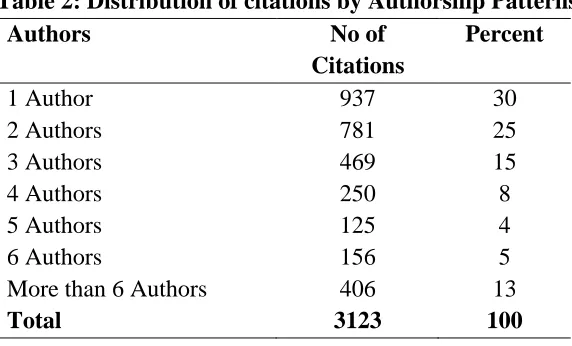
The first section under objective one assessed the authorship patterns among the cited articles. Co-authorship in research articles is considered a reliable proxy of research collaborations (Kumar, 2015). Table 2 presents the distribution of citations by authorship patterns.
Table 2: Distribution of citations by Authorship Patterns
Authors No of
Citations
Percent
1 Author 937 30
2 Authors 781 25
3 Authors 469 15
4 Authors 250 8
5 Authors 125 4
6 Authors 156 5
More than 6 Authors 406 13
Table 2 illustrates that most researchers in ICT systems prefer to work in collaboration as more than 70% (2186) of citations are multi – authored. However, 30% (937) of those cited are single authors. The table reveals that 25% (781) of citations in the sampled articles were of two authors; 15% (469) three authors; eight percent (250) involved 4 authors; four percent (125) involved 5 authors; five percent (156) were of six authors; and 13% involved more than six authors. This finding concurs with that of (Kamini & Rattan, 2013) who established in a citation analysis of articles appearing in an international electronic journal (IR) during the period 2008-2012 that more than half of the citations (51.44%) were multi-authored. This implies that the cited authors have high impact in emerging ICT systems as explained by (Chen, et al., 2017). According to (Chen, et al., 2017), co-authorship aids in examining the scientific impact of an individual scholar: an author can be evaluated by simply looking at citations of her published papers. Similar findings were also established in a study by (Pradhan, Solanki, & Patel, 2016) in an analysis of papers that were presented in the last nine PLANNER conventions held during the period 2003 to 2014 in North East Indian Universities. They found that all the papers presented in PLANNER conventions were mostly collaborative in nature with an average of 1.86 authors per paper.
4.1.2 Distribution of Emerging ICT Systems citations Vs Authorship Patterns
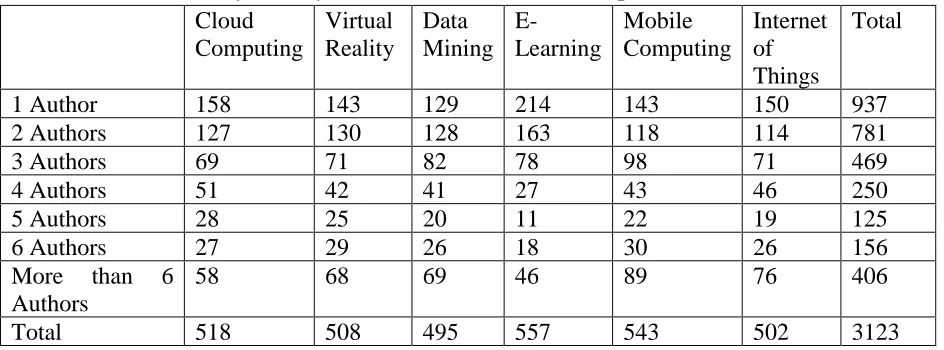
Citations according to authorship patterns in each of the selected articles per ICT system were also analysed. Table 3 presents the distribution of ICT systems citations verses authorship patterns. Table 3: Distribution by ICT System Citations Vs Authorship Patterns
Cloud Computing
Virtual Reality
Data Mining
E-Learning
Mobile Computing
Internet of Things
Total
1 Author 158 143 129 214 143 150 937
2 Authors 127 130 128 163 118 114 781
3 Authors 69 71 82 78 98 71 469
4 Authors 51 42 41 27 43 46 250
5 Authors 28 25 20 11 22 19 125
6 Authors 27 29 26 18 30 26 156
More than 6 Authors
58 68 69 46 89 76 406
Total 518 508 495 557 543 502 3123
with their lecturers (e.g (Mothibi, 2015); (Mutendwahothe, 2013); Walker & Forbes, 2017). It also worth to note that co-authorship has been largely adopted by scientists in emerging ICT systems as a mechanism that shapes the scientific community as enthused by Kumar (2015). Being new technologies whose adoption has not been entirely embraced, co-authorship is a key mechanism that links different sets of talent to produce a research output.
4.1.3 Forms and Age Distribution of Citations
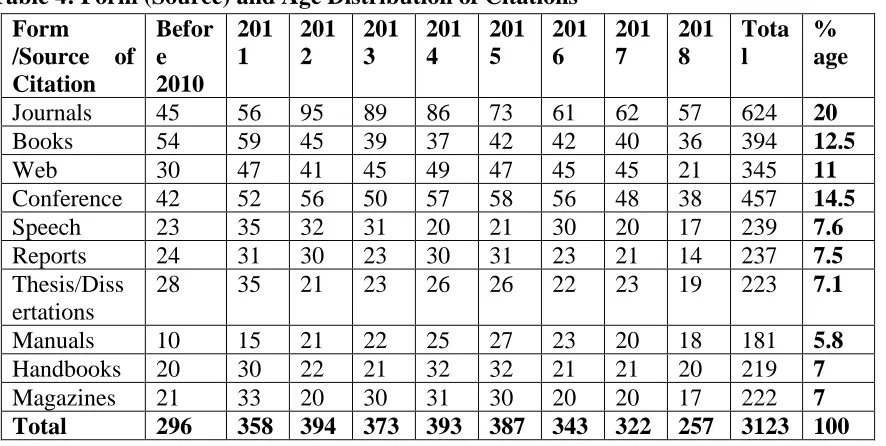
Part of the citation analysis also covered forms or sources and age of the citations revealed in the sampled articles. Citations were traced in the reference section of the sampled articles to determine their sources and forms as well as the year of publication (age). Table 4 presents the distribution of forma and age of citations.
Table 4: Form (Source) and Age Distribution of Citations Form
/Source of Citation Befor e 2010 201 1 201 2 201 3 201 4 201 5 201 6 201 7 201 8 Tota l % age Journals 45 56 95 89 86 73 61 62 57 624 20 Books 54 59 45 39 37 42 42 40 36 394 12.5 Web 30 47 41 45 49 47 45 45 21 345 11 Conference 42 52 56 50 57 58 56 48 38 457 14.5 Speech 23 35 32 31 20 21 30 20 17 239 7.6 Reports 24 31 30 23 30 31 23 21 14 237 7.5 Thesis/Diss
ertations
28 35 21 23 26 26 22 23 19 223 7.1 Manuals 10 15 21 22 25 27 23 20 18 181 5.8 Handbooks 20 30 22 21 32 32 21 21 20 219 7 Magazines 21 33 20 30 31 30 20 20 17 222 7 Total 296 358 394 373 393 387 343 322 257 3123 100
4.1.4 Distribution of Keywords Co-occurrence
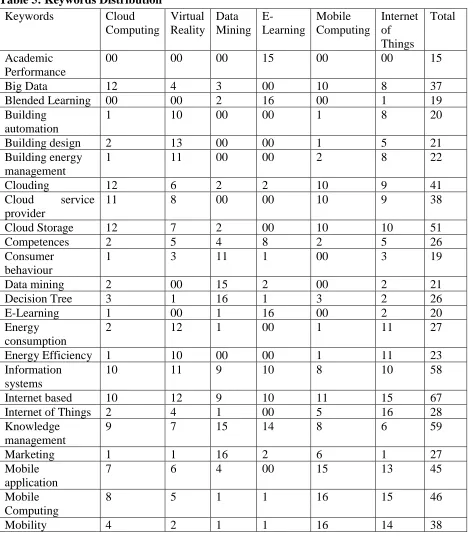
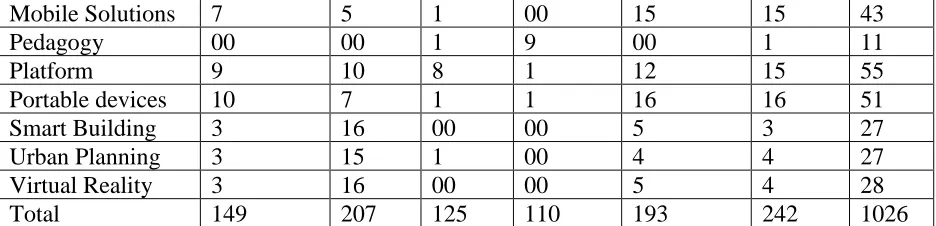
Keywords appearing in each article from which cited works were derived for analyses were also scrutinized by the study. Table 5 presents the distribution of keywords according to the technologies under study.
Table 5: Keywords Distribution Keywords Cloud
Computing Virtual Reality Data Mining E-Learning Mobile Computing Internet of Things Total Academic Performance
00 00 00 15 00 00 15
Big Data 12 4 3 00 10 8 37
Blended Learning 00 00 2 16 00 1 19
Building automation
1 10 00 00 1 8 20
Building design 2 13 00 00 1 5 21
Building energy management
1 11 00 00 2 8 22
Clouding 12 6 2 2 10 9 41
Cloud service provider
11 8 00 00 10 9 38
Cloud Storage 12 7 2 00 10 10 51
Competences 2 5 4 8 2 5 26
Consumer behaviour
1 3 11 1 00 3 19
Data mining 2 00 15 2 00 2 21
Decision Tree 3 1 16 1 3 2 26
E-Learning 1 00 1 16 00 2 20
Energy consumption
2 12 1 00 1 11 27
Energy Efficiency 1 10 00 00 1 11 23
Information systems
10 11 9 10 8 10 58
Internet based 10 12 9 10 11 15 67
Internet of Things 2 4 1 00 5 16 28
Knowledge management
9 7 15 14 8 6 59
Marketing 1 1 16 2 6 1 27
Mobile application
7 6 4 00 15 13 45
Mobile Computing
8 5 1 1 16 15 46
Mobile Solutions 7 5 1 00 15 15 43
Pedagogy 00 00 1 9 00 1 11
Platform 9 10 8 1 12 15 55
Portable devices 10 7 1 1 16 16 51
Smart Building 3 16 00 00 5 3 27
Urban Planning 3 15 1 00 4 4 27
Virtual Reality 3 16 00 00 5 4 28
Total 149 207 125 110 193 242 1026
Table 5 illustrates that internet of things (23.6%); virtual reality (20.2%); and mobile computing (18.8%) had the highest keyword co-occurrence. Equally, five keywords (internet based; knowledge management; information systems; cloud storage; portable devices, and platform) co-occurred most in citations among articles under the selected emerging ICT systems under study, particularly cloud computing, mobile clouding, virtual reality, and internet of things. According to (Radhakrishnan, Erbis, Isaacs, & Kamarthi, 2017), these points at knowledge expansion within this field (emerging ICT systems). It also indicates the interrelationship of these technologies. In similar view point, (Liu, Dong, Guo, Yang, & Peng, 2015.) analyzed the application of cloud computing and the Internet of Things on the field of medical environment. The simulation results showed that the proposed scheme can improve the efficiency of about 50%. This has the implication that there is critical connectedness between the emerging ICT systems that can be beneficial to every player in all sectors.
5. Conclusion and Recommendation
The study concludes that there is collaborative authorship pattern among citations in articles covering the selected emerging ICT Technologies. The study revealed that 70% of citations involved more than one author.
Mobile computing, cloud computing and internet of things led with citations involving more than three authors.
It is also concluded that most citations were extracted from journal sources followed by conferences/workshops and books. Additionally, most citations were from articles published in 2012 up to 2018, signifying the fact that the themes under study were emerging technologies whose adoption continues to evolve.
The study also reveals that internet of things; virtual reality; and mobile computing had the highest keyword co-occurrence. It also revealed that five keywords: internet based; knowledge management; information systems; cloud storage; portable devices, and platform had the highest co-occurrence of citations among articles under the selected emerging ICT Technologies.
The researcher feels that this exercise in bibliographic analysis can be very important in
It is recommended that other researchers can carry out the same analysis with other emerging technologies to compare the results.
References
Almrot, E., & Andersson, S. (2013). A study of the advantages & disadvantages of mobile cloud computing versus native environment. Thesis submitted to School of Computing Internet, Blekinge Institute of Technology (Sweden).
Barthelus, L. (2016). Adopting cloud computing within the healthcare industry: opportunity or risk? Online Journal of Applied Knowledge Management 4, (1), 1 – 16.
Bhaughman, J. C. (1974). A structural analysis of the literature of sociology, Library Quarterly,44 (Oct),. 293-308.
Chen, Y., Ding, C., Hu, J., Chen, R., Hui, P., & Fu, X. (2017). Building and Analyzing a Global Co- Authorship Network Using Google Scholar Data. International World Wide Web Conference Committee, April 3–7, 2017, Perth, Australia.
http://dx.doi.org/10.11145/3041021.3053056.
Chena, X., Chena, J., Wua, D., Xiea, Y., & Li, J. (2016). Mapping the research trends by co-word analysis based on keyco-words from funded project. Procedia Computer Science 91(2016). 547 – 555.
Dehdarirad, T., Villarroya, A., & Barrios, M. (2014). Research trends in gender differences in higher education and science: a co-word analysis, Scientometrics, 101 (2014) . 273-290. Ellegaard, O., & Wallin, J. A. (2015). The bibliometric analysis of scholarly production: How
great is the impact? Scientometrics 105 (3):1809–31. doi:10.1007/s11192-015-1645-z. Garfield, E. (1983). Citation Indexing - Its Theory and Application in Science, Technology and
Humanities. Philadelphia: ISI Press. Retrieved December 4, 2017 from Located at http://garfield.library.upenn.edu/ci/contents.pdf. accessed on 12.03.2018.
Hsiao, C.-H., Tang, K.-Y., & Liu, J. S. (2015). Citation-based analysis of literature: A case study of technology acceptance research. Scientometrics 105:2. doi:10.1007/s11192-015-1749-5.
Hu, J., & Zhang, Y. (2015). Research patterns and trends of Recommendation System in China using co-word analysis. Information Processing & Management, 51 (2015) . 329-339. Huang, M.-H., & Chang, C.-P. (2014). Detecting research fronts in OLED field using
Kakoty, S., Lal, M., & Sarma, K. (2011). E-learning as a Research Area: An Analytical
Approach. . International Journal of Advanced Computer Science and Applications, 2(9),, 144 – 148.
Kamini, G., & Rattan, G. K. (2013). Citation Analysis of Information Research: An International Electronic Journal" (2013). Library Philosophy and Practice (e-journal).
1034http://digitalcommons.unl.edu/libphilprac/1034.
Karen, M., & Dressler, V. (2018). Using Citation Analysis to Identify Research Fronts: A Case Study with the Internet of Things. Science & Technology Libraries, DOI:
10.1080/0194262X.2017.1415183.
Kumar, K., & Reddy, T. (2012). Citation analysis of dissertations submitted to the department of library and information science, Sri Venkateswara University, Tirupati. . International Journal of Digital Library Services, 2 (2), , 44 – 84.
Leiss, C., & Gregory, K. (2016). Visibility and impact of research: Bibliometric services for university management and researchers. Proceedings of the IAUTL Conferences. Paper 3,Halifax, Nova Scotia. Purdue e-Pubs Purdue University.
Liu, Y., Dong, B., Guo, B., Yang, J., & Peng, W. (2015.). Combination of Cloud Computing and Internet of Things (IOT) in Medical Monitoring Systems. International Journal of Hybrid Information Technology, 8(12), . 368 – 376.
Martyn, L. A. (1976). Use studies in library planning, Library Trends 24(30). Momeni, M.R. (2015). A Survey of Mobile Cloud Computing: Advantages, Challenges and Approaches. International Journal of Computer Science and Business Informatics, 15(4),, 14 – 28. Mishra, D., Gunasekaran, A., Childe, S. J., Papadopoulos, T., Dubey, R., & Wamba, S. (2016).
Vision, applications and future challenges of Internet of Things. Industrial Management & Data Systems 116 (7):1331–55. doi:10.1108/IMDS-11-2015-0478.
Mothibi, G. (2015). Meta-Analysis of the Relationship between E-Learning and Students’ Academic Achievement in Higher Education. . Journal of Education and Practice 6 (9),, 6-10.
Mutendwahothe, W. L. (2013). E-Learning’s Impact on the Academic Performance of Student-Teachers: A Curriculum Lens. Mediterranean Journal of Social Sciences, 4 (14), 695 – 704.
Pradhan, P., Solanki, H., & Patel, S. (2016). Analysis of the Citation Patterns, Keywords Clustering and Collaboration Networks in Presented Papers of PLANNER
Conventions;10th Convention PLANNER-2016, NEHU, Shillong, Meghalaya, 09-11 November, 2016. INFLIBNET Centre, Gandhinagar, Gujarat.
Radhakrishnan, B., Shineraj, G., & Muhammed, K. (2013). Application of Data Mining In Marketing. International Journal of Computer Science and Network, 2(5), 41 – 45. Radhakrishnan, S., Erbis, S., Isaacs, J., & Kamarthi, S. (2017). Novel keyword co-occurrence
network-based methods to foster systematic reviews of scientific literature. PLoS ONE 12(3): e0172778. https://doi.org/10.1371/journal.
Raorane, A., & Kulkarni, R. (2011). Data mining techniques: a source for consumer behavior analysis. International Journal of Database Management Systems, 3 (3), 45 – 56. Richard, R. (2010). Foundations of library and information science (3rd ed.). New York:
Neal-Schuman Publishers. ISBN 978-1-55570-690-6. Accessed
athttp://books.google.com/books?id=Pk1TSAAACAAJ accessed on 09.02.2018. http://en.wikipedia.org/wiki/Citation.
Singh, Y., Kandah, F., & Zhang, W. (2011). A Secured Cost-effective Multi-Cloud Storage in Cloud Computing. IEEE INFOCOM 2011 Workshop on Cloud Computing. 625 - 630. Waaijer, C. J., & Palmblad, M. (2015). Bibliometric mappping: Eight decades of analytical
ACKNOWLEDGEMENT
I am grateful and deeply indebted to my family and friends whom this work would have been impossible without their support. First of all, I thank Almighty God for bringing me this far and providing me with wisdom, guidance, strength and more so focus that has helped me to make this a success. I would like to express my most sincere gratitude to my University supervisors Dr. Solomon Ogara for his guidance and encouragement in preparation of this research journal. To all who made this work a success, I thank you all.
AUTHORS
Author MAURINE AWUOR ONYANGO
DOCTOR OF BIS -Student.
Student :- Jaramogi Oginga Odinga University of Science and Technology, Bondo, Kenya
E-mail: [email protected]
Co- Author DR.SOLOMON OGARA
Senior Lecturer, School of Information and Innovative Systems
Jaramogi Oginga Odinga University of Science and Technology, Bondo, Kenya
E-mail: [email protected]