VOLUME 37, ARTICLE 59, PAGES 1891
,
1916
PUBLISHED 13 DECEMBER 2017
http://www.demographic-research.org/Volumes/Vol37/59/ DOI: 10.4054/DemRes.2017.37.59
Research Article
Household structure vs. composition:
Understanding gendered effects on educational
progress in rural South Africa
Sangeetha Madhavan
Tyler W. Myroniuk
Randall Kuhn
Mark A. Collinson
© 2017 Madhavan, Myroniuk, Kuhn & Collinson.
This open-access work is published under the terms of the Creative Commons Attribution 3.0 Germany (CC BY 3.0 DE), which permits use, reproduction, and distribution in any medium, provided the original author(s) and source are given credit.
1 Introduction 1892
1.1 Living arrangements and gender differences in outcomes 1893
1.2 Unpacking household structure 1895
2 Site, data, and methods 1897
2.1 Site description 1897
2.2 Data and methods 1897
3 Results 1900
3.1 Who do children live with in Agincourt? 1900
3.2 Does structure matter for gendered educational outcomes? 1902
3.3 Do kin matter? 1903
3.4 When do kin matter? 1905
4 Discussion and conclusion 1907
5 Acknowledgements 1909
Household structure vs. composition: Understanding gendered
effects on educational progress in rural South Africa
Sangeetha Madhavan1 Tyler W. Myroniuk2
Randall Kuhn3 Mark A. Collinson4
Abstract
BACKGROUND
Demographers have long been interested in the relationship between living arrangements and gendered outcomes for children in sub-Saharan Africa. Most research conflates household structure with composition and has revealed little about the pathways that link these components to gendered outcomes.
OBJECTIVES
We offer a conceptual approach that differentiates structure from composition with a focus on gendered processes that operate in the household in rural South Africa.
METHODS
We use data from the 2002 round of the Agincourt Health and Socio-Demographic Surveillance System. Our analytical sample includes 22,997 children aged 6‒18 who were neither parents themselves nor lived with a partner or partner’s family. We employ ordinary least squares regression models to examine the effects of structure and composition on educational progress of girls and boys.
RESULTS
Non-nuclear structures are associated with similar negative effects for both boys and girls compared to children growing up in nuclear households. However, the presence of
1 University of Maryland, College Park, USA. E-Mail:[email protected]. 2 George Mason University, Fairfax, USA.
3 University of California, Los Angeles, USA.
4 MRC/Wits University Rural Public Health and Health Transitions Research Unit (Agincourt), School of
other kin in the absence of one or both parents results in gendered effects favouring boys.
CONCLUSION
The absence of any gendered effects when using a household structure typology suggests that secular changes to attitudes about gender equity trump any specific gendered processes stemming from particular configurations. On the other hand, gendered effects that appear when one or both parents are absent show that traditional gender norms and/or resource constraints continue to favour boys.
CONTRIBUTION
We have shown the value of unpacking household structure to better understand how gender norms and gendered resource allocations are linked to an important outcome for children in sub-Saharan Africa.
1. Introduction
Demographers have long been interested in the relationship between living arrangements and children’s well-being in sub-Saharan Africa. The people with whom children reside are conduits of physical and social capital and, therefore, key factors influencing their well-being. For starters, parental presence, particularly mothers’, has been critically linked to outcomes such as educational attainment (Lloyd and Blanc 1996; Townsend et al. 2002). Extended kin have also long been recognized as critical players in the lives of children (Desai 1992; Lloyd and Desai 1992; Sear et al. 2002), though studies that have examined the effects of extended family arrangements on well-being have arrived at inconsistent findings (Buchmann 2000; Doan and Bisharat 1990; Gage, Sommerfelt, and Piani 1996). More recently, a number of studies have focused on the presence of specific kin such as grandparents, finding that grandmothers have a positive influence on educational outcomes (Parker and Short 2009) and birthweight (Cunningham et al. 2010). Recent studies of societies affected by HIV/AIDS have postulated the importance of kin in the care of children (Ankrah 1993; Bicego, Rutstein, and Johnson 2003; Goldberg and Short 2012; Hill, Hosegood, and Newell 2008; Hosegood et al. 2007).
and resource allocation and are sensitive to economic exigencies. We address both issues in this paper by (1) offering a conceptual approach that explicitly differentiates structure from kin presence and identifies possible pathways that link structure and kin presence to gendered outcomes and (2) demonstrating the value of such an approach by focusing on the educational progress for boys and girls in a rural context in South Africa ‒ a setting particularly well suited for this analysis for two reasons. First, as a result of apartheid-era policies, high levels of unemployment, and cultural preference, Black family organization defies simplistic, conventional categorization including gender roles. Second, Black African5 children in rural South Africa continue to face large disadvantages in educational attainment compared to other racial groups. These inequalities underscore the need to better understand which aspects of household arrangements matter for educational outcomes and the extent of persistent gender differences.
1.1 Living arrangements and gender differences in outcomes
A number of scholars have examined differential effects of living arrangements on outcomes for boys and girls in Africa. Educational outcomes, in particular, have received notable attention. Lloyd and Blanc, in their oft-cited cross-national study using Demographic and Health Surveys (DHS) data from seven sub-Saharan African countries, claimed that they found “no evidence that family support systems operate systematically to the benefit of boys relative to girls” (Lloyd and Blanc 1996: 267). In the two decades since, researchers have tested this claim using different measures of household composition and have arrived at equivocal findings. Driven in large part by the HIV/AIDS epidemic, living without biological parents ‒ maternal, paternal, or double orphanhood ‒ has often been employed as an indicator of children’s vulnerability. Reports by the World Bank (2002) and UNAIDS (2002) suggested that orphaned girls face disadvantages in school enrollment compared to orphaned boys. Similar to Lloyd and Blanc (1996), Case, Paxson, and Ableidinger (2004: 500) ‒ although they analyzed more countries and DHS waves ‒ found that the effect of orphanhood on the chances of school enrollment are “equally severe” for boys and girls. Subsequent analyses found a more nuanced relationship, however. For instance, in Uganda, orphaned girls are less likely to receive any secondary schooling and are slower at progressing through the educational system than girls who were not orphaned, whereas there are no differences in educational attainment by orphan status among boys (Yamano, Shimamura, and Sserunkuuma 2006). But in a study based in rural Kenya,
5 We retain the term “Black African” to be consistent with current-day usage in both academic and policy
girls and boys, on average, do not significantly differ in terms of school participation following a parent’s death; however, when considering age, young girls are more likely than any other group to attend school less frequently if orphaned (Evans and Miguel 2007).
Headship and presence of siblings have also been used to examine gendered differences in educational achievement. Young girls in Kinshasa were found to have lower levels of education if they lived in a household headed by a woman while older boys enjoy educational advantages (Shapiro and Tambashe 2001). However, orphaned girls in female-headed households in rural Zimbabwe actually have better chances of completing primary school compared to boys and nonorphaned girls (Nyamukapa and Gregson 2005). Girls living with mothers with some education and older sisters appear to enjoy some educational advantages in Nigeria (Kazeem, Jensen, and Stokes 2010) ‒ likely due to the presence of female role models. The presence of a male pensioner, a critical source of financial support, has also been linked to higher educational achievement for girls but not for boys (Hamoudi and Thomas 2005). At the same time, girls in very large households (Mabika and Shapiro 2012), or in households with many young children (Lindskog 2013), have lower educational achievement and school attendance than boys, possibly due to resource constraints and son preference. Finally, work done in rural South Africa suggests even greater nuance when unpacking the effects of household composition on education. Townsend et al. (2002) found that boys’ and girls’ educational attainment is differentially influenced by factors such as female headship, multigenerational household, and the presence of both parents.
1.2 Unpacking household structure
Our approach builds on the extant research by unpacking how household structure, as it is used in the literature, conflates two dimensions: structure and composition. Structure, as we use it, refers to the generational contours and the extent of nucleation in the household. Nuclear arrangements, i.e., only parents and children, are often identified with lower fertility and changing values about family obligations (Bongaarts 2001; Mberu 2007). The shift from quantity to quality, accompanied by parents’ increasing educational attainment, should result in more gender-egalitarian values about the treatment of boys and girls, even if this process is a consequence of intra-household gendered bargaining about child investments. In other words, women and men with more education will advocate equally for their daughters and sons (Glick and Sahn 2000; Thomas 1990). Exceptions exist, of course; for example, Das Gupta (1987) found that with smaller family size, son preference actually intensifies in northern India.
control, do not offer the safety net in terms of financial and practical support found in multigenerational households (Casper and Bianchi 2002; Haider and McGarry 2006), even though even amongst this group variation has been noted along class, education, and racial/ethnic lines (Brady and Burroway 2012; Edin and Lein 1997).
Composition, as we see it, is about the individuals who comprise the structure, namely, parents, siblings, grandparents, aunts, uncles, and other kin. The focus on parental presence in the lives of children in both developed and developing country contexts (Lloyd and Blanc 1996; Townsend et al. 2002) reflects an increasingly dominant view that parents do (and should) shoulder the lion’s share of caregiving responsibilities and have primary decision-making power for their children. Cultural norms that promote a socially dispersed childrearing model, through practices such as fosterage (Bledsoe and Isiugo-Abanihe 1985; Isiugo-Abanihe 1985), emphasize the important roles of grandparents (Cunningham et al. 2010; Parker and Short 2009), male kin who take on “social father” roles (Mkhize 2006; Richardson 2009), and female kin who take on “social mother” roles (Madhavan et al. 2012) as sources of financial support, nurturing, and discipline. These adults assume responsibility and have some say in decision-making. Older siblings are often critical sources of role modelling (Madhavan and Crowell 2014). Each of these people, therefore, brings different constraints and opportunities to his/her relationship with the child, which, in turn, may condition the type of influence each person has. We suggest that these dyadic processes are likely to have effects on educational progress that are different from those emanating from a nuclear or extended family arrangement. These effects may come through underlying power dynamics and decision-making power that, taken together, determine investment (financial and mentoring) in girls’ and boys’ education.
In this paper, we address the following three questions:
1) Does type of household structure influence boys’ and girls’ schooling differently?
2) Does the presence of particular kin influence boys’ and girls’ schooling differently net of parental status?
2. Site, data, and methods
2.1 Site description
The Agincourt subdistrict in Mpumalanga Province in northeastern South Africa is typical of much of southern Africa in three important respects: (1) The land is insufficiently fertile to support the population through subsistence agriculture or other local activities, (2) there are very few local employment opportunities, and (3) the population has high levels of migration and mobility. Formerly part of the apartheid-era homeland system, the area encompasses a population of about 90,000 dispersed in 28 villages established through forced resettlement between 1920 and 1970. All villages have water provided through neighborhood taps, and most have electricity. Villages also have at least one primary school, and most have a secondary school nearby. The main languages spoken in the area are Shangaan and sePedi. Traditionally, most families have lived in multigenerational, extended family arrangements in which adult siblings live close to one another (Junod 1962; Niehaus 2001), although these patterns are undergoing change as a result of increased female migration and alteration in the labour market.
In examining the influence of living arrangements on educational outcomes, previous work using data from 1997 found that the presence of parents benefited educational attainment for all children, but having a migrant father (compared to having a nonmigrant father) had a positive effect only for older children, and female headship had no effect (Townsend et al. 2002). More recent analyses examining the correlates of children’s mobility found that the presence of women who can act as maternal substitutes lowers the likelihood of children moving when the mother is a labour migrant or when she is deceased (Madhavan et al. 2012). While providing important findings, these studies have measured extended living arrangements based only on headship, age–sex composition of the household, and generational structure, making it difficult to identify the critical dimensions and the pathways through which effects are felt.
2.2 Data and methods
classified into two categories. A ‘permanent’ migrant is defined as a person moving into or out of a household with a permanent intention. Someone who left the household permanently since the last update will not appear on the subsequent household roster. A ‘temporary’ migrant, on the other hand, is someone who is identified as a member of the household but has spent six or more months of the previous year out of the household for employment or other reasons. This categorization results in a much more expansive definition of coresidence than that which is normally used in censuses and surveys because members who are not physically present are still counted as coresidents if they are temporary migrants.
Collection of data using household rosters almost always begins with the identification of the household head, who tends to be the oldest male (Posel 2001). All other household members are assigned a relationship code in reference to the head. If we wanted to identify relationships from the perspective of children, we would need to transform the relationships that are based on household head. While doing this is relatively straightforward in nuclear and small households, it becomes increasingly difficult in large households extended along both vertical and lateral dimensions. An untapped aspect of the Agincourt data enables us to determine linkages of children to specific coresident and nonresident kin. Our data comes from two sources: (1) household rosters that collect conventional data on sex, age, and relationship to household head and (2) the innovative social connections database (SCDB) that uses multiple waves of the HDSS to derive robust indicators of both intra- and interhousehold connectivity from the child’s perspective. Nonresidential kinship links to children were identified through retrospectively tracking local mobility within the DSS site
We use data from the 2002 Agincourt HDSS update that covers a population of approximately 70,000 people living in 11,900 households. Even though it is dated, the 2002 round is well suited for demonstrating the value of our conceptual framework because it offers high-quality data on kin relationships and provides a robust baseline for future work that will examine change over time. Our analytical sample includes 22,997 children aged 6‒18 who were neither parents themselves nor lived with a partner or partner’s family. The last restriction was imposed to avoid combining caregiving received by children and caregiving given to children in the case of young parents, both of which are very different contexts.6 For each child we constructed an egocentric list relating all coresident adult household members (known as alters) to the child (ego). This produced a total of 87,199 adult coresident alters and a mean of 3.79 alters per child. We include only alters age 19+ because they are most critical for channeling
6 As a more robust approach to excluding teen parents, we instead restricted the sample to children age 6‒15
resources to children. However, because children are an indicator for the competition over resources, our regression models control for total number of children under age 18 living in the household. We then used the SCDB to confirm 96.2% of the relationships of coresident alters to the child with high confidence. To create the structural typology, we relied on age and relationship. For the kin presence models we aggregated counts of coresident alters according to kinship type (grandparent, aunt, uncle, etc.) and created dichotomous indicators for the presence of any kin of that type. The data was then collapsed into a single observation for each child.
We employ ordinary least squares (OLS) regression models to examine the relationship between children’s living arrangements as specified in each of the approaches and educational outcome. The model sequencing we present is in line with each of the three questions stated earlier and uses both additive and interaction models. Our outcome is children’s pace of education. This is a continuous variable that captures the difference between age and years of schooling attained and standardizes it by adding a constant for normal age of entry into school, which is 6 in this community (Kuhn 2006). A pace of 0 indicates that the child is meeting grade-for-age expectations. A pace less than 0 signals that the child is falling behind, and a pace greater than 0 suggests that the child is moving faster than expected.
3. Results
3.1 Who do children live with in Agincourt?
We begin by exploring the unique coresidence conditions of the Agincourt area. Figure 1 shows the distribution of children living with mothers, fathers, siblings, and different types of extended kin in 2002. Each relationship type is derived from eight elemental codes noted below the graph. We only include the most common living arrangements found in the area. These categories are not mutually exclusive but rather provide an overview of living arrangements.
Figure 1: Proportion of children coresiding with parents, siblings, and extended kin for children aged 6‒18, Agincourt 2002
Note: Kinship relationship codes are derived from the eight elemental relationships: mother (m), father (f), brother (b), sister (z), son (s), daughter (d), husband (h), and wife (w). These are combined to represent mother’s mother (mm), mother’s father (mf), father’s father (ff), father’s mother (fm), mother’s brother (mb), mother’s sister (mz), father’s brother (fb), and father’s sister (fz). Uncommon relationships such as mother’s husband (stepfather) are not included.
Consistent with expectations, we find that most children (82%) live with their mothers and about 55% with their fathers. While not shown, just over 50% of boys and girls live with both parents, which challenges the popular ‘absent father’ trope. These high proportions are partly attributable to the inclusion of temporary migrants as household members described in the data section. However, it should be noted that
0 10 20 30 40 50 60 70 80 90
about 14% of girls and boys live with neither parent. Moreover, 30% live with a brother, and 25% live with a sister (independent of parental coresidence). Interestingly, while half of the children live with some kind of extended kin, less than 20% live with any particular type of maternal extended kin – grandmothers (mm), uncles (mb), and aunts (mz) – and less than 10% live with paternal extended kin (fm or fb). There are no significant gender differences in these patterns.
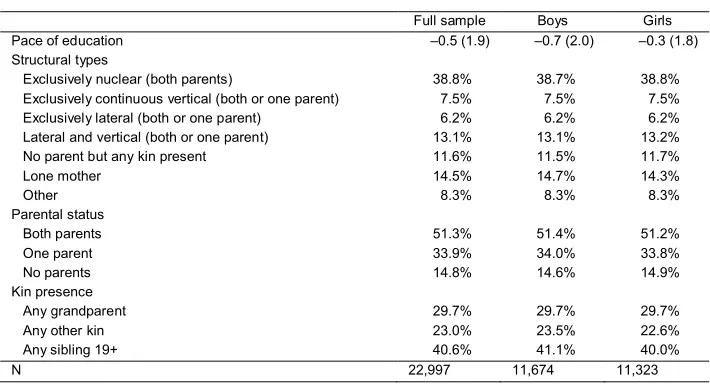
Table 1 presents sex-pooled and sex-stratified distributions of our key independent family structure and kin presence variables in addition to the dependent variable, educational pace.
Table 1: Descriptive statistics of dependent and key independent variables Full sample Boys Girls
Pace of education ‒0.5 (1.9) ‒0.7 (2.0) ‒0.3 (1.8)
Structural types
Exclusively nuclear (both parents) 38.8% 38.7% 38.8% Exclusively continuous vertical (both or one parent) 7.5% 7.5% 7.5% Exclusively lateral (both or one parent) 6.2% 6.2% 6.2% Lateral and vertical (both or one parent) 13.1% 13.1% 13.2%
No parent but any kin present 11.6% 11.5% 11.7%
Lone mother 14.5% 14.7% 14.3%
Other 8.3% 8.3% 8.3%
Parental status
Both parents 51.3% 51.4% 51.2%
One parent 33.9% 34.0% 33.8%
No parents 14.8% 14.6% 14.9%
Kin presence
Any grandparent 29.7% 29.7% 29.7%
Any other kin 23.0% 23.5% 22.6%
Any sibling 19+ 40.6% 41.1% 40.0%
N 22,997 11,674 11,323
Note: Standard deviations in parentheses.
3.2 Does structure matter for gendered educational outcomes?
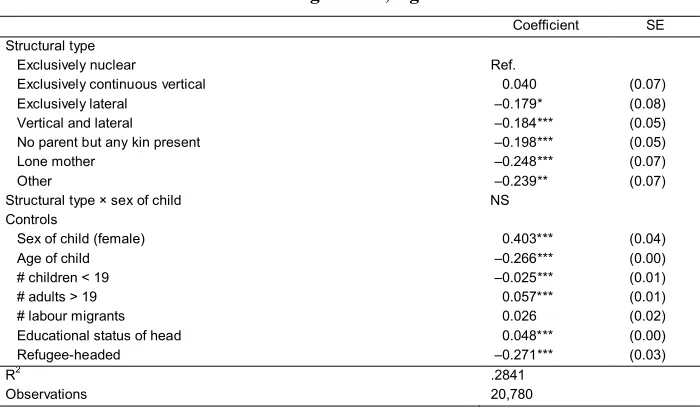
Table 2 shows the results of regressions using a structural typology based on the literature and what we know from fieldwork at the site. This typology is an attempt to develop a parsimonious, mutually exclusive categorization that is meaningful and analytically useful. The seven categories are (1) ‘exclusively nuclear’ (having only both parents and no other kin); (2) ‘exclusively continuous vertical’ (one or both parents, grandparents); (3) exclusively lateral (one or both parents, aunts, uncles); (4) ‘vertical and lateral’ (one or both parents and having at least one member from vertical and lateral arrangements); (5) ‘no parents but any kin present’; (6) ‘lone mother’ (no kin); and (7) ‘other.’ The residual category ‘other’ includes ‘lone father,’ ‘only adult siblings and/or spouses,’ ‘only adults with unknown relationships,’ ‘no adults,’ and ‘other rare combinations.’ Generational divisions are determined by age and relationship.
Table 2: OLS regression results for effects of structural typology on pace of education for children aged 6‒18, Agincourt 2002
Coefficient SE Structural type
Exclusively nuclear Ref.
Exclusively continuous vertical 0.040 (0.07)
Exclusively lateral ‒0.179* (0.08)
Vertical and lateral ‒0.184*** (0.05)
No parent but any kin present ‒0.198*** (0.05)
Lone mother ‒0.248*** (0.07)
Other ‒0.239** (0.07)
Structural type × sex of child NS
Controls
Sex of child (female) 0.403*** (0.04)
Age of child ‒0.266*** (0.00)
# children < 19 ‒0.025*** (0.01)
# adults > 19 0.057*** (0.01)
# labour migrants 0.026 (0.02)
Educational status of head 0.048*** (0.00)
Refugee-headed ‒0.271*** (0.03)
R2 .2841
Observations 20,780
Note: *p < 0.05, **p < 0.01, ***p < 0.001. Robust standard errors estimated (in parentheses). Estimates are clustered by household ID.
surprising if we see these arrangements as both normative in this context and having greater social and economic stability, which ensures that children receive needed educational support. All the other arrangements have significant negative effects, suggesting that economic pressures and the absence of role models compromise educational progress.
Even though the independent effect of being female has a highly significant positive effect on pace of education, the interaction effect of child’s sex and structure is not significant. This suggests that the positive and negative influences of structure on educational progress work similarly for both boys and girls. The independent effects of the control variables are as expected. Age of child is associated with decreasing pace of education. Total number of adults has an independent positive effect, and total number of children has a negative effect. Educational status of the head has the expected positive impact, whereas being in a refugee-headed household has a negative effect. Interestingly, number of labour migrants is not associated with educational pace. These effects are similar for boys and girls. Taken together, these results suggest that structural variation has little impact on gendered outcomes in education. We now turn to a more focused examination of the individual members who make up the structure.
3.3 Do kin matter?
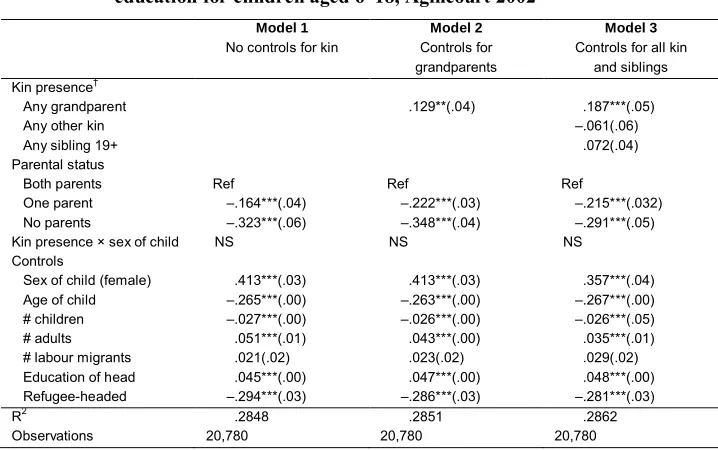
Table 3: OLS regression results for effects of kin presence on pace of education for children aged 6‒18, Agincourt 2002
Model 1 No controls for kin
Model 2 Controls for grandparents
Model 3 Controls for all kin
and siblings Kin presence†
Any grandparent .129**(.04) .187***(.05)
Any other kin ‒.061(.06)
Any sibling 19+ .072(.04)
Parental status
Both parents Ref Ref Ref
One parent ‒.164***(.04) ‒.222***(.03) ‒.215***(.032) No parents ‒.323***(.06) ‒.348***(.04) ‒.291***(.05)
Kin presence × sex of child NS NS NS
Controls
Sex of child (female) .413***(.03) .413***(.03) .357***(.04) Age of child ‒.265***(.00) ‒.263***(.00) ‒.267***(.00) # children ‒.027***(.00) ‒.026***(.00) ‒.026***(.05)
# adults .051***(.01) .043***(.00) .035***(.01)
# labour migrants .021(.02) .023(.02) .029(.02)
Education of head .045***(.00) .047***(.00) .048***(.00) Refugee-headed ‒.294***(.03) ‒.286***(.03) ‒.281***(.03)
R2 .2848 .2851 .2862
Observations 20,780 20,780 20,780
Note: *p < 0.05, **p < 0.01, ***p < 0.001. Robust standard errors in parentheses. Estimates clustered by household ID. † We include an additional dummy variable for kin who could not be classified in relation to a child (as a control) in order to more accurately estimate the association between the presence of grandparents, other kin, and siblings 19+ and educational pace (results not presented, p>0.05, N=1741).
living in the household, which is positively associated with child schooling. Coefficients could therefore be interpreted as indicating the benefit of a particular kin type above and beyond the benefit of just having additional adults. But we note that the significance of kin type coefficients does not change if we drop the control for number of adults.
3.4 When do kin matter?
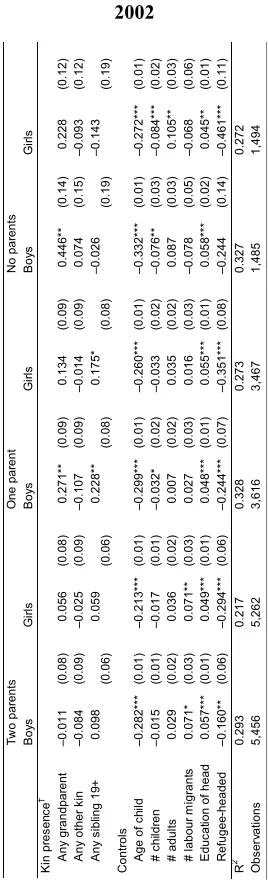
Given the importance of parental status net of the presence of other kin, we next explore the possibility that the significance of extended kin will vary by parental status. Indeed, in line with our conceptual framework, one would expect that any effects of kin presence cannot be fully appreciated without the interaction with parent status.
4. Discussion and conclusion
Despite the wealth of literature on household structure and children’s outcomes in sub-Saharan Africa, a relatively small number of studies have examined the role of structure and the individuals who comprise that structure in understanding gendered outcomes. In this analysis, we have attempted to push this literature by unpacking how structure is associated with gender norms, decision-making, and allocation of resources, which, taken together, can have a profound influence on outcomes for boys and girls. We used data from a large rural area in South Africa to provide empirical backing for our claims and uncovered a number of interesting findings. To start with, boys fare worse than girls in terms of the pace of education (Table 1). This pattern continues even in a multivariate framework that includes household structure (Table 2) and kin presence (Table 3). However, the more interesting story is with the effects of structure and kin presence on educational attainment. We found that extended kin bear relatively little influence compared to parents on the pace of educational attainment, and this is no different for boys and girls. As shown in the household structure model (Table 2), nuclear structures are the best arrangement for children’s education. The kin presence models (Tables 3 and 4) support this finding by showing that the presence of two parents offers a significant benefit for children and is independent of any effects of other kin. In other words, if both parents are there, very little else matters except for the presence of adult siblings, which appears to offer some additional benefit particularly for boys. This is consistent with a recent analysis of South African data showing that children in nuclear arrangements have better educational outcomes compared to those in other arrangements (Pedzisai and Nompumelelo 2016). However, in situations without either parent or even with only one parent, the presence of grandparents and adult siblings benefits boys but not girls. Put simply, if there is a substitution effect in play, it is a gendered one that favours boys.
else matters. On the other hand, the presence of specific kin in the absence of one or both parents does have gendered effects favouring boys. This reveals two important dimensions: (1) Under conditions of financial and social duress ‒ which is what usually characterizes arrangements without parents ‒ adult caregivers perceive boys to be the better investment, and (2) the absence of parents opens up space for other caregivers to revert to more traditional gender norms favouring boys. Adult siblings, who appear to be as significant as grandparents in their capacity as substitute caregivers or role models, are often neglected in the literature (Kuhn 2006). More puzzling, however, is their influence, which appears to benefit only boys when only one parent ‒ most likely the mother ‒ is present. This suggests that boys more than girls may need more guidance in the form of role modelling when fathers are absent. The role of siblings may be especially important in light of the bimodal pattern of childbearing among Black South African women, in which women often have two children separated by long birth spacing (Garenne, Tollman, and Kahn 2000; Timaeus and Moultrie 2008). In this context, first-born children, particularly boys, may merit special attention not merely because their mothers are often young and lacking spousal support, but because they lack an older sibling.
include potentially important covariates such as access to pensions and other social grants, employment status, or temporary migration status.
Despite these limitations, we believe that this analysis makes a worthwhile contribution to ongoing debatesabout the role of family structure in influencing gendered outcomes in the African context. Given the well-documented diversity of family structures in South Africa, it is critical that we not rely on conventional measures of structure that may, at best, give us results that are unclear and, at worst, lead to erroneous conclusions about gendered educational effects. Additionally, disaggregating extended family structures is very important from a policy perspective as it allows a more focused and efficient use of limited resources to target particularly vulnerable children (e.g., girls living without either parent but with a grandparent).We are hopeful that this line of research will be pursued so that findings can be better compared to those stemming from research in high-income contexts, like the United States, where researchers are interested in how the residential presence of fathers and unstable living arrangements might impact boys’ and girls’ lives (Brown 2010; Hawkins, Amato, and King 2007; Hofferth 2006) and how birth order (Conley 2005) and time spent rearing children (Casper and Bianchi 2002) within stable and unstable family environments predict children’s outcomes. Having a global perspective on gender and households would not only enrich theory but present opportunities to develop effective strategies to ensure healthy lives for all children.
5. Acknowledgements
References
Ankrah, E.M. (1993). The impact of HIV/AIDS on the family and other significant relationships: The African clan revisited.AIDS Care 5(1): 5‒22. doi:10.1080/
09540129308258580.
Babalola, S., Tambashe, B.O., and Vondrasek, C. (2005). Parental factors and sexual risk-taking among young people in Cote d’Ivoire.African Journal of Reproductive Health 9(1): 49‒65.doi:10.2307/3583160.
Bicego, G., Rutstein, S., and Johnson, K. (2003). Dimensions of the emerging orphan crisis in sub-Saharan Africa.Social Science and Medicine 56(6): 1235‒1247.
doi:10.1016/S0277-9536(02)00125-9.
Bledsoe, C.H. and Isiugo-Abanihe, U.C. (1985). Strategies of child fosterage among Mende grannies in Sierra Leone. Presented at the Annual Meeting of the Population Association of America, Boston, March 28‒31.
Bongaarts, J. (2001). Household size and composition in the developing world in the 1990s.Population Studies 55(3): 263‒279.doi:10.1080/00324720127697. Brady, D. and Burroway, R. (2012). Targeting, universalism, and single-mother
poverty: A multilevel analysis across 18 affluent democracies.Demography
49(2): 719‒746.doi:10.1007/s13524-012-0094-z.
Brown, S.L. (2010). Marriage and child well-being: Research and policy perspectives.Journal of Marriage and Family 72(5): 1059‒1077.doi:10.1111/j.
1741-3737.2010.00750.x.
Buchmann, C. (2000). Family structure, parental perceptions, and child labor in Kenya: What factors determine who is enrolled in school?Social Forces 78(4): 1349‒ 1378.doi:10.1093/sf/78.4.1349.
Case, A. and Deaton, A. (1998). Large cash transfers to the elderly in South Africa.The Economic Journal 108: 1338‒1361.doi:10.1111/1468-0297.00345.
Case, A., Paxson, C., and Ableidinger, J. (2004). Orphans in Africa: Parental death, poverty, and school enrollment.Demography 41(3): 483‒508.doi:10.1353/dem.
2004.0019.
Clark, S., Kabiru, C., and Mathur, R. (2010). Relationship transitions among youth in urban Kenya. Journal of Marriage and Family 72(1): 73‒88. doi:10.1111/j.
1741-3737.2009.00684.x.
Clark, S., Madhavan, S., Beguy, D., Kabiru, C., and Cotton, C. (2017). Who helps single mothers in Nairobi? The role of kin support. Journal of Marriage and Family79(4): 1186–1204.doi:10.1111/jomf.12404.
Conley, D. (2005).The pecking order: A bold new look at how family and society determine who we become. New York: Vintage.
Cunningham, S.A., Elo, I.T., Herbst, K., and Hosegood, V. (2010). Prenatal development in rural South Africa: Relationship between birth weight and access to fathers and grandparents.Population Studies 64(3): 229‒246.
doi:10.1080/00324728.2010.510201.
Das Gupta, M. (1987). Selective discrimination against female children in rural Punjab, India.Population and Development Review 13(1): 77‒100. doi:10.2307/1972
121.
Desai, S. (1992). Children at risk: The role of family structure in Latin America and West Africa.Population and Development Review 18(4): 689‒717.doi:10.2307/
1973760.
Doan, R.M. and Bisharat, L. (1990). Female autonomy and child nutritional status: the extended-family residential unit in Amman, Jordan.Social Science and Medicine 31(7): 783‒789.doi:10.1016/0277-9536(90)90173-P.
Dodoo, F.N.A. and Frost, A.E. (2008). Gender in African population research: The fertility/reproductive health example.Annual Review of Sociology 34: 431‒452.
doi:10.1146/annurev.soc.34.040507.134552.
Duflo, E. (2000). Child health and household resources in South Africa: Evidence from the Old Age Pension program.American Economic Review 90(2): 393‒398.
doi:10.1257/aer.90.2.393.
Edin, K. and Lein, L. (1997).Making ends meet: How single mothers survive welfare and low-wage work. New York: Russell Sage Foundation.
Evans, D.K. and Miguel, E. (2007). Orphans and schooling in Africa: A longitudinal analysis.Demography 44(1): 35‒57.doi:10.1353/dem.2007.0002.
Folbre, N. (1986). Cleaning house: New perspectives on households and economic development. Journal of Development Economics 22(1): 5–40. doi:10.1016/
Gage, A., Sommerfelt, A.E., and Piani, A.L. (1996). Household structure socioeconomic level and child health in sub-Saharan Africa. (Demographic and health surveys analytical report 1) Calverton: Macro International.
Garenne, M., Tollman, S., and Kahn, K. (2000). Premarital fertility in rural South Africa: A challenge to existing population policy.Studies in Family Planning
31(1): 47‒54.doi:10.1111/j.1728-4465.2000.00047.x.
Glick, P. and Sahn, D.E. (2000). Schooling of girls and boys in a West African country: The effects of parental education, income, and household structure. Economics of Education Review 19(1): 63‒87.doi:10.1016/S0272-7757(99)00029-1. Goldberg, R.E. (2013a). Family instability and early initiation of sexual activity in
Western Kenya.Demography 50(2): 725‒750.doi:10.1007/s13524-012-0150-8. Goldberg, R.E. (2013b). Family instability and pathways to adulthood in Cape Town,
South Africa. Population and Development Review 39(2): 231‒256.
doi:10.1111/j.1728-4457.2013.00590.x.
Goldberg, R.E. and Short, S.E. (2012). ‘The luggage that isn’t theirs is too heavy…’: Understandings of orphan disadvantage in Lesotho.Population Research and Policy Review 31(1): 67‒83.doi:10.1007/s11113-011-9223-4.
Haider, S.J. and McGarry, K. (2006). Recent trends in income sharing among the poor. In: Blank, R., Danziger, S., and Schoeni, R.F. (eds.). Working and poor: How economic and policy changes are affecting low wage workers. New York: Russell Sage: 205‒232.
Hamoudi, A. and Thomas, D. (2005). Pension income and the well-being of children and grandchildren: New evidence from South Africa. (Working paper: California Center for Population Research).
Hawkins, D.N., Amato, P.R., and King, V. (2007). Nonresident father involvement and adolescent well-being: Father effects or child effects? American Sociological Review 72(6): 990‒1010.doi:10.1177/000312240707200607.
Hill, C., Hosegood, V., and Newell, M.L. (2008). Children’s care and living arrangements in a high HIV prevalence area in rural South Africa.Vulnerable Children and Youth Studies 3(1): 65‒77.doi:10.1080/17450120701602091. Hofferth, S.L. (2006). Residential father family type and child well-being: Investment
Hosegood, V., Floyd, S., Marston, M., Hill, C., McGrath, N., Isingo, R., Campin, A., and Zaba, B. (2007). The effects of high HIV prevalence on orphanhood and living arrangements of children in Malawi, Tanzania, and South Africa.Population Studies 61(3): 327‒336.doi:10.1080/00324720701524292.
Isiugo-Abanihe, U.C. (1985). Child fosterage in West Africa.Population and Development Review 11(1): 53‒73.doi:10.2307/1973378.
Junod, H.L. (1962). The life of a South African tribe. New Hyde Park: University Books.
Kazeem, A., Jensen, L., and Stokes, C.S. (2010). School attendance in Nigeria: Understanding the impact and intersection of gender, urban-rural residence, and socioeconomic status.Comparative Education Review 54(2): 295‒319.
doi:10.1086/652139.
Kuhn, R. (2006). The effects of fathers’ and siblings’ migration on children’s pace of schooling in rural Bangladesh. Asian Population Studies 2(1): 69‒92.
doi:10.1080/17441730600700572.
Lam, D., Ardington, C., and Leibbrandt, M. (2011). Schooling as a lottery: Racial differences in school advancement in urban South Africa.Journal of Development Economics95(2): 121‒136.doi:10.1016/j.jdeveco.2010.05.005. Lindskog, A. (2013). The effect of siblings’ education on school-entry in the Ethiopian
highlands. Economics of Education Review 34: 45‒68. doi:10.1016/j.econedu
rev.2013.01.012.
Lloyd, C.B. and Blanc, A.K. (1996). Children’s schooling in sub-Saharan Africa: The role of fathers, mothers, and others.Population and Development Review 22(2): 265‒298.doi:10.2307/2137435.
Lloyd, C.B. and Desai, S. (1992). Children’s living arrangements in developing countries.Population Research and Policy Review 11(3): 193‒216.doi:10.1007/
BF00124937.
Mabika, C.M. and Shapiro, D. (2012). School enrollment in the Democratic Republic of the Congo: family economic well-being, gender, and place of residence. African Population Studies 26(2): 197‒220.doi:10.11564/26-2-213.
Madhavan, S., Clark, S., Beguy, D., Kabiru, C., and Gross, M. (2017). Moving beyond the household: Innovations in data collection on kinship.Population Studies71: 117‒132.doi:10.1080/00324728.2016.1262965.
Madhavan, S., Schatz, E., Clark, S., and Collinson, M. (2012). Child mobility, maternal status, and household composition in rural South Africa.Demography 49(2): 699‒718.doi:10.1007/s13524-011-0087-3.
Mberu, B. (2007). Household structure and living conditions in Nigeria. Journal of Marriage and the Family 69(2): 513‒527. doi:10.1111/j.1741-3737.2007.00
380.x.
Meillasoux, C. (1981). Maidens, meal and money: Capitalism and the domestic community. Cambridge: Cambridge University Press.
Mkhize, N. (2006). African traditions and the social, economic and moral dimensions of fatherhood. In: Richter, L. and Morrell, R. (eds.). Baba: men and fatherhood in South Africa. Pretoria: HSRC Press: 183‒198.
Ngom, P., Magadi, M.A., and Owuor, T. (2003). Parental presence and adolescent reproductive health among the Nairobi urban poor.Journal of Adolescent Health 33(5): 369‒377.doi:10.1016/S1054-139X(03)00213-1.
Niehaus, I. (2001). Witchcraft, power and politics: Exploring the occult in the South African Lowveld.London: Pluto Press.
Nyamukapa, C. and Gregson, S. (2005). Extended family’s and women’s roles in safeguarding orphans’ education in AIDS-afflicted rural Zimbabwe. Social Science and Medicine 60(10): 2155‒2167. doi:10.1016/j.socscimed.2004.10.
005.
Parker, E. and Short, S. (2009). Grandmother co-residence, maternal orphans, and school enrollment in sub-Saharan Africa. Journal of Family Issues30(6): 813‒
836.doi:10.1177/0192513X09331921.
Pedzisai, N. and Nompumelelo, N. (2016). Impact of family structure on schooling outcomes for children in South Africa. In: Makawane, M., Nduna, M., and
Khalema, N. (eds.). Children in South African families: Lives and times.
Newcastle Upon Tyne: Cambridge Scholars Publishing: 58‒115.
Richardson Jr, J.B. (2009). Men do matter: Ethnographic insights on the socially supportive role of the African American uncle in the lives of inner-city African American male youth.Journal of Family Issues30(8): 1041‒1069.doi:10.1177/
0192513X08330930.
Sear, R., Steele, F., McGregor, I.A., and Mace, R. (2002). The effects of kin on child mortality in rural Gambia.Demography 39(1): 43‒63. doi:10.1353/dem.2002.
0010.
Sen, A. (1990). Gender and cooperative conflicts. Tinker, I.I. (ed.). Persistent inequalities: Women and world development. Oxford: Oxford University Press: 123‒149.
Shapiro, D. and Tambashe, B.O. (2001). Gender, poverty, family structure, and investments in children’s education in Kinshasa, Congo.Economics of Education Review 20(4): 359‒375.doi:10.1016/S0272-7757(00)00059-5. Smith, D. (2001). Romance, parenthood, and gender in a modern African society.
Ethnology 40(2): 129‒151.doi:10.2307/3773927.
Spaull, N. (2013). Poverty and privilege: Primary school inequality in South Africa.International Journal of Educational Development 33(5): 436‒447.
doi:10.1016/j.ijedudev.2012.09.009.
Stucki, B.R. (1995). Managing the social clock: The negotiation of elderhood among rural Asante of Ghana. [PhD thesis]. Northwestern University.
Taylor, S.and Yu, D. (2009). The importance of socio-economic status in determining educational achievement in South Africa. Unpublished working paper (Economics). Stellenbosch: Stellenbosch University.
Thomas, D. (1990). Intra-household resource allocation: An inferential approach.
Journal of Human Resources 25(4): 635‒664.doi:10.2307/145670.
Timaeus, I. and Moultrie, T. (2008). On postponement and birth intervals.Population and Development Review 34(3): 483‒510. doi:10.1111/j.1728-4457.2008.00
233.x.
Wittenberg, M. and Collinson, M. (2007). Household transitions in rural South Africa, 1996‒2003. Scandinavian Journal of Public Health 35(69 suppl.): 130‒137.
doi:10.1080/14034950701355429.
World Bank (2002).Education and HIV/AIDS: A window of hope. Washington, D.C.: World Bank.doi:10.1596/0-8213-5117-6.