Determination of Pupils’ Retention Ability Using Fuzzy Logic Model T. A. Fayemi a
, O. A. Ojesanmi b
a
Department of Computer Science, College of Science and Information Technology. Tai Solarin University of Education, Ijebu – Ode, Ogun State, Nigeria
b
Department of Computer Science, Federal University of Agriculture, Abeokuta,, Nigeria
Abstract Elementary education, as the foundation to system of education is very necessary to predict the retention ability of pupils in order to be guided as school administrators, teachers and parents to monitor and improve on the methodology to be used to foster the pupil‟s future. This in turn, contributes to the success of our pupils in their academic pursuits. In order to make such prediction, constructing mathematical models is one of the most effective and appropriate method. Among many approaches, fuzzy logic models are most appropriate for this. In this research, fuzzy logic model was constructed named Retention Prediction Model (RPM) using the platform of MATLAB 7.6.0 R2008a to model data of pupils‟ of their terminal examination result conducted in their schools which involves public and private Nursery and primary schools in Ikenne Local Government Area of Ogun State, Nigeria. By using this model, Fuzzy membership function and fuzzy rules were created to increase the efficiency of the model. Data of the previous three sessions of the present Basic 4 pupils were used, that is, Basic 1, 2 and 3. From the result of the model, a pupil‟s retention level was predicted to be high for the next three years from Basic 4.
© 2018 Published by IJRP.ORG. Selection and/or peer-review under responsibility of International Journal of Research Publications (IJRP.ORG) Keywords: Fuzzy Logi; Fuzzifier; Inference Engine; Defuzzifier; Pupils‟ Retention; MatLab *Corresponding author. Tel.:+234-806-570-2901 E-mail address: [email protected]
1.Introduction
International Journal of Research Publications
Volume-3, Issue-1,April 2018
Accepted and Published Manuscript
DETERMINATION OF PUPILS’ RETENTION ABILITY USING FUZZY LOGIC MODEL
Fayemi Taiwo A., Dr. O. A. Ojesanmi, Dr. O. A. Ojesanmi
PII : Fayemi Taiwo A..100315201889
DOI: 100315201889
Web: http://ijrp.org/paper_detail/90
To appear in: International Journal of Research Publication (IJRP.ORG)
Received date: 20 Apr 2018
Accepted date: 28 Apr 2018
Published date: 06 May 2018
Please cite this article as: Fayemi Taiwo A., Dr. O. A. Ojesanmi, Dr. O. A. Ojesanmi ,
DETERMINATION OF PUPILS’ RETENTION ABILITY USING FUZZY LOGIC MODEL
, International Journal of Research Publication (Volume: 3, Issue: 1),
http://ijrp.org/paper_detail/90
Determination of Pupils’ Retention Ability Using Fuzzy
Logic Model
T.
A. Fayemi
a, O. A. Ojesanmi
baDepartment of Computer Science, College of Science and Information Technology. Tai Solarin University of Education, Ijebu – Ode,
Ogun State, Nigeria
bDepartment of Computer Science, Federal University of Agriculture, Abeokuta,, Nigeria
Abstract
Elementary education, as the foundation to system of education is very necessary to predict the retention ability of pupils in order to be guided as school administrators, teachers and parents to monitor and improve on the methodology to be used to foster the pupil‟s future. This in turn, contributes to the success of our pupils in their academic pursuits. In order to make such prediction, constructing mathematical models is one of the most effective and appropriate method. Among many approaches, fuzzy logic models are most appropriate for this. In this research, fuzzy logic model was constructed named Retention Prediction Model (RPM) using the platform of MATLAB 7.6.0 R2008a to model data of pupils‟ of their terminal examination result conducted in their schools which involves public and private Nursery and primary schools in Ikenne Local Government Area of Ogun State, Nigeria. By using this model, Fuzzy membership function and fuzzy rules were created to increase the efficiency of the model. Data of the previous three sessions of the present Basic 4 pupils were used, that is, Basic 1, 2 and 3. From the result of the model, a pupil‟s retention level was predicted to be high for the next three years from Basic 4.
© 2018 Published by IJRP.ORG. Selection and/or peer-review under responsibility of International Journal of Research Publications (IJRP.ORG)
Keywords: Fuzzy Logi; Fuzzifier; Inference Engine; Defuzzifier; Pupils‟ Retention; MatLab
*Corresponding author. Tel.:+234-806-570-2901 E-mail address: [email protected]
The challenges of today‟s experience with the pupils‟ at the elementary schools makes teachers to rethink of the best methodology to use in ensuring that pupils remember what they have been taught. In Africa today, one of the priorities placed by government, parents, and school administrators is on standard of education. Primary education is the foundational system of education in Africa which concerns pupils‟; this educational system cannot be meaningful, if pupils‟ do not retain information of what they were taught by their teacher. The ability to retain information determines the next level of a child in education pursuit.
For retention to take place in a child, memory should be in action (working memory) to remember relevant information at the point of request.(Maria, 2005) stated that, our brain is like a camera that sees something, captures it and develop it somewhere in our mind and fetch it out anytime and anywhere we want it at a glance or few minutes as it may take us, however, for few selected set of individuals, they experience the exact remembrance of events, actions or thing, these people are the super remembers, who have a condition called “hyperthymesia”, which is an ability to recall the most minute details from any day, event, action, thing as requested by the individual. At this primary level of education system, building the foundation at which any child will rest on to move to any limit or level of career in his/her life is of importance, this foundation needs a very conscious concern with reliable methods and techniques because, if the foundation is sound then, the future is sound and other wise, the future was a thing not to talk about.
The brain is the most important part of human body which is divided into two hemispheres, the right and left hemisphere. The right brain hemisphere controls the imagination, image capturing, creativity, music, color, intuition, insight, holistic thought and art awareness, while, left brain hemisphere controls the analytic thought, logical thinking, language, reasoning, science and maths and number skills. Kate (2014) contributed that right hemisphere is responsible for control of the left side of the body which is the more artistic and creative side of the brain while left hemisphere is responsible for control of the right side of the body which is the ore academic and logical side of the brain.
It is of a great importance to develop both the right and the left brain hemisphere to use at the same time so as to have a better condition for our working memory. Working memory is the system that allows easy retention and processing of new and existing information (Wikipedia, 2012). Memory according to psychologists is the process of encoding, storing, and retrieving information by people and other organisms. To encode means the initial reading and registration of information. Storage of information means the holding of encoded information over the period of time needed. Retrieval of information is the process of using the stored information as at when needed. According to Melanie (2011), a human memory is not a discrete thing that exists at a particular location; instead, it is an abstract relationship amongst thoughts that arises out of the neural activities spread over the whole brain at some periods of time. Scientists divided memory into categories based on the amount of periods the memory can function: the shortest memories that function within milliseconds are called Immediate Memories (IM), memories that function for about a minute are called Working Memories (WM), and memories that function within an hour to many years are called Long-term Memories (LM).
consolidation. The human brain is rich because it forms memories through associations: when an event occurs, the brain ties the sight (eye), sound (ear) and touch (hand) with impression that are together into a relationship. The relationship is the immediate memory of the event through attention; it is then transferred to Working Memory of the brain to hold the information for about a minute and the consolidation takes place where information are been converted to Long term Memory (Brain, 2013).
Fig. 1. Categories of Memories
Bradley (2013) stated that fluid intelligence (which is a catch-all term) can be improved with working memory training. Fluid intelligence refers to the ability to reason and to solve new problems independently of previously acquired knowledge. Therefore, retention is the mental capacity of recalling facts, events, and previous experiences; the dependant of retention is the functionality of an effective working memory. Tracy (2013) stated that a child‟s success in all aspects of learning boils down to how strong their working memory is, regardless of IQ (Intelligent Quotient) scores. It was also contributed by
Memory
Event
Consolidation
Long Term Memory Working Memory
Immediate Memory
Saga (2014) that working memory is not linked to the parents‟ level of education or social-economic background, this simply means that, all children working memory can perform efficiently if well monitored regardless of their parental background differences.
Seefeldt and Wasik (2010) proposed that, three years old and four years old child have good memories for things in their immediate experiences. For effective recalling of information over a long period of time, structures and routines are used to anticipate and predict what they was doing and what is expected of them. It is not easy to state the boundaries between low level retention and high level retention ability of a pupil; in this case, the use of fuzzy logic is suitable to represent the complexities and vagueness in modeling the pupil‟s retention ability level.
The purpose of this research is to develop a fuzzy logic model for predicting the retention ability of pupils in primary schools, a case study of Private and Public Nursery and Primary Schools, a MATLAB R2008a software was used for simulating the system. This method will help teachers, pupils and parents to know how to improve on the pupil‟s retention level.
2. Statement of the problem
The success of education system in Nigeria can be a worthwhile if at the elementary level of education things are done right. Retention at the elementary level of education can make or destroy the future of the country. The problem of poor performance of pupils in Nigeria is related to retention level of the children. From the experience of pupils cramming for a test or examination and forgetting most of what leant after the test or examination, it is now a big concern for the teacher to think of the method to use to make sure facts and information are retained in the pupils‟ memory. With all the methods and strategies ever used to curtail retention in pupils, it is therefore necessary to predict the future retention level of pupils‟ using Fuzzy logic model.
3. Literature review
3.1 What is retention ability?
The relative ease or difficulty of memory retrieval is related to the strength (ability) of the neural connections, therefore retention ability is the tendencies of remembering information that has been given within a period of time either short or longer time frame. Saga (2014) concluded in one of his discussion that knowledge relies almost exclusively on a pupil‟s ability to remember what he or she has learned and stated that “Proof of knowledge comes from demonstration of knowledge”. Retention ability is the function of the memory to represent a fact in a child because it is predictive of whom he or she will become in the future.
3.2 Fuzzy Logic
Fuzzy logic has two different meanings. In a narrow sense, fuzzy logic is a logical system, which is an extension of multivalued logic. However, in a wider sense fuzzy logic (FL) is almost synonymous with the theory of fuzzy sets, a theory which relates to classes of objects with un-sharp boundaries in which membership is a matter of degree. In this perspective, fuzzy logic in its more narrow definition, fuzzy logic differs both in concept and substance from traditional multivalued logical systems.
use to solve problems involving imprecise value or decision which can tolerate vagueness and ambiguity. A Fuzzy set of particular sets of data has a membership function that permits several levels of degree of membership for elements of the given set. Shilpa (2012) stated that there are four components of fuzzy system that contributes to its actualization:
fuzzy controller: this accepts an input values, performs some calculations and generate an output value;
fuzzifier: this translates crisp (real value) inputs into fuzzy value;
inference engine: it uses fuzzy reasoning mechanism to produce a fuzzy output;
defuzzifier: it translates the later output into crisp value (real value); and
knowledge base: it contains both fuzzy rules known as the rule base and membership functions known as the database.
Crisp Crisp
Inputs Output
Figure 2: Components of Fuzzy System
3.3 Fuzzification
Fuzzification is an important concept in the fuzzy logic theory. Fuzzification is the process where the crisp quantities are converted to fuzzy (crisp to fuzzy). By identifying some of the uncertainties present in the crisp values, fuzzy values are formed. The conversion of fuzzy values is represented by the membership functions.
3.4 Why use fuzzy logic?
Fuzzy logic was used for this research because of: It is easy understanding to users, the mathematical Knowledge Base
Fuzzy Fuzzy
Inputs Output
Fuzzifier
Defuzzifier
Inference
Engine
Fuzzy Rules
(Rule base)
Membership Function
concepts behind fuzzy reasoning are very simple, its flexibility and it‟s tolerant of imprecise data. To design a fuzzy logic model, the Membership Function and Fuzzy Rules are to be considered.
3.5 Membership functions
A membership function (MF) is a curve that defines how each point in the input space is mapped to a membership value (or degree of membership) between 0 and 1 or as desired by the user. It also defines how each point in the output space is mapped to a membership value mainly between 0 and 1. Sivanandam et al. (2007) contributed that fuzziness in a fuzzy set is characterized by its membership functions that classifies the element in the set, whether it is discrete or continuous. The rules formed to represent the fuzziness in an application are also fuzzy. The membership functions can also be formed by graphical representations. The graphical representations may include different shapes. There are certain restrictions regarding the shapes used. The “shape” of the membership function is an important criterion that has to be considered. There are different methods to form membership functions.
In the formation of membership functions, there are various methods to form or assign the membership functions to fuzzy variables. The formation can be done by intuition or using some algorithms or logical procedures. The methods used to form the membership function are:
intuition;
inference;
rank ordering;
angular fuzzy sets;
genetic algorithms;
inductive reasoning; and
neural networks;
3.5.1 Intuition
Intuition is based on the human‟s own intelligence and understanding to develop the membership functions. The thorough knowledge of the problem has to be known, the knowledge regarding the linguistic variable should also be known.
3.5.2 Inference
This method involves the knowledge to perform deductive reasoning. The membership function is formed from the facts known and knowledge acquired.
3.5.3 Ranking ordering
The polling concept is used to assign membership function by rank ordering process, which is, arranging the values according to their weight either in ascending or descending order.
3.5.4 Angular fuzzy sets
and that of 0 is false, then between “0” and “1” is partially true or partially false. The linguistic value are formed to vary with θ, the angle defined on the unit circle and their membership function values are on µ(θ).
3.5.5 Genetic algorithms
Genetic Algorithm (GA) uses the concept of Darwin‟s theory of evolution. Darwin‟s theory is based on the rule “survival of the fittest”. Ker (2015) postulated that the new classes of living things came into existence through natural selection.
Fig. 3. Fuzzy Membership (MFs) of the three levels
Fuzzy rules
Fuzzy Rules form the basis for the fuzzy logic to obtain the fuzzy output. The rule-based system is different from the expert system, that is, the rules comprising the rule based system originated from sources other than that of human experts. The rule-based formed uses linguistic variables as its antecedents and consequents. The antecedents express an inference or the inequality which should be satisfied. The consequents are those, which can be inferred, also is the output if the antecedent inequality is satisfied. The fuzzy rule-based system uses IF-THEN rule based system, given by, IF antecedent, THEN consequent.
Formation of Fuzzy Rules
Assignment statements
The assignment statements are those in which the variable is assignment with the value. The variable and the value assigned are combined by the assignment operator “=”. The assignment statements are necessary in forming fuzzy rules. The value to be assigned may be a linguistic term. For an example: y = low, Sky colour = blue.
Conditional statements are some specific conditions stated in the rules: if the conditions are satisfied then it enters the consequent statements known as restrictions. For an example:
If x = y Then both are equal, If Mark > 50 Then pass.
3.5.1 Inductive reasoning
Fuzzy Inductive Reasoning (FIR) offers a global optimization strategy that helps to keep the amount of computations needed within bounds. It also makes predictions very easy.
3.5.2 Neural networks
Neural networks are used to simulate the working network of the neurons in the human brain. The concept of the human brain is used to perform computation on computers.
3.6 Matlab procedures in memory retention ability prediction
MATLAB (Matrix Laboratory) is a multi-paradigm numerical computing environment and fourth-generation programming language. Developed by MathWorks, MATLAB allows matrix manipulations, plotting of functions and data, implementation of algorithms creation of user interfaces, and interfacing with programs written in other languages, including C, C++, Java and FORTRAN.
It is an interactive software package which was developed to perform numerical calculations on vectors and matrices. Initially, it was simply a MATrix LABoratory. However, today it is much more powerful:
It can do quite sophisticated graphics in two and three dimensions.
It contains a high level programming language (a “baby C”) which makes it quite easy to code complicated algorithms involving vectors and matrices.
It can numerically solve nonlinear initial-value ordinary differential equations.
It can numerically solve nonlinear boundary-value ordinary differential equations.
It contains a wide variety of toolboxes which allows it to perform a wide range of applications from science and engineering. Since users can write their own toolboxes, the breadth of application is quite amazing.
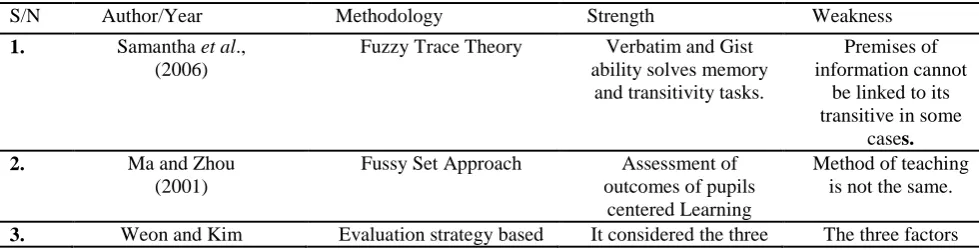
3.7 Summary of related works
Table 1. Summary of Related Works
S/N Author/Year Methodology Strength Weakness
1. Samantha et al., (2006)
Fuzzy Trace Theory Verbatim and Gist ability solves memory
and transitivity tasks.
Premises of information cannot
be linked to its transitive in some
cases. 2. Ma and Zhou
(2001)
Fussy Set Approach Assessment of outcomes of pupils
centered Learning
Method of teaching is not the same.
on Fuzzy Membership Functions factors: difficulty, importance and complexity of questions were not collectively effective
4. Hafeezullah and Aamir (2013)
EGG and fMRI brain techniques
It is used to rate retention and recall
processes
The technique signals consist of noise and artefacts
5. Audrey (2014) Fuzzy trace theory Prediction of gist and verbatim in people
with autism
Memory of verbatim information fades more rapidly than
gist traces
6. Ibrahim (2009) Evaluation of students answer scripts using fuzzy
logic
It considered the three factors: difficulty,
importance and complexity of
questions
Too large data evaluated at a time
reduce the proficiency of the
method
4. Material and methods
As this study aimed at developing logic model for the prediction of pupil memory retention, data were collected from secondary sources which consisted of private and public nursery and primary schools within the region of Ikenne Local Government Area in Ogun State, Nigeria. The data were collected from five (5) primary schools within the class of basic 4 in 2014/2015 academic session. The primary schools were selected using simple random sampling technique. They comprised
Babcock University Staff School, Ilisan, Ikenne L.G.A (Private School);
St. Banabas Welsly Primary School, Ilisan, Ikenne L.G.A (Public School);
Mayflower Nursery and Primary School, Ikenne, Ikenne L.G.A (Public School);
A.U.D Primary School, Iperu, Ikenne L.G.A (Public School); and
O &A Nursery and Primary School, Ikenne, Ikenne L.G.A (Private school).
The study population was 300 pupils while the sample used were 30 pupils each from the Basic 4 class of the schools. The data required were existing academic results of pupils in Mathematics, English and Elementary Science from the Basic 4 class. The results collected were for the last three sessions before the present class of the pupils (that is, the results of Basic 1, 2 and 3). The individual results of the pupils by school were collected as input value into the fuzzy logic model using MATLAB 7.6.0 (R2008a) to predict the retention level of the pupils.
5. Results and discussion
5.1 Formulation of Retention Prediction Model (RPM)
subjects written by each pupil, to be specific, Mathematics, English Language and Science subjects in Elementary schools. From Weon and Kim (2001), Bai and Chem (2008) contributions, the proposed research is to conduct prediction for each school rather than generalizing the prediction, using the existing results of pupils on various subjects. A proposed model was created called
Retention Predictor Model (RPM) to predict the retention ability level of pupils.
For an example let us assume that there are n pupils to write an examination in m subjects, accurate scores of pupils‟ answer scripts are the basis for evaluation and prediction (pupil‟s scores in the subject examination questions divided by the maximum score assigned to this subject examination questions). We get an accuracy rate matrix of dimension m ×n,
A = [ aij], m ×n; ………. (1)
where aijЄ [0, 1] denotes the accurate scores of pupil j on subject examination i. We are given a
grade vector
G = [gi], m × 1; ………. (2)
where gi Є [1,100] denotes the assigned maximum score of subject examination i satisfying
i= 100
Based on the accuracy rate matrix A and the grade vector G, we obtain the original total score vector of dimension n × 1,
S = AT G = [sj], n × 1, ……….…… (3)
where sj Є [0,100] is the total score of pupil j.
The „„classical” ranks of pupils are then obtained by sorting the element values of S in descending order.
5.2 Evaluation of RPM
Saleh and Kim (2001) used three node structures, they took accuracy rate and time rate to get the difficulty of the questions, but as discussed earlier that in many schools and institutions, time management is done by the pupils as total time allocated to attempt complete question paper is fixed. So how much time is taken by each pupil to attempt each question or all the questions before fixed time is uncertain, but complexity (the ability of the pupil to give the correct answer to a question) and importance (the significance of the questions) of questions are important issues that are needed to be considered. Difficulty may not be necessary as it was noted by Bai and Chen (2008) who pointed out that the difficulty factor is a very subjective parameter and may cause an argument regarding fairness in evaluation of pupils‟ academic achievement.
Therefore, in this research importance and complexity of subject‟s examination questions are taken into consideration and values are determined by domain expert or group of domain experts. If we consider group of domain experts, the average is taken for the values of complexity and importance. If l level of Importance is to describe the degree of Importance of each subject questions in the fuzzy domain. The importance of the questions is considered to be:
The Importance matrix of dimension m × l,
𝑃 = [p𝑖𝑘] , m × l, ……… (4)
where p𝑖𝑘 ϵ [0, 1] denotes the membership value (degree of the membership) of subject questions i
belonging to the importance level k. In this research, three levels (fuzzy sets) of importance (l - 3) are used: k = 3 used for linguistic term “Low”, k = 2 used for “Average”, k = 1 used for “High”.
The complexity of questions is given as: The complexity matrix of dimension m × l,
C = [c𝑖𝑘], m × l, ………. (5)
level k.
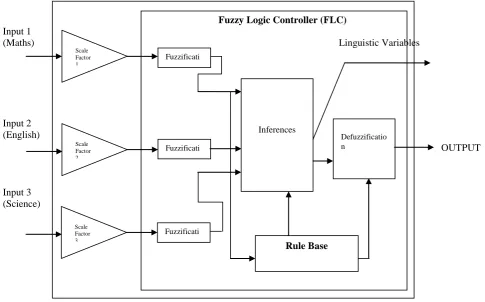
Figure 3.1 represent the architecture of Retention Predictor Model where the three inputs values are supplied into the Fuzzy Inference System (FIS). The inputs are fuzzified into the Inference engine through the knowledge base which consist of the rule base system of the model, then it is defuzzified into output.
Fuzzy Logic Controller (FLC)
Input 1
(Maths) Linguistic Variables
Input 2 (English)
Input 3 (Science)
Fig. 4. Retention Predictor Model Architecture
Rule Base
Scale Factor 1
Scale Factor 2
Fuzzificati on
Fuzzificati on
Inferences
Defuzzificatio n
Scale Factor 3
Fuzzificati on
Fig. 5. RPM inputs membership function model
The following are the three steps involved in the mode process of pupils‟ answer scripts evaluation: Step 1 is fuzzification stage;
Step 2 is Inference stage; and Step 3 is defuzzification stage.
Fuzzification stage (Step 1): Inputs are converted into membership values of the fuzzy sets. Triangular MF was used because of its simplicity and easy computation.
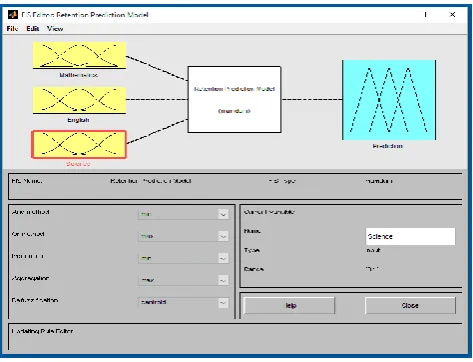
Fig. 6. RPM inputs /output membership function model
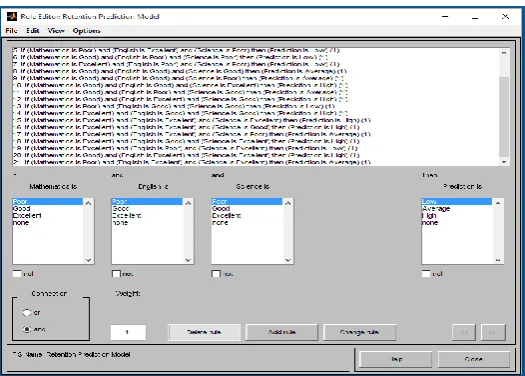
Fig. 7. RPM FIS rules editor
Fig. 8. RPM Surface viewer
5.2.1 The formula used to calculate the scores for each subject for the last three previous Sessions (Basic 1, Basic 2 And Basic 3 Scores) is;
MATHEMATICS = Basic 1 + Basic 2 + Basic 3 X 100 ; Total scores expected for the three sessions
ENGLISH = Basic 1 + Basic 2 + Basic 3 X 100 ; Total scores expected for the three sessions
SCIENCE = Basic 1 + Basic 2 + Basic 3 X 100 ; Total scores expected for the three sessions Where:
Basic 1 = 1st Term + 2nd Term + 3rd Term X 100 ;
300
,
Basic 2 = 1st Term + 2nd Term + 3rd Term X 100 ; 300
,
Basic 3 = 1st Term + 2nd Term + 3rd Term X 100 ; and 300
Total scores expected for the three sessions = 300.
5.3 RPM Model implementation and analysis
5.3.1 Input and Output design
Fig. 9. RPM input variables membership function editor
The output of the fuzzy logic model tagged prediction was created. The three levels of decision of the output in the fuzzy logic model were low, average and high respectively.
Fig. 10. RPM output variables Membership Function editor
5.3.2 Determining intervals
value in RPM output variables is formed: according to the design, if a pupil retention level is between 0.0 to 0.4, it is low, 0.41 to 0.6, it is average and 0.61 to 1.0, it is high.
5.3.3 Fuzzy mode rules editor
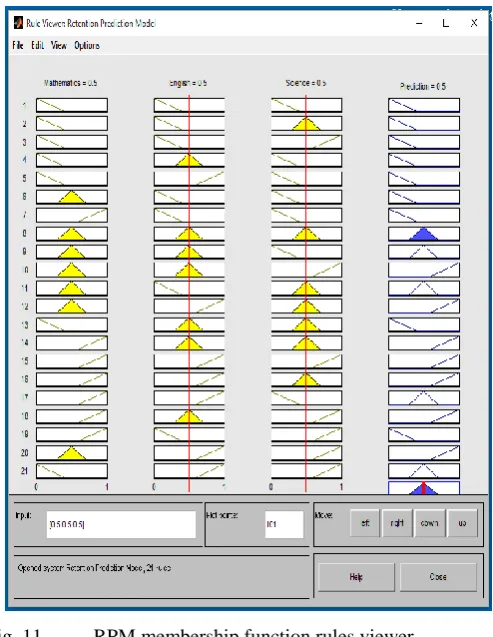
This consists of 21 rules created for the RPM fuzzy logic model, it is used to make decision on the inputs of the fuzzy logic model; the rules used in this research study are as follows:
1. If (Mathematics is poor) and (English is poor) and (Science is poor) then (Prediction is low).
2. If (Mathematics is poor) and (English is poor) and (Science is good) then (Prediction is low).
3. If (Mathematics is poor) and (English is poor) and (Science is excellent) then (Prediction is low).
4. If (Mathematics is poor) and (English is good) and (Science is poor) then (Prediction is low).
5. If (Mathematics is poor) and (English is excellent) and (Science is poor) then (Prediction is low).
6. If (Mathematics is good) and (English is poor) and (Science is poor) then (Prediction is low).
7. If (Mathematics is excellent) and (English is poor) and (Science is poor) then (Prediction is low).
8. If (Mathematics is good) and (English is good) and (Science is good) then (Prediction
is average).
9. If (Mathematics is good) and (English is good) and (Science is poor) then (Prediction is average).
10. If (Mathematics is good) and (English is good) and (Science is excellent) then (Prediction is high).
11. If (Mathematics is good) and (English is poor) and (Science is good) then (Prediction is average).
12. If (Mathematics is good) and (English is excellent) and (Science is good) then (Prediction is high).
13. If (Mathematics is poor) and (English is good) and (Science is good) then (Prediction is low).
14. If (Mathematics is excellent) and (English is good) and (Science is good) then (Prediction is high).
15. If (Mathematics is excellent) and (English is excellent) and (Science is excellent) then (Prediction is high).
16. If (Mathematics is excellent) and (English is excellent) and (Science is good) then (Prediction is high).
17. If (Mathematics is excellent) and (English is excellent) and (Science is poor) then (Prediction is average).
18. If (Mathematics is excellent) and (English is good) and (Science is excellent) then (Prediction is high).
20. If (Mathematics is good) and (English is excellent) and (Science is excellent) then (Prediction is high).
21. If (Mathematics is poor) and (English is excellent) and (Science is excellent) then (Prediction is average).
The 21 rules stated above formed the membership function for RPM Model
Fig. 11. RPM membership function rules viewer
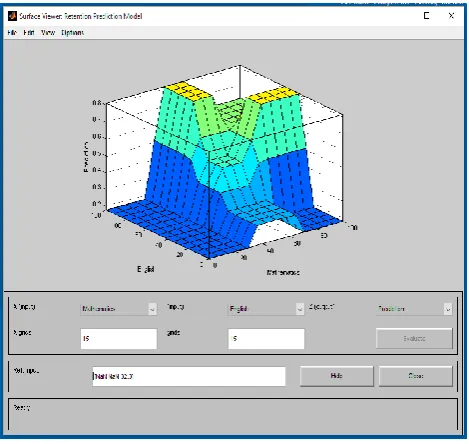
5.3.4 Fuzzy model surface viewer
Fig, 12. RPM model surface viewer
5.3.1 Discussion of RPM results
For an example from school 3, inputting the data of a particular pupil of serial number 6 from Basic one (1) through Basic three (3) into RPM model.
From Figure 14, it shows the Basic 1 result, it is read that the retention level of pupil no. 6 is 0.56 with respect to English and Mathematics, therefore, the retention level is average. This implies that the learning environment for the pupils is averagely conducive also the pupils can improve.
From Figure 15, it read that the retention level of pupil no. 6 is 0.5 with respect to Mathematics and Science, therefore, the retention level is average. This implies that the learning environment for the pupils is averagely conducive also the pupils can improve.
From Figure 16, it is read that the retention level of pupil no. 6 is 0.75 with respect to English and Science, therefore, the retention level is high. This implies that the learning environment for the pupils is highly conducive.
Fig. 13. Basic 1 data of pupil no. 6 Fig. 14. Basic 1 data surface viewer
In Basic 2 result, from Figure 18, it is read that the retention level of pupil no. 6 is 0.55 with respect to Science and Mathematics, therefore, the retention level is average. This implies that the learning environment for the pupils is averagely conducive.
From Figure 19, it is read that the retention level of no. 6 pupil is 0.56 with respect to Science and English, therefore, the retention level is average. This implies that the learning environment for the pupils is averagely conducive.
Also from Figure 20, it is read that the retention level of no. 6 pupil is 0.74 with respect to Science and English, therefore, the retention level is high. This implies that the learning environment for the pupils is highly conducive.
Fig. 19. Basic 2 data surface viewer Fig. 20. Basic 2 data surface viewer
And in Basic 3, from Figure 22, it is read that the retention level of pupil no.6 is 0.75 with respect to English and Science, therefore, the retention level is high. This implies that the learning environment for the pupils is highly conducive.
From Figure 23, it is read that the retention level of pupil no. 6 is 0.72 with respect to English and Mathematics, therefore, the retention level is high. This implies that the learning environment for the pupils is highly conducive.
Fig. 21. Basic 3 data of pupil no. 6 Fig. 22. Basic 3 data surface viewer
Table 2: Pupil no.6 of School 3 RPM result
CLASS English & Mathematics Mathematics & Science English & Science
Value Fuzzy Set Value Fuzzy Set Value Fuzzy Set
BASIC 1 0.56 Average 0.50 Average 0.75 High
BASIC 2 0.55 Average 0.56 Average 0.74 High
BASIC 3 0.75 High 0.72 High 0.75 High
From the result on the Table 2, it is read that the retention level of pupil no. 6 is increasing from Basic 1 through Basic 3. On the aggregate in basic 1 is 0.60, therefore, it is average, in Basic 2 is 0.62, it is high, in Basic 3 is 0.74, it is high. Therefore, it can be predicted that this pupil can maintain a high level of retention for the rest three (3) years.
6 Conclusion
The concept of fuzzy logic model can be widely used in any area of application; so far there is a problem to be solved. In this study, an attempt was made to predict the pupil‟s retention level using fuzzy logic on the platform of Fuzzy Inference System (FIS) of MATLAB 7.6.0 (R2008a). Evidences emanated from the results of study analysis showed that fuzzy logic system is a very useful tool for predicting pupil‟s retention ability. Retention prediction Model (RPM) created was used to predict individual pupil‟s retention ability referenced to individual school of the pupil.
The model proposed (RPM) was used to evaluate individual pupil‟s results in reference to the school of the child and make the school management, teacher, parent and pupil to know the child‟s retention status and how to improve on it. This study recommends that government and agencies should come to the aid of the Elementary level of education in Nigeria to help in improving the level of retention ability from the foundation. Also, school administrators for both Public and Private Nursery and Primary schools should work out every means to increase the level of memory retention in the children.
7 References
Alex, P. J., 2010. Memory Based Machine Intelligence Techniques in VLSI hardware. Machine intelligence research group, Indian Institute of Information Technology and Management-Kerala.
Audrey M. W., 2014. Predictors of reasoning ability: Working Memory capacity and fuzzy processing preference, Department of Psychology, Miami University, Oxford, Ohilo.
Neuroscience 4, 829-839.
Bai, S. M, Chen S. M., 2008. Automatically constructing grade membership function of fuzzy rules for students evaluation in Expert systems with Applications.
Balle B. C., (2014) . 6 Science- Backed Methods to Improve your Memory. Available at www.sciencedirect.com.
Bardley V., 2013. How can we enhance working memory, Brainfacts.org. Brain H. Q., 2013, How we Remember and Why we forget. Available at
www.sciencedirect.com.
Bradely V., 2013. How we Remember and why we forget. Available at www.sciencedirect.com. Szwarcman D. M., 2009. A fuzzy system for the Assessment of human Reliability).
Darlene P., 2013. Poor Retention in Children. Avaible at www.ispacs.com.
Qverman Ed., 2015. A Matlab Tutorial, Department of Mathematics, the Ohio State University. Hafeezullah A., Aamir S. M., 2013. Human memory retention and recall processes: A review of
EEG and fMRI studies, Neurosciences 2013; vol. 18(4):330334.
Hao zhuang, Q. et al. 2013. Adjustment of On-State Retention ability based on New Donor – Accptor Imides through Structural Tailoring for Volatile Device Applications 36, 2009, 6236-6243.
Kate F., 2014. The Split Brain: Making two hemisphere whole
Ker T., 2015. Live Science Contributor” What is Darwin‟s Theory of Evolution?
Ma J., Zhou. D., 2000. Fuzzy set approach to the assessment of student – centered learning. In transactions on Education – 43(2) , 237-241
Marcellious G., 2001. What factor effect retention in the classroom, Wakefield Hig School, Arlington Country.
Maria k., 2005. The psychology of remembering: a memory like a jounal Melanie P., 2001. Memeory Techniques.
Nidhi A., 2013 A fuzzy probabilistic Neural Network for student‟s Academic performance prediction. International Journal of innovative Research in Science, Engineering and Technology (An Iso 3297; 2007 Certified Organization) Vol. 2, Issue 9, September 2013. Mojtaba Z., 2014. Using fuzzy logic in the intelligent ATMs‟ cash management, in international
Research journal of Applied and Basic Sciences, 2014.
Regina S. C., (2007). Monitoring Students‟ actions and using teachers‟ expertise in
implementing and evaluating the neural network based fuzzy diagnostic model, in Ezepert system with application32, 200. Department of Information and Telecommunications, University of Athems, Panepistimiopolis, GR-15784 Athens, Greece. Available at www.sciencedirect.com.
Remy M., 2011. Life little Mysteries Staff writer: the difference between the Right Brain and Left Brain. Available at www.jus.org.uk.
Reyna and Llyd, 2012. Meaning, Memory and development in fuzzy – trace theory. Robert V. Lindsey, Jeff D. Shroyer, Harold Pashler.
Michael C. M., 2014. Improving Students‟ Long – Term Knowledge Retention through personalized review. Psychology Science 25, 639-647.
Saga B., 2014. Improving working memory: How the science of retention can enhace all aspects of learning.
Samantha B., Jeroen K.V., Klass S., 2006. Development and individual differences in transitive reasoning: A fuzzy trace theory apporoach. Available at www.sciencedirect.com.
Seefeldt C. and Wasik B.A. 2010. Behavioural Expectation in preschool classroom.
Conference in Recent Trends in Information Technology and Computer science (ICRTITCS-2012).
Sivanandam S. N., Sumathi. S. et al., 2010. Introduction to fuzzy logic using MATLAB. ISBN-13978-3-54935780-3S pringer Berlin Heidelberg, New York.
Tracy P. A., 2013. The Predictive Power of Working Memory and IQ in children Usha R., 2013. Mining Multi level Association Rules Using Fuzzy Logic in International
Journal of Emerging Technology and Advanced Engineering, 2013.
Wang H.Y and Chen S.M., 2008. Evaluating students‟ answer scripts using fuzzy number associated with degree of confidence. In Transaction on fuzzy system 16 (2), 403-415. Weon. S and Kim J., 2002. Learning achievement evaluation strategy using fuzzy membership
function. In proceedings of the 31st ASEE/IEEE frontiers in education conference, Reno. NV (vol. 19-24).
Wikipedia, 2012. Memory Development.