Application of Computers to Bibliographical
Information Processing : Some Developments in India (Bangalore)(10-13 July 1978)
COMPUTERIZATION IN THE REACTOR RESEARCH .CENTRE LIBRARY; A CASE STUDY
NAGARATHNA PARTHASARA THY, Reactor Research Centre, Kalpakkam 603 102.
ABSTRACT
Computerization of Library functions has many advantages over the manual methods if the areas to be computerized are chosen judiciously. A case study, of the different areas of the
Reactor Research Centre's Library that have been computerized, is presented. A database for the technical reports has been created on magnetic tape using the IBM's TEXTPAC Program
available at the IBM 370/155 System, I I T, Madras. The various programs that have been used, the options that have been taken for choosing the required output listings and the searches that are being conducted are described. The other areas, where proformas have been
developed in high level languages like Fortran and PL1 are briefly dealt with.
The factors that influenced this Library to computerise its functions are enumerated.
Nagarathna Parthasarathy
1 FELT-NEED TO COMPUTERIZE
The aim of the Library and Information Section of this Centre is to collect and supply all information re-levant to the Engineers and Scientists working in a num-ber of fields of Fast Breeder Reactor Technology.
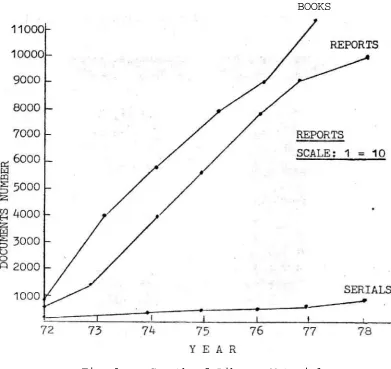
The growth of the library literature of this Centre is little peculiar. Though the Centre was established in 1968/9 the Library became a full fledged Section only in 1974. Our parent office, viz., the Bhabha Atomic Research Centre, Trombay used to cater to the needs 6f a small group of Engineers till then, on inter-library loan basis. But by 1974 the Centre expanded both in the number of scientific staff as well as research programmes. The BARC transferred its entire holdings of duplicate collection which was very considerable, as the BARC itself became one unit by combining a large number of DAE units scattered all over Bombay in the late 1950's. There was a proportional expansion in Library of this Centre both in manpower and material, and we therefore established our own procurement pro-gramme the growth of which is shown in figure 1 .
The procurement programme we are following is directly proportional to the experiment growth in re-search population together with fragmentation of areas of research. The information needs of our research programmes rose abruptly from 74 onwards and with their
complex requirements which the library had to cater to.
BOOKS
Fig. 1 Growth of Library Material
Before describing the areas which have been
com-puterized, the deciding factors which lead us to computerize the Library routines are the following:
(1) The unit economy of computerization;
Nagarathna Parthasarathy
(3) The managerial attitude towards mechanization; (4) Accessibility of programing personnel and
computer input preparation facilities; and (5) Availability of a suitable software.
The different types of literature, the existing volume of literature, the rate of increase in procure-ment, the readers population, the problem of the storage area of catalogues and indexes are other secondary but important factors which made us go in for computerizing the Library routines discarding the conventional, manual methods.
We have also felt that we would regret a great deal, if we wait for the book titles to exceed 25,000 in
number and the circulation transactions 200 per day and other statistics to increase, for adopting computeriza-tion. It is wise to take a decision at the initial stage than switching from manual to machine at a later stage when it becomes too cumbersome, frustrating and uneconomical.
With this philosophy we mechanised the library system and our first phase of the computerization was that of technical reports. Nearly 75% of literature published in the field of fast reactors and allied fields are in the form of reports and papers submitted to conferences. We have completed creating a database for our reports collection, and the design, program, input requirements for the output we need, are described
in detail. The computerization of Book section, Serials, Publication and circulation desk areas are briefly dealt with at the end of this paper.
In 1974, we received 40,000 reports and every year about 15,000 reports were being procured, until 1977 when it was decided to switch on to selective produre-ment program. The reports received in 1974 were the reports transferred from BARC and the period covered was nearly 25 years. Indexes were to be compiled for making these reports available at short notices to facilitate the access by the various approaches the users make. The conventional methods of processing were found to be too slow, too costly and too error prone. It was also realised that the conventional methods would prove unequal to the demands of both
the users and Library staff for processing. By computer-izing, the Library staff were released from doing the routine and repetitive functions and devote more time to the other areas where computerization could not be adopted. In addition to the speed of processing, re-liable control of work and high precision, the computeri-zation offered the staff and the users of the Library more information quickly and economically.
2 GENERAL ASPECTS
We decided to implement a programming language of sufficient power and efficiency to perform search, maintenance, retrieval and output preparation funct-ions depending on the types of literature, processing volume and the services the users require. For the processing of reports our goal was to optimize the following functions.
1 Ease and simplicity of data input 2 Ease of updating and correcting files 3 Preparation of multiple indexes
4 Preparation of current awareness bulletins 5 Preparation of notices for SDI
6 Retrospective searching and preparation of bibliographies
7 Rapid turn around of search requests 8 Ease of formulating searches
9 Efficiency of computer processing
10 Ability to print the upper/lower case and the other symbols and equations required for pro-cessing technical report contents.
The soft-ware we selected for carrying out the above mentioned functions was the TEXTPAC developed
by IBM. The TEXTPAC is written in a low-level language, Assembler, which is ideal considering the IBM 370/155
Nagarathna Parthasarathy
who may have little experience with the data manage-ment of computers. This package has the desired capa-bilities of a soft-ware, the outstanding aspect being
the flexibility built into it. The database allows great freedom in the use to which the system will be put while the system design allows a wide variety in its management. The text of the database is natural, normal language. Data need not be indexed and any
type of text can be used as input to the system. (It has been found with our experience that the original relationship between words within the bibliographical details of the document be kept in tact). This package is very efficient for updating and retrieval and pro-vides interface with a high level programming language
and the system requires minimum machine configuration. 21 File Structure and Format
We have considered carefully the complexity and difficulty of file structure and decided to follow the international standard of cataloguing so that the record format be compatible with the existing format of the databases. (Especially the INIS Atomindex database of IAEA, Vienna) of course the intended use of the file is paramount while considering the biblio-graphic elements to be included. The characteristics at the output stage of the data-base are the following
Current awareness lists; Cumulative indexes;
SDI notices;
Answers to queries (in batch mode); KWOC indexes;
The file structure to be chosen should have the flexibi-lity and efficiency when it comes to deleting items from the file, updating or changing description of items and retrieving items by whatever approach the users may make
The bibliographic details of the file are: The Class Number (classified according to INIS
Subject Category) Title (enriched and augmented)
Author (all) Source code and Source number
The bibliographic details, we observed, were sufficient to ensure the identification of much of the relevant material in answer to most search requests. They
re-cognise the varying needs of users by enabling each user to call on many different text processing modes and
by choosing a suitable sequence of procedures, eventually to obtain satisfactory retrieval performance.
3 SYSTEM DESIGN AND DESCRIPTION
31 Database Generation and Maintenance
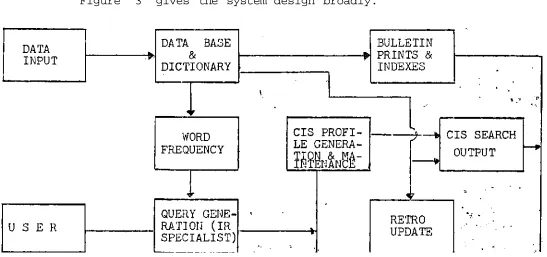
Figure 3 gives the system design broadly.
has been created or updated, it is possible to print bulletins of database additions together with various indexes.
TRC 202, the edit program reformats the input
data into normal text required by the system as follows Original Text-Input
Field name Id no. Card Coln. 1-12 Field zone 12
Example BRR740C0133
Print Control
13-13
3
20 $
Not Used
16-19.
4
Free
form Text 20-80
61
@ BOHL, W.G Coln. 1-12 functions as the computer index no. The input stream consisting of data should be strictly according to the ascending order of the id. no. The print control regulates the bibliographical detail of
the record and this also acts as a key to the index-sort programs. The TEXTPAC recommends the following print controls for the various bibliographic elements
00 Title
09 Accession number
10 Source (Publication or issuing agency) 20 Author
30 Source codes 40 Abstract of text
Nagarathna Parthasarathy
There is considerable flexibility built in the system so that by clever manipulation of combination of P C one can get any desired output one wants. For example we have adopted the TEXTPAC programs for managerial control system by dividing each P C into multiple levels. The outputs of this program are the edit output tape which is the input to search media, bulle-tin print and an optional word list tape which serves as input to the Dictionary compare program and an error list. If errors are listed by the edit program, the necessary corrections on cards are made. These corre-ction cards together with the edit text records on tape are used as input and recycled. The control card which also is input to TRC 202 indicates an update run.
There are a variety of update functions allowed and a few of them are, (a) Delete entire text data item (DT), (b) Delete from start of this print
control to end of ID (D*), (c) Delete just this print control (DC) and (d) Replace a line (RL) etc.
With these options, one does not face the problem when a weeding out program is in progress. We at this Centre had to weed out a number of plasma physics
reports as they were not required. We deleted all records of these reports on the database by using the option card D*
Column 1 to 12 13 to 15 16 to 22 23 24 25 to 80 id. no. P.C. D*
A few of the TRC202 output listings are shown in Appendix A.
32 Bulletin Print
This program is of great importance to us as (1) it provides us the options for indexes which form the potential off-line manual search media (2) Protection of records can be carried out at this
stage.
The indexes that can be selected by the Option Control Card are
1) Category 2) Subject 3) Author 4) Source code
(5) Accession number
Suppose a library is in need of only one index, say Subject index, the option to be taken is
PRINT*CHAIN=U/L*IKDEX*INDEXGEK=1 *
Other indexes can be chosen similarly. But the Isx index number must be 1 or 2 or 3.
Suppose a KWOC index is to be printed, the control option card would be
PRINT*CHA1N=U/L* INDEX*SKWOK*
The terms which are not to be considered as keywords should immediately follow the option card (with the Header card STOP LIST.)
Nagarathna Parthasarathy
Ex. Radiation damage on stainless steel pressure vessels in Fast Breeder Test Reactors
will be indexed under the keywords Radiation
Damage Stainless Steel Pressure Vessels Fast Breeder Test
Reactors.
This disadvantage can be overcome by not leaving blanks between words of a multiple worded keyword but using hypen's (-) instead. These hypens when they occur at the listing of indexes look quiet ugly and we are trying to suppress them at the output stage. In addition to providing options for compiling indexes, a page no.
option, re-start option and print option are provided at this stage.
The option for upper-case lower case print-out controls the printing at the output print stage. The printing by the U/L print chain is slower compared to monocase printout. When listings are being done for testing purposes, normally one does not require the U/L printing. The option at this stage is naturally the monocase. Great care is to be taken while exe-cuting this option when the data input stream is tagged with an @ if the first letter of the word is to be upper case or @@ if the full word is to be in upper case. By giving a foldin statement at the
print control card of the program, these indicators can be suppressed.
The restart option is to choose a portion of the database which is to be sorted for compiling indexes. If for example the first id no. of the data input in 1978 starts with the no BRR780000001 and a supple-ment index is to be compiled for all the data input later to this no. a restart id. option would be taken as under
PRINT*CKAIN=U/L*II\T3EX*RESTARTID*STARTID=BRR 780000001*
There is no option provided for suppressing the bulletin print if only the indexes are desired.
However, by the control card//PRINT DD DUMMY* DCB= (BLKSIZE=133) the bulletin print can be suppressed.
Nagarathna Parthasarathy
The sorted indexes are inputted to the Index print (TRC 021) program. The outputs of this program are the sorted indexes and KWOC listing. In addition to repeat-ing the various options that we have considered at the Bulletin program stage, the date option card shown below is mandatory here.
DATE=20JAN78*CHAIN=U/L*
The database creation and bulletin print programs that have been described are schematically shown in figure 4 with the types of secondary storage we have used.
The following are the core requirements (Approx.) Edit 120 K*
Bulletin Print 64K
•
INDEXSORT 162K* INDEXPRINT 32K
*ACTUAL CORE depends on program options and amount of data processed 32 Indexing
While discussing the format and file structure of the records that have to be inputted to the database, the problem of indexing was not considered. The highly uneconomical and tediousness of indexing is posing a problem to us in the sense that the existing thesauri are not able to satisfy our users when specific answers are required.
Example: A report on 'Preliminary measurements at
a Kohlenstein Insulation' would be indexed under
Pressure tubes Based on the INIS Helium cooled Reactors and {Thesaurus
Thermal testing 5 nesaurus
Naturally a specific query against Kohlestein insulation would not be retrieved and the second stage of search viz., 'thermal testing' gives a user with abundant ans-wers where he has to search for Kohlestein insluation. Considering the users efforts and input cost, the
con-trolled vocabulary subject indexing may not be an ideal situation. As the TEXTPAC allows in its search programs the retrieval of references, where the query word is matched with the occurrence of the word in any section of the record, manual indexing perhaps may not be very-essential . We are studying the types of indexing, the word relationships and the frequency of occurrence of
the words by the statistical approach to eliminate manual indexing if possible.
We have considered 100 documents falling in the area of 'fuel reprocessing* and their word distribution and the choice of words. By onstructing a maxrix of these keywords (considered by us as keywords) and the Document vectors, statistical association methods are applied to compute the similarity co-efficient between terms, based on the co-occurrence characteristics of the keywords in these 100 reports. We have observed that the similerity co-efficient between each pair of words depends on the frequency with which the key terms are jointly assigned in the documents of our collection. We want to
Nagarathna Parthasarathy
We plan to construct a dynamic open ended thesaurus as far as possible in natural language for specific re-treival. We have used for this purpose the TEXTPAC
programs for the experimental collection of 100 reports. The word, frequency occurrence in the documents are
generated as an option of TRC 210. The omaha output is fed as the input to Dictionary conversion program TRC-(052). This program generates a record for each word in the database which occurs five times or more.
This output is used as input to the Dictionary update program (TRC204) which further processes the words into an operating Dictionary in alphabetical order. Updat-ing is to be done by this program only. Three options * are provided for TRC204. They are, a) create, b) up-date and c) print the dictionary. The print Dict-ionary is very useful as the user's search word can be checked against the Dictionary.
The hierarchical relationship has to be established by giving a broader term by the IR specialist. The evaluation of the automatic dictionary is to be done by comparing the pertinency of retrieved documents to the search query, as the aim of this dictionary creation is for specific retrieval. This paper will not further discuss details about this problem as a small group of documents cannot establish concrete results. They are however included in this paper to give the programs available in the package for the automatic dictionary creation.
33 The Search System
knows what the data he requires but knows little about the contents of query language. We interface the user with the machine. As we know the logic of query language and the techniques to formulate the queries, it is essential that we guide the users to get the answers.
Two types of searches can be considered by the search programs. They are (1) The CIS Search and (2) The Retro Search. Both the types of searches allow selection of documents based upon the occurrence of specified words, or specified sequence of words, the occurrence of specified words within a sentence or * within a particular print control and various combina-tions of words.
331 CIS Profile Input
The input profiles to CIS are the questions in the IR language derived out of the natural language questions of the user. These profiles are maintained in the file and they will be updated if it is necessary. The pro-gram that processes the file will correct the errors in format or logic and will generate printed output that can be corrected.
332 CIS Search
The profiles are first converted into tabular forms which can easily be matched against search
Nagarathna Parthasarathy
document file is sorted to group the outputs
correspond-*
ing to particular questions.
An outstanding feature of this system is the flexi-bility built in it. The text of the database is normal language. The entire entry in the computer file is
searched including title, author, source code, publisher, indexing terms.
The basic building blocks of the queries are single words. The connective logic terms are OR, AND, ADJACENT, WITH, ABSOLUTE and NOT. There are two more techniques, viz., the conditional masking and an unconditional mask-ing.
$$ is used for conditional masking and $* for uncondi-tional masking.
The actual matching takes place against concepts. These are logical units beginning with external symbol CON1, C0N2 etc. For greater flexibility and precision, the concepts may be built upon logic combinations.
An example of the query formulation is shown below: What are the different types of isotopes pro-duced in BARC that are used in agriculture, medicine, industry and geochronology. The query is analysed as follows:
000001 000001 000001 000001 000001 000001 000001 000001 000001 1 A1 A2 A3 A4 A5 A6 CON1 END
SUBBARAO LB RRC 08058 01
ISOTOPES WITH BARC 02 AGRICULTURE OR MEDICINE 03
INDUSTR$* OR GEOCHRONOLOGY 04
A2 OR A3 05 A3 OR A2 06 A4 AND A5 07 A1 AND A6 08
The retrosearch cuery formulation is just like the CIS query formulation. We call the profiles of CIS, as question in Retrosearch.
The different programs that are used for CIS are shown in figure
5-In CIS search a small portion of the database is searched against a large number of queries, whereas in Retrosearch a large portion of the database is
searched against a small number of queries.
4 COMPUTERIZATION IN THE BOOKS AMD PERIODICALS SECTIONS
The computerization that have been adopted in the Book Section and Periodical and Publication Section will now be briefly dealt with.