University of New Orleans University of New Orleans
ScholarWorks@UNO
ScholarWorks@UNO
University of New Orleans Theses and
Dissertations Dissertations and Theses
Spring 5-13-2016
Happy Trails
Happy Trails
Elizabeth A. Derby
University of New Orleans, New Orleans, [email protected]
Follow this and additional works at: https://scholarworks.uno.edu/td Part of the Fine Arts Commons
Recommended Citation Recommended Citation
Derby, Elizabeth A., "Happy Trails" (2016). University of New Orleans Theses and Dissertations. 2142. https://scholarworks.uno.edu/td/2142
This Thesis is protected by copyright and/or related rights. It has been brought to you by ScholarWorks@UNO with permission from the rights-holder(s). You are free to use this Thesis in any way that is permitted by the copyright and related rights legislation that applies to your use. For other uses you need to obtain permission from the rights-holder(s) directly, unless additional rights are indicated by a Creative Commons license in the record and/or on the work itself.
Happy Trails
A Thesis
Submitted to the Graduate Faculty of the University of New Orleans
In partial fulfillment of the Requirements for the degree of
Master of Fine Arts In
Fine Arts
By
Elizabeth Agnes Derby
B.A. College of Charleston, 2010
ACKNOWLEDGEMENTS
This thesis is dedicated to the wonderful faculty members of the Fine Arts department of the University of New Orleans, and my fellow peers in the Master of Fine Arts program who have provided a helping hand, and an open ear. I would like to give special thanks to the members of my Thesis Committee, without whom I would not have made it to this point. First to Rebecca Reynolds for being able to read my mind when my mouth deserted me in attempting to communicate, and for enlightening me about Contemporary Art; Tony Campbell for taking me on as my minor Professor, getting me through my disco nightmares, and always looking so very dapper; and Richard Johnson for sponsoring me in the program and having my back along the way. I would also like to thank Kathy Rodriguez for her generosity in keeping me on at the UNO St. Claude gallery, Cheryl Hayes for her wisdom and conversation, and Aaron McNamee for his sculptural knowledge and support of my work. I would also like to give a shout-out to David Collanino, the only other member of the class of 2016, who despite being my complete opposite has broadened my perspectives, and inspired work I never thought I would make.
I would like to extend the biggest thanks to my family and friends for putting up with my erratic behavior while navigating this strange and sometimes extremely
TABLE OF CONTENTS
List of Illustrations……….v
Abstract ……….vii
Introduction: Identity can be such a Drag……….. 1
Brunette. Blonde. Lavender………..4
Oprah Dreams………...9
Muppet Minimalism………...13
Little Gay Deer………...15
Chest Hair and Happy Trails……….17
Maybe it’s Maybelline, Maybe it’s a Man in a Dress………22
Camp………25
Wigs……….31
Hair Creatures………36
Conclusion………41
References………42
LIST OF ILLUSTRATIONS
Figure 1 Marcel Duchamp, Fountain, 1917…………..2
Figure 2 Warenshinobu Hairstyle………...6
Figure 3 Sakko Hairstyle………6
Figure 4 Lorna Simpson, Wigs, 1994. ………6
Figure 5 Ellen Gallagher, DeLuxe (Detail), 2004-5. ………...7
Figure 6 Hair Paintings, Fall 2013. ………..8
Figure 7 Kiki Smith, Tail, 1992. ……….9
Figure 8 Robert Gober, Untitled (Torso), 1990. ………..9
Figure 9 Cindy Serman, Untitled Film Still #14, 1978. ………..10
Figure 10 Wig Taxidermy, Spring 2014. ………10
Figure 11 Hair Monster Consumption, Spring 2014. ………..11
Figure 12 Hair Monster Expulsion, Spring 2014. ………..12
Figure 13 Robert Rauschenberg, White Painting (Three Panel), 1951. ………13
Figure 14 Ad Reinhardt, Black Paintings, 1960s. ………13
Figure 15 Rauschenburg and Reinhardt, Spring 2014. ……….14
Figure 16 sassy red headed stepsister, Spring 2014. ………..14
Figure 17 Nurturant Kitchen. Womanhouse, 1972. ……….15
Figure 18 Cristiano Ronaldo for Giorgio Armani, Spring 2010. ……….17
Figure 19 Mikael Jansson for Calvin Klein, Fall 2015. ………..17
Figure 20 Body Hair Drawings, Pen on Paper, Fall 2013……….18
Figure 21 Bear, Bear Cub, Otter, Spring 2014. ………..19
Figure 22 #hairymen #furrymuff, Spring 2015. ………...20
Figure 23 Sandro Botticelli, The Birth of Venus, 1486. ……….20
Figure 24 Venus on the Half-Shell, video still, Fall 2015. ……….21
Figure 25 Maybelline Lash Stylist Mascara Print Ad, 2000. ……….22
Figure 26 Cockette Wally 1972. ……….23
Figure 27 Maybelline Great Lash Mascara Commercial, 1991……….24
Figure 28 Maybe She's Born With it, Maybe She's a Man, video still, Fall 2015………..24
Figure 29 Our Lady of Gagalupe, Oil on Canvas, Spring 2014. ……….27
Figure 30 Our Lady of Guadalupe, unknown origin. ……….27
Figure 31 My Pink Hairy Box on a Nice Set of Legs with Matching Drapes and a Luxurious Fur Rug, Installation view, Spring 2015. ………28
Figure 32 Dreaded Chandelier, Spring 2015. ………..29
Figure 33 Andy Warhol, Self Portrait (in Drag), 1980-1982……….32
Figure 34 Picture Day, installation view, Fall 2015. ………..34
Figure 35 Mike Kelley, Craft Morphology Flow Chart, 1991. ………34
Figure 36 Wig Dissection, Spring 2015. ……….34
Figure 37 Yayoi Kusama, Love is Calling, 2013. ………36
Figure 38 Jareth, installtion view, Fall 2015………...37
Figure 40 Lady In Red, installation view, Spring 2015. ………37
Figure 41 Lady in Redwith Barbie Doll Hands, Fall 2015. ………..38
Figure 42 Wig Slug, detail, Fall 2015. ……….38
Figure 43 Wig Slug, installation view, Fall 2016………..38
Figure 44 Ice Cream Babies, mixed media, Installation view, Fall 2015………..………..39
Figure 45 Fragonard, The Swing, 1767. ………40
ABSTRACT
My work uses hair as both a subject depicted in drawings, paintings, and prints; as well as a medium for sculpture, installation, and video created with synthetic hair pieces and wigs. I am interested in deconstructing gendered codes of appearance, and visions of the ideal woman and man as objects. I remove all identifiable traits from my characters, apart from their hair which appears to be consuming or erasing them. In doing so, I force the people viewing my work to rely on cultural stereotypes associated with hair to identify my characters. My work is heavily influenced by Drag culture and Camp, for their ability to mock identity, gender, and cultural stereotypes and portray them as something fluid that can be constructed and changed on a daily basis, instead of a biological trait forced upon them at birth. I view my artwork as my own form of Drag.
KEYWORDS:
INTRODUCTION: IDENTITY CAN BE SUCH A DRAG
In RuPaul’s book Workin it! RuPaul’s Guide to Life, Liberty, and the Pursuit of Style, she introduces the saying “’you’re born naked and the rest is drag’…Drag isn’t just a man wearing false eyelashes and a pussycat wig. Drag isn’t just a woman with a pair of glued-on sideburns and an Elvis jumpsuit. Drag is everything. Whatever you put on after you get out of the shower is your drag…The truth of who you really are is not defined by your clothes.” 1 She elaborates on this in an interview she did recently with Vulture, when asked how the function of drag has changed: "The function hasn't changed. It's been the same -since the beginning of time when shamans, witch doctors, or court jesters were the drags- which is to remind culture to not take itself seriously. To remind You that You are not your shirt or your religious
affiliation but that You are an extension of the power that created the whole universe. You are God in drag. You are dressed up in this outfit of a body, which is temporary. You are eternal. You are forever. You are unchanged. And this is a dream you're having. So don't get too attached to it. Make love. Love people. Be sweet. Have corn dogs. Dance. Live. Love. Fuck shit up. But it's all good. You can't fuck it up because you're eternal."2
Jacques Lacan believes that the moment a human is able to recognize its image in a mirror, not as a reflection but as “I”, there is an immediate transformation that leads the individual to both a representational view of himself and an ideal person to which he strives.3 This ideal vision is created in relation to the fictional development of the ego, where our lives become stories and we develop a vision of ourselves as the protagonist of our story. This links the subject’s psyche to the world outside, the groundwork for our cultural formation of
identity. Our aims and desires are shaped by the desires of others, in interpersonal terms and in terms of social expectations and prohibitions. Our knowledge of the world comes to us by way of other people; the language we learn to speak pre-exists us, and to a great degree our thoughts conform to pre-established concepts and linguistic structures. As we assimilate to these social conventions, the pressures of our instinctual drives--sexuality, for
1RuPaul, Workin' It!: RuPaul's Guide to Life, Liberty, and the Pursuit of Style (2010), ix.
2E. Alex Jung, "Real Talk with RuPaul," Vulture, last modified March 23, 2016, http://www.vulture.com/2016/03/rupaul-drag-race-interview.html. 3John Zuern, "Lacan: The Mirror Stage," Department of English, University of Hawaii at Mānoa | University of Hawaii Department of English, last
appear to us as threats, as "dangers."4 The pre-established concepts and linguistic structure that Lacan refers to is the heteronormative binary view of gender and sexuality created by our masculine-dominated society. Anything that does not fit into this view of society becomes a danger. Thus drag becomes a danger, because it blurs the lines of masculinity and femininity that fit with our cultural expectations of identity. By putting on the exaggerated costume of a stereotypical woman, drag queens are corrupting the illusion of gender as a binary code of aesthetics. Essentially mocking identity.
Marcel Duchamp’s approach to the aesthetic codes of the art world through his readymade sculptures is similar to how drag approaches gender. Duchamp took an ordinary
object, a urinal no less, put it in a gallery, signed it, and called it art. He was essentially giving it a costume that conformed to the art world’s rules of aesthetics, and the cultural concept of art. Duchamp explained “I thought to discourage aesthetics... I threw the bottle rack and the urinal in their faces and now they admire them for their aesthetic beauty.”5 Duchamp’s ready-mades forever changed the way the world would view art by ushering in an era where the function and form of art was no longer dictated by the aesthetic codes of the art world, but by the artist. Duchamp’s Fountain (fig. 1) has become one of the most important pieces in the history of art, and holds a specific place of reverence in our mainstream society. Fountain was able to find its place in the mainstream, because unlike drag it was not challenging the sensitive subject of identity, particularly masculine identity-the superior gender.
I view my art as my drag. Instead of viewing my work as paintings or sculptures or prints or any other defined form of art, I view each work as a figural representation of a
character. These characters allow me to question the way our society uses physical appearance as a semiotic language communicating identity. Formally, my body of work consists of a series of sculptures, installations, prints, drawings, paintings, and video investigating the way hair functions as a semiotic language. Each of my pieces depicts a character who has either been
4Zuern, "Lacan.”
consumed or erased by their hair. By removing any other identifiable characteristics that communicate identity, I force viewers to create their own assumptions about the identity of my characters based solely on their hair. I do this to expose the problematic nature of determining identity through aesthetics. When my characters are consumed by their hair, it shows how painful and destructive this method of identification can be.
My work aims to reclaim these stereotyped cultural objects and transform them into something strange and beautiful. The abject use of hair as a detached body part forces the viewer to make a slew of visceral personal opinions in regard to my characters:
Attractive/repulsive, beautiful/ugly, art/not art. My work thrives in that little slash. I’m not giving you any more information than length, color, and cut. It is you who gets to decide what side of the slash you choose to put my work on. What one person finds disgusting, another will find incredibly beautiful. What one person finds offensive, another will find amusing. What one person considers art, another will refuse. In her essay, “Notes on Camp,” Susan Sontag reveals this in her discussion of the “dandy”, “The old-style dandy hated vulgarity. The new style dandy, the lover of Camp, appreciates vulgarity. Where the dandy would be continually
offended or bored, the connoisseur of Camp is continually amused, delighted. The dandy held a perfumed handkerchief to his nostrils and was liable to swoon; the Connoisseur of Camp sniffs the stink and prides himself on his nerves.”6 My work lives in a world where the identity that you are born with and all of the judgments and stereotypes that come along with it are
circumstantial. In my little campy world of hair you are free to throw away this inbred identity and completely transform yourself or your identity into whatever you want it to be. The old style dandy will view my work with disdain and my characters will be consumed by their hair. The new style dandy will sniff the stink and my characters will be freed from consumption and transform into something beyond their hair.
BRUNETTE. BLONDE. LAVENDER.
My first works in graduate school were inspired by the way that changing my hair color elicited a profound change in my daily life. After hearing my mother tell me for many years that I should just wait to dye my hair because I was going to be gray by thirty, I decided to dye my hair from brunette to blonde. The change was palpable. People treat you differently when you’re blonde; they smile more, they’re more willing to engage in conversation. This sociological phenomenon has been investigated by Dr. Lisa Slattery Walker, who believes that hair color absolutely has an effect on how people are treated, noting that blondes are given higher salaries, blonde waitresses make more in tips, and people tend to be nicer, and are more likely to help out someone who is blonde.7 On the other hand, blonde came with a slew of negative connotations as well. Catcalls became a daily occurrence; my intelligence was
constantly questioned. I was no longer able to perform simple tasks like lifting something heavy, or carrying bags to my car without a constant stream of offers for help. I also found that the way that I was approached in conversation and flirtation by the opposite sex was
formatted completely differently than how I was spoken to as a brunette. There was an expectation to the way they formatted their questions, as though because I was blonde I was more likely to go home with them.
After almost three years of being blonde, I decided to dye my hair lavender. While the transition to blonde was palpable, adjusting to lavender verged on overwhelming. Simple tasks like getting gas or going to Walgreens became a silent battle with the gaze. I was constantly being blatantly stared at. I had unwittingly removed myself from the cultural formation of feminine beauty in our society; I was not ugly; I was not beautiful; I was undefinable. This made me an outsider: something strange, something to be stared at, and in some cases
something to be feared. The moment that this circumstance slapped me in the face is one I will never forget. I was in the grocery store having a heated internal debate between olive oil and rosemary Triscuits or just plain original Triscuits because goddamn they are salty and
delicious. My concentration was broken when a mother and her two daughters turned down the aisle, the daughters giggling and the mother preoccupied with her phone. I turned my head
7WCNC Staff, "Blonde Vs. Brunette: Does It Determine How You Get Treated?," WCNC, accessed April 4, 2016,
to look at the girls, smiling as their eyes lit up, ogling all the new colorful boxes and packaging. I then watched as the mother put down her phone, looked at the girls, the boxes, then me; I saw her mouth drop and eyes widen in horror as she grabbed her daughters’ arms and backed hastily out of the aisle.
This experience illuminated the massive implications that hair can have on perceived identity. I was perplexed at how two rounds of bleach and a slight change in the tone of my hair seemed to erase everything else about my identity. Non-traditional hair colors have a historical association with outsider subculture. The highly stylized aesthetic of the 80’s punk scene included a rainbow array of gelled spikes and Mohawks. This influenced the aesthetic identity of the subcultures like grunge, and the rave scene that would follow in its footsteps. Around 2010 pastel hair colors began to appear in the high fashion industry, and the runways of the avant-garde. By 2012 pastel hair had made its way into the realm of the celebrity
mainstream through Kelly Osbourne and Nicole Richie, but was still relatively uncommon in the lives of the masses. As social media has given an outlet of celebrity to the masses through the “Instagram Celebrity,” self proclaimed fashionistas and trendsetters have driven “fashion hair color” out of the realm of the social outsider into the fashionable mainstream.
I began to think about how hair can function as a semiotic system of cultural identity. Ferdinand de Saussure introduced his theory of Semiotics in Course in General Linguistics. 8
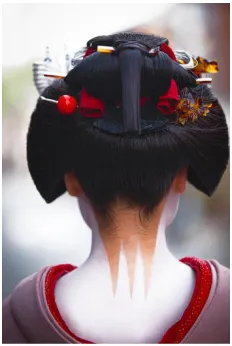
Saussure believed that language was an arbitrary construction because there is no objective relationship between the letters “d-o-g” and the actual four-legged creature it refers to. Instead language uses signs to communicate, and signs are made up of two parts, the signifier and the signified. Thus the sign “dog” is a signifier for the image of the four-legged creature, and the signified is the cultural concept of a dog. I wanted to discover how hair functions as a semiotic language, and how things like cut, curl, color, and length all have a signified cultural meaning. In Japan, hair had a very specific meaning in the Geisha culture, where specific hairstyles and hair decorations are used in addition to distinct specifications in clothing, jewelry, and makeup that indicate what stage they have reached in their apprenticeship:
After about a year, when the girl is about 16 years old, she experiences her misedashi or debut into the next level of apprenticeship. The girl’s hair is styled into a warenshinobu, an elaborate style that is commonly worn during this special event. It is adorned by kanzashi or hair ornaments which are determined by season and month of the year. After the ceremony, the maiko needs to
see a hair dresser weekly to have her hair washed and styled. She is required to sleep on a wooden box with a small pillow, called an omaku, to preserve the hairstyle even while sleeping... When an apprentice gets her first danna or patron, she changes her hairstyle to an ofuku. In the past, this hairstyle signified that a girl has lost her virginity and was often a source of embarrassment but today, geisha wear this to signify a coming of age and the completion of 3 years of training.9
Hair was equally important for Japanese men, particularly for Samurai who were identified by their top knot, a symbol of wealth and strength. A farmer or a shop owner would not have very much money and would probably be stabbed if they were caught wearing a top knot. On the opposite end of the scale from Samurai are Buddhist monks, who give up all worldly belongings in service of the temple, including their hair. This use of
hair as an indicator of wealth, marital status, or occupation has been practiced by cultures all over the world, all the way back to ancient Egypt.
These historical uses of hair as a sign have developed into our own present day cultural code of hair. Instead of being used deliberately as a tool for communication, it has
simply become a secondary sign reflecting our cultural preferences for beauty. Lorna Simpson and Ellen Gallagher have both made work exploring hair’s connection to identity in the black community and the cultural stereotyping that influences the formation of that identity. A lot of this discussion is created by whether women choose to display their natural hair or whether they are going to get it relaxed and straightened, sew in a weave, or get it braided to the head or put in rows. Simpson explores the ways black women are identified, classified, and judged based on their physical attributes; “For me, the specter of race looms so
9Spike, "Geisha Hair Styles | Geisha Culture," Geisha Culture | Understanding the Controversial World of Geisha, last modified June 18, 2014,
http://www.mcisf.com/2014/geisha-hair-styles/.
Figure 4 Lorna Simpson, Wigs, 1994. Figure 2 Warenshinobu
Hairstyle
large because this is a culture where using the black figure takes on very particular meanings, even stereotypes. But, if I were a white artist using Caucasian models, then the work would be read as completely universalist. It would be construed differently. I try to get viewers to realize … that it is all a matter of surfaces and façades.”10 Simpson’s work delves into the stigma
against black hairstyles, hairpieces in black culture, and reclaiming natural hair as a sign of black empowerment, as well as the variety of social and political implications caused by hair. 11 In her piece Wigs (fig. 4) Simpson displays twenty-one lithographs of wigs and hair pieces targeted towards black women. She removes any trace of figure, inviting the viewer to create their own narrative of the person they think would be using these pieces.
In her De-Luxe portfolio (fig. 5), Ellen Gallagher used advertisements from magazines directed at African American audiences, like Ebony and Sepia,that promote a range of beauty products aimed at women and men,
particularly hair products, wigs, and
pomades. Gallagher printed these images, and then used the addition of 3-D elements such as googly eyes and molded plasticine to cover the faces of the original models; “With
interventions such as covering up models’ faces and whiting out or cutting out eyes,
Gallagher emphasizes the complexities surrounding the construction of identity, specifically in relation to race and gender. The artist’s use of collage to unite different parts of a range of models’ pictures and the addition of extravagant new hairstyles onto female heads advertising wigs produces unsettling juxtapositions. These transformations parody the ‘improvements’ offered by the advertisements and underscore in particular the role of hair as a signifier of difference.”12
At the time I dyed my hair lavender, it had just barely begun to move into the realm of the celebrity mainstream, and thus was still closely identified with outsider subculture. The
10Barbara Pollack. 2002. "Turning Down the Stereotypes - Lorna Simpson Plays on Nostalgia and Cinematic Contrast to Illuminate Issues of Race,
Style, and the Unreliability of Memory." ARTnews 101 (8), 2002: 136 .
11"MoMA | Lorna Simpson. Wigs. 1994," MoMA | Museum of Modern Art, accessed March 1, 2016,
http://www.moma.org/learn/moma_learning/lorna-simpson-wigs-1994.
12Alice Sanger, "'DeLuxe', Ellen Gallagher: Summary |," Tate, last modified January 2010,
http://www.tate.org.uk/art/artworks/gallagher-deluxe-t12301/text-summary.
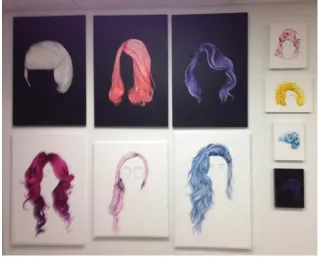
way that my own changes in hair color, particularly lavender, had drastically altered the cultural perception of my identity elicited a slightly manic preoccupation with hair and its connection to identity. I spent hours looking through pastel hair colors on Pinterest and Tumblr, searching for subjects to examine in portraiture. I found a selection of different hair colors and chose to remove any trace of the body and depict the hair as ghostly silhouettes floating in a black or white void. These Hair Paintings (fig. 6) were attempting to use Saussure’s theory of Semiotics to determine the cultural significance associated with pastel and non-traditional hair colors. By isolating the hair from the body and removing any other signs of cultural identity, the viewer is forced to determine the identity of these subjects solely by their hair.
OPRAH DREAMS
Before I could continue to make work exploring the relationship between hair and identity, I had to first re-assess my identity as an artist. I had always been a painter. I
understood paint. I could control paint. I had a visceral reverence for the viscosity of paint, the way that it escaped from its cage of a metal tube onto a palette, transforming as it mixed with its brethren. I felt at home with the feeling of brush on canvas, the familiar challenge presented by transforming a stark white void into an image.
There is also a pride that comes with being a
painter, gradually mastering the technical ability to create detailed replications of whatever subject matter you choose to depict. Despite this reverence, I was slowly realizing that although I possessed the technical ability to produce an image in paint, the images that I was producing were unable to
transcend their life as images. They were not communicating the thoughts and concerns that initiated their production.
As I was struggling with my ability to paint images that reflected my conceptual concerns, I was experiencing a very conflicting but incredibly visceral reaction to Abject Art;
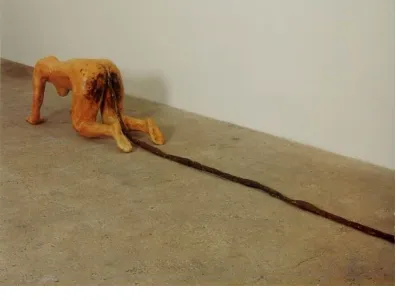
particularly to the works of Kiki Smith, Robert Gober, and Cindy Sherman. The first time I saw Smith’s work, in particular Pee Body
and Tail (fig. 7) I was absolutely horrified; the images of ripped,
torn, and defecating bodies made my skin crawl. Gober took a more playful approach to the abject, combining household objects and detached body parts to communicate feelings of attachment. I was particular taken with Untitled (Torso) (fig. 8), in which Gober cast a bag of flour, and covered it in skin-colored beeswax
depicting a sagging torso given half male and half female characteristics of the chest. I enjoyed this playful abjection of the body.
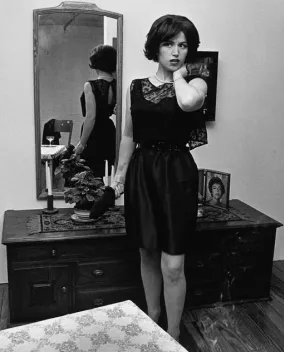
Cindy Sherman’s Untitled Film Stills (fig. 9) are a series of black and white
photographs where Sherman poses as different stereotypical female roles. This body of work Figure 7 Kiki Smith, Tail, 1992.
views gender as a social construction rather than a biological construction, and the characters she depicts reflect the way the Gaze turns woman into object. In the 80’s Sherman began to use
bright colors to depict subjects that have fallen victim to society’s visual standards of beauty and are suffering from eating
disorders and insanity.13 After this she turned to the grotesque in her fairy-tale and disaster imagery where her subjects are being turned inside out. Hal Foster discusses Sherman’s work in his essay “Obscene, Abject, Traumatic,” saying that Sherman’s
“impulse to erode the subject and to tear at the screen has driven Sherman from the early work, where the subject is caught in the gaze, through the middle work, where it is invaded by the gaze, to
the recent work, where it is obliterated by the gaze.”14 Sherman uses the abject form of the body throughout her work to show the destructive potential of the gaze. Despite my initial repulsion to some abject art, I began to realize the abject nature of hair when it is removed from the body. While a full head of long, luscious, blonde hair is a sign of attraction and beauty, a single blonde hair in your food or a clump of moldy blonde hair pulled from a bathtub drain is repulsive.
An impromptu trip to Oprah Beauty Supply deep in the heart of Kenner illuminated the potential of hair as an artistic medium. It was like walking into an art supply store. The walls of braiding hair in a rainbow array of
colors were begging me to use them like paint. Hairspray became workable fixative. Bobby pins became nails. I went back the next day and stocked up on as many different hairpieces in as many different colors as I could afford. I dug out the wig
heads that I had used for a previous installation, and used modeling clay to sculpt strange waxy faces onto the Styrofoam forms. I teased packs of kanekelon braiding hair into tufts and
13Marion Arnold, Simone Matthews, and Outi Remes, "Cindy Sherman's Untitled Film Stills," Webexhibits, accessed March 1, 2016,
http://www.webexhibits.org/colorart/sherman.html.
14Hal Foster, "Obscene Foster, Abject, and Traumatic", Law and the Image / Ed. by Costas Douzinas and Lynda Nead. 1999 (40-256), 113. Figure 10 Wig Taxidermy, Spring 2014.
attached them to the heads, building these strange lumpy hair monstrosities. With each new head, the hair piles began to consume more and more of their faces. I covered the last face completely with an iridescent veil. I wanted to present the heads mounted on the wall like taxidermy. I was presenting my women as objects, trophies stuck up on the wall being consumed by this monstrous hair mass of florets, tufts, teases, and braids, just as they were being consumed by the viewer, by the gaze, and by the pressures of our societal beauty standards.
In one piece I left the face behind entirely, covering the head in giant teased up balls of blonde and white, tufts of a horrific limey green sticking out from in between. The tufts were made from braiding hair. It is very coarse and when teased back you can create a lot of volume
that you can then smooth out with more braiding hair. I was also working with these incredibly silky pieces of blue and pink hair that are meant to be sewn into one’s natural hair. I tried tirelessly to make this hair cover some of the blonde and white tufts smoothly. Instead, they became increasingly disobedient, pooling together in sections and almost strangling the hair beneath them. The piece was messy and erratic, and as I continually tried to force the hair pieces to bend to my will, it began to look mildly tortured. I realized that this was really a more proper reflection of what I was trying to communicate with the work. It was this strangely beautiful hair monstrosity that I named, Hair Monster Consumption
(fig. 11). I was responding strongly to the way this piece had completely consumed the figure,
and I wanted to make another hair monster but I was almost out of hair and it was the night before critiques- I realized the only option was to scour my own personal collection of wigs. This was a difficult sacrifice to make; my wigs were precious to me. Each of them held in their fake plastic strands the memory of a character that I had created, toiled over and for one night, maybe more, embodied. It was like destroying a past life.
I found a teal cosplay wig consisting of a short bob accompanied by two pigtails that clipped onto the wig and went down to my calves, the only appropriate hair piece for the bubble-gun wielding futuristic space bandit that I had fondly named Orbit. I had a blonde wig
that was similar but had only one long ponytail, and a massive bubblegum pink afro wig that I had never worn. I threw them all in a bag and decided that if I had time I would try and put something together. It was an hour before critique and everything else was set up, so I decided to go for it. I screwed the foam head into the wall and slipped the giant pink wig over it. It consumed the head and the surrounding 14 inches of the wall. I clipped all the long ponytails together, adding in a pink hair piece for length, and tied a red bow to cover the clip and then attached them to the center of the pink afro wig. It looked like the pink wig was vomiting out this long strand of hair that was pooling on the ground below. I pulled together some leftover tufts and scattered them in the negative space of the bubblegum afro and ran a blonde braid along the front of the piece like a scar. I named this Hair Monster Expulsion (fig. 12). These works freed me from my attachments to paint and my artistic identity as a painter, and allowed me to explore hair in new ways.
MUPPET MINIMALISM
I wanted to explore the formal qualities synthetic hair possesses if treated in a similar manner as paint. I was learning about conceptual art at the time, and I wanted to explore hair
as paint in the same purist manner as the minimalists. I bought a mass produced white gallery style canvas and covered it in pure white tracks of synthetic hair in the style of the monochromatic White Paintings of Robert Raushenberg and Robert Ryman and named it Rauschenberg. Raushenburg has said about his monocrhomatic white paintings that, “an empty canvas is full.” My canvas certainly was not empty; it had about 20 weave tracks unceremoniously stapled and sewn onto it and weighed about 12 pounds. I offset Raushenburg with an all black painting of the same size and style, my hairy cousin It replica of Kazmir Malevich’s Black Squre and Ad Reinhardt’s Black Paintings (fig. 14), and titled Reinhardt.
I have never really been able to surpass my feelings of contempt for Minimalism and the egocentric manner in which these artists spoke
about their work. Reinhardt has referred to his work as “the ultimate paintings”15 believing that he had reached the pinicle of abstract painting and that he was creating the last abstract paintings that anyone could paint. A press release for a 2013 show at Pace Gallery of Robert Ryman’s works titled Recent
Paintings,16 quotes Ryman stating that his approach
to his paintings is “to figure out how it works, the different possibilities that can happen…it’s just my sensibility, I like to know how it works and I like to know how things go together. It’s a visual experience… I have to see how it’s developing; what can come from it.”17 Having come
15Holland Cotter, "An Abstraction Shaped by Wounded Ideas," The New York Times, last modified November 21, 2013,
http://www.nytimes.com/2013/11/22/arts/design/ad-reinhardt-at-the-david-zwirner-gallery.html?_r=0.
16Pace Gallery, ""Recent Paintings" - Robert Ryman," Pace Gallery, last modified September 10, 2013,
http://www.pacegallery.com/newyork/exhibitions/12599/recent-paintings.
17Pace Gallery, "Recent Paintings”. Figure 13 Robert Rauschenberg White Painting (Three Panel), 1951.
into the program as a painter, the way that these men were discussing their work was painful to me. It felt like the epitome of the male art ego, something only a white male artist in the 1960’s would be able to get away with.
Despite my frustration with these men and these works, I was exploring hair in the same manner as Ryman was exploring paint, “trying to figure out how things work…what can
come from it…creating a visual experience.” On the canvas the hair had a natural ability to to catch light and cast shadows that changed if the hair was brushed or messy. What I loved most about these paintings is that they mocked the poumpous seriousness that bothered me so much about the artists listed
above. It was like two muppets had snuck into an art gallery and hung themselves on the wall. They had combed their hair and made sure to look stern and serious, but they were snickering silently to each other as the gallery patrons stared at them in deep discussion about how important and meaningful they were. They were my first art drags. They had put on an exaggerated costume of minimalism and were challenging the constructs that gave Rauschenberg and Reinhardt’s paintings their validity, saying if that can be art, then we are definitely art right now. We have all the forms of a painting; we’re on a canvas, we’re hung on wall, we’re an exploration of color and material and lack of symbolic imagery. They were my Muppet Minimalism.
I wanted to create a more feminine version of these two very serious masculine Minimalist paintings. I bought a slightly taller and skinnier gallery style canvas and covered it
with bright fuscia hair, the most blatantly feminine color possible. I pulled her hair into pigtails and hung her next to Rauschenberg and Reinhardt. She was the epitome of Muppet Minimalism in that she was not Minimalist at all. She was Minimalism’s sassy red headed step sister (fig. 16), the one you don’t want to invite to your classy party because you know she’s going to drop a full glass of red wine and laugh too loud. Then when she starts telling embarrasing stories from your childhood everyone is going to find out that you’re related and your whole pompous fake façade will come crashing to the ground when everyone realizes that you’re really just an imposter, or in this case a muppet.
Figure 16 sassy red headed stepsister, Spring 2014.
Figure 16 Rauschenburg and
LITTLE GAY DEER
After red headed step sister, I wanted to explore Femininity more in my work and began looking at the feminist art movement of the 1970s. I had just read Linda Nochlin’s 1971
essay “Why Have There Been No Great Women
Artists?” and I was completely enamored with
the feminist art of Valie Export, Lynda Benglis, and Carolee Schneeman. I was obsessed with
the Womanhouse; I couldn’t get the image of
the kitchen covered in boobs out of my mind
(fig. 17). These women were calling out the
blatant imbalance in the art world between male and female artists. Frustrated with the favoritism towards men in both the art world and in society, they were proudly exploring the biology of the female body and fighting against common stereotypes associated with women. By celebrating the female body, using it as a source for imagery and performance, they were taking it out of the closet of shame it had been put into, and redefining it as something to celebrate womanhood instead of being the coveted property of men. They were defiantly posing as goddess figures, reclaiming another realm of female imagery that had long been the coveted subject matter of men as they used it to construct their idealistic view of woman as the ultimate object of desire. They were also reclaiming craft-based works that were associated with women, making high art out of media such as embroidery and pattern-making, and other stereotypical “women’s work.”18 I was inspired by these women, I felt that it was my duty as a woman and an artist to follow in their footsteps and create work that challenged the
patriarchal image of women in some way.
I was in a thrift shop in the French Quarter one day that had a wall full of taxidermy animals: massive buffaloes, majestic ten point bucks, bearded mountain goats, obscure beasts of unknown origins. Among these beasts, there was one little deer that stuck out to me in particular. He was small and he barely had 4 point antlers. He had been mounted with his two
18Tate Modern, "Feminist Art," Tate, accessed April 4, 2016, http://www.tate.org.uk/learn/online-resources/glossary/f/feminist-art. Figure 17 Susan Frazier, Vicki Hodgetts, Robin Weltsch. Nurturant
front hooves each bent at a 90-degree angle and attached below him to be used as coat hooks or a gun rack. Someone had knocked into one of the hooves and it was hanging upside down, resembling a popularized hand gesture usually used to refer to effeminate men. He just looked so strange and out of place among the rest of these beasts, this fabulous little gay deer pleading with me to get him the hell out of this place.
I’ve always had a strange fascination with taxidermy, probably due to my childhood summers spent at our family’s farm, hanging out with my cousins in a hunting lodge crowded with almost 100 years worth of stuffed animals. I enjoyed playing with the animals as a little girl, sitting on the massive three foot ridged shell of a snapping turtle, petting the fur of the softer animals. There was a duck that I named Gloria that I like to carry around. Looking at it now, my girlish naïveté in treating these creatures like toys and stuffed animals was
completely bastardizing the function of taxidermy as a trophic testament to man as the hunter and provider. My view of the societal function of taxidermy is to show that men are the top of the food chain, that they have conquered ferocious beasts, and that they are the epitome of strength and the ultimate protector and provider. My personal feelings are that taxidermy is a representation of the insecurity and ego of man by needing to engage in the hunt for sport and wasting the precious meat, skin and bones that hunting was intended to provide in favor of a fur-coated trophy.
Little gay thrift store deer was the embodiment of the absurd, decorative, ego massaging that taxidermy really is. Not only was he relatively small and unimpressive by hunting standards, but he was up for sale in a thrift store, lost on a wall of forgotten trophies looking for a new home. I wanted to transform this discarded totem of masculinity into something overtly decorative and feminine. Taking inspiration from the Pattern and
Decoration movement, I picked a vintage pink and turquoise floral wallpaper pattern to paint his fur. I bought some dainty yellow lace to cover the plaque and stick-on pearls and
CHEST HAIR AND HAPPY TRAILS
Despite the antagonism for masculinity that Little Gay Deer depicted, I have long had an obsession with male body hair as a somewhat debatable cultural symbol of manliness. Body
hair lives in the realm of the slash between attraction and repulsion and masculinity and femininity. While I have a
fetishized view of body hair and consider chest hair the ultimate symbol of Masculinity, there are a far greater amount of women who find it repulsive and would not be attracted to an un-groomed man. This is reflected in the commoditized images of the ideal male and female used in advertising campaigns. The hairless sculpted man in this underwear campaign (fig. 18) is the epitome of man as object. He bears a strong
resemblance to the classical image of man depicted in marble sculptures of the time; lean, sculpted muscles, and hairless. The female image object (fig. 19) is similarly lean and hairless, her ideal weight fluctuating to reflect the current standards of beauty, from the full-bodied women depicted in classical paintings to the
emaciated models of the 70’s. There is nothing natural about these images at all, particularly in the case of the hairless object male. This is why I have such a fascination with men’s body hair as a symbol of masculinity, particularly when you look at the role of body hair in gay culture.
The stereotypical traits associated with the gay male identity are largely negative traits associated with the stereotypical female; both women and gay men are considered to be weak, dependent, vain, and overemotional. This same reversal of traits applies to the butch lesbian who displays the masculine traits of toughness, self-reliance, and aggression.19 The way that our society has constructed these stereotypes is based on the heteronormative binary of gender created throughout the history of our masculine-dominated society. Since these men
19Linda Brannon, Gender: Psychological Perspectives (Boston: Allyn and Bacon, 1996), 162. Figure 18 Cristiano Ronaldo for
Giorgio Armani, Spring 2010
view homosexuality as an affront to their masculine identity, they have turned it into a perversion, a crime against nature. By imposing feminine traits onto the stereotypical gay male, they separate them from their own straight masculine identity. The gay community, who could care less about these heteronormative perceptions of manliness, choose instead to celebrate their gender and the wonders of a natural man’s body, hair and all. And from that celebration a vast array of gay subcultures have developed based solely on the body: “Bears”, “otters”, “wolves, “cubs”, “pups,” etc.
My first works investigating body hair in relation to masculine identity were created in my first semester alongside my Hair Paintings. While I chose to focus on fashion hair color in
the identity of my female characters, I wanted to explore body hair in the identity of my male characters. Instead of looking to Pinterest for source imagery for the men, I reached out through Facebook asking my male friends to send me
pictures of their hair, body hair, and facial hair. Some people were excited about my project and jumped at the chance, other people were affronted by the personal nature of the request, and other people just thought the whole thing was far too strange. As with the Hair Portraits, I removed the figure from the drawings and depicted only the hair in the images that I received.
have a stronger impact the closer it was to life size, initiating an abject response where the viewer is inclined to replace the absent form with their own body. Given the painstaking
process of etching, I wanted these prints to display chest hair with the amount of majesty and reverence that I held for it personally. Since my fetishistic level of appreciation for body hair is only matched by gay men, it seemed only fitting to create a holy trinity of gay chest hair, and I
depicted a “bear”, a “cub”, and an “otter” (fig. 21). In an article called “Gay Men: Are you a Jock, Otter, Bear, or Wolf”, blog author John Hollywood provides detailed descriptions of several of these subcultures:
Characteristically, a bear is a large, possibly heavy gay man that could also be muscular. A fairly large protruding belly is a defining characteristic of a bear. Masculinity is also a key feature of bears, and some bears are so caught up in projecting a masculine image that they shun other would-be bears who appear to be too effeminate. That said, many bears consider themselves to be harmless and even playful…For gay men, the term cub is used to describe a younger (or younger-looking) male that is usually husky or heavier in body type and is almost always hairy. While many cubs have a beard, it is not a requirement to fit this category since body hair and huskiness are the dominant features for this gay descriptor. Cubs are sometimes partnered with bears in passive relationships or with other cubs and they can sometimes be considered an apprentice to a bear…In the gay world, an otter is considered a thin gay male that is hairy and may or may not use a trimmer to shorten body hair. Some otters have beards, and some do not. Otters usually have smaller frames when compared to the heavier cub or bear and look a lot like what you would see in a picture of an otter . . . hairy. This might surprise some people who typically think of otters as smooth. Athletic but not super built, a person can be an otter regardless of age and they are considered to be part of the larger bear community..20
I wanted my next prints to engage the cultural standards of female body hair, and the general view that all natural body hair that does not grow from the head should be removed. There is an internet-fueled movement right now where women are trying to deconstruct our society’s stigmatization of female body hair by growing out their natural leg, armpit, and pubic hair, and displaying it proudly. Instead of conforming to the same heteronormative views of hair in relation to gender that advertise hairless men as sex objects and encourage women to have the same amount of pubic hair as a juvenile, these women are fighting for the natural and
20John Hollywood, "Gay Men: Are You a Jock, Otter, Bear or Wolf?," HubPages, last modified August 20, 2015,
http://hubpages.com/relationships/Gay-Men-Are-you-a-Jock-Otter-Bear-or-Wolf.
celebrating their bodies. Much like the first wave feminists were reclaiming the vagina, women today are trying to reclaim the furry muff. I chose to do two large, almost life-size prints in dry point, one displaying a woman with natural body hair, and the other mirroring the body position of the woman with a man with body hair. The pieces were titled for the hashtags that I used to find their imagery on tumblr, so the image of the woman is titled #furrymuff, and the male #hairymen (fig. 22).
I wanted to investigate the origins of the stigma against body hair, and realized that female body hair has been absent from images depicted of women for the majority of the history of art. Jill Burke, lecturer in Italian renaissance art history at the University of
Edinburgh, investigates this historical portrayal of women in a blog post titled “Did Rennaissance women remove their body hair?” She links the presence of body hair to the idea of masculinity all the way back to the 16th century. She even lists a recipe for body hair removal from 1532: “Boil together a solution of one pint of
arsenic and eighth of a pint of quicklime. Go to a baths or a hot room and smear medicine over the area to be depilated. When the skin feels hot, wash quickly with hot water so the flesh doesn’t come off.” 21I wanted to comment on the absence of body hair throughout art history, which has proliferated the association between body hair and masculinity and helped create the hairless ideal image of woman. Botticelli’s Birth of
Venus (fig. 23) depicts Venus just after her birth. She is naked and standing in a shell as she is
blown to shore. Her long red hair billows around her in the wind and she uses it to cover herself. I am very impressed that Venus managed to rid herself of all body hair between birth and being blown ashore. I wanted to question this traditional red haired, body hair free depiction of the Goddess. I found a bunch of knee length cosplay wigs and got one in blonde, black, and dark purple. I filmed each one on the green screen, mimicking the iconic Venus pose.
21Jill Burke, "Did Renaissance Women Remove Their Body Hair?," Renresearch, last modified December 9, 2012,
https://renresearch.wordpress.com/2012/12/09/did-renaissance-women-remove-their-body-hair/.
Figure 22 #hairymen #furrymuff, Spring 2015.
When I filmed the long purple hair, I put my actor in a green screen suit that had a massive curly purple bush that she covered and then slowly exposed. The first time I showed the video, I only included the blonde haired goddess. The second time, I layered all three goddesses on top of each other, coming in and out of the frame. The response showed an overwhelming preference for the blonde goddess figure.
MAYBE SHE’S BORN WITH IT, MAYBE SHE’S A MAN
I began to think about the image of the ideal woman as this goddess figure who
exudes natural beauty, and how there has been an entire consumer industry created to achieve this illusion. This idea of selling products to make you look like you aren’t wearing them is blatantly apparent in the sing-song slogan “Maybe she’s born with it, maybe it’s Maybelline.” For a long time, I viewed this slogan very negatively, it felt like the company was taking credit
for a woman’s beauty and saying that women could not be beautiful unless they were using these
products. Then you look at their advertisements, and they are using this slogan, but the model looks like she’s made out of plastic (fig. 25). I wanted to
deconstruct this notion that makeup should be used to feign natural beauty. It enforced the view of woman as a standardized object for the pleasure of men. I wanted to create work using makeup as a material, responding to the way it is used to create an image on the blank canvas of a woman’s face. I coated two 4’ x 6’ rolls of paper with old foundation that I was no longer using, and used natural tones of blush, eye shadow, and bronzer to spell out “Maybe She’s Born with it, Maybe it’s Maybelline” on the first one. On the second piece of paper I used unnatural eye shadow and blush and spelled out, “I don’t think anyone believes I was born with cat eyes and red lips.” This was my blatant refusal to
Maybelline that my makeup had to be any sort of mistakable birth right, and it was my right as a woman to use it to create whatever kind of image I wanted, be it natural or unnatural.
It was at this time that I had begun to think about the transformative abilities of makeup and wigs, and the way that this had been elevated to an art form in drag culture. What better way to show how makeup can transform your façade into the best woman you can be, than to turn a man into the best woman he can be. The term for applying makeup in drag is “beating a face,” so when you hear someone say, “Her face is beat for the Gods!” it means that the perfect amount of makeup has been applied and the resulting look is flawless. The term
beat refers to the motion of constantly dabbing a makeup sponge on one’s face .22 In drag, beating your face is just one step of the transformation process, and for some queens the application process can take several hours, depending on the illusion they are creating. There are many different types of Drag: pageant queens, comedy queens, fishy queens, camp queens, and my personal favorite the bearded queen. Fishy queens and pageant queens are attempting to create the illusion of a real biological woman. While fishy queens try to embody the natural goddess beauty sold to women in makeup ads, pageant queens mimic the stylized dresses, hair, and makeup used in female beauty pageants, in their own pageants, like Miss Gay America. Comedy queens and camp queens still exist in the realm of female impersonation and female illusion, but use a highly stylized costume form of makeup to create comedic depictions of female characters. For instance, Trixie Mattel created her drag persona with the intention of impersonating a life-size plastic doll. She even constructed her name to include the Mattel company, most famous for creating the Barbie Doll. The bearded queens, on the other hand, transcend female illusion in the form of Genderfuck, displaying both masculine and female characteristics in order to destroy the traditional binary of gender by deliberately mocking and exaggerating gender roles through costume and performance. This art form originated in the communes of San Francisco during the late 60’s, where the lines of sexual distinction became
blurred by freedom of expression and drug use. This led to a formation of a
psychedelic gay liberation theatre collective known as the The Cockettes, a group of like-minded people brought together by a full-bearded, long-haired man who renamed himself Hibiscus. They
enjoyed dropping acid and getting dressed up in extravagant makeup, glitter, and costumes free from any gender binary, and putting on performances. This idea of genderfuck has continued since then in movies like Hedwig and the
Angry Inch and even moved into the mainstream with Conchita Wurst.
22Logo, "RuPaul's Drag Race Dictionary," RuPaul's Drag Race Wiki, accessed March 12, 2016,
http://logosrupaulsdragrace.wikia.com/wiki/RuPaul's_Drag_Race_Dictionary.
I wanted to tear down the function of makeup in the heteronormative gender binary as a tool to enhance natural female beauty, and celebrate its transformative powers evidenced in drag, by genderfucking the Maybelline campaign. I went to Youtube and searched through old Maybelline commercials, eventually finding one from the 90’s for their Great Lash Mascara. I asked my mustached drag muse, Taylor Marrs to star in in the video. Since the commercial was for Mascara, I was able to contain the early shots in the video to his eyes, just as the original commercial had. The video starts out with a black screen with white writing that says some women have alright lashes (fig. 27) as they show a woman in black and white who has
average lashes, the screen fades to black again with the words, some women have… amazing lashes! Wealthier, healthier looking lashes, Are they born lucky? “oh sure”. At this point I panned out from his face and his blue mustache was revealed in all of its genderfuck glory (fig. 28). I had also used genderfuck secretly in my video working with the Birth of Venus. The actors wearing the wigs and the green screen suits had both been gay men.
Figure 27 Maybelline Great Lash Mascara Commercial, 1991.
CAMP
The early feminists of the 60’s and 70’s fought an incredibly hard battle to force the institutional structure of gender inequality into the light. The problem is that when you take a closer look at early feminism and early lesbian feminism, they were only fighting for a very specific image of women created by the straight white middle class. In her essay, “Towards the Butch Femme Aesthetic,” Sue Ellen Case introduces us to the Daughters of Bilitis, the first lesbian civil and political rights organization, founded in 1955. Their goal, as Case describes it, was to “erase butch -femme behavior, its dress codes, and lifestyle from the lesbian community and to change lesbians into lesbian feminists.”23 Case tells the sad story of a butch lesbian named Toni who goes to the DOB for help, “at our insistence, and as a result of the group’s example, its unspoken pressure, she toned down her dress. She was still very butch, but she wore women’s slacks and blouses…one of the DOB’s goals was to teach the lesbian a mode of behavior and dress acceptable to society.” 24 The DOB go on to portray Toni “similarly to the inappropriately dressed savage whom the missionary clothes and saves.” We then discover that through the DOB, Toni became fast friends with a gay man who over the months helped her to feel comfortable with herself as a woman.Case explains, “Here, in lesbian narrative, the missionary position is finally given over to a man (even if gay) who helps the butch to feel like a woman. The contemporary lesbian-identified reader can only marvel at the conflagration of gender identification in the terms of dominant, heterosexual culture with the adopted gender role playing with the lesbian subculture. If the butches are savages…the femmes are lost heterosexuals who damage birthright lesbians by forcing them to play the butch roles.”25
As a result of the early lesbian feminist desperation to conform to the straight feminist image of woman, “the lesbian butch-femme tradition went into the feminist closet…–The closet has given us camp….Camp both articulates the lives of homosexuals through the obtuse tone of irony and inscribes their oppression with the same device. Likewise, it
23 Sue Ellen Case, “Towards the Butch-Femme Aesthetic” in The Feminism and Visual Culture Reader by Amelia Jones, (London: Routledge,
2003), 404.
eradicated the ruling powers of hetero-sexist realist modes.”26 In my second year of graduate school I was introduced to Susan Sontag’s “Notes on Camp.” She states; “Indeed, the essence of Camp is its love of the unnatural: of artifice and exaggeration...a sensibility that, among other things, converts the serious into the frivolous…the way of Camp is not in terms of beauty, but in terms of the degree of artifice, of stylization….Not only is there a Camp vision, a Camp way of looking at things. Camp is as well a quality discoverable in objects and the behavior of persons…the Camp eye has the power to transform experience. But not
everything can be seen as Camp.”27 Reading this essay was like reading an almost biblical set of rules for everything that I held dear: artifice, exaggeration, stylization, making the serious into the frivolous. Camp was created by the gay community as a secret language, to mock the heteronormative gender binary, and to survive the harsh homophobia of the time. Given its origins in queer culture, it really comes as no surprise to me that I have a deep-rooted personal reverence for camp sensibility as it would seem that we have a touch of a gay gene in the family. I grew up with two gay uncles, my Uncle Frank and his partner Uncle David. My Uncle Frank also had a gay uncle, as well as a gay cousin, and my own cousin came out of the closet a few years ago. I have always felt far more attached to the gay men in my life than anyone else, and I identify with the Gay world far more than I do with the straight world that my biological identity binds me to.
In many ways, Sontag’s “Notes” led to the destruction and co-optation of the purity of Camp by letting the metaphorical camp cat out of the bag, and serving it up on a platter to the heteronormative masses. Sontag seemed to acknowledge this possibility early on when she states that “to talk about camp is therefore to betray it.” Sontag’s “Notes” are now over fifty years old and the groundwork that she laid out for Camp as a Sensibility has changed. Bruce La Bruce writes about the current state of Camp in our world in Notes on Camp, Anti-Camp,
“Camp is now for the masses. It’s a sensibility that has been appropriated, fetishized, commoditized, turned into a commodity fetish, and exploited by a hyper capitalist system…It still has many of the earmarks of ‘classic camp’-an emphasis on artifice and exaggeration and the unnatural, a spirit of extravagance, a kind of grand theatricality. It’s still based on a certain aestheticism and stylization. But what’s lacking is the sophistication, and especially the notion of esotericism, something shared by a group of insiders, or rather, outsiders, a secret code shared among a cetain ’campscenti’. Sadly, most of it falls under the category of “Bad Straight Camp”…What is Bad Straight Camp?... a performative femininity by females filtered through drag queens that has transmogrified into an arguably more “avant-garde” style (Lady Gaga,
Nikki Minaj) characterized by hyper-referentiality, extreme hyperbole, a crudely obvious, unnuanced female sexuality, and even a vaguely pornographic sensibility which, unhappily, is post-feminist to the point of misogyny: a capitulation to the male gaze and classic tropes of objectification to be found only in the worst nightmares of Laura Mulvey… Other examples of Bad Straight Camp might include the genres of extreme gross-out comedy (The Hangover franchise, Melissa McCarthy movies), certain instances of torture porn…and of course, last but not least, Reality TV, including such camp-fests as Mob Wives, The Real Housewife franchise, Toddlers and Tiaras and Jersey Shore, to name only a few. (The fact that all are probably gay-friendly does little to ameliorate their general heteronormative, capitalist and materialist tenor, with the notable exception of Honey Boo-Boo.)28
In all honesty it wasn’t until after I read “Notes on Camp” that I noticed its presence in my work. My work has always been driven by obsession. I have repeatedly depicted images of my obsessions ever since I first started painting. First it was trees, then birds, then jackalopes, then people, then spirit animals, then hair, which led to obsessively using it as a material. This obsessive nature continued into graduate school. When I was going through a period of
obsession with disco balls, nu-disco music, dancing, and the elaborate costumes of early 90’s rave culture, I obsessively created a collection of Disco Hats as a sort of interactive wearable art that could engage with a larger audience than the typical subjects found in a gallery. I then painted Our Lady of GaGalupe (fig. 29), a giant 4x6 foot panel of Lady GaGa painted into the
familiar backdrop of images of Our Lady of Guadalupe. This image combined my obsession with Lady Gaga as a personal muse for aestheticism and artifice and my obsession with saintly mandala and background of Our Lady of Gaudalupe (fig. 30. I was not thinking about Lady Gaga as a part of Camp, or as a camp character, certainly not “Bad Straight Camp”, nor was I thinking
28Bruce LaBruce, "[Essay] Notes on Camp/Anti-Camp by Bruce LaBruce," Nat. Brut, last modified March 3, 2016,
http://www.natbrut.com/essay-notes-on-campanti-camp-by-bruce-labruce.html.
Figure 29 Our Lady of Gagalupe, Oil on
Canvas, Spring 2014. Figure 30 Image of Our Lady of
about the campiness of the hats; I just happened to fall victim to my sensibilities and the work fell into “Bad Straight Camp.”
Not all of my campier art was bad though. The two campiest works from my graduate school career are undoubtedly My Pink Hairy Box on a Nice Set of Legs with Matching Drapes
and a Luxurious Fur Rug and Big Hairy Balls. The former I made
prior to reading Sontag, the latter I made after. Additionally, I would place the former on the side of good camp and the latter on the side of bad camp. My Pink Hairy Box on a Nice Set of Legs with
Matching Drapes and a Luxurious Fur Rug (fig. 31) was inspired by a
segment in “RuPaul’s Drag Race: Untucked,” where during judging the contestants are backstage drinking cocktails and Ru has one of them reach into her pink furry box and draw out a card that
instructs them to play a game or answer a trivia question about the other contestants. I enjoyed this playful language and wanted to create my own pink hairy box. I made an 8”x 8” box out of wood and covered it with the perfect shade of bubblegum pink hair. The hairy box on its own wasn’t enough; it needed to be presented in a manner befitting the glorified object it was
impersonating. I found the perfect set of legs in a booth at a flea market in Kenner. It was tucked into a corner supporting an old, incredibly gaudy, gold accented, porcelain statue of a Geisha. The table had these lovely curved legs with filigree detailing. The original marble top had been lost and replaced with a cheap faux-marble ceramic floor tile. The whole scenario of a little old man selling Asian antiques for thousands of dollars in an overwhelmingly cluttered flea market situated between a McDonalds and a Shell gas station on Veterans Blvd was ludicrous. The Geisha statue that had originally been on the table was marked at something like 12,000 dollars. The table was priced at $120. I bargained on the price and walked out with the table. I placed my pink hairy box on this nice set of legs and the candy pink hair dripped elegantly over the edges. I stared at the two together for a while, but it still wasn’t luxurious enough so I borrowed some pink and gold striped curtains with tassel fringe and completed the picture with a faux sheepskin rug from Costco. The resulting image met the qualifications of Camp as depicted by Sontag on many levels.
My next work was inspired by the phrase “Big Hairy Balls”. I envisioned them in this weird Ryan Trecartin-esque video of Drag Goldilocks traipsing through a Yayoi Kusama-like house having to make a grand decision between these three pairs of big hairy balls, and the big hairy bears that went along with them. I made the balls first and showed them as sculptures, but without the video to accompany them, and displayed in a corner lit with colored funhouse lights, I had again fallen into “Bad Straight Camp.” I created an installation next to the balls called Put your Hands in my Hairy Muff. I covered a white furry hand muff with an array of warm colors of hair, and hung it from the ceiling with fishing line. The piece hung at waist height so that you could easily slip your hands into it. If you chose to put your hands in the muff, you were positioned to face a 3 panel picture frame filled with pink, magenta, and orange hair, mimicking the colors of the muff. The piece created an interactive experience with the glorified art object. I was also tainting the glorified object and the gallery experience with blatant muff humor. These three are the only characters that I directly identify as Camp art.
Around this same time, a friend of mine had come in town to visit and she was
wearing dreadlocks, something she did not have the last time I had seen her only a few months before. She explained the process to me. She had gotten braiding hair, twisted it and boiled it and then braided it into her own hair, which was not dreaded. I was obsessed; I had to make something with dreadlocks. I decided that I wanted to work them into a chandelier. At first I imagined covering a chandelier with the dreadlocks, but I wasn’t really prepared to spend hundreds of dollars on a
instance, make up a large part of Camp. For Camp art is often decorative art, emphasizing texture, sensuous surface, and style at the expense of content.”29 While I agree with the
beginning of this statement, I have a huge problem with her belief that camp style comes at the expense of content. Camp was created as a method of communication. Camp’s whole purpose is to talk about serious issues in a way that can’t be easily detected. This is part of why I do not view the Chandelier as Camp. Though it fits in with the first part of what she is saying about furniture and visual decor, a chandelier is certainly an overtly gaudy piece of visual décor, and texture and sensuous surface are very important here. But I believe that this piece and much of my work has a lot of content, despite its campy nature. Both the chandelier and the dreadlocks are loaded with content that could be read in a number of different ways regarding race, class, wealth, gentrification, and cultural appropriation, or you can simply view it as a beautiful object. I personally choose not to tell anyone how to view this piece, because it will differ depending on your cultural identity. Just as I remove the figure from my hair paintings and prints, the figure is replaced here by a chandelier, and the viewer is at liberty to create their own narrative for the piece.