S T U D Y P R O T O C O L
Open Access
Spin in the reporting, interpretation, and
extrapolation of adverse effects of
orthodontic interventions: protocol for a
cross-sectional study of systematic reviews
Pauline A. J. Steegmans
1, Nicola Di Girolamo
2,3and Reint A. Meursinge Reynders
4,5*Abstract
Background:
Titles and abstracts are the most read sections of biomedical papers. It is therefore important that
abstracts transparently report both the beneficial and adverse effects of health care interventions and do not
mislead the reader. Misleading reporting, interpretation, or extrapolation of study results is called
“
spin
”
. In this
study, we will assess whether adverse effects of orthodontic interventions were reported or considered in the
abstracts of both Cochrane and non-Cochrane reviews and whether spin was identified and what type of spin.
Methods:
Eligibility criteria were defined for the type of study designs, participants, interventions, outcomes, and
settings. We will include systematic reviews of clinical orthodontic interventions published in the five leading
orthodontic journals and in the Cochrane Database. Empty reviews will be excluded. We will manually search
eligible reviews published between 1 August 2009 and 31 July 2019. Data collection forms were developed a priori.
All study selection and data extraction procedures will be conducted by two reviewers independently. Our main
outcomes will be the prevalence of reported or considered adverse effects of orthodontic interventions in the
abstract of systematic reviews and the prevalence of
“
spin
”
related to these adverse effects. We will also record the
prevalence of three subtypes of spin, i.e., misleading reporting, misleading interpretation, and misleading
extrapolation-related spin. All statistics will be calculated for the following groups: (1) all journals individually, (2) all journals together,
and (3) the five leading orthodontic journals and the Cochrane Database of Systematic Reviews separately. Generalized
linear models will be developed to compare the various groups.
Discussion:
We expect that our results will raise the awareness of the importance of reporting and considering of
adverse effects and the presence of the phenomenon of spin related to these effects in abstracts of systematic reviews
of orthodontic interventions. This is important, because an incomplete and inadequate reporting, interpretation, or
extrapolation of findings on adverse effects in abstracts of systematic reviews can mislead readers and could lead to
inadequate clinical practice. Our findings could result in policy implications for making judgments about the
acceptance for publication of systematic reviews of orthodontic interventions.
Keywords:
Orthodontics, Reporting, Systematic review, Intervention, Spin, Misleading reporting, Misleading
interpretation, Misleading extrapolation, Adverse effect, Adverse event, Harm, Safety
© The Author(s). 2019Open AccessThis article is distributed under the terms of the Creative Commons Attribution 4.0 International License (http://creativecommons.org/licenses/by/4.0/), which permits unrestricted use, distribution, and reproduction in any medium, provided you give appropriate credit to the original author(s) and the source, provide a link to the Creative Commons license, and indicate if changes were made. The Creative Commons Public Domain Dedication waiver (http://creativecommons.org/publicdomain/zero/1.0/) applies to the data made available in this article, unless otherwise stated.
* Correspondence:[email protected] 4
Department of Oral and Maxillofacial Surgery, Academic Medical Center, University of Amsterdam, Meibergdreef 9, 1105, AZ, Amsterdam, The Netherlands
5Studio di Ortodonzia, Via Matteo Bandello 15, 20123 Milan, Italy
Background
Readers of the biomedical literature mostly just screen
the title and the abstract of an article without assessing
the full publication [
1
]. The beneficial and adverse
ef-fects of interventions should therefore be transparently
reported in these summaries and should not mislead its
readers. Misleading reporting, interpretation, or
extrapo-lation of study results is called
“
spin
”
[
2
–
4
]. We will
as-sess in abstracts of both Cochrane and non-Cochrane
reviews whether adverse effects of orthodontic
interven-tions were reported or considered and whether spin was
identified and what type of spin.
Titles and abstracts are the most read sections of
bio-medical papers [
1
], because assessing the full research
article is often conditioned by paywalls or because of a
lack of time or language issues of the readers [
1
].
Ab-stracts should therefore clearly and truthfully reflect the
objectives, methods, results, and the interpretation of
re-search findings. The standard for Methodological
Expec-tations of Cochrane Intervention Reviews (MECIR) [
5
]
has listed a series of highly desirable and mandatory
items that should be consulted by reviewers when
pre-paring the abstract of their reviews. Item R13 of the
MECIR standard states that:
“
The Abstract of the review
should aim to reflect a balanced summary of the benefits
and harms of the intervention.
”
This mandatory item is
particularly crucial for presenting adverse effects of
health care interventions, because these effects are often
poorly reported in systematic reviews [
6
]. Numerous
epi-demiological studies have also shown that the
assess-ment and reporting of adverse effects of interventions in
primary research studies is often suboptimal [
7
–
11
]. We
adopted Cochrane
’
s definition of adverse effects:
“
An
ad-verse event for which the causal relation between the
intervention and the event is at least a reasonable
possi-bility
”
[
12
,
13
]. This definition and other key
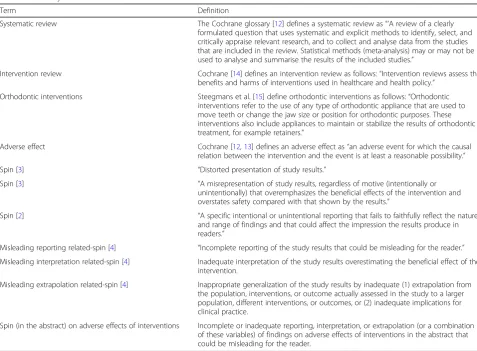
termin-ology in this manuscript are summarized in Table
1
[
2
–
4
,
12
–
15
].
When presenting information on adverse effects in the
abstract, it is also crucial that it does not mislead the
reader. A distorted presentation of study results has been
defined as
“
spin
”
[
3
], but more elaborate definitions are
also used (Table
1
). The term spin was first used in 1995
in the medical literature by Horton [
16
] and has been
fur-ther subdivided into three categories [
4
]: misleading
reporting-related spin, misleading interpretation-related
Table 1
Glossary of terms
Term Definition
Systematic review The Cochrane glossary [12] defines a systematic review as“‘A review of a clearly
formulated question that uses systematic and explicit methods to identify, select, and critically appraise relevant research, and to collect and analyse data from the studies that are included in the review. Statistical methods (meta-analysis) may or may not be used to analyse and summarise the results of the included studies.”
Intervention review Cochrane [14] defines an intervention review as follows:“Intervention reviews assess the
benefits and harms of interventions used in healthcare and health policy.”
Orthodontic interventions Steegmans et al. [15] define orthodontic interventions as follows:“Orthodontic
interventions refer to the use of any type of orthodontic appliance that are used to move teeth or change the jaw size or position for orthodontic purposes. These interventions also include appliances to maintain or stabilize the results of orthodontic treatment, for example retainers.”
Adverse effect Cochrane [12,13] defines an adverse effect as“an adverse event for which the causal
relation between the intervention and the event is at least a reasonable possibility.”
Spin [3] “Distorted presentation of study results.”
Spin [3] “A misrepresentation of study results, regardless of motive (intentionally or
unintentionally) that overemphasizes the beneficial effects of the intervention and overstates safety compared with that shown by the results.”
Spin [2] “A specific intentional or unintentional reporting that fails to faithfully reflect the nature
and range of findings and that could affect the impression the results produce in readers.”
Misleading reporting related-spin [4] “Incomplete reporting of the study results that could be misleading for the reader.”
Misleading interpretation related-spin [4] Inadequate interpretation of the study results overestimating the beneficial effect of the intervention.
Misleading extrapolation related-spin [4] Inappropriate generalization of the study results by inadequate (1) extrapolation from the population, interventions, or outcome actually assessed in the study to a larger population, different interventions, or outcomes, or (2) inadequate implications for clinical practice.
spin, and misleading extrapolation-related spin (Table
1
).
Yavchitz et al. [
17
] have ranked the various types of spin
according to their severity. The severest form of spin in
abstracts of systematic reviews and meta-analyses was
scored for
“
conclusions that contain recommendations for
clinical practices that were not supported by findings
”
[
17
]. A high prevalence of the various types of spin has
been identified in multiple epidemiological studies [
4
,
18
–
22
]. Boutron et al. [
18
] found spin in 50% (36/72) of the
conclusions sections of the main text of parallel-group
RCTs and in 58.3% (42/72) of the conclusions sections of
the abstracts. Spin was also common in diagnostic
accur-acy studies published in journals with high impact factors
[
22
]. Lockyer et al. [
21
] showed that spin is a frequent
phenomenon in abstracts of RCTs of wound treatments,
and Lazarus et al. [
4
] identified at least one example of
spin in 84% (107/128) of the abstracts of non-randomized
intervention studies. Spin is in strong conflict with the
Declaration of Helsinki [
23
] that states that:
“
Authors have
a duty to make publicly available the results of their
re-search on human subjects and are accountable for the
completeness and accuracy of their reports.
”
In this study, we will assess whether potential adverse
ef-fects of orthodontic interventions were reported or
consid-ered (i.e., discussed, weighed, etc.) in the abstract of
systematic reviews. We will further assess whether spin was
introduced regarding information on these adverse effects in
the abstract, and we will categorize the types of spin (Table
1
). We will assess these issues in the five leading orthodontic
journals and those included in the Cochrane Database of
Systematic Reviews. In these reviews, we will assess adverse
effects such as pain as a result of tooth movement and the
adverse effects defined by Preoteasa et al. (Table
2
) [
24
].
Scoping searches in the orthodontic literature confirmed the
knowledge gaps on our research questions. Our pilot studies
quantified these gaps and confirmed the need to address
these questions. We will assess these issues in systematic
re-views, because they are increasingly consulted by patients
[
25
] and when well-conducted systematic reviews are
con-sidered among the information sources with the highest
level of evidence [
26
]. Our research questions are important,
because incomplete or misleading information on adverse
effects of interventions may have detrimental effects on the
treatment of orthodontic patients.
Objectives
The objectives of this research study are summarized in
the following research questions:
Research questions
In abstracts of systematic reviews of orthodontic
interventions, were potential adverse effects of these
interventions reported or considered (i.e., discussed,
weighed, etc.)?
Table 2
Adverse effects hypothetically linked to orthodontic interventions [
24
]
Subgroup Description
Local adverse effects
Dental •Crown: decalcifications, decays, tooth wear, enamel cracks and fractures;
discolorations, deterioration of prosthetic crown (as fracturing a ceramic one during debonding);
•Root: root resorption, early closure of root apex, ankylosis; •Pulp: ischemia, pulpitis, necrosis;
Periodontal •Gingivitis, periodontitis, gingival recession or hypertrophy, alveolar bone loss,
dehiscences, fenestrations, interdental fold, dark triangles;
Temporomandibular joint •Condylar resorption, temporomandibular dysfunction;
Soft tissues of the oral and maxillofacial region •Trauma (e.g., long archwires, headgear related), mucosal ulcerations or hyperplasia, chemical burns (e.g., etching related), thermal injuries (e.g., overheated burs), stomatitis, clumsy handling of dental instruments;
Unsatisfactory treatment outcome •Inadequate morpho-functional, aesthetic or functional final result, relapse, failure to complete treatment due to treatment dropout.
Systemic adverse effects
Psychological •Teasing, behavioral changes of patients and parents; discomfort associated with pain
presence and aesthetic look discontents during orthodontic appliance usage;
Gastro-intestinal •Accidental swallowing of small parts of the orthodontic device (tubes, brackets);
Allergies •To nickel or latex;
Cardiac •Infective endocarditis;
Chronic fatigue syndrome
Cross infections •From doctor to patient, patient to doctor, patient to patient.
In abstracts of systematic reviews of orthodontic
interventions, was spin identified in the reporting,
interpretation, and extrapolation of adverse effects?
What was the prevalence of each type of spin?
Methods
This protocol is reported according to the guidance of the
Preferred Reporting Items for Systematic Review and
Meta-Analysis Protocols (PRISMA-P) 2015 statement, and the
PRISMA-P checklist is included as Additional file
1
[
27
,
28
].
We adopted the same flow of research methods as reported
in our published protocol on seeking adverse effects in
sys-tematic reviews of orthodontic interventions (Fig.
1
) and
con-ducted our pilot tests on the same sample of systematic
reviews as was described in our previous protocol [
15
]. Our
sample size of 14 reviews for the pilot test was calculated
with the formula reported by Viechtbauer et al. [
29
]. Further
details on the methods of our pilot test are reported in
Add-itional file
2
. This pilot test found that the reviewers in only
35.7% (5/14) of the abstracts reported or considered (i.e.,
dis-cussed, weighed) potential adverse effects of orthodontic
interventions. This sample identified an overall prevalence of
14.3% (2/14) of spin in the abstract on adverse effects of
orthodontic interventions. Both cases of spin were
“
mislead-ing reportmislead-ing-related spin.
”
The following sections describe
our planned methods based on these pilot tests. We will not
start the selection of eligible reviews and data extraction prior
to the complete acceptance of this protocol for publication.
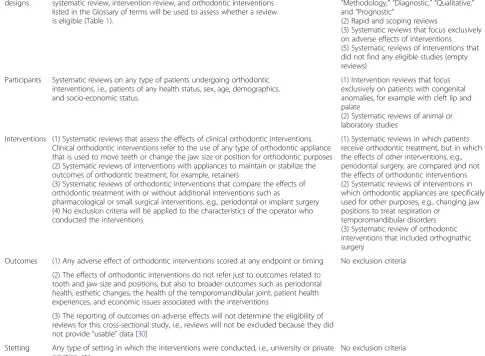
Eligibility criteria
We will adopt the same eligibility criteria that were
de-fined for our published protocol on seeking adverse
ef-fects in systematic reviews of orthodontic interventions
[
15
]. To avoid misinterpretation, we copied and pasted
these eligibility criteria into Table
3
[
15
,
30
].
Information sources
We will manually search the Cochrane library [
14
]
and the websites of the five leading orthodontic
jour-nals to identify eligible systematic reviews published
between 1 August 2009 and 31 July 2019. We chose
this starting date because the first of August 2009
co-incides with the launch of the Preferred Reporting
Items for Systematic Reviews and Meta-Analyses
(PRISMA) statement and its guidance paper on 21
July 2009 [
27
,
28
]. Journal selection was based on two
criteria: (1) the journal has been published for 10
years or more and (2) the impact factor. The journal
citation reports by Clarivate Analytics were consulted
to identify the five leading orthodontic journals based
on impact factor [
31
]. The following five orthodontic
journals fulfilled both criteria: European Journal of
Orthodontics (EJO), American Journal of
Orthodon-tics and Dentofacial Orthopedics (AJODO), Angle
Orthodontist, The Korean Journal of Orthodontics,
and Orthodontics and Craniofacial Research.
Study records
Data management
Two authors (PS and RMR) will conduct all study
selection and data extraction procedures
independently.
Pilot tests were conducted to train both reviewers in
applying these methods consistently and for
calibration purposes [
28
].
We will apply the following strategies in the case of
disagreement between the two authors on the eligibility
of a paper or the extraction of data: (1) discussions
between reviewers, (2) rereading the paper, (3) or if
necessary contacting its authors [
32
]. Persistent
disagreements will be resolved through the
consultation and arbitration of a methodologist (NDG).
All eligible systematic reviews will be downloaded,
and all extracted data will be collected in an Excel
spreadsheet.
Selection process
All titles and abstracts in the websites of the five
orthodontic journals will be hand-searched to
iden-tify eligible reviews. The section
“
Dentistry and Oral
health
”
will be searched in the Cochrane library for
eligible Cochrane reviews [
14
].
We will only include the latest version of a review
when updates have been published.
Authors will be contacted in the case of doubt
regarding multiple publications of the same review.
We plan to include the first publication, but will
make this decision on a case by case basis and will
report the rationale for this choice.
Our selection procedures will be presented in a
PRISMA flow diagram [
32
,
33
].
All included and excluded studies will be presented
in tables, and the rationale for exclusion will be
given for each excluded review.
Data collection process
All eligible studies together with their supplemental
files will be merged into binder PDFs, and pertinent
Table 3
Eligibility criteria
Item Included Excluded
Study designs
Systematic reviews of orthodontic interventions. The definition of systematic review, intervention review, and orthodontic interventions listed in the Glossary of terms will be used to assess whether a review is eligible (Table1).
(1) Non-interventional reviews such as, “Methodology,” “Diagnostic,” “Qualitative,” and“Prognostic”
(2) Rapid and scoping reviews
(3) Systematic reviews that focus exclusively on adverse effects of interventions (5) Systematic reviews of interventions that did not find any eligible studies (empty reviews)
Participants Systematic reviews on any type of patients undergoing orthodontic interventions, i.e., patients of any health status, sex, age, demographics, and socio-economic status.
(1) Intervention reviews that focus exclusively on patients with congenital anomalies, for example with cleft lip and palate
(2) Systematic reviews of animal or laboratory studies
Interventions (1) Systematic reviews that assess the effects of clinical orthodontic interventions. Clinical orthodontic interventions refer to the use of any type of orthodontic appliance that is used to move teeth or change the jaw size or position for orthodontic purposes (2) Systematic reviews of interventions with appliances to maintain or stabilize the outcomes of orthodontic treatment, for example, retainers
(3) Systematic reviews of orthodontic interventions that compare the effects of orthodontic treatment with or without additional interventions such as
pharmacological or small surgical interventions, e.g., periodontal or implant surgery (4) No exclusion criteria will be applied to the characteristics of the operator who conducted the interventions
(1) Systematic reviews in which patients receive orthodontic treatment, but in which the effects of other interventions, e.g., periodontal surgery, are compared and not the effects of orthodontic interventions (2) Systematic reviews of interventions in which orthodontic appliances are specifically used for other purposes, e.g., changing jaw positions to treat respiration or
temporomandibular disorders (3) Systematic review of orthodontic interventions that included orthognathic surgery
Outcomes (1) Any adverse effect of orthodontic interventions scored at any endpoint or timing No exclusion criteria
(2) The effects of orthodontic interventions do not refer just to outcomes related to tooth and jaw size and positions, but also to broader outcomes such as periodontal health, esthetic changes, the health of the temporomandibular joint, patient health experiences, and economic issues associated with the interventions
(3) The reporting of outcomes on adverse effects will not determine the eligibility of reviews for this cross-sectional study, i.e., reviews will not be excluded because they did not provide“usable”data [30]
Stetting Any type of setting in which the interventions were conducted, i.e., university or private practice, etc.
search terms are linked to these documents to
facilitate data extraction [
34
,
35
].
Eligible search terms were identified through
searches in thesauri and in key articles on adverse
effects [
13
,
36
–
40
]. These terms are given in
Additional file
3
and are identical to those used in
our protocol on seeking adverse effects in systematic
reviews of orthodontic interventions [
15
].
Our pilot-tested data collection forms will be used
for all data extraction procedures (Additional file
4
).
The PRISMA [
32
,
33
] and the PRISMA-P [
27
,
28
]
checklists and guidance were consulted to develop
these forms. The criteria for scoring pertinent data
items are defined in these forms.
The entire eligible review of both orthodontic and
Cochrane reviews will be searched for data items, i.e.,
the text, tables, figures, and all supplemental files. The
plain language summary in the eligible Cochrane
reviews will not be searched for data items.
When during the data extraction procedure changes
are made in the data collection forms, we will
present this with rationale in the section
“
Differences between the protocol and review.
”
Scoring adverse effects of orthodontic interventions
We will use the framework of categories of known
orthodontic adverse effects as defined by Preoteasa
et al. [
24
] (Table
2
). We will also include pain as a
result of tooth movement as an adverse effect.
Potential adverse effects that are identified during
data extraction will be discussed between the two
reviewers (PS and RMR). We will report the
rationale when including additional adverse effects
and will categorize them.
Ambiguous outcomes that could be interpreted as
either a beneficial or an adverse outcome will not be
scored as
“
adverse.
”
The rationale for this score will
be given. We will only consider ambiguous
outcomes as
“
adverse
”
when the review authors
define these outcomes as such and make a strong
case for this classification.
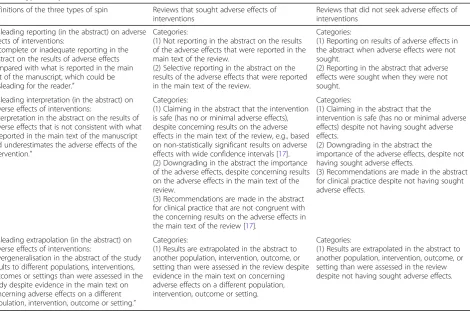
Scoring spin in the reporting, interpretation, and
extrapolation of adverse effects of orthodontic
interventions
We will assess three types of spin, i.e., misleading
reporting, misleading interpretation, and misleading
extrapolation on adverse effects of orthodontic
interventions in the abstract (Table
4
). Each type of
spin will be assessed separately for reviews that
either did or did not seek adverse effects of
interventions.
To facilitate our scoring procedures and to reduce
the risk of misinterpretation, we subdivided each
type of spin into categories and defined each
category (Table
4
). We will score the presence of
spin when spin is identified for one or more of these
categories. The scoring procedures are summarized
in Additional file
4
. Pilot tests were conducted to
assess the validity of these procedures.
Outcomes and statistical analyses
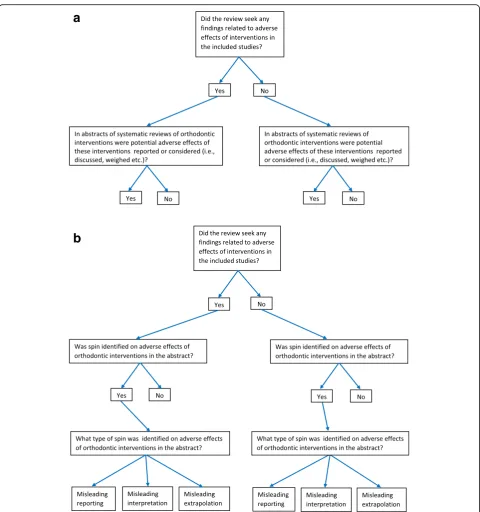
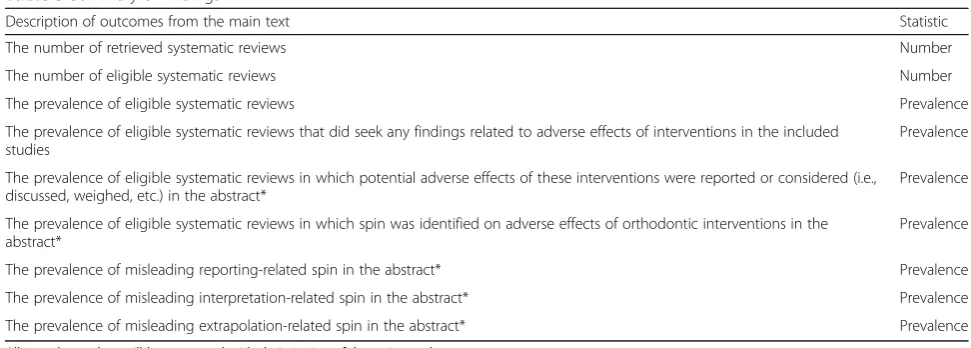
Figure
2
a and b present all research questions in a
flow diagram, and Table
5
lists all planned
outcomes.
We will calculate and report all prevalence data with
their 95% confidence levels.
We calculate the prevalence statistics for (1) all
journals as one group, (2) the group of five
leading orthodontic journals and the Cochrane
Database of Systematic Reviews separately, and (3)
each individual journal separately. Generalized linear
models will be developed having the following
outcomes for the abstracts of systematic reviews of
orthodontic interventions: the reporting or
considering of potential adverse effects of
interventions/no reporting or considering of potential
adverse effects of interventions (binary); presence of
SPIN/absence of
“
SPIN
”
(binary); and misleading
reporting/misleading interpretation/misleading
extrapolation/no SPIN (categorical). The models will
account for journal category (Cochrane Database of
Systematic Reviews vs others), individual journals, and
the geographical location of the study. Statistical
significance will be based on a
p
value < 0.05. Stata
software (Stata Corporation, College Station, TX,
USA) version 15 will be used for all the statistical
analyses [
41
].
All outcomes that will be introduced or eliminated
post hoc will be reported together with the rationale
for inclusion or exclusion.
Reporting of the research study and data management
The Strengthening the Reporting of Observational
Studies in Epidemiology (STROBE) Statement will
be used as the guideline for reporting the completed
cross-sectional study [
42
].
appropriate repository for our type of research
data. We selected Dryad [
45
] for two reasons:
(1) it is an international repository of data of
peer-reviewed scientific and medical research and
(2) it also includes data sets for which no
spe-cific data repository exist such as
meta-epidemiological research data of systematic
re-views in orthodontics. Our data management
plan implies that (1) all our research data will be
made freely available, (2) our completed article
will present a link to a repository in which all
raw data of the study will be deposited, (3) the
repository is registered in the Registry of
Re-search Data Repositories [
44
], (4) our research
data will be reported in a format that permits
other researchers to understand, cite, and reuse
these data, (5) all sensitive data will be
pro-tected, and (6) it will be reassessed frequently
and also updated if necessary [
43
,
44
].
Differences between the protocol and the completed
study
We will report all modifications between the
protocol and the final research study. The rationale
for each of these changes will be given.
We will also report the consequences of these
modifications on the magnitude, direction, and the
validity of the outcomes [
46
].
Discussion
Strengths
Key strengths of this research study include the
follow-ing: (1) we conducted extensive scoping searches and
pilot studies to fine-tune our research questions and
methods. These activities confirmed the importance of
our questions. (2) Our research team consists of two
topic experts (PS and RMR) and two methodologists
(RMR and NDG). (3) All study selection and data
collec-tion procedures will be undertaken independently by
two authors (PS and RMR). Calibration of these
opera-tors was done during the pilot studies. (4) To guarantee
reproducibility and full access to our data, we will
pub-lish our protocol a priori and will include all raw data of
the completed research study in additional files or will
deposit them in an open-access repository [
43
–
45
,
47
].
Limitations
Including only orthodontic intervention reviews
pub-lished in the five leading orthodontic journals and in
the Cochrane Database of Systematic Reviews could
Table 4
Types of spin in reviews that did or did not seek adverse effects of interventions
Definitions of the three types of spin Reviews that sought adverse effects of interventions
Reviews that did not seek adverse effects of interventions
Misleading reporting (in the abstract) on adverse effects of interventions:
“Incomplete or inadequate reporting in the abstract on the results of adverse effects compared with what is reported in the main text of the manuscript, which could be misleading for the reader.”
Categories:
(1) Not reporting in the abstract on the results of the adverse effects that were reported in the main text of the review.
(2) Selective reporting in the abstract on the results of the adverse effects that were reported in the main text of the review.
Categories:
(1) Reporting on results of adverse effects in the abstract when adverse effects were not sought.
(2) Reporting in the abstract that adverse effects were sought when they were not sought.
Misleading interpretation (in the abstract) on adverse effects of interventions:
“Interpretation in the abstract on the results of adverse effects that is not consistent with what is reported in the main text of the manuscript and underestimates the adverse effects of the intervention.”
Categories:
(1) Claiming in the abstract that the intervention is safe (has no or minimal adverse effects), despite concerning results on the adverse effects in the main text of the review, e.g., based on non-statistically significant results on adverse effects with wide confidence intervals [17]. (2) Downgrading in the abstract the importance of the adverse effects, despite concerning results on the adverse effects in the main text of the review.
(3) Recommendations are made in the abstract for clinical practice that are not congruent with the concerning results on the adverse effects in the main text of the review [17].
Categories:
(1) Claiming in the abstract that the
intervention is safe (has no or minimal adverse effects) despite not having sought adverse effects.
(2) Downgrading in the abstract the importance of the adverse effects, despite not having sought adverse effects.
(3) Recommendations are made in the abstract for clinical practice despite not having sought adverse effects.
Misleading extrapolation (in the abstract) on adverse effects of interventions:
“Overgeneralisation in the abstract of the study results to different populations, interventions, outcomes or settings than were assessed in the study despite evidence in the main text on concerning adverse effects on a different population, intervention, outcome or setting.”
Categories:
(1) Results are extrapolated in the abstract to another population, intervention, outcome, or setting than were assessed in the review despite evidence in the main text on concerning adverse effects on a different population, intervention, outcome or setting.
Categories:
be a limitation, but we expect that the findings in this
subgroup of journals will underestimate the true
se-verity of spin on adverse effects of interventions in
the abstracts of these reviews. Including only reviews
published in the last 10 years could also be a
limita-tion. However, we chose this period because it brings
the current knowledge status on our research
ques-tions to the foreground and these 10 years coincide
with the launch in 2009 of the checklist of Preferred
Reporting Items for Systematic Reviews and
Meta-Analyses (PRISMA) [
32
,
33
].
Importance and beneficiaries
In this research study, we will address three key
ques-tions in abstracts of systematic reviews of orthodontic
interventions: whether potential adverse effects of
these interventions were reported or considered,
whether spin was identified regarding information on
a
b
these adverse effects, and the type of spin. These
is-sues are important, because (1) the assessment and
reporting of adverse effects of interventions is often
suboptimal [
7
–
11
], (2) titles and abstracts are the
most read sections of papers in the biomedical
litera-ture [
1
], (3) a high prevalence of spin has been
identified in abstracts of both randomized and
non-randomized studies [
4
,
21
], and (4) incomplete or
inadequate reporting, interpretation, or extrapolation
of findings on adverse effects in the abstract can
mis-lead readers and could mis-lead to inadequate practice
[
4
]. Our results will raise the awareness of
consider-ing adverse effects and the phenomenon of spin
regarding these effects in abstracts of systematic
re-views of orthodontic interventions. Patients, clinicians,
researchers, editors, peer-reviewers, guideline
devel-opers, policy makers, and research funders will all be
beneficiaries of the findings of this research study.
Supplementary information
Supplementary informationaccompanies this paper athttps://doi.org/10.
1186/s41073-019-0084-4.
Additional file 1.Checklist for the Preferred Reporting Items for Systematic review and Meta-Analysis Protocols (PRISMA-P) 2015 statement.
Additional file 2.Pilot tests.
Additional file 3.Search terms and their derivatives.
Additional file 4.Data collection forms.
Abbreviations
MECIR:Methodological Expectations of Cochrane Intervention Reviews; PRISMA: Preferred reporting items for systematic reviews and meta-analyses; PRISMA-P: Preferred Reporting Items for Systematic review and Meta-Analysis-Protocols
Acknowledgements
Not applicable
Authors’contributions
PS and RMR conceived and designed the study protocol for this cross-sectional study. RMR is the guarantor. PS and RMR conducted the pilot testing of the study selection procedures and data extraction forms and fine-tuned the research proto-col after the pilot testing. NDG provided support on methodological and statistical issues and assisted in the overall fine-tuning of this protocol. All three authors read and approved the final protocol.
Funding
All expenses for preparing this protocol and for conducting the subsequent research study will be paid evenly by each author.
Availability of data and materials
Not applicable
Ethics approval and consent to participate
Not applicable
Consent for publication
Not applicable
Competing interests
The authors declare that they have no competing interests.
Author details
1Department of Orthodontics, Academisch Centrum Tandheelkunde
Amsterdam (ACTA), University of Amsterdam, Gustav Mahlerlaan 3004, 1081, LA, Amsterdam, The Netherlands.2Center for Veterinary Health Sciences, Oklahoma State University, 2065 W Farm Road, Stillwater, OK 74078, USA. 3EBMVet, Via Sigismondo Trecchi 20, 26100 Cremona, CR, Italy.4Department
of Oral and Maxillofacial Surgery, Academic Medical Center, University of Amsterdam, Meibergdreef 9, 1105, AZ, Amsterdam, The Netherlands.5Studio di Ortodonzia, Via Matteo Bandello 15, 20123 Milan, Italy.
Received: 13 April 2019 Accepted: 10 October 2019
References
1. Dogan RI, Murray GC, Névéol A, Lu Z. Understanding PubMed user search behavior through log analysis. Database (Oxford). 2009;2009:bap018 Epub 2009 Nov 27.
Table 5
Summary of findings
Description of outcomes from the main text Statistic
The number of retrieved systematic reviews Number
The number of eligible systematic reviews Number
The prevalence of eligible systematic reviews Prevalence
The prevalence of eligible systematic reviews that did seek any findings related to adverse effects of interventions in the included studies
Prevalence
The prevalence of eligible systematic reviews in which potential adverse effects of these interventions were reported or considered (i.e., discussed, weighed, etc.) in the abstract*
Prevalence
The prevalence of eligible systematic reviews in which spin was identified on adverse effects of orthodontic interventions in the abstract*
Prevalence
The prevalence of misleading reporting-related spin in the abstract* Prevalence
The prevalence of misleading interpretation-related spin in the abstract* Prevalence
The prevalence of misleading extrapolation-related spin in the abstract* Prevalence
All prevalence data will be presented with their 95% confidence intervals
2. Boutron I, Ravaud P. Misrepresentation and distortion of research in biomedical literature. Proc Natl Acad Sci U S A. 2018;115(11):2613–9.https:// doi.org/10.1073/pnas.1710755115.
3. Haneef R, Yavchitz A, Ravaud P, Baron G, Oranksy I, Schwitzer G, Boutron I. Interpretation of health news items reported with or without spin: protocol for a prospective meta-analysis of 16 randomised controlled trials. BMJ Open. 2017;7(11):e017425.https://doi.org/10.1136/bmjopen-2017-017425. 4. Lazarus C, Haneef R, Ravaud P, Boutron I. Classification and prevalence
of spin in abstracts of non-randomized studies evaluating an intervention. BMC Med Res Methodol. 2015;15:85.https://doi.org/10. 1186/s12874-015-0079-x.
5. Higgins JPT, Lasserson T, Chandler J, Tovey D, Churchill R.
Methodological Expectations of Cochrane Intervention Reviews (MECIR). Standards for the conduct and reporting of new Cochrane Intervention Reviews, reporting of protocols and the planning, conduct and reporting of updates. Cochrane: London, 2016. Available from:https:// methods.cochrane.org/sites/default/files/public/uploads/mecir_printed_ booklet_final_v1.02.pdf(accessed 18 Feb 2019).
6. Parsons R, Golder S, Watt I. More than one-third of systematic reviews did not fully report the adverse events outcome. J Clin Epidemiol. 2019;108:95– 101.https://doi.org/10.1016/j.jclinepi.2018.12.007.
7. Bagul NB, Kirkham JJ. The reporting of harms in randomized controlled trials of hypertension using the CONSORT criteria for harm reporting. Clin Exp Hypertens. 2012;34(8):548–54.https://doi.org/10.3109/10641963.2012.681724
Epub 2012 May 9.
8. Hodkinson A, Kirkham JJ, Tudur-Smith C, Gamble C. Reporting of harms data in RCTs: a systematic review of empirical assessments against the CONSORT harms extension. BMJ Open. 2013;3(9):e003436.https://doi.org/10. 1136/bmjopen-2013-003436.
9. Péron J, Maillet D, Gan HK, Chen EX, You B. Adherence to CONSORT adverse event reporting guidelines in randomized clinical trials evaluating systemic cancer therapy: a systematic review. J Clin Oncol. 2013;31(31): 3957–63.https://doi.org/10.1200/JCO.2013.49.3981Epub 2013 Sep 23. 10. Pitrou I, Boutron I, Ahmad N, Ravaud P. Reporting of safety results in
published reports of randomized controlled trials. Arch Intern Med. 2009; 169(19):1756–61.
11. Smith SM, Chang RD, Pereira A, Shah N, Gilron I, Katz NP, Lin AH, McDermott MP, Rappaport BA, Rowbotham MC, Sampaio C, Turk DC, Dworkin RH. Adherence to CONSORT harms-reporting recommendations in publications of recent analgesic clinical trials: an ACTTION systematic review. Pain. 2012;153(12):2415–21.https://doi.org/10.1016/j.pain.2012.08.009Epub 2012 Sep 15.
12. Glossary of terms in the Cochrane Collaboration. Version 4.2.5. Updated May 2005. Available from:http://aaz.hr/resources/pages/57/7.%20Cochrane%2 0glossary.pdf(accessed 27 Sept 2019).
13. Loke YK, Price D, Herxheimer A. Chapter 14: adverse efffects. In: Higgins JPT, Green S. editors. Cochrane handbook for systematic reviews of interventions version 5.1.0 (updated March 2011). The Cochrane Collaboration, 2011. Available from:http://handbook-5-1.cochrane.org/(accessed 29 Aug 2019). 14. Cochrane library. Available from:https://www.cochranelibrary.com/about/
about-cochrane-reviews(accessed 24 Sept 2019).
15. Steegmans PAJ, Bipat S, Meursinge Reynders RA. Seeking adverse effects in systematic reviews of orthodontic interventions: protocol for a cross-sectional study. Syst Rev. 2019;8(1):89. https://doi.org/10.1186/s13643-019-1000-1.
16. Horton R. The rhetoric of research. BMJ. 1995;310(6985):985–7. 17. Yavchitz A, Ravaud P, Altman DG, Moher D, Hrobjartsson A, Lasserson T,
Boutron I. A new classification of spin in systematic reviews and meta-analyses was developed and ranked according to the severity. J Clin Epidemiol. 2016;75:56–65.https://doi.org/10.1016/j.jclinepi.2016.01.020Epub 2016 Feb 2.
18. Boutron I, Dutton S, Ravaud P, Altman DG. Reporting and interpretation of randomized controlled trials with statistically nonsignificant results for primary outcomes. JAMA. 2010;303(20):2058–64.https://doi.org/10.1001/ jama.2010.651.
19. Haneef R, Lazarus C, Ravaud P, Yavchitz A, Boutron I. Interpretation of results of studies evaluating an intervention highlighted in Google health news: a cross-sectional study of news. PLoS One. 2015;10(10):e0140889.https://doi. org/10.1371/journal.pone.0140889eCollection 2015.
20. Latronico N, Metelli M, Turin M, Piva S, Rasulo FA, Minelli C. Quality of reporting of randomized controlled trials published in Intensive Care
Medicine from 2001 to 2010. Intensive Care Med. 2013;39(8):1386–95.
https://doi.org/10.1007/s00134-013-2947-3Epub 2013 Jun 7.
21. Lockyer S, Hodgson R, Dumville JC, Cullum N.“Spin”in wound care research: the reporting and interpretation of randomized controlled trials with statistically non-significant primary outcome results or unspecified primary outcomes. Trials. 2013;14:371.https://doi.org/10.1186/1745-6215-14-371. 22. Ochodo EA, de Haan MC, Reitsma JB, Hooft L, Bossuyt PM, Leeflang MM.
Overinterpretation and misreporting of diagnostic accuracy studies: evidence of“spin”. Radiology. 2013;267(2):581–8.https://doi.org/10.1148/ radiol.12120527Epub 2013 Jan 29.
23. World Medical Association Declaration of Helsinki Ethical Principles for Medical Research Involving Human Subjects. Research registration and publication and dissemination of results. Principle 36. 64th WMA General Assembly, Fortaleza, Brazil, October 2013. Published Online: October 19, 2013. doi:10.1001/jama. 2013.281053. Available from:https://www.wma.net/wp-content/uploads/2 016/11/DoH-Oct2013-JAMA.pdf(accessed 28 Sept 2019).
24. Preoteasa CT, Ionescu E, Preoteasa E. Chapter 18: Risks and complications associated with orthodontic treatment. In: Bourzgui F. (editor).
Orthodontics-Basic aspects and clinical considerations. March 9, 2012 under CC BY 3.0 license.www.intechopen.com. Available from:https://www. intechopen.com/books/orthodontics-basic-aspects-and-clinical- considerations/risks-and-complications-associated-with-orthodontic-treatment(accessed 29 Sept 2019).
25. Reeves BC. Reporting of harms in systematic reviews and their primary studies. BMJ. 2014;349:g6819.https://doi.org/10.1136/bmj.g6819. 26. Ioannidis JP. The mass production of redundant, misleading, and conflicted
systematic reviews and meta-analyses. Milbank Q. 2016;94(3):485–514. 27. Moher D, Shamseer L, Clarke M, Ghersi D, Liberati A, Petticrew M, Shekelle P,
Stewart LA. Preferred Reporting Items for Systematic Review and Meta-Analysis Protocols (PRISMA-P) 2015 statement. Syst Rev. 2015;4(1):1. 28. Shamseer L, Moher D, Clarke M, Ghersi D, Liberati A, Petticrew M, Shekelle P,
Stewart LA, the PRISMA-P Group. Preferred reporting items for systematic review and meta-analysis protocols (PRISMA-P) 2015: elaboration and explanation. BMJ. 2015;349:g7647.
29. Viechtbauer W, Smits L, Kotz D, Budé L, Spigt M, Serroyen J, Crutzen R. A simple formula for the calculation of sample size in pilot studies. J Clin Epidemiol. 2015;68(11):1375–9.https://doi.org/10.1016/j.jclinepi.2015.04.014
Epub 2015 Jun 6.
30. O’Connor D, Green S, Higgins JPT (editors). Chapter 5: Defining the review question and developing criteria for including studies. In: Higgins JPT, Green S (editors). Cochrane Handbook for Systematic Reviews of Interventions Version 5.1.0 (updated March 2011). The Cochrane Collaboration, 2011. [online] Available from:www.cochrane-handbook.org. (accessed 29 Sept 2019).
31. Clarivate Analytics. Available from:https://clarivate.com/(accessed 29th Sept 2019). 32. Liberati A, Altman DG, Tetzlaff J, et al. The PRISMA statement for reporting systematic reviews and meta-analyses of studies that evaluate health care interventions: explanation and elaboration. PLoS Med. 2009;6:e1000100 Epub 2009 Jul 21.
33. Moher D, Liberati A, Tetzlaff J, Altman DG, PRISMA Group. Preferred reporting items for systematic reviews and meta-analyses: the PRISMA statement. PLoS Med. 2009;6:e1000097.
34. Adobe Merge PDFs, combine files into one PDF. Available from:http:// www.wikihow.com/Merge-PDF-Files(accessed 29 Sept 2019). 35. Acrobat for legal professionals. Searching and marking multiple words.
[online] Available from: http://blogs.adobe.com/acrolaw/2010/04/searching-and-marking-multiple-words-in-a-pdf/(accessed 29 Sept 2019).
36. Ioannidis JP, Evans SJ, Gøtzsche PC, O'Neill RT, Altman DG, Schulz K, Moher D, CONSORT Group. Better reporting of harms in randomized trials: an extension of the CONSORT statement. Ann Intern Med. 2004;141(10):781–8. 37. Golder S, Loke YK, Zorzela L. Some improvements are apparent in
identifying adverse effects in systematic reviews from 1994 to 2011. J Clin Epidemiol. 2013;66(3):253–60.https://doi.org/10.1016/j.jclinepi.2012.09.013. 38. Saini P, Loke YK, Gamble C, Altman DG, Williamson PR, Kirkham JJ. Selective
reporting bias of harm outcomes within studies: findings from a cohort of systematic reviews. BMJ. 2014;349:g6501.https://doi.org/10.1136/bmj.g6501. 39. Zorzela L, Golder S, Liu Y, Pilkington K, Hartling L, Joffe A, Loke Y, Vohra S.
Quality of reporting in systematic reviews of adverse events: systematic review. BMJ. 2014;348:f7668.https://doi.org/10.1136/bmj.f7668Review. 40. Zorzela L, Loke YK, Ioannidis JP, Golder S, Santaguida P, Altman DG, Moher
reporting in systematic reviews. BMJ. 2016;352:i157.https://doi.org/10.1136/ bmj.i157.
41. StataCorp. Stata Statistical Software: Release 15. College Station: StataCorp LLC.; 2017.
42. von Elm E, Altman DG, Egger M, Pocock SJ, Gøtzsche PC, Vandenbroucke JP, STROBE Initiative. The Strengthening the Reporting of Observational Studies in Epidemiology (STROBE) statement: guidelines for reporting observational studies. Ann Intern Med. 2007;147(8):573–7.
43. Schiermeier Q. For the record. Making project data freely available for open science. Nature. 2018;555:403–5.
44. Registry of Research Data Repositories. [online] Available from:https://www. re3data.org/(accessed 29 Sept 2019).
45. Dryad. [online] Available from:https://datadryad.org/stash(accessed 28 Sept 2019).
46. Higgins JPT, Deeks JJ, Altman DG (editors). Chapter 16: Special topics in statistics. In: Higgins JPT, Green S (editors), Cochrane Handbook for Systematic Reviews of Interventions Version 5.1.0 (updated March 2011). The Cochrane Collaboration, 2011. [online] Available from:http:// handbook-5-1.cochrane.org/(accessed 29 Sept 2019).
47. Goodman SN, Fanelli D, Ioannidis JP. What does research reproducibility mean? Sci Transl Med. 2016;8(341):341ps12.https://doi.org/10.1126/ scitranslmed.aaf5027.
![Table 2 Adverse effects hypothetically linked to orthodontic interventions [24]](https://thumb-us.123doks.com/thumbv2/123dok_us/9531114.1936060/3.595.58.542.435.725/table-adverse-effects-hypothetically-linked-orthodontic-interventions.webp)
![Fig. 1 Flow diagram of the research methods. “Flow diagram of theresearch methods” was published previously by Steegmans et al.[15] in the journal “Systematic Reviews,” which is an open accessjournal of BioMed Central](https://thumb-us.123doks.com/thumbv2/123dok_us/9531114.1936060/4.595.305.539.86.564/theresearch-published-previously-steegmans-systematic-reviews-accessjournal-central.webp)